🍋 Citrus
Citrus fruits, rootstocks, varieties, flowering, disorders, and major diseases for competitive exams
Citrus
- Family: Rutaceae
- Origin: Northeast India / Southeast Asia
- Classification of citrus given by Tanaka & Swingle (1945)
- Citrus is a micro-nutrient loving plant (high requirement for Zn, Mn, Fe, B)
Types of Citrus
| Common Name | Botanical Name |
|---|---|
| Sweet Orange | Citrus sinensis |
| Mandarin | Citrus reticulata |
| Lime | Citrus aurantifolia |
| Lemon | Citrus limon |
| Grapefruit | Citrus paradisi |
| Pomelo | Citrus grandis / maxima |
- Nagpur: Orange City of India (famous for Nagpur mandarin)
- Coorg: Known for Coorg mandarin
- Mandarin occupies 50% area under citrus in India
- State with highest citrus production: Andhra Pradesh
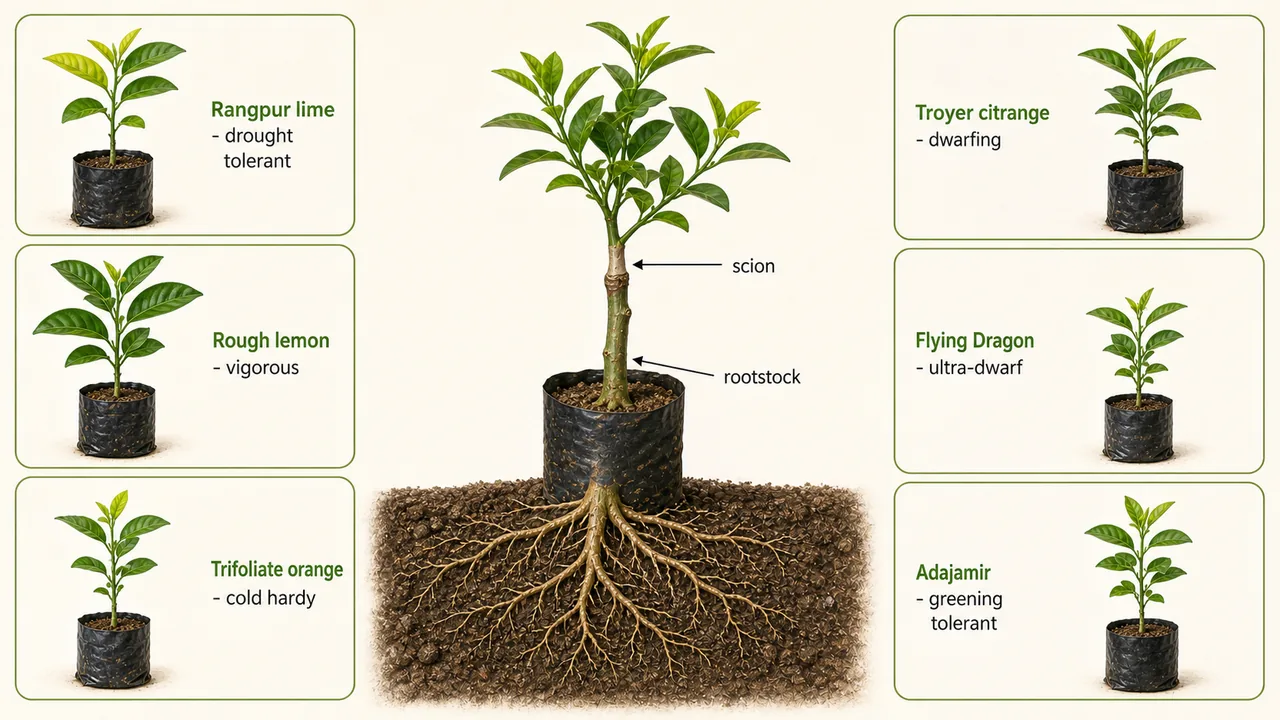
Rootstocks
| Rootstock | Key Feature |
|---|---|
| Rangpur lime | Most promising for mandarin & sweet orange; drought tolerant |
| Rough lemon | Vigorous, widely used |
| Trifoliate orange | Cold hardy, resistant to Phytophthora and nematodes |
| Jambhiri (C. jambhiri) | Vigorous, drought tolerant |
| Troyer citrange | HDP rootstock (1.8 x 1.8 m), dwarfing effect |
| Flying Dragon | Ultra-dwarf rootstock |
| Adajamir (C. assamensis) | Resistant to Greening |
Propagation & Planting
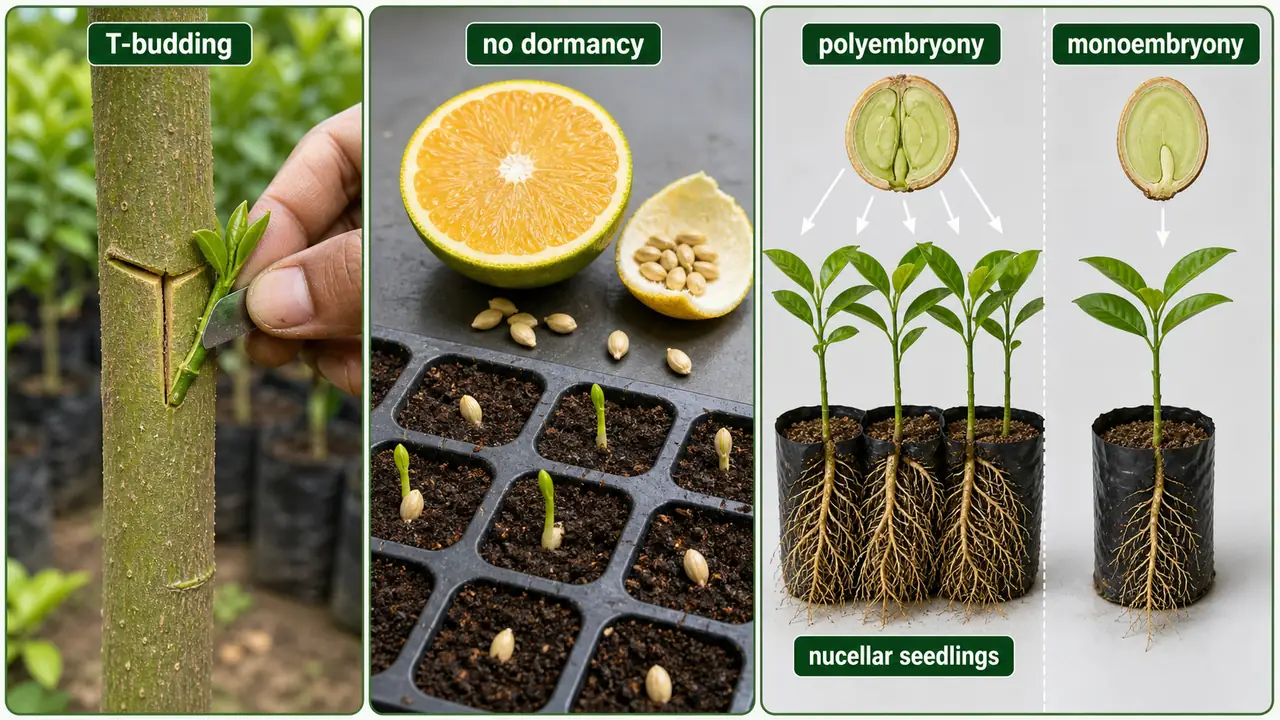
- Propagation: T-budding (most common method)
- Citrus seeds don't have dormancy -- sow immediately after extraction (recalcitrant seeds)
- Polyembryony: Mandarin, sweet orange, acid lime, grapefruit are highly polyembryonic (nucellar seedlings = uniform rootstock)
- Monoembryonic: Pummelo, Tahiti lime, Citron
- Spacing: 6 m x 6 m (lime, lemon, sweet orange)
- Blooming: Three times a year -- Ambe bahar, Mrig bahar, Hasta bahar
Maturity & Post-Harvest
- Maturity index: Juice content 50%
- Fruit ripening: 9 months after flowering
- Degreening: Done with Ethrel (Ethephon) to remove green colour from mature fruits
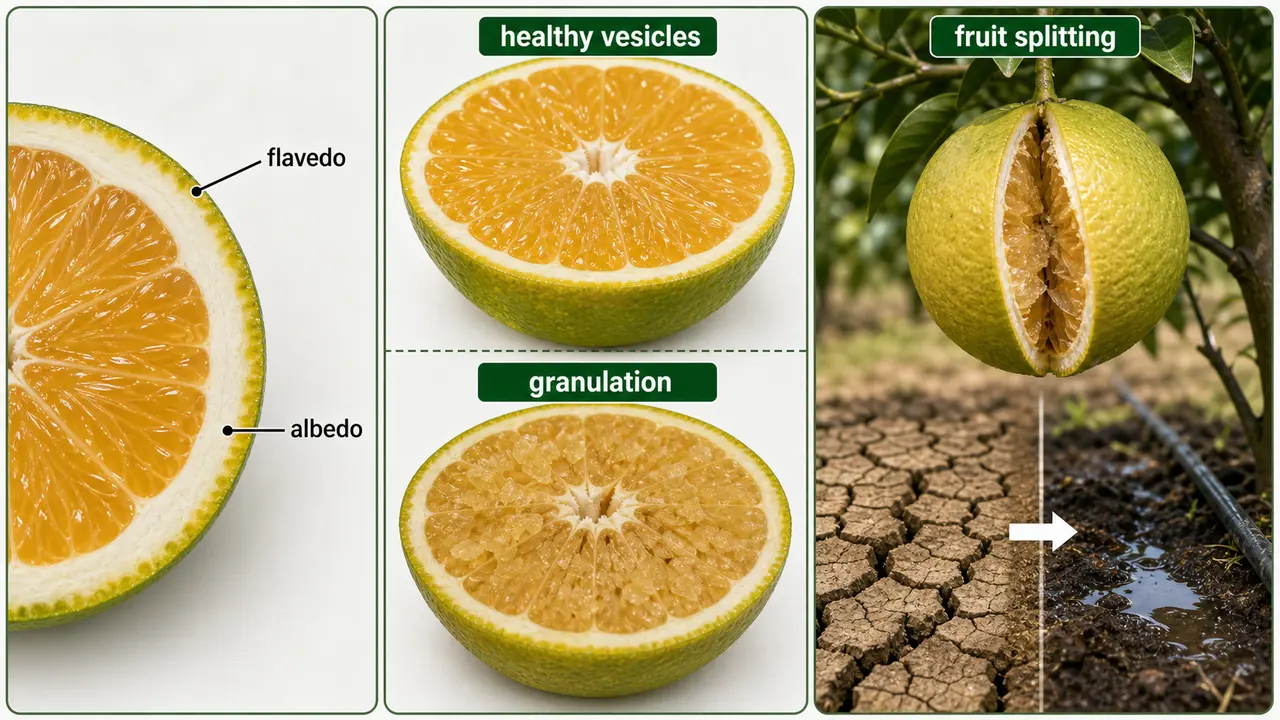
- Granulation (drying of juice vesicles) -- physiological disorder, more in sweet orange and mandarin
- Fruit splitting -- caused by irregular irrigation, especially after drought stress
- Limonin glycoside responsible for bitter taste in citrus juice
- Citrus rind: outer flavedo (essential oils) + inner albedo (pectin-rich)
Mandarin
- Botanical Name: Citrus reticulata
- Family: Rutaceae
- Origin: China
- Most common among citrus fruits grown in India. Mandarin is the backbone of India's citrus industry, cultivated across diverse agro-climatic zones from the Nagpur region to the North-Eastern hills.
- Mandarin occupies 50% area under citrus spp.
- Seeds of citrus don't have dormancy so they should be sown immediately after extraction. Unlike many other fruit crop seeds, citrus seeds are recalcitrant and lose viability rapidly on drying.
- Blooming occurs three times in a year: Ambe bahar, Mrig bahar, and Hasta bahar.
- Mandarins are highly susceptible to water logging.
- Best time for pruning: Late winter or Early spring
- Irrigation requirement of mandarin is higher than other citrus species.
- Nagpur mandarin was introduced in India in 1894 by Shuji Raja Bhosle.
- Weeds are a serious problem in nursery, and the older note highlights bromocial as an effective weedicide in controlling monocot and dicot weeds.
- Sikkim is the only place where mandarins are packed in wooden boxes.
Mandarin Varieties
- Coorg: Most important commercial variety in South India (Karnataka)
- Kodai orange: Tamil Nadu
- Khasi: Locally known as Sikkim or Kamla mandarin in North-East India
- Nagpur Santra (Ponkan): Finest mandarin in the world; grown in the Satpuda hills in Maharashtra
- Laddu mandrain
- Sutwal: Introduced from Nepal
- Satsuma (seedless): Commercial mandarin of Japan
- Emperor and Fuetrelles: Introduction from Australia
Kinnow
- It is a high-yield mandarin and a cross between King Sweet x Willow Leaf mandarins
- Developed by H.B. Frost, USA, in 1935
- Kinnow was introduced in India in 1959
- It was first introduced in Punjab
- It is juicier than oranges and is majorly grown in Punjab, Himachal Pradesh, Jammu & Kashmir, Rajasthan, and Haryana
- Kinnow can be grown in high density planting by using Troyer citrange as a rootstock at 1.8 x 1.8 m
- Kinnow is generally darker in colour than orange
Sweet Orange
- Botanical Name: Citrus sinensis
- Family: Rutaceae
- Origin: China
- Pre-harvest fruit drop is common in citrus and may be due to physiological or pathological factors
- Control measure: spray of 2,4-D (20 ppm); most prone varieties mentioned are Mosambi and Blood Red
- Degreening of citrus fruits is done by CaC2 in the older note, while this lesson also retains Ethrel/Ethephon as a standard degreening reference
- Sweet orange is susceptible to water logging and Phytophthora rot
- Double ring method is highlighted as the best irrigation method
- Deficiency of zinc, along with N, is a major nutritional problem of sweet orange
- Rangpur lime is the best rootstock for Mosambi
- T-budding or patch budding are the most common methods for sweet orange propagation
- Pineapple and Valencia are listed as indicator varieties for greening
Sweet Orange Varieties
- Hamlin: Early variety
- Jaffa: Mid-season variety
- Pineapple: Mid-season variety
- Valencia: Late-season variety
- Mosambi: Most popular in Maharashtra; best rootstock is Rangpur lime
- Satgudi: Most popular in Andhra Pradesh; best rootstock is Rough lemon
- Blood red: Most popular in North India; best rootstocks are Karnakhatta and Jatti khatha
- Shamouti: Seedless variety
- Washinghton navel
- Batavin
- Mudkhed: Bud mutant of Nagpur mandarin
Lime, Lemon, and Sweet Lime
- India ranks 5th among the major lime and lemon producing countries of the world
- Sweet lime: Citrus limetoides, native to India, self-incompatible
- Tahiti lime: Citrus latifolia — seedless triploid
- Rangpur lime: Citrus limonia, native to India
- Pummelo: Citrus grandis (largest fruit), self-incompatible
- Acid lime is propagated by seeds
- Kagzi lime (C. aurantifolia) is the indicator plant for Tristeza
- Citrus canker is the most serious disease of acid lime
- Acid lime is a tropical plant
- Lemons are divided into four groups; the note lists Eureka, Lisbon, and Anamalous
- Gajanimma (Citrus Pennivesiculata) is a promising rootstock for acid lime followed by rough lemon
- Sweet lime contains nonacid juice
- Sweet lime is resistant to greening
Acid Lime / Sweet Lime / Lemon Varieties
- Pramalini: Canker tolerant
- Vikram
- Chakradhar: Seedless variety of acid lime
- PKM-1
- Sai sarbati: Tolerant to tristeza and canker
- Jai devi: Pleasant aroma
- Sweet lime varieties: Mitha chikna, Mithotra
- Lemon varieties: Eureka, Lucknow seedless, Lisbon, Kagzikalan, Nepali oblong, Nepali round, Pant lemon-I, Villafrance
Grapefruit and Citron within Citrus
- Botanical Name: Citrus paradisi
- Grapefruit is also known as forbidden fruit or breakfast fruit
- Citron is called Persian apple
- The note associates hespiridin with citron
Grapefruit Varieties
- Star ruby: From Hudson grapefruit through mutation breeding
- Red Blush
- Duncan
- Marsh Seedless
- Foster
- Triumph
- Sharanpur Special
- Thompson
Flowering in Citrus
Diseases of Citrus
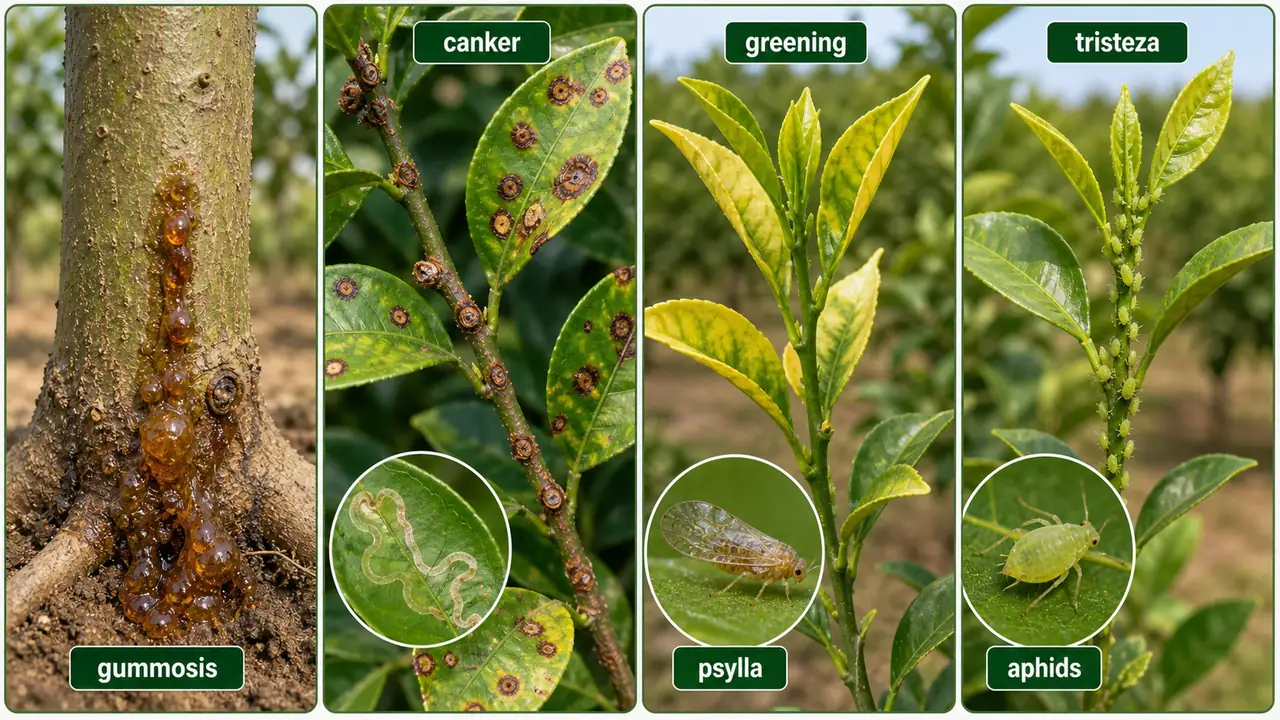
- Gummosis: Phytophthora spp.
- Bacterial canker: Xanthomonas campestris pv. citri (older note spells the bacterium slightly differently) and is transmitted through wounds associated with leaf miner
- Citrus greening / HLB: Earlier grouped with mycoplasma-like organisms; the note updates this to Candidatus Liberibacter and says it is transmitted by citrus psylla, Diaphorina citri
- Tristeza: Virus transmitted by aphids (Toxoptera sp.)
- Exocortis: Viroid disease causing bark scaling on susceptible rootstocks
Summary Cheat Sheet
| Concept / Topic | Key Details / Explanation |
|---|---|
| Citrus identity | Citrus belongs to family Rutaceae, originated in Northeast India or Southeast Asia, follows the Tanaka and Swingle classification, and is a micronutrient-loving crop with high need for Zn, Mn, Fe, and B. |
| Important citrus species | Sweet orange is Citrus sinensis, mandarin is Citrus reticulata, lime is Citrus aurantifolia, lemon is Citrus limon, grapefruit is Citrus paradisi, and pomelo is Citrus grandis/maxima. |
| Production facts | Nagpur is called the Orange City of India, Coorg is known for Coorg mandarin, mandarin occupies about 50% of citrus area in India, and Andhra Pradesh is listed as the top citrus-producing state. |
| Rootstocks | Rangpur lime is promising for mandarin and sweet orange and is drought tolerant; rough lemon and Jambhiri are vigorous; trifoliate orange is cold hardy and resistant to Phytophthora and nematodes; Troyer citrange is a dwarfing HDP rootstock; Flying Dragon is ultra-dwarf; Adajamir is resistant to greening. |
| Propagation and seed behaviour | Citrus is mainly propagated by T-budding; seeds do not show dormancy and should be sown soon after extraction. |
| Polyembryony and spacing | Mandarin, sweet orange, acid lime, and grapefruit are highly polyembryonic and give nucellar seedlings useful for rootstocks, while pummelo, Tahiti lime, and citron are monoembryonic; common spacing given is 6 x 6 m for lime, lemon, and sweet orange. |
| Blooming and bahar | Citrus may bloom in three bahars: Ambe bahar, Mrig bahar, and Hasta bahar. |
| Maturity and ripening | Maturity is judged by about 50% juice content, fruits ripen about 9 months after flowering, and degreening is done with Ethrel or Ethephon. |
| Physiological disorders and rind | Granulation is drying of juice vesicles and is common in sweet orange and mandarin, fruit splitting is linked to irregular irrigation after drought, limonin causes bitterness in juice, and the rind has outer flavedo plus inner albedo. |
| Mandarin and kinnow points | Mandarin is Citrus reticulata, dominates Indian citrus area, is sensitive to waterlogging, and is linked to varieties like Coorg, Khasi, Nagpur Santra, and Satsuma; Kinnow is a King Sweet × Willow Leaf mandarin introduced first in Punjab and fits HDP with Troyer citrange. |
| Sweet orange points | Sweet orange is Citrus sinensis; Mosambi, Satgudi, Blood Red, Valencia, Hamlin, and Jaffa are important names, while 2,4-D is used against pre-harvest drop and Rangpur lime is a major rootstock. |
| Lime and sweet lime points | Sweet lime is Citrus limetoides, Tahiti lime is a seedless triploid, acid lime is often seed propagated, Kagzi lime indicates tristeza, and canker is a major disease in acid lime. |
| Grapefruit within citrus | Grapefruit is Citrus paradisi, also called breakfast or forbidden fruit, and named varieties include Star Ruby, Red Blush, Duncan, Marsh Seedless, Foster, Triumph, Sharanpur Special, and Thompson. |
| Major diseases | Gummosis is caused by Phytophthora, bacterial canker by Xanthomonas, greening or HLB is psylla transmitted, tristeza is viral and aphid transmitted, and exocortis is caused by a viroid. |
Citrus
- Family: Rutaceae
- Origin: Northeast India / Southeast Asia
- Classification of citrus given by Tanaka & Swingle (1945)
- Citrus is a micro-nutrient loving plant (high requirement for Zn, Mn, Fe, B)
Types of Citrus
| Common Name | Botanical Name |
|---|---|
| Sweet Orange | Citrus sinensis |
| Mandarin | Citrus reticulata |
| Lime | Citrus aurantifolia |
| Lemon | Citrus limon |
| Grapefruit | Citrus paradisi |
| Pomelo | Citrus grandis / maxima |
- Nagpur: Orange City of India (famous for Nagpur mandarin)
- Coorg: Known for Coorg mandarin
- Mandarin occupies 50% area under citrus in India
- State with highest citrus production: Andhra Pradesh
Rootstocks
| Rootstock | Key Feature |
|---|---|
| Rangpur lime | Most promising for mandarin & sweet orange; drought tolerant |
| Rough lemon | Vigorous, widely used |
| Trifoliate orange | Cold hardy, resistant to Phytophthora and nematodes |
| Jambhiri (C. jambhiri) | Vigorous, drought tolerant |
| Troyer citrange | HDP rootstock (1.8 x 1.8 m), dwarfing effect |
| Flying Dragon | Ultra-dwarf rootstock |
| Adajamir (C. assamensis) | Resistant to Greening |
Propagation & Planting
- Propagation: T-budding (most common method)
- Citrus seeds don't have dormancy -- sow immediately after extraction (recalcitrant seeds)
- Polyembryony: Mandarin, sweet orange, acid lime, grapefruit are highly polyembryonic (nucellar seedlings = uniform rootstock)
- Monoembryonic: Pummelo, Tahiti lime, Citron
- Spacing: 6 m x 6 m (lime, lemon, sweet orange)
- Blooming: Three times a year -- Ambe bahar, Mrig bahar, Hasta bahar
Maturity & Post-Harvest
- Maturity index: Juice content 50%
- Fruit ripening: 9 months after flowering
- Degreening: Done with Ethrel (Ethephon) to remove green colour from mature fruits
- Granulation (drying of juice vesicles) -- physiological disorder, more in sweet orange and mandarin
- Fruit splitting -- caused by irregular irrigation, especially after drought stress
- Limonin glycoside responsible for bitter taste in citrus juice
- Citrus rind: outer flavedo (essential oils) + inner albedo (pectin-rich)
Mandarin
- Botanical Name: Citrus reticulata
- Family: Rutaceae
- Origin: China
- Most common among citrus fruits grown in India. Mandarin is the backbone of India's citrus industry, cultivated across diverse agro-climatic zones from the Nagpur region to the North-Eastern hills.
- Mandarin occupies 50% area under citrus spp.
- Seeds of citrus don't have dormancy so they should be sown immediately after extraction. Unlike many other fruit crop seeds, citrus seeds are recalcitrant and lose viability rapidly on drying.
- Blooming occurs three times in a year: Ambe bahar, Mrig bahar, and Hasta bahar.
- Mandarins are highly susceptible to water logging.
- Best time for pruning: Late winter or Early spring
- Irrigation requirement of mandarin is higher than other citrus species.
- Nagpur mandarin was introduced in India in 1894 by Shuji Raja Bhosle.
- Weeds are a serious problem in nursery, and the older note highlights bromocial as an effective weedicide in controlling monocot and dicot weeds.
- Sikkim is the only place where mandarins are packed in wooden boxes.
Mandarin Varieties
- Coorg: Most important commercial variety in South India (Karnataka)
- Kodai orange: Tamil Nadu
- Khasi: Locally known as Sikkim or Kamla mandarin in North-East India
- Nagpur Santra (Ponkan): Finest mandarin in the world; grown in the Satpuda hills in Maharashtra
- Laddu mandrain
- Sutwal: Introduced from Nepal
- Satsuma (seedless): Commercial mandarin of Japan
- Emperor and Fuetrelles: Introduction from Australia
Kinnow
- It is a high-yield mandarin and a cross between King Sweet x Willow Leaf mandarins
- Developed by H.B. Frost, USA, in 1935
- Kinnow was introduced in India in 1959
- It was first introduced in Punjab
- It is juicier than oranges and is majorly grown in Punjab, Himachal Pradesh, Jammu & Kashmir, Rajasthan, and Haryana
- Kinnow can be grown in high density planting by using Troyer citrange as a rootstock at 1.8 x 1.8 m
- Kinnow is generally darker in colour than orange
Sweet Orange
- Botanical Name: Citrus sinensis
- Family: Rutaceae
- Origin: China
- Pre-harvest fruit drop is common in citrus and may be due to physiological or pathological factors
- Control measure: spray of 2,4-D (20 ppm); most prone varieties mentioned are Mosambi and Blood Red
- Degreening of citrus fruits is done by CaC2 in the older note, while this lesson also retains Ethrel/Ethephon as a standard degreening reference
- Sweet orange is susceptible to water logging and Phytophthora rot
- Double ring method is highlighted as the best irrigation method
- Deficiency of zinc, along with N, is a major nutritional problem of sweet orange
- Rangpur lime is the best rootstock for Mosambi
- T-budding or patch budding are the most common methods for sweet orange propagation
- Pineapple and Valencia are listed as indicator varieties for greening
Sweet Orange Varieties
- Hamlin: Early variety
- Jaffa: Mid-season variety
- Pineapple: Mid-season variety
- Valencia: Late-season variety
- Mosambi: Most popular in Maharashtra; best rootstock is Rangpur lime
- Satgudi: Most popular in Andhra Pradesh; best rootstock is Rough lemon
- Blood red: Most popular in North India; best rootstocks are Karnakhatta and Jatti khatha
- Shamouti: Seedless variety
- Washinghton navel
- Batavin
- Mudkhed: Bud mutant of Nagpur mandarin
Lime, Lemon, and Sweet Lime
- India ranks 5th among the major lime and lemon producing countries of the world
- Sweet lime: Citrus limetoides, native to India, self-incompatible
- Tahiti lime: Citrus latifolia — seedless triploid
- Rangpur lime: Citrus limonia, native to India
- Pummelo: Citrus grandis (largest fruit), self-incompatible
- Acid lime is propagated by seeds
- Kagzi lime (C. aurantifolia) is the indicator plant for Tristeza
- Citrus canker is the most serious disease of acid lime
- Acid lime is a tropical plant
- Lemons are divided into four groups; the note lists Eureka, Lisbon, and Anamalous
- Gajanimma (Citrus Pennivesiculata) is a promising rootstock for acid lime followed by rough lemon
- Sweet lime contains nonacid juice
- Sweet lime is resistant to greening
Acid Lime / Sweet Lime / Lemon Varieties
- Pramalini: Canker tolerant
- Vikram
- Chakradhar: Seedless variety of acid lime
- PKM-1
- Sai sarbati: Tolerant to tristeza and canker
- Jai devi: Pleasant aroma
- Sweet lime varieties: Mitha chikna, Mithotra
- Lemon varieties: Eureka, Lucknow seedless, Lisbon, Kagzikalan, Nepali oblong, Nepali round, Pant lemon-I, Villafrance
Grapefruit and Citron within Citrus
- Botanical Name: Citrus paradisi
- Grapefruit is also known as forbidden fruit or breakfast fruit
- Citron is called Persian apple
- The note associates hespiridin with citron
Grapefruit Varieties
- Star ruby: From Hudson grapefruit through mutation breeding
- Red Blush
- Duncan
- Marsh Seedless
- Foster
- Triumph
- Sharanpur Special
- Thompson
Flowering in Citrus
Diseases of Citrus
- Gummosis: Phytophthora spp.
- Bacterial canker: Xanthomonas campestris pv. citri (older note spells the bacterium slightly differently) and is transmitted through wounds associated with leaf miner
- Citrus greening / HLB: Earlier grouped with mycoplasma-like organisms; the note updates this to Candidatus Liberibacter and says it is transmitted by citrus psylla, Diaphorina citri
- Tristeza: Virus transmitted by aphids (Toxoptera sp.)
- Exocortis: Viroid disease causing bark scaling on susceptible rootstocks
Summary Cheat Sheet
| Concept / Topic | Key Details / Explanation |
|---|---|
| Citrus identity | Citrus belongs to family Rutaceae, originated in Northeast India or Southeast Asia, follows the Tanaka and Swingle classification, and is a micronutrient-loving crop with high need for Zn, Mn, Fe, and B. |
| Important citrus species | Sweet orange is Citrus sinensis, mandarin is Citrus reticulata, lime is Citrus aurantifolia, lemon is Citrus limon, grapefruit is Citrus paradisi, and pomelo is Citrus grandis/maxima. |
| Production facts | Nagpur is called the Orange City of India, Coorg is known for Coorg mandarin, mandarin occupies about 50% of citrus area in India, and Andhra Pradesh is listed as the top citrus-producing state. |
| Rootstocks | Rangpur lime is promising for mandarin and sweet orange and is drought tolerant; rough lemon and Jambhiri are vigorous; trifoliate orange is cold hardy and resistant to Phytophthora and nematodes; Troyer citrange is a dwarfing HDP rootstock; Flying Dragon is ultra-dwarf; Adajamir is resistant to greening. |
| Propagation and seed behaviour | Citrus is mainly propagated by T-budding; seeds do not show dormancy and should be sown soon after extraction. |
| Polyembryony and spacing | Mandarin, sweet orange, acid lime, and grapefruit are highly polyembryonic and give nucellar seedlings useful for rootstocks, while pummelo, Tahiti lime, and citron are monoembryonic; common spacing given is 6 x 6 m for lime, lemon, and sweet orange. |
| Blooming and bahar | Citrus may bloom in three bahars: Ambe bahar, Mrig bahar, and Hasta bahar. |
| Maturity and ripening | Maturity is judged by about 50% juice content, fruits ripen about 9 months after flowering, and degreening is done with Ethrel or Ethephon. |
| Physiological disorders and rind | Granulation is drying of juice vesicles and is common in sweet orange and mandarin, fruit splitting is linked to irregular irrigation after drought, limonin causes bitterness in juice, and the rind has outer flavedo plus inner albedo. |
| Mandarin and kinnow points | Mandarin is Citrus reticulata, dominates Indian citrus area, is sensitive to waterlogging, and is linked to varieties like Coorg, Khasi, Nagpur Santra, and Satsuma; Kinnow is a King Sweet × Willow Leaf mandarin introduced first in Punjab and fits HDP with Troyer citrange. |
| Sweet orange points | Sweet orange is Citrus sinensis; Mosambi, Satgudi, Blood Red, Valencia, Hamlin, and Jaffa are important names, while 2,4-D is used against pre-harvest drop and Rangpur lime is a major rootstock. |
| Lime and sweet lime points | Sweet lime is Citrus limetoides, Tahiti lime is a seedless triploid, acid lime is often seed propagated, Kagzi lime indicates tristeza, and canker is a major disease in acid lime. |
| Grapefruit within citrus | Grapefruit is Citrus paradisi, also called breakfast or forbidden fruit, and named varieties include Star Ruby, Red Blush, Duncan, Marsh Seedless, Foster, Triumph, Sharanpur Special, and Thompson. |
| Major diseases | Gummosis is caused by Phytophthora, bacterial canker by Xanthomonas, greening or HLB is psylla transmitted, tristeza is viral and aphid transmitted, and exocortis is caused by a viroid. |
🔐
Pro Content Locked
Upgrade to Pro to access this lesson and all other premium content.
Pro
Popular Save ₹100/mo
₹ 99 /mo
₹99 charged monthly · Cancel anytime
- All Agriculture & Banking Courses
- AI Lesson Questions (100/day)
- AI Doubt Solver (50/day)
- Glows & Grows Feedback (30/day)
- AI Section Quiz (20/day)
- 22-Language Translation (100/day)
- Recall Questions (20/day)
- AI Quiz (15/day)
- AI Quiz Paper Analysis (100/day)
- AI Step-by-Step Explanations (100/day)
- Spaced Repetition Recall (FSRS)
- AI Tutor
- Immersive Text Questions
- Audio Lessons — Hindi & English
- Mock Tests & Previous Year Papers
- Summary & Mind Maps
- XP, Levels, Leaderboard & Badges
- Generate New Classrooms
- Voice AI Teacher (AgriDots Live)
- AI Revision Assistant
- Knowledge Gap Analysis
- Interactive Revision (LangGraph)
🔒 Secure via Razorpay · Cancel anytime · No hidden fees
Lesson Doubts
Ask questions, get expert answers