🍎 Temperate Fruits
Apple, pear, peach, plum, cherry, walnut, almond and other temperate fruits for exams
Apple (Seb)
- Botanical Name: Malus domestica (syn. Malus pumila)
- Family: Rosaceae
- Origin: Central Asia (Kazakhstan — Alma Ata = "Father of Apple")
- Leading state: Jammu & Kashmir (>75% of India's production), followed by Himachal Pradesh
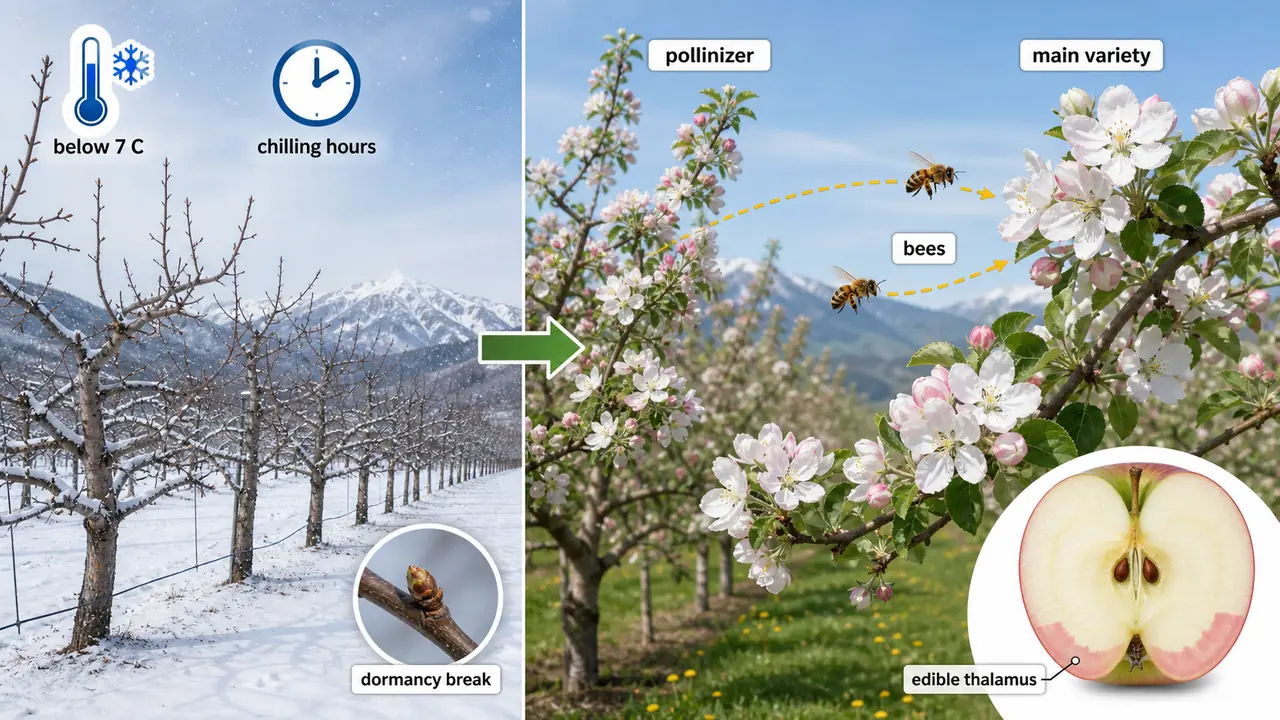
- Fruit type: Pome (false fruit — thalamus forms the edible part)
- Edible part: Fleshy thalamus
- Propagation: Tongue grafting (Whip grafting) — most common method
- Chilling requirement: 1000–1600 hours below 7°C for proper dormancy breaking
- Apple is a climacteric fruit
- Cross-pollinated — requires pollinizer varieties (Red Delicious pollinized by Golden Delicious)
- Maturity index: T-stage — starch-iodine test shows clear zone around core in T-shape
IMPORTANT
Chilling Requirement is critical for apple. Trees need 1000–1600 hours of exposure to temperature below 7°C during winter to break dormancy and produce normal flowering. Insufficient chilling leads to delayed foliation, poor flowering, and button fruit formation.
Important Rootstocks
| Rootstock | Vigour | Key Feature |
|---|---|---|
| M9 (Malling 9) | Dwarf | Most dwarfing, used in high-density planting |
| M26 | Semi-dwarf | Good for medium density orchards |
| MM106 | Semi-vigorous | Most widely used, tolerant to collar rot |
| MM111 | Vigorous | Drought tolerant, good anchorage |
| M7 | Semi-dwarf | Resistant to woolly apple aphid |
| Crab apple | Vigorous | Used as seedling rootstock in India |
TIP
- M-series (Malling) rootstocks were developed at East Malling Research Station, England.
- MM-series (Malling-Merton) rootstocks were developed jointly by East Malling and the John Innes Institute.
- The MM series is associated with woolly apple aphid resistance.
Important Varieties
| Variety | Key Feature |
|---|---|
| Red Delicious | Most popular, attractive red, five-pointed base |
| Royal Delicious | Sport of Red Delicious, deeper red colour |
| Golden Delicious | Yellow skin, used as pollinizer for Red Delicious |
| Ambri | Indigenous J&K variety, excellent keeping quality |
| McIntosh | Aromatic, used in breeding |
| Red Chief | Spur type, deep red |
| Gala | Bicoloured, early maturing |
| Lal Ambri | Red sport of Ambri |
Major Diseases
| Disease | Causal Organism | Key Feature |
|---|---|---|
| Apple Scab | Venturia inaequalis | Most serious disease, olive-green velvety spots on leaves & fruit |
| Fire Blight | Erwinia amylovora | Bacterial disease, blossoms & shoots appear scorched/burnt |
| Powdery Mildew | Podosphaera leucotricha | White powdery growth on leaves |
| Crown/Collar Rot | Phytophthora cactorum | Rotting at soil level, rootstock MM106 is tolerant |
Major Pests
- Woolly Apple Aphid: Eriosoma lanigerum — white woolly colonies on roots and shoots. Biological control by Aphelinus mali (parasitoid wasp)
- San Jose Scale: Quadraspidiotus perniciosus — serious scale insect
- Codling Moth: Cydia pomonella — larva bores into fruit
NOTE
Apple was introduced in India by the British in Kullu valley, Himachal Pradesh. Satyanand Stokes (an American) is credited with popularizing Red Delicious apple cultivation in Shimla hills.
Pear (Nashpati)
- Botanical Name: Pyrus communis (European pear) / Pyrus pyrifolia (Asian pear)
- Family: Rosaceae
- Origin: Europe and Western Asia
- Fruit type: Pome
- Propagation: Grafting on seedling rootstock
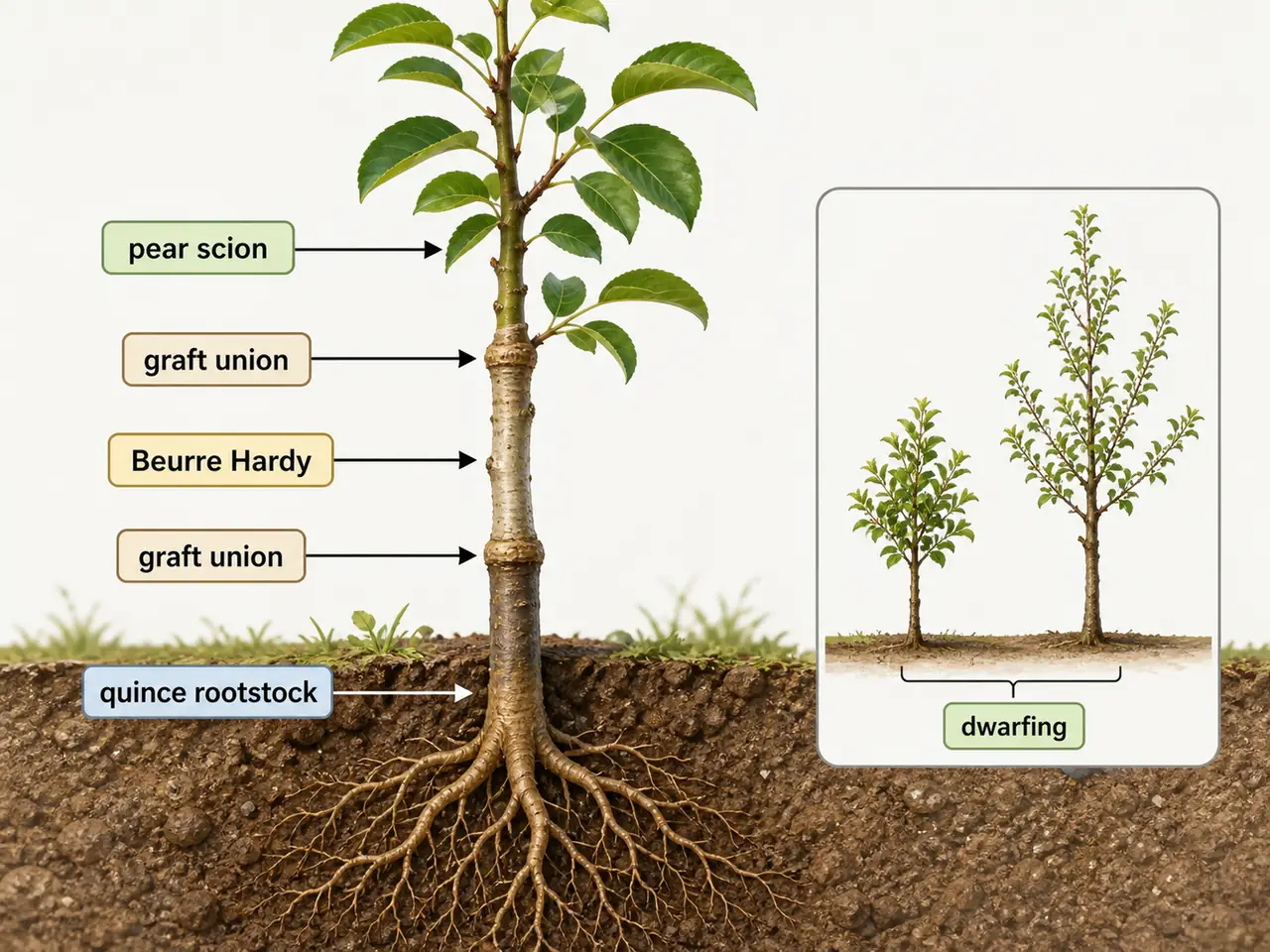
- Dwarfing rootstock: Quince (Cydonia oblonga) — most important dwarfing rootstock for pear
- Interstock: Beurre Hardy — used for double working when scion is incompatible with quince rootstock
- Leading states: J&K, Himachal Pradesh, U.P.
IMPORTANT
Double Working: When pear varieties are incompatible with quince rootstock, an intermediate piece (interstock) of Beurre Hardy is grafted between rootstock and scion. This is called double working or bridge grafting.
Important Varieties
| Variety | Key Feature |
|---|---|
| Bartlett (William) | Most popular European pear, excellent for canning |
| Conference | Good pollinizer, self-fertile |
| Patharnakh | Most popular Indian variety, hard, crisp, sandy texture |
| Gola | Soft, juicy, popular in Punjab |
| Leconte | Hybrid pear (sand pear × European pear) |
| Max Red Bartlett | Red sport of Bartlett |
Peach (Aadoo)
- Botanical Name: Prunus persica
- Family: Rosaceae
- Origin: China
- Fruit type: Drupe (stone fruit)
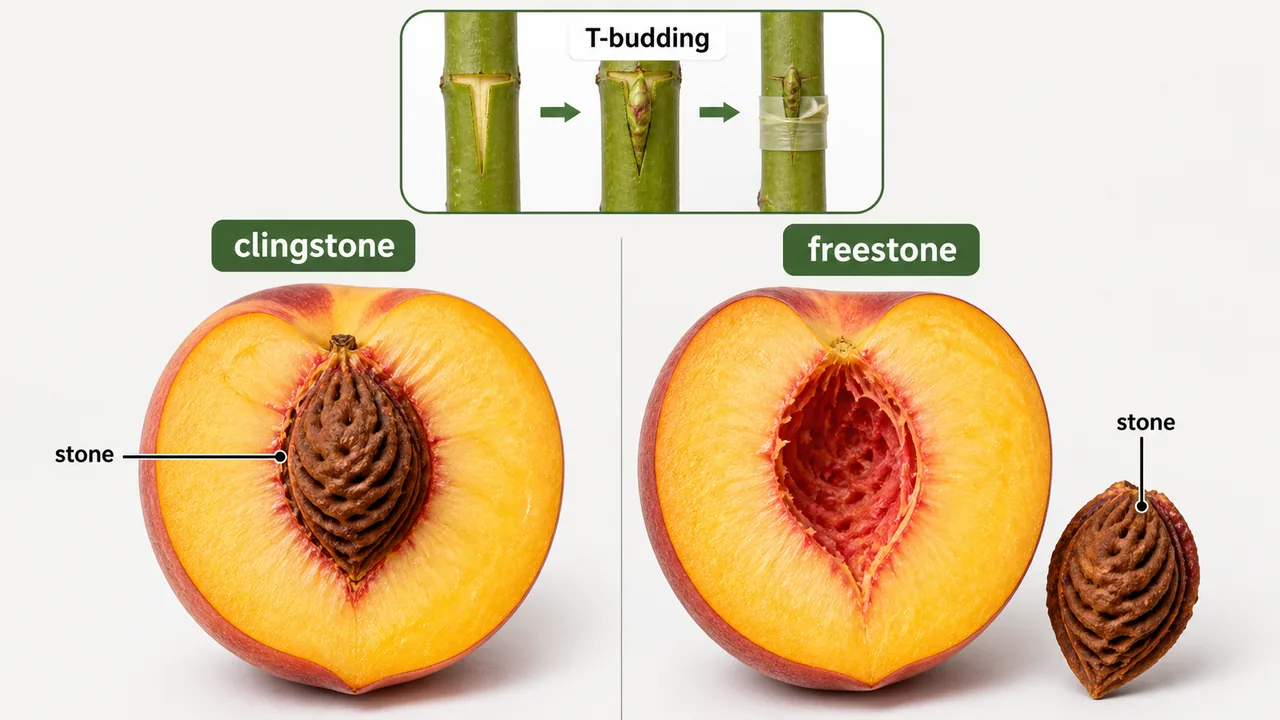
- Propagation: T-budding on peach seedling rootstock
- Two types: Clingstone (flesh adheres to stone) and Freestone (flesh separates easily)
- Clingstone preferred for canning; Freestone for fresh consumption
- Low chilling varieties developed for subtropical plains of North India
- Self-fertile (unlike most Rosaceae fruits)
Important Varieties
| Variety | Key Feature |
|---|---|
| Shan-i-Punjab | Most popular, low chilling, suitable for plains |
| Flordasun | Low chilling (150 hours), very early |
| Sharbati | White flesh, good quality |
| Pratap | IARI release |
| Flordaprince | Very low chilling |
| July Elberta | Late season, good for canning |
Major Disease
- Peach Leaf Curl: Caused by Taphrina deformans — leaves become thick, puckered, curled, and reddish. Spray Bordeaux mixture 4:4:50 before bud swell.
TIP
Peach has the shortest juvenile period among temperate fruits — starts bearing within 2–3 years of planting.
Plum (Aloo Bukhara)
- Botanical Name: Prunus domestica (European plum) / Prunus salicina (Japanese plum)
- Family: Rosaceae
- Origin: Caucasus region (European), China (Japanese)
- Fruit type: Drupe
- Propagation: T-budding, tongue grafting
- Japanese plums are commercially more important in India (lower chilling requirement)
- European plums are used for making prunes (dried plums)
Important Varieties
| Variety | Key Feature |
|---|---|
| Santa Rosa | Most popular, self-fertile, Japanese plum |
| Satluj Purple | PAU release, suitable for plains |
| Kala Amritsari | Popular in Punjab, dark purple |
| Titron | Good for canning |
| Frontier | Large fruit |
NOTE
Santa Rosa plum was developed by the famous plant breeder Luther Burbank in California, USA.
Strawberry
- Botanical Name: Fragaria × ananassa
- Family: Rosaceae
- Origin: France (hybrid between F. virginiana × F. chiloensis)
- Ploidy: Octoploid (2n = 56)
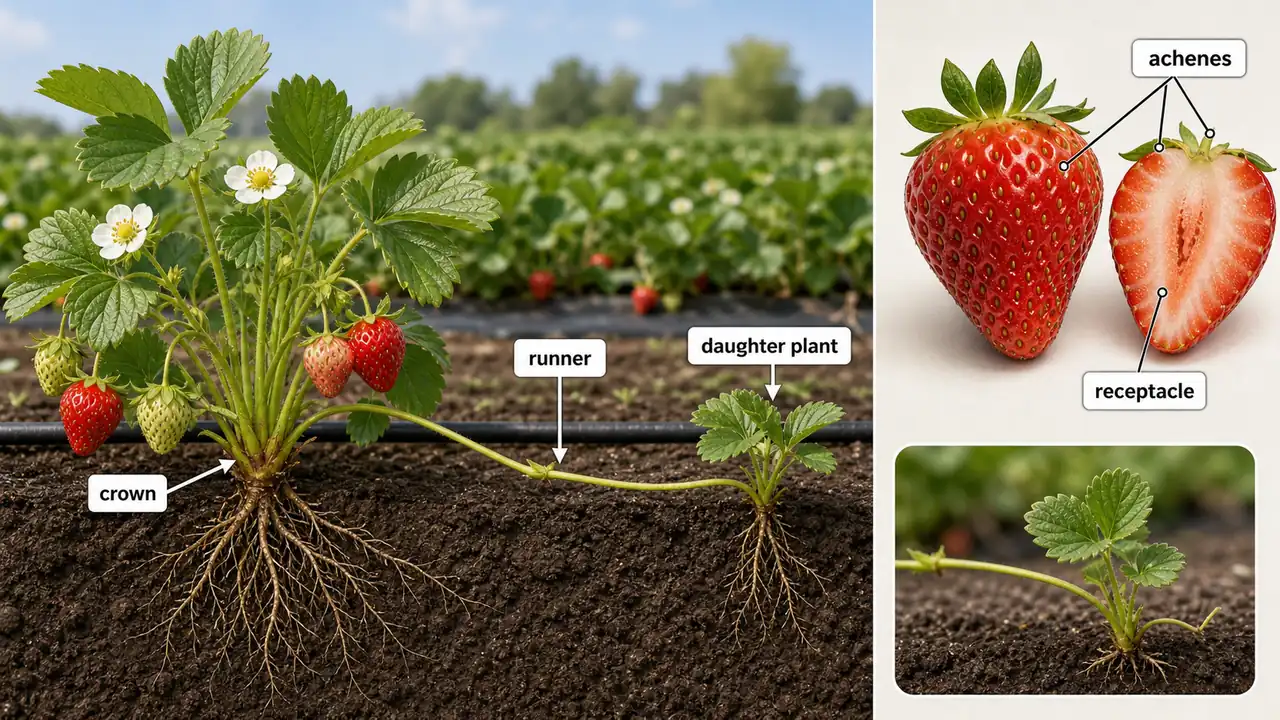
- Propagation: Runners (stolons) — the primary method
- Fruit type: Etaerio of achenes (aggregate fruit; edible part = fleshy receptacle)
- Short-day plant — flower induction occurs under short-day conditions
- Leading states: Maharashtra (Mahabaleshwar), Himachal Pradesh, Jammu
- Planting time: October–November
Important Varieties
| Variety | Key Feature |
|---|---|
| Chandler | Most popular in India, large fruit, high yield |
| Camarosa | Firm fruit, excellent for transport & processing |
| Sweet Charlie | Early maturing, very sweet |
| Winter Dawn | Good for subtropical conditions |
| Festival | High yield, good flavour |
| Nabila | Day-neutral variety |
IMPORTANT
Strawberry is the only fruit where seeds are on the outside (on the surface of the receptacle). Each "seed" is actually an achene — the true fruit.
Walnut (Akhrot)
- Botanical Name: Juglans regia
- Family: Juglandaceae
- Origin: Iran / Central Asia
- Leading state: Jammu & Kashmir (>90% of India's production)
- Monoecious — male (catkins) and female flowers on same tree
- Propagation: Patch budding or tongue grafting
- Maturity index: PTB stage (Packing Tissue turns Brown)
- Dichogamy is common — male and female flowers mature at different times (protandrous or protogynous)
- Rich in omega-3 fatty acids and antioxidants
Important Varieties
| Variety | Key Feature |
|---|---|
| Kashmir Budded | Most popular, thin shell |
| Gobind | IARI release |
| Eureka, Hartley, Franquette | International varieties grown in India |
TIP
- Walnut shows strong allelopathy.
- It secretes juglone from roots, which inhibits nearby sensitive plants.
- Sensitive intercrops should be avoided near walnut trees.
Almond (Badam)
- Botanical Name: Prunus amygdalus (syn. Prunus dulcis)
- Family: Rosaceae
- Origin: Central and Western Asia
- Leading state: Jammu & Kashmir
- Earliest flowering temperate fruit — blooms in late January/February
- Edible part: Seed (kernel) — cotyledons
- Propagation: T-budding on wild almond or peach rootstock
- Self-incompatible — requires cross-pollination
- Two types: Sweet almond (edible) and Bitter almond (contains amygdalin/HCN)
Important Varieties
| Variety | Key Feature |
|---|---|
| Non Pareil | Most popular international variety, paper shell |
| Ne Plus Ultra | Good pollinizer |
| Drake | Self-fertile |
| Pranyaj | Indian selection |
| Merced | Late blooming |
NOTE
Almond flowers before leaf emergence. Early flowering makes it susceptible to spring frost damage, which is a major limiting factor for almond cultivation.
Quick Exam Facts
One-Liner Exam Facts — Temperate Fruits
- Apple chilling requirement: 1000–1600 hours below 7°C
- Apple scab is caused by Venturia inaequalis — most serious apple disease
- Fire blight of apple is caused by Erwinia amylovora (bacterial)
- Woolly apple aphid biocontrol: Aphelinus mali
- M9 is the most dwarfing apple rootstock; MM106 is most widely used
- T-stage is the maturity index for apple (starch-iodine test)
- Quince is the dwarfing rootstock for pear; Beurre Hardy is used as interstock
- Bartlett (William) is the most popular pear variety worldwide
- Peach originated in China, not Persia (despite name Prunus persica)
- Peach leaf curl is caused by Taphrina deformans
- Santa Rosa plum was bred by Luther Burbank
- Strawberry is an octoploid (2n=56), propagated by runners
- Strawberry edible part = fleshy receptacle (thalamus)
- Walnut maturity index: PTB (Packing Tissue turns Brown)
- Walnut secretes juglone — strong allelopathic compound
- Almond is the earliest flowering temperate fruit
- J&K leads in apple, walnut, and almond production
- All temperate fruits except strawberry belong to family Rosaceae (walnut = Juglandaceae)
- Prunus genus includes peach, plum, cherry, almond, and apricot
- Double working in pear = Quince rootstock + Beurre Hardy interstock + scion variety
Summary Cheat Sheet
| Concept / Topic | Key Details / Explanation |
|---|---|
| Apple overview | Malus domestica of Rosaceae originated in Central Asia, leads temperate-fruit questions in India, and is mainly grown in Jammu and Kashmir with pome fruit and fleshy thalamus as key identity points. |
| Apple production and management | Apple is propagated mainly by tongue grafting, needs 1000-1600 chilling hours below 7°C, behaves as a climacteric and cross-pollinated crop, and uses T-stage as the maturity index. |
| Apple rootstocks, varieties, and protection | Key rootstocks are M9, M26, MM106, MM111, M7, and crab apple; important varieties are Red Delicious, Royal Delicious, Golden Delicious, Ambri, Gala, and Red Chief; apple scab is the major disease and woolly apple aphid is a major pest with Aphelinus mali as biocontrol. |
| Pear overview | Pear includes Pyrus communis and Pyrus pyrifolia, belongs to Rosaceae, bears pome fruit, and is commonly grafted on seedling rootstock in temperate regions. |
| Pear key exam points | Quince is the main dwarfing rootstock, Beurre Hardy is the classic interstock for double working, and Bartlett, Conference, Patharnakh, Gola, Leconte, and Max Red Bartlett are the key varieties. |
| Peach overview | Prunus persica of Rosaceae originated in China, bears drupe fruit, and is propagated by T-budding on peach seedling rootstock. |
| Peach key exam points | Clingstone types are preferred for canning, freestone for table use, the crop is self-fertile, low-chilling varieties are important for subtropical plains, and peach leaf curl is caused by Taphrina deformans. |
| Peach varieties | Important varieties are Shan-i-Punjab, Flordasun, Sharbati, Pratap, Flordaprince, and July Elberta; peach is also noted for the shortest juvenile period among temperate fruits. |
| Plum overview | Plum includes Prunus domestica and Prunus salicina, bears drupe fruit, and is propagated through T-budding or tongue grafting. |
Summary Continued
| Concept / Topic | Key Details / Explanation |
|---|---|
| Plum key exam points | Japanese plums are more important in India because of lower chilling need, European plums are used for prunes, and Santa Rosa, Satluj Purple, Kala Amritsari, Titron, and Frontier are the key varieties. |
| Strawberry overview | Fragaria × ananassa of Rosaceae originated in France, is octoploid, is propagated by runners, and bears etaerio of achenes with fleshy receptacle as the edible part. |
| Strawberry key exam points | It is a short-day crop, major production comes from Maharashtra and hill states, Chandler and Camarosa are major varieties, and the surface "seeds" are actually achenes. |
| Walnut overview | Juglans regia of Juglandaceae originated around Iran or Central Asia, Jammu and Kashmir dominates production, and the crop is monoecious with dichogamy. |
| Walnut key exam points | Propagation is by patch budding or tongue grafting, PTB is the maturity index, important varieties include Kashmir Budded, Gobind, Eureka, Hartley, and Franquette, and juglone causes strong allelopathy. |
| Almond overview | Prunus amygdalus or P. dulcis belongs to Rosaceae, is the earliest flowering temperate fruit, and is mainly grown in Jammu and Kashmir. |
| Almond key exam points | The edible part is the seed kernel, propagation is by T-budding on wild almond or peach rootstock, the crop is self-incompatible, and Non Pareil, Ne Plus Ultra, Drake, Pranyaj, and Merced are important varieties. |
| Fast revision points | Remember apple for chilling requirement and scab, pear for quince rootstock and Beurre Hardy interstock, peach for leaf curl, plum for Santa Rosa and prunes, strawberry for octoploid runners, walnut for PTB and juglone, and almond for earliest flowering plus frost sensitivity. |
Apple (Seb)
- Botanical Name: Malus domestica (syn. Malus pumila)
- Family: Rosaceae
- Origin: Central Asia (Kazakhstan — Alma Ata = "Father of Apple")
- Leading state: Jammu & Kashmir (>75% of India's production), followed by Himachal Pradesh
- Fruit type: Pome (false fruit — thalamus forms the edible part)
- Edible part: Fleshy thalamus
- Propagation: Tongue grafting (Whip grafting) — most common method
- Chilling requirement: 1000–1600 hours below 7°C for proper dormancy breaking
- Apple is a climacteric fruit
- Cross-pollinated — requires pollinizer varieties (Red Delicious pollinized by Golden Delicious)
- Maturity index: T-stage — starch-iodine test shows clear zone around core in T-shape
IMPORTANT
Chilling Requirement is critical for apple. Trees need 1000–1600 hours of exposure to temperature below 7°C during winter to break dormancy and produce normal flowering. Insufficient chilling leads to delayed foliation, poor flowering, and button fruit formation.
Important Rootstocks
| Rootstock | Vigour | Key Feature |
|---|---|---|
| M9 (Malling 9) | Dwarf | Most dwarfing, used in high-density planting |
| M26 | Semi-dwarf | Good for medium density orchards |
| MM106 | Semi-vigorous | Most widely used, tolerant to collar rot |
| MM111 | Vigorous | Drought tolerant, good anchorage |
| M7 | Semi-dwarf | Resistant to woolly apple aphid |
| Crab apple | Vigorous | Used as seedling rootstock in India |
TIP
- M-series (Malling) rootstocks were developed at East Malling Research Station, England.
- MM-series (Malling-Merton) rootstocks were developed jointly by East Malling and the John Innes Institute.
- The MM series is associated with woolly apple aphid resistance.
Important Varieties
| Variety | Key Feature |
|---|---|
| Red Delicious | Most popular, attractive red, five-pointed base |
| Royal Delicious | Sport of Red Delicious, deeper red colour |
| Golden Delicious | Yellow skin, used as pollinizer for Red Delicious |
| Ambri | Indigenous J&K variety, excellent keeping quality |
| McIntosh | Aromatic, used in breeding |
| Red Chief | Spur type, deep red |
| Gala | Bicoloured, early maturing |
| Lal Ambri | Red sport of Ambri |
Major Diseases
| Disease | Causal Organism | Key Feature |
|---|---|---|
| Apple Scab | Venturia inaequalis | Most serious disease, olive-green velvety spots on leaves & fruit |
| Fire Blight | Erwinia amylovora | Bacterial disease, blossoms & shoots appear scorched/burnt |
| Powdery Mildew | Podosphaera leucotricha | White powdery growth on leaves |
| Crown/Collar Rot | Phytophthora cactorum | Rotting at soil level, rootstock MM106 is tolerant |
Major Pests
- Woolly Apple Aphid: Eriosoma lanigerum — white woolly colonies on roots and shoots. Biological control by Aphelinus mali (parasitoid wasp)
- San Jose Scale: Quadraspidiotus perniciosus — serious scale insect
- Codling Moth: Cydia pomonella — larva bores into fruit
NOTE
Apple was introduced in India by the British in Kullu valley, Himachal Pradesh. Satyanand Stokes (an American) is credited with popularizing Red Delicious apple cultivation in Shimla hills.
Pear (Nashpati)
- Botanical Name: Pyrus communis (European pear) / Pyrus pyrifolia (Asian pear)
- Family: Rosaceae
- Origin: Europe and Western Asia
- Fruit type: Pome
- Propagation: Grafting on seedling rootstock
- Dwarfing rootstock: Quince (Cydonia oblonga) — most important dwarfing rootstock for pear
- Interstock: Beurre Hardy — used for double working when scion is incompatible with quince rootstock
- Leading states: J&K, Himachal Pradesh, U.P.
IMPORTANT
Double Working: When pear varieties are incompatible with quince rootstock, an intermediate piece (interstock) of Beurre Hardy is grafted between rootstock and scion. This is called double working or bridge grafting.
Important Varieties
| Variety | Key Feature |
|---|---|
| Bartlett (William) | Most popular European pear, excellent for canning |
| Conference | Good pollinizer, self-fertile |
| Patharnakh | Most popular Indian variety, hard, crisp, sandy texture |
| Gola | Soft, juicy, popular in Punjab |
| Leconte | Hybrid pear (sand pear × European pear) |
| Max Red Bartlett | Red sport of Bartlett |
Peach (Aadoo)
- Botanical Name: Prunus persica
- Family: Rosaceae
- Origin: China
- Fruit type: Drupe (stone fruit)
- Propagation: T-budding on peach seedling rootstock
- Two types: Clingstone (flesh adheres to stone) and Freestone (flesh separates easily)
- Clingstone preferred for canning; Freestone for fresh consumption
- Low chilling varieties developed for subtropical plains of North India
- Self-fertile (unlike most Rosaceae fruits)
Important Varieties
| Variety | Key Feature |
|---|---|
| Shan-i-Punjab | Most popular, low chilling, suitable for plains |
| Flordasun | Low chilling (150 hours), very early |
| Sharbati | White flesh, good quality |
| Pratap | IARI release |
| Flordaprince | Very low chilling |
| July Elberta | Late season, good for canning |
Major Disease
- Peach Leaf Curl: Caused by Taphrina deformans — leaves become thick, puckered, curled, and reddish. Spray Bordeaux mixture 4:4:50 before bud swell.
TIP
Peach has the shortest juvenile period among temperate fruits — starts bearing within 2–3 years of planting.
Plum (Aloo Bukhara)
- Botanical Name: Prunus domestica (European plum) / Prunus salicina (Japanese plum)
- Family: Rosaceae
- Origin: Caucasus region (European), China (Japanese)
- Fruit type: Drupe
- Propagation: T-budding, tongue grafting
- Japanese plums are commercially more important in India (lower chilling requirement)
- European plums are used for making prunes (dried plums)
Important Varieties
| Variety | Key Feature |
|---|---|
| Santa Rosa | Most popular, self-fertile, Japanese plum |
| Satluj Purple | PAU release, suitable for plains |
| Kala Amritsari | Popular in Punjab, dark purple |
| Titron | Good for canning |
| Frontier | Large fruit |
NOTE
Santa Rosa plum was developed by the famous plant breeder Luther Burbank in California, USA.
Strawberry
- Botanical Name: Fragaria × ananassa
- Family: Rosaceae
- Origin: France (hybrid between F. virginiana × F. chiloensis)
- Ploidy: Octoploid (2n = 56)
- Propagation: Runners (stolons) — the primary method
- Fruit type: Etaerio of achenes (aggregate fruit; edible part = fleshy receptacle)
- Short-day plant — flower induction occurs under short-day conditions
- Leading states: Maharashtra (Mahabaleshwar), Himachal Pradesh, Jammu
- Planting time: October–November
Important Varieties
| Variety | Key Feature |
|---|---|
| Chandler | Most popular in India, large fruit, high yield |
| Camarosa | Firm fruit, excellent for transport & processing |
| Sweet Charlie | Early maturing, very sweet |
| Winter Dawn | Good for subtropical conditions |
| Festival | High yield, good flavour |
| Nabila | Day-neutral variety |
IMPORTANT
Strawberry is the only fruit where seeds are on the outside (on the surface of the receptacle). Each "seed" is actually an achene — the true fruit.
Walnut (Akhrot)
- Botanical Name: Juglans regia
- Family: Juglandaceae
- Origin: Iran / Central Asia
- Leading state: Jammu & Kashmir (>90% of India's production)
- Monoecious — male (catkins) and female flowers on same tree
- Propagation: Patch budding or tongue grafting
- Maturity index: PTB stage (Packing Tissue turns Brown)
- Dichogamy is common — male and female flowers mature at different times (protandrous or protogynous)
- Rich in omega-3 fatty acids and antioxidants
Important Varieties
| Variety | Key Feature |
|---|---|
| Kashmir Budded | Most popular, thin shell |
| Gobind | IARI release |
| Eureka, Hartley, Franquette | International varieties grown in India |
TIP
- Walnut shows strong allelopathy.
- It secretes juglone from roots, which inhibits nearby sensitive plants.
- Sensitive intercrops should be avoided near walnut trees.
Almond (Badam)
- Botanical Name: Prunus amygdalus (syn. Prunus dulcis)
- Family: Rosaceae
- Origin: Central and Western Asia
- Leading state: Jammu & Kashmir
- Earliest flowering temperate fruit — blooms in late January/February
- Edible part: Seed (kernel) — cotyledons
- Propagation: T-budding on wild almond or peach rootstock
- Self-incompatible — requires cross-pollination
- Two types: Sweet almond (edible) and Bitter almond (contains amygdalin/HCN)
Important Varieties
| Variety | Key Feature |
|---|---|
| Non Pareil | Most popular international variety, paper shell |
| Ne Plus Ultra | Good pollinizer |
| Drake | Self-fertile |
| Pranyaj | Indian selection |
| Merced | Late blooming |
NOTE
Almond flowers before leaf emergence. Early flowering makes it susceptible to spring frost damage, which is a major limiting factor for almond cultivation.
Quick Exam Facts
One-Liner Exam Facts — Temperate Fruits
- Apple chilling requirement: 1000–1600 hours below 7°C
- Apple scab is caused by Venturia inaequalis — most serious apple disease
- Fire blight of apple is caused by Erwinia amylovora (bacterial)
- Woolly apple aphid biocontrol: Aphelinus mali
- M9 is the most dwarfing apple rootstock; MM106 is most widely used
- T-stage is the maturity index for apple (starch-iodine test)
- Quince is the dwarfing rootstock for pear; Beurre Hardy is used as interstock
- Bartlett (William) is the most popular pear variety worldwide
- Peach originated in China, not Persia (despite name Prunus persica)
- Peach leaf curl is caused by Taphrina deformans
- Santa Rosa plum was bred by Luther Burbank
- Strawberry is an octoploid (2n=56), propagated by runners
- Strawberry edible part = fleshy receptacle (thalamus)
- Walnut maturity index: PTB (Packing Tissue turns Brown)
- Walnut secretes juglone — strong allelopathic compound
- Almond is the earliest flowering temperate fruit
- J&K leads in apple, walnut, and almond production
- All temperate fruits except strawberry belong to family Rosaceae (walnut = Juglandaceae)
- Prunus genus includes peach, plum, cherry, almond, and apricot
- Double working in pear = Quince rootstock + Beurre Hardy interstock + scion variety
Summary Cheat Sheet
| Concept / Topic | Key Details / Explanation |
|---|---|
| Apple overview | Malus domestica of Rosaceae originated in Central Asia, leads temperate-fruit questions in India, and is mainly grown in Jammu and Kashmir with pome fruit and fleshy thalamus as key identity points. |
| Apple production and management | Apple is propagated mainly by tongue grafting, needs 1000-1600 chilling hours below 7°C, behaves as a climacteric and cross-pollinated crop, and uses T-stage as the maturity index. |
| Apple rootstocks, varieties, and protection | Key rootstocks are M9, M26, MM106, MM111, M7, and crab apple; important varieties are Red Delicious, Royal Delicious, Golden Delicious, Ambri, Gala, and Red Chief; apple scab is the major disease and woolly apple aphid is a major pest with Aphelinus mali as biocontrol. |
| Pear overview | Pear includes Pyrus communis and Pyrus pyrifolia, belongs to Rosaceae, bears pome fruit, and is commonly grafted on seedling rootstock in temperate regions. |
| Pear key exam points | Quince is the main dwarfing rootstock, Beurre Hardy is the classic interstock for double working, and Bartlett, Conference, Patharnakh, Gola, Leconte, and Max Red Bartlett are the key varieties. |
| Peach overview | Prunus persica of Rosaceae originated in China, bears drupe fruit, and is propagated by T-budding on peach seedling rootstock. |
| Peach key exam points | Clingstone types are preferred for canning, freestone for table use, the crop is self-fertile, low-chilling varieties are important for subtropical plains, and peach leaf curl is caused by Taphrina deformans. |
| Peach varieties | Important varieties are Shan-i-Punjab, Flordasun, Sharbati, Pratap, Flordaprince, and July Elberta; peach is also noted for the shortest juvenile period among temperate fruits. |
| Plum overview | Plum includes Prunus domestica and Prunus salicina, bears drupe fruit, and is propagated through T-budding or tongue grafting. |
Summary Continued
| Concept / Topic | Key Details / Explanation |
|---|---|
| Plum key exam points | Japanese plums are more important in India because of lower chilling need, European plums are used for prunes, and Santa Rosa, Satluj Purple, Kala Amritsari, Titron, and Frontier are the key varieties. |
| Strawberry overview | Fragaria × ananassa of Rosaceae originated in France, is octoploid, is propagated by runners, and bears etaerio of achenes with fleshy receptacle as the edible part. |
| Strawberry key exam points | It is a short-day crop, major production comes from Maharashtra and hill states, Chandler and Camarosa are major varieties, and the surface "seeds" are actually achenes. |
| Walnut overview | Juglans regia of Juglandaceae originated around Iran or Central Asia, Jammu and Kashmir dominates production, and the crop is monoecious with dichogamy. |
| Walnut key exam points | Propagation is by patch budding or tongue grafting, PTB is the maturity index, important varieties include Kashmir Budded, Gobind, Eureka, Hartley, and Franquette, and juglone causes strong allelopathy. |
| Almond overview | Prunus amygdalus or P. dulcis belongs to Rosaceae, is the earliest flowering temperate fruit, and is mainly grown in Jammu and Kashmir. |
| Almond key exam points | The edible part is the seed kernel, propagation is by T-budding on wild almond or peach rootstock, the crop is self-incompatible, and Non Pareil, Ne Plus Ultra, Drake, Pranyaj, and Merced are important varieties. |
| Fast revision points | Remember apple for chilling requirement and scab, pear for quince rootstock and Beurre Hardy interstock, peach for leaf curl, plum for Santa Rosa and prunes, strawberry for octoploid runners, walnut for PTB and juglone, and almond for earliest flowering plus frost sensitivity. |
Pro Content Locked
Upgrade to Pro to access this lesson and all other premium content.
₹99 charged monthly · Cancel anytime
- All Agriculture & Banking Courses
- AI Lesson Questions (100/day)
- AI Doubt Solver (50/day)
- Glows & Grows Feedback (30/day)
- AI Section Quiz (20/day)
- 22-Language Translation (100/day)
- Recall Questions (20/day)
- AI Quiz (15/day)
- AI Quiz Paper Analysis (100/day)
- AI Step-by-Step Explanations (100/day)
- Spaced Repetition Recall (FSRS)
- AI Tutor
- Immersive Text Questions
- Audio Lessons — Hindi & English
- Mock Tests & Previous Year Papers
- Summary & Mind Maps
- XP, Levels, Leaderboard & Badges
- Generate New Classrooms
- Voice AI Teacher (AgriDots Live)
- AI Revision Assistant
- Knowledge Gap Analysis
- Interactive Revision (LangGraph)
🔒 Secure via Razorpay · Cancel anytime · No hidden fees
Lesson Doubts
Ask questions, get expert answers