🍍 Tropical & Subtropical Fruits
Guava, litchi, pineapple, sapota, pomegranate, jackfruit and other tropical fruits for exams
Guava (Amrood)
- Botanical Name: Psidium guajava
- Family: Myrtaceae
- Origin: Tropical America / Mexico
- Also called Apple of the Tropics or Poor Man's Apple
- Richest source of Vitamin C among all fruits (200–300 mg/100g)
- Rich source of pectin — excellent for jelly and jam making
- Leading state: Uttar Pradesh (Allahabad/Prayagraj famous for best quality)
- Propagation: Air layering (Gootee) and Stool layering (most common & cheapest)
- Dwarfing rootstock: Aneuploid-82; P. friedrichsthalianum (Chinese guava) — resistant to wilt & nematodes
- Meadow orcharding developed in guava (2.0 m × 1.0 m spacing)
- Bears fruit 3 times a year in South India (Ambe, Mrig, Hasta bahar)
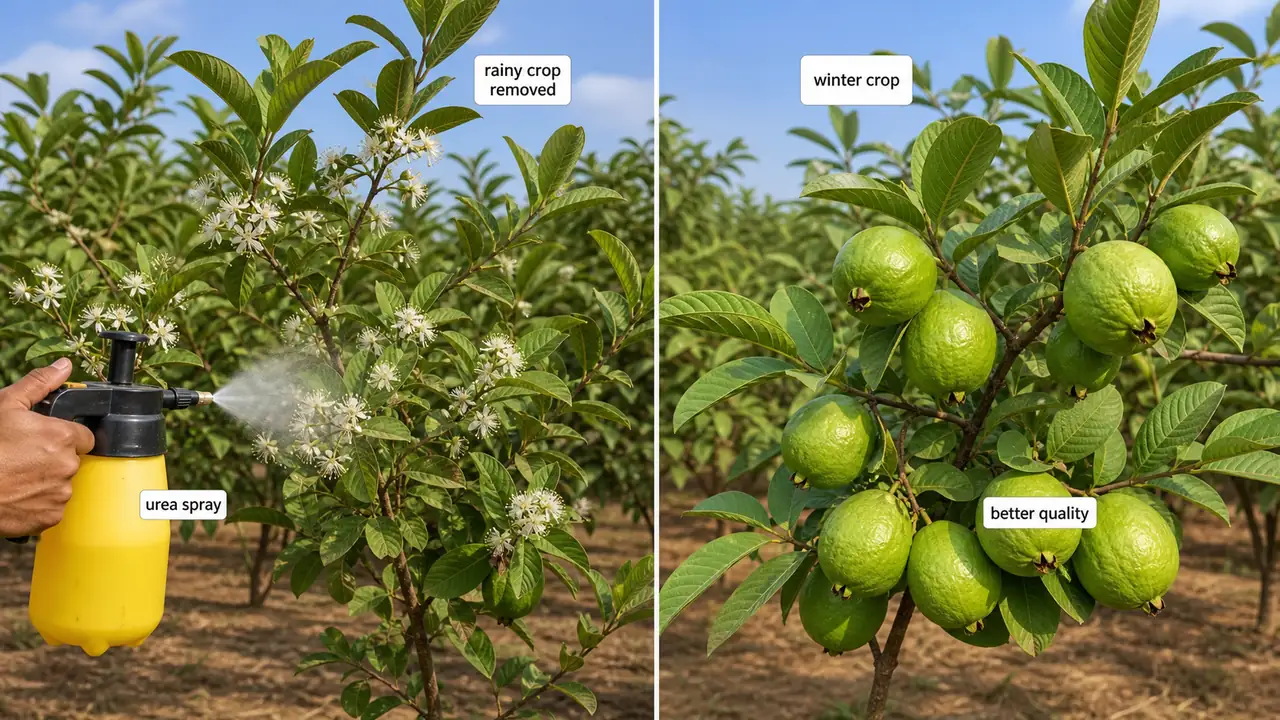
- Winter crop is best quality — escapes fruit fly attack
IMPORTANT
Crop Regulation: Rainy season crop is removed by spraying urea 10% (Allahabad Safeda) or 20% (Lucknow-49) at peak flowering to divert energy to superior winter crop.
Important Varieties
| Variety | Key Feature |
|---|---|
| Allahabad Safeda | Benchmark quality, white flesh, high Vitamin C |
| Lucknow-49 (Sardar) | Most widely cultivated, chance seedling from Allahabad Safeda |
| Lalit | Pink flesh, 24% higher yield, suitable for jelly |
| Arka Mridula | Seedling selection from Allahabad Safeda, soft-seeded |
| Behat Coconut | Seedless guava |
| Allahabad Surkha | Uniform pink fruit, deep pink flesh |
| Chittidar | Red dots on skin |
| Hafsi | Red fleshed |

Major Disease & Pest
- Guava Wilt: Caused by Fusarium oxysporum f.sp. psidii — most destructive disease, common in alkaline soils
- Guava Fruit Fly: Bactrocera dorsalis — most serious pest, attacks rainy season crop
TIP
- Guava can tolerate salinity.
- Guava is susceptible to soil acidity.
- Wilt is most common in alkali soils.
Litchi
- Botanical Name: Litchi chinensis
- Family: Sapindaceae
- Origin: Southern China
- Also called Queen of Fruits
- Bihar is the largest producer (~75% of India's production), followed by Uttarakhand
- Muzaffarpur (Bihar) is the litchi capital of India
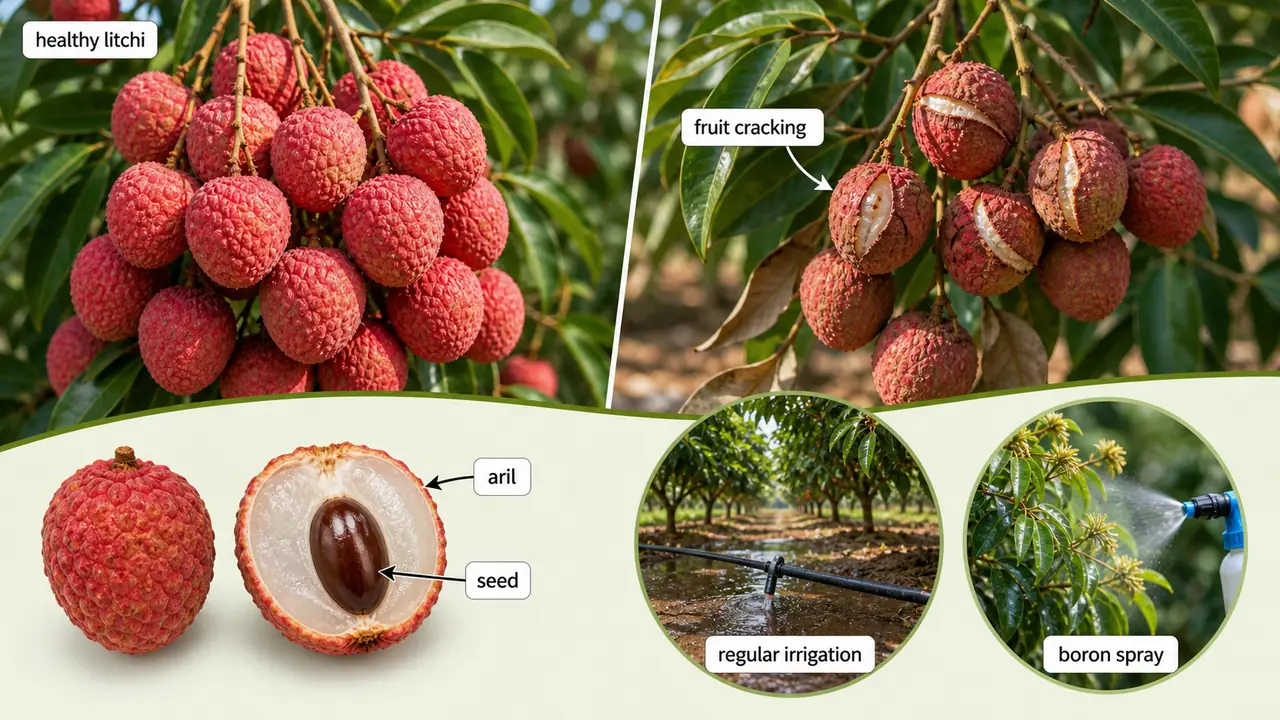
- Edible part: Fleshy aril (juicy covering of seed)
- Propagation: Air layering (Gootee) — most common and successful method
- Fruit maturity index: Specific gravity of 1.05
- Litchi is a non-climacteric fruit
- Requires subtropical climate with distinct cool winter (for flower induction) and hot humid summer
IMPORTANT
Fruit cracking is a major problem in litchi — caused by moisture stress, hot dry winds, and boron deficiency. Spray borax 0.4% and maintain regular irrigation to reduce cracking.
Important Varieties
| Variety | Key Feature |
|---|---|
| Shahi | Most popular commercial variety, excellent quality |
| China | Large fruit, late maturing |
| Bombai | Large fruit, bold seed |
| Rose Scented | Distinct rose aroma |
| Calcuttia | Early maturing |
| Purbi | Good quality, mid-season |
| Dehradun | Popular in Uttarakhand |
NOTE
Litchi is highly perishable — browning of pericarp occurs within 48–72 hours after harvest. SO₂ fumigation or acid dip treatment helps maintain red colour.
Pineapple
- Botanical Name: Ananas comosus
- Family: Bromeliaceae
- Origin: Brazil (South America)
- Only monocotyledonous commercial fruit crop
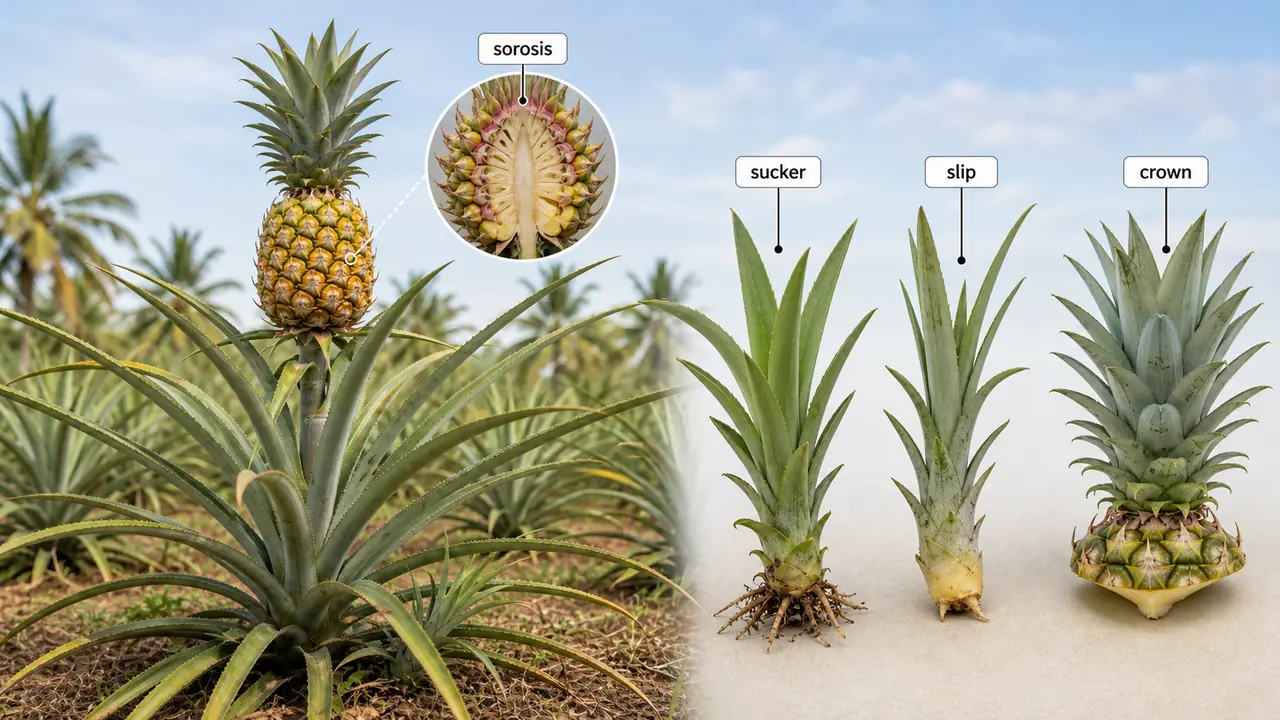
- Fruit type: Sorosis (composite/multiple fruit formed from fusion of flowers on a spike)
- Edible part: Fleshy perianth, bract, and axis
- Leading states: Meghalaya, Assam, Kerala, Manipur
- Propagation: Suckers (best), Slips, and Crowns
- Contains enzyme Bromelin — a protein-digesting enzyme
- Ethrel (Ethephon) 100 ppm spray induces uniform flowering
- Pineapple is a CAM plant (Crassulacean Acid Metabolism)
Important Varieties
| Variety | Key Feature |
|---|---|
| Kew (Giant Kew) | Most popular, suitable for canning, large fruit |
| Queen | Best for table purpose, golden yellow, aromatic |
| Mauritius | Excellent flavour, reddish-orange skin |
Major Disease & Pest
- Heart Rot: Caused by Phytophthora parasitica — central whorl of leaves turns brown and pulls out easily
- Mealy Bug: Transmits pineapple wilt virus
TIP
- Pineapple is a shade-loving plant.
- Intercropping with coconut, arecanut, or rubber is highly beneficial.
- It grows best in acidic soils (pH 5.0–6.0).
Sapota / Chiku
- Botanical Name: Manilkara zapota (syn. Achras zapota)
- Family: Sapotaceae
- Origin: Mexico and Central America
- Leading states: Karnataka, Gujarat, Maharashtra
- Source of Chicle — the natural chewing gum base obtained from latex
- Edible part: Pericarp (entire fleshy portion)
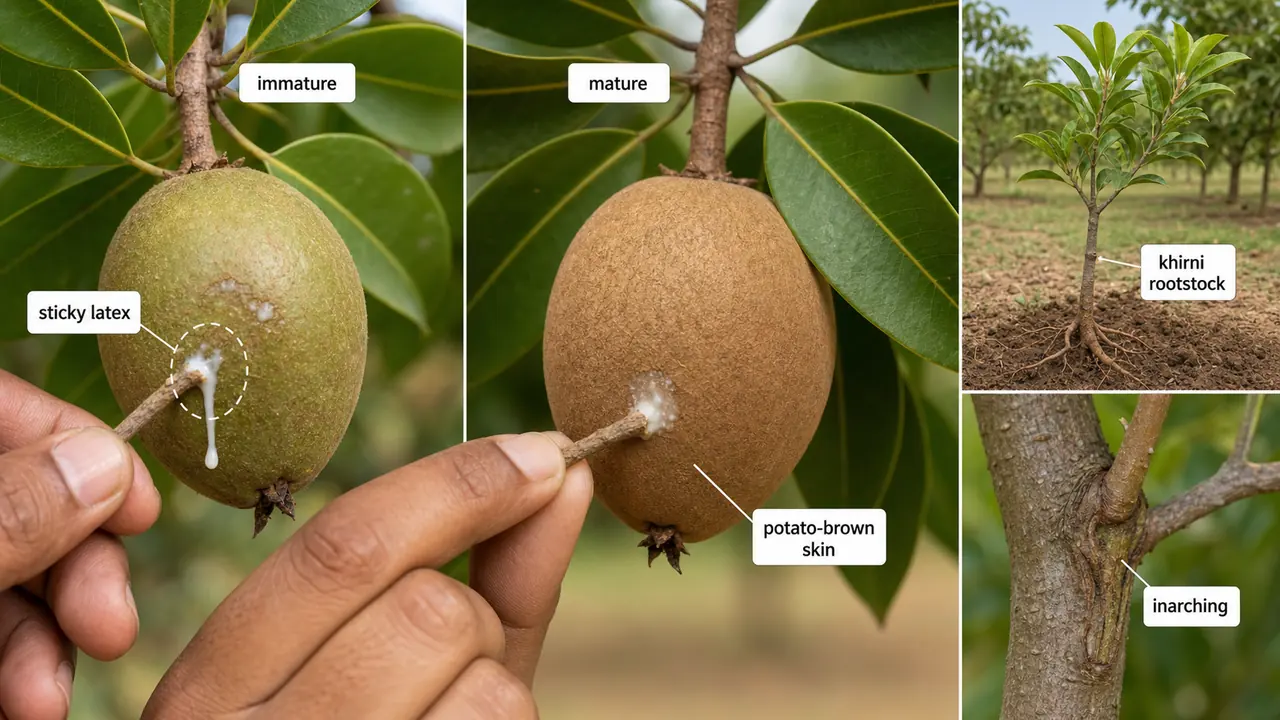
- Propagation: Inarching (most common) and Softwood grafting
- Sapota is an evergreen tree, bears fruit throughout the year
- Rootstock: Khirni (Manilkara hexandra)
Important Varieties
| Variety | Key Feature |
|---|---|
| Kalipatti | Most popular, oval fruit, good quality |
| Cricket Ball | Round like cricket ball, large, popular in Gujarat |
| PKM-1 | High yielding, developed by TNAU |
| Pilipatti | Oblong fruit |
| DSH-2 | Hybrid |
| CO-1, CO-2 | TNAU releases |
NOTE
Sapota fruit is harvested when the skin turns potato brown and scratching reveals yellowish-green colour underneath, with milky latex becoming non-sticky.
Pomegranate (Anar)
- Botanical Name: Punica granatum
- Family: Punicaceae (some classify under Lythraceae)
- Origin: Iran (Persia)
- Fruit type: Balausta — a specialized berry with leathery rind
- Edible part: Juicy testa (Aril) — the fleshy seed coat
- Leading states: Maharashtra (largest), Karnataka, Andhra Pradesh
- India is the largest producer of pomegranate in the world
- Propagation: Hardwood cuttings (most common), also air layering
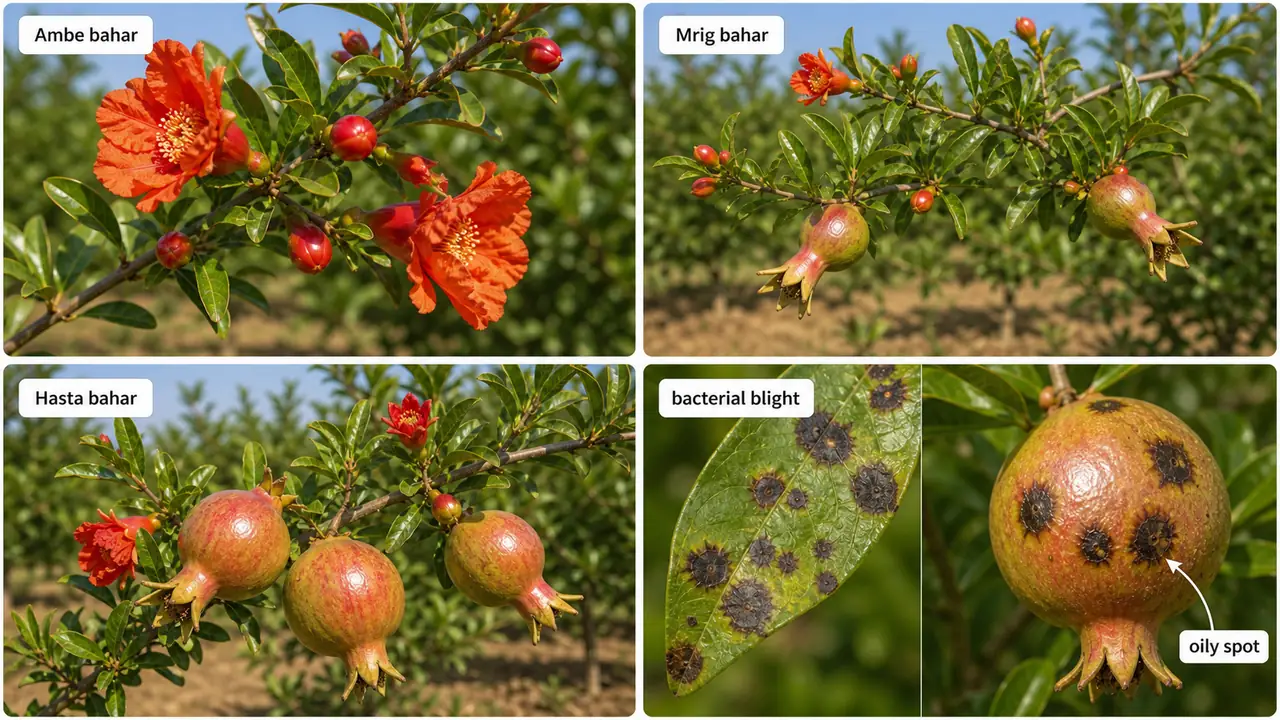
- Three flowering seasons: Ambe bahar (Jan–Feb), Mrig bahar (June–July), Hasta bahar (Sept–Oct)
- Mrig bahar is preferred commercially in Maharashtra
IMPORTANT
Bacterial Blight (Oily Spot): Caused by Xanthomonas axonopodis pv. punicae — most destructive disease of pomegranate. Causes oily spots on leaves and fruit, leading to fruit cracking and rotting. Spray Streptocycline 500 ppm + Copper oxychloride 0.2%.
Important Varieties
| Variety | Key Feature |
|---|---|
| Bhagwa (Sinduri) | Most popular commercial variety, attractive red, soft-seeded |
| Ganesh | Soft-seeded, pinkish-white arils, good for fresh consumption |
| Mridula | Dark red arils, good for processing |
| Arakta | Deep red arils, developed by NRCP Sholapur |
| Ruby | Red arils |
| Super Bhagwa | Improved selection from Bhagwa |

Major Pest
- Anar Butterfly: Deudorix (Virachola) isocrates — larva bores into fruit, most damaging pest
- Fruit Borer: Also called pomegranate butterfly
TIP
NRCP (National Research Centre on Pomegranate) is located at Sholapur, Maharashtra.
Jackfruit (Kathal)
- Botanical Name: Artocarpus heterophyllus
- Family: Moraceae
- Origin: Western Ghats of India
- Largest tree-borne fruit in the world (can weigh up to 40–50 kg)
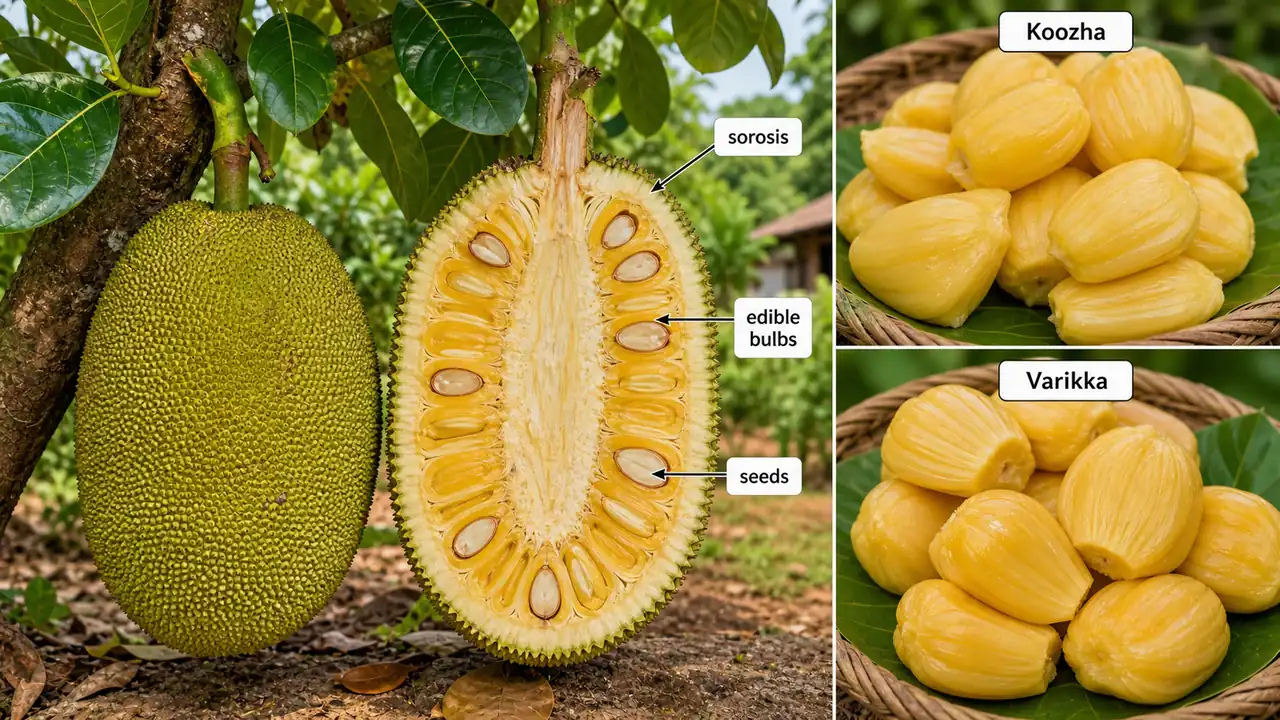
- Fruit type: Sorosis (multiple fruit)
- Edible part: Perianth and seeds
- National fruit of Bangladesh and Sri Lanka
- State fruit of Kerala
- Propagation: Seeds (most common), also softwood grafting and epicotyl grafting
- Contains latex — fruits harvested by applying mustard oil on hands
- Two types: Koozha (soft, sweet) and Varikka (firm, crisp)
NOTE
Jackfruit is a multipurpose tree — fruit is eaten raw (vegetable) when unripe and as dessert when ripe. Seeds are rich in starch and can be roasted or boiled. Wood is used for furniture and construction.
Ber / Indian Jujube
- Botanical Name: Ziziphus mauritiana
- Family: Rhamnaceae
- Origin: Indo-Burma region
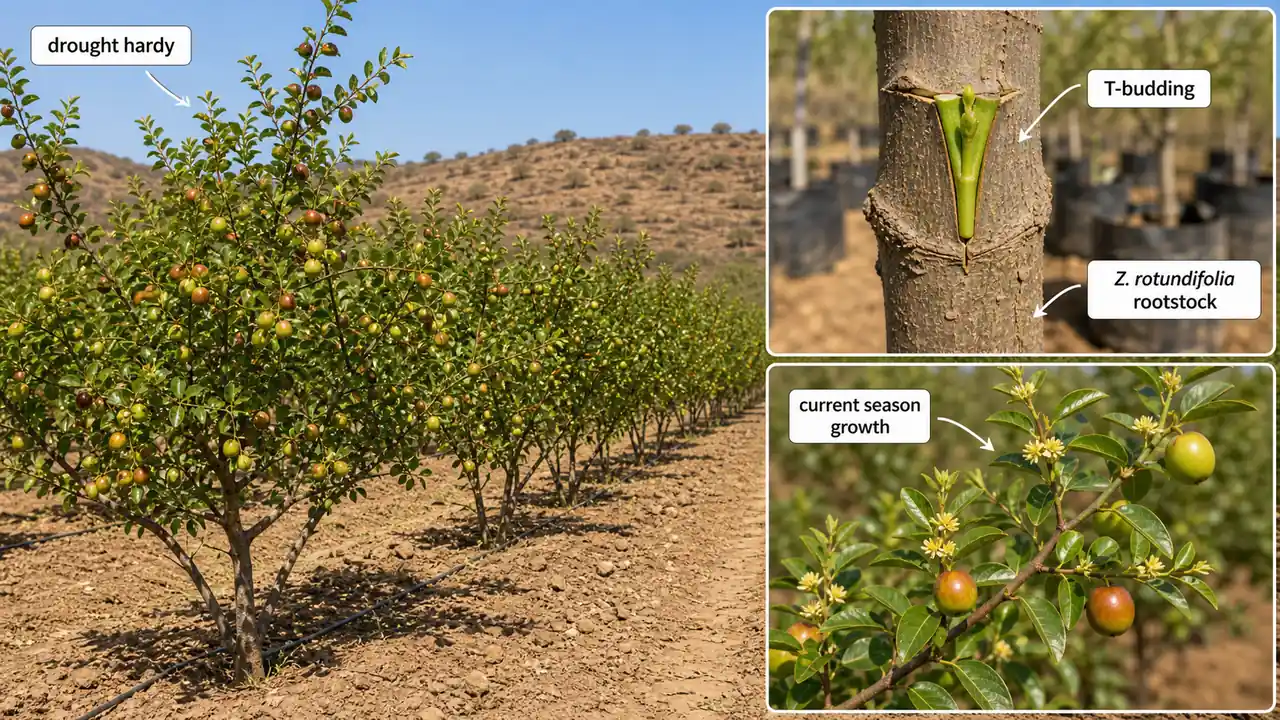
- Most drought-hardy fruit crop — thrives in arid and semi-arid regions
- Also called King of Arid Fruits
- Leading states: Rajasthan, Gujarat, Haryana, Maharashtra
- Propagation: Budding (T-budding or Shield budding) on Z. rotundifolia rootstock
- Rootstock: Ziziphus rotundifolia — drought resistant
- Flowers on current season's growth — pruning is essential
- Cross-pollinated crop (entomophilous)
Important Varieties
| Variety | Key Feature |
|---|---|
| Umran | Largest fruit, most popular, late maturing |
| Gola | Round shape, early maturing, good quality |
| Seb | Apple-shaped, very large |
| Mundia | Medium size, good quality |
| Kaithali | Oblong shape |
| Thar Sevika | CAZRI release for arid zone |
IMPORTANT
Powdery Mildew (Oidium sp.) is the most serious disease of ber. Spray wettable sulphur 0.2% or Karathane 0.1% at the onset of disease.
Comparison Table: Tropical & Subtropical Fruits
Quick Comparison — All Tropical & Subtropical Fruits
| Feature | Guava | Litchi | Pineapple | Sapota | Pomegranate | Jackfruit | Ber |
|---|---|---|---|---|---|---|---|
| Family | Myrtaceae | Sapindaceae | Bromeliaceae | Sapotaceae | Punicaceae | Moraceae | Rhamnaceae |
| Origin | Tropical America | Southern China | Brazil | Mexico | Iran | Western Ghats | Indo-Burma |
| Leading State | U.P. | Bihar | Meghalaya | Karnataka | Maharashtra | Kerala | Rajasthan |
| Fruit Type | Berry | Nut-like drupe | Sorosis | Berry | Balausta | Sorosis | Drupe |
| Propagation | Air layering | Air layering | Suckers/Slips | Inarching | Hardwood cuttings | Seeds | T-budding |
| Key Variety | Allahabad Safeda | Shahi | Kew | Kalipatti | Bhagwa | — | Umran |
| Special Feature | Richest Vit C source | SG 1.05 maturity | Only monocot fruit | Chicle source | Balausta fruit | Largest tree fruit | Most drought-hardy |
| Major Disease | Wilt (Fusarium) | Fruit cracking | Heart Rot | Leaf spot | Bacterial blight | Soft rot | Powdery mildew |
| Major Pest | Fruit fly | Litchi mite | Mealy bug | Leaf webber | Anar butterfly | Shoot borer | Fruit fly |
Summary Cheat Sheet
| Concept / Topic | Key Details / Explanation |
|---|---|
| Guava overview | Psidium guajava of Myrtaceae originated in tropical America or Mexico, is called apple of the tropics or poor man's apple, and is noted as the richest vitamin C fruit plus an important pectin source. |
| Guava production and management | Uttar Pradesh leads production, Allahabad is famous for quality, propagation is mainly by air layering or stooling, meadow orcharding is used, and rainy-season crop is regulated with 10% or 20% urea to favour the better winter crop. |
| Guava key exam points | Important varieties are Allahabad Safeda, Lucknow-49, Lalit, Arka Mridula, Behat Coconut, Allahabad Surkha, Chittidar, and Hafsi; guava wilt is caused by Fusarium oxysporum f.sp. psidii and fruit fly is the major pest. |
| Litchi overview | Litchi chinensis of Sapindaceae originated in southern China, Bihar is the top producer with Muzaffarpur as the litchi belt, the edible part is the aril, and commercial propagation is by air layering or gootee. |
| Litchi key exam points | It is non-climacteric, maturity is judged by specific gravity 1.05, and fruit cracking is a major problem managed with irrigation plus borax 0.4%; varieties include Shahi, China, Bombai, Rose Scented, Calcuttia, Purbi, and Dehradun. |
Summary Continued
| Concept / Topic | Key Details / Explanation |
|---|---|
| Pineapple overview | Ananas comosus of Bromeliaceae originated in Brazil, is the only monocot commercial fruit crop, bears a sorosis fruit, and is propagated mainly through suckers, slips, and crowns. |
| Pineapple key exam points | Leading states include Meghalaya, Assam, Kerala, and Manipur; bromelin is the important enzyme, ethrel 100 ppm induces uniform flowering, it is a CAM plant, and Kew, Queen, and Mauritius are key varieties. |
| Pineapple disorders and pest | Heart rot is caused by Phytophthora parasitica, mealy bug spreads wilt, and the crop prefers acidic soils with partial shade, making it suitable for intercropping under coconut, arecanut, or rubber. |
| Sapota overview | Manilkara zapota of Sapotaceae originated in Mexico and Central America, yields chicle from latex, uses pericarp as edible part, and is commonly propagated by inarching or softwood grafting on khirni rootstock. |
Summary Continued
| Concept / Topic | Key Details / Explanation |
|---|---|
| Sapota key exam points | Karnataka, Gujarat, and Maharashtra are major states; the tree is evergreen and bears year-round; important varieties are Kalipatti, Cricket Ball, PKM-1, Pilipatti, DSH-2, CO-1, and CO-2. |
| Pomegranate overview | Punica granatum of Punicaceae or Lythraceae originated in Iran, has balausta fruit with edible arils, Maharashtra leads production, and propagation is mainly by hardwood cuttings. |
| Pomegranate key exam points | India is the largest producer, Mrig bahar is preferred commercially, varieties include Bhagwa, Ganesh, Mridula, Arakta, Ruby, and Super Bhagwa, bacterial blight is the major disease, and anar butterfly is the major pest. |
| Jackfruit overview | Artocarpus heterophyllus of Moraceae originated in the Western Ghats, is the largest tree-borne fruit, bears sorosis fruit, and is grown for both ripe dessert use and raw vegetable use. |
| Jackfruit key exam points | Kerala treats it as state fruit, Bangladesh and Sri Lanka use it as national fruit, propagation is mainly by seeds though softwood and epicotyl grafting are also noted, and the main market types are Koozha and Varikka. |
| Ber overview | Ziziphus mauritiana of Rhamnaceae originated in the Indo-Burma region, is the king of arid fruits, and is known as the most drought-hardy fruit crop. |
| Ber key exam points | Rajasthan is the leading belt, propagation is by T-budding or shield budding on Ziziphus rotundifolia, flowering occurs on current season growth so pruning is essential, and Umran, Gola, Seb, Mundia, Kaithali, and Thar Sevika are important varieties. |
| Ber disease and comparison memory | Powdery mildew is the major disease of ber and is managed with wettable sulphur 0.2% or Karathane 0.1%; for quick comparison, remember guava for vitamin C, litchi for aril and SG 1.05, pineapple for monocot sorosis, sapota for chicle, pomegranate for balausta, jackfruit for largest tree-borne fruit, and ber for drought hardiness. |
Lesson Doubts
Ask questions, get expert answers