🎨Cultivation Practices
Location, Site, Lay out, System of planting, Training, Nurseries
Location and Site selection of orchard
Location
👉🏻 Refers to geography of the field in relation to city, highway, town etc. Location is primarily about accessibility and market proximity. An orchard located near a highway or city has advantages in terms of transportation, labour availability, and access to markets, which directly affects profitability.
Site of orchard
- Place in relation to topography, altitude, water body and other factor which affect tree beavering. Unlike location, site refers to the micro-environmental conditions that directly influence the health and productivity of the fruit trees.
- Factors affecting selection of site:
- Land slope: Should not be more than 5%. If slope more than 15% unsuitable for orchard. Gentle slopes (up to 5%) are ideal because they allow adequate drainage without causing soil erosion. Steep slopes make mechanized operations difficult and increase the risk of soil and nutrient loss.
- Direction of slope: Southern slope receives more sunshine hence produce early flowering so, early crop can be taken. In the Northern Hemisphere, a south-facing slope gets maximum sunlight exposure, which warms the soil earlier in spring and promotes early growth. Conversely, north-facing slopes are cooler and may delay flowering.
- Soil fertility:
- High fertility requiring crops: Mango, Citrus, Grape. These crops have high nutrient demands and perform best in rich, well-drained soils with good organic matter content.
- Poor fertile crops: Phalsa, Aonla. These hardy crops can produce satisfactory yields even in marginal soils with lower fertility, making them suitable for less productive lands.
- Soil texture:
- Light texture for papaya and Ber. Sandy or light-textured soils provide excellent drainage, which is essential for crops like papaya that are very susceptible to waterlogging. Ber, being a drought-hardy crop, also thrives in such conditions.
Lay out of orchard
- It includes system of planting and planting distance. The layout determines how trees are arranged in the orchard, which affects sunlight interception, air circulation, ease of cultural operations, and ultimately the yield and quality of the fruit crop.
System of planting
Square system
- Simplest and widely adopted/popular method. It is preferred by most growers due to its ease of layout and simplicity in carrying out intercultural operations.
- In this method R x R and P x P distances are kept
similar. This means the spacing between rows equals the spacing between plants within a row. - The plants are planted exactly at
right angleat each corner. Each tree occupies the corner of a square. - Number of plants/ha = 10,000 m2/x2
- Where, x2 = R x R/P x P
Rectangular system
More plantscan be planted as compare to square system. The rectangular system accommodates more trees per unit area because the spacing is optimized differently.- Keeping more space between row to row and plant to plant distance is kept comparatively less. The wider row spacing allows for easy movement of machinery and implements, while the closer plant spacing maximizes the number of trees.
- Number of plants = 10,000 m2/X x Y.
Hexagonal or Equilateral Triangle System

Quincunx system/diagonal/filler system

Contour (Terrace) system

Triangular system
- In this system, trees are planted as in the square system but the plants in the 2nd, 4th, 6th and such other alternate rows are planted midway between the 1st, 3rd, 5th and such other alternative rows. This system provides more open space for the trees and for intercrop. The staggered arrangement ensures better light penetration and air movement between trees.
- It is mostly used in
HDP(High Density Planting). HDP is an increasingly popular approach that maximizes yield per unit area by planting more trees using dwarf rootstocks or compact varieties. - E.g. Amrapali variety of mango. Amrapali is a naturally dwarf and regular-bearing hybrid (Dashehari x Neelum) that is ideally suited for HDP systems.
Intercropping
- Suitable plants for intercrops in orchard: | Main crop | Intercrop | |---|---| | Mango | Papaya, Garlic | | Coconut | Banana |
Intercropping in orchards involves growing short-duration crops (vegetables, pulses, or other plants) between the rows of fruit trees during their early non-bearing years. This practice provides additional income, improves soil health, controls weeds, and makes efficient use of available land, sunlight, and water. However, tall-growing crops that compete with fruit trees for light and nutrients should be avoided.
Pruning
- Removal of any excess or undesirable/ unproductive branches, shoots or any other parts of plants so as to allow the remaining part to grow normally or according to desire of pruner is called pruning. NABARD 2021 Pruning is one of the most important cultural practices in fruit crop management and is essential for maintaining tree health and productivity.
- It improves the shape of plant, influences the growth behavior, flowering time and fruitfulness, besides improving the quality of fruit. Well-pruned trees receive better sunlight and air circulation, which leads to higher quality fruits with better colour and size.
- Pruning is started in later part of plant life when becomes produce fruits and flowers. It is primarily a practice for mature, bearing trees rather than young trees.
- Pruning time in north India:
April – May. This timing coincides with the end of the dormant period when new growth is about to begin, allowing pruning wounds to heal quickly.
Method of pruning
Thinning Out
- This refers to the removal of the branches entirely from its base leaving no stubs. Thinning out opens up the canopy, allowing more sunlight and air to reach the interior of the tree. It does not stimulate vigorous regrowth at the point of the cut.
Does not give strength to the tree — it simply removes branches without promoting new structural growth.- No re-growth is allowed at the point of removal.

Heading Back
- This refers to pruning or cutting of terminal part of main stem or all or few of the branches leaving a basal portion. Unlike thinning out, heading back stimulates the growth of lateral buds below the cut, resulting in a denser, more compact canopy.
- This method is often followed for hedges, ornamental shrubs, first dormant pruning and October pruning in grapes.
- Only tops of branches are headed back or cut off (light pruning).
Encourages lateral growth .

Dehorning
Cutting away the main limbs or thick major branches of a tree.- It is done to remove overcrowding and intermingling of branches.
- Also done to
induce flowering in unproductive trees.
Bulk Pruning
Heavy pruning all over the tree .- For good fruit production, only judicious heading back or thinning out should be done — bulk pruning is generally avoided as it weakens the tree.
Skeletonizing
- An extreme form of pruning where almost all the branches are removed, leaving only the main scaffold or skeleton of the tree.
- Used for
rejuvenation of old, unproductive trees to promote entirely new growth.
Ringing/ Girdling
- In this method a circular ring measuring about 3 cm in length is removed to hasten bearing by allowing greater accumulation of photosynthesis in upward portion of the plant. Ringing works by interrupting the downward flow of photosynthates (sugars produced by leaves) through the phloem, causing them to accumulate above the ring. This accumulation promotes flower bud formation and fruit set.

Notching

Disbudding or Rubbing off
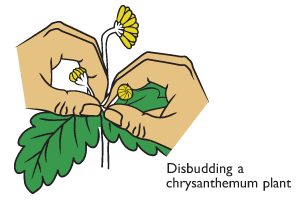
Pinching and Topping
- This refers to the removal of the tip of the shoot alone with a view to stimulate mildly the lateral growth. Pinching is a mild form of pruning that breaks apical dominance, encouraging the plant to branch out and become bushier.
- This is practiced regularly in coffee to remove the apical dominance and to allow the side brandies to grow vigouresely. In coffee, this practice ensures a wider, more spreading canopy that produces more fruiting branches.
- E.g. Deshi cotton.

Top Working
- It is a technique or method of rejuvenation where in the objective is to upgrade seedling plantations of inferior varieties with superior commercial cultivars or hybrids suitable for domestic or export market or the desired variety of the grower. Eg Cashew tree. Top working is essentially a way to convert an existing, less profitable tree into a high-value one without uprooting and replanting.
- The technique involves
graftingwith procured scions of desired variety on shoots emerged on pruned branches by adoptingTongue graftingduring monsoon season. (Season of top working slightly varies from species as it also depends on availability of good shoot and scions). The existing tree provides a well-established root system, enabling the grafted variety to come into bearing much faster than a newly planted tree. - The scion shoots and the emerged shoots should be of same thickness. Matching the diameter of the scion and rootstock shoot is critical for successful cambial alignment and graft union formation.

Types of Pruning
👉🏻 Pruning can be divided into two based on the seasons in which it is done:
Dormant Pruning
- Most often done during the
winter- commonly referred to as dormant pruning. During winter, trees are in a resting state with no active growth, making it the ideal time for major pruning operations. - Dormant pruning is an invigorating (enerziging) process. When a tree is pruned during dormancy, the stored carbohydrate reserves in the roots are distributed among fewer buds and branches, resulting in more vigorous growth in the following spring.
- Heavy dormant pruning also promotes excessive vegetative vigor. This can be a problem if the goal is to promote fruiting rather than vegetative growth, so the extent of dormant pruning must be carefully managed.
- Timing of dormant pruning is critical. Pruning should begin as late in the winter as possible to avoid winter injury. Pruning too early in winter exposes fresh cuts to severe cold, which can damage tissues and invite disease.
Summer Pruning
- Done during
summers- referred to as summer pruning. Summer pruning is used for fine-tuning the tree canopy rather than major structural changes. - It’s severity is much less, less common, more specific and selective. Only targeted branches and shoots are removed, making it a more precise operation.
- Eliminates an energy or food producing portion of the tree and results in reduced tree growth. Since leaves are actively photosynthesizing during summer, removing them reduces the tree’s ability to produce food, leading to a dwarfing effect.
- For most purposes, summer pruning should be limited to removing the upright and vigorous current season’s growth; only thin cuts should be used. Upright, vigorous shoots (called water sprouts or suckers) are unproductive and shade the interior canopy, so removing them improves light distribution.
- To minimize the potential for winter injury, summer pruning should not be done after the end of July. Late summer pruning can stimulate new tender growth that does not have time to harden off before winter, making it vulnerable to frost damage.
Pruning based on height
| Pruning Type | Height |
|---|---|
| Low Head Pruning | 0.7 m - 0.9 m |
| Medium Head Pruning | 0.9 m - 1.2 m |
| High Head Pruning | More than 1.2 m |
Technique of training and their timings

Training
- Training is a practice in which tree
growth is directed into a desired shape and form. Unlike pruning (which is corrective), training is a proactive practice that guides the tree’s structural development from the beginning. - Judicious removal of plant parts to develop a proper shape of plant capable of bearing heavy crop load. A well-trained tree has a strong framework that can support the weight of a full crop without branch breakage.
- It is done from earlier part of plant life. Training begins soon after planting and continues for the first few years until the desired tree architecture is established.
- It determines the general character and even details of the plants outline and of its branching and framework. The scaffold branches established during training form the permanent structure of the tree for its entire productive life.
Objectives of Training
- To admit more sunlight and air to the centre of the tree and to expose maximum leaf surface to the sunlight. Good light distribution is essential for uniform fruit colour, ripening, and quality.
- To direct the growth of the tree so that various cultural operations, such as spraying, and harvesting are performed at the lowest cost. A properly trained tree enables efficient orchard management and reduces labour costs.
- To protect the tree from sunburn and wind damage. The arrangement of branches can provide shade to the trunk and scaffold limbs, preventing sunscald.
- To secure a balanced distribution of fruit-bearing parts on the main limbs of the plant. This ensures uniform fruiting throughout the canopy and prevents overloading on any single branch.
Principle of Training
- The principle objective in training a young tree is to develop strong framework of scaffold branches. Scaffold branches are the main structural limbs that arise from the trunk and form the tree’s permanent framework. Their angle of attachment, spacing, and distribution are critical.
- All methods of training must stand or fall by their ability to achieve a tree capable of bearing high yielding fruits without undue breakage. A well-trained tree should have branches with wide crotch angles (45-60 degrees from the trunk) for maximum strength.
Types of Training Systems

Central Leader System
- Main trunk extends from the soil surface to the total height of the tree. In this system, the central trunk (leader) is maintained as the dominant vertical axis throughout the life of the tree.
- Several side branches grow at different heights in various directions. They are usually lower in vigour and productivity. These side branches are subordinate to the central leader, creating a pyramidal or Christmas-tree-like shape.
- This system of training is adopted such types of trees which have a pronounced apical dominance. Trees with strong apical dominance naturally tend to grow in this form, making the system easier to implement.
- On account of vigorous and rapid growth of the main trunk the tree develops a close center and grows to great heights. The strong central leader enables the tree to grow very tall, which can be both an advantage (structural strength) and a disadvantage (difficulty in management).
- Since the plants would be very tall, the spraying and harvesting operation becomes difficult and costly e.g. pear and some varieties of apple.
✅ Advantages
- Such trees are structurally best suited to bear crop load and to resist the damage from strong winds. The central trunk acts as a strong supporting pillar, distributing the weight of the crop evenly.
❌ Disadvantages
- Trees under this system grow too tall and are less spreading.
- Tree management (spraying, pruning, thinning and harvesting) is difficult.
- This method not suitable for high altitude and hot arid places where wind velocity is high.
- Shading effect on interior canopy (the lower branches of such trees may be so much in shade that the fruit may not be able to develop proper colour). This is a significant problem for crops where fruit colour is an important quality parameter.
Open Centre System
- In this system, the main trunk (main stem) is allowed to grow only up to a certain height (upto 1 m) by cutting within a year of planting and all the subsequent vegetative growth promoted by lateral branches. This creates a vase-shaped or bowl-shaped tree with an open centre that allows maximum light to reach all parts of the canopy.
- This results in a low head and as such the bulk of crop is borne closer to the ground. The low-growing nature of the tree makes all orchard operations significantly easier.
✅ Advantages
- The trees so trained allow maximum sunshine to reach their branches. The open centre ensures that sunlight penetrates deep into the canopy.
- Better coloration of fruits on the interior side of the tree. Since light reaches all parts of the tree, fruits develop uniform and attractive colour.
- Trees are more fruitful and low spreading tree greatly facilitate operations like spraying, pruning, thinning and harvesting. The reduced height translates to lower labour costs and safer working conditions.
❌ Disadvantages
- Such trees are structurally weak, and their limbs are more likely to break with crop load and strong winds. Without a central leader, the branches lack a strong central support, making them prone to splitting, especially at narrow crotch angles.
- Not suitable for frost prone area. The open canopy exposes the tree to cold air settling into the centre, increasing the risk of frost damage.
- This system does not only need severe pruning to start with but also constant effort to maintain its form through drastic pruning treatment.
Modified Leader System
- This system stands intermediate between the central leader and the open center, combining the advantages of both the system. It is often considered the best compromise between structural strength and ease of management.
- It is developed first by training the tree to the leader type allowing the central stem to grow unsharpened for first four to five years. During these initial years, the tree develops a strong trunk and well-spaced scaffold branches.
- The main branches are allowed to arise on the main stem at reasonable intervals. After the required number of branches has arisen the main stem is cut off. By removing the central leader after sufficient scaffold branches are established, the tree transitions to a spreading form with good structural integrity.
- Most widely adopted method for fruit crops. Its balance of strength, productivity, and ease of management makes it the preferred training system for most commercial orchards.
- The top laterals will take the place of the main stem. The result in a fairly strong and moderately spreading type of tress. E.g. Pear, Apple, Walnuts, etc.
✅ Advantages
- The branches are well distributed, allowing plenty of sunshine to reach the interior of the tree.
- The trees are structurally strong and not prone to limb breakage. The well-spaced scaffold branches with wide crotch angles provide excellent strength.
- This is most acceptable for commercial fruit production. It offers the best balance of high yield, good fruit quality, and manageable tree size.
Tools
Secateur

Hedge Shear

Bill Hook

Grafting Knife

The grafting knife is a specialized tool with a sharp, thin blade designed for making precise cuts during grafting and budding operations. A clean, smooth cut is essential for successful graft union formation.
Trowel

A trowel is a small hand tool used for digging, planting, and transplanting seedlings. It is an essential tool in nursery work and kitchen gardening.
Nurseries
👉🏻 Nursery is place where young crop plants are raised under intensive care for later transplanting to the field. A well-managed nursery is the foundation of successful horticulture, as the quality of planting material directly determines the performance of the orchard.
Classification
- On the basis of irrigation facilities
- Dry Nursery — Relies on rainfall for irrigation; suitable for hardy species in regions with adequate rainfall.
- We Nursery — Has organized irrigation facilities; more suitable for raising quality planting material.
- Temporary Nursery: Flying Nursery — Established for a specific, short-term purpose and is dismantled after the planting material has been raised and distributed.
- Permanent Nursery — A well-established nursery with permanent infrastructure that operates year after year, continuously producing planting material.
- On the basis of size of production
- Commercial Nursery — Operates on a large scale for commercial sale of plants to growers and the general public.
- Small Scale Nursery — Produces plants on a limited scale, often for personal use or local distribution.
- On the basis of kind of plant material raised
- Fruit nursery — Specializes in raising fruit tree saplings, grafts, and budded plants.
- Vegetable nursery — Raises vegetable seedlings for transplanting.
- Flowering plant nursery — Produces ornamental and flowering plants.
- Forest Nursery — Raises forest tree seedlings for afforestation and reforestation programmes.
- Irrigation Methods in Nursery
- Flow or flood irrigation
- Furrow irrigation
- Overhead irrigation
- Rose canes
- Automizer
- Sprinkler System
The choice of irrigation method depends on the type of plants being raised, the nursery size, and the available water supply. Overhead irrigation and sprinkler systems are preferred in modern nurseries as they provide uniform water distribution and can be used for applying foliar nutrients and pesticides as well.
- Water
- The water for nursery should have pH between 5.5 to 7.5 and contain salt less than 400 ppm. Water quality is critical in nursery management — alkaline or saline water can damage tender seedlings and affect root development.
- Amount of water required for raising one lakh plants in dry areas during summer is 20-30 cc/plant/day and during winter is 10 cc/plant/day. The water requirement is lower in winter due to reduced evapotranspiration and lower temperatures.
Orchard Establishment Decision Guide
Key decisions when establishing a fruit orchard:
| Decision | Options | How to Choose |
|---|---|---|
| Layout system | Square, rectangular, hexagonal, contour, quincunx | Square = simplest, suits flat land. Hexagonal = 15% more trees/area. Contour = hilly terrain. Quincunx = filler trees between permanent trees for early income |
| Spacing | Varies by crop and vigour | Mango: 10×10m. Citrus: 6×6m. Guava: 6×6m. Banana: 1.8×1.8m. Wider for vigorous rootstocks |
| Filler crops | Short-duration fruit or vegetable crops between young trees | Papaya, guava, or vegetables as fillers until main crop (mango) starts bearing at 5-7 years. Provides early income from same land |
| Training system | Open centre, modified leader, espalier | Open centre for mango/guava (light penetration). Modified leader for apple/pear. Choice affects light, spray access, and yield |
| Irrigation | Basin, drip, micro-sprinkler | Drip saves 40-60% water; ideal for fruit crops with wide spacing. Basin for flood-irrigated areas |
Economics of filler crops: A mango orchard takes 5-7 years to bear fruit. Without filler crops, the farmer earns nothing from the land for years. By planting papaya as filler (bears in 10-12 months), the farmer earns ₹1-2 lakh/acre/year while waiting for mango to establish.
Summary Cheat Sheet
| Concept / Topic | Key Details |
|---|---|
| Orchard | Systematic plantation of fruit trees |
| Site selection | Well-drained soil, water availability, market access |
| Layout systems | Square, rectangular, triangular, hexagonal, contour |
| Square system | Most common; easy for intercultural operations |
| Hexagonal / Quincunx | 15% more trees than square; denser planting |
| Triangular | Trees at triangle corners; for slopes |
| Contour | For hilly terrain; follows contour lines |
| Training | Directing tree growth; strong framework |
| Central leader | One main trunk; used in apple, pear |
| Modified leader | Leader cut at 4–5 branches; most common system |
| Open centre / Vase | No central leader; cup-shaped; peach, plum |
| Pruning | Removal of plant parts for shape, productivity, health |
| Heading back | Cutting terminal portion of branch |
| Thinning out | Removing entire branch at base |
| Filler trees | Temporary trees planted between permanent ones |
| Windbreak | Trees planted around orchard to protect from wind |
Pro Content Locked
Upgrade to Pro to access this lesson and all other premium content.
₹2388 billed yearly
- All Agriculture & Banking Courses
- AI Lesson Questions (100/day)
- AI Doubt Solver (50/day)
- Glows & Grows Feedback (30/day)
- AI Section Quiz (20/day)
- 22-Language Translation (30/day)
- Recall Questions (20/day)
- AI Quiz (15/day)
- AI Quiz Paper Analysis
- AI Step-by-Step Explanations
- Spaced Repetition Recall (FSRS)
- AI Tutor
- Immersive Text Questions
- Audio Lessons — Hindi & English
- Mock Tests & Previous Year Papers
- Summary & Mind Maps
- XP, Levels, Leaderboard & Badges
- Generate New Classrooms
- Voice AI Teacher (AgriDots Live)
- AI Revision Assistant
- Knowledge Gap Analysis
- Interactive Revision (LangGraph)
🔒 Secure via Razorpay · Cancel anytime · No hidden fees
Location and Site selection of orchard
Location
👉🏻 Refers to geography of the field in relation to city, highway, town etc. Location is primarily about accessibility and market proximity. An orchard located near a highway or city has advantages in terms of transportation, labour availability, and access to markets, which directly affects profitability.
Site of orchard
- Place in relation to topography, altitude, water body and other factor which affect tree beavering. Unlike location, site refers to the micro-environmental conditions that directly influence the health and productivity of the fruit trees.
- Factors affecting selection of site:
- Land slope: Should not be more than 5%. If slope more than 15% unsuitable for orchard. Gentle slopes (up to 5%) are ideal because they allow adequate drainage without causing soil erosion. Steep slopes make mechanized operations difficult and increase the risk of soil and nutrient loss.
- Direction of slope: Southern slope receives more sunshine hence produce early flowering so, early crop can be taken. In the Northern Hemisphere, a south-facing slope gets maximum sunlight exposure, which warms the soil earlier in spring and promotes early growth. Conversely, north-facing slopes are cooler and may delay flowering.
- Soil fertility:
- High fertility requiring crops: Mango, Citrus, Grape. These crops have high nutrient demands and perform best in rich, well-drained soils with good organic matter content.
- Poor fertile crops: Phalsa, Aonla. These hardy crops can produce satisfactory yields even in marginal soils with lower fertility, making them suitable for less productive lands.
- Soil texture:
- Light texture for papaya and Ber. Sandy or light-textured soils provide excellent drainage, which is essential for crops like papaya that are very susceptible to waterlogging. Ber, being a drought-hardy crop, also thrives in such conditions.
Lay out of orchard
- It includes system of planting and planting distance. The layout determines how trees are arranged in the orchard, which affects sunlight interception, air circulation, ease of cultural operations, and ultimately the yield and quality of the fruit crop.
System of planting
Square system
- Simplest and widely adopted/popular method. It is preferred by most growers due to its ease of layout and simplicity in carrying out intercultural operations.
- In this method R x R and P x P distances are kept
similar. This means the spacing between rows equals the spacing between plants within a row. - The plants are planted exactly at
right angleat each corner. Each tree occupies the corner of a square. - Number of plants/ha = 10,000 m2/x2
- Where, x2 = R x R/P x P
Rectangular system
More plantscan be planted as compare to square system. The rectangular system accommodates more trees per unit area because the spacing is optimized differently.- Keeping more space between row to row and plant to plant distance is kept comparatively less. The wider row spacing allows for easy movement of machinery and implements, while the closer plant spacing maximizes the number of trees.
- Number of plants = 10,000 m2/X x Y.
Hexagonal or Equilateral Triangle System
Quincunx system/diagonal/filler system
Contour (Terrace) system
Triangular system
- In this system, trees are planted as in the square system but the plants in the 2nd, 4th, 6th and such other alternate rows are planted midway between the 1st, 3rd, 5th and such other alternative rows. This system provides more open space for the trees and for intercrop. The staggered arrangement ensures better light penetration and air movement between trees.
- It is mostly used in
HDP(High Density Planting). HDP is an increasingly popular approach that maximizes yield per unit area by planting more trees using dwarf rootstocks or compact varieties. - E.g. Amrapali variety of mango. Amrapali is a naturally dwarf and regular-bearing hybrid (Dashehari x Neelum) that is ideally suited for HDP systems.
Intercropping
- Suitable plants for intercrops in orchard: | Main crop | Intercrop | |---|---| | Mango | Papaya, Garlic | | Coconut | Banana |
Intercropping in orchards involves growing short-duration crops (vegetables, pulses, or other plants) between the rows of fruit trees during their early non-bearing years. This practice provides additional income, improves soil health, controls weeds, and makes efficient use of available land, sunlight, and water. However, tall-growing crops that compete with fruit trees for light and nutrients should be avoided.
Pruning
- Removal of any excess or undesirable/ unproductive branches, shoots or any other parts of plants so as to allow the remaining part to grow normally or according to desire of pruner is called pruning. NABARD 2021 Pruning is one of the most important cultural practices in fruit crop management and is essential for maintaining tree health and productivity.
- It improves the shape of plant, influences the growth behavior, flowering time and fruitfulness, besides improving the quality of fruit. Well-pruned trees receive better sunlight and air circulation, which leads to higher quality fruits with better colour and size.
- Pruning is started in later part of plant life when becomes produce fruits and flowers. It is primarily a practice for mature, bearing trees rather than young trees.
- Pruning time in north India:
April – May. This timing coincides with the end of the dormant period when new growth is about to begin, allowing pruning wounds to heal quickly.
Method of pruning
Thinning Out
- This refers to the removal of the branches entirely from its base leaving no stubs. Thinning out opens up the canopy, allowing more sunlight and air to reach the interior of the tree. It does not stimulate vigorous regrowth at the point of the cut.
Does not give strength to the tree — it simply removes branches without promoting new structural growth.- No re-growth is allowed at the point of removal.
Heading Back
- This refers to pruning or cutting of terminal part of main stem or all or few of the branches leaving a basal portion. Unlike thinning out, heading back stimulates the growth of lateral buds below the cut, resulting in a denser, more compact canopy.
- This method is often followed for hedges, ornamental shrubs, first dormant pruning and October pruning in grapes.
- Only tops of branches are headed back or cut off (light pruning).
Encourages lateral growth .
Dehorning
Cutting away the main limbs or thick major branches of a tree.- It is done to remove overcrowding and intermingling of branches.
- Also done to
induce flowering in unproductive trees.
Bulk Pruning
Heavy pruning all over the tree .- For good fruit production, only judicious heading back or thinning out should be done — bulk pruning is generally avoided as it weakens the tree.
Skeletonizing
- An extreme form of pruning where almost all the branches are removed, leaving only the main scaffold or skeleton of the tree.
- Used for
rejuvenation of old, unproductive trees to promote entirely new growth.
Ringing/ Girdling
- In this method a circular ring measuring about 3 cm in length is removed to hasten bearing by allowing greater accumulation of photosynthesis in upward portion of the plant. Ringing works by interrupting the downward flow of photosynthates (sugars produced by leaves) through the phloem, causing them to accumulate above the ring. This accumulation promotes flower bud formation and fruit set.
Notching
Disbudding or Rubbing off
Pinching and Topping
- This refers to the removal of the tip of the shoot alone with a view to stimulate mildly the lateral growth. Pinching is a mild form of pruning that breaks apical dominance, encouraging the plant to branch out and become bushier.
- This is practiced regularly in coffee to remove the apical dominance and to allow the side brandies to grow vigouresely. In coffee, this practice ensures a wider, more spreading canopy that produces more fruiting branches.
- E.g. Deshi cotton.
Top Working
- It is a technique or method of rejuvenation where in the objective is to upgrade seedling plantations of inferior varieties with superior commercial cultivars or hybrids suitable for domestic or export market or the desired variety of the grower. Eg Cashew tree. Top working is essentially a way to convert an existing, less profitable tree into a high-value one without uprooting and replanting.
- The technique involves
graftingwith procured scions of desired variety on shoots emerged on pruned branches by adoptingTongue graftingduring monsoon season. (Season of top working slightly varies from species as it also depends on availability of good shoot and scions). The existing tree provides a well-established root system, enabling the grafted variety to come into bearing much faster than a newly planted tree. - The scion shoots and the emerged shoots should be of same thickness. Matching the diameter of the scion and rootstock shoot is critical for successful cambial alignment and graft union formation.
Types of Pruning
👉🏻 Pruning can be divided into two based on the seasons in which it is done:
Dormant Pruning
- Most often done during the
winter- commonly referred to as dormant pruning. During winter, trees are in a resting state with no active growth, making it the ideal time for major pruning operations. - Dormant pruning is an invigorating (enerziging) process. When a tree is pruned during dormancy, the stored carbohydrate reserves in the roots are distributed among fewer buds and branches, resulting in more vigorous growth in the following spring.
- Heavy dormant pruning also promotes excessive vegetative vigor. This can be a problem if the goal is to promote fruiting rather than vegetative growth, so the extent of dormant pruning must be carefully managed.
- Timing of dormant pruning is critical. Pruning should begin as late in the winter as possible to avoid winter injury. Pruning too early in winter exposes fresh cuts to severe cold, which can damage tissues and invite disease.
Summer Pruning
- Done during
summers- referred to as summer pruning. Summer pruning is used for fine-tuning the tree canopy rather than major structural changes. - It’s severity is much less, less common, more specific and selective. Only targeted branches and shoots are removed, making it a more precise operation.
- Eliminates an energy or food producing portion of the tree and results in reduced tree growth. Since leaves are actively photosynthesizing during summer, removing them reduces the tree’s ability to produce food, leading to a dwarfing effect.
- For most purposes, summer pruning should be limited to removing the upright and vigorous current season’s growth; only thin cuts should be used. Upright, vigorous shoots (called water sprouts or suckers) are unproductive and shade the interior canopy, so removing them improves light distribution.
- To minimize the potential for winter injury, summer pruning should not be done after the end of July. Late summer pruning can stimulate new tender growth that does not have time to harden off before winter, making it vulnerable to frost damage.
Pruning based on height
| Pruning Type | Height |
|---|---|
| Low Head Pruning | 0.7 m - 0.9 m |
| Medium Head Pruning | 0.9 m - 1.2 m |
| High Head Pruning | More than 1.2 m |
Technique of training and their timings
Training
- Training is a practice in which tree
growth is directed into a desired shape and form. Unlike pruning (which is corrective), training is a proactive practice that guides the tree’s structural development from the beginning. - Judicious removal of plant parts to develop a proper shape of plant capable of bearing heavy crop load. A well-trained tree has a strong framework that can support the weight of a full crop without branch breakage.
- It is done from earlier part of plant life. Training begins soon after planting and continues for the first few years until the desired tree architecture is established.
- It determines the general character and even details of the plants outline and of its branching and framework. The scaffold branches established during training form the permanent structure of the tree for its entire productive life.
Objectives of Training
- To admit more sunlight and air to the centre of the tree and to expose maximum leaf surface to the sunlight. Good light distribution is essential for uniform fruit colour, ripening, and quality.
- To direct the growth of the tree so that various cultural operations, such as spraying, and harvesting are performed at the lowest cost. A properly trained tree enables efficient orchard management and reduces labour costs.
- To protect the tree from sunburn and wind damage. The arrangement of branches can provide shade to the trunk and scaffold limbs, preventing sunscald.
- To secure a balanced distribution of fruit-bearing parts on the main limbs of the plant. This ensures uniform fruiting throughout the canopy and prevents overloading on any single branch.
Principle of Training
- The principle objective in training a young tree is to develop strong framework of scaffold branches. Scaffold branches are the main structural limbs that arise from the trunk and form the tree’s permanent framework. Their angle of attachment, spacing, and distribution are critical.
- All methods of training must stand or fall by their ability to achieve a tree capable of bearing high yielding fruits without undue breakage. A well-trained tree should have branches with wide crotch angles (45-60 degrees from the trunk) for maximum strength.
Types of Training Systems
Central Leader System
- Main trunk extends from the soil surface to the total height of the tree. In this system, the central trunk (leader) is maintained as the dominant vertical axis throughout the life of the tree.
- Several side branches grow at different heights in various directions. They are usually lower in vigour and productivity. These side branches are subordinate to the central leader, creating a pyramidal or Christmas-tree-like shape.
- This system of training is adopted such types of trees which have a pronounced apical dominance. Trees with strong apical dominance naturally tend to grow in this form, making the system easier to implement.
- On account of vigorous and rapid growth of the main trunk the tree develops a close center and grows to great heights. The strong central leader enables the tree to grow very tall, which can be both an advantage (structural strength) and a disadvantage (difficulty in management).
- Since the plants would be very tall, the spraying and harvesting operation becomes difficult and costly e.g. pear and some varieties of apple.
✅ Advantages
- Such trees are structurally best suited to bear crop load and to resist the damage from strong winds. The central trunk acts as a strong supporting pillar, distributing the weight of the crop evenly.
❌ Disadvantages
- Trees under this system grow too tall and are less spreading.
- Tree management (spraying, pruning, thinning and harvesting) is difficult.
- This method not suitable for high altitude and hot arid places where wind velocity is high.
- Shading effect on interior canopy (the lower branches of such trees may be so much in shade that the fruit may not be able to develop proper colour). This is a significant problem for crops where fruit colour is an important quality parameter.
Open Centre System
- In this system, the main trunk (main stem) is allowed to grow only up to a certain height (upto 1 m) by cutting within a year of planting and all the subsequent vegetative growth promoted by lateral branches. This creates a vase-shaped or bowl-shaped tree with an open centre that allows maximum light to reach all parts of the canopy.
- This results in a low head and as such the bulk of crop is borne closer to the ground. The low-growing nature of the tree makes all orchard operations significantly easier.
✅ Advantages
- The trees so trained allow maximum sunshine to reach their branches. The open centre ensures that sunlight penetrates deep into the canopy.
- Better coloration of fruits on the interior side of the tree. Since light reaches all parts of the tree, fruits develop uniform and attractive colour.
- Trees are more fruitful and low spreading tree greatly facilitate operations like spraying, pruning, thinning and harvesting. The reduced height translates to lower labour costs and safer working conditions.
❌ Disadvantages
- Such trees are structurally weak, and their limbs are more likely to break with crop load and strong winds. Without a central leader, the branches lack a strong central support, making them prone to splitting, especially at narrow crotch angles.
- Not suitable for frost prone area. The open canopy exposes the tree to cold air settling into the centre, increasing the risk of frost damage.
- This system does not only need severe pruning to start with but also constant effort to maintain its form through drastic pruning treatment.
Modified Leader System
- This system stands intermediate between the central leader and the open center, combining the advantages of both the system. It is often considered the best compromise between structural strength and ease of management.
- It is developed first by training the tree to the leader type allowing the central stem to grow unsharpened for first four to five years. During these initial years, the tree develops a strong trunk and well-spaced scaffold branches.
- The main branches are allowed to arise on the main stem at reasonable intervals. After the required number of branches has arisen the main stem is cut off. By removing the central leader after sufficient scaffold branches are established, the tree transitions to a spreading form with good structural integrity.
- Most widely adopted method for fruit crops. Its balance of strength, productivity, and ease of management makes it the preferred training system for most commercial orchards.
- The top laterals will take the place of the main stem. The result in a fairly strong and moderately spreading type of tress. E.g. Pear, Apple, Walnuts, etc.
✅ Advantages
- The branches are well distributed, allowing plenty of sunshine to reach the interior of the tree.
- The trees are structurally strong and not prone to limb breakage. The well-spaced scaffold branches with wide crotch angles provide excellent strength.
- This is most acceptable for commercial fruit production. It offers the best balance of high yield, good fruit quality, and manageable tree size.
Tools
Secateur
Hedge Shear
Bill Hook
Grafting Knife
The grafting knife is a specialized tool with a sharp, thin blade designed for making precise cuts during grafting and budding operations. A clean, smooth cut is essential for successful graft union formation.
Trowel
A trowel is a small hand tool used for digging, planting, and transplanting seedlings. It is an essential tool in nursery work and kitchen gardening.
Nurseries
👉🏻 Nursery is place where young crop plants are raised under intensive care for later transplanting to the field. A well-managed nursery is the foundation of successful horticulture, as the quality of planting material directly determines the performance of the orchard.
Classification
- On the basis of irrigation facilities
- Dry Nursery — Relies on rainfall for irrigation; suitable for hardy species in regions with adequate rainfall.
- We Nursery — Has organized irrigation facilities; more suitable for raising quality planting material.
- Temporary Nursery: Flying Nursery — Established for a specific, short-term purpose and is dismantled after the planting material has been raised and distributed.
- Permanent Nursery — A well-established nursery with permanent infrastructure that operates year after year, continuously producing planting material.
- On the basis of size of production
- Commercial Nursery — Operates on a large scale for commercial sale of plants to growers and the general public.
- Small Scale Nursery — Produces plants on a limited scale, often for personal use or local distribution.
- On the basis of kind of plant material raised
- Fruit nursery — Specializes in raising fruit tree saplings, grafts, and budded plants.
- Vegetable nursery — Raises vegetable seedlings for transplanting.
- Flowering plant nursery — Produces ornamental and flowering plants.
- Forest Nursery — Raises forest tree seedlings for afforestation and reforestation programmes.
- Irrigation Methods in Nursery
- Flow or flood irrigation
- Furrow irrigation
- Overhead irrigation
- Rose canes
- Automizer
- Sprinkler System
The choice of irrigation method depends on the type of plants being raised, the nursery size, and the available water supply. Overhead irrigation and sprinkler systems are preferred in modern nurseries as they provide uniform water distribution and can be used for applying foliar nutrients and pesticides as well.
- Water
- The water for nursery should have pH between 5.5 to 7.5 and contain salt less than 400 ppm. Water quality is critical in nursery management — alkaline or saline water can damage tender seedlings and affect root development.
- Amount of water required for raising one lakh plants in dry areas during summer is 20-30 cc/plant/day and during winter is 10 cc/plant/day. The water requirement is lower in winter due to reduced evapotranspiration and lower temperatures.
Orchard Establishment Decision Guide
Key decisions when establishing a fruit orchard:
| Decision | Options | How to Choose |
|---|---|---|
| Layout system | Square, rectangular, hexagonal, contour, quincunx | Square = simplest, suits flat land. Hexagonal = 15% more trees/area. Contour = hilly terrain. Quincunx = filler trees between permanent trees for early income |
| Spacing | Varies by crop and vigour | Mango: 10×10m. Citrus: 6×6m. Guava: 6×6m. Banana: 1.8×1.8m. Wider for vigorous rootstocks |
| Filler crops | Short-duration fruit or vegetable crops between young trees | Papaya, guava, or vegetables as fillers until main crop (mango) starts bearing at 5-7 years. Provides early income from same land |
| Training system | Open centre, modified leader, espalier | Open centre for mango/guava (light penetration). Modified leader for apple/pear. Choice affects light, spray access, and yield |
| Irrigation | Basin, drip, micro-sprinkler | Drip saves 40-60% water; ideal for fruit crops with wide spacing. Basin for flood-irrigated areas |
Economics of filler crops: A mango orchard takes 5-7 years to bear fruit. Without filler crops, the farmer earns nothing from the land for years. By planting papaya as filler (bears in 10-12 months), the farmer earns ₹1-2 lakh/acre/year while waiting for mango to establish.
Summary Cheat Sheet
| Concept / Topic | Key Details |
|---|---|
| Orchard | Systematic plantation of fruit trees |
| Site selection | Well-drained soil, water availability, market access |
| Layout systems | Square, rectangular, triangular, hexagonal, contour |
| Square system | Most common; easy for intercultural operations |
| Hexagonal / Quincunx | 15% more trees than square; denser planting |
| Triangular | Trees at triangle corners; for slopes |
| Contour | For hilly terrain; follows contour lines |
| Training | Directing tree growth; strong framework |
| Central leader | One main trunk; used in apple, pear |
| Modified leader | Leader cut at 4–5 branches; most common system |
| Open centre / Vase | No central leader; cup-shaped; peach, plum |
| Pruning | Removal of plant parts for shape, productivity, health |
| Heading back | Cutting terminal portion of branch |
| Thinning out | Removing entire branch at base |
| Filler trees | Temporary trees planted between permanent ones |
| Windbreak | Trees planted around orchard to protect from wind |
Knowledge Check
Take a dynamically generated quiz based on the material you just read to test your understanding and get personalized feedback.
Lesson Doubts
Ask questions, get expert answers