🍅 Pomegranate
Important points, varities, pests
- Botanical Name: Punica granatum
- Family: Punicaceae
- Origin: South West Asia (Iran)
- Chromosome number: 2n = 16
- It is highly drought tolerant among fruit crops. Pomegranate's ability to survive and produce under severe water stress makes it one of the best-suited fruit crops for arid and semi-arid regions.
- Pigment responsible for the red colour in pomegranate fruits is Anthocyanin. Anthocyanins are water-soluble pigments that not only give the arils their attractive red colour but also act as powerful antioxidants with significant health benefits.
- Also known as Fruit of Paradise / National Fruit of Iran.
- Dollar earning fruit -- one of India's important export fruits.
- Pomegranate fruit is symbol of abundance and prosperity.
- Favourite table fruit of tropical and subtropical countries.
- Carbohydrate content: 14.5%
- NRC for Pomegranate: Kesaon-Solapur (Maharashtra)
- Winter hardy and highly drought tolerant shrub.
- Most pomegranate varieties are deciduous trees.
- For proper fruit development, maturity and sweetness, temperature of 35-38°C is needed.
- Pomegranate taste is due to Citric acid.
- Non-climacteric fruit.
- Fruit ready for harvest: 120-130 days after fruit set.
- Harvesting stage: Colour change to yellowish red.
- Fruits ready for harvest in about 5-7 months after appearance of blossoms.
- Seedlessness in pomegranate: Lack of lignification of testa.
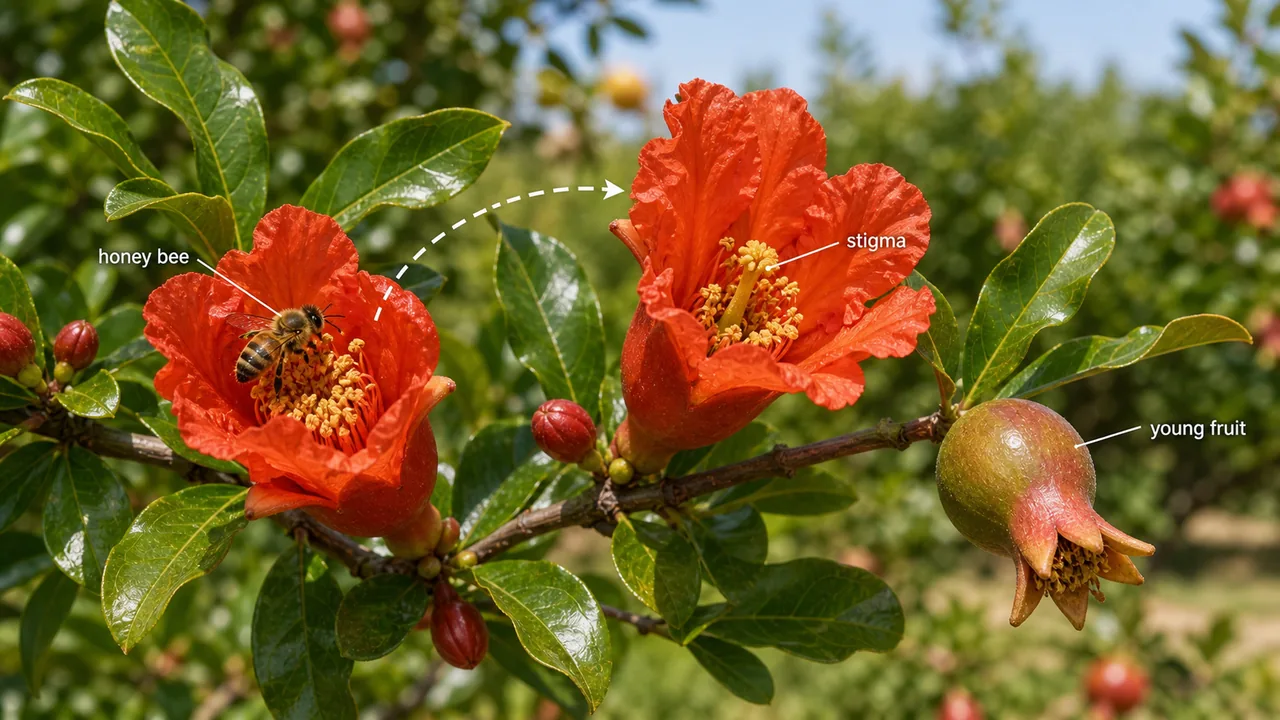
- Type of pollination: Often cross pollination. Main pollinator: Honey bee.
-
Common method of propagation: Hardwood cuttings.
Pro Content Locked
Upgrade to Pro to access this lesson and all other premium content.
Charged once for one year · ₹1188 total
Save ₹100/month vs ₹2388/year launch price
- All Agriculture & Banking Courses
- AI Lesson Questions (100/day)
- AI Doubt Solver (50/day)
- Glows & Grows Feedback (30/day)
- AI Section Quiz (20/day)
- 22-Language Translation (100/day)
- Recall Questions (20/day)
- AI Quiz (15/day)
- AI Quiz Paper Analysis (100/day)
- AI Step-by-Step Explanations (100/day)
- Spaced Repetition Recall (FSRS)
- AI Tutor
- Immersive Text Questions
- Audio Lessons — Hindi & English
- Mock Tests & Previous Year Papers
- Summary & Mind Maps
- XP, Levels, Leaderboard & Badges
- Generate New Classrooms
- Voice AI Teacher (AgriDots Live)
- AI Revision Assistant
- Knowledge Gap Analysis
- Interactive Revision (LangGraph)
🔒 Secure one-time yearly payment via Razorpay · No hidden fees
- Botanical Name: Punica granatum
- Family: Punicaceae
- Origin: South West Asia (Iran)
- Chromosome number: 2n = 16
- It is highly drought tolerant among fruit crops. Pomegranate's ability to survive and produce under severe water stress makes it one of the best-suited fruit crops for arid and semi-arid regions.
- Pigment responsible for the red colour in pomegranate fruits is Anthocyanin. Anthocyanins are water-soluble pigments that not only give the arils their attractive red colour but also act as powerful antioxidants with significant health benefits.
- Also known as Fruit of Paradise / National Fruit of Iran.
- Dollar earning fruit -- one of India's important export fruits.
- Pomegranate fruit is symbol of abundance and prosperity.
- Favourite table fruit of tropical and subtropical countries.
- Carbohydrate content: 14.5%
- NRC for Pomegranate: Kesaon-Solapur (Maharashtra)
- Winter hardy and highly drought tolerant shrub.
- Most pomegranate varieties are deciduous trees.
- For proper fruit development, maturity and sweetness, temperature of 35-38°C is needed.
- Pomegranate taste is due to Citric acid.
- Non-climacteric fruit.
- Fruit ready for harvest: 120-130 days after fruit set.
- Harvesting stage: Colour change to yellowish red.
- Fruits ready for harvest in about 5-7 months after appearance of blossoms.
- Seedlessness in pomegranate: Lack of lignification of testa.
- Type of pollination: Often cross pollination. Main pollinator: Honey bee.
-
Common method of propagation: Hardwood cuttings.
-
Commercial propagation: Cutting & Air layering.
-
High incidence of fruit cracking: Spring crop (63%): January to June.
-
Hardening peels disorder occurs due to prolonged drought condition.
-
India has first position in the world with respect to pomegranate area and production.
-
In India Maharashtra is the leading state in area and production followed by KR, AP, GJ, TN and RAJ. Maharashtra's Solapur, Nashik, and Sangli districts form the pomegranate belt of India, benefiting from hot, dry conditions ideal for this crop.
-
Juice of pomegranate is useful for patient suffering from leprosy.
-
July-August is ideal time of planting in tropics. Planting during the onset of monsoon ensures adequate soil moisture for root establishment.
- Wild type Anar is known is Daru. Daru is the wild, thorny form of pomegranate that produces small, sour fruits and is used as a rootstock for improved cultivars.
- Presently Bhagawa is the leading variety of pomegranate cultivation in India especially in Maharashtra. Bhagawa has gained dominance due to its large fruit size, deep red arils, soft seeds, and excellent shelf life -- making it ideal for both domestic and export markets.
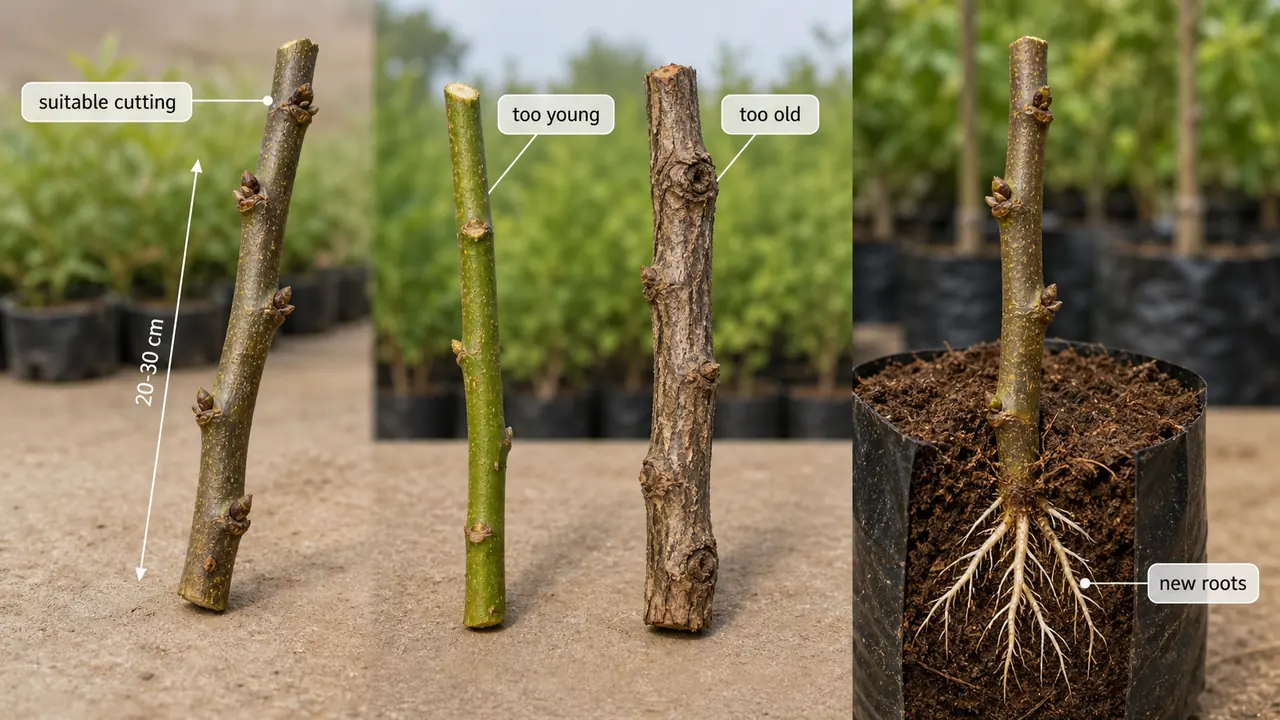
- Propagated by stem cutting (Hardwood Cutting) and air layering (Gootee). Hardwood cuttings of 20-30 cm length taken from one-year-old shoots root readily and are the most common commercial propagation method.
- Wood younger than 6 months and older than 18 months is unsuitable for cutting. Cuttings from very young wood have insufficient reserves for rooting, while old wood has lower regeneration capacity.
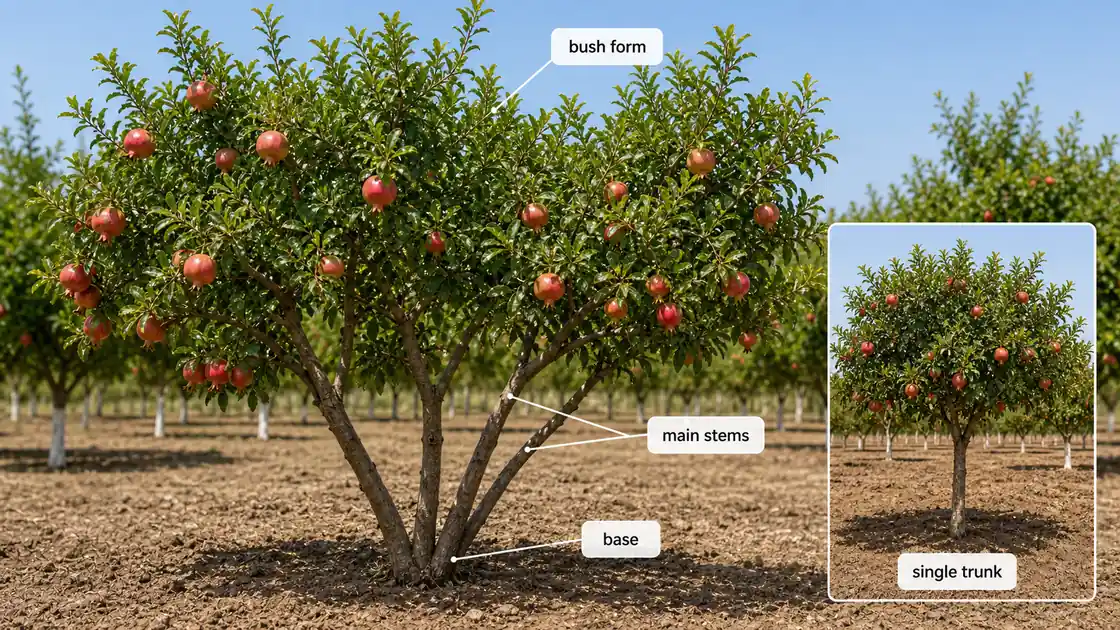
- Multi stem training system is followed in India. In the multi-stem system, 3-4 main stems are allowed to grow from the base, creating a bush-like structure that is easier to manage and harvest compared to a single-trunk tree form.
- Anti-transpirants such as 10% kaolin, 10-5 m phenyl mercuric acetate, 1.5% power oil, 1% liquid paraffin is beneficial for increasing its productivity. Anti-transpirants reduce water loss through stomata and leaf surface, helping the plant conserve moisture during dry periods and maintain better fruit quality.
- Summer crop maximum demand.
- Root treatment with 3000 ppm IBA gives maximum survival. Indole-3-Butyric Acid (IBA) is an auxin that stimulates adventitious root formation on cuttings, dramatically improving their survival rate and establishment.
- Bahar treatment is followed in pomegranate. Bahar treatment is a unique crop regulation practice where irrigation is withheld for a period (stress period) and then resumed, along with manuring and pruning, to induce synchronized flowering in a desired season.
- Pomegranate has three distinct flowering seasons.
- Ambe bahar is most commonly preferred by the growers because of high yield as compared to other flowering season. Ambe bahar (January-February flowering, June-August harvest) coincides with the rainy season harvest, producing the highest yields due to favourable growing conditions. Practised in high rainfall and humid areas. Internal breakdown is more in this season.
- Mrig Bahar (June-July flowering, November-January harvest): Preferred in dry areas. More prone to cracking. During mrig bahar, the transition from humid monsoon to dry winter creates moisture stress that causes the rind to lose flexibility, resulting in cracking.
- Hasth Bahar (September-October flowering, February-April harvest): Preferred for export purpose.

Varieties


- Solapur Lal
- Muskati red
- Paper shelled
- Alandi
- Karadi
- Madhugiri
- Bassein seedless
- Chawla
- Country large red
- Spanish Ruby
- Muskat
- Nabha
- G-137: Clonal selection from Ganesh. Clonal selection involves identifying and propagating a superior-performing individual plant from an existing variety, preserving its desirable traits.
- P-26: Seedling selection from muscat.
- Jyoli: Bassein seedless x Dholka
Varieties by Seed Type
| Hard Seeded | Soft Seeded |
|---|---|
| Kandhari, Muskat Red, Alandi (Vadki), Kabul | Dholka (Gujarat), Paper Shell, Spanish Ruby, Ganesh (GBG-1), Jyothi (GKVK-1), Yercud-l 1 (YCD-1), Co-1, Mridula, Ruby (11 HR), Amlidana |
Other Important Varieties
- Bhagwa (Kesar): Leading variety in Maharashtra. Also known as Sinduri, Mastani, Jai. Attractive skin and aril colour.
- Jyoti: Grown in Gujarat.
- Phule Arkata, Goma Khatta, Hyti, Muscat.
- Wonderful: Origin from USA. Average fruit size: 700 gm.
- Solapur Lal: Biofortified variety.
- Mridula, Bhagwa and Ganesh are evergreen cultivars.
- CO-1: Purple aril and soft seeds, higher pulp and sweet taste.
- Spanish Ruby, Ganesh (GBG-1): Selection from Alandi, very soft seeded, well known cultivar.
- Mridula: Fruit weight about 250 g, juice sweet, TSS 16.32%, acidity 0.47%. Seeds softer than Ganesh.
- Ruby: A multiple cross hybrid developed at IIHR. Ganesh x Kabul for aril colour and seed mellowness.
- Amlidana: F1 hybrid (Ganesh x Nana).
Harvest and Yield
- 12A grade is preferred in Northern and Southern India.
- During 4th year, tree bears 25-30 fruits; a 10-year-old tree gives 150-200 fruits/year.
- Fruits can be stored for 15-20 days under ambient temperature.
- At 0°C with 80-85% RH and at 5°C with 90-95% RH, can be stored for 2 months.
Hybrid
- Ruby: Ganesh x Kabul x Yercaud
- Soft seeded var: 1. Jyothi 2. Ganesh 3. Bassein seedless 4. Paper shell. Soft-seeded varieties are strongly preferred by consumers because the seeds can be easily chewed and do not cause discomfort while eating.
- Hard seeded var: 1. Khandhari 2. Alandi
Insects
- Anar butterfly: Virachola isocrates

- Serious pest of pomegranate. The anar butterfly (pomegranate butterfly) is the most destructive pest of pomegranate, capable of causing 40-50% fruit damage in unmanaged orchards.
- Pencil size bored holes can be seen on fruits from which larval excreta comes out continuously. The adult butterfly lays eggs on flowers and young fruits, and the larva bores inside, feeding on the developing seeds (arils) and filling the fruit cavity with frass (excreta).
- It is managed by Covering of fruits with butter paper.
- Spray Carbaryl 50 WP @ 2-4 g/liter or Methomyl 40 SP @ 1.0 ml/l or Monocrotophos 36 SL @ 1 ml/liter spray on plants.
- Fruit fly:
- Bactrocera zonata
- Minor pest of pomegranate

- Fruit sucking moth:
- Othreis spp. The adult moth pierces the rind of ripening fruits with its proboscis and sucks the juice, creating entry points for secondary infections that cause fruit rot.
Disease
- Bacterial blight:
- Caused by Xanthomonas axonopodis pv. punicae

- Also known as nodal blight or black spot
- In Maharashtra commonly known as oily spot or Telya. This is currently the most devastating disease of pomegranate in India. The bacteria cause oily, water-soaked spots on leaves and fruits that later turn dark brown to black, leading to severe defoliation and unmarketable fruits.
Physiological disorder
- Fruit cracking:
- Due to B deficiency. Boron is essential for cell wall integrity and water transport. Its deficiency weakens the fruit rind, making it prone to cracking.

- More in Rajasthan (dry areas). The hot, dry climate of Rajasthan exacerbates moisture stress, and when combined with boron deficiency, the rind becomes brittle and cracks as the arils expand.
- Managed by spray of Borax @ 0.5 %.
Internal breakdown
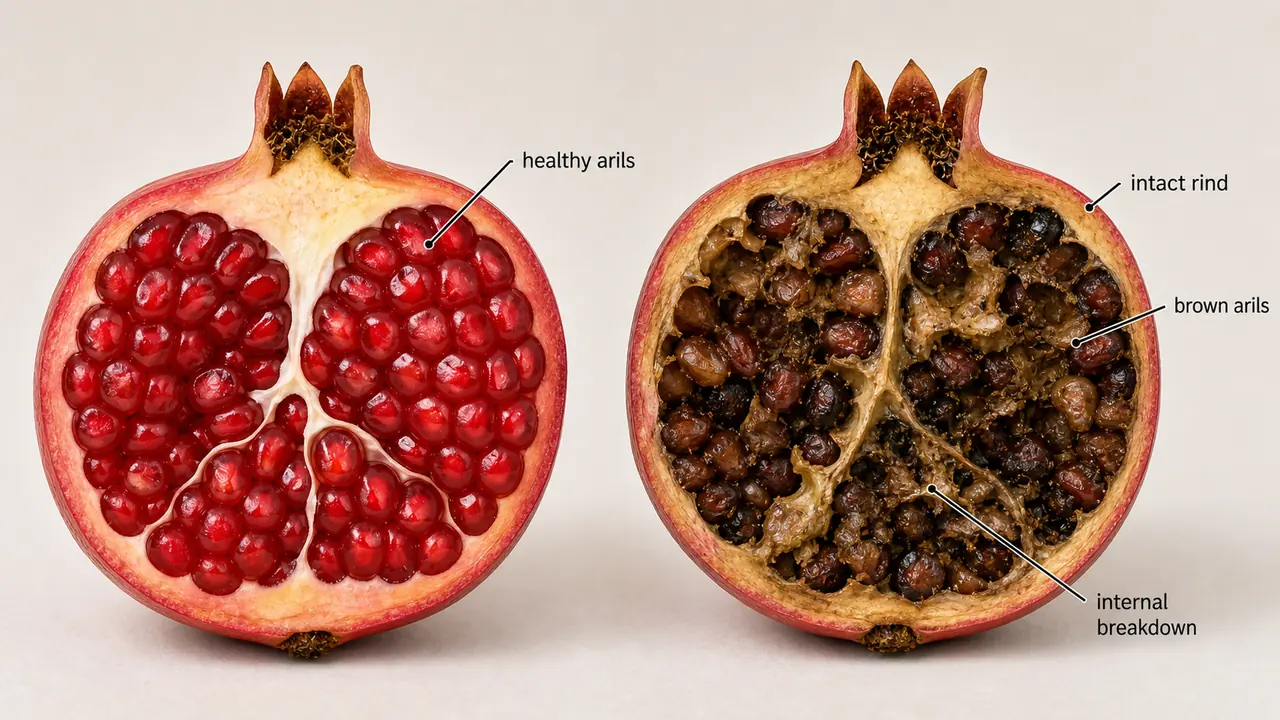
- Disintegration of arils in matured pomegranate. The arils (seed sacs) lose their firmness, become mushy, and start decomposing inside the intact-looking fruit.
- Arils become brown and blackening. This internal browning is caused by oxidation of phenolic compounds in the aril tissue.
- The incidence is more in ambe bahar (Jan - June). During the ambe bahar season, the combination of rising temperatures and humidity during fruit maturation promotes this disorder, making it a significant post-harvest quality concern.
Summary Cheat Sheet
| Concept / Topic | Key Details / Explanation |
|---|---|
| Pomegranate identity | Punica granatum of Punicaceae originated in Iran or South West Asia, has chromosome number 2n = 16, is highly drought tolerant, non-climacteric, and known as fruit of paradise as well as an export-oriented dollar-earning fruit. |
| Fruit and climate points | Anthocyanin gives the red colour, citric acid gives the taste, 35-38°C favours sweetness and maturity, fruits are harvested about 120-130 days after fruit set, and yellowish-red colour is the harvest stage. |
| Pollination and propagation | Pomegranate is often cross-pollinated with honey bee as main pollinator, seedlessness is due to lack of lignification of the testa, and commercial propagation is mainly by hardwood cuttings and air layering. |
| Production and planting | India leads the world in area and production, Maharashtra is the leading state, July to August is the preferred planting season in the tropics, and Daru is the wild type used as a rootstock reference. |
| Orchard management | Multi-stem training is common in India, cuttings root best with 3000 ppm IBA, wood younger than 6 months or older than 18 months is unsuitable, and anti-transpirants such as kaolin are used to improve productivity. |
| Bahar treatment | Bahar treatment is the crop-regulation practice used in pomegranate, and the crop has three flowering seasons: Ambe bahar for high yield in humid areas, Mrig bahar for dry areas but with more cracking risk, and Hasth bahar for export. |
| Important varieties | Important varieties listed are Solapur Lal, Muskati Red, Paper Shelled, Alandi, Karadi, Madhugiri, Bassein Seedless, Chawla, Country Large Red, Spanish Ruby, Muskat, Nabha, G-137, P-26, and Jyoti or Jyoli. |
Summary Continued
| Concept / Topic | Key Details / Explanation |
|---|---|
| Seed type groups and leading cultivars | Hard-seeded types include Kandhari, Muskat Red, Alandi, and Kabul, while soft-seeded types include Dholka, Paper Shell, Spanish Ruby, Ganesh, Jyothi, Yercaud-1, CO-1, Mridula, Ruby, and Amlidana; Bhagwa is the current leading commercial variety in Maharashtra. |
| Special variety notes | Bhagwa is also called Sinduri, Mastani, or Jai; Wonderful is the USA variety with large fruit; Solapur Lal is biofortified; Mridula, Bhagwa, and Ganesh are evergreen cultivars; and CO-1 is known for purple arils and soft seeds. |
| Harvest, yield, and storage | Grade 12A is preferred in some markets, fourth-year trees bear about 25-30 fruits, a ten-year-old tree may bear 150-200 fruits, fruits keep 15-20 days at ambient conditions, and around 2 months in cool storage. |
| Hybrids and soft-seeded preference | Ruby is listed as a hybrid, Amlidana is an F1 hybrid, and soft-seeded types such as Jyothi, Ganesh, Bassein Seedless, and Paper Shell are preferred for eating quality. |
| Major pests | Anar butterfly Virachola isocrates is the most serious insect pest, fruit fly Bactrocera zonata is a minor pest, and fruit-sucking moth Othreis damages ripening fruits. |
| Major disease and disorders | Bacterial blight caused by Xanthomonas axonopodis pv. punicae is the major disease and is also called oily spot or Telya; fruit cracking is linked to boron deficiency and managed with borax 0.5%; internal breakdown is more common in Ambe bahar; and hardening peel is associated with prolonged drought. |