🌶 Cultivation of Important Spices
Complete guide to cultivation of saffron, black pepper, cardamom, ginger, fenugreek, cumin, and coriander covering botanical details, growing conditions, and key exam facts for competitive agriculture exams.
From the Pampore valley of Kashmir — the only region in India where saffron is commercially grown — to the pepper gardens of Kerala's Western Ghats, India's spice cultivation spans an extraordinary range of agro-climatic zones. Each spice has unique requirements, and understanding its cultivation is essential for both farming and competitive examinations.
Keshar (Saffron)
-
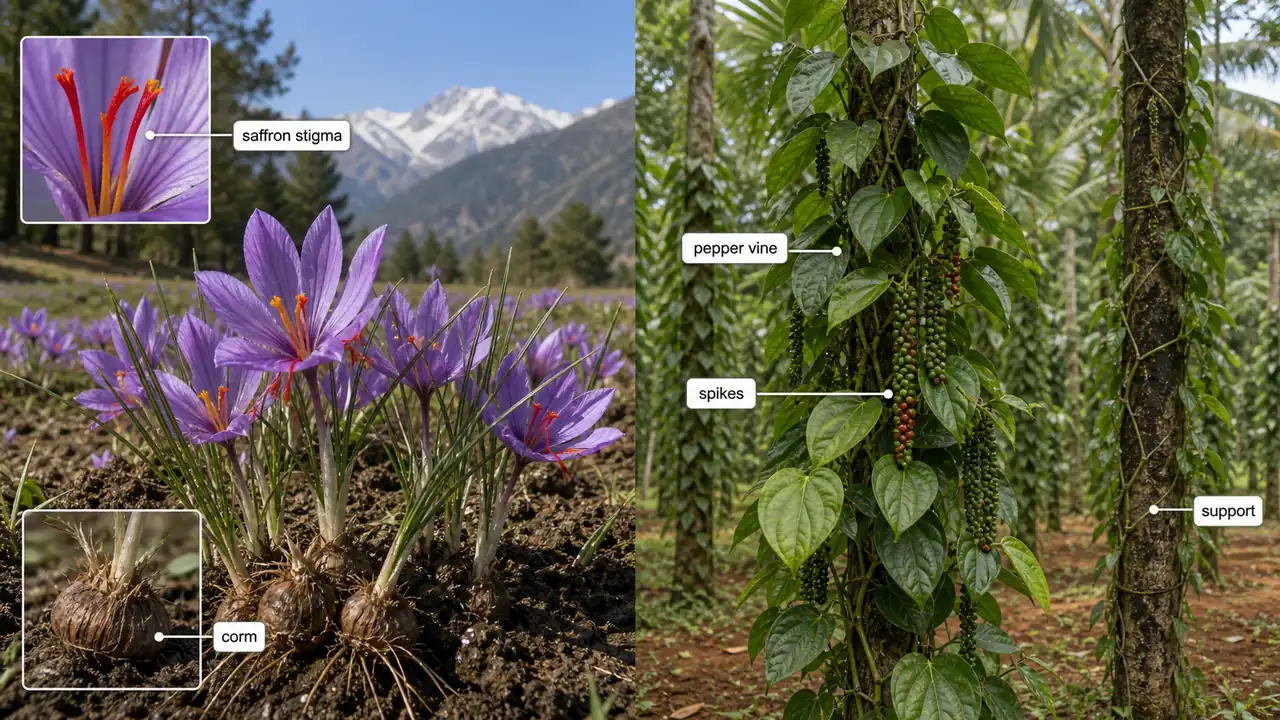
B.N.: Crocus sativus. Saffron is the world's most expensive spice by weight, derived from the dried stigmas (thread-like female parts) of the Crocus flower. Each flower produces only three stigmas, and it takes approximately 150,000 flowers to yield just one kilogram of saffron, which explains its extraordinary cost.
-
Family: Iridaceae. This family, commonly known as the iris family, includes many ornamental and economically important plants. Saffron is the most commercially significant member, cultivated primarily in Jammu & Kashmir (Pampore region) in India, as well as in Iran, Spain, and Greece.
Pro Content Locked
Upgrade to Pro to access this lesson and all other premium content.
Charged once for one year · ₹1188 total
Save ₹100/month vs ₹2388/year launch price
- All Agriculture & Banking Courses
- AI Lesson Questions (100/day)
- AI Doubt Solver (50/day)
- Glows & Grows Feedback (30/day)
- AI Section Quiz (20/day)
- 22-Language Translation (100/day)
- Recall Questions (20/day)
- AI Quiz (15/day)
- AI Quiz Paper Analysis (100/day)
- AI Step-by-Step Explanations (100/day)
- Spaced Repetition Recall (FSRS)
- AI Tutor
- Immersive Text Questions
- Audio Lessons — Hindi & English
- Mock Tests & Previous Year Papers
- Summary & Mind Maps
- XP, Levels, Leaderboard & Badges
- Generate New Classrooms
- Voice AI Teacher (AgriDots Live)
- AI Revision Assistant
- Knowledge Gap Analysis
- Interactive Revision (LangGraph)
🔒 Secure one-time yearly payment via Razorpay · No hidden fees
From the Pampore valley of Kashmir — the only region in India where saffron is commercially grown — to the pepper gardens of Kerala's Western Ghats, India's spice cultivation spans an extraordinary range of agro-climatic zones. Each spice has unique requirements, and understanding its cultivation is essential for both farming and competitive examinations.
Keshar (Saffron)
-
B.N.: Crocus sativus. Saffron is the world's most expensive spice by weight, derived from the dried stigmas (thread-like female parts) of the Crocus flower. Each flower produces only three stigmas, and it takes approximately 150,000 flowers to yield just one kilogram of saffron, which explains its extraordinary cost.
-
Family: Iridaceae. This family, commonly known as the iris family, includes many ornamental and economically important plants. Saffron is the most commercially significant member, cultivated primarily in Jammu & Kashmir (Pampore region) in India, as well as in Iran, Spain, and Greece.
NOTE
Saffron is obtained from the stigma of the flower — the only spice derived from this plant part. The Pampore region of J&K is India's sole significant saffron-growing area.
Black Pepper
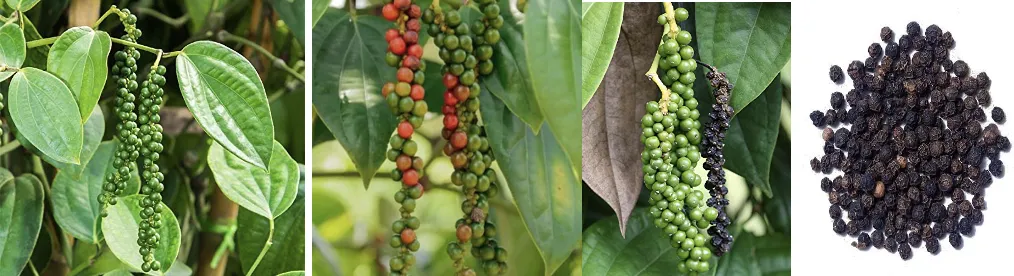
- King of Spices. Black pepper (Piper nigrum) holds this title because it is the most widely traded and consumed spice in the world. It has been a cornerstone of the global spice trade for centuries and was historically so valuable that it was used as currency and tribute. India, particularly the Malabar Coast of Kerala, is considered its center of origin.
TIP
King of Spices = Black Pepper | Queen of Spices = Cardamom. These titles are exam staples.
- Insect-Pest:
- Pollu Beetle (Longitarsus nigripennis): Major pest of pepper. The Pollu Beetle is the most destructive insect pest of black pepper. It feeds on the developing berries, causing them to become hollow and shriveled — a condition known as "pollu" damage (meaning hollow in Malayalam). Infested berries lose their pungency and market value, leading to significant economic losses for growers. Management strategies include timely spraying during the fruiting season and maintaining good field sanitation.
Cardamom
- Queen of Spices. Cardamom (Elettaria cardamomum) is honored with this title due to its exquisite aroma and flavor, making it one of the most prized and expensive spices globally (second only to saffron and vanilla). It is a perennial herbaceous plant native to the Western Ghats of India, and the country's primary production areas include Kerala, Karnataka, and Tamil Nadu. The spice is obtained from the dried seed pods of the plant.
Ginger
-
B.N.: Zingiber officinale. Ginger is one of the most important spice and medicinal crops worldwide. The underground rhizome (modified stem) is the commercially used part, valued for its pungent flavor (due to compounds called gingerols and shogaols) and its wide range of therapeutic properties, including anti-inflammatory, digestive, and anti-nausea effects.
-
Inflorescence: Spike. The flowering structure of ginger is a spike — a type of inflorescence where sessile flowers (flowers without individual stalks) are arranged along an unbranched central axis. While ginger is primarily cultivated for its rhizome, the flowers are occasionally used in ornamental horticulture.
Fenugreek
-
Pant Ragini. This is an important improved variety of fenugreek (Trigonella foenum-graecum), developed for higher yield and better quality. Fenugreek is a versatile crop — its leaves are consumed as a vegetable (known as "methi"), while the seeds are used as a spice and in traditional medicine for blood sugar regulation and digestive health.
-
RMT-1, RMT-141, Rajendra kranti are Fenugreek varieties. These are notable released varieties developed by agricultural universities. RMT-1 and RMT-141 are selections known for their good seed yield, while Rajendra Kranti was released by Rajendra Agricultural University (RAU), Pusa, Bihar, and is recognized for its adaptability to different agro-climatic zones.
Cumin
- RS-1 and RZ-19 are varieties of cumin. Cumin (Cuminum cyminum) is an important seed spice widely used in Indian cuisine and traditional medicine. It belongs to the family Apiaceae. RS-1 and RZ-19 are improved varieties developed for higher yield and disease resistance. Cumin is predominantly grown in Rajasthan and Gujarat, which together account for the bulk of India's cumin production.
Coriander
- RCR-41 and UD-20 are the varieties of coriander. Coriander (Coriandrum sativum) is a dual-purpose crop — its fresh leaves (cilantro) are used as an herb, while the dried seeds are used as a spice. It belongs to the family Apiaceae (same as cumin). RCR-41 is a popular variety known for its high seed yield and essential oil content, while UD-20 is valued for its bold grain size. Major coriander-growing states in India include Rajasthan, Madhya Pradesh, Gujarat, and Andhra Pradesh.
Cultivation Details of Important Spices
The following table summarizes key cultivation parameters for major spices — pH, seed rate, propagation method, and yield — all frequently tested in competitive exams.
| Crop | pH | Seed Rate | Propagation | Yield |
|---|---|---|---|---|
| Ginger | 6-6.5 | 1500-1800 kg (plains), 2000-2500 kg/ha (hilly) | Seed tubers/Rhizome | 15-20 tonnes/ha |
| Black Pepper | 4.5-6 | 3-5 cuttings per pit/pot | Shoot Cuttings | 2-3 kg/vine/year |
| Cardamom | 5-5.5 | 600 g/ha (seed) | Suckers/Seedlings | 200-250 kg/ha |
| Turmeric | - | 2000 kg/ha | Rhizome (mother), Finger Rhizome | Fresh: 25-30 t/ha, Cured: 5-6 t/ha |
| Coriander | 6-8 | 10-12 kg/ha (irrigated), 20-25 kg/ha (rainfed) | Seed | Seed: 500-600 kg/ha, Leaf: 6-7 t/ha |
| Clove | - | - | Seed | 2-3 kg dried buds/tree |
| Nutmeg | - | - | Seeds/Grafts/Budded plants | Fruit: 1000-2000/tree, Dried nuts: 5-7 kg/tree |
| Cinnamon | - | - | Seed/Semi-hard wood cutting | Dried bark: 100 g, Leaf oil: 35 kg/ha/year |
| Fenugreek | 6-7 | 12 kg/ha | Seed | Green: 4000-5000 kg/ha, Grains: 500-700 kg/ha |
IMPORTANT
Ginger is propagated by seed tubers/rhizomes, Black Pepper by shoot cuttings, and Cardamom by suckers/seedlings. These propagation methods are high-frequency exam questions.
Summary Cheat Sheet
| Concept / Topic | Key Details / Explanation |
|---|---|
| Saffron | Saffron is Crocus sativus of Iridaceae, obtained from the stigma, and India’s main production region is Pampore in Jammu and Kashmir. |
| Black pepper | Black pepper is the king of spices, originates from the Malabar region, and pollu beetle Longitarsus nigripennis is the major insect pest mentioned. |
| Cardamom | Cardamom is the queen of spices, comes from the dried seed pods of Elettaria cardamomum, and is associated with the Western Ghats, especially Kerala, Karnataka, and Tamil Nadu. |
| Ginger | Ginger is Zingiber officinale and the commercial part is the rhizome; the inflorescence type mentioned is spike. |
| Fenugreek | Pant Ragini, RMT-1, RMT-141, and Rajendra Kranti are named fenugreek varieties, and the crop is used both as leafy methi and as a seed spice. |
| Cumin and coriander | RS-1 and RZ-19 are cumin varieties; RCR-41 and UD-20 are coriander varieties, and coriander is noted as a dual-purpose herb-plus-spice crop. |
| Important propagation matches | High-frequency propagation facts are saffron by corms implied through flower-based production, black pepper by shoot cuttings, cardamom by suckers or seedlings, ginger and turmeric by rhizomes, and coriander or fenugreek by seed. |
| Cultivation table memory points | Key cultivation values from the lesson include ginger pH 6-6.5, black pepper pH 4.5-6, cardamom pH 5-5.5, coriander pH 6-8, and fenugreek pH 6-7. |
| Yield and seed-rate facts | Ginger uses 1500-2500 kg/ha planting material depending on plains or hills; cardamom seed rate is about 600 g/ha; coriander seed rate is 10-12 kg/ha irrigated and 20-25 kg/ha rainfed; fenugreek seed rate is about 12 kg/ha. |
| Yield highlights | Ginger yields 15-20 t/ha, turmeric gives 25-30 t/ha fresh and 5-6 t/ha cured produce, black pepper yields about 2-3 kg/vine/year, cardamom about 200-250 kg/ha, and coriander gives both seed and leaf yield. |