🔬 Introduction to Microbiology — The Invisible World Shaping Agriculture
History of microbiology, key scientists and their contributions, branches of microbiology, and classification of microorganisms with exam-focused tables and mnemonics
From Field to Lab — Why Microbiology Matters in Agriculture
Walk through any thriving paddy field and you are surrounded by billions of invisible workers. Nitrogen-fixing bacteria in the root nodules of nearby legumes are enriching the soil. Decomposer fungi are breaking down last season's stubble into humus. Blue-green algae floating in the standing water are adding nitrogen that the rice crop will absorb. Every gram of fertile soil contains 100 million to 1 billion bacteria — more microorganisms than there are people on Earth.
Understanding these tiny organisms is not just academic; it is the foundation of modern agriculture. From biological nitrogen fixation to plant disease management, microbiology underpins nearly every aspect of crop production.

What is Microbiology?
Microbiology is the study of microorganisms — organisms too small to be seen with the naked eye. These include bacteria, fungi, algae, viruses, protozoa, and mycoplasma.
The term microbiology is linked in many agriculture exam notes with Louis Pasteur, but the title Father of Microbiology is generally assigned to Antonie van Leeuwenhoek. Louis Pasteur is remembered as the Father of Modern Microbiology.
- The title Agricultural Microbiology is closely associated with G. Rangaswami. In direct exam-style recall, he is commonly linked with the book Agricultural Microbiology.
- In history-of-terminology recall, the term microbe is classically linked with Sedillot.
Father Figures — Scientists Who Built the Foundation
| Title | Scientist | Key Contribution |
|---|---|---|
| Father of Microbiology | Antonie van Leeuwenhoek | First visualized microorganisms with handcrafted microscopes |
| Father of Modern Microbiology | Louis Pasteur | Disproved spontaneous generation; advanced germ theory |
| Father of Soil Microbiology | S.N. Winogradsky | Isolated nitrifying bacteria; demonstrated free-living N-fixation |
| Father of Mycology | Anton de Bary | Proved fungi cause plant diseases (potato late blight) |
| Father of Nematology | Cobb | Pioneered nematode taxonomy and disease measurement |
| Father of Modern Bacteriology | Robert Koch | Pure culture work and bacteriological technique |
| Father of Plant Bacteriology in India | M.K. Patel | Early plant bacteriology foundation in India |
| Pure culture technique | O. Brefeld | Developed fungal pure-culture approaches |
TIP
Mnemonic — "Pasteur Wins Bary's Cobb": Pasteur = Microbiology, Winogradsky = Soil Microbiology, Bary = Mycology, Cobb = Nematology.
Milestones in Microbiology
Understanding the chronological development helps you answer "Who discovered what?" questions that appear in nearly every agriculture exam.
| Year | Scientist | Milestone |
|---|---|---|
| 1590 | Janssen and Janssen | Early compound microscope |
| 1675 | Leeuwenhoek | Developed/refined the simple microscope; first to observe microorganisms |
| 1931 | Knoll and Ruska | Developed the electron microscope |
| — | Joseph Lister | Obtained early pure cultures of bacteria and advanced antiseptic practice |
| — | Robert Koch | Developed the bacterial pure-culture technique and popularized gelatin as a bacterial culture medium |
| — | Beijerinck and Winogradsky | Developed the logic of enrichment culture for isolating specialized microorganisms |
| — | Dr. Hesse | Proposed the use of agar as a bacterial culture medium |
| 1878 | Kuhne | Coined the term enzyme |
| — | Edward Jenner | Used cowpox virus to immunize against smallpox |
| — | Stanley | Proved the crystalline nature of viruses |
| — | Haeckel E.H. | Proposed the third kingdom Protista |
| — | John Needham | Supported the Theory of Spontaneous Generation |
| — | Gram | Developed the technique of differential staining in bacteria |
| — | Robert Koch | Identified the bacteria responsible for anthrax and tuberculosis |
| 1882 | T.J. Burrill | Identified fire blight of apple and pear as a bacterial disease |
| 1796 | Edward Jenner | Developed the first vaccine for smallpox using cowpox material |
| — | Louis Pasteur | Developed the rabies vaccine |
| — | Jonas Salk | Developed the polio vaccine |
IMPORTANT
Commonly tested distinction: Leeuwenhoek = simple microscope, Robert Hooke = compound microscope. Do not confuse the two.
NOTE
Older objective-book microbiology notes sometimes reverse the Janssen story by loosely calling it the "first simple microscope," but the stable exam-safe recall is that the Janssen pair is associated with the early compound microscope, while Leeuwenhoek is tied to the powerful single-lens instrument used to directly observe microbes.
- In older microbiology one-liners, Antonie van Leeuwenhoek is also remembered as the father of microscopy because his handcrafted lenses opened the way to direct observation of microorganisms.
- In vaccine-history recall, Edward Jenner is also remembered as the Father of Vaccination and often as a foundational figure in immunology.
- In immune-history recall, the phenomenon of phagocytosis is classically linked with Metchnikoff.
These milestones are easiest to remember as a lab-method progression: Lister helped establish bacterial isolation in practice, Koch refined pure-culture bacteriology into a dependable method, and culture media such as gelatin and later agar made routine microbial work much more reliable.
Important Institutions and Committees
- The National Institute of Virology (NIV) is located at Pune, Maharashtra.
- ICTV stands for the International Committee on Taxonomy of Viruses.
- The Indian Type Culture Collection (ITCC) was established at IARI, New Delhi in 1936 for preservation and identification of fungal and bacterial cultures.
Key terms:
- Origin of life from non-living matter is known as Abiogenesis or Spontaneous Generation
- Louis Pasteur disproved spontaneous generation through his famous swan-neck flask experiment
- The spontaneous-generation idea was first associated with Aristotle, and later disproved experimentally by Redi, Spallanzani, Pasteur, and Tyndall
Organism Classification Systems Often Asked in Exams
| Classification system | Scientist | Main idea |
|---|---|---|
| Two-kingdom system | Carolus Linnaeus | Plantae and Animalia |
| Three-kingdom system | E.H. Haeckel | Added Protista |
| Four-kingdom system | H.F. Copeland | Expanded microbial separation |
| Five-kingdom system | R.H. Whittaker (1969) | Monera, Protista, Fungi, Plantae, Animalia |
- In older biological-history recall tables, Aristotle is commonly remembered as the Father of Biological Classification.
Binomial Nomenclature
- Carolus Linnaeus proposed binomial nomenclature.
- He is also widely remembered as the Father of Taxonomy.
- For plants, the landmark work is Species Plantarum (1753).
- For animals, the key reference point is the 10th edition of Systema Naturae (1758).
- The first edition of Systema Naturae was published in 1735.
- In a scientific name, the first word is the genus and the second word is the species, for example Homo sapiens.
- Scientific names are traditionally written in Latin or latinized form.
Branches of Microbiology
Each branch focuses on a specific group of microorganisms. Knowing the branch name and what it studies is a staple exam question.
| Branch | Studies | Agricultural Relevance |
|---|---|---|
| Mycology | Fungi | Most plant diseases are caused by fungi |
| Phycology | Algae | BGA used as biofertiliser in rice |
| Bacteriology | Bacteria | Nutrient cycling, N-fixation, bacterial diseases |
| Virology | Viruses | Viral diseases transmitted by insect vectors |
| Nematology | Nematodes | Root-knot and cyst nematode management |
TIP
Mnemonic — "My Phy Bac Vir Nem": Mycology, Phycology, Bacteriology, Virology, Nematology — in order of organism size from largest to smallest (fungi > algae > bacteria > viruses > ... nematodes are an exception as they are macroscopic but microscopic in the soil context).

Classification of Microorganisms
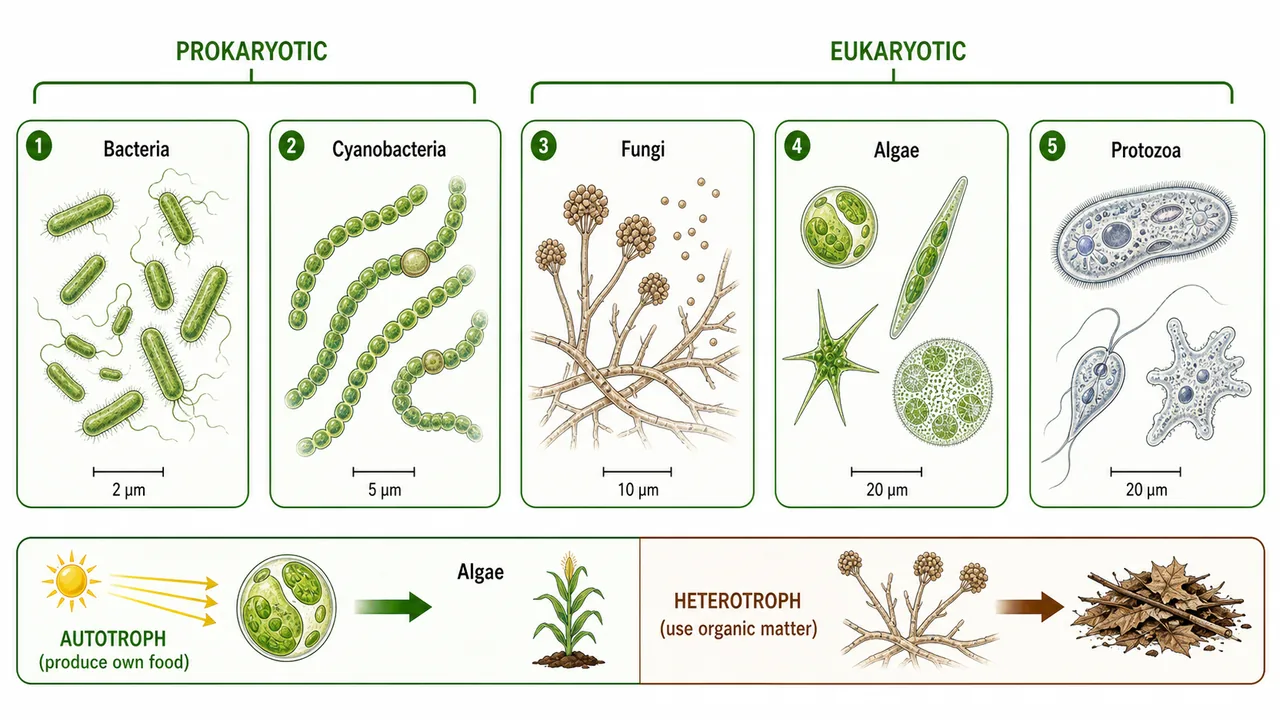
Prokaryotic vs Eukaryotic
This is the most fundamental division in biology. The presence or absence of a true, membrane-bound nucleus defines these two groups.
| Feature | Prokaryotic | Eukaryotic |
|---|---|---|
| Nucleus | No well-defined nucleus (Nucleoid) | Well-defined, membrane-bound nucleus |
| Examples | Bacteria, Cyanobacteria (BGA), Mycoplasmas, Actinomycetes | Fungi, Protozoa, Algae (except BGA), Nematodes |
- Actinomycetes are filamentous in shape but prokaryotic in nature — a frequently tested trick question
- All Blue-Green Algae (BGA) are prokaryotic, unlike other algae which are eukaryotic
- Non-cellular infectious agents include viruses, viroids, virusoids, and prions
Unicellular vs Multicellular
| Type | Examples |
|---|---|
| Unicellular | Bacteria, Protozoa, Yeasts |
| Multicellular | Fungi (moulds), Nematodes |
Autotrophs vs Heterotrophs — How Microorganisms Obtain Food
This classification is based on the source of carbon and energy used by the organism.
| Nutritional Type | Definition | Example |
|---|---|---|
| Autotrophs | Utilise CO₂ as sole source of carbon and energy | All algae are autotrophs |
| Heterotrophs | Utilise organic compounds as food source | All fungi are heterotrophs |
| Chemotrophs | Utilise inorganic material as source of energy | Nitrosomonas, Nitrobacter (nitrifying bacteria) |
IMPORTANT
Exam favourite: All fungi are heterotrophs (cannot photosynthesize). All algae are autotrophs (can photosynthesize). Never confuse these two.
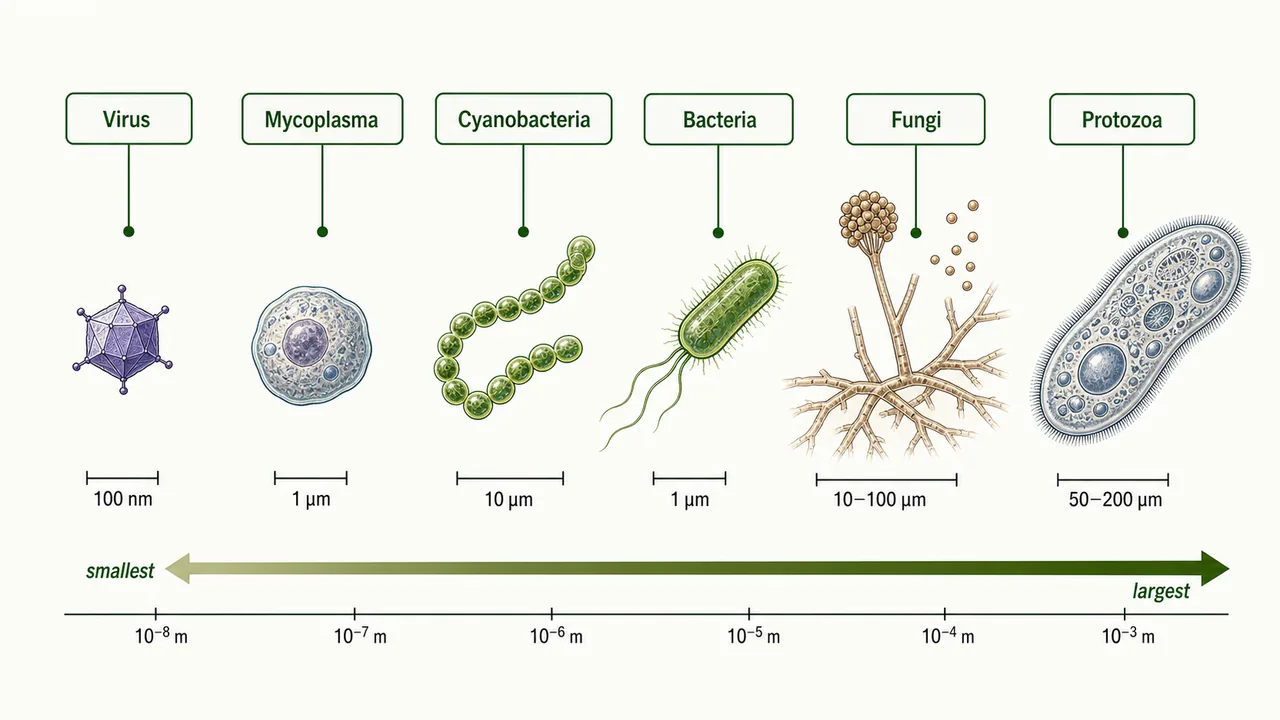
Size of Microorganisms
Knowing the relative sizes helps you answer "which is the smallest/largest?" type questions.
| Microorganism | Size | Rank (smallest to largest) |
|---|---|---|
| Prions / Viroids / Viruses | Smallest non-cellular agents | Smallest |
| Mycoplasma | 0.1–0.3 microns | Very small cellular form |
| Bacteria | 0.5–3.0 microns | Small prokaryotes |
| Actinomycetes | Intermediate | Larger than many bacteria |
| Fungi | 1.5–10 microns | Larger microbes |
| Protozoa / Algae | Up to hundreds of microns | Largest microbial groups in many comparisons |
IMPORTANT
Viruses are the smallest (0.06–0.14 microns) and Protozoa are the largest (up to 200 microns) among microorganisms. This is frequently tested.
TIP
Mnemonic for size order (smallest to largest) — "Very Merry Ants Build Fine Pyramids": Viruses, Mycoplasma, Algae (BGA), Bacteria, Fungi, Protozoa.
- A shorter exam-style comparison often used for the very small end of the scale is: Actinomycetes → Bacteria → Mycoplasma → Virus → Viroid → Prion, moving from relatively larger microbial forms toward the simplest non-cellular agents.
- In the reverse, larger-to-smaller classroom shorthand, students also meet the order Algae → Protozoa → Fungi → Actinomycetes → Bacteria → Mycoplasma → Virus → Viroid → Prion.
Microscope resolving-power recall:
- Human eye: about 100 um
- Light microscope: about 0.2-0.3 um
- Electron microscope: reaches the angstrom-scale range used in older exam notes
Saprophytes and Parasites
Understanding how microorganisms obtain nutrients from their environment is critical for disease management.
| Type | Definition | Agricultural Example |
|---|---|---|
| Saprobes / Saprophytes | Organisms that live on dead material | Decomposer fungi breaking down crop residue |
| Obligate parasites | Organisms that require only a living host for survival and multiplication | Rust fungi, viruses |
Key facts:
- The most numerous organisms in soil are Bacteria
- Rhizosphere is the region where soil and plant roots make contact — microbial activity here is 10–100 times higher than in bulk soil
- On aerial plant parts, the comparable microbial habitat is the phyllosphere, meaning the immediate micro-environment around the leaf surface where microorganisms are abundant.
- The phylloplane is the actual leaf surface itself, so the relation is similar to "zone around" versus "surface proper."
Summary Table — Key Facts at a Glance
| Fact | Answer |
|---|---|
| Father of Microbiology | Antonie van Leeuwenhoek |
| Father of Modern Microbiology | Louis Pasteur |
| Father of Soil Microbiology | S.N. Winogradsky |
| Father of Mycology | Anton de Bary |
| Father of Nematology | Cobb |
| Simple microscope | Leeuwenhoek |
| Early compound microscope | Janssen and Janssen |
| Electron microscope | Knoll and Ruska |
| Term "enzyme" coined by | Kuhne (1878) |
| Most numerous in soil | Bacteria |
| All fungi are | Heterotrophs |
| All algae are | Autotrophs |
| Actinomycetes are | Filamentous but Prokaryotic |
| Differential staining | Gram |
| Spontaneous generation = | Abiogenesis |
| Soil-root contact zone | Rhizosphere |
| Leaf-associated microbial zone | Phyllosphere |
| Actual leaf surface | Phylloplane |
Summary Cheat Sheet
| Fact | Answer |
|---|---|
| Father of Microbiology | Antonie van Leeuwenhoek |
| Father of Modern Microbiology | Louis Pasteur |
| Father of Soil Microbiology | S.N. Winogradsky |
| Father of Mycology | Anton de Bary |
| Father of Nematology | Cobb |
| First to observe bacteria | Leeuwenhoek (simple microscope) |
| Early compound microscope | Janssen and Janssen |
| Electron microscope | Knoll and Ruska |
| Five-kingdom classification | R.H. Whittaker (1969) |
| Binomial nomenclature | Carolus Linnaeus |
| Father of Taxonomy | Carolus Linnaeus |
| Plant nomenclature landmark | Species Plantarum (1753) |
| Systema Naturae first edition | 1735 |
| Systema Naturae 10th edition | 1758 |
| Term "enzyme" coined by | Kuhne (1878) |
| Smallpox immunisation | Edward Jenner (cowpox virus) |
| Crystalline nature of viruses | Stanley |
| Kingdom Protista proposed by | Haeckel E.H. |
| Spontaneous generation = | Abiogenesis |
| Differential staining in bacteria | Gram |
| Scientific name format | Genus + species |
| Size order (smallest → largest, exam shorthand) | Virus / viroid / prion → Mycoplasma → Bacteria → Fungi / Protozoa |
| Actinomycetes are | Filamentous but Prokaryotic |
| All BGA are | Prokaryotic |
| All fungi are | Heterotrophs |
| All algae are | Autotrophs |
| Most numerous in soil | Bacteria |
| Soil-root contact zone | Rhizosphere |
| Leaf-associated microbial zone | Phyllosphere |
| Actual leaf surface | Phylloplane |
Lesson Doubts
Ask questions, get expert answers