⚗️ Nitrogen Fixation, Enzymes & Sterilisation — The Science Behind Soil Fertility and Lab Safety
Biological nitrogen fixation, symbiotic vs non-symbiotic organisms, enzyme terminology, and sterilisation methods with comparison tables and exam mnemonics
From Field to Lab — The Nitrogen Puzzle
A farmer in Bihar notices something curious: the wheat crop planted after a previous season of chickpea (gram) grows visibly better than wheat planted after wheat. The soil was not fertilised differently. The secret lies underground — the chickpea's root nodules, powered by Rhizobium bacteria, had fixed atmospheric nitrogen into the soil, providing a free nitrogen boost worth roughly 20–30 kg N/ha.
Biological nitrogen fixation is nature's own fertiliser factory. Understanding which organisms fix nitrogen, what enzymes and genes drive the process, and how we sterilise lab equipment to study them are all critical topics for agriculture exams.
Biological Nitrogen Fixation
Nitrogen fixation is the process by which atmospheric N₂ is converted into plant-usable forms (NH₃/NH₄⁺). Although the atmosphere is 78% nitrogen, plants cannot use gaseous N₂ directly. Only certain microorganisms possess the ability to "fix" it.
The Machinery of N-Fixation
| Component | Detail | Exam Tip |
|---|---|---|
| Enzyme | Nitrogenase | The only enzyme that can break the triple bond of N₂ |
| Gene | Nif genes | Nif = Nitrogen fixation |
| Nif gene location | Associated with Rhizobium bacteroid | The bacterial form inside nodules |
| Co-factor needed | Cobalt (Co) | Cobalt deficiency reduces N-fixation |
| Element involved | Molybdenum (Mo) | Mo is part of the nitrogenase enzyme complex |
| Red pigment in nodules | Leghemoglobin | Protects nitrogenase from O₂ (nitrogenase is O₂-sensitive) |
IMPORTANT
Leghemoglobin gives root nodules their pink/red colour. It binds oxygen to create a microaerobic environment inside the nodule — essential because nitrogenase is destroyed by oxygen. The "leg" in leghemoglobin comes from "legume."
Symbiotic vs Non-Symbiotic N-Fixation
This is one of the most commonly tested comparisons in agriculture exams.
| Feature | Symbiotic | Non-Symbiotic (Free-living) |
|---|---|---|
| Key organism | Rhizobium | Azotobacter |
| Association | Lives inside root nodules of legumes | Free-living in soil |
| Fixation type | Symbiotic | Asymbiotic / Non-symbiotic |
| Host specificity | Host-specific (each Rhizobium sp. for specific legumes) | Non-specific |
| Oxygen requirement | Microaerobic (protected by leghemoglobin) | Aerobic |
| N fixed (approx.) | 50–300 kg/ha/year | 15–25 kg/ha/year |
TIP
Mnemonic — "Rhizobium Stays, Azotobacter Roams": Rhizobium is Symbiotic (stays inside nodules), Azotobacter is Asymbiotic (roams freely in soil).
Important N-Fixing Organisms — Complete List
| Organism | Type of Fixation | Special Feature |
|---|---|---|
| Rhizobium spp. | Symbiotic | Fixes N₂ in legume root nodules |
| Azotobacter spp. | Free-living (aerobic) | Asymbiotic N-fixer in well-aerated soils |
| Clostridium pasteurianum | Free-living (anaerobic) | Fixes N₂ in waterlogged / anaerobic soils |
| Frankia | Symbiotic | Nodulates non-legume plants (Alnus, Casuarina) |
| Azorhizobium caulinodans | Symbiotic | Creates stem and root nodules in Sesbania |
| Anabaena + Azolla | Associative symbiosis | N-fixation in rice fields (BGA + water fern) |
Frequently Tested Trick Questions
| Question | Answer |
|---|---|
| Non-legume plants that fix nitrogen? | Alnus, Casuarina, Myrica (via Frankia) |
| Leguminous crop that does NOT fix nitrogen? | Rajma (Kidney bean) |
| N-fixation in rice fields? | Anabaena (BGA) + Azolla (water fern) |
| Plant with stem nodules? | Sesbania (via Azorhizobium caulinodans) |
WARNING
Rajma (kidney bean) is the only leguminous crop that does NOT fix nitrogen. This is a trick question that appears repeatedly in exams. Despite being a legume, Rajma lacks effective Rhizobium association.

Enzymes — Biological Catalysts
Enzymes are biological catalysts that speed up biochemical reactions without being consumed. All enzymes are chemically Proteins.
Enzyme Terminology — The Building Blocks
| Term | Definition | Memory Aid |
|---|---|---|
| Holoenzyme | Complete, active enzyme | Holo = whole/complete |
| Apoenzyme | The protein part of an enzyme | Apo = A for Amino acids (protein) |
| Co-enzyme | The non-protein organic part | Organic helper molecule |
| Co-factor | Inorganic ion needed for activity | Metal ion helper (Zn²⁺, Mg²⁺, Fe²⁺) |
The Enzyme Equation
Holoenzyme = Apoenzyme + Co-enzyme + Co-factor
Think of it as: Complete enzyme = Protein part + Organic helper + Metal ion helper
Additional facts:
- The term enzyme was coined by Kuhne (1878)
- Enzymes are Colloidal in nature
TIP
Mnemonic — "HAC Makes Enzymes Whole":
- Holoenzyme = whole enzyme
- Apoenzyme = protein part
- Co-enzyme = organic non-protein
- Co-factor = inorganic ion
- H = A + C + f
Sterilisation & Disinfection
These concepts are fundamental to laboratory microbiology and also appear in questions about seed treatment and soil treatment.
Key Definitions
| Term | Definition | Kills Endospores? |
|---|---|---|
| Sterilisation | Complete destruction of ALL microbial life including endospores | Yes |
| Disinfection | Reduction in numbers of pathogenic organisms (does NOT kill all microbes) | No |
TIP
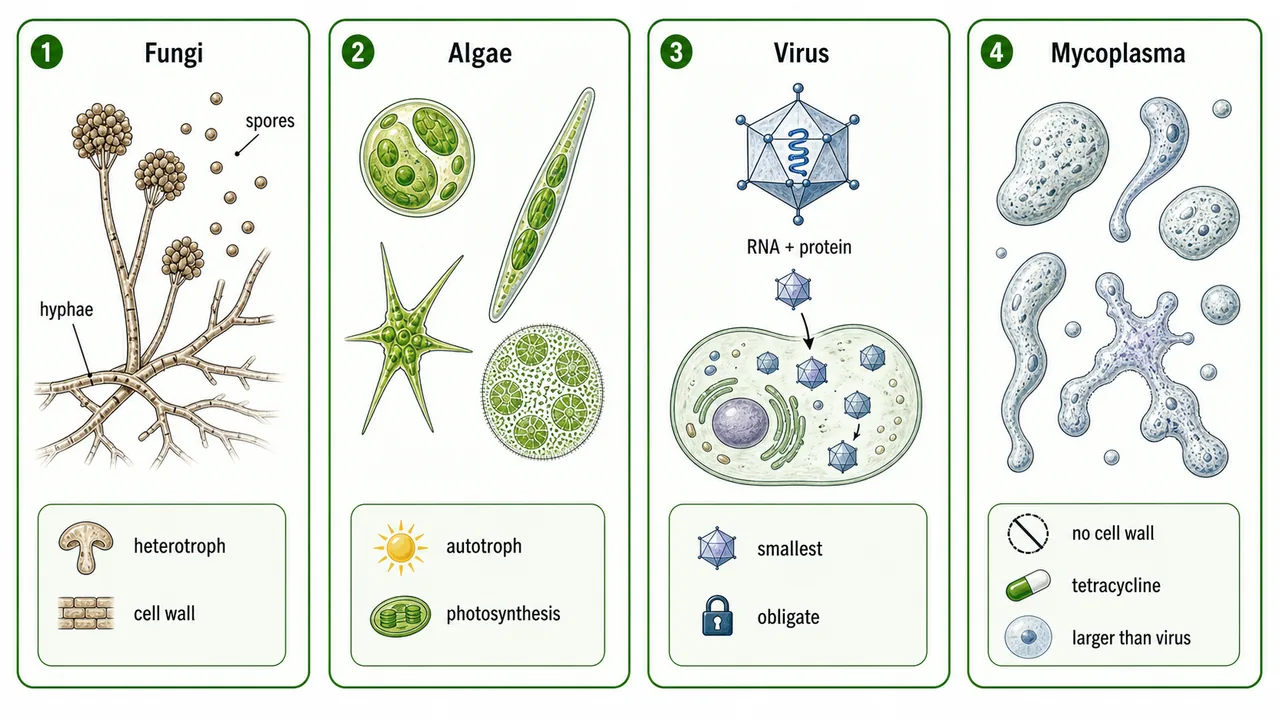
"Sterilisation = Total kill, Disinfection = Partial kill." Sterilisation is absolute; disinfection is relative.
- In antimicrobial terminology, a bacteriostatic chemical only inhibits bacterial growth without necessarily killing the cells, whereas a bactericidal treatment actually kills bacteria.
Methods of Heat Sterilisation — Comparison Table
| Method | Temperature | Time | Kills Endospores? | Best For |
|---|---|---|---|---|
| Incineration | 500°C | — | Yes | Inoculation loops, needles |
| Boiling | 100°C | 30 min | No (may not) | Basic water purification |
| Intermittent boiling | 100°C | 3 × 30 min (with cooling) | Yes | Media when autoclave unavailable |
| Autoclave (steam under pressure) | 121°C | 15 min at 15 lbs/sq. inch | Yes | Culture media, surgical tools |
| Dry heat (Hot air oven) | 160°C / 2 hrs OR 180°C / 30 min | — | Yes | Glassware, metal (NOT plastic) |
| Pasteurisation (Batch) | 62.8°C | 30 min | No | Milk (traditional) |
| Pasteurisation (Flash) | 71.7°C | 15 seconds | No | Milk (industrial — better quality) |
IMPORTANT
Autoclave (121°C, 15 lbs pressure, 15–20 min) is the gold standard for sterilisation. It kills everything including endospores. Boiling alone does NOT sterilise — it may leave endospores alive. Culture media are sterilised in an Autoclave.
- The method of intermittent boiling is also known as Tyndallization, named after John Tyndall.
- Conceptually, Tyndallization is a form of fractional sterilization by discontinuous heating: repeated heating destroys vegetative cells, while the cooling intervals allow surviving spores to germinate before the next heating cycle.
- In compact exam recall, Tyndallization is often written as 100°C for about 15 minutes on three successive days, though descriptive notes may show slightly different heating durations.
Pasteurisation Facts
- Bacteria that survive at pasteurisation temperature are called Thermoduric
- The Flash method (71.7°C / 15 seconds) is preferred for industrial milk processing — fewer effects on quality and taste
- Pasteurisation kills most vegetative bacterial cells but does NOT kill all endospores
TIP
Dry heat rule: Increasing temperature by 10°C shortens sterilising time by 50%. That is why 160°C needs 2 hours but 180°C needs only 30 minutes.
Antibiotic and Diagnostic Recall
- Penicillin was discovered by Alexander Fleming from Penicillium notatum, and later production methods were scaled by Florey and Chain.
- Streptomycin is classically linked with Selman Waksman and Streptomyces griseus.
- Streptocycline is the standard agriculture recall for the combination streptomycin sulphate + tetracycline hydrochloride.
- Aureofungin is remembered as the first antibiotic developed in India for plant-disease use.
- Because mycoplasma lacks a cell wall, it is considered resistant to penicillin, whereas tetracycline remains the standard control recall.
- In plant-diagnostic recall, ELISA for plant-virus detection is classically associated with Clark and Adams, while the broader assay development history is linked with Perlmann and Engvall.
Comparison — Sterilisation Methods at a Glance
| Method | Type | Temperature | Endospores Killed? | Common Agricultural Use |
|---|---|---|---|---|
| Autoclave | Moist heat | 121°C | Yes | Lab media sterilisation |
| Hot air oven | Dry heat | 160–180°C | Yes | Glassware |
| Boiling | Moist heat | 100°C | No | Basic water treatment |
| Pasteurisation | Moist heat | 62.8–71.7°C | No | Milk processing |
| Solar treatment | Dry heat | Sun heat | Partial | Seed treatment (loose smut) |
| Chemical (Formaldehyde) | Chemical | Room temp | Yes | Soil fumigation |
Summary Table — Key Facts at a Glance
| Fact | Answer |
|---|---|
| N-fixing enzyme | Nitrogenase |
| N-fixing gene | Nif genes |
| Nif gene associated with | Rhizobium bacteroid |
| Co-factor for N-fixation | Cobalt (Co) |
| Element in nitrogenase | Molybdenum (Mo) |
| Red pigment in nodules | Leghemoglobin |
| Symbiotic N-fixer | Rhizobium |
| Free-living N-fixer (aerobic) | Azotobacter |
| Free-living N-fixer (anaerobic) | Clostridium |
| Non-legume nodulation | Frankia (Alnus, Casuarina) |
| Legume not fixing N₂ | Rajma |
| Rice field N-fixation | Anabaena + Azolla |
| Holoenzyme formula | Apoenzyme + Co-enzyme + Co-factor |
| Term "enzyme" coined by | Kuhne (1878) |
| Gold standard sterilisation | Autoclave (121°C, 15 lbs, 15 min) |
| Boiling kills endospores? | No (may not) |
| Thermoduric bacteria survive | Pasteurisation temperature |
| Flash pasteurisation | 71.7°C / 15 seconds |
| Stem nodules in | Sesbania (Azorhizobium) |
Summary Cheat Sheet
| Fact | Answer |
|---|---|
| N-fixing enzyme | Nitrogenase |
| N-fixing gene | Nif genes |
| Nif gene associated with | Rhizobium bacteroid |
| Co-factor for N-fixation | Cobalt (Co) |
| Element in nitrogenase complex | Molybdenum (Mo) |
| Red pigment in root nodules | Leghemoglobin |
| Leghemoglobin protects | Nitrogenase from O₂ |
| Symbiotic N-fixer | Rhizobium |
| Free-living aerobic N-fixer | Azotobacter |
| Free-living anaerobic N-fixer | Clostridium pasteurianum |
| Non-legume nodulation | Frankia (Alnus, Casuarina) |
| Stem + root nodules in | Sesbania (via Azorhizobium caulinodans) |
| Legume NOT fixing N₂ | Rajma (Kidney bean) |
| Rice field N-fixation | Anabaena + Azolla |
| Holoenzyme = | Apoenzyme + Co-enzyme + Co-factor |
| Apoenzyme is the | Protein part of enzyme |
| Co-factor is | Inorganic ion (Zn²⁺, Mg²⁺, Fe²⁺) |
| Term "enzyme" coined by | Kuhne (1878) |
| Gold standard sterilisation | Autoclave (121°C, 15 lbs, 15 min) |
| Boiling kills endospores? | No |
| Dry heat — glassware | Hot air oven (160°C/2 hr or 180°C/30 min) |
| Flash pasteurisation | 71.7°C / 15 seconds |
| Batch pasteurisation | 62.8°C / 30 minutes |
| Thermoduric bacteria survive | Pasteurisation temperature |
Microbiology Quick Facts for Exams
| Fact | Answer |
|---|---|
| Leguminous crop not fixing N₂ | Rajma |
| Blue pigment in BGA | Phycocyanin |
| Nif gene associated with | Rhizobium bacteroid |
| Non-legume N-fixing plants | Alnus, Casuarina, Myrica |
| Yeast responsible for fermentation | Saccharomyces cerevisiae |
| Baker's yeast | Candida milleri |
| Bacteria not responsible for N-fixation | E. coli |
| Photosynthetic microorganism | Algae |
| Primary producers of organic matter | Algae |
| Most numerous organisms in soil | Bacteria |
| Richest source of antibiotics | Actinomycetes (Streptomyces) |
| Penicillin discovered by | Alexander Fleming |
| Red pigment in root nodules | Leghemoglobin |
| Best media for growing fungi | PDA (Potato Dextrose Agar) |
| Solidifying agent in culture media | Agar-agar |
| Cowpox vaccine against smallpox | Edward Jenner |
Lesson Doubts
Ask questions, get expert answers