👶 Plant Physiology & Water Relations — The Science of How Plants Work
Introduction to plant physiology, photosynthesis basics, functions of water in plants, and the three key questions of water relations with exam-focused tables
From Field to Lab — Why Every Farmer is a Plant Physiologist
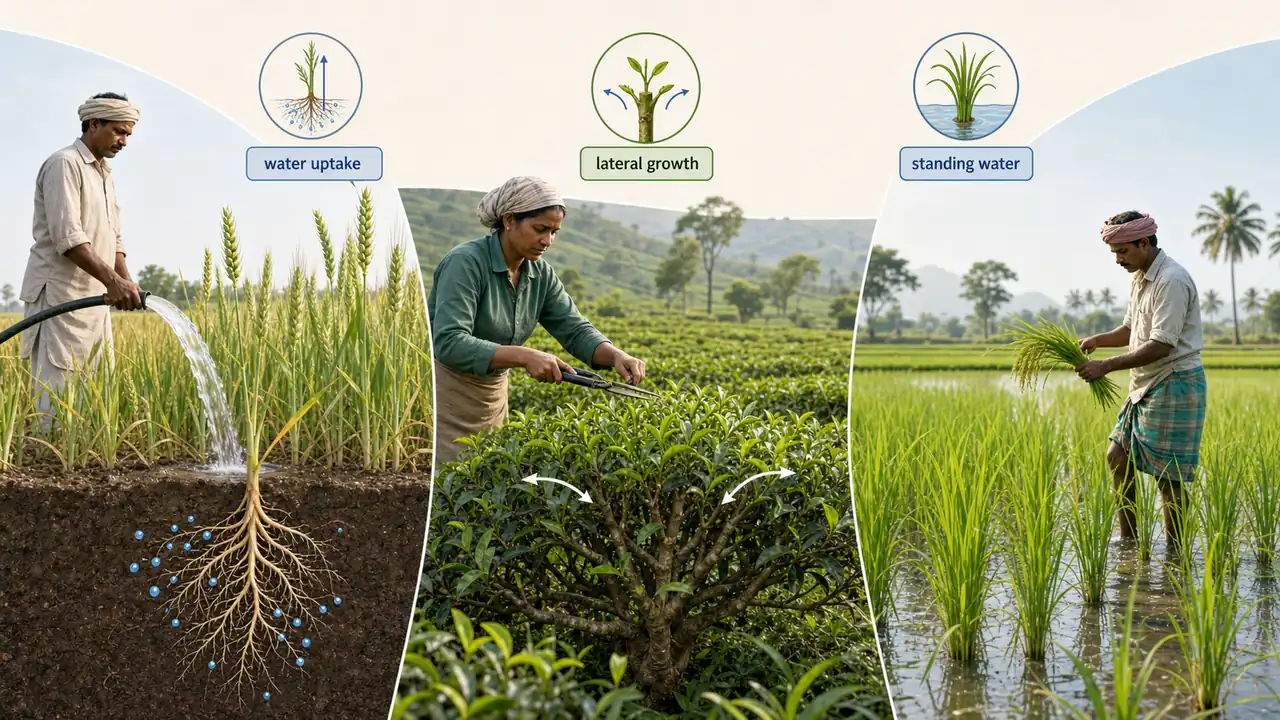
A wheat farmer in Haryana irrigates at the right time, a tea planter prunes bushes to promote lateral growth, and a rice grower floods the paddy to maintain standing water. Each of these decisions is rooted in plant physiology — the science of how plants absorb water, produce food, grow, and respond to their environment. Understanding these processes is not just academic; it directly determines yield, quality, and profitability of every crop.
This lesson covers:
- What is Plant Physiology — definition, scope, and the father of plant physiology
- Introduction to Photosynthesis — equation, chloroplast structure, and compensation point
- Functions of Water — the six key roles water plays inside a plant
- Water Relations — the three fundamental questions that structure the upcoming lessons
- Photosynthesis vs Respiration — a comparison table for exam clarity
All topics are high-yield for exams, NABARD, and FCI exams.
Pro Content Locked
Upgrade to Pro to access this lesson and all other premium content.
Charged once for one year · ₹1188 total
Save ₹100/month vs ₹2388/year launch price
- All Agriculture & Banking Courses
- AI Lesson Questions (100/day)
- AI Doubt Solver (50/day)
- Glows & Grows Feedback (30/day)
- AI Section Quiz (20/day)
- 22-Language Translation (100/day)
- Recall Questions (20/day)
- AI Quiz (15/day)
- AI Quiz Paper Analysis (100/day)
- AI Step-by-Step Explanations (100/day)
- Spaced Repetition Recall (FSRS)
- AI Tutor
- Immersive Text Questions
- Audio Lessons — Hindi & English
- Mock Tests & Previous Year Papers
- Summary & Mind Maps
- XP, Levels, Leaderboard & Badges
- Generate New Classrooms
- Voice AI Teacher (AgriDots Live)
- AI Revision Assistant
- Knowledge Gap Analysis
- Interactive Revision (LangGraph)
🔒 Secure one-time yearly payment via Razorpay · No hidden fees
From Field to Lab — Why Every Farmer is a Plant Physiologist
A wheat farmer in Haryana irrigates at the right time, a tea planter prunes bushes to promote lateral growth, and a rice grower floods the paddy to maintain standing water. Each of these decisions is rooted in plant physiology — the science of how plants absorb water, produce food, grow, and respond to their environment. Understanding these processes is not just academic; it directly determines yield, quality, and profitability of every crop.
This lesson covers:
- What is Plant Physiology — definition, scope, and the father of plant physiology
- Introduction to Photosynthesis — equation, chloroplast structure, and compensation point
- Functions of Water — the six key roles water plays inside a plant
- Water Relations — the three fundamental questions that structure the upcoming lessons
- Photosynthesis vs Respiration — a comparison table for exam clarity
All topics are high-yield for exams, NABARD, and FCI exams.
What is Plant Physiology?
Before diving into individual processes like photosynthesis or transpiration, we need to define the discipline itself. Plant physiology is the foundation on which all applied crop science rests.
Plant physiology is the study of vital or functional activities of plants. It explores how plants grow, develop, reproduce, and respond to their environment at the molecular, cellular, and whole-organism levels.
- Stephen Hales is the Father of Plant Physiology — he was the first to apply experimental methods to study plant processes, pioneering the quantitative approach that modern physiology still follows
- In 1727, he explained the relationship between sunlight and leaves, suggesting that green plants get part of their nourishment through leaves — a revolutionary idea at a time when scientists believed plants fed exclusively from the soil
- J. C. Bose is commonly remembered as the Father of Indian Plant Physiology, and the classic textbook Plant Physiology is associated with Salisbury and Ross.
- Water is essential for all functional activities of plants — it acts as a solvent, transport medium, temperature regulator, and structural support agent, which is why water relations dominate the first unit of plant physiology
Introduction to Photosynthesis
With the definition of plant physiology established, we now turn to the single most important process in the plant kingdom. Photosynthesis is the engine that powers all of agriculture — every grain of wheat, every sugar crystal, and every fibre of cotton begins here.
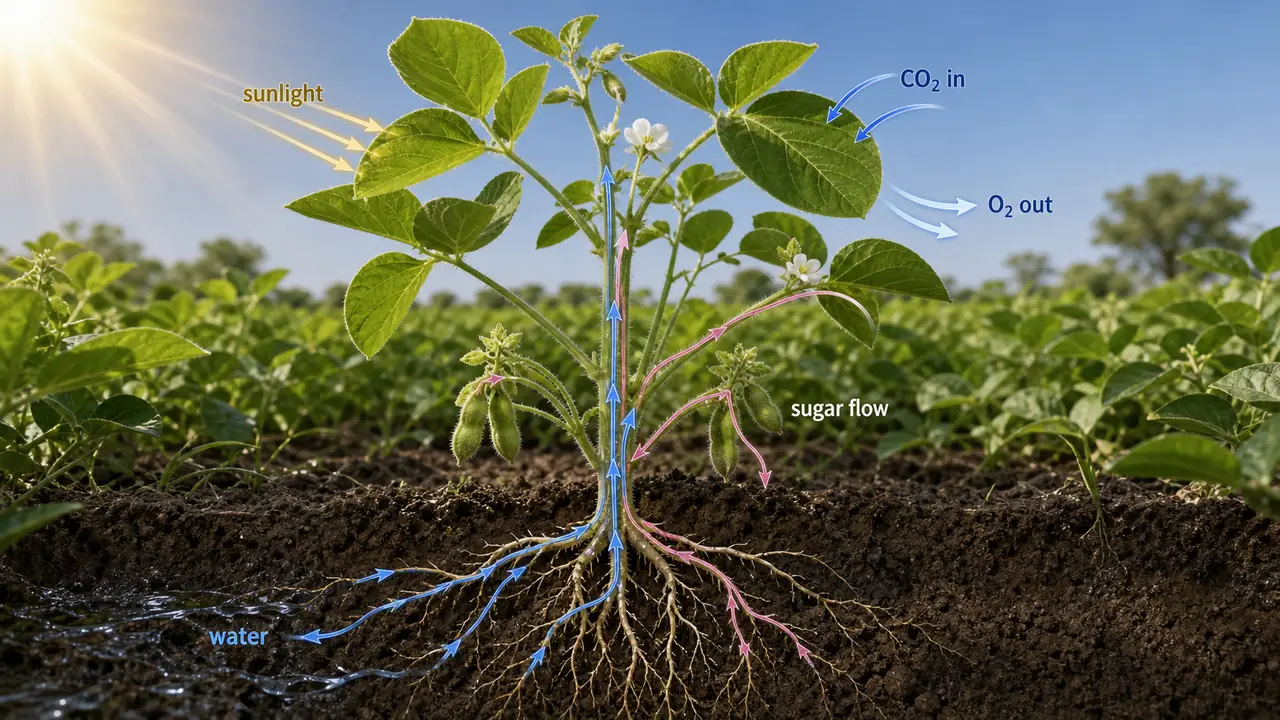
Photosynthesis is the process by which green plants convert light energy into chemical energy stored in carbohydrates. It is also called carbon assimilation.
In standard exam language, photosynthesis is an anabolic process because it builds complex carbohydrates from simple raw materials such as CO₂ and water using an external energy source.
Overall Equation
6CO₂ + 12H₂O →(Light, Green Pigments) 6O₂ + C₆H₁₂O₆ + 6H₂O
| Component | Detail |
|---|---|
| Raw materials | CO₂ and Water |
| Products | Oxygen, Water, and Carbohydrates |
| Energy per glucose molecule | 686 K Calories |
| Type of reaction | Oxidation-reduction (water is oxidized, CO₂ is reduced) |
| First visible product | Starch — established by Sachs (1887) |
| Conversion of light to ATP | Photophosphorylation |
IMPORTANT
Highest rate of photosynthesis is found in C4 Plants (sugarcane, maize, sorghum).
Photosynthetic Apparatus — The Chloroplast
| Feature | Detail |
|---|---|
| Shape | Discoid |
| Size | 4–6 microns length, 1–2 microns thick |
| Internal structure | Stroma with grana (stacks of 5–25 thylakoids) |
| Pigment location | Confined to the grana (site of photochemical reactions) |
| Visible spectrum used | 350–750 nm |
Compensation Point
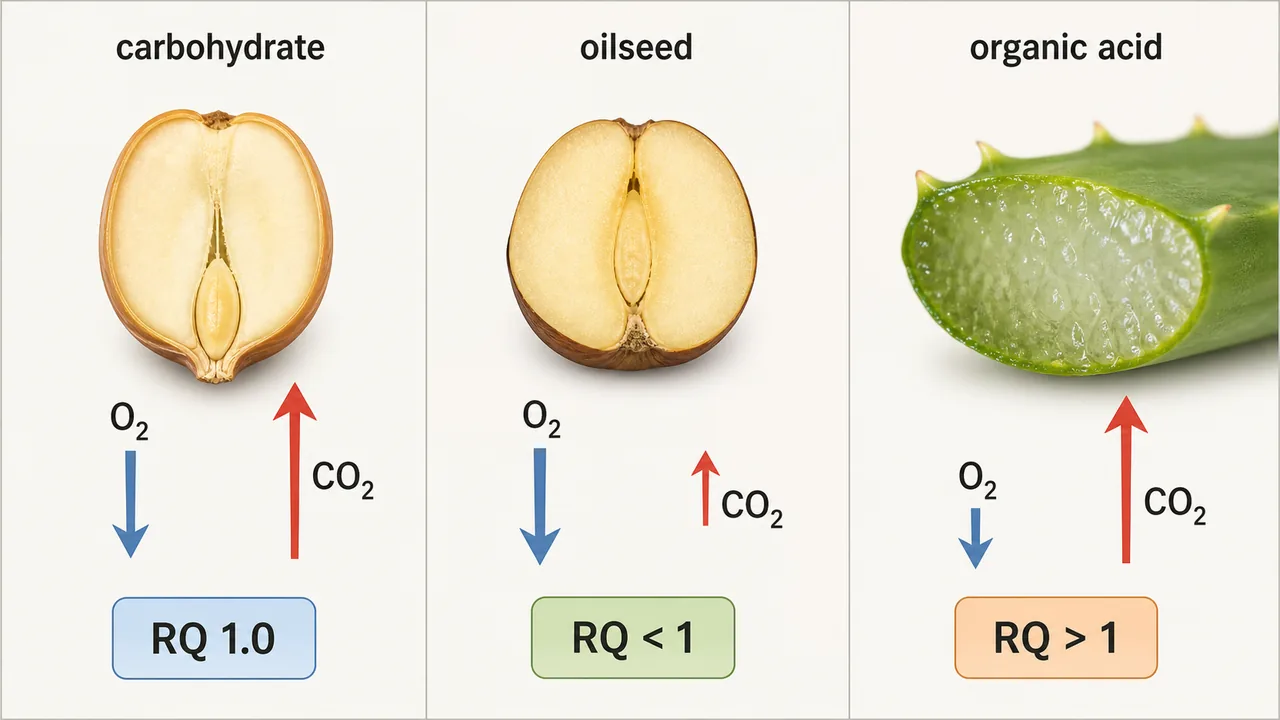
The compensation point is the light intensity at which CO₂ intake by photosynthesis exactly equals CO₂ output by respiration. At this point, net photosynthesis = zero — the plant neither gains nor loses organic matter.
TIP
Agricultural application: Shade-tolerant crops (tea, coffee) have a low compensation point — they can achieve net photosynthesis even in low light. Sun-loving crops (sugarcane, maize) have a high compensation point.
Functions of Water in Plants
Having seen how photosynthesis converts light into food, we now examine the substance without which photosynthesis — and virtually every other plant process — would be impossible: water. Water is not just a raw material for photosynthesis; it serves at least six distinct roles inside the plant body.
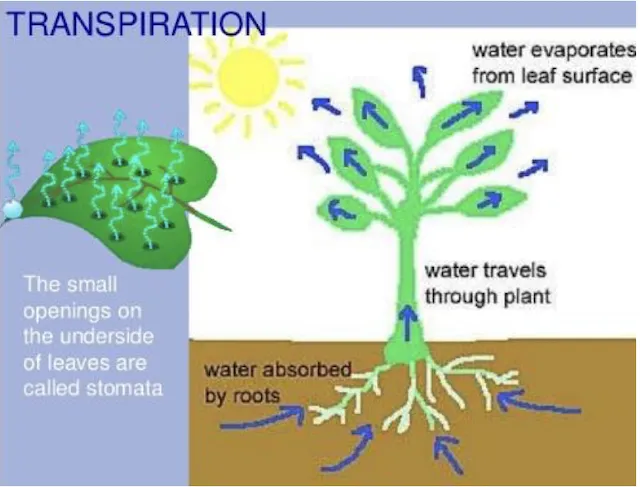
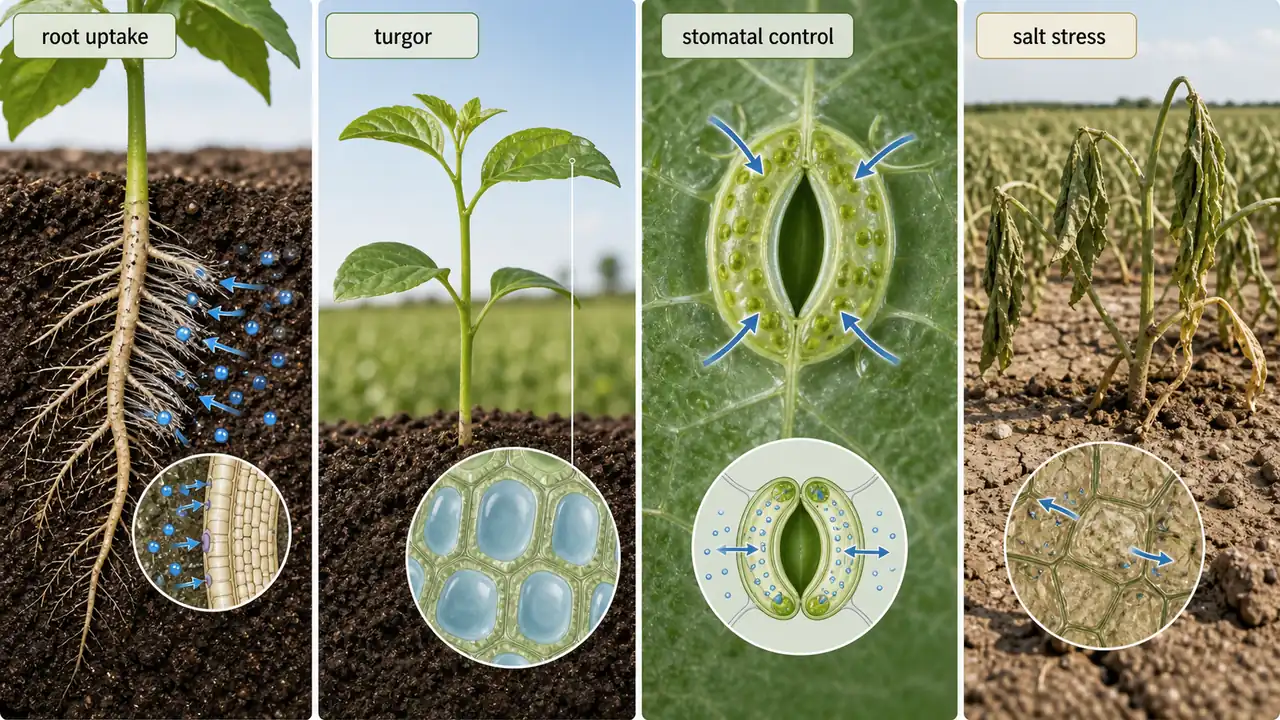
Water is arguably the most important substance for plant life. It forms over 90% of the plant body by fresh weight.
| Function | How It Works | Agricultural Relevance |
|---|---|---|
| Germination | Activates enzymes in seeds | Sowing requires adequate soil moisture |
| Photosynthesis | Raw material and hydrogen donor | Drought reduces carbohydrate production |
| Solvent | Dissolves fertilisers and minerals for root uptake | Nutrients are absorbed only in solution form |
| Transport medium | Moves chemicals via xylem and phloem | Nutrient translocation depends on water flow |
| Turgor pressure | Provides firmness to non-woody plant parts | Wilting = loss of turgor = loss of water |
| Transpiration | Creates pulling force for water and mineral uptake | Transpiration stream drives nutrient absorption |
| Temperature regulation | Transpirational cooling dissipates excess heat | Similar to sweating in animals |
| Aquatic ecosystems | Supports aquatic plant and animal communities | Rice paddies, fisheries, wetland agriculture |
TIP
Exam mnemonic — "GIST Triple-T": Germination, solIent (solvent), Structure (turgor), Transpiration, Transport, Temperature regulation — the six key functions of water in plants.
Water Relations — The Three Key Questions
Now that we know what water does inside the plant, the next logical question is: how does the plant manage its water? Almost all functional activities of plants depend on water relations. The entire topic is built around three fundamental questions that form the structure of the next two lessons:
| Question | Topic | What It Covers |
|---|---|---|
| How does water enter the plant? | Osmosis | Diffusion, osmotic pressure, imbibition |
| How does water move up inside the plant? | Ascent of Sap | Transpiration pull, cohesion theory, root pressure |
| How is water lost from the plant? | Transpiration | Stomatal, cuticular, and lenticular water loss |
TIP
Remember the three key questions of water relations: Entry (Osmosis), Movement (Ascent of Sap), and Loss (Transpiration). These form the logical flow for the upcoming lessons.
Source and Sink Concept
Plant physiology also tracks how the products of photosynthesis are distributed after they are formed. A source is an organ that exports assimilates, while a sink is an organ that imports and uses or stores them.
| Term | Meaning | Typical examples |
|---|---|---|
| Source | Produces and exports sugars, mainly sucrose | Mature leaves |
| Sink | Uses or stores imported assimilates | Seeds, fruits, flowers, roots, tubers, developing organs |
| Transport pathway | Long-distance movement between source and sink | Phloem |
- Sink strength = Sink size × Sink activity
- In field-crop recall, rice and wheat are commonly cited as relatively sink-limited crops, where yield depends strongly on sink development and filling.
Comparison — Photosynthesis vs Respiration
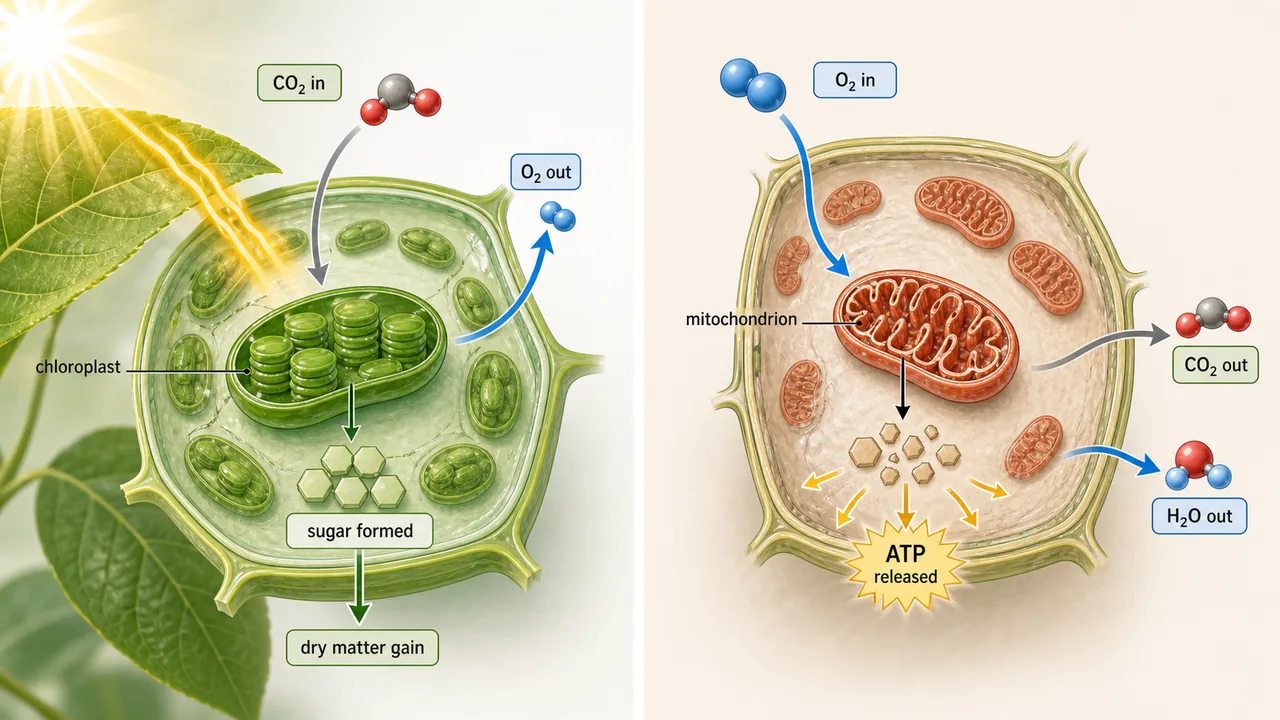
Photosynthesis and respiration are the two sides of the plant's energy economy. Photosynthesis stores energy in organic molecules; respiration releases it for cellular work. Understanding their differences is a recurring exam topic, especially around gas exchange and timing.
| Feature | Photosynthesis | Respiration |
|---|---|---|
| Process | Builds carbohydrates from CO₂ + H₂O | Breaks down carbohydrates to CO₂ + H₂O |
| Energy | Stores energy (endothermic) | Releases energy (exothermic) |
| Occurs in | Chloroplasts | Mitochondria (+ cytoplasm for glycolysis) |
| Gas exchange | Absorbs CO₂, releases O₂ | Absorbs O₂, releases CO₂ |
| When | Only in light | Day and night (continuous) |
| Where | Only in green parts | All living cells |
| Net effect | Increases dry weight | Decreases dry weight |
Summary Cheat Sheet
| Fact | Answer |
|---|---|
| Father of Plant Physiology | Stephen Hales (1727) |
| Father of Indian Plant Physiology | J. C. Bose |
| Classic book | Salisbury and Ross — Plant Physiology |
| Photosynthesis = | Carbon assimilation |
| Nature of photosynthesis | Anabolic process |
| Energy per glucose molecule | 686 K Calories |
| First visible product of photosynthesis | Starch (Sachs, 1887) |
| Highest photosynthesis rate | C4 Plants |
| Light to ATP conversion | Photophosphorylation |
| Chloroplast size | 4–6 microns long, 1–2 microns thick |
| Thylakoids per granum | 5–25 thylakoids |
| Visible spectrum for photosynthesis | 350–750 nm |
| Water content of herbaceous plants | 80–90% |
| Water content of woody plants | Often over 50% |
| Water entry into plant | Osmosis |
| Water movement upward | Ascent of Sap |
| Water loss from plant | Transpiration |
| Compensation point | Light intensity where photosynthesis = respiration |
TIP
Next: Lesson 02 covers Osmosis, Diffusion, and Water Absorption — the detailed mechanisms behind the first question of water relations: how water enters the plant.