🎨 Photosynthetic Pigments — Chlorophyll, Carotenoids, Phycobilins, and Anthocyanins
History of photosynthesis discoveries, chlorophyll a vs b, carotene, xanthophyll, phycobilins, anthocyanin, light and dark reactions overview, and Leaf Area Index with comparison tables
From Field to Lab — Why Leaves Are Green and Carrots Are Orange
In the previous chapter on Water Relations, we explored how water enters, moves through, and exits the plant. Now we shift to the other side of the photosynthesis equation — light capture. Stomata let CO₂ in, but it is the pigments inside chloroplasts that actually harvest the light energy needed to fix that CO₂ into sugars.
Have you ever wondered why healthy rice leaves are deep green, autumn leaves turn yellow, and carrots are bright orange? The answer lies in photosynthetic pigments. Chlorophyll makes leaves green by reflecting green light while absorbing red and blue light for photosynthesis. When chlorophyll breaks down in autumn, the hidden yellow carotenoid pigments are revealed. In carrots, the orange beta-carotene (a precursor of Vitamin A) dominates. Understanding these pigments is essential — they are the molecular machinery that captures sunlight and powers all of agriculture.
Pro Content Locked
Upgrade to Pro to access this lesson and all other premium content.
Charged once for one year · ₹1188 total
Save ₹100/month vs ₹2388/year launch price
- All Agriculture & Banking Courses
- AI Lesson Questions (100/day)
- AI Doubt Solver (50/day)
- Glows & Grows Feedback (30/day)
- AI Section Quiz (20/day)
- 22-Language Translation (100/day)
- Recall Questions (20/day)
- AI Quiz (15/day)
- AI Quiz Paper Analysis (100/day)
- AI Step-by-Step Explanations (100/day)
- Spaced Repetition Recall (FSRS)
- AI Tutor
- Immersive Text Questions
- Audio Lessons — Hindi & English
- Mock Tests & Previous Year Papers
- Summary & Mind Maps
- XP, Levels, Leaderboard & Badges
- Generate New Classrooms
- Voice AI Teacher (AgriDots Live)
- AI Revision Assistant
- Knowledge Gap Analysis
- Interactive Revision (LangGraph)
🔒 Secure one-time yearly payment via Razorpay · No hidden fees
From Field to Lab — Why Leaves Are Green and Carrots Are Orange
In the previous chapter on Water Relations, we explored how water enters, moves through, and exits the plant. Now we shift to the other side of the photosynthesis equation — light capture. Stomata let CO₂ in, but it is the pigments inside chloroplasts that actually harvest the light energy needed to fix that CO₂ into sugars.
Have you ever wondered why healthy rice leaves are deep green, autumn leaves turn yellow, and carrots are bright orange? The answer lies in photosynthetic pigments. Chlorophyll makes leaves green by reflecting green light while absorbing red and blue light for photosynthesis. When chlorophyll breaks down in autumn, the hidden yellow carotenoid pigments are revealed. In carrots, the orange beta-carotene (a precursor of Vitamin A) dominates. Understanding these pigments is essential — they are the molecular machinery that captures sunlight and powers all of agriculture.
This lesson covers:
- Historical Milestones — key scientists and discoveries in photosynthesis research
- Chlorophyll Pigments — Chl. a vs Chl. b, structure, and role
- Carotenoid Pigments — carotene vs xanthophyll
- Phycobilin Pigments — phycoerythrin and phycocyanin in algae
- Anthocyanin — the non-photosynthetic purple pigment
- Light and Dark Reactions — overview and source of oxygen
- Leaf Area Index (LAI) — measuring canopy productivity
All topics are high-yield for exams, NABARD, and FCI exams.
Historical Milestones of Photosynthesis
Our understanding of photosynthesis was built over three centuries of careful experimentation. These scientist-discovery pairs are frequently tested in exams — knowing the chronological flow also helps understand how each discovery corrected or extended the previous one.
About 90% of the world's photosynthesis is carried out by marine and freshwater algae — not by land plants. The following scientists built our understanding of this process over three centuries:
Timeline of Key Photosynthesis Discoveries
| Year | Scientist | Discovery |
|---|---|---|
| 17th c. | Von Helmont | Water and soil contribute to plant growth (willow tree experiment) |
| 1727 | Stephan Hales | Plants get nourishment through leaves using sunlight |
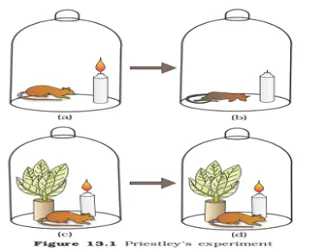
| 1772 | Priestley | Gas exchange — plants "restore" air injured by a burning candle |
| 1779 | Ingenhouz (Austria) | Only green parts in light produce O₂; recognised role of chlorophyll |
| 1800 | Jean Senebier | O₂ comes from CO₂ (later corrected); red light most effective |
| 1837 | Dutrochet | Green part of plant essential for photosynthesis |
| 1840 | Liebig | Sole source of carbon in plants = CO₂ from air |
| 1840 | de Saussure | Water also utilised in photosynthesis |
| 1845-48 | Robert Mayer | Conservation of energy; plants convert light → chemical energy |
| 1887 | Sachs | Chloroplast is the site; starch is first visible product (iodine test) |
- Older historical one-liners sometimes also credit Francis Bacon with the early idea that water is the principal nourishment of plants. Treat this as part of the pre-modern evolution of plant-nutrition ideas rather than as the current scientific view.
-
Some older exam books key Priestley's oxygen-restoration experiment to 1771. Treat this as a textbook date variant; the shared lesson keeps the standard 1772 chronology.
-
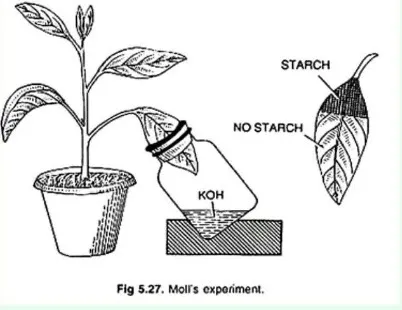
Moll's half leaf experiment proved that CO₂ is necessary for photosynthesis — KOH covering one half absorbed CO₂, so no starch was produced in that half (tested by iodine), while the uncovered half produced starch normally
TIP
Mnemonic for Photosynthesis Pioneers — "Hales Priestly Inge Sene": Hales (sunlight+leaves), Priestley (gas exchange), Ingenhouz (light+green parts), Senebier (CO₂ absorbed). These four laid the groundwork.
Photosynthetic Pigments — Overview
With the historical context established, we now examine the pigments themselves. Four groups of pigments are found in plants — but only three actually participate in photosynthesis. The fourth (anthocyanin) is a common exam trap.
Plants appear green because they reflect green light and absorb red and blue wavelengths for photosynthesis.
| Pigment Group | Colour | Solubility | Role in Photosynthesis | Location |
|---|---|---|---|---|
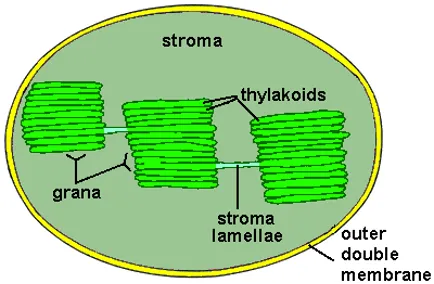
| Chlorophyll | Green | Insoluble in water; soluble in organic solvents | Primary pigment | Grana (thylakoid membrane) |
| Carotenoids | Yellow-Orange | Insoluble in water; fat-soluble | Accessory pigment + photoprotection | Chloroplast & chromoplast |
| Phycobilins | Red or Blue | Soluble in hot water | Accessory pigment (BGA & red algae) | Cytoplasm |
| Anthocyanins | Purple-Red | Soluble in water | No role in photosynthesis | Cell sap (vacuole) |
A. Chlorophyll Pigments
Chlorophylls are magnesium porphyrin compounds located in the grana of chloroplasts. At least 7 types are known (a, b, c, d, e, bacteriochlorophyll, bacterioviridin).
Structure
- All chlorophyll molecules contain a tetrapyrrole skeleton (4 pyrrole rings) with Magnesium (Mg) at the centre
- A chlorophyll molecule has a porphyrin head with central Mg and a long hydrophobic phytol tail that helps anchor it in the thylakoid membrane.
- Only Chl. a and Chl. b contain Magnesium
- Precursor: Protochlorophyllide → Chlorophyllide → Chl. a → Chl. b
- In the thylakoid membrane, chlorophyll is organized into functional pigment-protein units traditionally described as quantasomes, which serve as basic light-harvesting assemblies.
Chlorophyll a vs Chlorophyll b — Detailed Comparison
| Feature | Chl. a | Chl. b |
|---|---|---|
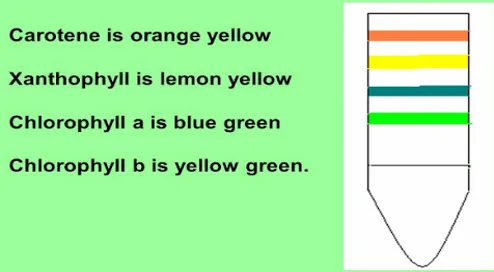
| Colour | Blue-green micro-crystalline solid | Yellow-green / black micro-crystalline solid |
| Empirical formula | C₅₅H₇₂O₅N₄Mg | C₅₅H₇₀O₆N₄Mg |
| Solution in ethyl alcohol | Blue-green solution | Yellow-green solution |
| Occurrence | Universal in all green plants | In higher plants and green algae but absent in blue-green, brown and red algae |
| Methyl/Aldehyde group | Possesses a —CH₃ group (methyl) attached to carbon no. 3 | Possesses —CHO (aldehyde) group attached to carbon no. 3 |
| Maximum absorption | Absorbs at 449 nm in red and 2nd peak at 660 nm in red end | Absorbs at 453 nm in red end and at 642 nm in red end |
| Role in photosynthesis | Light absorbed by Chl. a is utilised by itself in photosynthesis | Light absorbed by Chl. b is transferred to Chl. a (i.e. b → a) and Chl. d → Chl. a |
IMPORTANT
Chl. a is the only pigment that directly participates in photosynthetic reactions. All other pigments (Chl. b, carotenoids, phycobilins) are accessory — they absorb light and transfer the energy to Chl. a.
NOTE
Chl. c is found in brown algae and diatoms. Chl. d is found in red algae (breakdown product of Chl. a). Both are accessory pigments.
| Name of pigment | Proportion | Remarks |
|---|---|---|
| Chlorophyll a | 2 parts | Green pigment |
| Chlorophyll b | 2/3 of one part | Green pigment |
| Carotene | 1/6 of one part | Yellow pigment |
| Xanthophyll | 1/3 of one part per 1000 parts | Yellow pigment |
The classic pigment proportion table reinforces that chlorophyll a predominates, while carotenoids occur in much smaller amounts.
- In compact objective-style recall, the chlorophyll a : chlorophyll b proportion is often summarized as roughly 3:1.
B. Carotenoid Pigments
Carotene and Xanthophyll together are called carotenoids — they are fat-soluble yellow pigments, insoluble in water, located in chloroplasts and chromoplasts.
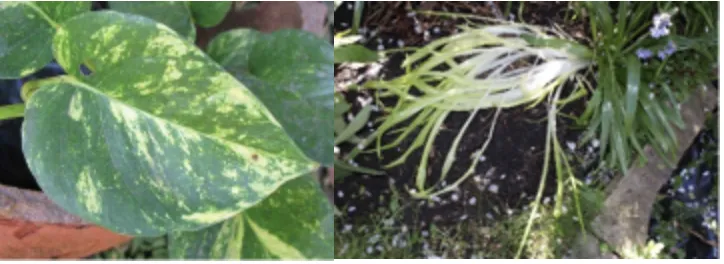
- Yellow colour of etiolated and variegated leaves is due to carotenoids
- They absorb strongly in the blue-violet and ultraviolet range
- Energy absorbed is transferred to Chl. a → results in fluorescence
- In older exam wording, carotenoids are also emphasised as accessory pigments that protect chlorophyll from photo-oxidation under excess light.
Carotene vs Xanthophyll — Comparison
| Feature | Carotene | Xanthophyll |
|---|---|---|
| Colour | Orange-yellow | Yellow to brown |
| Formula | C₄₀H₅₆ (pure hydrocarbon — no oxygen) | C₄₀H₅₆O₂ (contains oxygen) |
| Abundance | Less abundant | More abundant than carotene |
| Common form | Beta-carotene (precursor of Vitamin A) | Luteol (lutein), violaxanthin |
| Named after | Carrot (abundant in carrot roots) | Greek "xanthos" = yellow |
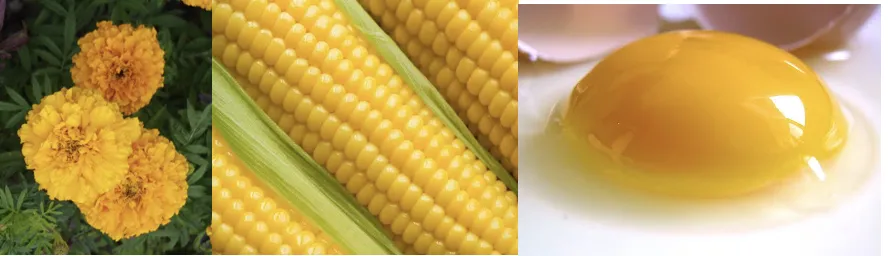
| Notable example | — | Zeaxanthin = principal yellow pigment of maize |
- A small book-style recall point: carotene is quickly oxidized in air, which is why a scraped carrot can show a rapid colour change on exposure.
TIP
How to distinguish: Carotene = no oxygen (C₄₀H₅₆), Xanthophyll = has oxygen (C₄₀H₅₆O₂). The "O₂" in xanthophyll is the key difference.
C. Phycobilin Pigments
Phycobilins are accessory pigments found exclusively in algae, not in higher plants. They enable photosynthesis in deep water where only blue-green wavelengths penetrate — a critical adaptation for aquatic organisms.
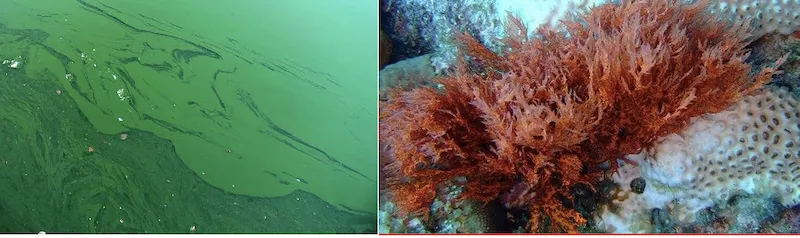
Found in blue-green algae (BGA) and red algae. These pigments are crucial for photosynthesis in aquatic environments.
| Feature | Detail |
|---|---|
| Structure | Tetrapyrrole rings in straight chain (open, unlike chlorophyll's closed ring) |
| Magnesium | Not present |
| Energy transfer | Absorbed light → transferred to Chl. a |
| Solubility | Soluble in hot water |
| Pigment | Colour | Found in |
|---|---|---|
| Phycoerythrin | Red | Red algae |
| Phycocyanin | Blue | Blue-green algae (BGA) |
TIP
Mnemonic: Phyco-Erythrin = Ermesinda (red), Phyco-Cyanin = Cerulean (blue). "Erythro" = red (like erythrocytes), "Cyano" = blue (like cyan).
D. Anthocyanin
Anthocyanin is a common exam trap — despite being a plant pigment, it plays no role in photosynthesis. It is found in the vacuole (cell sap), not in the chloroplast, and serves entirely different functions.
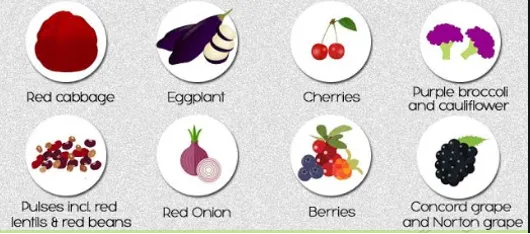
- Purple pigment, soluble in water, dissolved in cell sap (vacuole, not cytoplasm)
- Does NOT take part in photosynthesis
- Present in Sugarbeet, Brinjal, Apple, Pomegranate, and Litchi
- Functions: attracting pollinators, UV protection, deterring herbivores
Two Phases of Photosynthesis
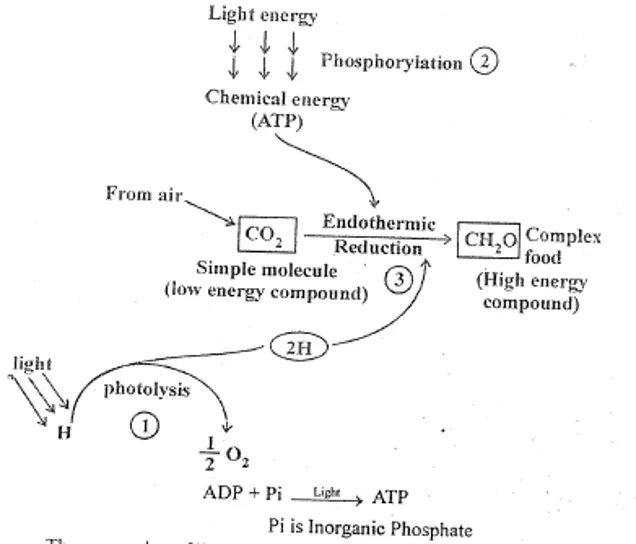
With all four pigment groups covered, we now see how they function in the actual process. Photosynthesis proceeds in two distinct phases — a light-dependent phase (where pigments capture energy) and a light-independent phase (where that energy is used to fix CO₂). These phases differ in location, products, and sensitivity.
| Feature | Light Phase | Dark Phase |
|---|---|---|
| Other names | Photochemical reaction, Hill's reaction | Blackman's reaction, Path of Carbon |
| Location | Thylakoid membranes (grana) | Stroma of chloroplast |
| Sensitivity | Light sensitive | Temperature sensitive (enzyme-dependent) |
| Products | ATP + NADPH₂ + O₂ | Carbohydrates (glucose) |
| Named after | F.F. Blackman (dark phase) | — |

Source of Oxygen in Photosynthesis
One of the most important corrections in photosynthesis research was identifying the true source of oxygen. For decades, scientists assumed O₂ came from CO₂ — three landmark experiments proved it actually comes from water. This is a very high-yield exam topic.
Ancient View vs Modern View
| View | Source of O₂ | Evidence |
|---|---|---|
| Ancient | CO₂ | — |
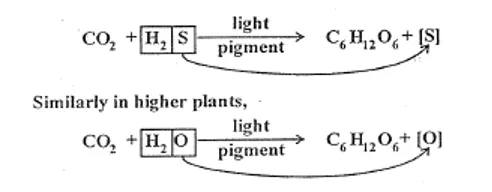
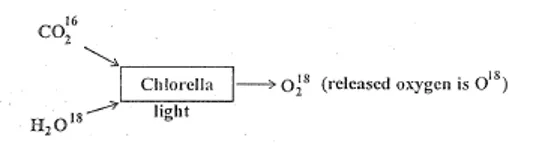
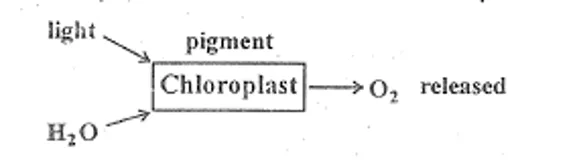
| Modern (correct) | H₂O | Von Niel (purple sulphur bacteria), Ruben (isotope O¹⁸ in Chlorella), Hill (isolated chloroplast) |

Three key experiments:
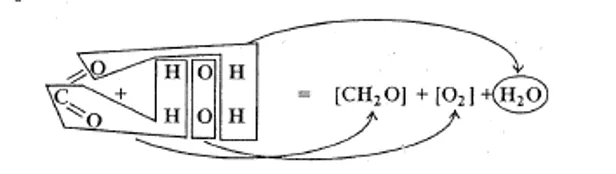
- Von Niel — Purple sulphur bacteria use H₂S instead of H₂O; O₂ analogue comes from H₂S → by analogy, O₂ from H₂O in green plants
- Ruben — Used heavy oxygen (O¹⁸) in water with Chlorella; O₂ released contained O¹⁸ → proves O₂ from water
- Hill — Isolated chloroplasts released O₂ without CO₂ supply → O₂ from water splitting
Key Terms
- Photolysis of water = breakdown of H₂O into H and O by light energy (at Photosystem II)
- Photophosphorylation = conversion of light energy into ATP
- In standard textbook recall, the oxygen released as O₂ during photosynthesis comes from water, whereas the oxygen incorporated into glucose/carbohydrate is traced back to CO₂.
Leaf Area Index (LAI)
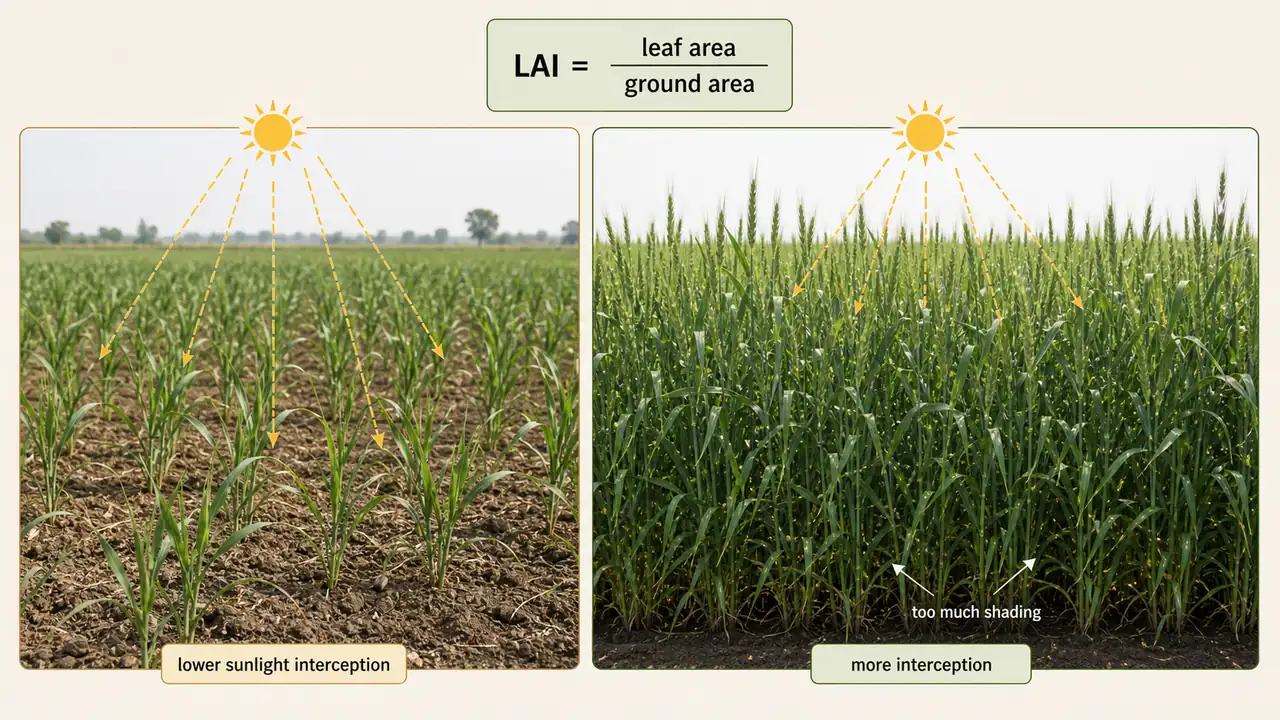
The total photosynthesis of a crop depends not just on individual leaf efficiency but on how much total leaf surface is available to intercept sunlight. LAI quantifies this at the canopy level — a key concept linking pigment biology to field-level productivity.
LAI is a dimensionless quantity that characterises plant canopies — an important measure for crop productivity.
- LAI = Leaf Area / Ground Area
- Leaf Area = L × W × A (L = length, W = max width, A = constant specific to the crop species)
- Higher LAI = more leaf surface for photosynthesis, but excessively high LAI causes mutual shading — lower leaves receive insufficient light and may fall below their compensation point, becoming net consumers of carbohydrates rather than producers
- Optimum LAI varies by crop species — typically 3–5 for cereals and 6–8 for some tropical crops
- In older crop-physiology recall tables, the flag leaf is credited with contributing about 52% of total photosynthesis supporting grain filling, which is why flag-leaf health matters so much in cereal yield.
Explore More
Summary Cheat Sheet
| Fact | Answer |
|---|---|
| 90% of world photosynthesis by | Marine and freshwater algae |
| Flag-leaf contribution to photosynthesis | ~52% |
| First visible product of photosynthesis | Starch (Sachs, 1887) |
| Chl. a colour | Blue-green |
| Chl. b colour | Yellow-green |
| Primary photosynthetic pigment | Chlorophyll a |
| Accessory pigments | Chl. b, carotenoids, phycobilins |
| Chl. a formula | C₅₅H₇₂O₅N₄Mg |
| Central atom in chlorophyll | Magnesium (Mg) |
| Carotene formula | C₄₀H₅₆ (no oxygen) |
| Xanthophyll formula | C₄₀H₅₆O₂ (has oxygen) |
| Beta-carotene is precursor of | Vitamin A |
| Zeaxanthin found in | Maize |
| Red pigment in red algae | Phycoerythrin |
| Blue pigment in BGA | Phycocyanin |
| Phycobilins soluble in | Hot water |
| Anthocyanin present in | Sugarbeet, Brinjal, Apple, Pomegranate, Litchi |
| Source of O₂ in photosynthesis | Water (H₂O) |
| Photolysis of water occurs at | Photosystem II |
| Light reactions occur in | Grana (thylakoid membranes) |
| Dark reactions occur in | Stroma |
| LAI formula | Leaf Area / Ground Area |
| Proved O₂ from H₂O (isotope) | Ruben (Chlorella) |
| Anthocyanin role in photosynthesis | No role (found in cell sap, not chloroplast) |
| Chl. a group at carbon 3 | Methyl (-CH₃) |
| Chl. b group at carbon 3 | Aldehyde (-CHO) |
| Von Niel's organism | Purple sulphur bacteria |
| Hill reaction proved | O₂ from water splitting without CO₂ |
| Moll's experiment proved | CO₂ is necessary for photosynthesis |
TIP
Next: Lesson 02 covers the Light Reactions in detail — photophosphorylation (cyclic and non-cyclic), photosystems I and II, electron transport chain, and Emerson's enhancement effect.