🔥 Respiration — The Energy Engine of Every Living Cell
Definition of respiration, aerobic vs anaerobic types, respiratory substrates, energy output, and the amphibolic nature of respiration with comparison tables and exam mnemonics
From Field to Lab — Why Grain Heats Up in Storage
In the previous chapter, we studied photosynthesis — how plants capture light energy and fix CO₂ into carbohydrates. Now we examine the reverse process: respiration, where those carbohydrates are broken down to release energy for every cellular activity.
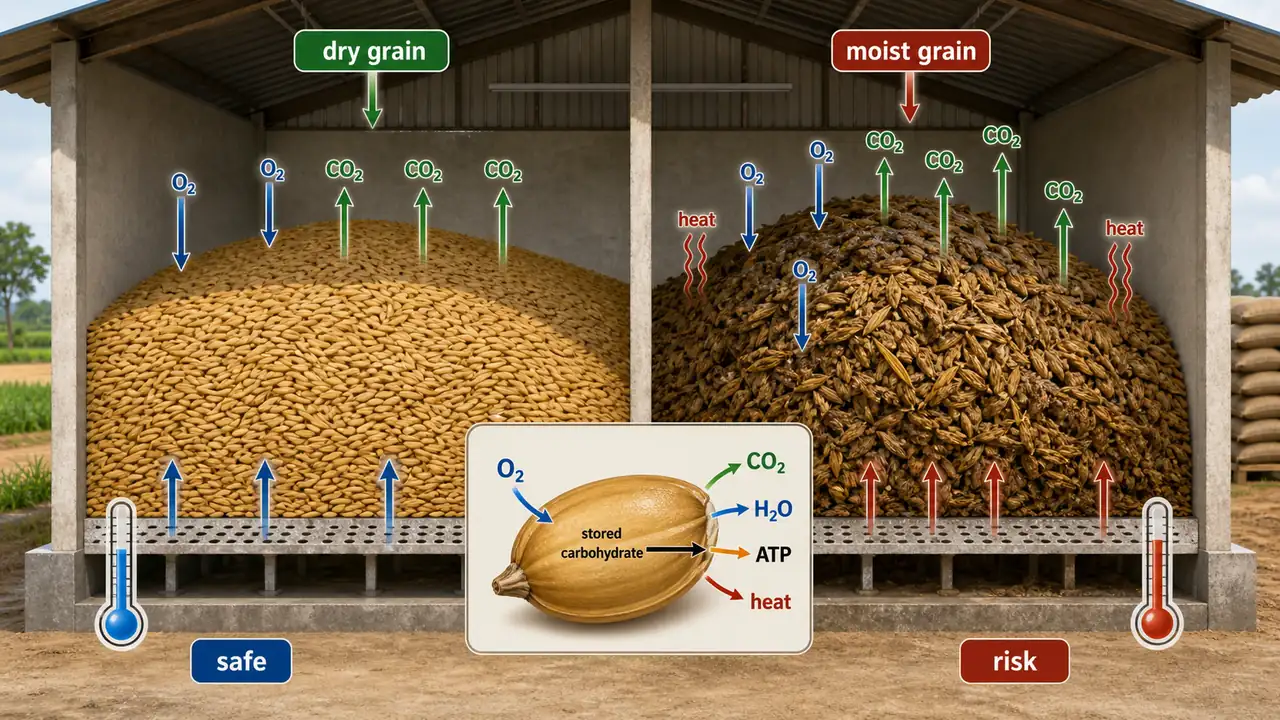
A farmer stores freshly harvested paddy in a poorly ventilated godown. Within days, the grain pile becomes warm to the touch and the moisture content rises. What is happening? The living seeds are respiring — breaking down their stored carbohydrates into CO₂, water, and heat energy. If this process continues unchecked, the grain loses weight, quality deteriorates, and fungal growth begins. This is why proper drying (to 12–14% moisture) and aeration are essential — they slow down respiration and preserve the grain.
This lesson covers:
- Definition and nature of respiration — why it is amphibolic
- Respiratory substrates — carbohydrates, fats, and proteins
- Aerobic vs anaerobic respiration — comparison and ATP yields
- Photosynthesis vs respiration — the master comparison
Respiration is the opposite of photosynthesis: while photosynthesis stores energy, respiration releases it for cellular work.
Pro Content Locked
Upgrade to Pro to access this lesson and all other premium content.
Charged once for one year · ₹1188 total
Save ₹100/month vs ₹2388/year launch price
- All Agriculture & Banking Courses
- AI Lesson Questions (100/day)
- AI Doubt Solver (50/day)
- Glows & Grows Feedback (30/day)
- AI Section Quiz (20/day)
- 22-Language Translation (100/day)
- Recall Questions (20/day)
- AI Quiz (15/day)
- AI Quiz Paper Analysis (100/day)
- AI Step-by-Step Explanations (100/day)
- Spaced Repetition Recall (FSRS)
- AI Tutor
- Immersive Text Questions
- Audio Lessons — Hindi & English
- Mock Tests & Previous Year Papers
- Summary & Mind Maps
- XP, Levels, Leaderboard & Badges
- Generate New Classrooms
- Voice AI Teacher (AgriDots Live)
- AI Revision Assistant
- Knowledge Gap Analysis
- Interactive Revision (LangGraph)
🔒 Secure one-time yearly payment via Razorpay · No hidden fees
From Field to Lab — Why Grain Heats Up in Storage
In the previous chapter, we studied photosynthesis — how plants capture light energy and fix CO₂ into carbohydrates. Now we examine the reverse process: respiration, where those carbohydrates are broken down to release energy for every cellular activity.
A farmer stores freshly harvested paddy in a poorly ventilated godown. Within days, the grain pile becomes warm to the touch and the moisture content rises. What is happening? The living seeds are respiring — breaking down their stored carbohydrates into CO₂, water, and heat energy. If this process continues unchecked, the grain loses weight, quality deteriorates, and fungal growth begins. This is why proper drying (to 12–14% moisture) and aeration are essential — they slow down respiration and preserve the grain.
This lesson covers:
- Definition and nature of respiration — why it is amphibolic
- Respiratory substrates — carbohydrates, fats, and proteins
- Aerobic vs anaerobic respiration — comparison and ATP yields
- Photosynthesis vs respiration — the master comparison
Respiration is the opposite of photosynthesis: while photosynthesis stores energy, respiration releases it for cellular work.
What is Respiration?
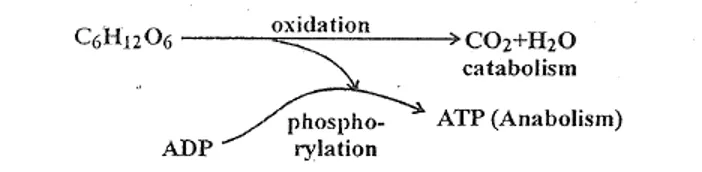
Respiration is the cellular oxidation/breakdown of carbohydrates (and other organic substances) into carbon dioxide, water, and energy (ATP).
| Feature | Detail |
|---|---|
| Process | Oxidation of food in living cells |
| Energy release | Slow, stepwise, enzyme-controlled |
| Energy type | Exothermic (releases heat) |
| Energy storage | Conserved in ATP molecules |
| Nature | Amphibolic — both catabolic (breakdown) and anabolic (building) |
IMPORTANT
Respiration is amphibolic — its intermediates serve as raw materials for biosynthesis (fats, amino acids). It is not purely destructive; it is a central metabolic hub.
- ATP (adenosine triphosphate) is the primary energy currency of the cell. In standard exam wording, it consists of an adenine base, a ribose sugar, and three phosphate groups.
Respiration vs Combustion
| Fast Oxidation | Slow Oxidation | |
|---|---|---|
| 1) Energy release | C₆H₁₂O₆ → Fast release of energy → 673 K.cal. lost as heat or/and light. Release of hydrogen at a time — 12 H | C₆H₁₂O₆ → Slow release of energy → 673 K.cal. Release of hydrogen in phases i.e. 6 oxidation steps = 2 H in each step |
| 2) Temperature | At high temperature | At low temperature |
| 3) Catalyst | Non-catalytic | Catalytic (enzyme) |
| 4) Example | Burning | Respiration |
Unlike rapid combustion (burning), biological respiration releases energy in a stepwise, controlled manner through enzyme-catalysed reactions, capturing energy in ATP rather than losing it entirely as heat.
Key Features of Biological Respiration
Unlike burning (combustion), biological respiration is a controlled, stepwise process. Understanding these features helps distinguish it from simple chemical oxidation in exam questions.
- Oxidation of food — complex organic compounds are broken down to simple compounds (CO₂ and H₂O), releasing the chemical energy stored in their bonds
- Exothermic — net energy is released as heat, which is why germinating seeds, compost heaps, and freshly harvested grain piles become warm
- Stepwise hydrogen release — instead of releasing all 12 hydrogen atoms at once (which would generate lethal heat), respiration removes them in 6 oxidation steps (2H per step), allowing gradual energy capture
- Energy conserved in ATP — approximately 42% of the released energy is trapped in ATP molecules; the remaining 58% is lost as heat
- Enzyme-controlled — each step is catalysed by specific enzymes, which is why respiration occurs at low biological temperatures (20–40°C) rather than requiring flame temperatures
Respiratory Substrates
Cells do not always burn glucose. The substrate used depends on availability and metabolic state. Understanding which substrate is consumed explains why the Respiratory Quotient (RQ) varies — a concept covered in the third lesson of this chapter.

| Substrate | Priority | Entry Point | Energy per gram |
|---|---|---|---|
| Carbohydrates (glucose) | 1st (preferred) | Glycolysis | 4 kcal/g |
| Fats | 2nd | Glycerol → PGAL; Fatty acids → Acetyl CoA | 9 kcal/g (highest) |
| Proteins | 3rd (last resort) | Amino acids → various Krebs cycle points | 4 kcal/g |
- Glucose is the commonest substrate for respiration
- Proteins are used only when carbohydrates and fats are depleted (starvation)
- Floating respiration (Blackman) = normal respiration using carbohydrates
- Protoplasmic respiration (Blackman) = extreme stress when proteins are consumed
The Master Equation
C₆H₁₂O₆ + 6O₂ + 6H₂O → 6CO₂ + 12H₂O + Energy
IMPORTANT
Simplified equation: C₆H₁₂O₆ + 6O₂ → 6CO₂ + 6H₂O + 686 kcal of energy. One glucose molecule yields 686 kilocalories.
Types of Respiration
Whether oxygen is available or not determines how far glucose oxidation can proceed and how much ATP is produced. This distinction has direct agricultural consequences — waterlogged roots are forced into anaerobic respiration, yielding only a fraction of the normal energy.
Comparison — Aerobic vs Anaerobic
| Feature | Aerobic Respiration | Anaerobic Respiration (Fermentation) |
|---|---|---|
| Oxygen | Required | Not required |
| Complete oxidation? | Yes (glucose → CO₂ + H₂O) | No (glucose → ethanol or lactic acid) |
| ATP yield | 38 ATP per glucose | 2 ATP per glucose |
| Energy efficiency | 42% (38 × 7.6 / 686) | Very low (~2%) |
| End products | CO₂ + H₂O | Ethanol + CO₂ or Lactic acid |
| Location | Cytoplasm → Mitochondria | Cytoplasm only |
| Organisms | Most plants and animals | Yeast (alcoholic), some bacteria (lactic acid) |
| Agricultural example | Normal plant growth | Waterlogged root respiration, fermentation of silage |
TIP
Mnemonic — "Aerobic = 38, Anaerobic = 2": Aerobic respiration produces 38 ATP per glucose; anaerobic produces only 2 ATP. The 19-fold difference explains why plants suffer under waterlogging (anaerobic conditions).
Comparison — Photosynthesis vs Respiration
Photosynthesis and respiration are mirror-image processes — one builds carbohydrates using light energy, the other breaks them down to release it. This comparison table is among the most frequently asked in agriculture exams.
| Feature | Photosynthesis | Respiration |
|---|---|---|
| Process | Builds carbohydrates | Breaks down carbohydrates |
| Energy | Endothermic (stores energy) | Exothermic (releases energy) |
| Occurs in | Chloroplasts | Mitochondria (+ cytoplasm) |
| Gas exchange | Absorbs CO₂, releases O₂ | Absorbs O₂, releases CO₂ |
| When | Only in light | Day and night (continuous) |
| Where in plant | Only in green parts | All living cells |
| Raw materials | CO₂ + H₂O | Glucose + O₂ |
| Products | Glucose + O₂ | CO₂ + H₂O + ATP |
| Net effect on weight | Increases dry weight | Decreases dry weight |
| Nature | Anabolic | Amphibolic (both catabolic + anabolic) |
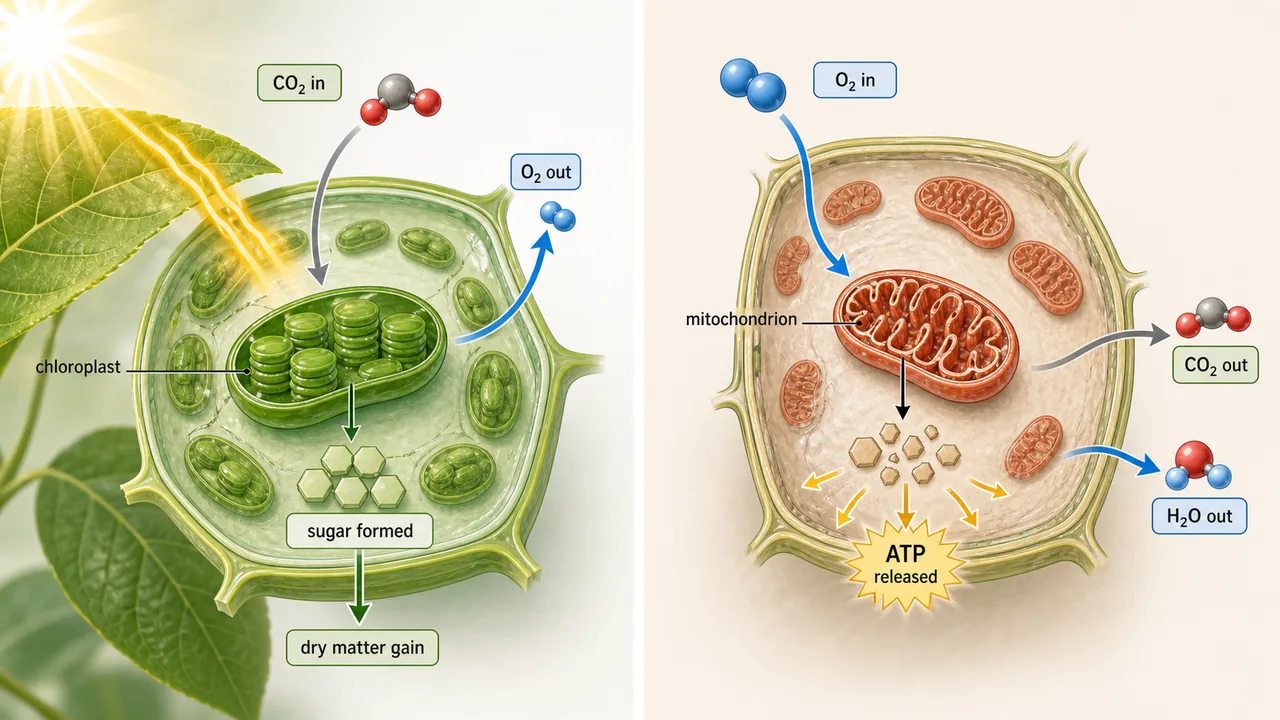
Summary Table — Key Facts at a Glance
| Fact | Answer |
|---|---|
| Respiration = | Cellular oxidation of carbohydrates |
| Nature of respiration | Amphibolic (catabolic + anabolic) |
| Most common substrate | Glucose |
| Energy per glucose | 686 kcal |
| ATP per glucose (aerobic) | 38 ATP |
| ATP per glucose (anaerobic) | 2 ATP |
| Energy per ATP | 7.6 kcal |
| Efficiency of respiration | 42% (rest lost as heat) |
| Respiration is reverse of | Photosynthesis |
| Proteins respired when | Carbohydrates and fats are depleted |
| Floating respiration = | Carbohydrate-based (normal) |
| Protoplasmic respiration = | Protein-based (starvation) |
| Dormant seed respiration | Slow (low moisture keeps enzymes inactive) |
| Germinating seed respiration | Fast (high moisture activates enzymes) |
Summary Cheat Sheet
| Fact | Answer |
|---|---|
| Definition of respiration | Cellular oxidation of carbohydrates into CO₂, H₂O, and energy |
| Nature of respiration | Amphibolic (both catabolic and anabolic) |
| Type of energy reaction | Exothermic (releases heat) |
| Most common respiratory substrate | Glucose (carbohydrates used first) |
| Energy released per glucose molecule | 686 kcal |
| Energy stored per ATP molecule | 7.6 kcal |
| Efficiency of aerobic respiration | 42% energy trapped in ATP; 58% lost as heat |
| ATP yield — aerobic respiration | 38 ATP per glucose |
| ATP yield — anaerobic respiration | 2 ATP per glucose |
| Aerobic respiration location | Cytoplasm → Mitochondria |
| Anaerobic respiration location | Cytoplasm only |
| End products — aerobic | CO₂ + H₂O |
| End products — anaerobic | Ethanol + CO₂ or Lactic acid |
| Floating respiration (Blackman) | Carbohydrate-based respiration (normal) |
| Protoplasmic respiration (Blackman) | Protein-based respiration (starvation) |
| Substrate priority order | Carbohydrates → Fats → Proteins |
| Highest energy per gram substrate | Fats — 9 kcal/g |
| Hydrogen release in respiration | 6 oxidation steps, 2H per step (stepwise) |
| Safe grain storage moisture | 12–14% moisture content |
| Photosynthesis vs respiration — energy | Photosynthesis is endothermic; respiration is exothermic |
TIP
Next: Lesson 03-02 dives into the step-by-step mechanism — Glycolysis, Link Reaction, Krebs Cycle, and ETS — showing exactly how those 38 ATP molecules are produced.