🌻 Photoperiodism and Vernalisation — How Day Length and Temperature Control Flowering
Short day, long day, and day neutral plants, phytochrome system, night break experiments, vernalisation, and kharif vs rabi crop classification with comparison tables and exam mnemonics
From Field to Lab — Why Rice Flowers in October and Wheat in March
In the previous lesson, we studied the five major plant hormones that control growth, dormancy, and ripening. But hormones do not act in isolation — they respond to environmental signals. The two most powerful external signals that trigger flowering are day length (photoperiod) and temperature (vernalisation). This lesson explains how plants sense these signals and translate them into the decision to flower.
Indian farmers have known for centuries that rice (a kharif crop) flowers during the short days of September-October, while wheat (a rabi crop) flowers during the lengthening days of February-March. But why? The answer lies in photoperiodism — the plant's ability to measure day length (or more precisely, the length of the uninterrupted dark period) and use it as a signal to initiate flowering. Understanding photoperiodism explains why crops cannot be arbitrarily shifted between seasons and why certain varieties perform differently at different latitudes.
Pro Content Locked
Upgrade to Pro to access this lesson and all other premium content.
Charged once for one year · ₹1188 total
Save ₹100/month vs ₹2388/year launch price
- All Agriculture & Banking Courses
- AI Lesson Questions (100/day)
- AI Doubt Solver (50/day)
- Glows & Grows Feedback (30/day)
- AI Section Quiz (20/day)
- 22-Language Translation (100/day)
- Recall Questions (20/day)
- AI Quiz (15/day)
- AI Quiz Paper Analysis (100/day)
- AI Step-by-Step Explanations (100/day)
- Spaced Repetition Recall (FSRS)
- AI Tutor
- Immersive Text Questions
- Audio Lessons — Hindi & English
- Mock Tests & Previous Year Papers
- Summary & Mind Maps
- XP, Levels, Leaderboard & Badges
- Generate New Classrooms
- Voice AI Teacher (AgriDots Live)
- AI Revision Assistant
- Knowledge Gap Analysis
- Interactive Revision (LangGraph)
🔒 Secure one-time yearly payment via Razorpay · No hidden fees
From Field to Lab — Why Rice Flowers in October and Wheat in March
In the previous lesson, we studied the five major plant hormones that control growth, dormancy, and ripening. But hormones do not act in isolation — they respond to environmental signals. The two most powerful external signals that trigger flowering are day length (photoperiod) and temperature (vernalisation). This lesson explains how plants sense these signals and translate them into the decision to flower.
Indian farmers have known for centuries that rice (a kharif crop) flowers during the short days of September-October, while wheat (a rabi crop) flowers during the lengthening days of February-March. But why? The answer lies in photoperiodism — the plant's ability to measure day length (or more precisely, the length of the uninterrupted dark period) and use it as a signal to initiate flowering. Understanding photoperiodism explains why crops cannot be arbitrarily shifted between seasons and why certain varieties perform differently at different latitudes.
This lesson covers:
- Photoperiodism — definition, Garner and Allard's discovery
- Three plant categories — Short Day Plants (kharif), Long Day Plants (rabi), Day Neutral Plants
- Night break experiments — how red light interrupts the dark period
- Phytochrome system — Pr/Pfr interconversion as the molecular clock
- Vernalisation — cold-induced flowering, Lysenko, devernalisation
- Photoperiodism vs vernalisation — comparison for exams
This is a very high-yield topic — expect MCQs on SDP/LDP examples, night break effects, and vernalisation details.
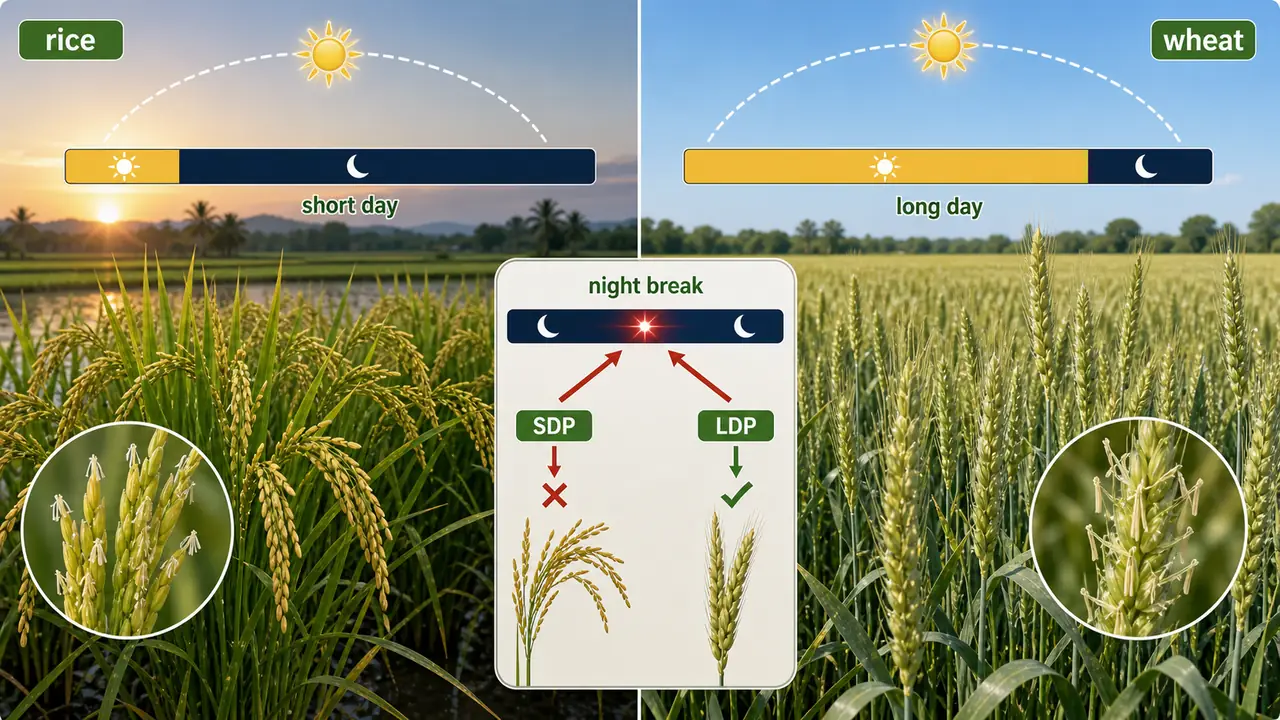
What is Photoperiodism?
Photoperiodism is the physiological response of plants to the relative length of light (day) and dark (night) periods. It is the mechanism by which plants synchronise their flowering with the most favourable season.
- Term coined by Garner and Allard (1920)
- Discovered through experiments with Maryland Mammoth tobacco and soybeans at USDA
- Phototropism (growth toward light) is a different concept — do not confuse

IMPORTANT
The critical factor is NOT the length of the day but the length of the uninterrupted dark period. Short day plants are actually "long night plants" and long day plants are actually "short night plants".
Three Categories of Plants
Based on their photoperiod response, plants fall into three categories. This classification directly maps to Indian agricultural seasons — SDP crops are kharif, LDP crops are rabi, and DNP crops can be grown in any season.
1. Short Day Plants (SDP) — Actually "Long Night Plants"
| Feature | Detail |
|---|---|
| Light requirement | 8–10 hours of light |
| Dark requirement | 14–16 hours of continuous dark |
| Critical factor | Uninterrupted dark period must exceed critical length |
| Season in India | Kharif (rainy season) |
| Night break effect | Red light (660–665 nm) during dark period prevents flowering |
Examples: Rice, Jowar (Sorghum), Pearl millet, Soybean, Sesame, Green gram, Black gram, Niger, Tobacco, Cowpea, Chrysanthemum, Xanthium (Cocklebur), Sugarcane — generally kharif crops
TIP
Xanthium (Cocklebur) is the classic experimental SDP — it requires only one single long night to be induced to flower, making it the standard plant for photoperiodism research.
Night break in SDP:
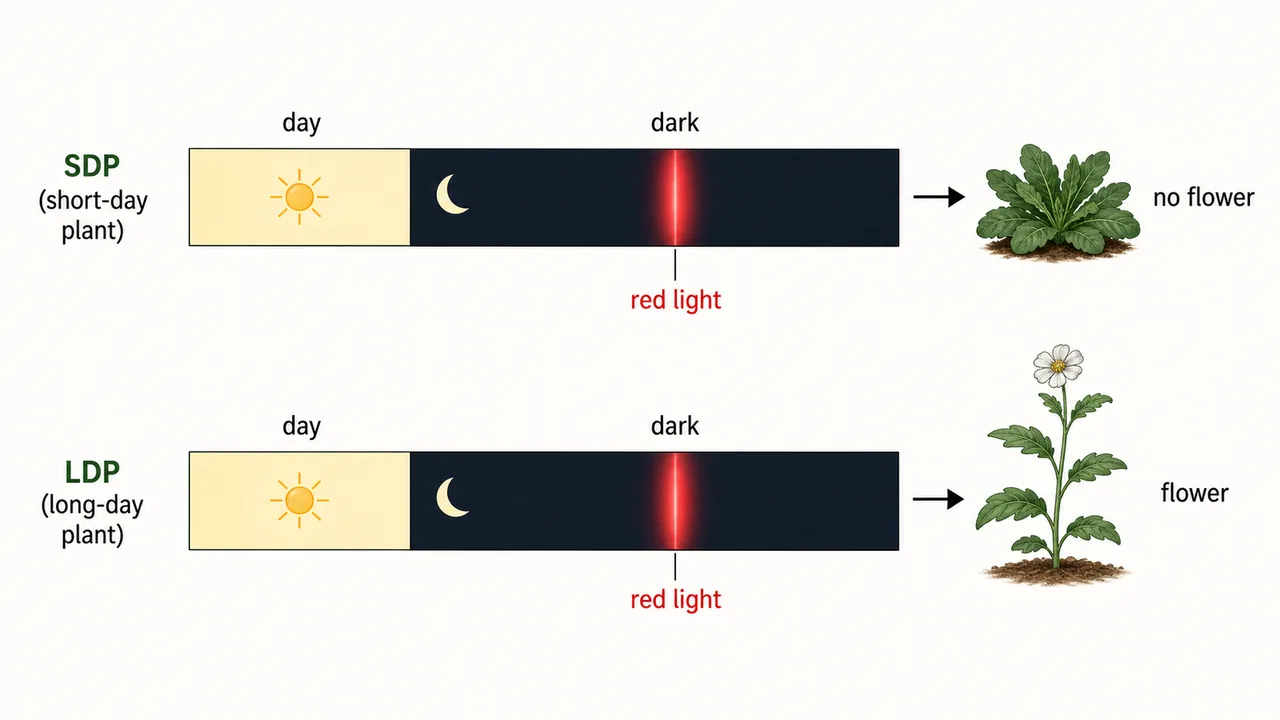
- If the dark period is broken by a flash of red light (660 nm) → SDP will NOT flower
- The night break is most effective during the middle of the dark period
- Prolonging the continuous dark period initiates early flowering
2. Long Day Plants (LDP) — Actually "Short Night Plants"
| Feature | Detail |
|---|---|
| Light requirement | 14–16 hours of light |
| Dark requirement | Short or none |
| Critical factor | Long dark periods inhibit flowering |
| Season in India | Rabi (winter season — flowers in spring as days lengthen) |
| Night break effect | Red light during dark period promotes flowering |
Examples: Wheat, Barley, Oat, Sugarbeet, Spinach, Radish, Lettuce, Castor, Rapeseed-Mustard — generally rabi crops
- Qualitative LDP examples classically include winter wheat, winter barley, and sugarbeet, whereas pea is a standard quantitative LDP recall.
TIP
Night break has opposite effects: In SDP, it prevents flowering. In LDP, it promotes flowering. This is because it effectively breaks a long night into two short nights — satisfying LDP requirements but disrupting SDP requirements.
3. Day Neutral Plants (DNP)
| Feature | Detail |
|---|---|
| Light requirement | Flower in all photoperiods (5–24 hours) |
| Flowering trigger | Based on age/developmental stage, not day length |
| Season | Any season |
Examples: Cotton, Sunflower, Safflower, Maize, Tomato, Cucumber, Balsam
-
Some summaries also separate intermediate-day plants, with sugarcane often cited as an intermediate short-day example.
-
In life-cycle terminology often paired with flowering behaviour, a monocarpic plant flowers, fruits, and then dies after a single reproductive cycle, whereas a polycarpic plant can flower and fruit repeatedly over multiple seasons or years. Many annual crop plants behave as monocarpic species because reproduction marks the completion of their life cycle.
Master Comparison Table — SDP vs LDP vs DNP
| Feature | SDP (Long Night Plants) | LDP (Short Night Plants) | DNP |
|---|---|---|---|
| Light required | 8–10 hours | 14–16 hours | 5–24 hours |
| Dark required | 14–16 hours (continuous) | Short or none | Any |
| Night break effect | Inhibits flowering | Promotes flowering | No effect |
| Season (India) | Kharif | Rabi | Any |
| Critical factor | Long uninterrupted night | Short night (long day) | Age/development |
| Examples | Rice, Soybean, Jowar | Wheat, Barley, Mustard | Cotton, Sunflower |
| Effective light for night break | Red (660 nm) | Red (660 nm) | — |
TIP
Mnemonic — "Short days, Kharif crops; Long days, Rabi crops":
- SDP = Kharif (Rice, Jowar, Soybean, Millet)
- LDP = Rabi (Wheat, Barley, Mustard, Oat)
- DNP = Any season (Cotton, Sunflower, Safflower)
Important Terms
The molecular mechanism behind photoperiodism centres on phytochrome, a light-sensitive pigment that acts as the plant's internal clock. Understanding the Pr/Pfr system explains why red light night breaks work and why the dark period — not the light period — is what truly matters.
| Term | Definition |
|---|---|
| Critical Period / Critical Day Length | The photoperiod threshold for flowering. SDP flower when days are shorter than this; LDP flower when days are longer |
| Photoperiod | The favourable day length for a particular plant |
| Phytochrome | The light-receptor pigment that measures day/night length |
| Pr (P660) | Red-absorbing form of phytochrome → converts to Pfr upon absorbing red light |
| Pfr (P730) | Far-red absorbing form → the active form that triggers responses |
| Florigen | Hypothetical flowering hormone (proposed by Chailakhyan, 1936) |
- In classical flowering summaries, florigen is sometimes described as a combined flowering stimulus built around gibberellin and a complementary component named anthesin.
Phytochrome System
| Form | Absorbs | Converts To | Present In |
|---|---|---|---|
| Pr (P660) | Red light (660 nm) | → Pfr | Darkness (predominant at night) |
| Pfr (P730) | Far-red light (730 nm) | → Pr | Light (predominant during day) |
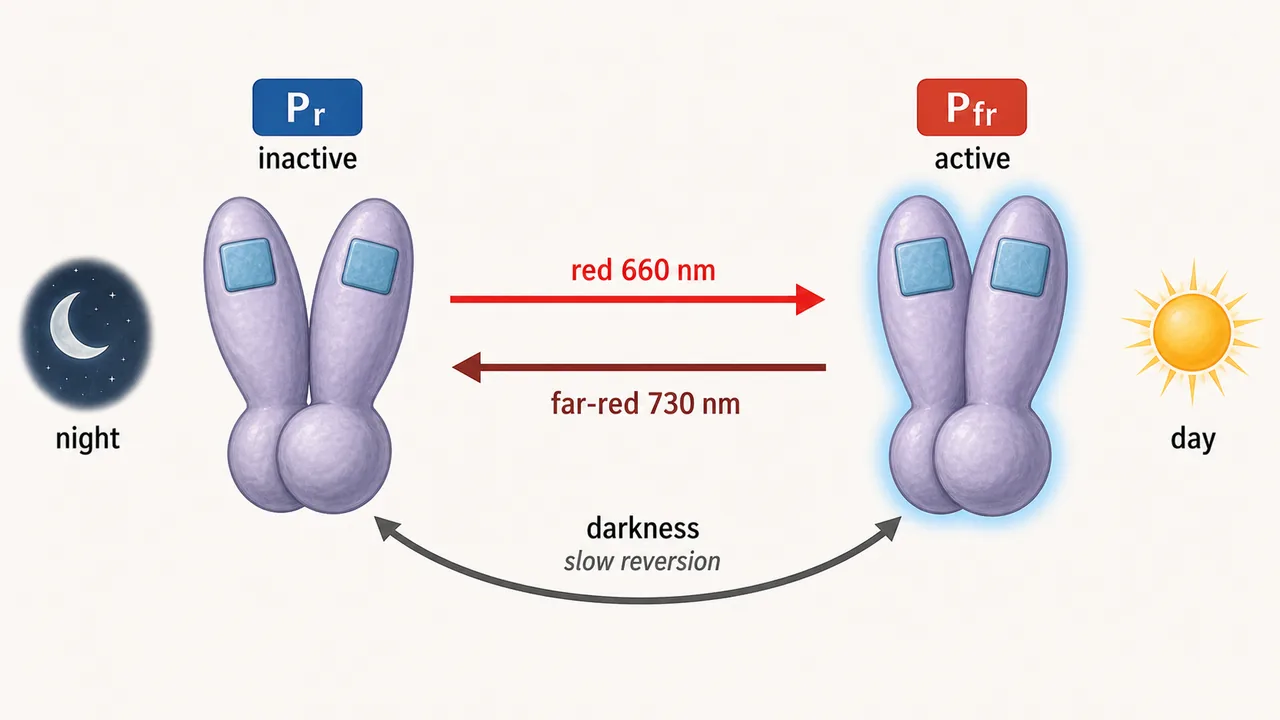
- Pfr is the active form that triggers biological responses
- In SDP: High Pfr (from red night break) inhibits flowering
- In LDP: High Pfr promotes flowering
- Older physiology notes also emphasise that phytochrome helps entrain the plant circadian clock to the natural light-dark cycle, which is why it functions as more than just a flowering switch.
- In older light-quality one-liners, green light is treated as largely ineffective in inducing flowering, whereas blue light is described as capable of inducing flowering in some exam-oriented summaries.
- Classical descriptive keys sometimes add that phytochrome is a protein pigment with a chromophore, with Pr described as blue-green and Pfr as light green, and older summaries may associate it with the plasma membrane.
IMPORTANT
The phytochrome system is the molecular clock that plants use to measure night length. Red light converts Pr → Pfr; during long dark periods, Pfr slowly converts back to Pr. This Pfr/Pr ratio is what the plant "reads" to decide whether to flower.
Vernalisation — Cold Treatment for Flowering
While photoperiodism uses light as the flowering signal, some plants require a period of cold before they can flower. This is especially important for winter cereals and biennial crops that must "experience" winter before transitioning to the reproductive phase.
Vernalisation is the promotion of flowering by exposure to low temperature (0–5°C) during the seedling stage or seed imbibition stage.
| Feature | Detail |
|---|---|
| Term coined by | Lysenko (Soviet scientist) |
| Temperature | 0–5°C for several weeks |
| Favourable working range | Often recalled more narrowly as 2–5°C |
| Applied to | Imbibed seeds or young seedlings |
| Site of perception | Shoot apex (meristem) |
| Stimulus | Perceived by dividing cells at the growing point |
- Actively dividing tissues such as the shoot apex, embryo / plumule region, and other meristematic cells are the main perception sites emphasized in exam-oriented vernalisation notes.
Crops Requiring Vernalisation
| Crop Type | Examples | Agricultural Significance |
|---|---|---|
| Winter cereals | Winter wheat, winter barley, winter rye | Must be sown in autumn to experience winter cold |
| Biennial crops | Cabbage, carrot, sugarbeet, turnip | Need cold period between vegetative and flowering phases |
TIP
Vernalisation can be replaced by gibberellins in some crops — GA₃ application can substitute for cold treatment and induce flowering. This is useful in tropical regions where natural vernalisation conditions do not exist.
Devernalisation
Exposure to high temperature (30–35°C) immediately after vernalisation can reverse the effect — this is called devernalisation.
- Some compact vernalisation recalls also note that anaerobic conditions can interfere with or reverse the vernalised state.
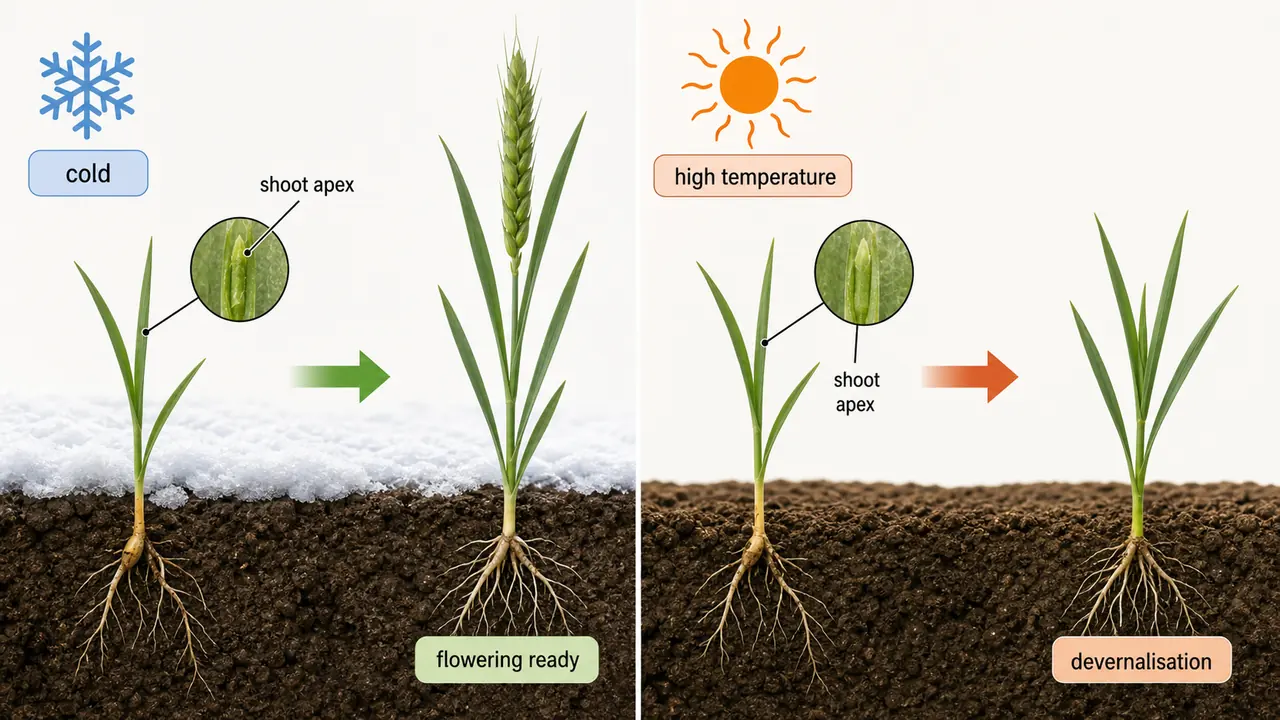
Comparison — Photoperiodism vs Vernalisation
Both photoperiodism and vernalisation are environmental signals that control flowering, but they differ in the type of stimulus, the organ that perceives it, and the hypothetical signal molecule. This comparison is a frequent MCQ topic.
| Feature | Photoperiodism | Vernalisation |
|---|---|---|
| Stimulus | Day/night length (light) | Low temperature (cold) |
| Perceived by | Leaves (phytochrome in leaf cells) | Shoot apex (meristem) |
| Signal molecule | Florigen (hypothetical) | Vernalin (hypothetical) |
| Can be substituted by | Night break (red light) | Gibberellins |
| Reversed by | Changing photoperiod | Devernalisation (high temperature) |
| Examples | Kharif vs Rabi crops | Winter wheat, cabbage, sugarbeet |
Summary Table — Key Facts at a Glance
| Fact | Answer |
|---|---|
| Term "photoperiodism" coined by | Garner and Allard (1920) |
| Critical factor in SDP | Length of uninterrupted dark period |
| SDP light requirement | 8–10 hours |
| LDP light requirement | 14–16 hours |
| Night break in SDP | Prevents flowering |
| Night break in LDP | Promotes flowering |
| Effective night break light | Red (660 nm) |
| SDP = which season | Kharif |
| LDP = which season | Rabi |
| SDP examples | Rice, Soybean, Jowar, Sesame |
| LDP examples | Wheat, Barley, Mustard, Oat |
| DNP examples | Cotton, Sunflower, Safflower |
| Active phytochrome form | Pfr (P730) |
| Florigen proposed by | Chailakhyan (1936) |
| Vernalisation coined by | Lysenko |
| Vernalisation temperature | 0–5°C |
| Vernalisation perceived at | Shoot apex |
| Vernalisation substitute | Gibberellins (GA₃) |
| Devernalisation by | High temperature (30–35°C) |
| Xanthium needs | One long night to flower |
| Thermoperiodism | Response of plants to alternating day/night temperatures; coined by F. Went |
NOTE
This lesson concludes the Plant Growth chapter. You have now covered growth definition, measurement, phases, growth rates, all five plant hormones, growth retardants, photoperiodism, phytochrome, and vernalisation — a complete foundation for plant physiology questions in competitive exams.
Summary Cheat Sheet
| Fact | Answer |
|---|---|
| Photoperiodism coined by | Garner and Allard (1920) |
| Experimental plant for photoperiodism discovery | Maryland Mammoth tobacco and soybeans |
| Critical factor in photoperiodism | Length of uninterrupted dark period, not light |
| SDP are actually | Long night plants |
| SDP light requirement | 8–10 hours |
| SDP dark requirement | 14–16 hours continuous |
| LDP light requirement | 14–16 hours |
| SDP season in India | Kharif |
| LDP season in India | Rabi |
| SDP crop examples | Rice, Jowar, Soybean, Sesame, Pearl millet |
| LDP crop examples | Wheat, Barley, Oat, Mustard, Spinach |
| DNP crop examples | Cotton, Sunflower, Safflower |
| Night break effect on SDP | Prevents (inhibits) flowering |
| Night break effect on LDP | Promotes flowering |
| Effective wavelength for night break | Red light — 660 nm |
| Classic experimental SDP | Xanthium (Cocklebur) — needs only one long night |
| Light-receptor pigment in plants | Phytochrome |
| Active form of phytochrome | Pfr (P730) |
| Pr absorbs and converts to | Absorbs red light (660 nm) → converts to Pfr |
| Pfr absorbs and converts to | Absorbs far-red light (730 nm) → converts to Pr |
| Florigen proposed by | Chailakhyan (1936) |
| Vernalisation coined by | Lysenko |
| Vernalisation temperature | 0–5°C for several weeks |
| Site of vernalisation perception | Shoot apex (meristem) |
| Vernalisation can be substituted by | Gibberellins (GA₃) |
| Devernalisation caused by | High temperature (30–35°C) |
| Photoperiodism perceived by | Leaves (phytochrome in leaf cells) |
| Vernalisation signal molecule | Vernalin (hypothetical) |
| Thermoperiodism coined by | F. Went |
| Crops requiring vernalisation | Winter wheat, winter barley, cabbage, sugarbeet |