🌧 Respiratory Quotient (RQ): Formula, Values and Exam Applications
Answer-first Respiratory Quotient notes: RQ formula, values for carbohydrates, fats, proteins, organic acids and anaerobic respiration, with Ganong's respirometer and seed-storage examples.
From Field to Lab — Measuring What a Seed Breathes
Quick answer: Respiratory Quotient (RQ) is the ratio of volume of CO₂ evolved to volume of O₂ consumed during respiration. In exams, remember: carbohydrates = 1.0, fats = 0.7, proteins = about 0.8, organic acids > 1, and anaerobic respiration = infinity because no oxygen is consumed.
| Search Query / Exam Prompt | Direct Answer |
|---|---|
| RQ formula | RQ = volume of CO₂ evolved / volume of O₂ consumed |
| RQ of glucose / carbohydrate | 1.0 |
| RQ of fat / oilseed | 0.7 or < 1 |
| RQ of protein | ~0.8 |
| RQ of organic acids | > 1 |
| RQ of anaerobic respiration | Infinity |
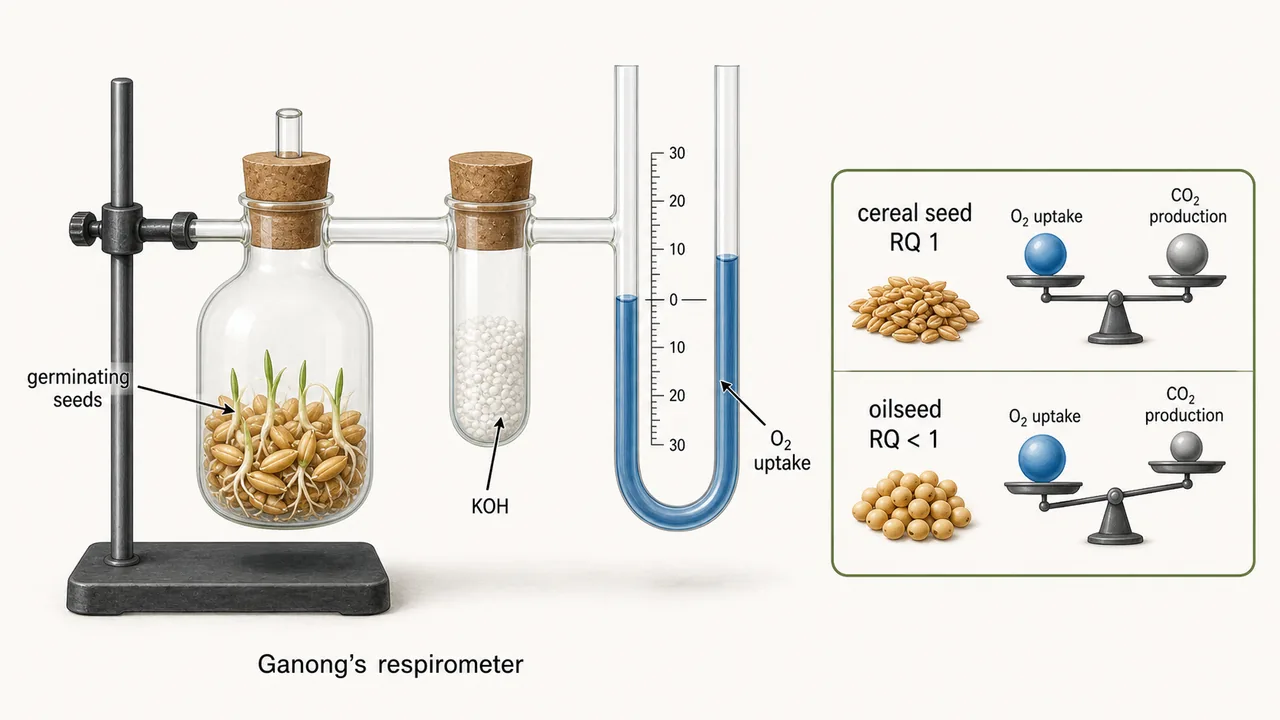
| RQ instrument | Ganong's Respirometer |
In the previous lesson, we traced the step-by-step mechanism of respiration — glycolysis, the link reaction, Krebs cycle, and ETS — and arrived at a total of 38 ATP per glucose. Now we examine the efficiency of that energy capture, learn how to identify which substrate is being respired using the Respiratory Quotient, and explore the external factors that speed up or slow down respiration in living tissues.
A plant breeder wants to know whether stored groundnut seeds are respiring fats or carbohydrates. The answer lies in the Respiratory Quotient (RQ) — the ratio of CO₂ released to O₂ absorbed. If RQ is less than 1, the seeds are burning fats (which need extra oxygen). If RQ equals 1, they are burning carbohydrates. This simple measurement, done with a Ganong's Respirometer, reveals the metabolic state of the seed — and helps predict how long it will remain viable in storage.
This lesson covers:
- Efficiency of respiration — how much energy is captured vs lost as heat
- Respiratory substrates — entry points for fats, proteins, and carbohydrates
- Respiratory Quotient (RQ) — values for different substrates and their agricultural meaning
- Factors affecting respiration — temperature, oxygen, moisture, and more
Efficiency of Respiration
How efficiently does respiration convert food energy into usable ATP? The answer matters practically — the 58% lost as heat is why grain heaps warm up in storage and why compost piles steam.
When glucose is completely oxidised aerobically, 686 kcal of energy is released. Of this, 38 ATP molecules are produced.
| Parameter | Value |
|---|---|
| Total energy per glucose | 686 kcal |
| ATP molecules produced | 38 |
| Energy per ATP | 7.6 kcal |
| Efficiency | 38 × 7.6 / 686 = 42% |
| Energy lost as heat | 58% |
IMPORTANT
Respiration is only 40–50% efficient — the rest is lost as heat. This is why germinating seeds and composting material become warm.
Practical observations:
- Germinating seeds in a test tube cause temperature to rise (fast respiration)
- Dormant seeds have slow respiration (low moisture keeps enzymes inactive)
Solved Problem
Q: During aerobic respiration, a plant cell released 42 molecules of CO₂. How many ATP are produced?
Solution: 6 CO₂ per glucose = 38 ATP. For 42 CO₂ = 42/6 × 38 = 7 × 38 = 266 ATP.
Respiratory Substrates — Entry Points
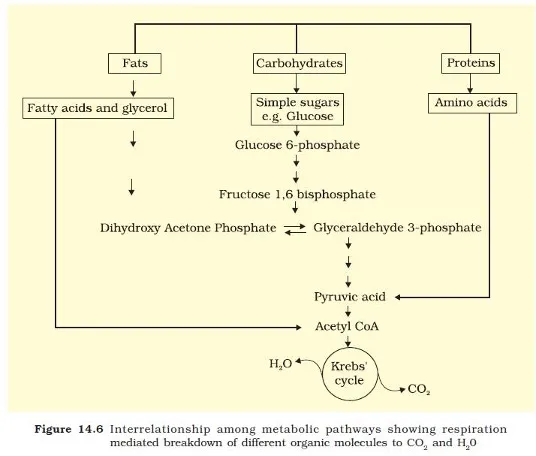
Cells do not always burn glucose. Depending on tissue type and nutritional status, fats or proteins may be the primary fuel. Each substrate enters the respiratory pathway at a different point and yields a different amount of energy — which directly determines the RQ value measured in experiments.
| Substrate | Breakdown | Entry Point | Energy Yield |
|---|---|---|---|
| Glucose (carbohydrate) | Direct | Glycolysis (start) | Standard (686 kcal) |
| Fats | Glycerol → PGAL; Fatty acids → Acetyl CoA | Mid-glycolysis; Krebs | More per gram (9 kcal/g vs 4 kcal/g) |
| Proteins | Deamination → carbon skeletons | Various Krebs cycle points | Last resort (starvation) |
Key Metabolic Connections
| Intermediate | Connects To | Significance |
|---|---|---|
| PGAL | Glycerol → fats/lipids | Glycolysis intermediate for fat synthesis |
| PGA | Serine, Glycine, Cysteine (amino acids) | Links to protein synthesis |
| Pyruvate | Alanine (amino acid) | Transamination |
| Acetyl CoA | Common link: fats ↔ carbohydrates ↔ proteins | Central metabolic hub |
- Beta-oxidation = sequential removal of 2-carbon units from fatty acids as Acetyl CoA, producing NADH and FADH₂
- This is why respiration is amphibolic — intermediates feed both breakdown and synthesis pathways
Respiratory Quotient (RQ)
Now that we know different substrates require different amounts of O₂ and produce different amounts of CO₂, we can use their ratio as a diagnostic tool. The RQ (also called Respiratory Ratio) reveals what substrate is being respired — a single number that tells you the metabolic state of any tissue.
RQ = Volume of CO₂ released / Volume of O₂ absorbed
- Measured by Ganong's Respirometer
- NCERT's respiration-in-plants syllabus explicitly includes amphibolic pathways and respiratory quotient, so RQ is a core plant physiology topic, not an optional laboratory detail.
IMPORTANT
Comprehensive RQ Values Table:
| Substrate | Equation | CO₂ | O₂ | RQ | Meaning |
|---|---|---|---|---|---|
| Carbohydrates (glucose) | C₆H₁₂O₆ + 6O₂ → 6CO₂ + 6H₂O | 6 | 6 | 1.0 | Equal CO₂ and O₂ |
| Fats (tripalmitin) | C₅₁H₉₈O₆ + 72.5O₂ → 51CO₂ + 49H₂O | 51 | 72.5 | 0.7 | More O₂ needed (fats have less O) |
| Proteins | — | — | — | 0.8 | Between fats and carbs |
| Organic acids (malic acid) | C₄H₆O₅ + 3O₂ → 4CO₂ + 3H₂O | 4 | 3 | 1.33 | Already partly oxidised |
| Anaerobic respiration | C₆H₁₂O₆ → 2C₂H₅OH + 2CO₂ | 2 | 0 | ∞ (infinity) | No O₂ absorbed |
TIP
How to remember RQ values:
- Carbohydrates = 1.0 (balanced — equal C, H, O ratio)
- Fats < 1.0 (0.7) — fats have very little oxygen, so extra O₂ is needed
- Proteins = 0.8 — between fats and carbs
- Organic acids > 1.0 (1.33) — already partly oxidised, need less O₂
- Anaerobic = infinity — CO₂ released but no O₂ used
What RQ Tells Us
| RQ Value | Substrate Being Respired | Agricultural Significance |
|---|---|---|
| = 1.0 | Carbohydrates | Normal respiration in most tissues |
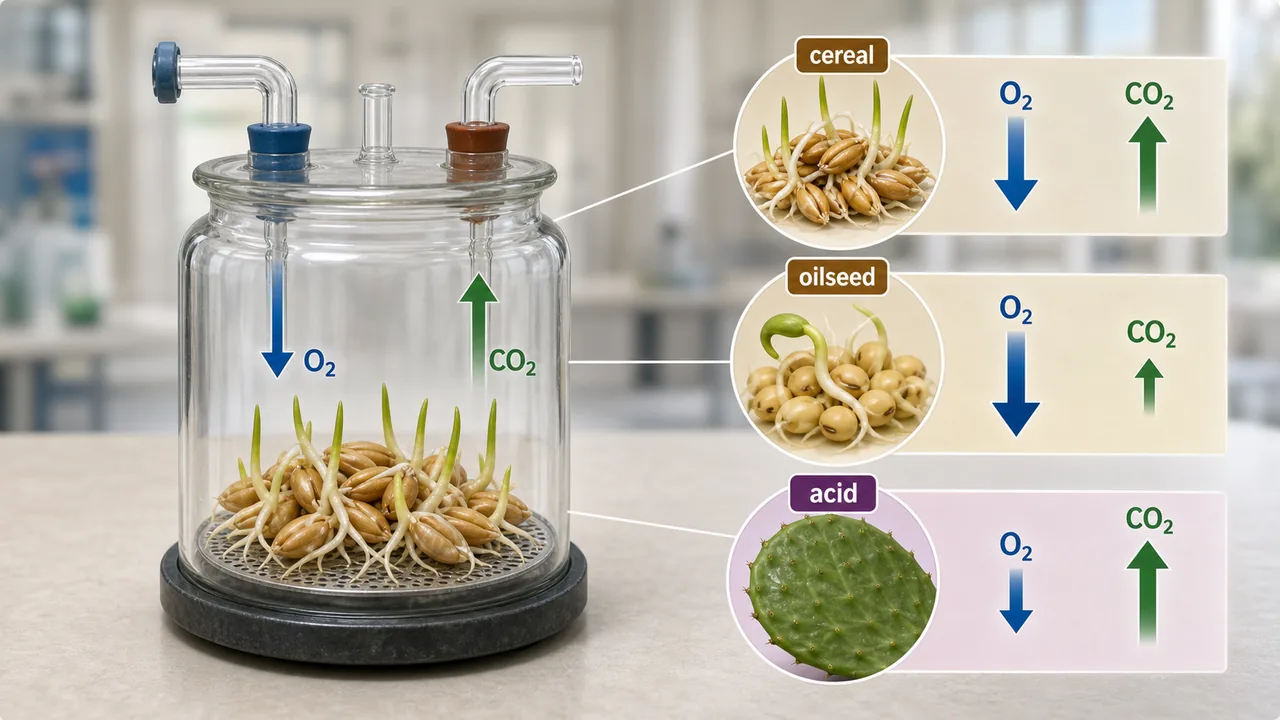
| < 1.0 | Fats | Germinating oilseeds (groundnut, mustard) |
| 0.8 | Proteins | Protein-rich seeds; starvation conditions |
| > 1.0 | Organic acids | Succulents, CAM plants |
| = ∞ | Anaerobic respiration | Waterlogged roots, fermentation |
RQ Interpretation for Crop and Storage Questions
| Situation | Likely RQ | Why It Matters |
|---|---|---|
| Germinating wheat seed | Around 1.0 | Starch is the main reserve; carbohydrate oxidation dominates |
| Germinating groundnut / mustard seed | < 1.0 | Oil reserves need more oxygen for oxidation |
| Starving tissue | < 1.0 | Fats and proteins are increasingly used as substrates |
| Waterlogged root | ∞ if anaerobic | Oxygen uptake stops; fermentation products injure roots |
| Succulent tissue rich in organic acids | > 1.0 | Organic acids are already oxygen-rich, so less O₂ is needed |
IMPORTANT
Most common MCQ trap: RQ does not measure the total rate of respiration. It identifies the type of substrate being oxidised by comparing CO₂ output with O₂ uptake.
Factors Affecting Respiration
Respiration rate is not constant — it responds to environmental conditions. Understanding these factors is directly applicable to post-harvest management, seed storage, cold chain logistics, and waterlogging tolerance in crops.
| Factor | Effect | Agricultural Relevance |
|---|---|---|
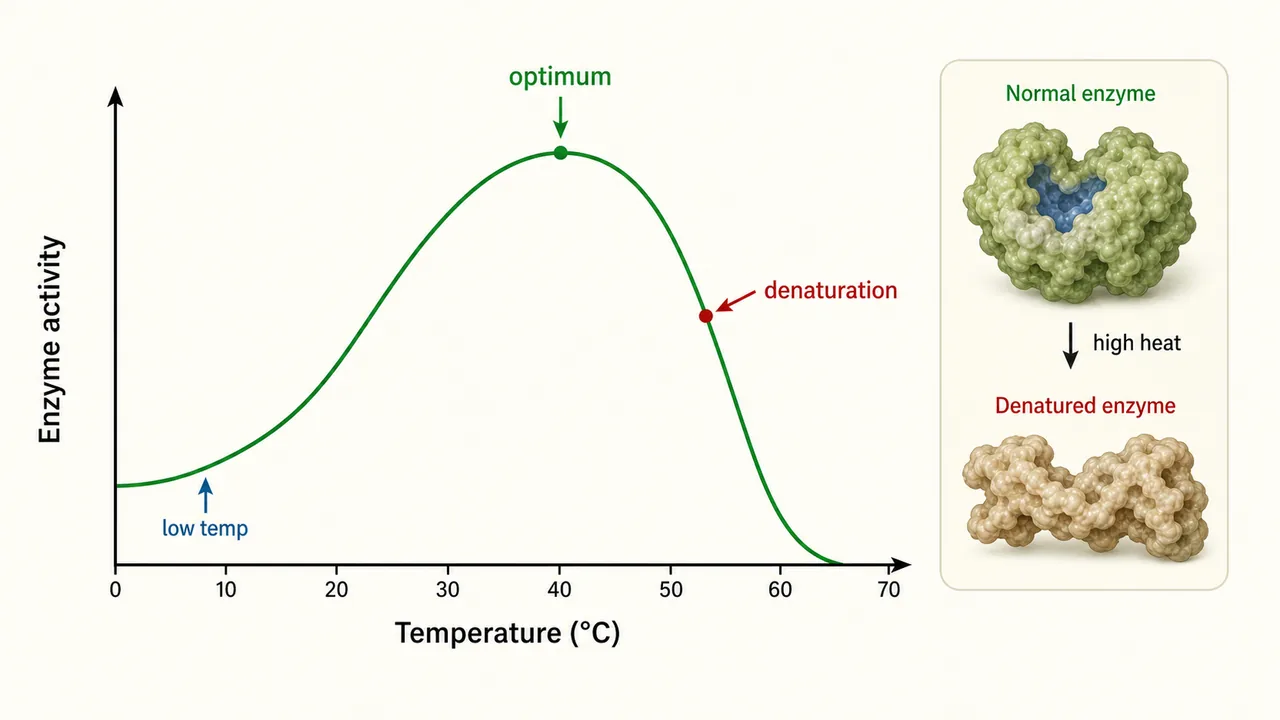
| Temperature | Rate increases with temperature (Q₁₀ = 2); optimal 30°C | Cold storage slows respiration, preserves produce |
| Oxygen supply | Aerobic respiration needs O₂; without O₂ → fermentation | Waterlogging reduces O₂ → root death |
| CO₂ concentration | High CO₂ inhibits respiration | Modified atmosphere storage uses high CO₂ |
| Water content | Low moisture → slow respiration (dormant seeds) | Seed drying to 12% moisture for safe storage |
| Substrate availability | More substrate → more respiration (up to enzyme saturation) | Well-nourished plants respire more |
| Injury / Wounding | Increases respiration rate (wound respiration) | Harvesting damage → faster post-harvest deterioration |
| Light | Indirectly increases respiration (more photosynthate available) | — |
TIP
Why cold storage works: Lowering temperature reduces enzyme activity → slower respiration → less food reserve consumed → fruits/vegetables stay fresh longer. Every 10°C drop roughly halves the respiration rate (Q₁₀ = 2).
- In older physiology recall, Van't Hoff's rule is often stated as respiration changing by about 2-3 times for each 10°C rise within the moderate biological range.
- Under intense photosynthetic activity, some of the CO₂ released in respiration may be rapidly reused by nearby photosynthesising tissues, even though high external CO₂ itself tends to suppress respiration.
- A classic wound-response one-liner is that injury can increase sugar content in half-cut potato tubers, reflecting metabolic adjustments after wounding.
Climacteric Rise and Pasteur Effect
Two compact respiration recalls frequently appear in objective exams because they connect respiration to post-harvest biology and oxygen response.
- Climacteric rise = an abrupt increase in respiration rate during fruit ripening, closely associated with ethylene production.
- Pasteur effect = the inhibition of fermentation in the presence of oxygen because cells shift toward the more efficient aerobic respiration pathway.
Summary Table — Key Facts at a Glance
| Fact | Answer |
|---|---|
| Respiration efficiency | 42% |
| Energy per glucose | 686 kcal |
| ATP per glucose (aerobic) | 38 ATP |
| Energy per ATP | 7.6 kcal |
| RQ of carbohydrates | 1.0 |
| RQ of fats | 0.7 |
| RQ of proteins | 0.8 |
| RQ of organic acids | 1.33 |
| RQ of anaerobic respiration | Infinity (∞) |
| RQ measured by | Ganong's Respirometer |
| Common metabolic link | Acetyl CoA |
| Fat oxidation pathway | Beta-oxidation |
| Germinating oilseed RQ | < 1.0 (fats being respired) |
| Dormant seed respiration | Slow (low moisture) |
| Q₁₀ for enzymes | 2 |
Summary Cheat Sheet
| Fact | Answer |
|---|---|
| Total energy released per glucose molecule | 686 kcal |
| Number of ATP produced per glucose (aerobic) | 38 ATP |
| Energy stored per ATP molecule | 7.6 kcal |
| Efficiency of aerobic respiration | 42% |
| Energy lost as heat during respiration | 58% |
| RQ formula | CO₂ released / O₂ absorbed |
| Instrument to measure RQ | Ganong's Respirometer |
| RQ of carbohydrates (glucose) | 1.0 |
| RQ of fats (tripalmitin) | 0.7 |
| RQ of proteins | 0.8 |
| RQ of organic acids (malic acid) | 1.33 |
| RQ of anaerobic respiration | Infinity (∞) |
| RQ of germinating oilseeds (groundnut, mustard) | Less than 1.0 (fats) |
| Central metabolic hub linking fats, carbs, and proteins | Acetyl CoA |
| Fatty acid breakdown pathway producing Acetyl CoA | Beta-oxidation |
| Glycerol from fat breakdown enters glycolysis as | PGAL |
| Respiration is called amphibolic because | It serves both catabolic and anabolic pathways |
| Q₁₀ value for respiratory enzymes | 2 (rate doubles per 10°C rise) |
| Safe moisture content for seed storage | 12% |
| High CO₂ effect on respiration | Inhibits respiration (used in modified atmosphere storage) |
TIP
Next: The next chapter focuses on Enzymes — the protein catalysts that drive every reaction in both photosynthesis and respiration. Understanding enzyme characteristics, classification, and kinetics (Km, turn over number) is essential for biochemistry questions.