🌚 Dark Reactions — Calvin Cycle, C4 Pathway, CAM, and Photorespiration
Calvin cycle (C3), Hatch-Slack cycle (C4), Crassulacean Acid Metabolism (CAM), photorespiration, Blackman's Law of Limiting Factors, and C3 vs C4 comparison with exam tables
From Field to Lab — Why Sugarcane Out-yields Wheat
In the previous lesson, we explored the light reactions of photosynthesis — how chlorophyll captures light energy and converts it into ATP and NADPH₂. Now we move to the second half: the dark reactions, where that stored energy is used to fix CO₂ into carbohydrates.
A wheat farmer in Punjab achieves about 4–5 tonnes per hectare. A sugarcane farmer next door harvests 70–80 tonnes of cane. Why the massive difference? Part of the answer lies in the dark reactions of photosynthesis. Wheat is a C3 plant — it uses the Calvin cycle, which loses energy through photorespiration. Sugarcane is a C4 plant — it uses the Hatch-Slack pathway with a CO₂-concentrating mechanism that eliminates photorespiration, enabling much higher photosynthetic efficiency in hot, sunny conditions.
This lesson covers:
- Dark reactions overview — definition, location, and the three CO₂ fixation pathways
- Calvin Cycle (C₃) — the universal carbon fixation pathway
- Blackman's Law — limiting factors in photosynthesis
- Hatch-Slack Cycle (C₄) — the tropical efficiency pathway with Kranz anatomy
- C₃ vs C₄ comparison — the master table for exams
- CAM Pathway — how desert plants fix CO₂ at night
- Photorespiration — why C₃ plants waste energy
Understanding C3 vs C4 vs CAM pathways is one of the highest-weightage topics in agriculture exams.
Pro Content Locked
Upgrade to Pro to access this lesson and all other premium content.
Charged once for one year · ₹1188 total
Save ₹100/month vs ₹2388/year launch price
- All Agriculture & Banking Courses
- AI Lesson Questions (100/day)
- AI Doubt Solver (50/day)
- Glows & Grows Feedback (30/day)
- AI Section Quiz (20/day)
- 22-Language Translation (100/day)
- Recall Questions (20/day)
- AI Quiz (15/day)
- AI Quiz Paper Analysis (100/day)
- AI Step-by-Step Explanations (100/day)
- Spaced Repetition Recall (FSRS)
- AI Tutor
- Immersive Text Questions
- Audio Lessons — Hindi & English
- Mock Tests & Previous Year Papers
- Summary & Mind Maps
- XP, Levels, Leaderboard & Badges
- Generate New Classrooms
- Voice AI Teacher (AgriDots Live)
- AI Revision Assistant
- Knowledge Gap Analysis
- Interactive Revision (LangGraph)
🔒 Secure one-time yearly payment via Razorpay · No hidden fees
From Field to Lab — Why Sugarcane Out-yields Wheat
In the previous lesson, we explored the light reactions of photosynthesis — how chlorophyll captures light energy and converts it into ATP and NADPH₂. Now we move to the second half: the dark reactions, where that stored energy is used to fix CO₂ into carbohydrates.
A wheat farmer in Punjab achieves about 4–5 tonnes per hectare. A sugarcane farmer next door harvests 70–80 tonnes of cane. Why the massive difference? Part of the answer lies in the dark reactions of photosynthesis. Wheat is a C3 plant — it uses the Calvin cycle, which loses energy through photorespiration. Sugarcane is a C4 plant — it uses the Hatch-Slack pathway with a CO₂-concentrating mechanism that eliminates photorespiration, enabling much higher photosynthetic efficiency in hot, sunny conditions.
This lesson covers:
- Dark reactions overview — definition, location, and the three CO₂ fixation pathways
- Calvin Cycle (C₃) — the universal carbon fixation pathway
- Blackman's Law — limiting factors in photosynthesis
- Hatch-Slack Cycle (C₄) — the tropical efficiency pathway with Kranz anatomy
- C₃ vs C₄ comparison — the master table for exams
- CAM Pathway — how desert plants fix CO₂ at night
- Photorespiration — why C₃ plants waste energy
Understanding C3 vs C4 vs CAM pathways is one of the highest-weightage topics in agriculture exams.
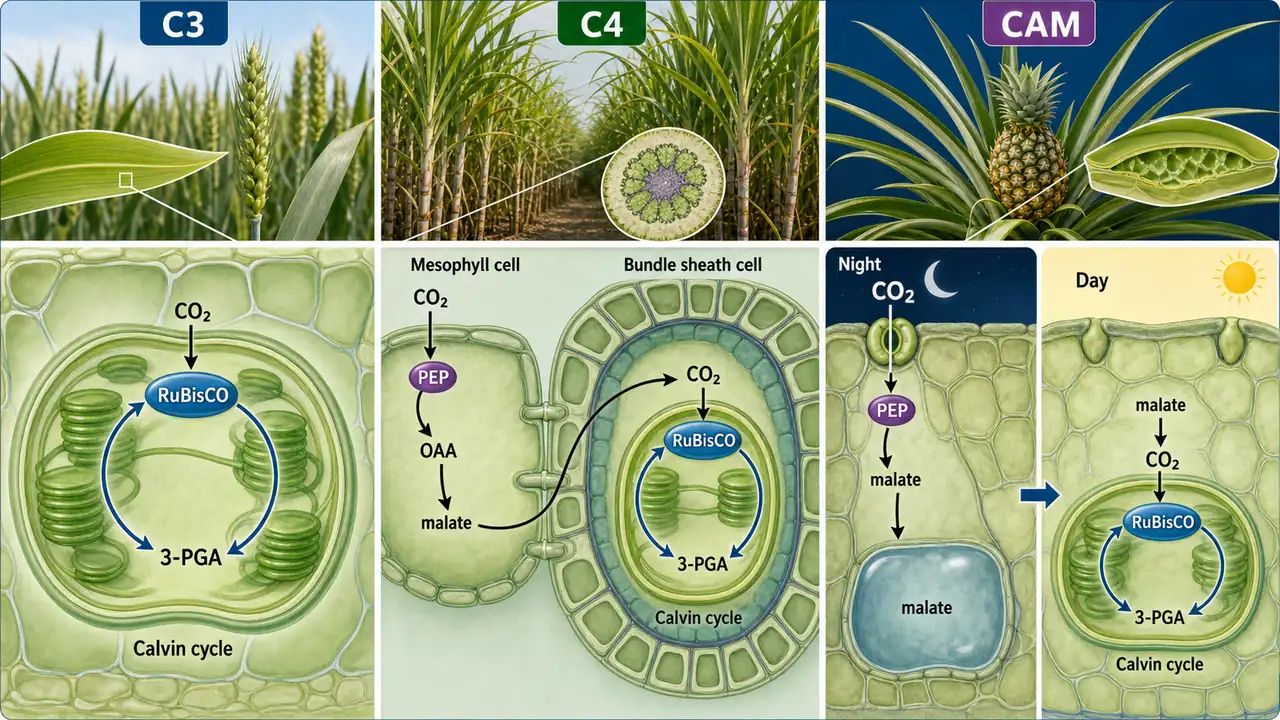
What Are Dark Reactions?
The dark phase of photosynthesis is the CO₂ fixation step — also called Blackman's reaction or Path of Carbon.
| Feature | Detail |
|---|---|
| Location | Stroma of chloroplast |
| Speed | Slower than light reactions |
| Dependent on | Enzymes (temperature-dependent) |
| Uses | ATP and NADPH₂ from light reactions |
| Products | Carbohydrates (glucose) |
NOTE
Dark reactions also occur in the presence of light. The name "dark reaction" only means they do not directly require light energy — they depend on ATP and NADPH₂ from the light reactions.
Three Pathways of CO₂ Fixation
| Pathway | Common Name | First Stable Product | Key Plants |
|---|---|---|---|
| Calvin Cycle | C₃ cycle | 3-PGA (C₃ compound) | Wheat, Rice, Barley, Pulses |
| Hatch-Slack Cycle | C₄ cycle | OAA (C₄ compound) | Sugarcane, Maize, Sorghum |
| CAM Cycle | Crassulacean Acid Metabolism | Malic acid (at night) | Pineapple, Cacti, Opuntia |

Calvin Cycle (C₃ Cycle)
Found predominantly in Wheat, Rice, Barley, Pulses, Soybean, Cotton, Sunflower — these are called C₃ plants.
| Feature | Detail |
|---|---|
| First stable product | 3-Phosphoglyceric acid (3-PGA) — a 3-carbon compound |
| CO₂ acceptor | RuBP (Ribulose bisphosphate) |
| Key enzyme | RuBisCO (most abundant enzyme on Earth) |
| Energy requirement | 12 NADPH₂ + 18 ATP per glucose molecule |
| Location | Stroma of chloroplast |
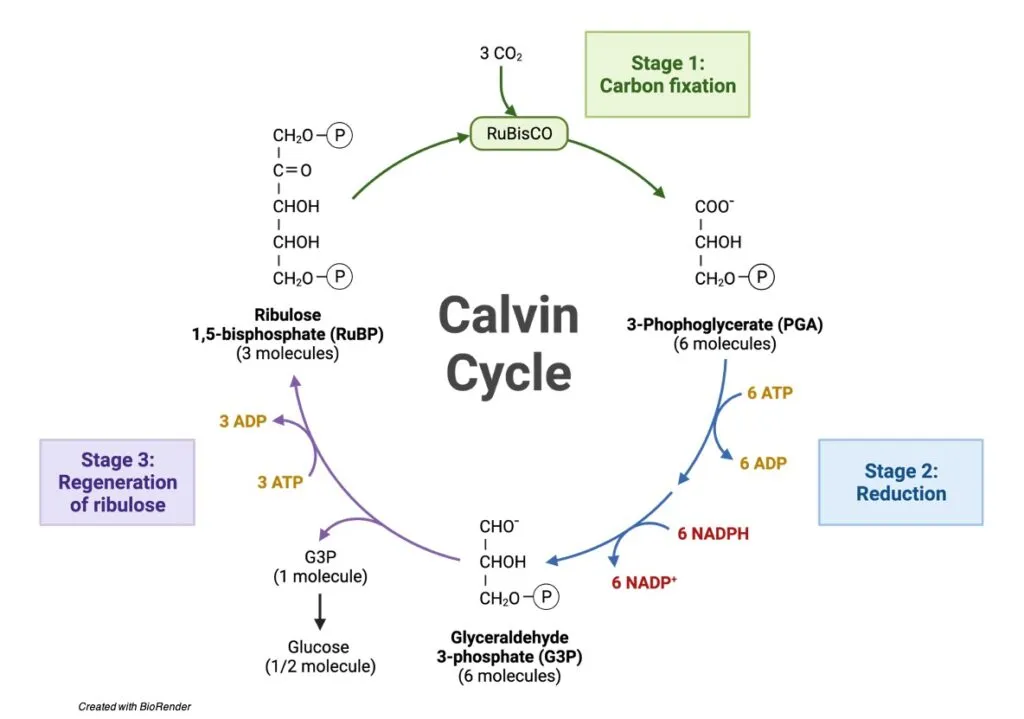
How it works:
- 6 molecules of RuBP combine with 6 molecules of CO₂ (catalysed by RuBisCO)
- This produces 6 molecules of hexose (6-carbon sugar)
- 1 hexose is consumed as food (net gain)
- 5 hexoses are reconverted to 6 RuBP (regeneration phase, requires ATP)
TIP
Exam shortcut: Calvin Cycle = C₃ = First product is 3-PGA = CO₂ acceptor is RuBP = Needs 18 ATP + 12 NADPH₂.
Blackman's Law of Limiting Factors
If light intensity is doubled but CO₂ concentration remains constant, there will be no increase in photosynthetic rate — CO₂ becomes the limiting factor.
IMPORTANT
Blackman's Law: The rate of a process governed by multiple factors is limited by the factor available in minimum quantity (Law of Minimum). This is critical in agriculture — it helps identify which factor constrains crop productivity.
- In practical revision, the main external factors are grouped as light (intensity, quality, duration), CO₂ concentration, temperature, water, and oxygen.
- The light compensation point is the light intensity at which photosynthetic CO₂ uptake equals respiratory CO₂ release, so net photosynthesis becomes zero.
- A related older one-liner is the CO₂ compensation point: the CO₂ concentration at which photosynthesis just balances respiration.
- For classical light-quality recall, the highest photosynthetic rate is usually keyed to the red region, followed by blue, whereas green light gives the lowest effective photosynthesis because much of it is reflected.
- In agronomy-style exam framing, water is often described as the most limiting factor for photosynthesis under Indian field conditions, and photosynthetic rate rises rapidly as temperature increases through the moderate biological range before other constraints take over.
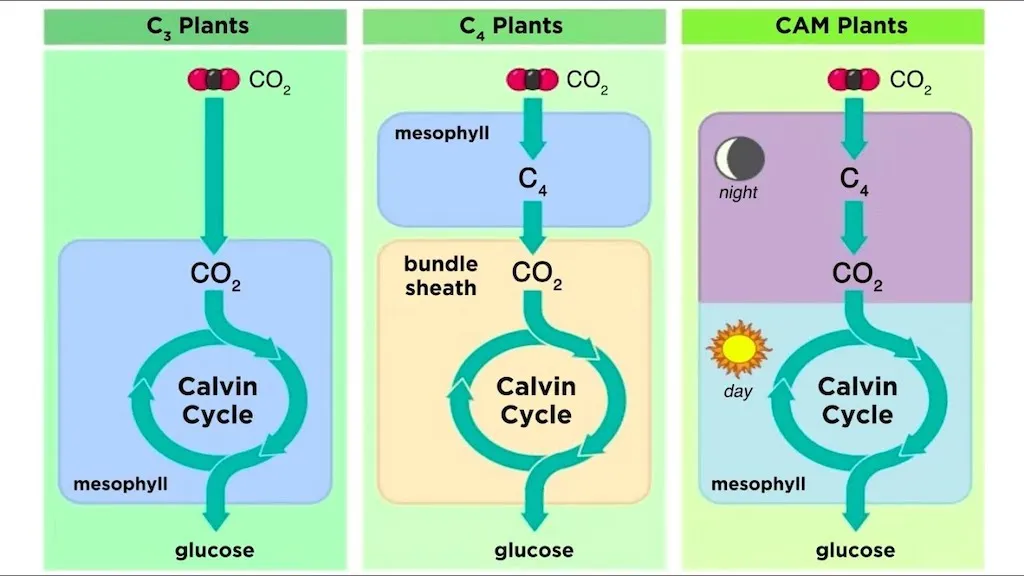
Hatch-Slack Cycle (C₄ Cycle)
Found in Sugarcane, Maize, Sorghum, Bajra, Amaranthus, and other tropical grasses — called C₄ plants.
| Feature | Detail |
|---|---|
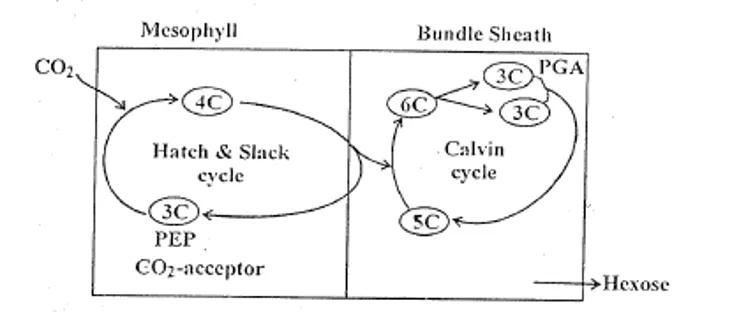
| First stable product | Oxaloacetic acid (OAA) — a 4-carbon compound |
| CO₂ acceptor | PEP (Phosphoenol Pyruvate) |
| Key enzyme | PEP carboxylase (high affinity for CO₂) |
| Energy requirement | 12 NADPH₂ + 30 ATP per glucose (more than C₃) |
| Leaf anatomy | Kranz anatomy (bundle sheath + mesophyll) |
- Discovered by Kortschak, Hartt & Burr (1965, sugarcane) and confirmed by M.D. Hatch & C.R. Slack (1967, Australia)
- A subtropical species of Atriplex rosea shows C₄ while the temperate species shows C₃ — demonstrating adaptation
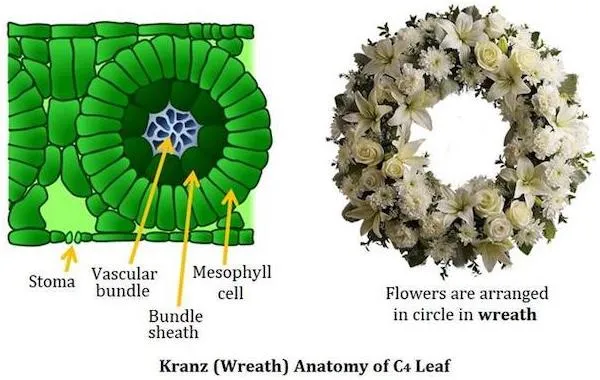
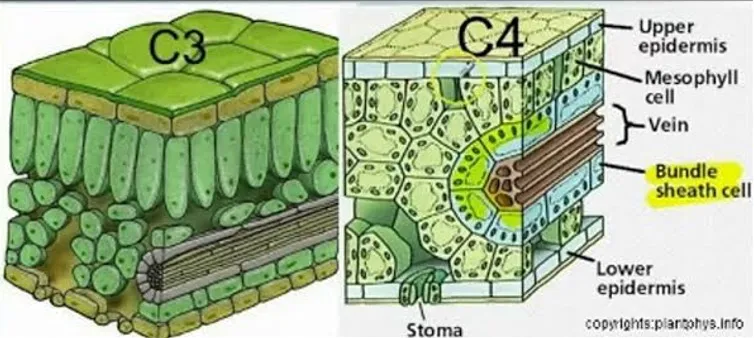
Kranz Anatomy — The C₄ Advantage
C₄ plants have a distinctive leaf structure with two types of chloroplasts:
| Cell Type | Chloroplast Type | Function |
|---|---|---|
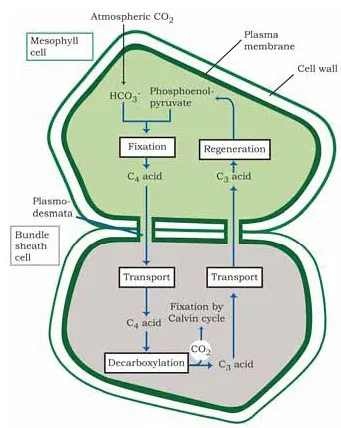
| Mesophyll cells | Normal (isomorphic) — with grana | Initial CO₂ fixation by PEP carboxylase |
| Bundle sheath cells | Kranz type — typically lacking grana | Calvin cycle (CO₂ released from C₄ acids is refixed) |
C₃ vs C₄ Plants — The Master Comparison Table
| Feature | C₃ Plants | C₄ Plants |
|---|---|---|
| First stable product | 3-PGA (3-carbon) | OAA (4-carbon) |
| CO₂ acceptor | RuBP | PEP |
| Key enzyme | RuBisCO | PEP carboxylase |
| CO₂ affinity of enzyme | Lower | Much higher |
| Kranz anatomy | Absent | Present |
| Photorespiration | Present (wastes energy) | Absent (major advantage) |
| Photosynthetic rate | Lower | Higher |
| ATP per glucose | 18 ATP | 30 ATP (extra cost of CO₂ pump) |
| NADPH₂ per glucose | 12 | 12 |
| O₂ sensitivity | RuBisCO is O₂-sensitive | PEP carboxylase is not O₂-sensitive |
| N & S reduction | Competes with Calvin cycle in mesophyll | Occurs in mesophyll; Calvin cycle in bundle sheath (no competition) |
| Photosynthate transport | Slower | Faster (Calvin cycle near vascular tissue) |
| Examples | Wheat, Rice, Barley, Pulses | Sugarcane, Maize, Sorghum, Bajra |
| Common weeds | Fewer | Most world's worst weeds are C₄ |
| Climate adaptation | Temperate | Tropical (hot, sunny) |
IMPORTANT
Three key C₄ advantages to remember:
- PEP carboxylase has very high CO₂ affinity — works even at low CO₂
- PEP carboxylase is not sensitive to O₂ — unlike RuBisCO
- C₄ plants lack photorespiration — no energy wasted
TIP
Mnemonic — "C₄ = SMASH": Sugarcane, Maize, Amaranthus, Sorghum, and other tropical grasses with Hatch-Slack pathway. C₃ = WRBS (Wheat, Rice, Barley, Soybean).
C₄ Pathway Variants
Some exam books further divide C₄ plants by the major transported C₄ acid and the decarboxylating enzyme in bundle sheath cells:
| Variant | Main transported C₄ acid | Major decarboxylating enzyme | Common examples |
|---|---|---|---|
| NADP-ME | Malate | NADP-dependent malic enzyme | Maize, Sugarcane, Sorghum |
| NAD-ME | Aspartate | NAD-dependent malic enzyme | Millets, Pigweed, Panicum, Amaranthus |
| PEP-CK | Aspartate | Phosphoenolpyruvate carboxykinase | Guinea grass, Chloris |
- For most agriculture exams, the key recall point is simply: malate commonly dominates in NADP-ME plants, while aspartate is more typical in NAD-ME and PEP-CK plants
CAM — Crassulacean Acid Metabolism
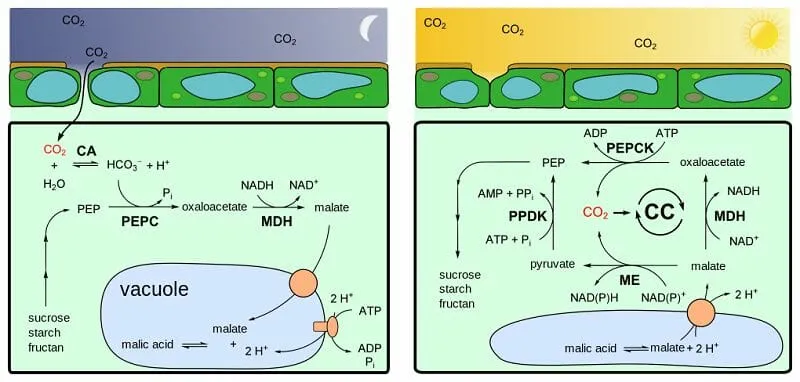
Desert and arid-zone plants face a dilemma: opening stomata during the hot day to absorb CO₂ means losing precious water. CAM plants solve this by separating CO₂ fixation and the Calvin cycle temporally — they fix CO₂ at night and run the Calvin cycle during the day.
| Feature | Detail |
|---|---|
| Stomata open | Night (minimises water loss) |
| CO₂ fixation at night | PEP carboxylase fixes CO₂ → Malic acid (stored in vacuole) |
| During the day | Malic acid is decarboxylated → CO₂ released → enters Calvin cycle |
| Key enzyme (night) | PEP carboxylase |
| Key enzyme (day) | RuBisCO (Calvin cycle) |
| Examples | Pineapple, Cacti, Opuntia, Agave, Bryophyllum |
IMPORTANT
C₄ vs CAM — Key distinction:
- C₄ plants separate CO₂ fixation spatially (mesophyll vs bundle sheath cells)
- CAM plants separate CO₂ fixation temporally (night vs day)
- Both use PEP carboxylase for initial CO₂ fixation, but CAM plants store malic acid in vacuoles overnight
TIP
Exam fact: CAM stands for Crassulacean Acid Metabolism because it was first discovered in the family Crassulaceae (stonecrops). The "acid" refers to malic acid that accumulates at night, making the tissue taste sour in the morning.
Photorespiration — The C₃ Energy Leak
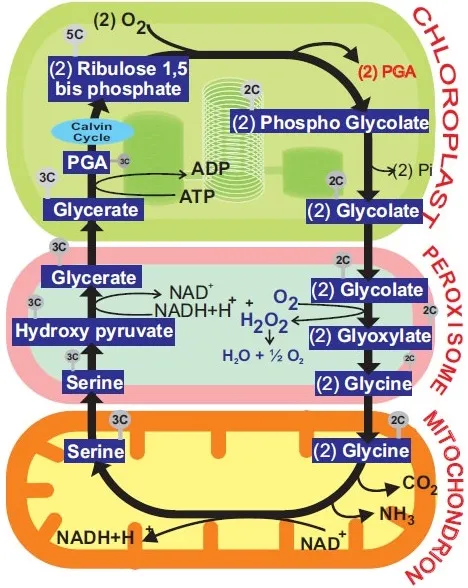
Photorespiration is a wasteful process in which RuBisCO fixes O₂ instead of CO₂, producing a toxic 2-carbon compound (phosphoglycolate) that must be salvaged at the cost of energy. It occurs only in C₃ plants because their RuBisCO is exposed to atmospheric O₂ without a CO₂-concentrating mechanism.
- Older competitive-exam books often attach two recall tags here: photorespiration was first associated with Decker (1959), and the term photorespiration itself is commonly linked with Krotkov (1963).
| Feature | Detail |
|---|---|
| Occurs in | C₃ plants only |
| Absent in | C₄ plants (PEP carboxylase has no oxygenase activity) |
| Enzyme responsible | RuBisCO (acts as oxygenase instead of carboxylase) |
| Substrate | RuBP + O₂ (instead of CO₂) |
| Product | Phosphoglycolate (2C) — toxic, must be recycled |
| Organelles involved | Chloroplast → Peroxisome → Mitochondria (3-organelle shuttle) |
| Energy loss | Up to 25–30% of fixed carbon is lost |
| Light requirement | Occurs only in light (hence "photo"-respiration) |
| CO₂ production | Yes — releases CO₂ without producing ATP |
| Favoured by | High O₂, high temperature, high light, low CO₂ |
- In the book's terminology, photorespiration is also called the glycolate pathway / C2 cycle. After RuBisCO oxygenation, the 2-carbon product is processed through the chloroplast-peroxisome-mitochondria shuttle, where glycolate and related intermediates are handled and recovered at energetic cost. Peroxisomes are especially important in this pathway.
- Older exam keys may specifically ask that the substrate/intermediate highlighted in photorespiration is glycolate, that the main site often keyed for photorespiration is the peroxisome, that catalase in peroxisomes destroys the hydrogen peroxide formed there, and that the recovered pathway releases CO₂ from mitochondria.
- Another older recall point is the Warburg effect — the inhibition of photosynthesis by the presence of oxygen. It is classically associated with C₃ plants, where higher O₂ favours RuBisCO oxygenase activity and increases photorespiration.
WARNING
Common MCQ trap: Photorespiration is not the same as normal (dark/mitochondrial) respiration. Photorespiration produces no ATP and occurs in light only. It is a wasteful side-reaction of RuBisCO, not an energy-producing pathway.
IMPORTANT
Why C₄ plants dominate in the tropics: In hot, sunny conditions, O₂ concentration rises in leaves and CO₂ drops (stomata close to conserve water). This triggers heavy photorespiration in C₃ plants, wasting 25–30% of fixed carbon. C₄ plants avoid this entirely because PEP carboxylase has zero oxygenase activity and bundle sheath cells maintain high CO₂ concentration around RuBisCO.
Summary Table — Key Facts at a Glance
| Fact | Answer |
|---|---|
| Dark reactions occur in | Stroma of chloroplast |
| Dark reactions = | Blackman's reaction |
| C₃ first stable product | 3-PGA (3-carbon) |
| C₄ first stable product | OAA (4-carbon) |
| C₃ CO₂ acceptor | RuBP |
| C₄ CO₂ acceptor | PEP |
| Calvin cycle energy | 18 ATP + 12 NADPH₂ |
| C₄ cycle energy | 30 ATP + 12 NADPH₂ |
| Kranz anatomy in | C₄ plants only |
| Photorespiration in C₄ | Absent |
| Most abundant enzyme | RuBisCO |
| C₄ pathway discovered by | Hatch & Slack (1967) |
| Law of Limiting Factors | Blackman |
| Most world's weeds are | C₄ plants |
| C₃ examples | Wheat, Rice, Barley, Pulses, Soybean |
| C₄ examples | Sugarcane, Maize, Sorghum, Bajra |
| CAM stomata open at | Night |
| CAM acid stored | Malic acid (in vacuole) |
| CAM examples | Pineapple, Cacti, Opuntia, Agave |
| C₄ vs CAM separation | C₄ = spatial; CAM = temporal |
| Photorespiration in | C₃ plants only (absent in C₄) |
| Photorespiration product | Phosphoglycolate (2C) |
| Carbon lost to photorespiration | 25–30% |
| Photorespiration produces ATP? | No — purely wasteful |
Summary Cheat Sheet
| Fact | Answer |
|---|---|
| Dark reactions also called | Blackman's reaction / Path of Carbon |
| Location of dark reactions | Stroma of chloroplast |
| Calvin Cycle first stable product | 3-PGA (3-carbon compound) |
| Calvin Cycle CO₂ acceptor | RuBP (Ribulose bisphosphate) |
| Calvin Cycle key enzyme | RuBisCO (most abundant enzyme on Earth) |
| Energy for Calvin Cycle (per glucose) | 18 ATP + 12 NADPH₂ |
| C₃ plant examples | Wheat, Rice, Barley, Pulses, Soybean, Cotton |
| Hatch-Slack pathway discovered by | Hatch & Slack (1967, Australia) |
| First observation of C₄ fixation | Kortschak, Hartt & Burr (1965, sugarcane) |
| C₄ first stable product | OAA (Oxaloacetic acid, 4-carbon) |
| C₄ CO₂ acceptor | PEP (Phosphoenol Pyruvate) |
| C₄ key enzyme | PEP carboxylase (high CO₂ affinity, no O₂ sensitivity) |
| Energy for C₄ cycle (per glucose) | 30 ATP + 12 NADPH₂ |
| C₄ leaf anatomy | Kranz anatomy (bundle sheath + mesophyll) |
| C₄ plant examples | Sugarcane, Maize, Sorghum, Bajra |
| C₄ subtype — NADP-ME | Main transported acid = Malate |
| C₄ subtypes — NAD-ME and PEP-CK | Aspartate is more typical transported acid |
| Photorespiration occurs in | C₃ plants only (absent in C₄) |
| Photorespiration product | Phosphoglycolate (2C) — toxic |
| Carbon lost to photorespiration | 25–30% of fixed carbon |
| Photorespiration organelles | Chloroplast → Peroxisome → Mitochondria |
| Another name of photorespiration | Glycolate pathway / C2 cycle |
| Does photorespiration produce ATP? | No — purely wasteful |
| CAM stomata open at | Night (minimises water loss) |
| CAM acid stored overnight | Malic acid (in vacuole) |
| CAM plant examples | Pineapple, Cacti, Opuntia, Agave, Bryophyllum |
| CAM named after family | Crassulaceae |
| C₄ separation type | Spatial (mesophyll vs bundle sheath) |
| CAM separation type | Temporal (night vs day) |
| Blackman's Law of Limiting Factors | Rate limited by factor in minimum quantity |
| Most world's worst weeds are | C₄ plants |
TIP
Next: The next chapter shifts from photosynthesis to its counterpart — Respiration, the process by which plants break down the very sugars they made and release the stored energy as ATP.