🟢 Stomata — Structure, Classification, and Mechanism of Opening and Closing
Stomatal distribution, types of transpiration, mechanisms of stomatal movement including K+ transport and ABA, guttation and bleeding with comparison tables and exam mnemonics
From Field to Lab — The Gatekeepers of Every Leaf
In the previous lesson, we covered osmosis, diffusion, absorption, ascent of sap, and transpiration — the complete journey of water through the plant. This lesson zooms in on the structures that control transpiration: the stomata, and related processes of guttation and bleeding.
Early morning in a rice field, tiny water droplets glisten at the tips of leaves — that is guttation, water forced out by root pressure through specialised pores called hydathodes. As the sun rises, thousands of microscopic pores on the leaf surface — stomata — begin to open, allowing CO₂ in for photosynthesis while releasing water vapour. By noon on a hot day, a single maize plant may lose 2–3 litres of water per hour through these tiny openings. If drought stress builds, the hormone ABA signals the stomata to close, shutting down water loss but also halting photosynthesis.
Pro Content Locked
Upgrade to Pro to access this lesson and all other premium content.
Charged once for one year · ₹1188 total
Save ₹100/month vs ₹2388/year launch price
- All Agriculture & Banking Courses
- AI Lesson Questions (100/day)
- AI Doubt Solver (50/day)
- Glows & Grows Feedback (30/day)
- AI Section Quiz (20/day)
- 22-Language Translation (100/day)
- Recall Questions (20/day)
- AI Quiz (15/day)
- AI Quiz Paper Analysis (100/day)
- AI Step-by-Step Explanations (100/day)
- Spaced Repetition Recall (FSRS)
- AI Tutor
- Immersive Text Questions
- Audio Lessons — Hindi & English
- Mock Tests & Previous Year Papers
- Summary & Mind Maps
- XP, Levels, Leaderboard & Badges
- Generate New Classrooms
- Voice AI Teacher (AgriDots Live)
- AI Revision Assistant
- Knowledge Gap Analysis
- Interactive Revision (LangGraph)
🔒 Secure one-time yearly payment via Razorpay · No hidden fees
From Field to Lab — The Gatekeepers of Every Leaf
In the previous lesson, we covered osmosis, diffusion, absorption, ascent of sap, and transpiration — the complete journey of water through the plant. This lesson zooms in on the structures that control transpiration: the stomata, and related processes of guttation and bleeding.
Early morning in a rice field, tiny water droplets glisten at the tips of leaves — that is guttation, water forced out by root pressure through specialised pores called hydathodes. As the sun rises, thousands of microscopic pores on the leaf surface — stomata — begin to open, allowing CO₂ in for photosynthesis while releasing water vapour. By noon on a hot day, a single maize plant may lose 2–3 litres of water per hour through these tiny openings. If drought stress builds, the hormone ABA signals the stomata to close, shutting down water loss but also halting photosynthesis.
Stomata are the gatekeepers of plant gas exchange — they control the balance between water conservation and carbon gain that determines crop productivity.
This lesson covers:
- Stomatal Structure and Distribution — guard cells, inner/outer wall thickness
- Types of Transpiration — stomatal, cuticular, lenticular
- Classification of Stomata — by distribution and by daily pattern
- Mechanism of Opening and Closing — starch-sugar, K⁺ transport, ABA
- Guttation and Bleeding — liquid water loss vs vapour loss
All topics are high-yield for exams, NABARD, and FCI exams.
Stomatal Structure and Distribution
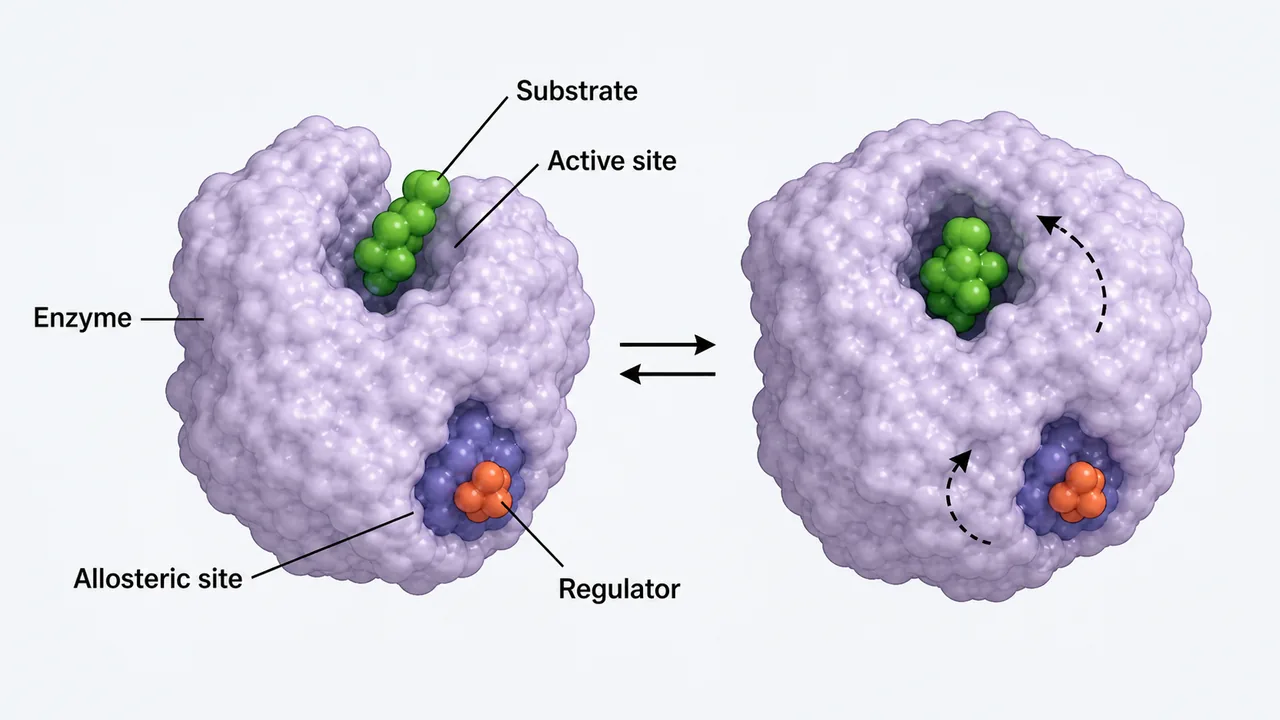
Stomata are the microscopic pores responsible for nearly all gas exchange in leaves. Their structure is elegantly simple — two cells with uneven wall thickness that act like a valve. Understanding this structure is essential for understanding the mechanism of opening and closing covered later in this lesson.
- Stomata are specialised epidermal cells distributed over the leaf surface
- In terrestrial plants, stomata are mainly on the lower surface — so approximately 97% of transpiration occurs from the lower surface. This placement reduces water loss because the lower surface receives less direct sunlight and heat
- In monocots/grasses, stomata are equally distributed on both sides because grass leaves are held vertically, exposing both surfaces equally to the environment
- Each stoma has two kidney-shaped guard cells (in monocots, guard cells are dumbbell-shaped)
- Inner wall of guard cell is thick; outer wall is thin — this differential thickness causes the cell to curve outward and the pore to open when turgid, much like an inflating balloon bulges more on the thinner side
- Stomata open when guard cell TP increases; close when TP decreases
- Guard cells are surrounded by subsidiary or accessory cells that participate in ion exchange during stomatal movement — they act as a reservoir of K⁺ ions
Loss of Water from Living Tissues
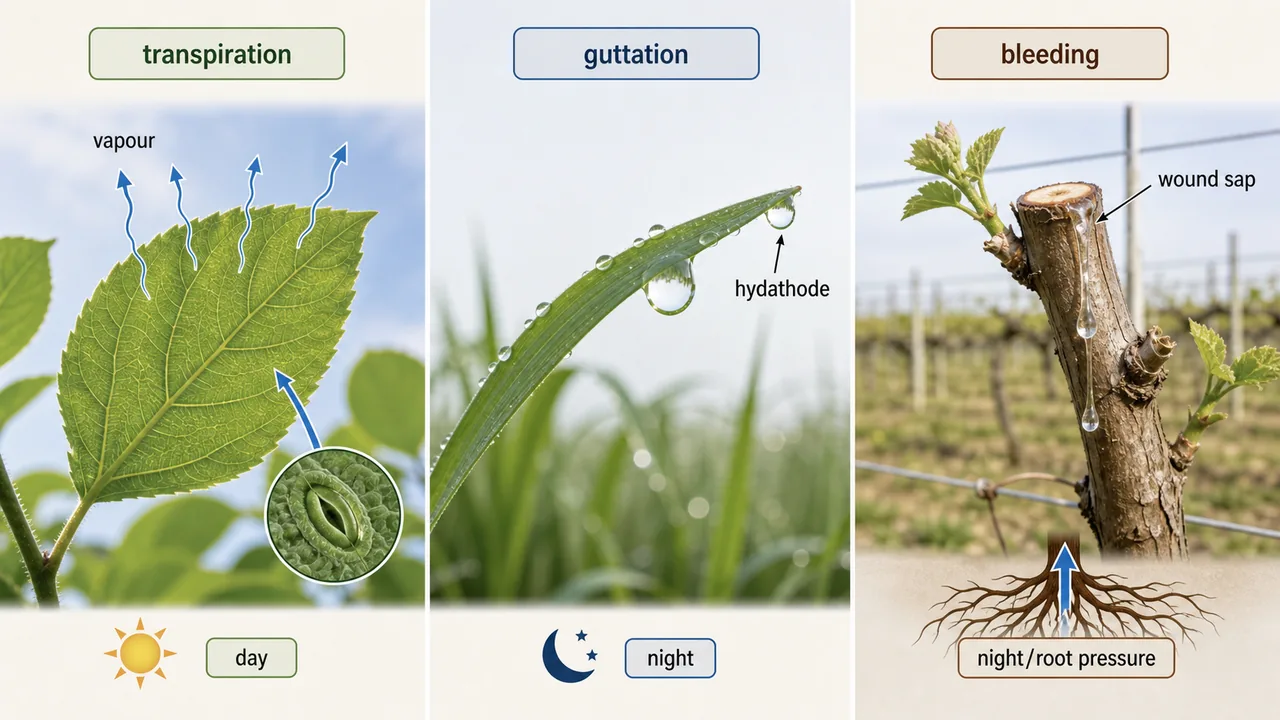
Plants lose water in two forms — vapour (transpiration) and liquid (guttation, bleeding). These three processes differ in their pathway, timing, and driving force. The table below summarises all three at a glance before we explore each in detail.
| Form | Process | Through | Cause |
|---|---|---|---|
| Vapour | Transpiration | Stomata, cuticle, lenticels | Evaporation from mesophyll cells |
| Liquid | Guttation | Hydathodes | Root pressure |
| Liquid | Bleeding | Injured parts | Root pressure |
Transpiration — A "Necessary Evil"
Transpiration is the loss of water in vapour form from living aerial parts. It is called a "necessary evil" because while it drives water uptake and nutrient transport, 99% of absorbed water is lost through transpiration.
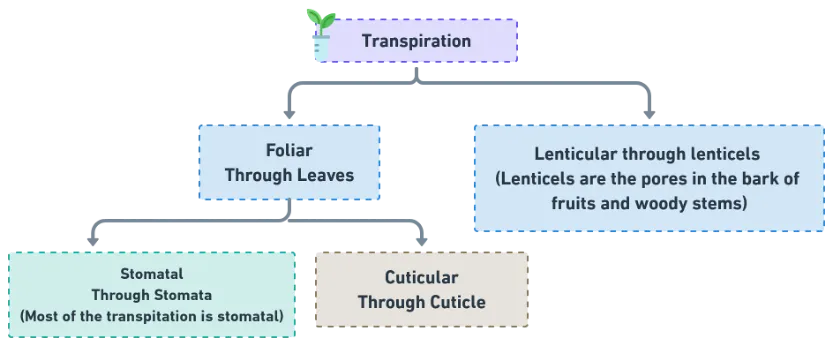
Three Types of Transpiration
| Type | % of Total | Through | Agricultural Relevance |
|---|---|---|---|
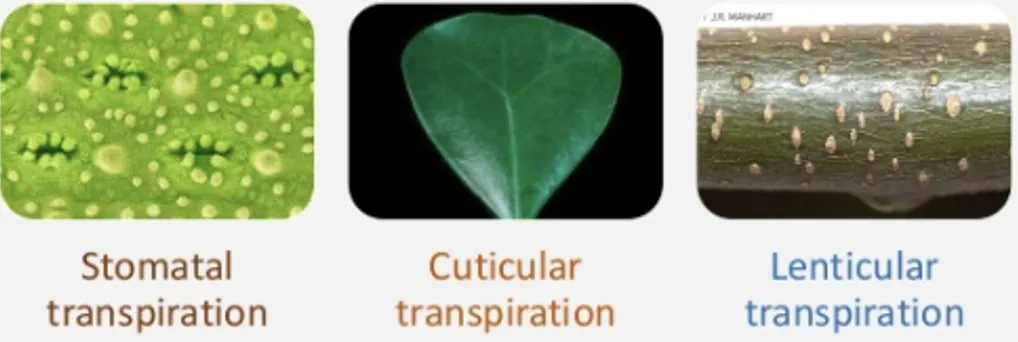
| Stomatal transpiration | 80–90% | Stomata | Controlled by guard cell turgor |
| Cuticular transpiration | up to 20% | Cuticle on leaf surface | Thicker cuticle in xerophytes reduces loss |
| Lenticular transpiration | 0.1% | Lenticels in woody stems | Negligible contribution |
- In classical plant-physiology one-liners, Curtis is credited with calling transpiration a "necessary evil" because the process is unavoidable even though it causes large water loss.
- Lysimeter is used for measurement of transpiration from a soil-plant system
- Lenticels are the aerating pores found in the bark of woody stems and also on some fruits, so lenticular transpiration is associated with those structures rather than with the leaf epidermis.
- Older revision books sometimes give the classical split as stomata 90%, cuticle 9%, and lenticels 1%. Treat that as a legacy exam-book variant rather than a contradiction in principle, because modern summaries often compress lenticular transpiration to a much smaller contribution.
Classification of Stomata
Stomata can be classified in two ways: by their physical location on the leaf surface (which determines how exposed they are to the environment) and by their daily opening-closing pattern (which determines when the plant allows gas exchange). Both classifications appear frequently in exams.
By Distribution on Leaf Surface
| Type | Stomatal Location | Example |
|---|---|---|
| Apple/Mulberry type | Lower surface only (hypostomatic) | Apple, Mulberry |
| Potato type | More on lower than upper surface | Potato |
| Oat type | Equally on both surfaces | Oat, grasses (monocots) |
| Water Lily type | Upper surface only | Water Lily (lower surface submerged) |
| Potamogeton type | Stomata absent or functionless | Submerged aquatic plants |
TIP
Mnemonic — "APOWP": Apple (lower only), Potato (mostly lower), Oat (both equal), Water lily (upper only), Potamogeton (none). Remember: aquatic plants with floating leaves have stomata on top; submerged plants have none.
By Daily Movement Pattern (Loftfield Classification)
| Type | Behaviour | Examples |
|---|---|---|
| Alfalfa type | Open day and night | Pea, bean, radish, mustard |
| Potato type | Open day and night except few evening hours | Onion, cabbage, pumpkin |
| Barley type | Open only few hours during day | Cereals (water-conserving) |
Mechanism of Stomatal Opening and Closing
This is the most conceptually dense section of the lesson and one of the highest-yield topics for exams. Four theories have been proposed to explain what drives turgor changes in guard cells — from early photosynthesis-based hypotheses to the modern K⁺ transport mechanism.
Stomatal movement is governed by turgor changes in guard cells. When TP increases, stomata open; when TP decreases, stomata close. Four major theories explain what causes these turgor changes:
A. Photosynthetic Production Theory (Von Mohl, 1856)
Guard cell chloroplasts synthesise osmotically active substances in day → increased O.P. → endo-osmosis → stomata open. Reverse at night.
Drawbacks: Guard cell chloroplasts are small and few — only feeble photosynthesis is possible. Also, increasing CO₂ in bright light causes partial closure (contradicts this theory).
B. Starch-Sugar Inter-conversion Hypothesis (Lloyd, 1908; Scarth, 1932)
- Starch in guard cells decreases in day and increases at night
- CO₂ removal by photosynthesis raises pH → starch converts to sugar (by phosphorylase)
- More sugar → higher O.P. → water enters → stomata open


| Illuminated guard cells | Dark guard cells |
|---|---|
| Respirator CO₂ of intercellular spaces is used up by mesophylls in photosynthesis | Accumulates in spaces |
| pH of guard cells rises (Alkaline) | Falls (Acidic) |
| The decrease in acidity hydrolysis of Starch → Sugar | The increase in acidity favours Sugar → Starch |
| O.P. in cell sap of guard cells increases | Decreases |
| Water enters into guard cells and T.P. and volume increases | Water leaves the guard cells and T.P. and volume decreases |
Drawbacks:
- How does CO₂ removal raise pH from 4.5 to 7.0?
- Starch converts to organic acid, not sugar — sugar is never seen in guard cells
- In monocots, starch is not formed at all in guard cells
C. Active K⁺ Transport Mechanism (Most Accepted)
- Immamura (1943), Fischer & Hsiao (1968): Direct correlation between K⁺ concentration and stomatal opening
- K. Raschke (1975) — the most comprehensive explanation:
| Event (Opening) | Event (Closing) |
|---|---|
| Starch disappears from guard cells | Starch accumulates |
| Organic acids (malic acid) produced | Malic acid decreases |
| H⁺ ions excreted from guard cells | H⁺ excretion blocked |
| K⁺ and Cl⁻ enter guard cell vacuoles | K⁺ and Cl⁻ leave |
| O.P. increases → water enters → TP increases | O.P. decreases → water exits → TP decreases |
| Stomata OPEN | Stomata CLOSE |
IMPORTANT
Abscisic acid (ABA) blocks H⁺ ion excretion from guard cells → prevents K⁺ uptake → causes stomatal closure. ABA is the key stress hormone — during drought, ABA levels rise and force stomata to close, conserving water.
D. Proton Transport Concept
Photoactive opening (Levitt, 1974): A synthetic theory combining Scarth's pH theory + K⁺ transport theory — the most comprehensive explanation of light-driven stomatal opening.
- Older competitive-exam keys often add a direct light-quality recall here: blue light is the most effective for maximum stomatal opening and therefore commonly keyed with the maximum transpiration rate.
Scotoactive opening (Pallas, 1969): Explains why stomata open at night in succulent/CAM plants. O₂ deficiency in thick leaves → anaerobic respiration → pH rises → PEP → organic acid → K⁺ absorption → stomata open.
Measurement Instruments
| Instrument | Measures |
|---|---|
| Potometer (Farmer's or Ganong's) | Rate of transpiration (water uptake) |
| Knight's Porometer | Stomatal opening (airflow resistance) |
Guttation
Unlike transpiration which involves water vapour, guttation is the loss of water in liquid form. It is commonly observed as droplets at leaf tips early in the morning — a phenomenon often confused with dew but driven by an entirely different mechanism (root pressure, not condensation).
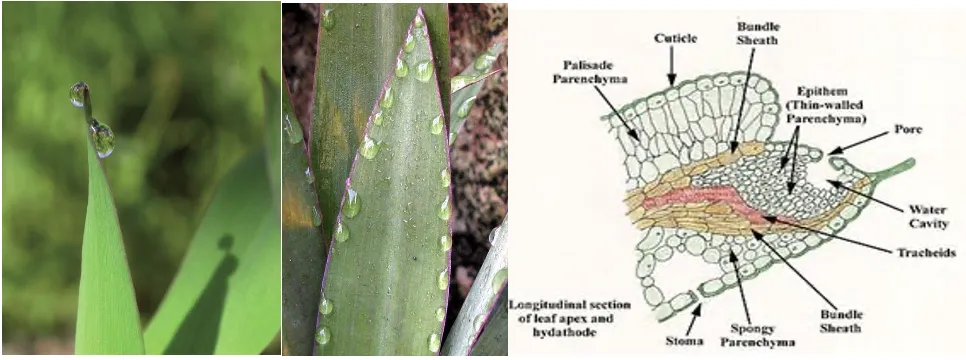
Guttation is the exudation of water in liquid form through hydathodes (specialised structures at leaf tips/margins).
- Cause: Root pressure
- Occurs normally at night (transpiration minimal, absorption continues)
- Conditions: Warm soil + humid/cool atmosphere; warm day followed by cool night (winter)
- Hydathode: Specialised epidermal cell at leaf tip/margin; group of parenchyma beneath = epithem; always open (unlike stomata)
- Salt accumulation at leaf tip/margin in winter = guttation deposits
Bleeding
While guttation is a normal physiological process through specialised pores, bleeding is an abnormal loss of sap from wounds. Both are driven by the same force — root pressure — but differ in pathway and trigger.
The loss of sap from injured parts of the plant is called bleeding. Cause: Root pressure.
- Bleeding is commonly observed when pruning grapevines or tapping rubber trees — the sap that oozes out is driven upward by positive root pressure
- Like guttation, bleeding is more pronounced when transpiration is low (night, humid conditions) because root pressure is not counteracted by transpiration pull
- The sap lost during bleeding contains dissolved minerals and sugars, unlike the nearly pure water vapour lost in transpiration
Comparison — Transpiration vs Guttation
Transpiration and guttation are both mechanisms of water loss, but they differ in form, timing, pathway, and driving force. This comparison is an exam favourite — pay special attention to the opposites (day vs night, vapour vs liquid, stomata vs hydathodes).
| Transpiration | Guttation |
|---|---|
| It usually occurs in day time. | It occurs during night. |
| The loss of water occurs in the form of vapour. | Here occurs in the form of liquid. |
| It occurs through stomata, leticels & cuticle. | It occurs through hydathodes. |
| It is regulated & controlled by stomatal activities. | It is regulated by the root pressure and the climatic condition. |
| The effect of transpiration is cooling the leaf surface. | There is no such effect. |
| The transpiring water is pure. | Guttation water contains dissolved salts & minerals. |
Transpiration vs Guttation — Detailed Comparison
| Feature | Transpiration | Guttation |
|---|---|---|
| Timing | Usually daytime | Usually night |
| Form of water | Vapour | Liquid |
| Through | Stomata, lenticels, cuticle | Hydathodes |
| Regulated by | Stomatal activities | Root pressure & climate |
| Cooling effect | Yes | No |
| Water purity | Pure water lost | Contains dissolved salts & minerals |
| Humidity effect | Reduced in humid days | Humidity enhances guttation |
| Dry conditions | Favour transpiration | Resist guttation |
Important Points
These frequently tested facts tie together multiple concepts from this lesson.
- Dry weight of a green leaf is highest during afternoon — peak photosynthesis produces maximum organic matter, while transpiration removes only water (not dry matter)
- Stomatal transpiration accounts for 80–90% of all water loss — this is why stomatal regulation is the primary control mechanism for plant water balance
- ABA is the key hormone for stomatal closure under drought stress — it blocks H⁺ excretion from guard cells, preventing K⁺ uptake and causing turgor loss
- In older plant-physiology recall notes, peak stomatal opening is commonly keyed to late morning (~10 AM) and late afternoon (~3 PM), with a partial midday closure around noon under stronger evaporative demand
- Root pressure is classically measured with a manometer, while stomatal opening is measured with Knight's Porometer
Summary Cheat Sheet
| Fact | Answer |
|---|---|
| Transpiration from lower surface | 97% in terrestrial plants |
| Stomata in monocots | Equal on both surfaces |
| Guard cell inner wall | Thick |
| Guard cell outer wall | Thin |
| Transpiration = "necessary evil" | 99% absorbed water is lost |
| Stomatal transpiration | 80–90% |
| Cuticular transpiration | Up to 20% |
| Transpiration measurement | Potometer |
| Root pressure measurement | Manometer |
| Stomatal opening measurement | Knight's Porometer |
| Peak stomatal opening | Late morning (~10 AM) and late afternoon (~3 PM) |
| ABA effect on stomata | Closes stomata (blocks H⁺ excretion) |
| K⁺ transport — stomata open | K⁺ enters guard cells → TP increases |
| Guttation occurs at | Night |
| Guttation through | Hydathodes |
| Guttation cause | Root pressure |
| Bleeding cause | Root pressure |
| CAM plants stomata open at | Night (scotoactive opening) |
| Lysimeter measures | Transpiration from soil-plant system |
| Loftfield classification | Alfalfa (always open), Potato (mostly open), Barley (few hours) |
| Starch-sugar hypothesis | Lloyd (1908), Scarth (1932) |
| K⁺ transport mechanism | Immamura (1943), K. Raschke (1975) |
| Proton transport concept | Levitt (1974) — photoactive; Pallas (1969) — scotoactive |
TIP
Next: The Photosynthesis unit begins with Photosynthetic Pigments — chlorophyll, carotenoids, phycobilins, and anthocyanins — the molecular machinery that captures the light energy stomata let in.