💩 Manures: Bulky and Concentrated Organic Sources of Plant Nutrition
Complete guide to organic manures — FYM, compost, vermicompost, green manures, and concentrated organic manures like oilcakes and bone meal. Covers nutrient content, preparation methods, and exam-focused comparisons.
Introduction
A wheat farmer in Punjab notices that after years of using only chemical fertilizers, the soil has become hard and compacted. Yields are stagnating despite increasing fertilizer doses. When the farmer starts adding 10 tonnes of FYM per hectare along with fertilizers, the soil becomes friable again, water-holding capacity improves, and yields recover. This is the power of organic manures -- they feed the soil, not just the crop.
What Are Organic Manures?
The word manure comes from the French "Manoeuvrer", meaning to work the land for crop production. Manures are plant and animal wastes used as sources of plant nutrients.
The key distinction is simple:
- Manures = organic origin (plant/animal waste)
- Fertilizers = inorganic origin (manufactured chemicals)
Unlike chemical fertilizers that supply one or two nutrients, manures improve overall soil health -- structure, microbial activity, and nutrient-holding capacity.
Advantages of Manuring
- Supply all plant nutrients including micronutrients
- Improve soil structure, water-holding capacity, and aeration
- CO2 released during decomposition acts as a CO2 fertilizer for photosynthesis
- Provide food for soil microorganisms, building a healthy soil ecosystem
- Suppress plant parasitic nematodes and fungi through biological pest control
- Provide buffering action that stabilizes soil pH
- Reduce nutrient loss from leaching and erosion
- Increase cation exchange capacity of soil
Classification of Manures
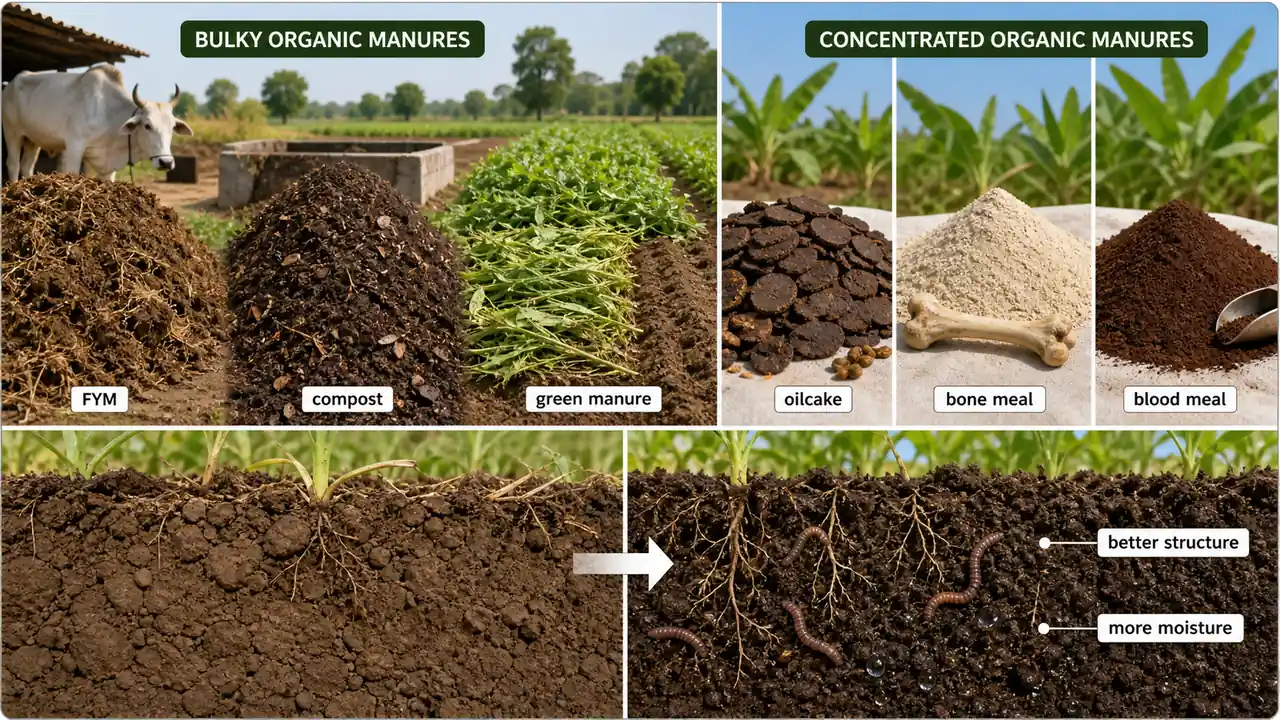
| Type | Nutrient Level | Quantity Applied | Examples |
|---|---|---|---|
| Bulky organic manures | Low (0.5-3% N) | Large (10-25 t/ha) | FYM, Compost, Green manure |
| Concentrated organic manures | High (3-20% N) | Small (0.2-1 t/ha) | Oilcakes, Blood meal, Bone meal |
Bulky Organic Manures
Farm Yard Manure (FYM)
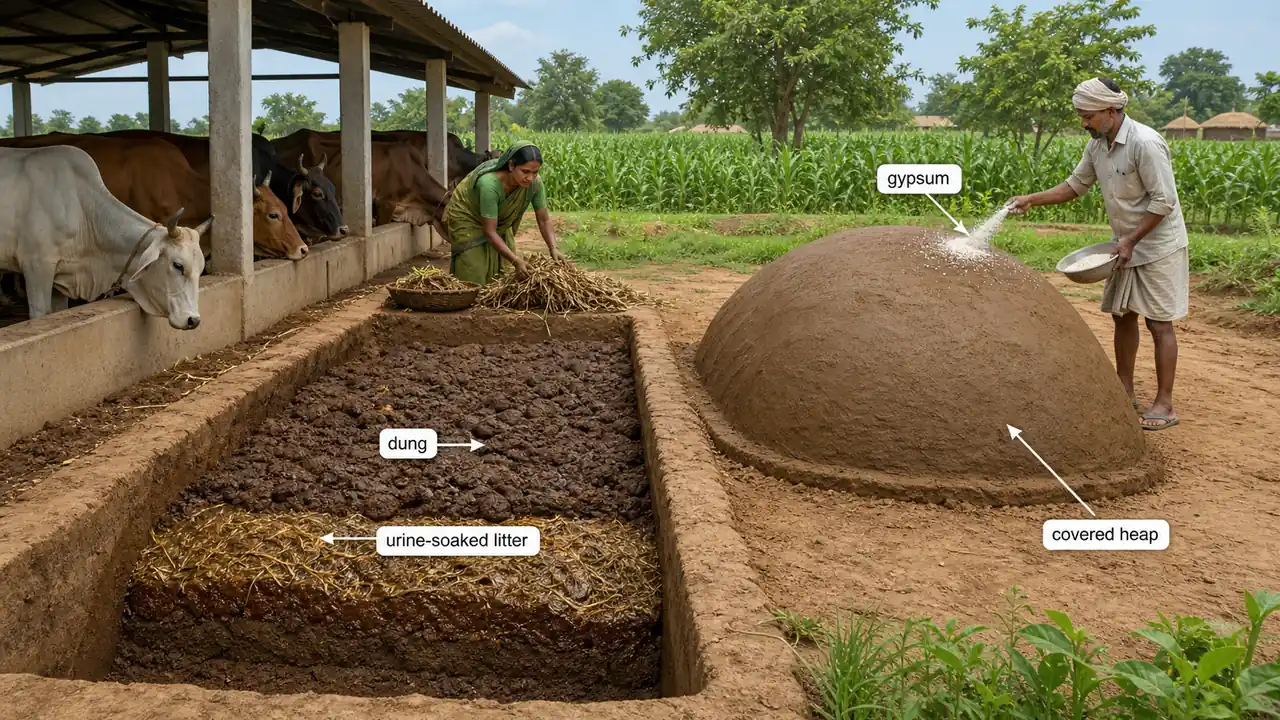
FYM is a decomposed mixture of dung and urine of farm animals along with litter and leftover roughage. It is the most commonly used organic manure in India.
Pro Content Locked
Upgrade to Pro to access this lesson and all other premium content.
Charged once for one year · ₹1188 total
Save ₹100/month vs ₹2388/year launch price
- All Agriculture & Banking Courses
- AI Lesson Questions (100/day)
- AI Doubt Solver (50/day)
- Glows & Grows Feedback (30/day)
- AI Section Quiz (20/day)
- 22-Language Translation (100/day)
- Recall Questions (20/day)
- AI Quiz (15/day)
- AI Quiz Paper Analysis (100/day)
- AI Step-by-Step Explanations (100/day)
- Spaced Repetition Recall (FSRS)
- AI Tutor
- Immersive Text Questions
- Audio Lessons — Hindi & English
- Mock Tests & Previous Year Papers
- Summary & Mind Maps
- XP, Levels, Leaderboard & Badges
- Generate New Classrooms
- Voice AI Teacher (AgriDots Live)
- AI Revision Assistant
- Knowledge Gap Analysis
- Interactive Revision (LangGraph)
🔒 Secure one-time yearly payment via Razorpay · No hidden fees
Introduction
A wheat farmer in Punjab notices that after years of using only chemical fertilizers, the soil has become hard and compacted. Yields are stagnating despite increasing fertilizer doses. When the farmer starts adding 10 tonnes of FYM per hectare along with fertilizers, the soil becomes friable again, water-holding capacity improves, and yields recover. This is the power of organic manures -- they feed the soil, not just the crop.
What Are Organic Manures?
The word manure comes from the French "Manoeuvrer", meaning to work the land for crop production. Manures are plant and animal wastes used as sources of plant nutrients.
The key distinction is simple:
- Manures = organic origin (plant/animal waste)
- Fertilizers = inorganic origin (manufactured chemicals)
Unlike chemical fertilizers that supply one or two nutrients, manures improve overall soil health -- structure, microbial activity, and nutrient-holding capacity.
Advantages of Manuring
- Supply all plant nutrients including micronutrients
- Improve soil structure, water-holding capacity, and aeration
- CO2 released during decomposition acts as a CO2 fertilizer for photosynthesis
- Provide food for soil microorganisms, building a healthy soil ecosystem
- Suppress plant parasitic nematodes and fungi through biological pest control
- Provide buffering action that stabilizes soil pH
- Reduce nutrient loss from leaching and erosion
- Increase cation exchange capacity of soil
Classification of Manures
| Type | Nutrient Level | Quantity Applied | Examples |
|---|---|---|---|
| Bulky organic manures | Low (0.5-3% N) | Large (10-25 t/ha) | FYM, Compost, Green manure |
| Concentrated organic manures | High (3-20% N) | Small (0.2-1 t/ha) | Oilcakes, Blood meal, Bone meal |
Bulky Organic Manures
Farm Yard Manure (FYM)
FYM is a decomposed mixture of dung and urine of farm animals along with litter and leftover roughage. It is the most commonly used organic manure in India.
Nutrient Composition of FYM:
| Nutrient | Content (%) |
|---|---|
| Nitrogen (N) | 0.5% (range 0.5-0.75%) |
| Phosphorus (P2O5) | 0.25% |
| Potassium (K2O) | 0.5% |
IMPORTANT
FYM composition: N : P : K = 0.5 : 0.25 : 0.5. This is frequently asked in exams and exams. Think of it as "half-quarter-half."
Key Facts about FYM:
- Nitrogen in urine is mostly as urea, subject to volatilization losses -- proper storage is critical
- One tonne of cattle dung supplies only 2.95 kg N, 1.59 kg P2O5, and 2.95 kg K2O
- Storage trench size: 6-7.5 m long, 1.5-2.0 m wide, 1 m deep
- Heaped 45-60 cm above ground, dome-shaped, plastered with cow dung-earth slurry
- Ready for use in 4-5 months after plastering
Chemical preservatives reduce losses and enrich FYM:
- Gypsum -- absorbs urine, prevents NH3 loss, adds Ca and S
- Superphosphate -- prevents NH3 loss, adds P
- Kainite -- reduces volatilization
Application:
- Apply 10-20 tonnes/ha of well-decomposed FYM (>20 t/ha for fodder grasses and vegetables)
- Apply at least 15 days before sowing to avoid nitrogen immobilization (microbes temporarily lock up N while decomposing fresh organic matter)
Nutrient Availability to First Crop:
| Nutrient | Available to First Crop | Residual for Later Crops |
|---|---|---|
| Nitrogen | 30% | 70% |
| Phosphorus (P2O5) | 60-70% | 30-40% |
| Potassium (K2O) | 70% | 30% |
IMPORTANT
Only 30% of N from FYM is available to the first crop. This is why FYM alone cannot meet the nitrogen demand of high-yielding varieties -- integrated nutrient management (INM) is essential.
Decomposition: Bacteria and Actinomycetes drive decomposition. Optimal conditions are 60-70% moisture initially, 30-40% when ready, and 50-60 degree C temperature in the heap.
Dung and Urine Production by Farm Animals
| Animal | Dung per Day |
|---|---|
| Cattle | 18-30 kg |
| Buffaloes | 25-40 kg |
| Sheep and goats | 1-2.5 kg |
| Pigs | 3-5 kg |
| Poultry | 120 g (chicken) |
Nutritive Value of Animal Dung (mg/g)
| Animal | N | P | K |
|---|---|---|---|
| Cattle | 20-45 | 4-10 | 7-25 |
| Sheep and goat | 20-45 | 4-11 | 20-29 |
| Pig | 20-45 | 6-12 | 15-48 |
| Poultry | 28-62 | 9-26 | 8-29 |
Hot vs Cold Manure and Short vs Long Manure
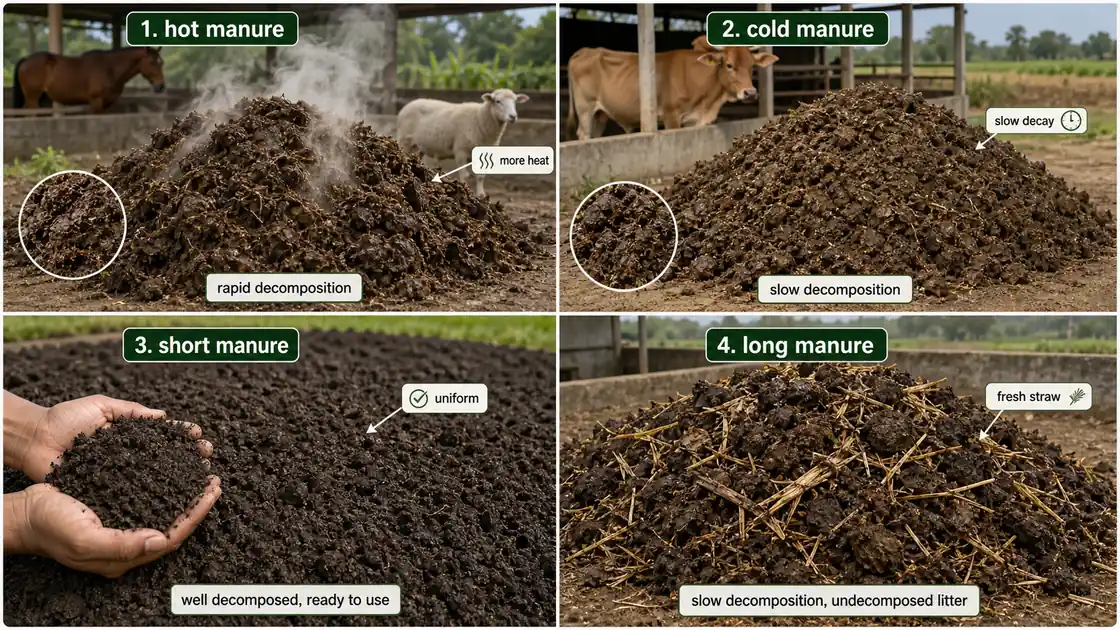
| Term | Meaning | Example |
|---|---|---|
| Hot manure | Decomposes vigorously, generates more heat | Horse, Sheep manure |
| Cold manure | Decomposes slowly, less heat | Cattle, Pig manure |
| Short manure | Well decomposed, lost original structure, uniform | Ready-to-use FYM |
| Long manure | Fresh, contains straw pieces, needs further decomposition | Fresh dung with litter |
Fire Fanging: Profuse fungal growth on moist manure surface giving an ashy grey appearance. Indicates excessive drying and poor decomposition. Prevent by maintaining adequate moisture in the heap.
Composting
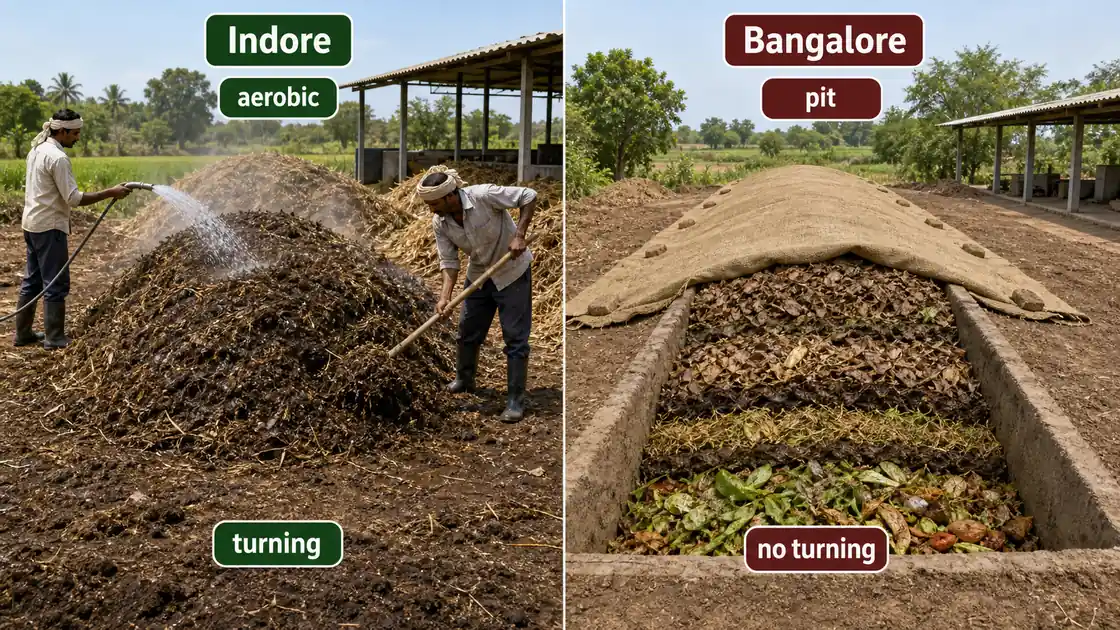
Composting is the controlled decomposition of organic matter by microorganisms. The end product -- compost -- resembles well-decomposed cattle manure but is more powdery and lighter in colour.
Think of composting as recycling farm and household waste into a valuable soil amendment. A sugarcane farmer, for instance, can compost trash and press mud instead of burning them.
Two Methods of Composting
| Feature | Indore Method | Bangalore Method |
|---|---|---|
| Type | Aerobic (Heap method) | Anaerobic (Pit method) |
| Developed by | Sir Albert Howard | C.N. Acharya |
| Location | Institute of Plant Industry, Indore | Indian Institute of Science, Bangalore |
| Turning required? | Yes, regular turning + water sprinkling | No turning needed |
| Labour cost | Higher | Lower (labour saving) |
| Time to ready | 3-4 months | 6-8 months |
| Best for | Farm waste | Night soil and refuse |
| Quality | Good | Best method of composting |
TIP
Mnemonic -- "IAH-BAP":
- Indore = Aerobic = Heap = Sir Albert Howard = needs turning
- Bangalore = Anaerobic = Pit = C.N. Acharya = no turning = best method
Types of Compost and Their Nutrient Content
| Compost Type | N (%) | P2O5 (%) | K2O (%) | Key Feature |
|---|---|---|---|---|
| Farm compost (general) | 0.5 | 0.15 | 0.5 | Made from farm waste |
| Farm compost (Bangalore method) | 0.80-1.24 | 0.40-0.59 | 2.0-3.3 | Better quality |
| Town compost | 1.4 | 1.0 | 1.4 | Made from urban refuse, night soil |
| Azo compost | ~1.5 | - | - | Cheapest source of N among organic manures |
| Super compost | - | Enriched P | - | Superphosphate added (10-15 kg/t) |
- Azo compost uses Azotobacter (N-fixing bacteria) during preparation
- Super compost uses superphosphate or rock phosphate at 10-15 kg/tonne of raw material
Vermicomposting
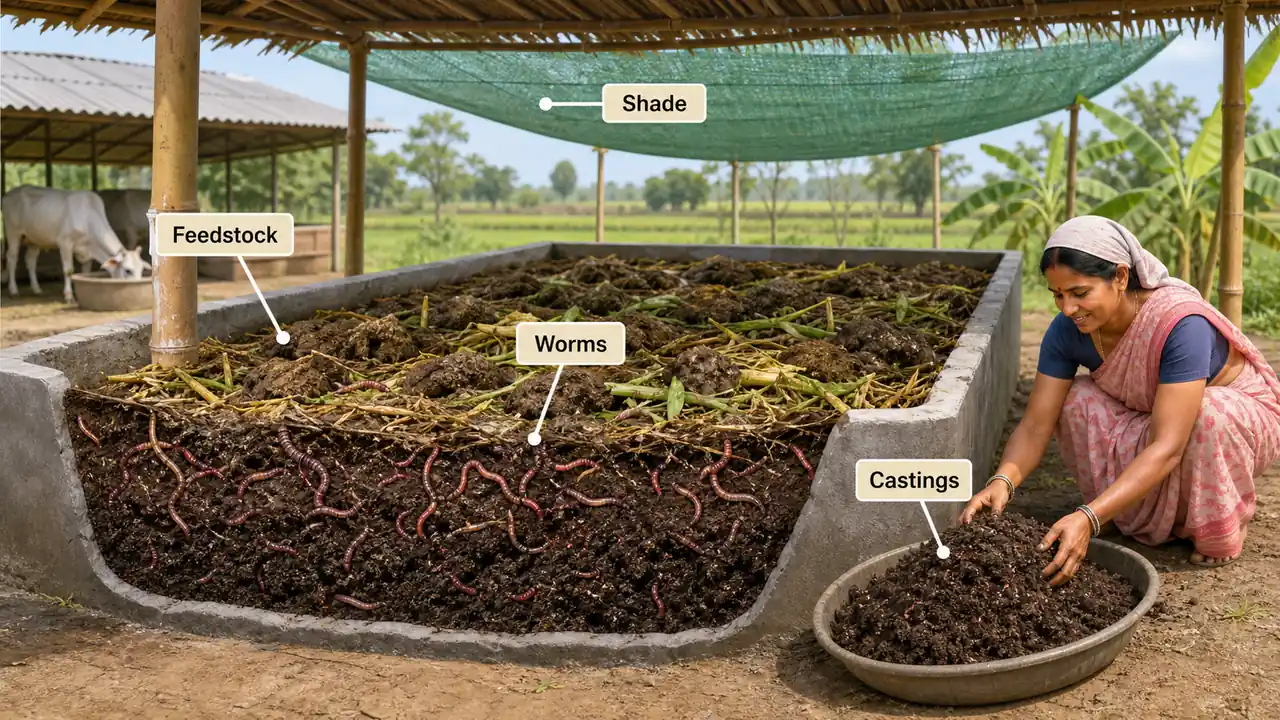
Vermicomposting uses earthworms to decompose organic waste. Earthworms produce castings rich in plant nutrients and beneficial microbes.
Key Earthworm Species:
| Species | Common Name | Key Feature |
|---|---|---|
| Eisenia foetida | Red wiggler | Most widely used, thermo-tolerant |
| Lumbricus rubellus | Red worm | Thermo-tolerant |
| Eudrilus eugeniae | African night crawler | Fast reproducing, suited to tropics |
| Lumbricus terrestris | Night crawler | Deep burrowing |
| Allobophora caliginosa | Field worm | Used in field conditions |
IMPORTANT
Eisenia foetida and Lumbricus rubellus are the most important vermicomposting species because they are thermo-tolerant.
Vermicompost Nutrient Content:
- Organic carbon: 9.5-17.98%
- Nitrogen: 0.5-1.50%
- Phosphorus: 0.1-0.30%
- Potassium: 0.15-0.56%
Comparison of All Bulky Organic Manures
| Manure | N (%) | P (%) | K (%) |
|---|---|---|---|
| FYM | 0.5 | 0.25 | 0.5 |
| Town compost | 1.5 | 0.4 | 1.4 |
| Vermicompost | 3.0 | 1.0 | 1.5 |
| Night soil | 5.5 | 4.0 | 2.0 |
| Sheep and goat manure | 3.0 | 1.0 | 2.0 |
| Poultry manure | 3.03 | 2.63 | 1.40 |
Night Soil (Poudrette)
- Night soil = human excreta (solid + liquid)
- Contains 5.5% N, 4.0% P2O5, 2.0% K2O
- Dehydration with soil, ash, charcoal, or sawdust produces poudrette (1.32% N, 2.8% P2O5, 4.1% K2O)
- Proper sanitary treatment is essential before use to eliminate pathogens
Sewage and Sludge

- Sludge = solid portion of sewage; sewage water = liquid portion
- Untreated sewage makes soil "sewage sick" due to clogging and anaerobic organisms that reduce nitrates and produce alkalinity
- Activated sludge treatment = aerating sewage in settling tanks by blowing air through it
- Activated sludge composition: 3-6% N, 2% P2O5, 1% K2O
Sheep and Goat Manure

- Contains 3% N, 1% P2O5, 2% K2O -- considerably richer than FYM
- Two application methods:
- Sweeping shed waste into pits for decomposition, then applying to fields
- Sheep penning -- animals stay overnight in the field, adding urine and dung directly (traditional in-situ manuring)
Poultry Manure

- Contains 3.03% N, 2.63% P2O5, 1.4% K2O
- One of the richest organic manures due to high N and P content
- Litter (straw, peat, sawdust, dry leaves) used as bedding absorbs urine and faeces
- Especially valued for vegetable and horticultural crops
Green Manures
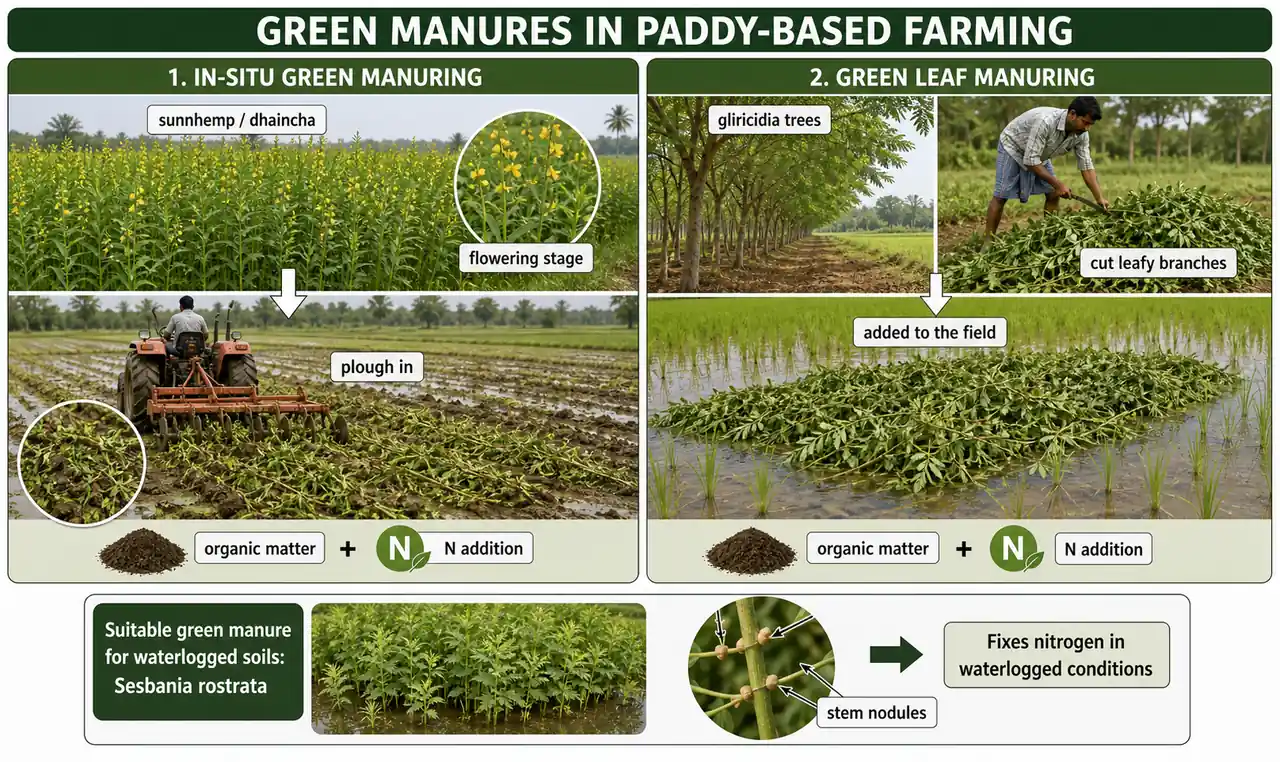
Green manuring means growing a crop and ploughing it into the soil at flowering stage as a source of organic matter and nutrients. A rice farmer in Tamil Nadu, for example, grows dhaincha for 45 days before paddy and incorporates it -- saving significant fertilizer cost.
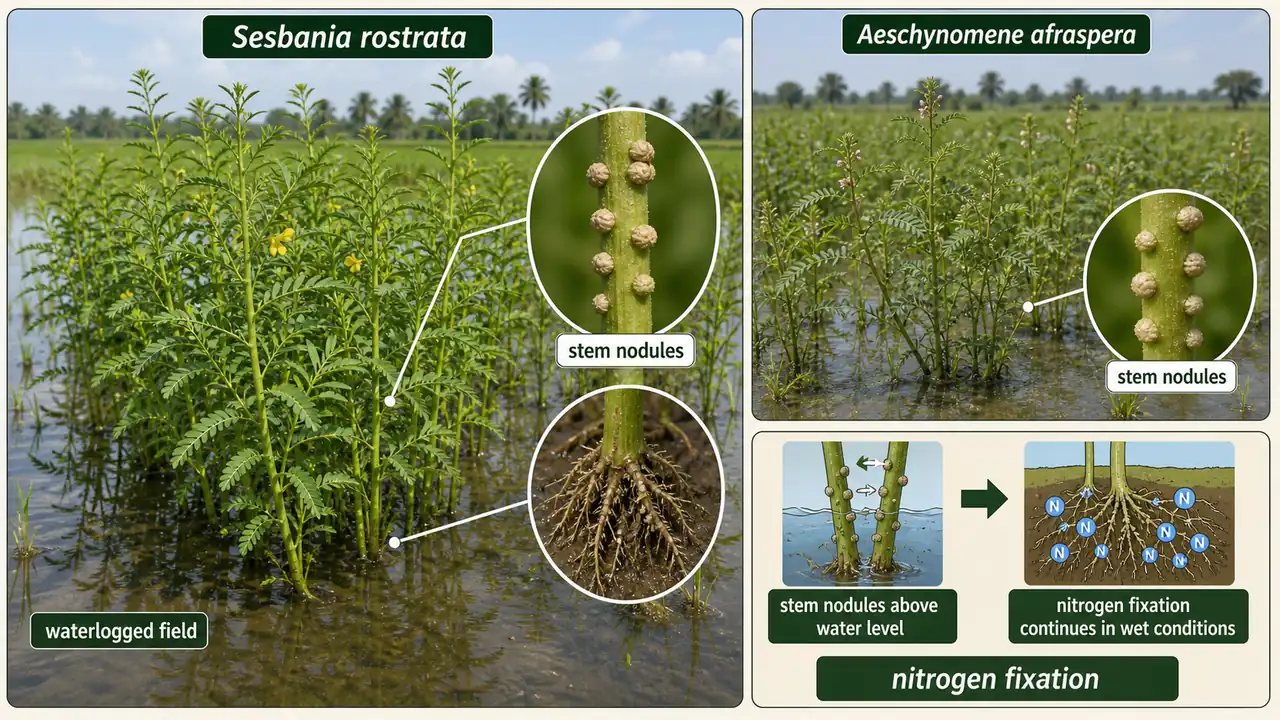
| Stem-Nodulating Green Manure | What the Image Shows | Why It Matters |
|---|---|---|
| Sesbania rostrata | Stem nodules clearly visible above the flooded soil-water line | Supports rapid nitrogen fixation under wet paddy-field conditions |
| Aeschynomene afraspera | Another stem-nodulating species adapted to wet conditions | Useful comparison species for the same adaptation |
| Stem nodules above water level | Nodules form on stem portions exposed to air rather than relying only on roots | Helps biological N fixation continue where waterlogging limits normal root nodulation |
Two Types of Green Manuring
| Type | Method | Example |
|---|---|---|
| Green manuring (in-situ) | Grow crop in the field and incorporate it there | Sunnhemp, Dhaincha before paddy |
| Green leaf manuring (ex-situ) | Collect green leaves/twigs from elsewhere and apply | Neem, Mahua, Glyricidia Raj Pre PG 2021, Pongamia, Subabul |
Key Green Manure Crops:
- Sunnhemp (Crotalaria juncea) -- best all-round green manure, suited to all parts of India
- Dhaincha (Sesbania aculeata) -- best for alkaline and waterlogged soils (problem soils)
- Berseem -- for orchards, irrigated cotton, and sugarcane
- Lentil -- used in Kashmir for green manuring in paddy
TIP
Remember: Sunnhemp = best overall green manure. Dhaincha = best for problem soils (alkaline/waterlogged). Sesbania rostrata = fastest N-fixer (stem nodulation).
Why Incorporate at Flowering Stage?
At flowering, the plant has the greatest bulk of succulent organic matter with a low C:N ratio. Low C:N ratio means faster decomposition and quicker nitrogen release. The fertilizer value increases further if the green manure crop is manured with superphosphate (100 kg/ha).
Green manuring adds 60-80 kg N/ha on average -- a substantial saving on chemical nitrogen.
Green Manure Crops with Stem Nodulation
These fix nitrogen even in waterlogged conditions where root nodulation is limited:
- Sesbania rostrata -- the fastest N2-fixing plant, fixing 100-285 kg N/ha in 45-55 days
- Aeschynomene afraspera
Detailed Comparison of Major Green Manure Crops
Dhaincha vs Sunnhemp vs Sesbania rostrata vs Sesbania speciosa
| Feature | Dhaincha (S. aculeata) | Sunnhemp (C. juncea) | S. rostrata | S. speciosa |
|---|---|---|---|---|
| Soil tolerance | Drought tolerant, stands floods | Loamy soil, irrigated | Summer preferred | Grows in standing water |
| Incorporation time | 45 days | 60 days | Like dhaincha | Like dhaincha |
| Seed rate (GM) | 50 kg/ha | 25-35 kg/ha | 40 kg/ha | 15 kg/ha |
| Nodulation | Root nodulating | Root nodulating | Stem nodulating | Root nodulating |
| N content (air dry) | 3.50% | 2.30% | - | - |
| N accumulation (60 d) | 133 kg/ha | 134 kg/ha | - | - |
| Biomass | 10-20 t green matter | 30.6 t/ha dry matter | - | Higher than dhaincha |
| Special feature | Alkaline/waterlogged soils | Most outstanding GM | Fastest N2-fixer | Grows in standing water |
Nutrient Content of Green Manure Crops (% on air dry basis)
| Plant | N (%) | P (%) | K (%) |
|---|---|---|---|
| Sunnhemp (Crotalaria juncea) | 2.30 | 0.50 | 1.80 |
| Dhaincha (Sesbania aculeata) | 3.50 | 0.60 | 1.20 |
| Sesbania (Sesbania speciosa) | 2.71 | 0.53 | 2.21 |
Biomass Production and N Accumulation
| Crop | Age (days) | Dry Matter (t/ha) | N Accumulation (kg/ha) |
|---|---|---|---|
| Dhaincha | 60 | 23.2 | 133 |
| Sunnhemp | 60 | 30.6 | 134 |
| Cowpea | 60 | 23.2 | 74 |
Characteristics of a Good Green Manure Crop
- Rapid growth and short duration -- fits into crop rotations
- Abundant succulent biomass -- ensures low C:N ratio and rapid decomposition
- Ability to grow on poor soils -- useful even in marginal farming conditions
- Preferably a legume -- fixes atmospheric nitrogen
Concentrated Organic Manures
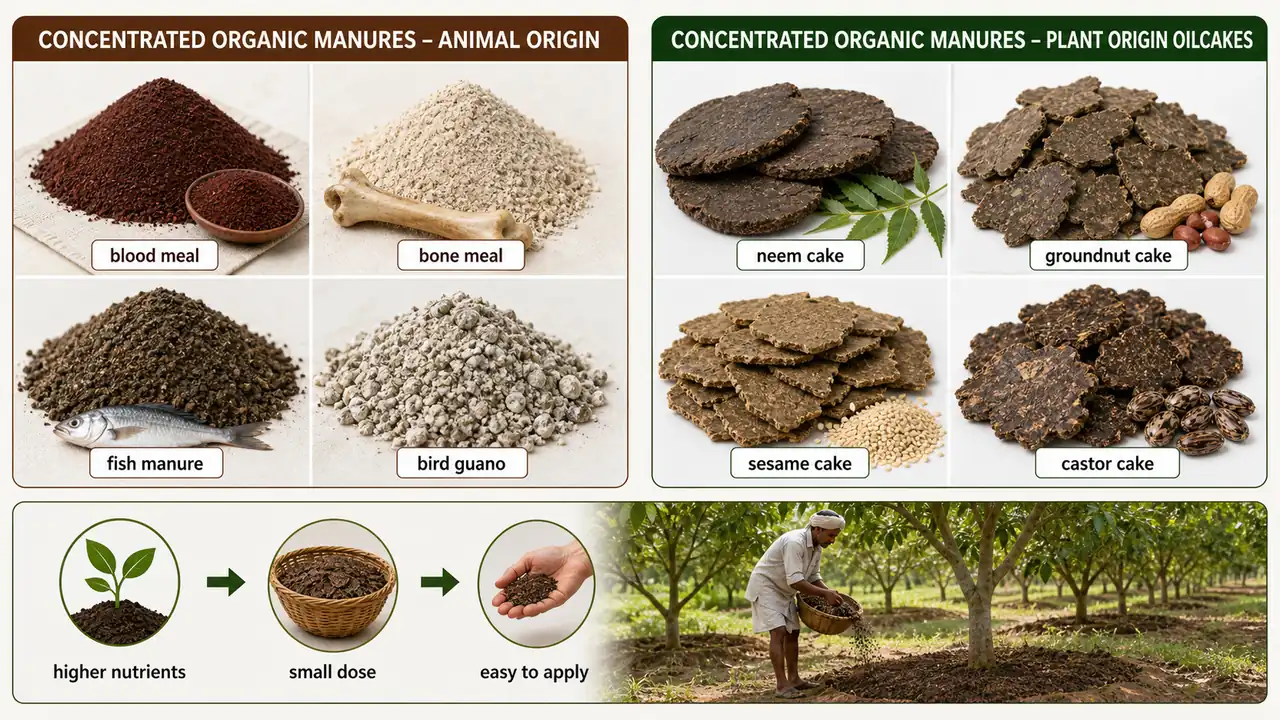
Concentrated manures have higher nutrient content than bulky manures and are applied in smaller quantities. They come from animal by-products and plant oilcakes.
Consider a mango orchard farmer: applying neem cake (5.2% N) not only provides nutrients but also acts as a nitrification inhibitor, improving nitrogen use efficiency. This dual benefit makes concentrated manures valuable in horticulture.
Animal-Origin Concentrated Manures
| Manure | N (%) | P2O5 (%) | K2O (%) | Key Feature |
|---|---|---|---|---|
| Blood meal | 10-12 (some sources: 13-20) | 1-2 | 0.6-0.8 | Richest organic source of N; rich in Iron |
| Meat meal / tankage | 10-11 | 2-2.5 | 0.7-1.0 | Slaughterhouse by-product |
| Bird guano | 7-8 | 11-14 | 2-3 | Excreta + dead remains of birds |
| Fish guano | 7 | 8 | - | Residue after oil extraction |
| Fish manure | 4-10 | 3-9 | 0.3-1.5 | Excellent N + P source |
| Raw bone meal | 3-4 | 20-25 | - | Best organic P source; citrate/water insoluble; for acid soils |
| Steamed bone meal | 1-2 | 25-30 | - | Steaming removes fat, increases P |
| Calcined bone | - | 37 | - | Highest P among bone-derived manures |


TIP
Mnemonic for highest values: Highest N = Blood meal. Highest P = Calcined bone (37% P2O5).
Oilcakes

Oilcakes are the residue left after extracting oil from oilseeds. They are classified into two categories based on edibility.
Edible Oilcakes (can be fed to cattle; used as manure only when surplus)
| Oil Cake | N (%) | P (%) | K (%) |
|---|---|---|---|
| Safflower cake (decorticated) | 7.9 | 2.2 | 1.9 |
| Groundnut cake | 7.3 | 1.5 | 1.3 |
| Sesame cake | 6.2 | 2.0 | 1.2 |
| Linseed cake | 5.5 | 1.4 | 1.2 |
| Rapeseed/Mustard cake | 5.2 | 1.8 | 1.2 |
| Niger cake | 4.8 | 1.8 | 1.0 |
| Coconut cake | 3.0 | 1.9 | 1.8 |
Non-Edible Oilcakes (used directly as manure, especially for horticultural crops)
| Oil Cake | N (%) | P (%) | K (%) |
|---|---|---|---|
| Neem cake | 5.2 | 1.0 | 1.4 |
| Castor cake | 4.3 | 1.8 | 1.3 |
| Cotton seed cake (undecorticated) | 3.9 | 1.8 | 1.6 |
| Mahua cake | 2.5 | 0.8 | 1.8 |
Key Facts about Oilcakes:
- Nutrients become available to crops 7-10 days after application through mineralization
- Must be well powdered before application for even distribution
- Neem cake acts as a nitrification inhibitor -- slows conversion of NH4+ to NO3-, reducing leaching losses. This dual role (nutrient source + inhibitor) makes neem cake especially valuable in integrated nutrient management.
N content ranking of common oilcakes:
- Safflower/Sunflower: 7.8% N
- Groundnut: 7.2% N
- Cotton: 6.5% N
Concentrated Organic Manures - Quick Nutrient Reference
| Manure | N (%) | P2O5 (%) | K2O (%) |
|---|---|---|---|
| Bird guano | 7-8 | 11-14 | 2-3 |
| Blood meal | 13-20 | - | - |
| Raw bone meal | 3-4 | 20-25 | - |
| Steamed bone meal | 1-2 | 25-30 | - |
| Calcined bone | - | 37 | - |
| Fish manure | 4-10 | 3-9 | 0.3-1.5 |
| Poultry manure | 3.03 | 2.63 | 1.4 |
| Sheep/goat manure | 3 | 1 | 2 |
Highest N: Blood meal. Highest P: Calcined bone.
Nutrient content of commonly used Concentrated manures
| Oil Cake | N | P₂O₅ | K₂O |
|---|---|---|---|
| Safflower (Decordicated) | 7.8 | 2.2 | 2.0 |
| Groundnut Cake (Decordicated) | 7.2 | 1.5 – 1.9 | 1.4 |
| Sesamum | 6.2 | 2.0 | 1.2 |
| Neem Cake | 5.2 | 1.0 | 1.4 |
| Lin seed Cake | 5.5 | 1.4 | 1.2 |
| Mustard Cake | 4.5 | 1.5 | 1.0 |
| Niger Cake | 4.8 | 1.8 | 1.0 |
| Pungam Cake | 2.5 | 1.0 | 1.0 |
| Castor | 5.8 | 1.8 | 1.0 |
| Coconut | 3.2 | 1.8 | 1.7 |
Exam Tips and Mnemonics
TIP
"FYM is Half-Quarter-Half" -- N:P:K = 0.5 : 0.25 : 0.5
"Only 30% N reaches the first crop from FYM" -- rest is residual
"IAH-BAP" for composting methods:
- Indore = Aerobic = Heap = Howard = 3-4 months
- Bangalore = Anaerobic = Pit = Acharya = 6-8 months = best
"Blood for N, Bone for P" -- Blood meal has highest N; Calcined bone has highest P
"Neem does double duty" -- Neem cake is both a nutrient source AND a nitrification inhibitor
Green manure trio: Sunnhemp (best overall), Dhaincha (problem soils), S. rostrata (fastest N-fixer, stem nodulation)
Summary Cheat Sheet
| Concept / Topic | Key Details / Explanation |
|---|---|
| FYM composition | N:P:K = 0.5 : 0.25 : 0.5 (Half-Quarter-Half) |
| FYM N availability | Only 30% of N reaches the first crop; rest is residual |
| FYM application | 10–20 t/ha; applied 15 days before sowing |
| Indore method | Aerobic, heap system; by Sir Albert Howard; ready in 3–4 months |
| Bangalore method | Anaerobic, pit system; by C.N. Acharya; ready in 6–8 months; considered best |
| Azo compost | Cheapest organic N source (~1.5% N); made with Azospirillum |
| Vermicomposting | Uses earthworms — Eisenia foetida most important species; thermo-tolerant |
| Sunnhemp | Best all-round green manure; adds 134 kg N/ha in 60 days |
| Dhaincha (Sesbania aculeata) | Best green manure for alkaline/waterlogged soils; 133 kg N/ha in 60 days |
| Sesbania rostrata | Fastest N₂-fixer; stem nodulation; 100–285 kg N/ha in 45–55 days |
| Green manuring average | Adds 60–80 kg N/ha on average |
| Blood meal | Highest N among organic manures (10–20%); rich in iron |
| Calcined bone | Highest P (37% P₂O₅) among bone-derived manures |
| Raw bone meal | 3–4% N, 20–25% P₂O₅; best organic P source; suited for acid soils |
| Bird guano | 7–8% N, 11–14% P₂O₅ — high in both N and P |
| Neem cake | 5.2% N; acts as nitrification inhibitor (slows NH₄⁺ → NO₃⁻) |
| Oilcake nutrient release | 7–10 days after application via mineralization |
| Sheep penning | In-situ manuring method in field |
| Fire fanging | Fungal growth on manure giving ashy-grey appearance |
| Hot manure | Horse, sheep — rapid decomposition |
| Cold manure | Cattle, pig — slow decomposition |
| FYM trench size | 6-7.5 m x 1.5-2.0 m x 1 m deep; Exam tip: Medium |
| Green manuring N addition | 60-80 kg N/ha average; Exam tip: High |