📚 Fertilizer Legislation in India — FCO and FMO
Fertilizer Control Order 1957, quality control specifications, biuret limits, Fertilizer Movement Control Order 1973, and UPSC previous year questions for competitive exams
Introduction
A small farmer in Bihar buys a bag of "urea" from a local dealer. The crop response is poor, and upon testing, the bag contains only 38% nitrogen instead of the mandatory 46%. The farmer has been sold adulterated fertilizer -- a common malpractice driven by rising raw material costs (petroleum, natural gas) that tempt unscrupulous dealers to blend degraded or substandard products for higher profit margins.
Without enforceable quality standards, farmers have no protection against such fraud. This is precisely why the Government of India enacted legislation to regulate the manufacture, distribution, and sale of fertilizers.
Fertilizer Control Order (FCO), 1957
Background and Legal Basis
| Feature | Detail |
|---|---|
| Year of enactment | 1957 |
| Parent legislation | Essential Commodities Act, 1955 (Section 3) |
| Enacted by | Union Government of India |
| Purpose | Regulate fertilizer business in India |
| Published by | Fertilizer Association of India (FAI) |
The Essential Commodities Act empowers the government to control the production, supply, and distribution of items critical to national food security -- and fertilizers fall squarely into that category.
Pro Content Locked
Upgrade to Pro to access this lesson and all other premium content.
Charged once for one year · ₹1188 total
Save ₹100/month vs ₹2388/year launch price
- All Agriculture & Banking Courses
- AI Lesson Questions (100/day)
- AI Doubt Solver (50/day)
- Glows & Grows Feedback (30/day)
- AI Section Quiz (20/day)
- 22-Language Translation (100/day)
- Recall Questions (20/day)
- AI Quiz (15/day)
- AI Quiz Paper Analysis (100/day)
- AI Step-by-Step Explanations (100/day)
- Spaced Repetition Recall (FSRS)
- AI Tutor
- Immersive Text Questions
- Audio Lessons — Hindi & English
- Mock Tests & Previous Year Papers
- Summary & Mind Maps
- XP, Levels, Leaderboard & Badges
- Generate New Classrooms
- Voice AI Teacher (AgriDots Live)
- AI Revision Assistant
- Knowledge Gap Analysis
- Interactive Revision (LangGraph)
🔒 Secure one-time yearly payment via Razorpay · No hidden fees
Introduction
A small farmer in Bihar buys a bag of "urea" from a local dealer. The crop response is poor, and upon testing, the bag contains only 38% nitrogen instead of the mandatory 46%. The farmer has been sold adulterated fertilizer -- a common malpractice driven by rising raw material costs (petroleum, natural gas) that tempt unscrupulous dealers to blend degraded or substandard products for higher profit margins.
Without enforceable quality standards, farmers have no protection against such fraud. This is precisely why the Government of India enacted legislation to regulate the manufacture, distribution, and sale of fertilizers.
Fertilizer Control Order (FCO), 1957
Background and Legal Basis
| Feature | Detail |
|---|---|
| Year of enactment | 1957 |
| Parent legislation | Essential Commodities Act, 1955 (Section 3) |
| Enacted by | Union Government of India |
| Purpose | Regulate fertilizer business in India |
| Published by | Fertilizer Association of India (FAI) |
The Essential Commodities Act empowers the government to control the production, supply, and distribution of items critical to national food security -- and fertilizers fall squarely into that category.
IMPORTANT
Exam fact: The FCO was enacted in 1957 under the Essential Commodities Act, 1955 (Section 3). These dates and the parent legislation are frequently asked in competitive exams.
What the FCO Controls
The FCO provides a comprehensive regulatory framework covering three key areas:
| Area | What It Does |
|---|---|
| Quality control | Sets minimum/maximum specifications for nutrient content, moisture, and impurities for every fertilizer product |
| Dealer registration | No person can manufacture, sell, or distribute fertilizers without a valid licence under the FCO |
| Price control | Statutory control of fertilizer prices by the government |
Consumer Protection
The FCO also protects farmers by giving them the legal right to:
- Receive standard quality products
- Seek redress for supply of substandard materials, overcharging, or underweight containers
- Approach designated authorities with grievances
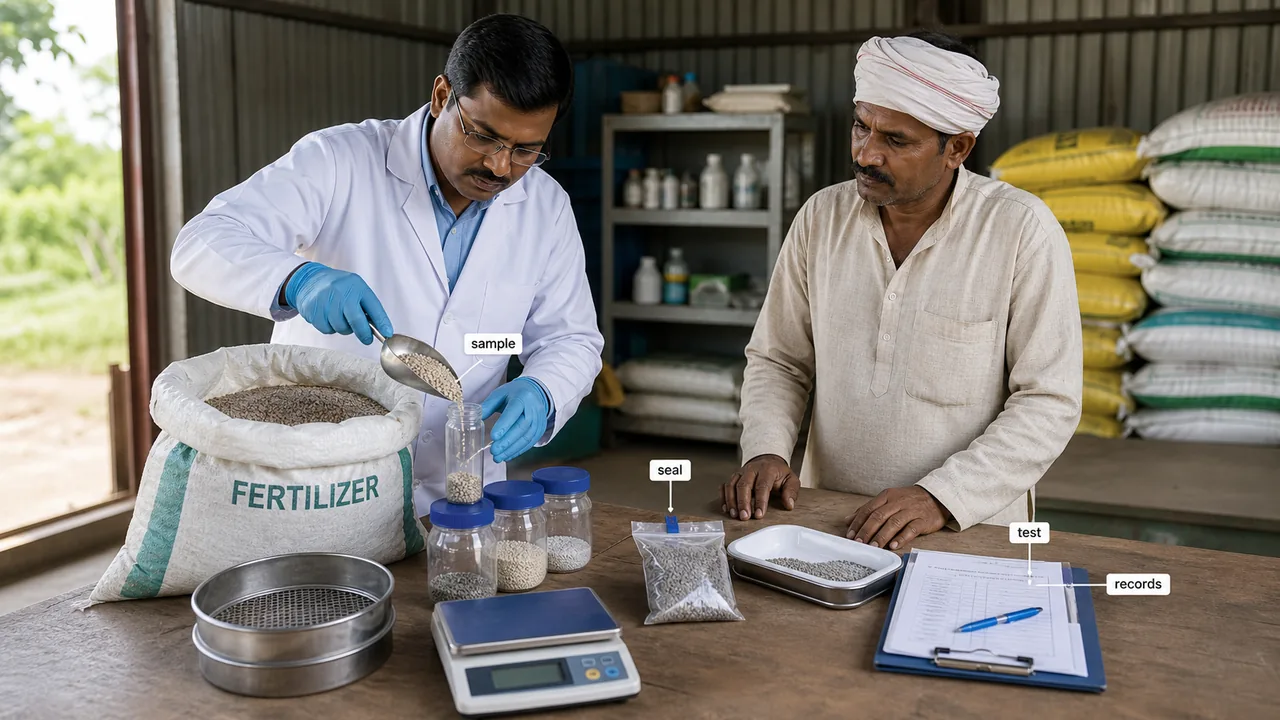
Quality Specifications under FCO
The FCO fixes mandatory specifications for every fertilizer product. Any deviation is a punishable offence. Manufacturers, distributors, and dealers face penalties for supplying spurious or adulterated fertilizers.
Example: Urea Specifications
| Parameter | FCO Specification |
|---|---|
| Moisture (% by weight, maximum) | 1% |
| Total nitrogen (% by weight, minimum) | 46% |
| Biuret (% by weight, maximum) | 1.5% |
Understanding Biuret Toxicity
Biuret is a toxic byproduct formed during urea manufacturing. Its significance:
| Application Type | Maximum Biuret Allowed | Why It Matters |
|---|---|---|
| Soil application | 1.5% | Higher tolerance because soil dilutes the biuret |
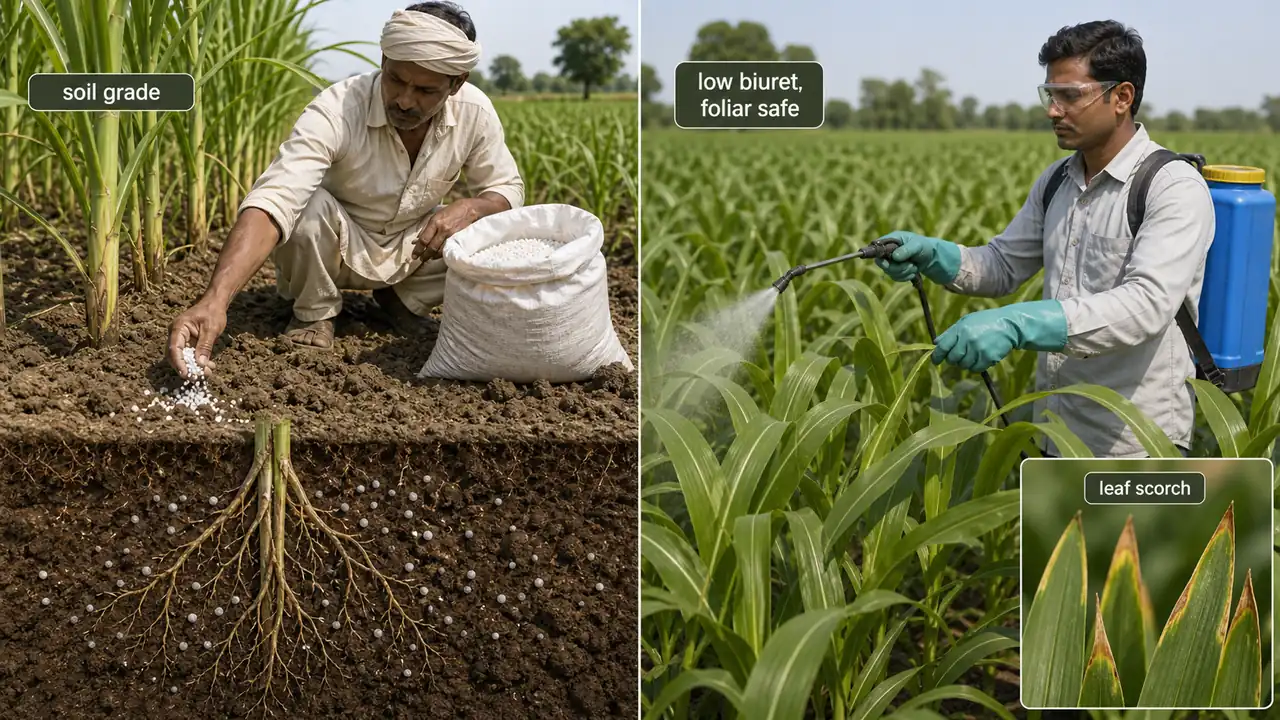
| Foliar spray | 0.25% | Direct contact with leaves -- even small amounts cause leaf-tip scorch and reduced germination |
Agricultural example: A citrus grower using urea as foliar spray must ensure the biuret content is below 0.25%. Standard agricultural-grade urea (up to 1.5% biuret) is safe for soil application but dangerous for foliar use on sensitive crops.
WARNING
Biuret toxicity is a serious concern for foliar application. Always use low-biuret urea (< 0.25% biuret) for foliar sprays. Standard urea (up to 1.5% biuret) is safe only for soil application.
Fertilizer Movement Control Order (FMO), 1973
Background and Purpose
| Feature | Detail |
|---|---|
| Year of enactment | April 1973 |
| Purpose | Ensure equitable distribution of fertilizers across all states |
| Core restriction | No person or agency can export chemical fertilizers from any state without authorization |
The FMO was enacted to prevent hoarding and diversion of fertilizers from surplus regions to deficit ones. It ensures every state receives its fair share of fertilizer supply during critical cropping seasons (Kharif and Rabi).
Exemptions from Movement Restrictions
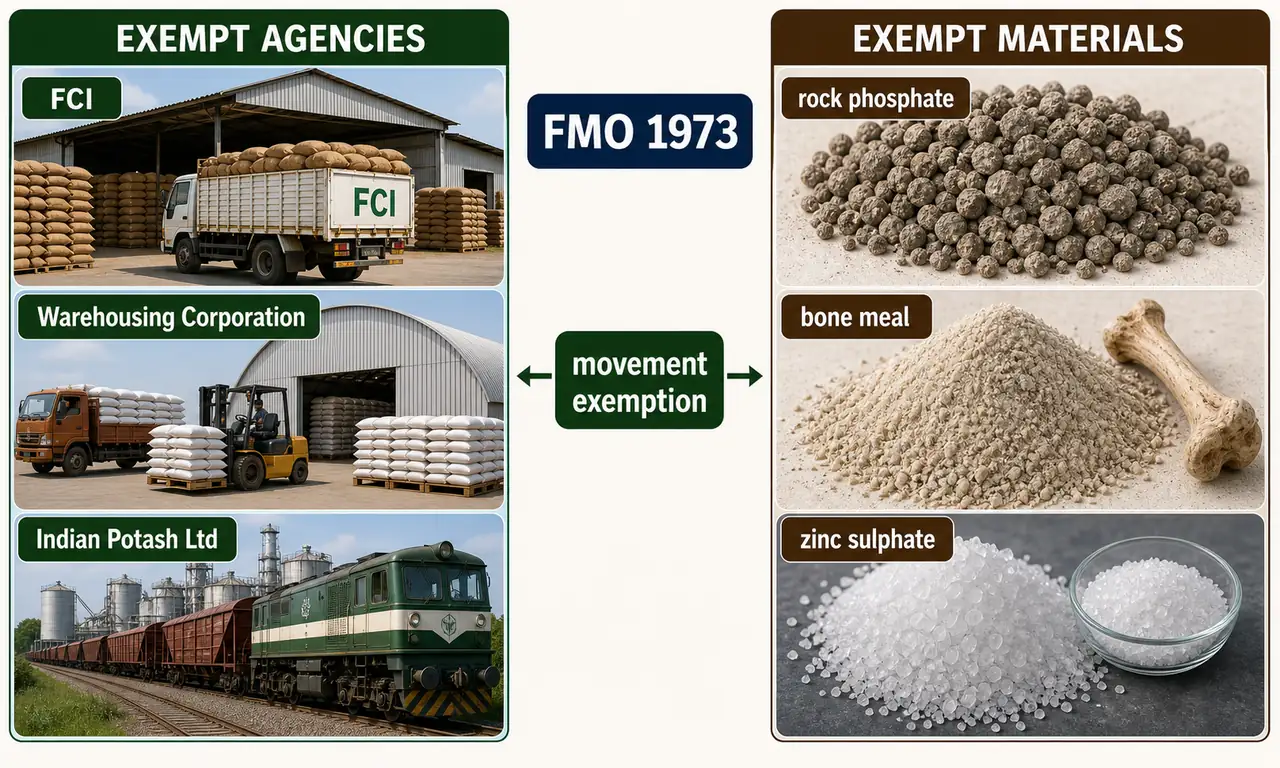
Certain agencies and materials are exempt because they operate under government oversight or have limited abuse potential:
| Category | Exempted Entities / Materials |
|---|---|
| Agencies | Food Corporation of India (FCI), Warehousing Corporation of India, Indian Potash Limited |
| Materials | Rock phosphate, bone meal (raw and steamed), zinc sulphate |
| FMO Exemption Group | Items Included | Exam Recall Use |
|---|---|---|
| Exempt agencies | FCI, Warehousing Corporation of India, Indian Potash Limited | Government-linked logistics and fertilizer distribution agencies |
| Exempt materials | Rock phosphate, bone meal (raw and steamed), zinc sulphate | Limited-abuse or special materials exempt from movement restriction |
TIP
Mnemonic -- "FWI-RBZ" for FMO exemptions: FCI, Warehousing Corporation, Indian Potash (agencies) + Rock phosphate, Bone meal, Zinc sulphate (materials).
Comparison: FCO vs FMO
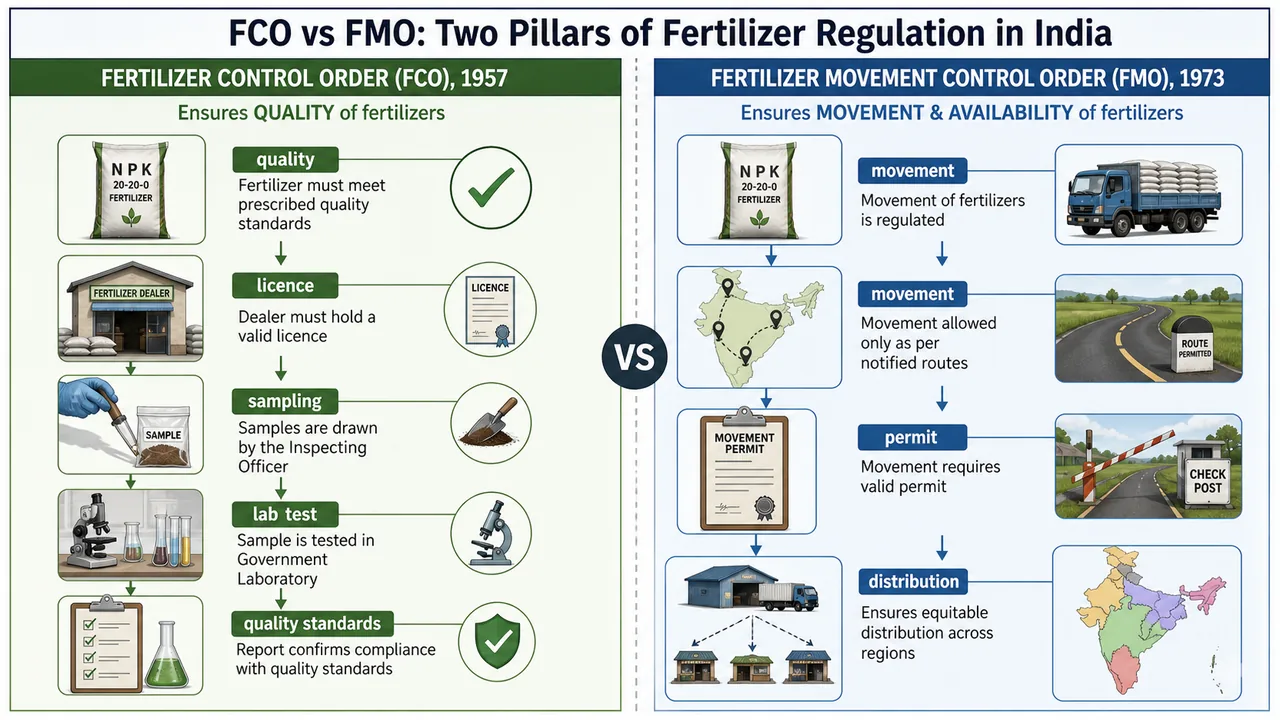
| Feature | FCO (1957) | FMO (1973) |
|---|---|---|
| Year | 1957 | 1973 |
| Parent Act | Essential Commodities Act, 1955 | Essential Commodities Act, 1955 |
| Primary focus | Quality control and dealer registration | Equitable distribution across states |
| Controls | Nutrient specs, moisture, impurities, prices, licensing | Interstate movement of fertilizers |
| Protects against | Adulteration, substandard products, overcharging | Hoarding, diversion, regional shortages |
Previous Year Questions
Q1. With reference to chemical fertilizers in India, consider the following statements: UPSC Pre 2020
- At present, the retail price of chemical fertilizers is market-driven and not administered by the Government.
- Ammonia, which is an input of urea, is produced from natural gas.
- Sulphur, which is a raw material for phosphoric acid fertilizer, is a by-product of oil refineries.
Which of the statements given above is/are correct?
- (a) 1 only
- (b) 2 and 3 only
- (c) 2 only
- (d) 1, 2 and 3
Answer: (b)
Explanation: Statement 1 is incorrect -- fertilizer prices are administered by the government through the FCO and subsidy mechanisms. Statement 2 is correct -- natural gas is the feedstock for ammonia production (Haber process), which is then converted to urea. Statement 3 is correct -- sulphur recovered from petroleum refining is used in manufacturing sulphuric and phosphoric acid.
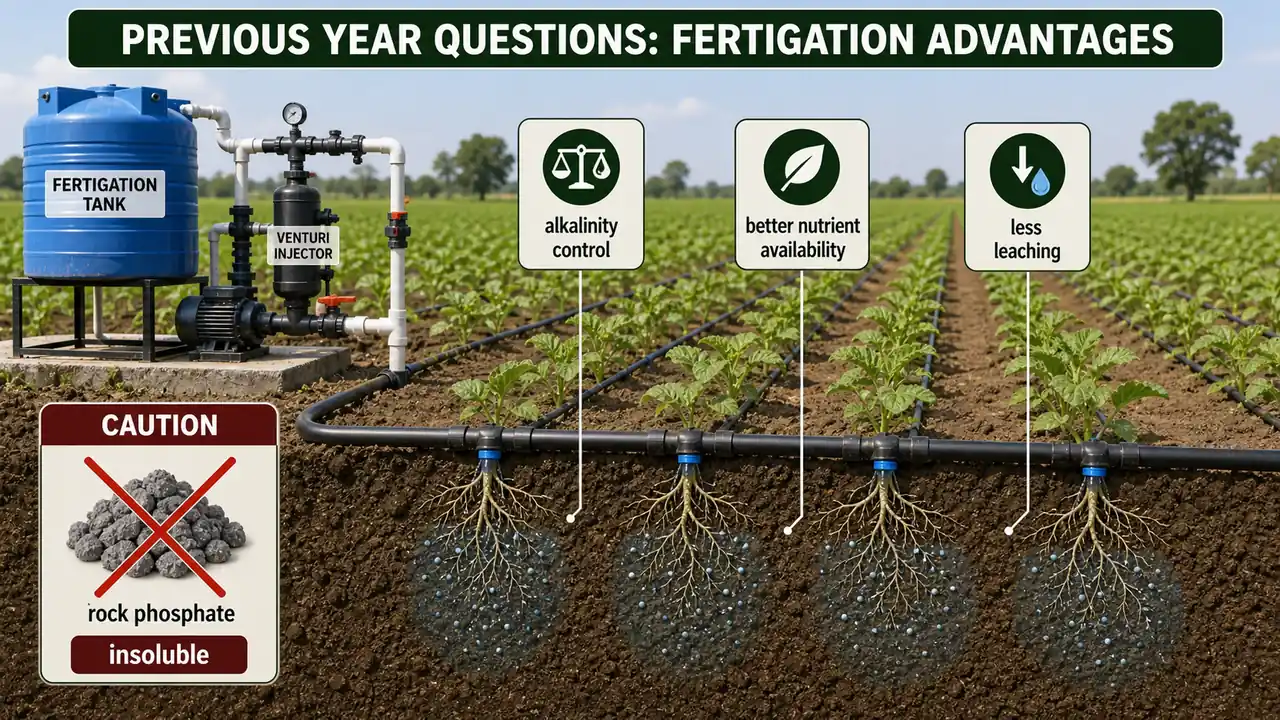
Q2. What are the advantages of fertigation in agriculture? UPSC Pre 2020
- Controlling the alkalinity of irrigation water is possible.
- Efficient application of Rock Phosphate and all other phosphatic fertilizers is possible.
- Increased availability of nutrients to plants is possible.
- Reduction in the leaching of chemical nutrients is possible.
Select the correct answer using the code given below:
- (a) 1, 2 and 3 only
- (b) 1, 2 and 4 only
- (c) 1, 3 and 4 only
- (d) 2, 3 and 4 only
Answer: (c)
Explanation: Statement 2 is incorrect -- rock phosphate is insoluble and cannot be efficiently applied through fertigation (drip/sprinkler systems require water-soluble fertilizers). Statements 1, 3, and 4 are correct advantages of fertigation.
Summary Cheat Sheet
| Concept / Topic | Key Details / Explanation |
|---|---|
| FCO year | 1957 |
| FCO parent legislation | Essential Commodities Act, 1955 (Section 3) |
| FCO published by | Fertilizer Association of India (FAI) |
| FCO covers | Quality control + dealer licensing + price control |
| Urea — minimum N | 46% |
| Urea — maximum moisture | 1% |
| Urea — maximum biuret (soil) | 1.5% |
| Urea — maximum biuret (foliar) | 0.25% (higher causes leaf-tip scorch) |
| Biuret hazard | Toxic byproduct of urea manufacture; forms above 150°C |
| FMO year | April 1973 |
| FMO parent legislation | Essential Commodities Act, 1955 |
| FMO purpose | Equitable distribution of fertilizers across states; prevents hoarding/diversion |
| FMO restriction | No interstate export of fertilizers without authorization |
| FMO exempt agencies | FCI, Warehousing Corporation of India, Indian Potash Limited |
| FMO exempt materials | Rock phosphate, bone meal (raw + steamed), zinc sulphate |
| Fertilizer prices | Government-administered (NOT market-driven) |
| Ammonia feedstock for urea | Natural gas (Haber process) |
| Sulphur for phosphoric acid | Byproduct of oil refineries |
| Rock phosphate in fertigation | Not suitable — insoluble; cannot pass through drip/sprinkler systems |
| Fertigation advantages | Alkalinity control, increased nutrient availability, reduced leaching (NOT rock phosphate) |
| FCO parent act | Essential Commodities Act, 1955 (Section 3) |
| Biuret limit for foliar spray | 0.25% |
| Sulphur source | Byproduct of oil refineries |