🥈 Secondary Nutrients, Micronutrient Fertilizers, and Application Methods
Gypsum, chelated micronutrients, zinc/sulphur deficiency, fertilizer application methods, suitability, crop-wise recommendations, NPK ratio, and NBS scheme for competitive exams
Introduction
A groundnut farmer in Gujarat applies plenty of urea and DAP every season, yet his pods remain hollow and poorly filled. The cause? Sulphur deficiency -- a secondary nutrient that most farmers overlook. Across India, 50% of soils are deficient in zinc and 25% in sulphur. These "hidden hungers" -- secondary and micronutrient deficiencies -- silently cap yields even when primary nutrients (N, P, K) are adequately supplied. Understanding these nutrients, their fertilizer sources, and correct application methods is essential for both crop productivity and competitive exams.
IMPORTANT
India's two most widespread nutrient deficiencies: Zinc (50% of soils) and Sulphur (25% of soils). These are high-priority exam facts.
Secondary Nutrients
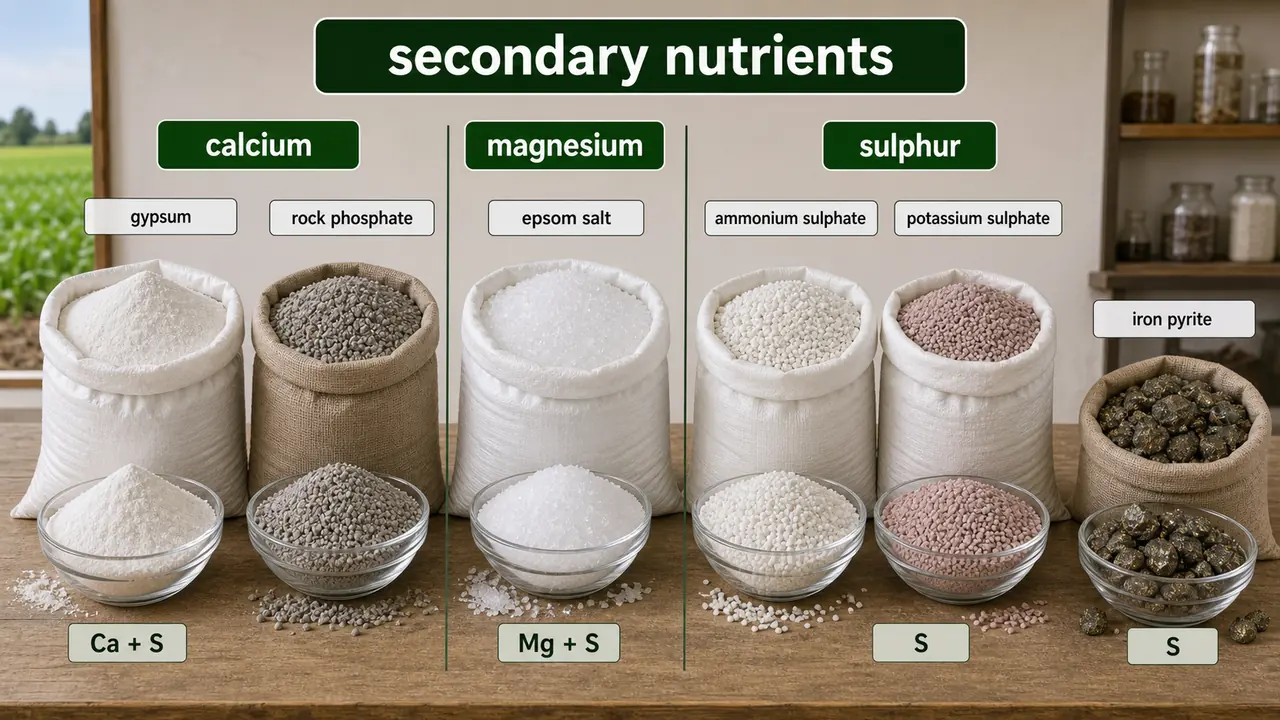
| Fertilizer | Ca % | Mg % | S % | Other % |
|---|---|---|---|---|
| Gypsum (CaSO₄.2H₂O) | 29.2% | - | 18.6% | - |
| Epsom Salt (MgSO₄.7H₂O) | - | 9.6 | 13.0 | - |
| Rock Phosphate | 33.1 | - | - | 25.2 P₂O₅ |
| SSP | - | - | - | - |
| Pot. Sulphate | - | - | 17.5 | 48 (K₂O) |
| Amm. Sulphate | - | - | 24.2 | 21 (N) |
| Basic Slag | - | - | 3 | 15.6 (P₂O₅) |
| CuSO₄ | - | - | 11.4 | 21 (Cu) |
| FeSO₄ | - | - | 18.8 | 32.8 (Fe) |
| ZnSO₄ | - | - | 17.8 | 36.4 (Zn) |
| Iron Pyrite (FeS₂) | - | - | 22-24 | - |
| Borax (Na₂B₄O₇.10H₂O) | - | - | - | 11 B |
Gypsum (CaSO4.2H2O)
Gypsum serves a dual purpose: it is both a source of calcium and sulphur, and a critical soil amendment for reclaiming alkali soils.
Pro Content Locked
Upgrade to Pro to access this lesson and all other premium content.
Charged once for one year · ₹1188 total
Save ₹100/month vs ₹2388/year launch price
- All Agriculture & Banking Courses
- AI Lesson Questions (100/day)
- AI Doubt Solver (50/day)
- Glows & Grows Feedback (30/day)
- AI Section Quiz (20/day)
- 22-Language Translation (100/day)
- Recall Questions (20/day)
- AI Quiz (15/day)
- AI Quiz Paper Analysis (100/day)
- AI Step-by-Step Explanations (100/day)
- Spaced Repetition Recall (FSRS)
- AI Tutor
- Immersive Text Questions
- Audio Lessons — Hindi & English
- Mock Tests & Previous Year Papers
- Summary & Mind Maps
- XP, Levels, Leaderboard & Badges
- Generate New Classrooms
- Voice AI Teacher (AgriDots Live)
- AI Revision Assistant
- Knowledge Gap Analysis
- Interactive Revision (LangGraph)
🔒 Secure one-time yearly payment via Razorpay · No hidden fees
Introduction
A groundnut farmer in Gujarat applies plenty of urea and DAP every season, yet his pods remain hollow and poorly filled. The cause? Sulphur deficiency -- a secondary nutrient that most farmers overlook. Across India, 50% of soils are deficient in zinc and 25% in sulphur. These "hidden hungers" -- secondary and micronutrient deficiencies -- silently cap yields even when primary nutrients (N, P, K) are adequately supplied. Understanding these nutrients, their fertilizer sources, and correct application methods is essential for both crop productivity and competitive exams.
IMPORTANT
India's two most widespread nutrient deficiencies: Zinc (50% of soils) and Sulphur (25% of soils). These are high-priority exam facts.
Secondary Nutrients
| Fertilizer | Ca % | Mg % | S % | Other % |
|---|---|---|---|---|
| Gypsum (CaSO₄.2H₂O) | 29.2% | - | 18.6% | - |
| Epsom Salt (MgSO₄.7H₂O) | - | 9.6 | 13.0 | - |
| Rock Phosphate | 33.1 | - | - | 25.2 P₂O₅ |
| SSP | - | - | - | - |
| Pot. Sulphate | - | - | 17.5 | 48 (K₂O) |
| Amm. Sulphate | - | - | 24.2 | 21 (N) |
| Basic Slag | - | - | 3 | 15.6 (P₂O₅) |
| CuSO₄ | - | - | 11.4 | 21 (Cu) |
| FeSO₄ | - | - | 18.8 | 32.8 (Fe) |
| ZnSO₄ | - | - | 17.8 | 36.4 (Zn) |
| Iron Pyrite (FeS₂) | - | - | 22-24 | - |
| Borax (Na₂B₄O₇.10H₂O) | - | - | - | 11 B |
Gypsum (CaSO4.2H2O)
Gypsum serves a dual purpose: it is both a source of calcium and sulphur, and a critical soil amendment for reclaiming alkali soils.
| Property | Value |
|---|---|
| Calcium content | 29.2% |
| Sulphur content | 18.6% |
| Agriculture grade purity | 70% |
Application rates:
| Purpose | Rate | Target Crops |
|---|---|---|
| Sulphur and calcium supply | 250 kg/ha | Onion, mustard, groundnut, pulses |
| Alkali soil reclamation | 800 kg/ha | All crops on sodic soils |
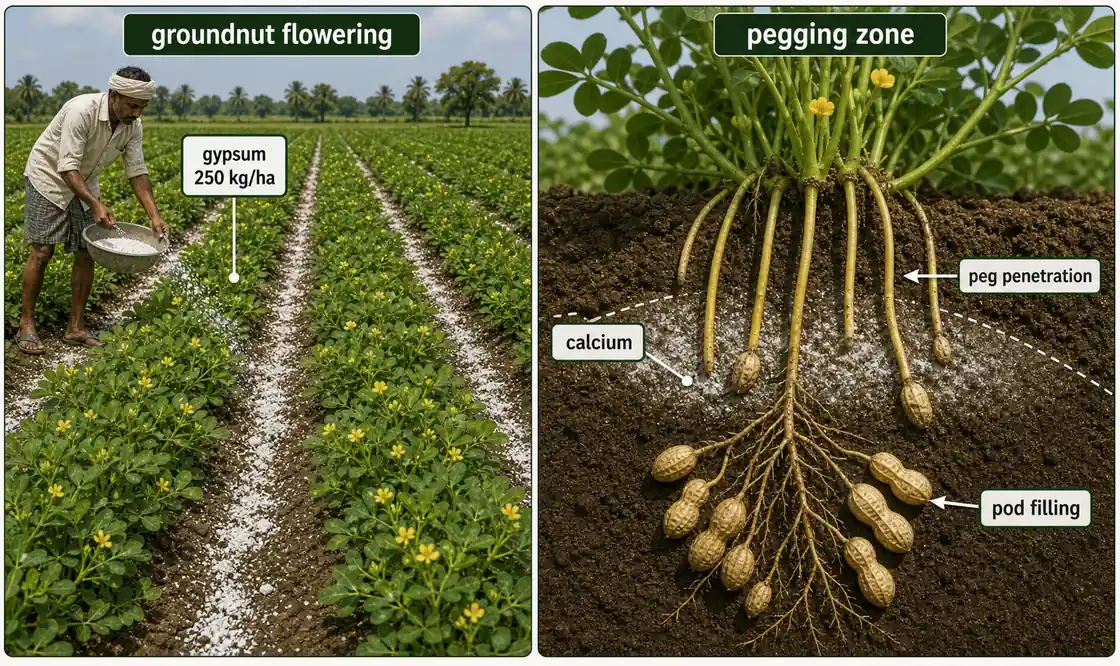
| Gypsum Use in Groundnut | What the Image Shows | Why It Helps |
|---|---|---|
| Timing | Gypsum applied at groundnut flowering | Matches the stage when pegging and pod development become critical |
| Placement effect | Calcium-rich zone created where pegs enter the soil | Improves peg penetration into the soil |
| Yield effect | Better pod set and underground pod growth | Improves pod filling and final yield quality |
Agricultural example: In groundnut cultivation, gypsum applied at 250 kg/ha at flowering significantly improves peg penetration and pod filling because calcium is essential for cell wall development in the pegging zone, while sulphur improves protein quality.
Why sulphur matters in pulses: Sulphur is a key component of amino acids methionine and cysteine. Its deficiency leads to formation of indigestible protein in pulse crops, reducing their nutritional value.
Micronutrients
Micronutrients (Fe, Zn, Mn, Cu, B, Mo) are needed in very small quantities but are equally essential. Deficiency of even one micronutrient can severely limit crop yields.
The Problem of Fixation
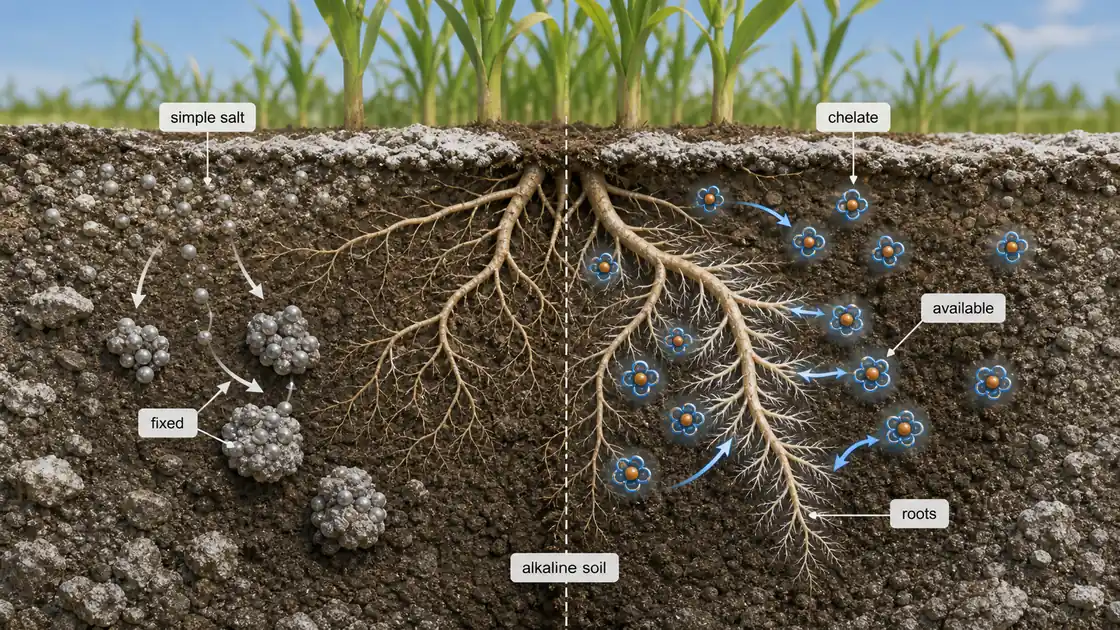
When metallic micronutrient salts are applied to soil, they are often transformed into non-available forms due to chemical reactions. The solution is chelation.
Chelating agents -- organic compounds like EDTA, DTPA, and CDTA -- hold metallic ions in their cyclic molecular structure, creating metal chelates. Think of chelation as placing a metal ion inside a protective molecular cage.
| Feature | Simple Salt | Chelated Form |
|---|---|---|
| Solubility | May precipitate in alkaline soil | Remains soluble |
| Soil reactions | Reacts with soil constituents, gets fixed | Does not ionize, stays available |
| Efficiency | Lower | Higher (especially in alkaline soils) |
| Available as chelate | -- | Fe, Cu, Zn, Mn |
Micronutrient Fertilizers at a Glance
| Fertilizer | Nutrient | Content (%) | Application Method | Key Agricultural Role |
|---|---|---|---|---|
| Zinc Sulphate | Zn | 36 | Soil: 25 kg/ha; Spray: 0.5% | Auxin synthesis, enzyme activation, photosynthesis |
| Zinc Oxide | Zn | 78 | Seed treatment | Used when foliar/soil not feasible |
| Ferrous Sulphate | Fe | 33 | Spray: 0.5% | Controls iron chlorosis (yellowing of young leaves with green veins) |
| Manganese Sulphate | Mn | 26 | Soil or spray | Photosynthesis, N metabolism, enzyme activation |
| Copper Sulphate | Cu | 21 | Soil or spray | Lignin synthesis, pollen viability, disease resistance |
| Borax | B | 11 | Boron frits (slow-release) | Cell wall formation, pollen tube growth, sugar transport |
| Ammonium Molybdate | Mo | 54 | Seed treatment: 3 g/kg seed (pulses) | Constituent of nitrogenase enzyme; essential for N-fixation |
Agricultural example: In paddy-wheat systems of the Indo-Gangetic plains, zinc deficiency is the most common micronutrient problem. Applying zinc sulphate at 25 kg/ha to the rice crop corrects the "khaira disease" (zinc deficiency in rice) -- characterized by dusty brown spots on leaves.
TIP
Mnemonic for micronutrient contents: "36-78-33-26-21-11-54" = Zn sulphate, Zn oxide, Fe, Mn, Cu, B, Mo. Remember: Zinc oxide (78%) has the highest nutrient content; Borax (11%) has the lowest.
Special note on Molybdenum in pulses: Mo is a constituent of leghaemoglobin and the nitrogenase enzyme in root nodules. Even 3 g of ammonium molybdate per kg of seed can dramatically improve nodulation and nitrogen fixation in chickpea, lentil, and other legumes.
Special note on Boron: The gap between deficiency and toxicity is very narrow. Use boron frits (slow-release form) rather than borax directly to prevent boron toxicity.
Methods of Fertilizer Application
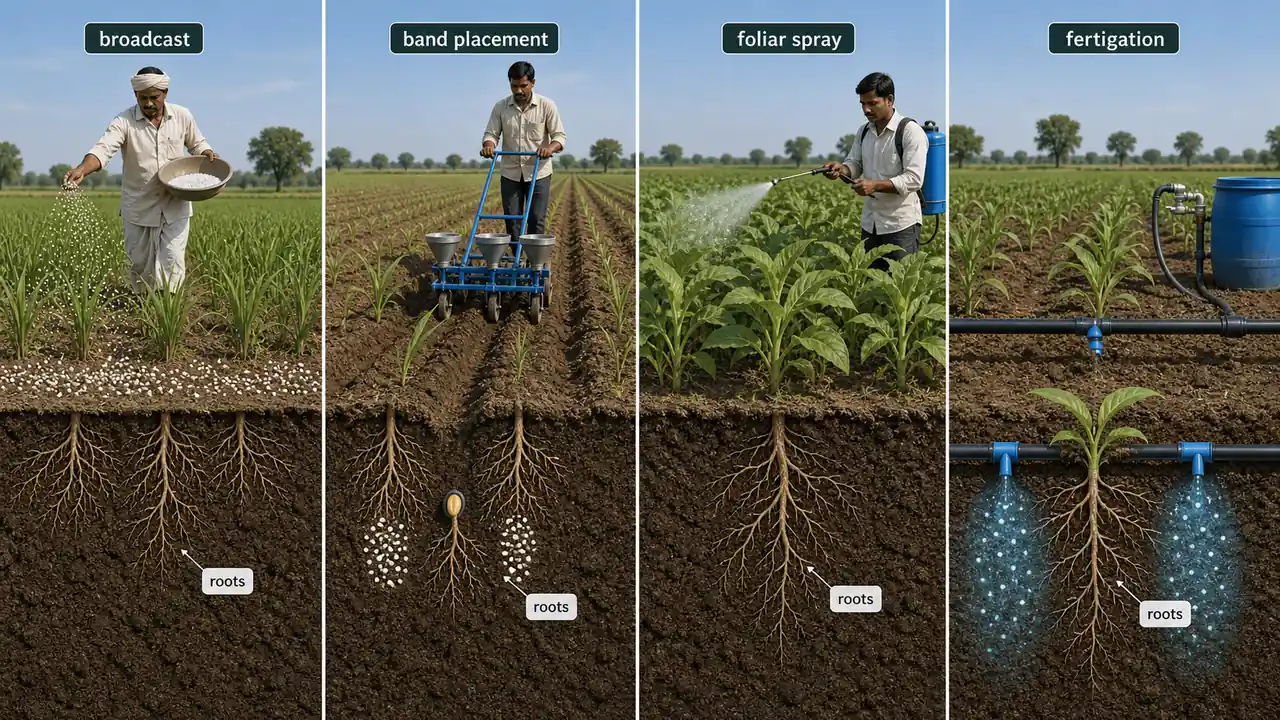
Choosing the right method affects nutrient availability, efficiency, and cost. The following methods are arranged from simplest to most specialized:
a. Basal Dose
- Fertilizer applied at the time of sowing/transplanting.
- Phosphorus and potassium are always applied as basal dose because they are immobile in soil and slow-releasing. Placing them near the developing root zone at sowing ensures early availability.
Agricultural example: When sowing wheat, the entire dose of P and K (e.g., DAP + MOP) is drilled at sowing, while nitrogen is split.
b. Split Doses of Nitrogen
- Nitrogen is applied in multiple doses to match crop demand at different growth stages, reducing losses and improving Nitrogen Use Efficiency (NUE).
| Crop Duration | Number of Splits | Rationale |
|---|---|---|
| 4--5 months (wheat, rice) | 2 splits | Sowing + tillering/panicle initiation |
| > 5 months (sugarcane, cotton) | 3 splits | Sowing + vegetative + reproductive stage |
c. Deep Placement
- In paddy, only ammonium form (NH4+) is placed in the reduced (anaerobic) zone to prevent leaching and volatilization losses UPPSC 2021.
- In the reduced zone, ammonium remains stable and is not converted to nitrate (which would be lost through denitrification).
d. Starter Dose
- In legumes and vegetable seedlings at transplanting, apply NPK at 1:2:1 ratio.
- The higher proportion of phosphorus supports root establishment during the critical transplanting phase.
e. Foliar Application
- Spraying nutrients directly on leaves for rapid absorption.
- Best for micronutrients (Fe, Zn, Mn) and for the last dose of nitrogen in seed crops (improves seed quality and germinability).
Suitability of Fertilizers for Different Conditions
This is a frequently tested topic. The following table summarizes which fertilizer works best under which condition:
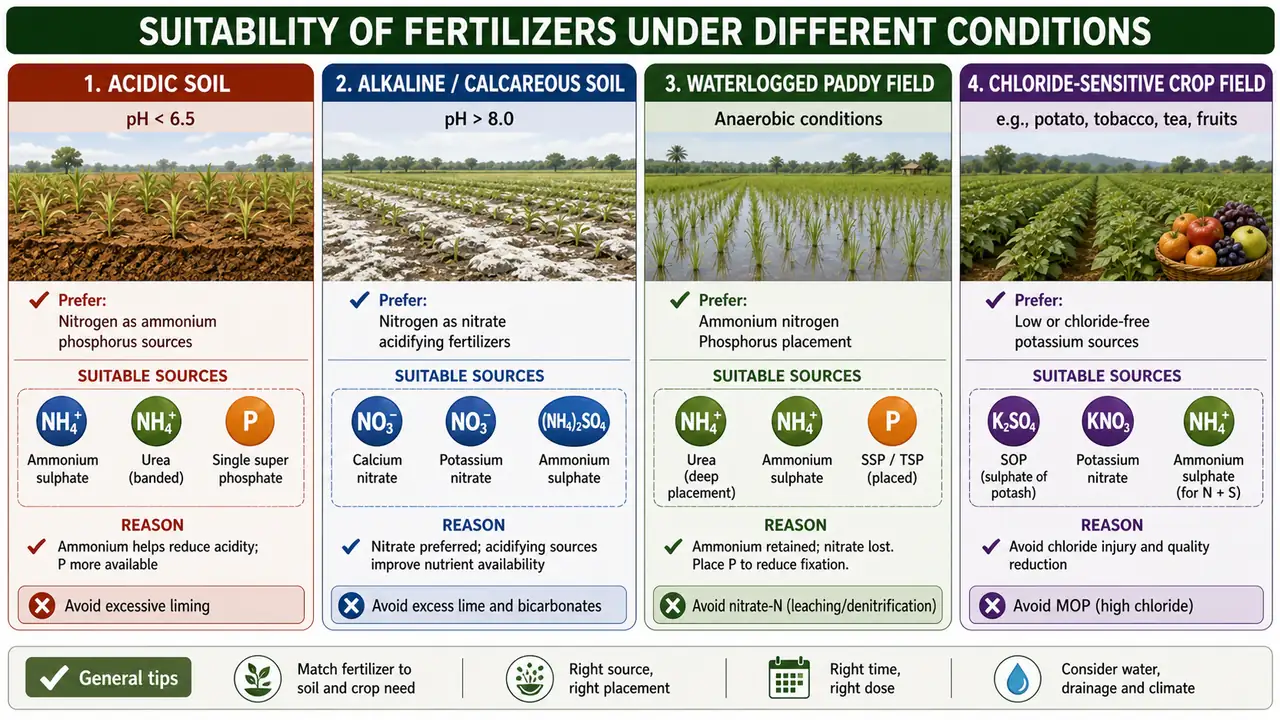
| Condition | Suitable Fertilizer | Reason |
|---|---|---|
| Indian soils (universal deficiency) | N and Zn supplements | Universally deficient across India |
| Paddy and potato | Ammonical form (NH4+) | These crops directly absorb ammonium |
| Reduced (anaerobic) zone | Ammonical fertilizers | NH4+ remains stable without oxygen |
| Oxidised (aerobic) zone | Nitrate fertilizers | NO3- is the dominant available form in well-aerated soil |
| Acidic soils | Rock phosphate, SSP | Rock phosphate dissolves in acid; SSP also provides sulphur |
| Saline and alkali soils | NOT ammonical | At high pH, ammonium converts to volatile ammonia (nitrogen loss) |
| Acidic and heavy soils | Potassic fertilizers | Suitable here but NOT for alkaline soils |
| Anaerobic (waterlogged) soils | Avoid sulphate fertilizers | Sulphates are reduced to toxic H2S by Desulfovibrio bacteria |
Elemental sulphur transformation:
S --(Thiobacillus spp.)--> SO42-
Crop-Specific Nitrogen Management
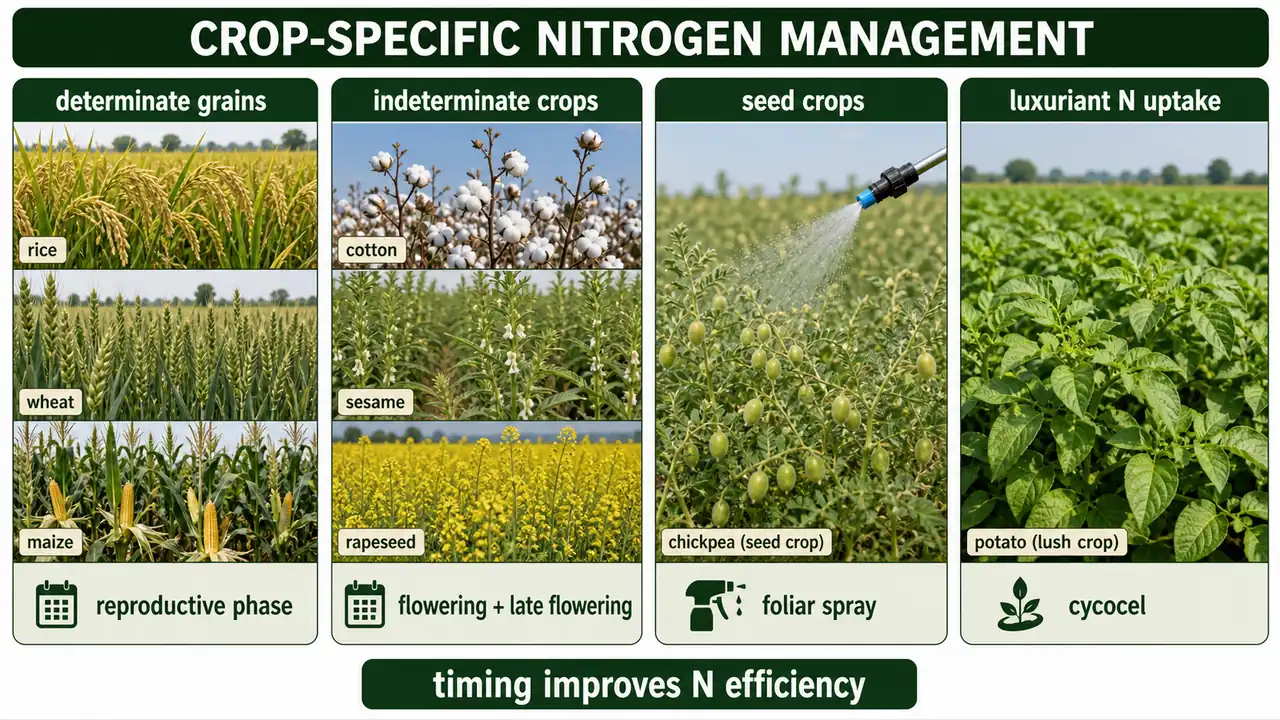
| Crop Type | Nitrogen Timing | Effect |
|---|---|---|
| Determinate grains (rice, wheat, maize) | Last dose at reproductive phase (panicle initiation) | Increases grain number and weight |
| Indeterminate crops (rapeseed, sesame, cotton) | At flowering + late flowering stage | Increases yield and quality |
| Seed crops | Last dose as foliar spray during seed development | Improves seed quality and germinability |
| Crops with luxuriant N uptake | Apply cycocel (growth retardant) | Restricts vegetative growth, redirects energy to grain/fruit |
Key Research Finding
De Datta and Gomez (1975): N-efficiency was highest in the first rice crop and declined progressively with successive crops. However, K-efficiency increased sharply over years, especially in the dry season.
Timing of P and K
- Plants require more phosphorus at early stages (root development).
- Plants absorb potassium continuously up to harvesting, and K-fertilizer becomes available slowly.
Rabbing
Rabbing = heat treatment applied to soil by burning refuse placed over it. This traditional practice destroys soil-borne pathogens and releases nutrients from organic residues.
General Recommended Fertilizer Doses (N:P:K)
| Crop type | N : P : K ratio |
|---|---|
| Cereal crops | 4 : 2 : 1 |
| Pulse crops | 1 : 2 : 1 or 1 : 2 : 2 |
| Oilseed crops | 3 : 2 : 1 |
| Fodder/Fibre crops | 2 : 1 : 4 |
The NPK Imbalance Problem
| Parameter | Value |
|---|---|
| Ideal N:P:K ratio | 4:2:1 |
| India average | 6.1:2.5:1 |
| Punjab | 25.8:5.8:1 |
| NPK ratio in 2013-14 | 8.2:3.2:1 |
The extreme imbalance (especially in Punjab) is a direct consequence of heavy urea subsidy and reflects serious soil health degradation from nitrogen over-application.
Nutrient Based Subsidy (NBS) Scheme
| Feature | Detail |
|---|---|
| Implemented from | April 2010 |
| Implementing body | Department of Fertilizers, Ministry of Chemicals & Fertilizers |
| Coverage | Urea + 21 grades of P & K fertilizers at subsidized prices |
| Objective | Correct imbalanced fertilizer use |
The Core Problem
- Fertilizer subsidy is the 2nd largest subsidy after food subsidy.
- Urea remains excluded from NBS, keeping its price artificially low and encouraging overuse.
- This exclusion is the primary reason the NPK ratio keeps worsening.
WARNING
The widening gap between ideal NPK (4:2:1) and actual NPK (8.2:3.2:1 in 2013-14) indicates severe nutrient imbalance driven by urea subsidy. This is a major soil health and policy concern frequently tested in exams.
| Nitrogen | Phosphorus | Potash |
|---|---|---|
| Rs 18.9 per kg | Rs 15.21 per kg | Rs 3.56 per kg |
Summary Cheat Sheet
| Concept / Topic | Key Details / Explanation |
|---|---|
| Most widespread deficiencies (India) | Zinc (50% of soils) and Sulphur (25% of soils) |
| Gypsum composition | CaSO₄.2H₂O; Ca = 29.2%, S = 18.6%; agriculture grade = 70% purity |
| Gypsum for nutrition | 250 kg/ha — onion, mustard, groundnut, pulses |
| Gypsum for sodic reclamation | 800 kg/ha |
| Sulphur role in pulses | Component of amino acids methionine and cysteine; deficiency → indigestible protein |
| Chelating agents | EDTA, DTPA, CDTA — keep metallic micronutrients soluble; chelated forms: Fe, Cu, Zn, Mn |
| Zinc sulphate | 36% Zn; soil: 25 kg/ha; foliar: 0.5% spray; corrects khaira disease in rice |
| Zinc oxide | 78% Zn — highest Zn content fertilizer; used as seed treatment |
| Ferrous sulphate | 33% Fe; foliar spray 0.5%; corrects iron chlorosis |
| Manganese sulphate | 26% Mn; soil or spray; photosynthesis + enzyme activation |
| Copper sulphate | 21% Cu; lignin synthesis, pollen viability |
| Borax | 11% B (lowest micronutrient content); use boron frits (slow-release) to avoid toxicity |
| Ammonium molybdate | 54% Mo (highest); seed treatment 3 g/kg seed for pulses; nitrogenase enzyme component |
| Basal dose nutrients | P and K (immobile in soil — applied at sowing) |
| N splits for 4–5 month crops | 2 splits |
| N splits for > 5 month crops | 3 splits |
| Deep placement | Paddy only — NH₄⁺ in reduced (anaerobic) zone; prevents denitrification loss |
| Starter dose ratio | NPK 1:2:1 (high P for root establishment in legumes/vegetable seedlings) |
| Crops absorbing NH₄⁺ directly | Paddy and potato |
| Foliar application best for | Micronutrients (Fe, Zn, Mn) + last N dose in seed crops |
| Paddy/potato vs dry soils | Ammoniacal (NH₄⁺) form for paddy/potato; nitrate (NO₃⁻) for dry/aerobic soils |
| Avoid in waterlogged soils | Sulphate fertilizers — Desulfovibrio reduces SO₄²⁻ to toxic H₂S |
| Elemental S transformation | Thiobacillus spp. oxidizes S → SO₄²⁻ |
| Cereal NPK ratio | 4:2:1 |
| Pulse NPK ratio | 1:2:1 or 1:2:2 |
| Oilseed NPK ratio | 3:2:1 |
| Fodder/Fibre NPK ratio | 2:1:4 |
| Ideal NPK ratio (India) | 4:2:1; actual India = 6.1:2.5:1; Punjab = 25.8:5.8:1 |
| NBS scheme | Nutrient-Based Subsidy; from April 2010; covers 21 grades of P & K; urea excluded |
| Rabbing | Heat treatment — burning refuse on soil surface to destroy pathogens |
| Zinc deficiency in India | 50% of soils |
| Sulphur deficiency in India | 25% of soils |
| Gypsum Ca content | 29.2% |
| Gypsum S content | 18.6% |
| Most common Zn fertilizer | Zinc sulphate (36% Zn) at 25 kg/ha |
| Highest Zn content fertilizer | Zinc oxide (78%) |
| Mo for pulses | Ammonium molybdate (54% Mo) at 3 g/kg seed |
| Most common Fe fertilizer | Ferrous sulphate (33% Fe) at 0.5% spray |
| Chelated forms available | Fe, Cu, Zn, Mn |
| Crops absorbing NH4+ directly | Paddy and potato |
| India actual NPK ratio | 6.1:2.5:1 |
| Punjab NPK ratio | 25.8:5.8:1 |
| NBS started | April 2010 |
| Sulphate in waterlogged soil | Reduced to toxic H2S by Desulfovibrio |
| Elemental S oxidation | By Thiobacillus spp. to SO42- |