☢️ Problem Soils — Saline, Sodic, and Saline-Sodic Soils
Classification, diagnosis, reclamation, and management of salt-affected soils (saline, alkali/sodic, saline-sodic) with EC, ESP, SAR thresholds and crop tolerance for competitive exams
Introduction
A farmer in Haryana's canal-irrigated belt notices white salt crusts forming on his field after every irrigation cycle. His wheat yields have dropped by 30% over five years. Across the border in UP, another farmer struggles with hard, impermeable soil that refuses to absorb water -- the surface turns dark and slippery when wet. These are two faces of the same problem: salt-affected soils. India has over 67 lakh hectares of such problem soils, and understanding their classification, diagnosis, and reclamation is critical for both agricultural practice and competitive exams.
What Are Problem Soils?
Problem soils are those where excess salts or exchangeable sodium accumulate in the root zone, causing partial or complete loss of soil productivity. They occur mainly in arid and semi-arid regions where evaporation exceeds rainfall.
When chloride (Cl-), sulphate (SO42-), carbonate (CO32-), and bicarbonate (HCO3-) salts of sodium, calcium, and magnesium increase beyond critical levels, the soil is classified based on three diagnostic parameters.
Pro Content Locked
Upgrade to Pro to access this lesson and all other premium content.
Charged once for one year · ₹1188 total
Save ₹100/month vs ₹2388/year launch price
- All Agriculture & Banking Courses
- AI Lesson Questions (100/day)
- AI Doubt Solver (50/day)
- Glows & Grows Feedback (30/day)
- AI Section Quiz (20/day)
- 22-Language Translation (100/day)
- Recall Questions (20/day)
- AI Quiz (15/day)
- AI Quiz Paper Analysis (100/day)
- AI Step-by-Step Explanations (100/day)
- Spaced Repetition Recall (FSRS)
- AI Tutor
- Immersive Text Questions
- Audio Lessons — Hindi & English
- Mock Tests & Previous Year Papers
- Summary & Mind Maps
- XP, Levels, Leaderboard & Badges
- Generate New Classrooms
- Voice AI Teacher (AgriDots Live)
- AI Revision Assistant
- Knowledge Gap Analysis
- Interactive Revision (LangGraph)
🔒 Secure one-time yearly payment via Razorpay · No hidden fees
Introduction
A farmer in Haryana's canal-irrigated belt notices white salt crusts forming on his field after every irrigation cycle. His wheat yields have dropped by 30% over five years. Across the border in UP, another farmer struggles with hard, impermeable soil that refuses to absorb water -- the surface turns dark and slippery when wet. These are two faces of the same problem: salt-affected soils. India has over 67 lakh hectares of such problem soils, and understanding their classification, diagnosis, and reclamation is critical for both agricultural practice and competitive exams.
What Are Problem Soils?
Problem soils are those where excess salts or exchangeable sodium accumulate in the root zone, causing partial or complete loss of soil productivity. They occur mainly in arid and semi-arid regions where evaporation exceeds rainfall.
When chloride (Cl-), sulphate (SO42-), carbonate (CO32-), and bicarbonate (HCO3-) salts of sodium, calcium, and magnesium increase beyond critical levels, the soil is classified based on three diagnostic parameters.
The Three Diagnostic Parameters
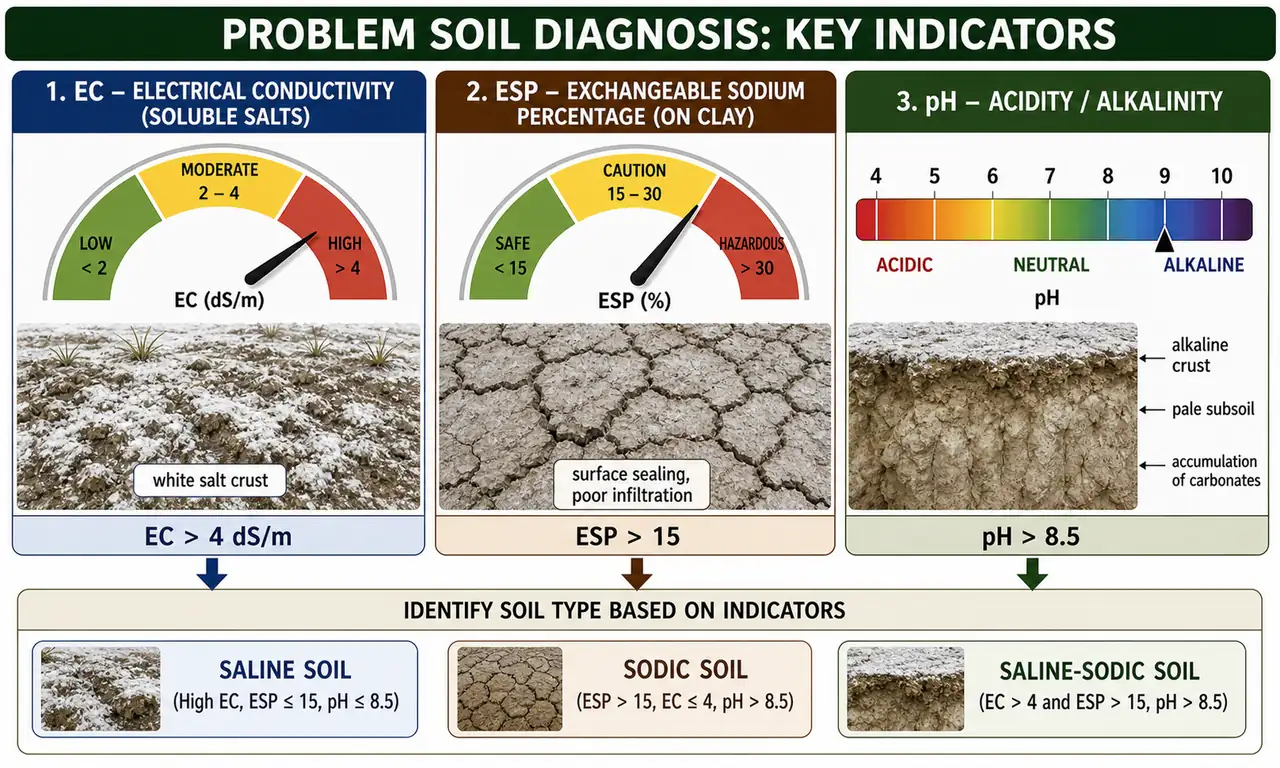
Before understanding problem soil types, master these three measurements:
EC -- Electrical Conductivity
- Measures total soluble salt content of the soil saturation extract.
- Unit: dS/m (deciSiemens per metre) = mmhos/cm (numerically equivalent).
- Threshold: EC > 4 dS/m at 25°C = saline condition.
| Degree | EC (dS/m) | Salinity Status |
|---|---|---|
| Slight | 4.0 -- 8.0 | Mildly saline |
| Moderate | 8.1 -- 30.0 | Moderately saline |
| Strong | > 30.0 | Severely saline |
ESP -- Exchangeable Sodium Percentage
- Formula: ESP = (Exchangeable Na+ / CEC) x 100
- Measures the proportion of sodium on the soil exchange complex.
- Threshold: ESP > 15% = sodic/alkali condition.
| Degree | ESP (%) | pH | Sodicity Status |
|---|---|---|---|
| Slight | < 15 | 8.5 -- 9.0 | Mildly sodic |
| Moderate | 15 -- 40 | 9.1 -- 9.8 | Moderately sodic |
| Strong | > 40 | > 9.8 | Severely sodic |
SAR -- Sodium Adsorption Ratio
- Measures sodium hazard in soil solution or irrigation water.
- Formula: SAR = Na+ / ((Ca2+ + Mg2+) / 2)0.5 (concentrations in me/L).
- When SAR exceeds ~13, ESP generally exceeds 15.
- ESP measures sodicity in soil; SAR measures it in water/soil solution.
| Water Class | SAR Range | Hazard Level |
|---|---|---|
| S1 | 0 -- 10 | Low sodium hazard |
| S2 | 10 -- 18 | Medium (usable with management) |
| S3 | 18 -- 26 | High (unsatisfactory for most crops) |
| S4 | > 26 | Very high |
TIP
Mnemonic -- "4 and 15": The two magic numbers for problem soil diagnosis. EC = 4 dS/m divides saline from non-saline. ESP = 15% divides sodic from non-sodic. Everything in the classification table follows from these two thresholds.
Classification of Problem Soils (USSL System)
The US Salinity Laboratory (Richards, 1954) classified salt-affected soils into three categories:
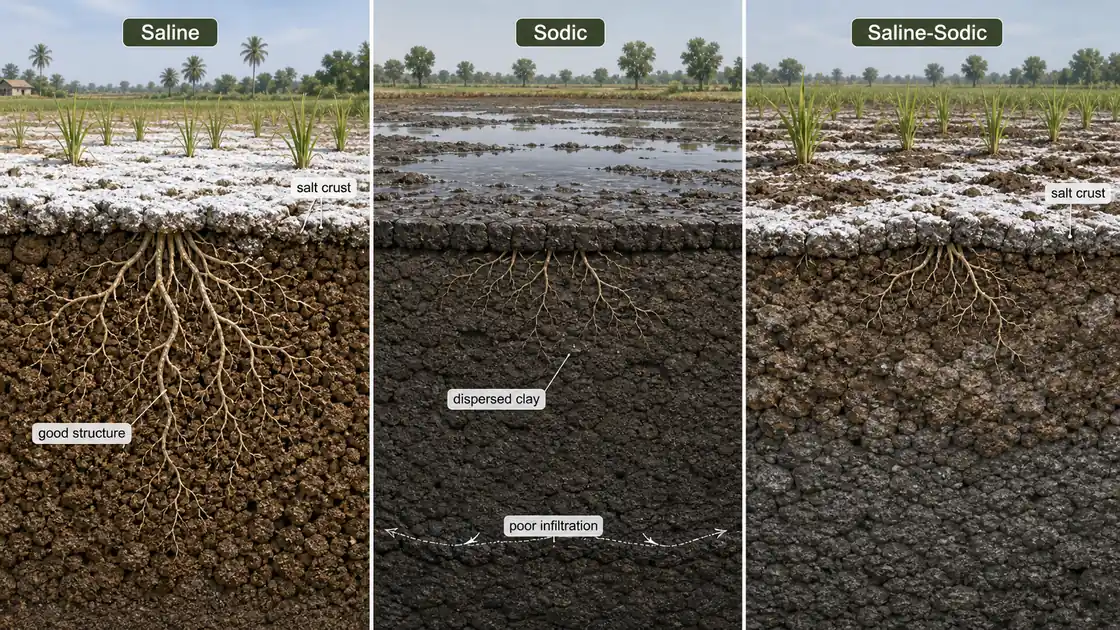
| Parameter | Saline Soil | Sodic / Alkali Soil | Saline-Sodic Soil |
|---|---|---|---|
| EC (dS/m) | > 4 | < 4 | > 4 |
| ESP (%) | < 15 | > 15 | > 15 |
| pH | < 8.5 | > 8.5 (8.5--10) | > 8.5 (variable) |
| Old Name | White alkali | Black alkali | Brown alkali |
| Russian Term | Solonchak | Solonetz | -- |
| Structure | Flocculated (good) | Dispersed (poor) | Variable |
| Dominant Salts | NaCl, Na2SO4 | Na2CO3, NaHCO3 | Both neutral + alkaline |
| Formation Process | Salinization | Alkalization | Combined |
| Primary Amendment | Leaching + drainage | Gypsum + leaching | Gypsum first, then leach |
| First Reclamation Crop | Rice | Rice | Rice |
Loss in Productivity due to ESP
| ESP Range | Black Soil (Vertisols) | Alluvial Soils (Entisols, Inceptisols) |
|---|---|---|
| Up to 5 | 0--10% loss | Nil |
| 5--15 | 10--25% loss | < 10% loss |
| 15--40 | 25--50% loss | 10--25% loss |
| > 40 | > 50% loss | 25--50% loss |
Saline Soils (White Alkali / Solonchak)

Diagnostic Features
- EC > 4 dS/m IBPS 2018, ESP < 15, pH usually < 8.5.
- Dominated by chloride and sulphate ions (neutral salts).
- Structure remains flocculated (relatively good) because excess salts hold clay particles together.
- White salt crust on surface gives the name "white alkali".
- Central Soil Salinity Research Institute (CSSRI): established 1969 at Karnal, Haryana.
Regional names:
| Region | Local Name |
|---|---|
| Punjab | Thur |
| Uttar Pradesh | Reh |
| Rajasthan | Luni |
How Saline Soils Form (Genesis)
- Arid/semi-arid climate: Evapotranspiration exceeds rainfall, so salts move upward through capillary action and accumulate near the surface.
- Canal irrigation without drainage: Continuous irrigation raises the water table, bringing dissolved salts to the root zone (waterlogging).
- Coastal salinity: Seawater intrusion through estuaries and rivers causes large-scale salinization in coastal regions.
Agricultural example: In Rajasthan's Indira Gandhi Canal command area, canal irrigation without adequate drainage has raised water tables and created extensive saline patches in previously productive land.

How Salinity Harms Crops
| Mechanism | Effect on Crops |
|---|---|
| Osmotic stress | Roots cannot absorb water even when soil appears moist (physiological drought) |
| Reduced nutrient uptake | Less water absorption = less N, P, K uptake |
| Ion toxicity | Excess Cl- causes leaf burn; excess Na+ disrupts enzymes |
| Reduced microbial activity | Salt stress inhibits N-fixers, mycorrhizae, decomposers |
Salinity Severity Bands
Boron Toxicity in Saline Soils
Boron can accumulate to toxic levels in saline soils. The range between deficiency and toxicity is very narrow.
| Boron Concentration (ppm) | Effect |
|---|---|
| < 0.7 | Crops can grow (safe) |
| 0.7-1.5 | Marginal |
| >1.5 | Unsafe |
| EC (dS m⁻¹) | Effect |
|---|---|
| < 2 | Salinity effects mostly negligible |
| 2-4 | Yields of very sensitive crops may be restricted |
| 4-8 (Saline soil start) | Yields of many crops restricted |
| 8-16 | Only tolerant crops yield satisfactorily |
| >16 | Only a few tolerant crops yield satisfactorily |
Reclamation of Saline Soils
Principle: Remove excess salts from the root zone to bring EC below 4 dS/m.
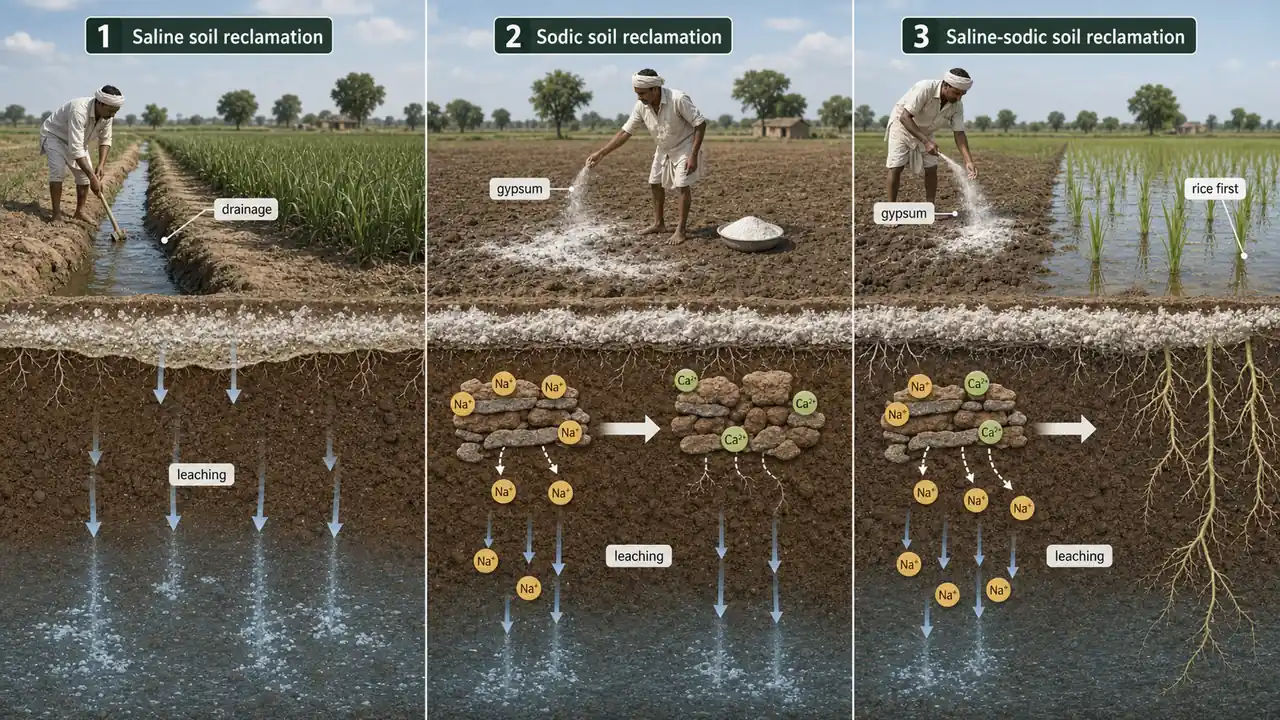
| Method | How It Works | Limitation |
|---|---|---|
| Scraping | Physically remove surface salt crust | Only removes visible surface salts; deeper salts remain |
| Leaching | Flood with good-quality water to wash salts below root zone | Requires adequate drainage |
| Drainage | Install lateral/main channels (60 cm deep, 45 cm wide) | Pre-requisite for all reclamation |
| Sub-surface drainage | Perforated pipes at 1--2 m depth intercept rising saline groundwater | Most effective long-term solution |
| Salt-tolerant crops | Grow tolerant varieties during reclamation | Alone not sufficient -- crops remove only a fraction of total salt |
IMPORTANT
Gypsum should NOT be applied to saline soils. Gypsum adds sulphate, which increases salt concentration and worsens salinity. Gypsum is specifically for sodic/alkali soils. This is a frequently tested distinction.
Irrigation Management for Saline Soils
- Use good-quality water (EC < 2 dS/m) for leaching.
- Intermittent ponding is more efficient than continuous ponding -- uses 25--50% less water for the same salt removal.
- Rice is ideal as the first reclamation crop: it thrives under standing water, which simultaneously leaches salts.
- Apply FYM -- organic acids from decomposition improve structure and counter salt effects.
Bio-drainage
- High water-consuming trees (Eucalyptus, Prosopis, Casuarina) lower the water table through transpiration.
- A 5-year-old Eucalyptus tree can lower the water table by 85 cm with transpiration of 50 litres/day/plant.
- Cost-effective and environmentally friendly alternative to engineered drainage.
Soil and Cultural Management
- Do not plant seeds at the centre of raised beds -- salts accumulate at the highest point through capillary rise.
- Use sloping beds with seeds on the slope just above the water line where salts have been leached sideways.
- Alternate furrow irrigation pushes salts toward the dry (non-irrigated) furrow, keeping the crop row salt-free.
- Straw or polythene mulch reduces evaporation, preventing upward salt movement within 30 days.

Fertilizer Management
- Apply 20--25% extra nitrogen to compensate for volatilization and denitrification losses in saline conditions.
- Organic manures (FYM at 5 t/ha, compost) release organic acids that lower pH and improve structure.
- Green manuring (Sunhemp, Dhaincha, Kolingi) produces organic acids and CO2 during decomposition, helping dissolve CaCO3.
Salt Tolerance of Crops
Threshold Salinity (EC at which yield decline begins)
| Crop | Threshold EC (dS/m) | Tolerance Level |
|---|---|---|
| Canola / Rapeseed | 11.0 | Very high |
| Guar | 8.8 | Very high |
| Barley | 8.0 | High |
| Cotton | 7.7 | High |
| Sugar beet | 7.0 | High |
| Sorghum | 6.8 | High |
| Wheat | 6.0 | Moderate |
| Soybean | 5.0 | Moderate |
| Date Palm | 4.0 | Moderate |
| Rice | 3.0 | Low |
| Groundnut | 3.2 | Low |
| Tomato | 2.5 | Low |
| Sugarcane | 1.7 | Sensitive |
| Maize | 1.7 | Sensitive |
| Potato | 1.7 | Sensitive |
| Citrus | 1.7 | Sensitive |
| Grape | 1.5 | Sensitive |
| Onion | 1.2 | Very sensitive |
| Carrot | 1.0 | Very sensitive |
TIP
Mnemonic: "Guar and Canola Bravely Cross Salty Soils" -- the top 6 salt-tolerant field crops in order. For sensitive crops, remember "SMPC" -- Sugarcane, Maize, Potato, Citrus all share threshold 1.7 dS/m.
Relative Salt Sensitivity
| Category | Field Crops | Vegetables | Fruit Crops |
|---|---|---|---|
| High tolerant | Barley, Dhaincha, Sugar beet, Tobacco, Cotton, Mustard | Spinach, Radish, Sugar beet | Date Palm, Phalsa |
| Medium tolerant | Rice, Sorghum, Pearl Millet, Arhar, Wheat, Rye, Oat | Cabbage, Cauliflower, Tomato, Carrot, Onion, Potato | Pomegranate, Grapes, Guava, Mango, Banana, Ber |
| Sensitive | Sunhemp, Pea, Groundnut, Moong, Gram, Urd, Maize Exams | English varieties of radish | Apple, Lemon, Strawberry, Almond |
| Crop | High Tolerant (> 10 m mho/cm) | Medium Tolerant (4.0 – 10 m mho/cm) | Sensitive Crops (< 4.0 m mho/cm) |
|---|---|---|---|
| Field crops | Barley, Cotton, Mustard, Tobacco, Dhaicha | Rice, Wheat, Sorghum, Pearl Millet, Arhar, Rye, Oat | Sunhemp, Pea, Groundnut, Moong, Gram, Urd |
| Vegetables | Spinach, Raphanus, Sugar Beet, B. repa | Cabbage, Cauliflower, Tomato, Carrot, Onion, Potato | Sam, English varieties of Raphanus |
| Fruits | Datepalm | Grape | Citrus |
| Fodder crops | Rhodes Grass, Khush Grass | Sudan Grass, Berseem, Lucerne, Sorghum | Cluster Bean |
Occurrence of Saline Soils in India
Saline soils occur mainly in Gujarat (largest extent due to long coastline and Rann of Kutch), West Bengal, Odisha, Rajasthan, Bihar, Haryana, Maharashtra, Andhra Pradesh, Kerala, and Tamil Nadu.
State-wise Salt Affected Soil Area in India
Inland Saline Soil:
| State | Area (ha) |
|---|---|
| Gujarat | 12,18,255 |
| Rajasthan | 1,95,571 |
| Maharashtra | 1,77,093 |
| Haryana | 49,157 |
| Bihar | 47,301 |
Coastal Saline Soil:
| State | Area (ha) |
|---|---|
| Gujarat | 4,62,315 |
| West Bengal | 4,41,272 |
| Orissa | 1,47,138 |
| Andhra Pradesh | 77,598 |
| A & N Islands | 77,000 |
| Kerala | 20,000 |
| Tamil Nadu | 13,231 |
| Total Coastal | 12,46,136 ha |
Sodic / Alkali Soil:
| State | Area (ha) |
|---|---|
| Uttar Pradesh | 13,46,971 |
| Gujarat | 5,41,430 |
| Maharashtra | 4,22,670 |
| Tamil Nadu | 3,54,784 |
| Andhra Pradesh | 1,96,609 |
| Haryana | 1,83,399 |
| Rajasthan | 1,79,371 |
| Punjab | 1,51,717 |
| Karnataka | 1,48,136 |
| Madhya Pradesh | 1,39,720 |
| Bihar | 1,05,852 |
| J & K | 17,500 |
| Total Sodic | 37,88,159 ha |
Total Salt Affected Soil in India: 67,44,968 ha
Gujarat has the highest salt-affected soil area overall.
Alkali / Sodic Soils (Black Alkali / Solonetz)

Diagnostic Features
- EC < 4 dS/m, ESP > 15, pH usually 8.5 to 10.0 exams 2017/2018.
- Low total salt but high proportion of sodium on the exchange complex.
- Structure is dispersed (poor) -- sodium causes clay particles to repel each other.
- Dark surface film of dissolved humus gives the name "black alkali".
- Developed due to excess Na2CO3 and NaHCO3.
- Found in semi-arid and sub-humid areas with annual rainfall 55--90 cm.
Regional names:
| Region | Local Name |
|---|---|
| Punjab | Kallar |
| Uttar Pradesh | Usar |
| Gujarat | Kshar |
How Alkali Soils Form (Genesis)
- In arid soils, Ca2+ and Mg2+ normally dominate the exchange complex.
- As salts concentrate through evaporation, Ca and Mg precipitate as CaSO4, CaCO3, and MgCO3 (lower solubility), while sodium remains in solution.
- When Na+ exceeds 15% of total cations, it replaces Ca2+ and Mg2+ on clay surfaces by mass action.
- Released Ca2+ is removed in drainage water, making the process unidirectional (self-reinforcing).
Three stages of evolution: Salinization --> Saline-alkali stage --> Alkalization (desalination + intense sodic formation)
Impact of Sodicity on Agriculture
| Impact | Mechanism |
|---|---|
| Soil compaction | Sodium disperses clay, destroying aggregates and pore structure |
| Low infiltration | Dense, impermeable surface (often < 0.1 cm/hour) |
| Poor aeration | Collapsed pore structure limits oxygen to roots |
| Reduced microbial activity | High pH hostile to beneficial microbes |
| Nutrient deficiency | N, P, Ca, Fe, Mg, Cu, Zn become unavailable at high pH |
| Direct toxicity | High OH- concentration damages root tissues above pH 9.0 |
| Ca and Mg deficiency | Excess Na+ competitively inhibits their uptake |
Reclamation of Alkali Soils
Principle: Replace exchangeable Na+ with Ca2+, then leach the displaced sodium out.
Reaction: Na-Clay + CaSO4 --> Ca-Clay + Na2SO4 (leachable)
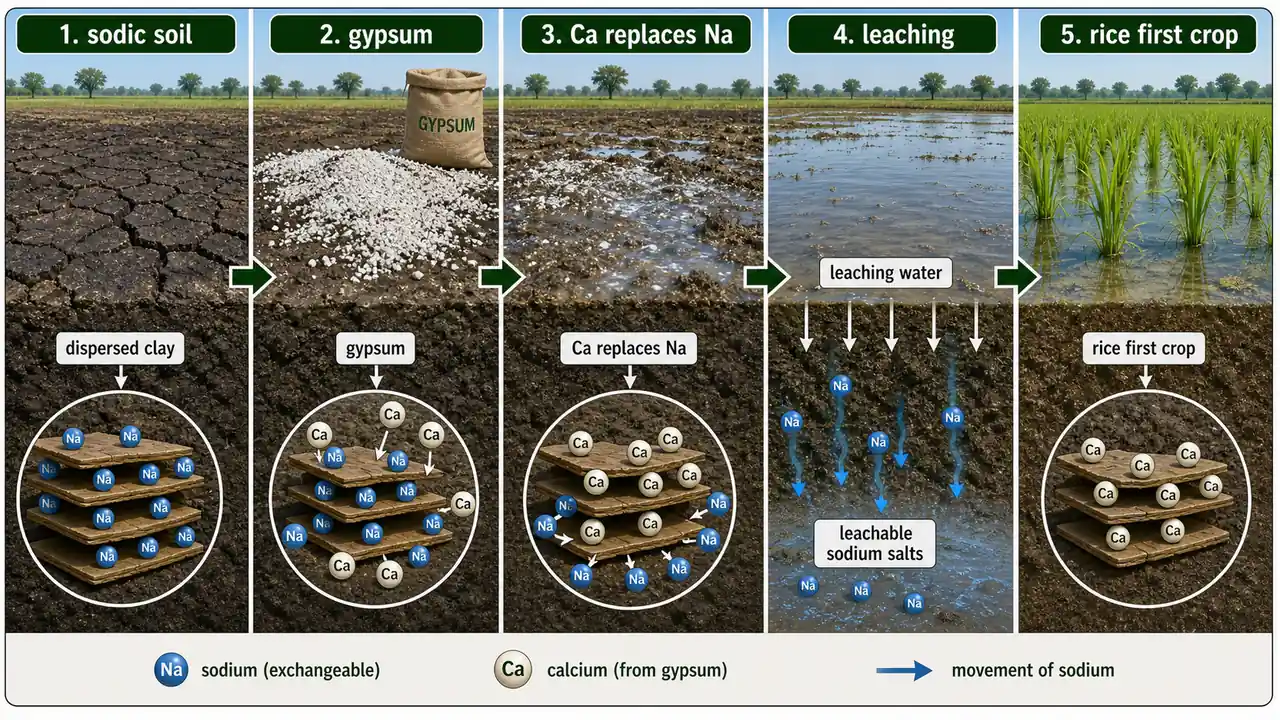
| Reclamation Step | What Happens | Why It Matters |
|---|---|---|
| Sodic soil condition | Dispersed clay and exchangeable sodium dominate the exchange complex | Poor structure, infiltration, and aeration |
| Gypsum application | Gypsum supplies soluble Ca2+ | Calcium is needed to displace sodium from clay surfaces |
| Ca replaces Na | Exchangeable Na+ is replaced by Ca2+ | Soil structure begins to improve and sodium becomes removable |
| Leaching | Displaced sodium forms leachable salts and moves downward with water | Removes the harmful sodium from the root zone |
| Rice first crop | Rice is grown under shallow ponding during early reclamation | Rice tolerates sodicity and the standing water helps reclamation progress |
| Amendment | How It Works | Application Rate |
|---|---|---|
| Gypsum (CaSO4.2H2O) | Directly supplies soluble Ca2+ to replace Na+ | 8 quintal/ha |
| Iron pyrite (FeS2) | Oxidizes to H2SO4, which dissolves soil CaCO3 to release Ca2+ | Effective in calcareous soils |
| Sulphur | Oxidized by Thiobacillus to H2SO4, which releases Ca from CaCO3 | For soils with free CaCO3 |
| Organic manures | Release organic acids that dissolve CaCO3 and improve biology | Used with gypsum for synergistic effect |
IMPORTANT
Gypsum is the most widely used amendment for sodic soils due to low cost and easy availability exams, NABARD 2020. In sodic soils, use CAN or DAP instead of urea -- urea causes severe ammonia volatilization at high pH.
Management Practices
- Rice is the preferred first crop -- tolerates submergence and high ESP; anaerobic conditions produce organic acids that aid reclamation.
- Rotations: Rice-Dhaincha (UP); Dhaincha-Rice-Berseem (Punjab).
- Apply 25--50% extra nitrogen (volatilization losses at high pH) + zinc (severely deficient above pH 7.5).
- Frequent irrigation with small quantities of water.
- Green manuring with salt-tolerant legumes (Dhaincha, Sunhemp).
- Agroforestry -- tree roots break hardpans, leaf litter adds organic matter (Prosopis juliflora, Casuarina).
- Grow Acacia jungle -- tap root breaks the hardpan (kankar pan), reclaims in 15--20 years.
Crop Choice Based on ESP Level
| ESP Range | Tolerant Crops |
|---|---|
| 60--70 | Rice |
| 50--60 | Beets, Barley, Sesbania |
| 30--50 | Oats, Mustard, Cotton, Wheat, Tomatoes |
| 25--30 | Linseed, Garlic, Clusterbean |
| 20--25 | Clover, Groundnut, Cowpea, Pearl millet |
| 16--20 | Chickpea, Soybean |
| 10--15 | Safflower, Blackgram, Peas, Lentil, Pigeonpea |
| 2--10 | Deciduous fruits, Nuts, Citrus, Avocado |
Sodicity Tolerance of Fruit Trees
| Tree | ESP Tolerance | Level |
|---|---|---|
| Ber, Tamarind, Sapota, Wood Apple, Date Palm | 40--50 | High |
| Pomegranate | 30--40 | Medium |
| Guava, Lemon, Grape | 20--30 | Low |
| Mango, Jackfruit, Banana | 20 | Sensitive |
Occurrence in India
Alkali soils are largely in the Indo-Gangetic plains -- Gujarat Exams, Uttar Pradesh, Punjab, Haryana, Bihar -- and partly in Chhattisgarh, Rajasthan, AP, Maharashtra, Karnataka, MP, and Tamil Nadu. UP has the largest sodic soil area (13.47 lakh ha).
| Property | Saline | Alkaline |
|---|---|---|
| Dominant ions | Cl⁻ and SO₄²⁻ of Na but also CO₃²⁻ and HCO₃⁻ of Ca²⁺ and Mg²⁺ in small amount | CO₃²⁻ of Na⁺ but also CO₃²⁻ of K⁺, Ca²⁺ and Mg²⁺ in small amount |
| Soluble salt concentration | Equal to or more than 0.1% | Soluble conc < 0.1% |
| Exchangeable sodium % | < 15% | ESP >15% |
| pH | < 8.5 | > 8.5 |
| EC of saturated extract at 25°C | More than or equal to 4 milli mho per cm, i.e. EC > 4 mmho/cm | EC < 4 mmho/cm |
| Appearance | White/light grey colour hence called white alkali | Black colour hence called black alkali |
| Soil condition | Flocculated soils therefore soil, aeration and permeability is normal | Dispersed & compact soil, aeration and permeability is low |
| Management | Easy to manage because physical condition of soil is good | Such soils cannot be easily managed because physical condition is not good |
| O.M. | Very little amount of O.M. or humus in soil | Very less amount of O.M. or humus in soil |
| Reclamation | Can be reclaimed by mechanical methods up to some extent | Use of amendments is must |
| Natural vegetation | In rainy season, some natural vegetation except grasses | No any Natural Vegetation except some grasses |
Saline-Sodic Soils (Brown Alkali)
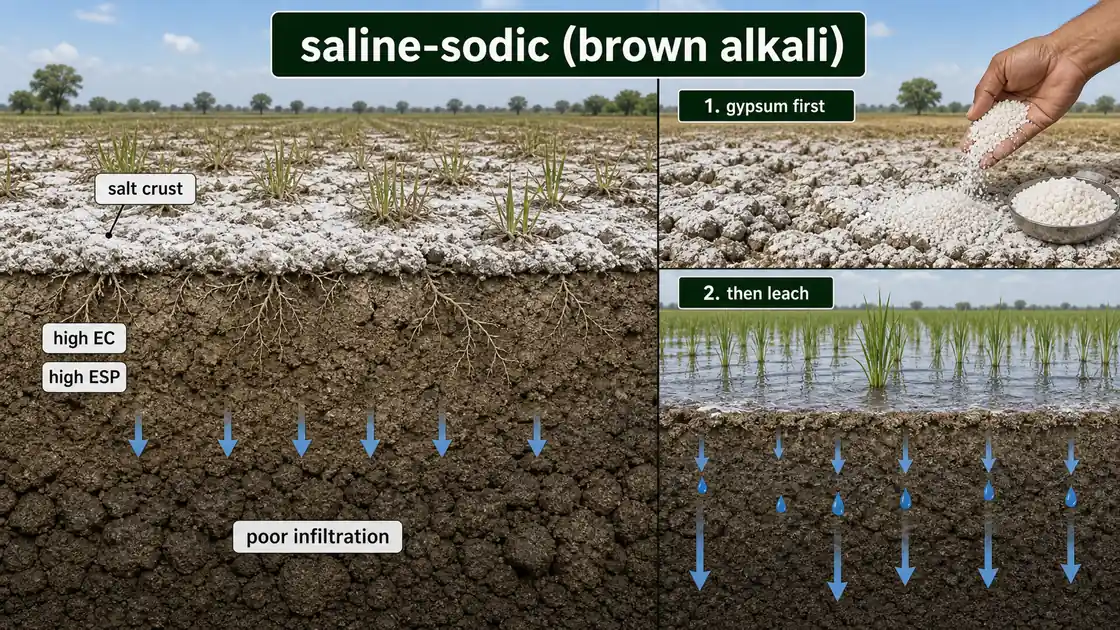
Diagnostic Features
- EC > 4 dS/m AND ESP > 15 Exams.
- pH variable, usually above 8.5 (depends on relative amounts of Na and soluble salts).
- Contains both soluble salts and exchangeable Na -- very difficult to manage.
- Neutral salts suppress pH by preventing sodium hydrolysis; when salts are leached, pH rises sharply.
Formation -- Favourable Factors
| Factor | How It Contributes |
|---|---|
| Aridity | Insufficient rainfall for natural leaching |
| Poor drainage | Prevents removal of excess salts and water |
| Saline irrigation water | Each cycle adds more salts |
| Rising water table | Capillary rise brings salts to root zone |
| Erratic irrigation | Alternating flood and drought maximizes salt accumulation |
Management -- Critical Sequence
IMPORTANT
For saline-sodic soils, the order matters: First apply gypsum to replace exchangeable sodium, THEN leach to remove displaced sodium salts. Reversing this order is disastrous -- removing neutral salts first causes pH to spike and soil to disperse irreversibly.
Detrimental Effects
- Dispersed, compact soil with poor structure
- Low water permeability (often < 0.1 cm/hour)
- Poor aeration limiting root respiration
- Reduced microbial activity from combined salt and pH stress
- Nutrient unavailability -- P, Ca, N locked in insoluble forms or lost through volatilization
Soil pH Range for Major Crops
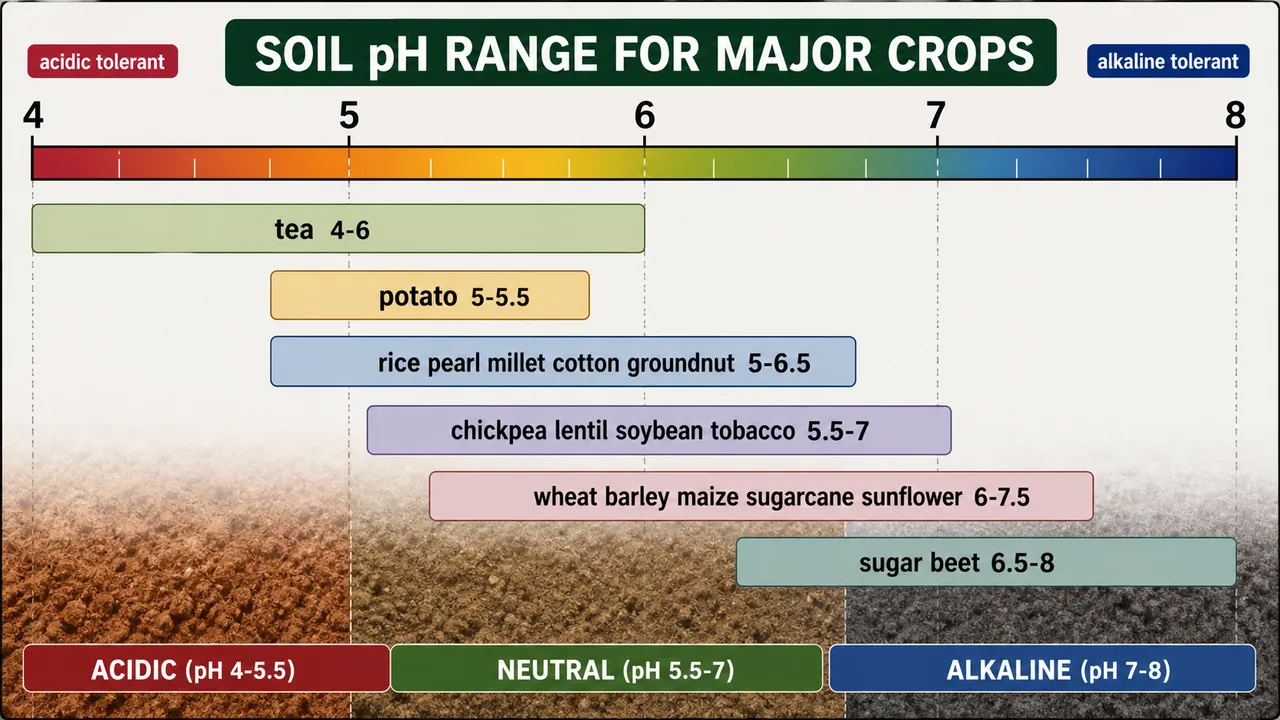
| pH Range | Crops |
|---|---|
| 4–6 (most acidic tolerant) | Tea |
| 5–5.5 | Potato |
| 5–6.5 | Rice, Pearl millet, Cotton, Groundnut |
| 5.5–7 | Chickpea, Lentil, Soybean, Tobacco |
| 6–7.5 (ideal for most crops) | Wheat, Barley, Maize, Sugarcane, Sunflower |
| 6.5–8 (most alkaline tolerant) | Sugar beet |
TIP
Exam shortcut: Tea = most acidic tolerant (pH 4-6). Sugar beet = most alkaline tolerant (pH 6.5-8). Most field crops thrive at pH 6-7.5. Rice tolerates acidity better than wheat.
Summary Cheat Sheet
| Concept / Topic | Key Details / Explanation |
|---|---|
| Two diagnostic thresholds | EC = 4 dS/m (saline/non-saline divide); ESP = 15% (sodic/non-sodic divide) |
| EC unit | dS/m = mmhos/cm (numerically same) |
| SAR formula | Na⁺ / √((Ca²⁺ + Mg²⁺)/2); SAR > 13 ≈ ESP > 15 |
| Saline soil (White alkali / Solonchak) | EC > 4, ESP < 15, pH < 8.5; dominant salts NaCl + Na₂SO₄; structure flocculated |
| Sodic soil (Black alkali / Solonetz) | EC < 4, ESP > 15, pH 8.5–10; dominant salts Na₂CO₃ + NaHCO₃; structure dispersed |
| Saline-sodic soil (Brown alkali) | EC > 4 AND ESP > 15; pH > 8.5; most complex to manage |
| Saline reclamation | Leaching + drainage (NO gypsum — gypsum worsens salinity) |
| Sodic reclamation | Gypsum (8 quintal/ha) + leaching; reaction: Na-Clay + CaSO₄ → Ca-Clay + Na₂SO₄ |
| Saline-sodic reclamation | Gypsum FIRST, then leach (reversing order causes pH spike) |
| First reclamation crop (all types) | Rice — thrives under submergence which leaches salts |
| CSSRI | Central Soil Salinity Research Institute; Karnal, Haryana; established 1969 |
| Iron pyrite (FeS₂) | Used for sodic soils; oxidizes to H₂SO₄ → dissolves CaCO₃ → releases Ca²⁺ |
| Bio-drainage tree | Eucalyptus — lowers water table by 85 cm; transpires 50 L/day/plant |
| Total salt-affected area (India) | 67,44,968 ha (~67 lakh ha) |
| Largest saline soil state | Gujarat (inland + coastal) |
| Largest sodic soil state | Uttar Pradesh (13.47 lakh ha) |
| Most salt-tolerant field crop | Canola (threshold EC = 11.0 dS/m) |
| Most salt-sensitive crop | Carrot (threshold EC = 1.0 dS/m) |
| Sensitive crops (threshold 1.7 dS/m) | Sugarcane, Maize, Potato, Citrus |
| Highest ESP-tolerant crop | Rice (ESP 60–70) |
| Sodic crop sequence (UP) | Rice → Dhaincha rotation |
| Alkali fertilizer choice | Use CAN or DAP (not urea — urea causes NH₃ volatilization at high pH) |
| Tea pH tolerance | 4–6 (most acidic tolerant crop) |
| Sugar beet pH tolerance | 6.5–8 (most alkaline tolerant crop) |
| Saline bed management | Seeds on slope, not at centre of raised beds (salts accumulate at top) |
| Intermittent ponding | 25–50% more efficient than continuous ponding for salt leaching |
| Two magic numbers | EC = 4 dS/m, ESP = 15% |
| First crop for all types | Rice |
| Ideal sodic amendment | Gypsum (low cost, easy availability) |
| Saline local names | Thur (Punjab), Reh (UP), Luni (Rajasthan) |
| Sodic local names | Kallar (Punjab), Usar (UP), Kshar (Gujarat) |