👨👨👦👦 Fertilizer Classification and the Indian Fertilizer Industry
Answer-first guide to fertilizer classification: straight, binary, complete, complex and mixed fertilizers, NPK grade and ratio, mixing precautions, acidity/basicity and Indian fertilizer industry facts for agriculture exams
Introduction
Imagine a wheat farmer in Punjab applying urea year after year without any phosphorus or potash. The first few years, yields stay high. But gradually, the soil becomes nutrient-imbalanced, the crop response ratio drops, and despite using more fertilizer, yields stagnate. This real-world problem -- driven by India's skewed fertilizer subsidy -- is why understanding fertilizer classification, grades, and balanced nutrition is essential for both farming practice and competitive exams.
Fertilizer Classification: Direct Answer
30-Second Search Snippet
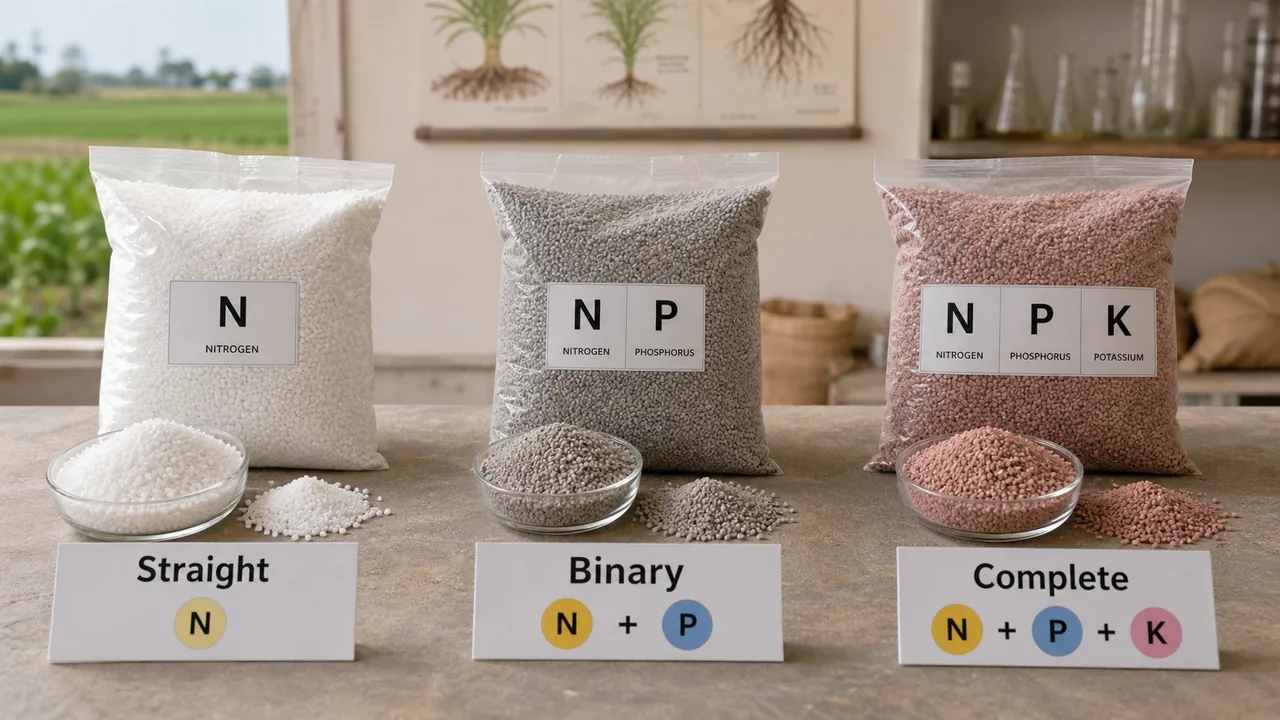
Fertilizer classification: urea is a straight nitrogen fertilizer; DAP is a binary and complex fertilizer containing N and P; NPK 19:19:19 is a complete fertilizer; complex fertilizers have uniform granules; mixed fertilizers are physically blended. Fertilizer grade means guaranteed % of N:P2O5:K2O, while fertilizer ratio is the same proportion reduced to the smallest whole numbers.
Exam-Use Classification Table
| Question Stem | Correct Concept | Example |
|---|---|---|
| Supplies only one nutrient | Straight fertilizer | Urea, MOP, SSP |
| Supplies two nutrients | Binary fertilizer | DAP |
| Supplies N, P and K | Complete / ternary fertilizer | NPK 19:19:19 |
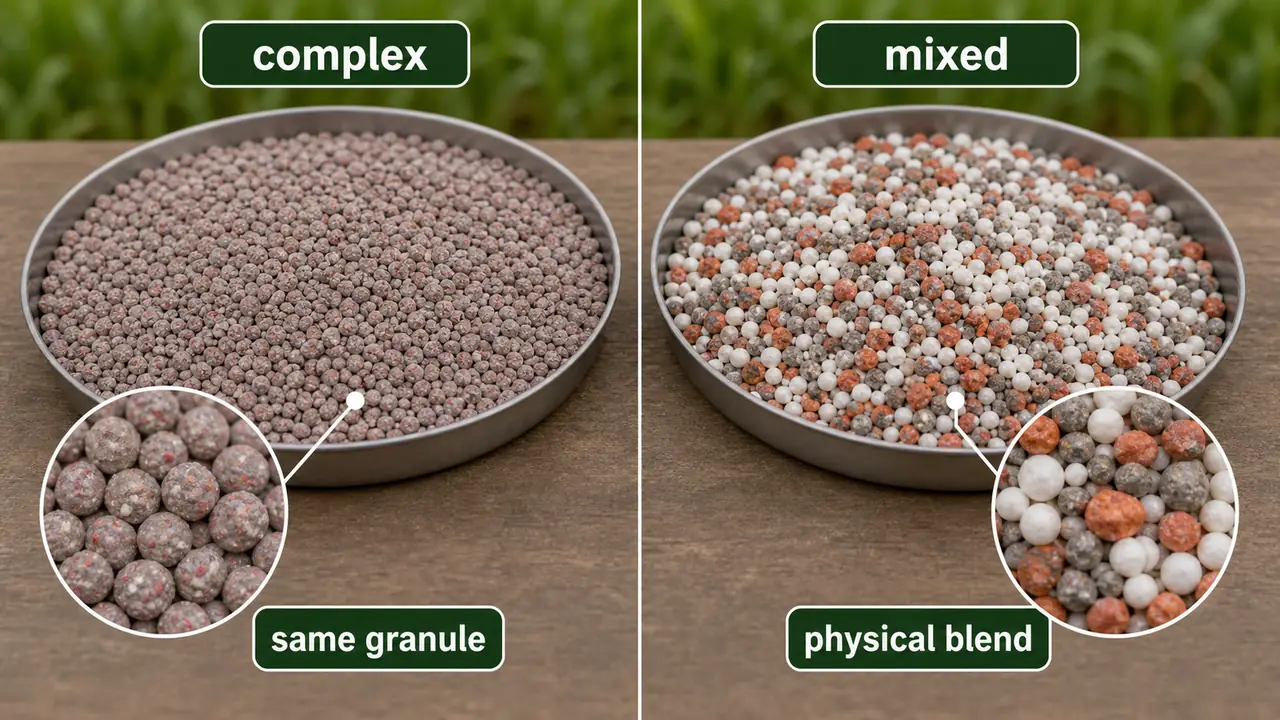
| Each granule has same ratio | Complex fertilizer | DAP, NPK complexes |
| Physical blending of fertilizers | Mixed fertilizer | Custom NPK mixtures |
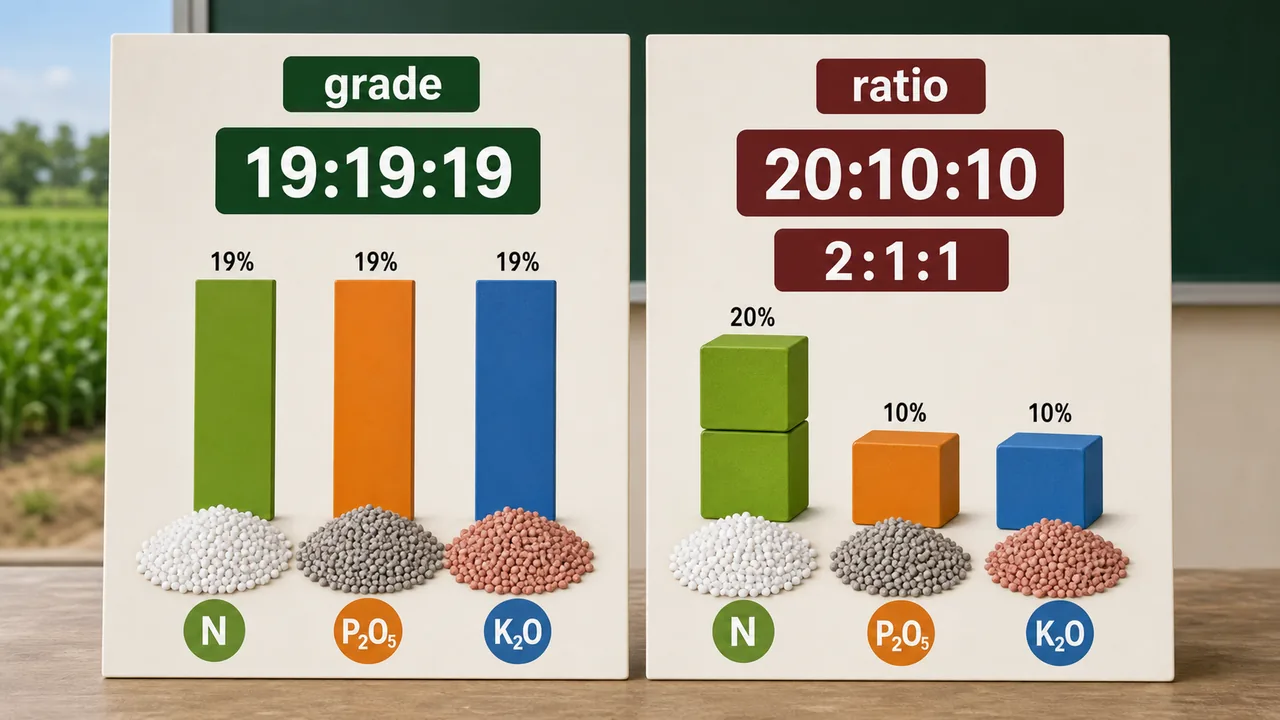
| 19:19:19 meaning | Grade | 19% N, 19% P2O5, 19% K2O |
| 20:10:10 simplified | Ratio | 2:1:1 |
TIP
Memory line: Straight = 1, Binary = 2, Complete = 3, Complex = chemical, Mixed = physical.
What Are Fertilizers, Manures, and Amendments?
Before classifying fertilizers, it is important to distinguish three related terms:
| Term | Nature | Primary Purpose | Example |
|---|---|---|---|
| Manure | Organic (plant/animal origin) | Supply nutrients + improve soil | FYM, compost, vermicompost |
| Fertilizer | Usually inorganic, commercial product | Supply one or more essential nutrients in large proportions | Urea, DAP, MOP |
| Amendment | May be organic or inorganic | Improve soil condition (not primarily nutrient supply) | Gypsum, lime |
- Amendments are also called ameliorants, improvers, or soil conditioners. For example, gypsum reclaims sodic soils and lime corrects acidic soils -- though both supply some nutrients, their main role is soil improvement.
NOTE
Exam Tip: If a question asks "Which is a soil amendment?" -- choose gypsum or lime. If it asks "Which is a fertilizer?" -- choose urea or DAP. The distinction is about primary purpose.
History of Fertilizers
- Liebig (Germany) and Lawes (England) independently developed the idea of treating phosphate rock with H2SO4 to produce water-soluble superphosphate around 1840. This discovery marked the beginning of the modern fertilizer industry.
- Lawes established the first commercial fertilizer factory at Deptford in 1843 for superphosphate production.
- First Agricultural Chemist of ICAR: J.W. Leather.
- Reverse Fertilization exams 2021: Removal of soil nutrients when crops are harvested without replenishing what was taken up.
- The relationship between water and fertilizer as crop production factors is synergistic -- fertilizers work best with adequate water, and irrigation is most productive when nutrients are not limiting.
- Overall foodgrain production to fertilizer ratio in India: approximately 10:1 (10 kg grain per 1 kg fertilizer).
Classification of Fertilizers
Fertilizers are classified based on the number and type of nutrients they supply. Think of it like a rice farmer's choices: a straight fertilizer (urea) for a quick nitrogen top-dress, a complex fertilizer (DAP) for combined N and P at sowing, or a complete fertilizer (NPK 19:19:19) for balanced nutrition.
By Number of Nutrients
| Type | Definition | Example | Agricultural Use |
|---|---|---|---|
| Straight | Supplies only one major nutrient | Urea (N only) | Top-dressing in wheat, rice |
| Binary | Contains two nutrients | DAP (N + P) | Basal dose in cereals, pulses |
| Ternary / Complete | Contains three nutrients (N, P, K) | NPK 19:19:19 | Balanced nutrition for vegetables, sugarcane |
By Manufacturing Process
| Type | How Made | Example | Key Feature |
|---|---|---|---|
| Complex | Nutrients chemically combined during manufacture | DAP, NPK complexes | Each granule has a fixed nutrient ratio |
| Mixed | Two or more fertilizers physically blended | Nitrophosphate + potash (15:15:15) | Granules may differ in composition |
By Nutrient Concentration
| Type | Nutrient Content | Example | Practical Implication |
|---|---|---|---|
| Low analysis | Less than 25% primary nutrient | SSP (16% P2O5), Sodium nitrate (16% N) | Larger quantity needed; higher transport cost |
| High analysis | More than 25% primary nutrient | Urea (46% N), DAP (46% P2O5) | More economical per unit nutrient |
TIP
Mnemonic -- "SBC for classification": Straight (1 nutrient), Binary (2), Complete (3). For concentration: think 25% is the dividing line between low and high analysis.
Fertilizer Grade and Ratio
Fertilizer Grade
- The guaranteed minimum analysis of plant nutrients in a fertilizer, expressed as percentages of N, P2O5, and K2O.
- Example: NPK 19:19:19 means at least 19% N, 19% P2O5, and 19% K2O.
Fertilizer Ratio
- The relative proportion of N, P2O5, and K2O, reduced to the smallest whole numbers.
- Example: A grade of 20:10:10 has a ratio of 2:1:1.
- Practical calculation: 160 kg fertilizer with ratio 2:1:1 = 80 kg N, 40 kg P2O5, and 40 kg K2O.
Materials Used in Mixed Fertilizer Manufacturing
| Component | Purpose | Examples |
|---|---|---|
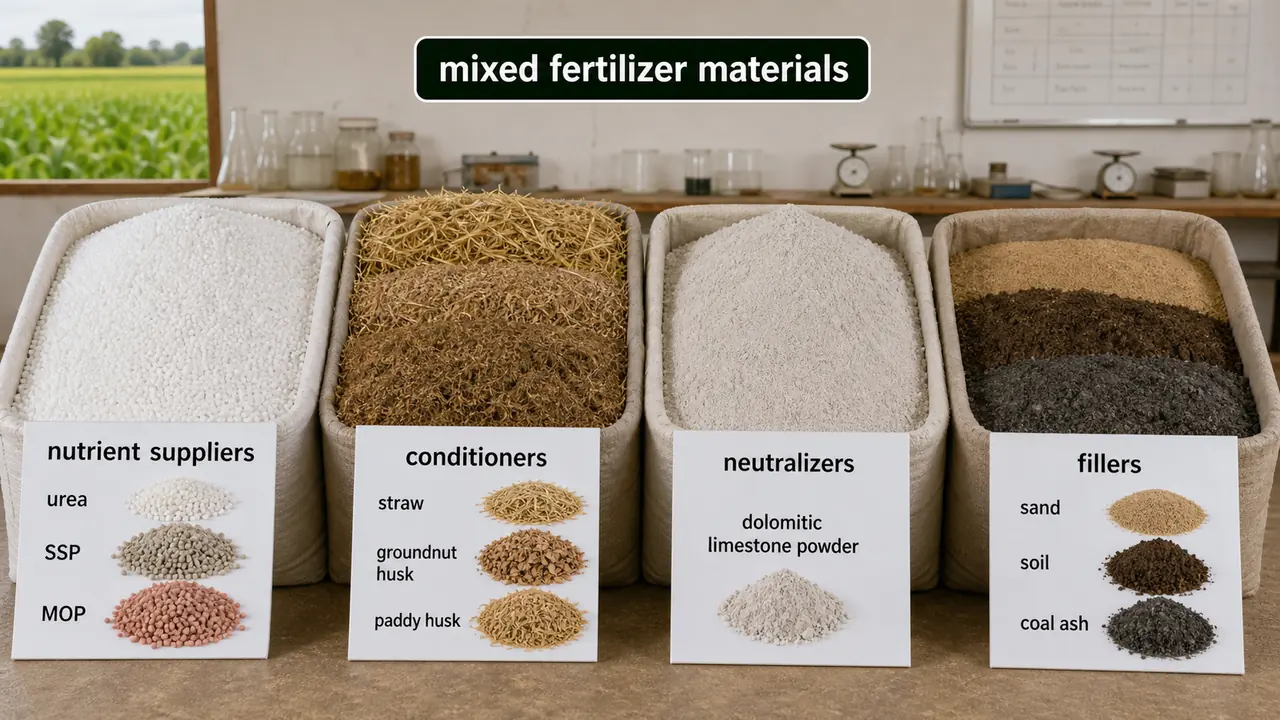
| Nutrient suppliers | Provide plant nutrients | Straight fertilizers (urea, SSP, MOP) |
| Conditioners | Prevent caking (clumping due to moisture absorption) | Straw, groundnut husk, paddy husk, peat soil |
| Neutralizers | Counteract residual acidity or basicity | Dolomitic limestone (for acidity) |
| Fillers | Make up weight to desired total quantity | Sand, soil, coal ash, charcoal |
Precautions in Mixing Fertilizers
Improper mixing can cause nutrient losses or physical deterioration. These rules are critical:
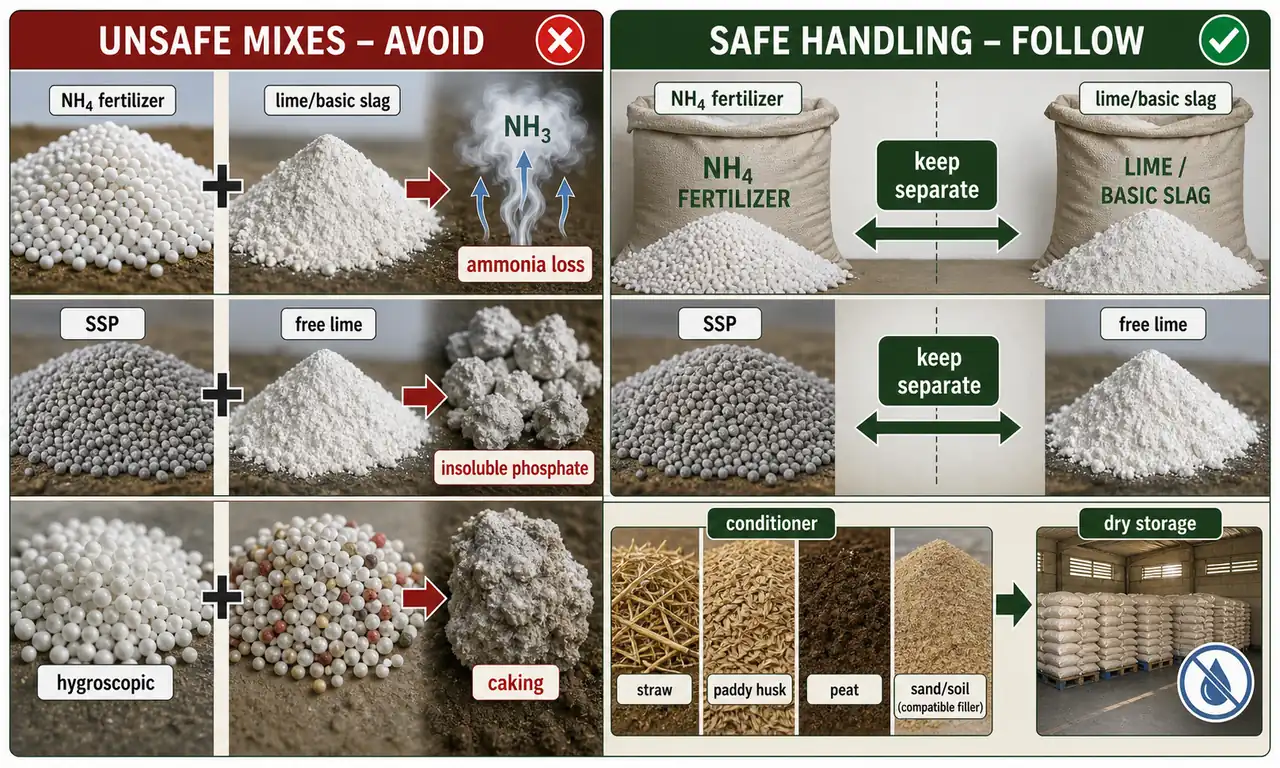
| Mixing Rule | Unsafe Combination or Condition | What Goes Wrong | Safe Handling |
|---|---|---|---|
| Do not mix ammonium fertilizers with basic materials | NH4+ fertilizers + lime/basic slag | Ammonia gas escapes, causing N loss | Keep them separate |
| Do not mix water-soluble phosphates with free lime | SSP + free lime | Soluble phosphate becomes insoluble | Keep them separate |
| Avoid mixing highly hygroscopic fertilizers carelessly | Moisture-absorbing fertilizers in poor storage | Fertilizer cakes/clumps | Use conditioners/fillers where appropriate and maintain dry storage |
1. Avoid mixing highly hygroscopic fertilizers -- they absorb moisture and form cakes.
Hygroscopic nature (decreasing order):
Ammonium Nitrate > Urea > Ammonium Sulphate > Ammonium Sulphate Nitrate > CAN
2. Never mix NH4+ fertilizers with basic materials (lime, basic slag, rock phosphate) -- the basic material raises pH and converts ammonium to volatile ammonia gas, causing nitrogen loss.
Agricultural example: A farmer mixing urea with lime before applying to his mustard field would lose significant nitrogen as ammonia gas escaping into the air.
3. Never mix water-soluble phosphatic fertilizers (SSP) with materials containing free lime -- it converts soluble phosphate into insoluble forms, making P unavailable to crops.
4. Slightly acidic fertilizers containing chloride may damage gunny bags and drilling equipment.
Equivalent Acidity and Basicity
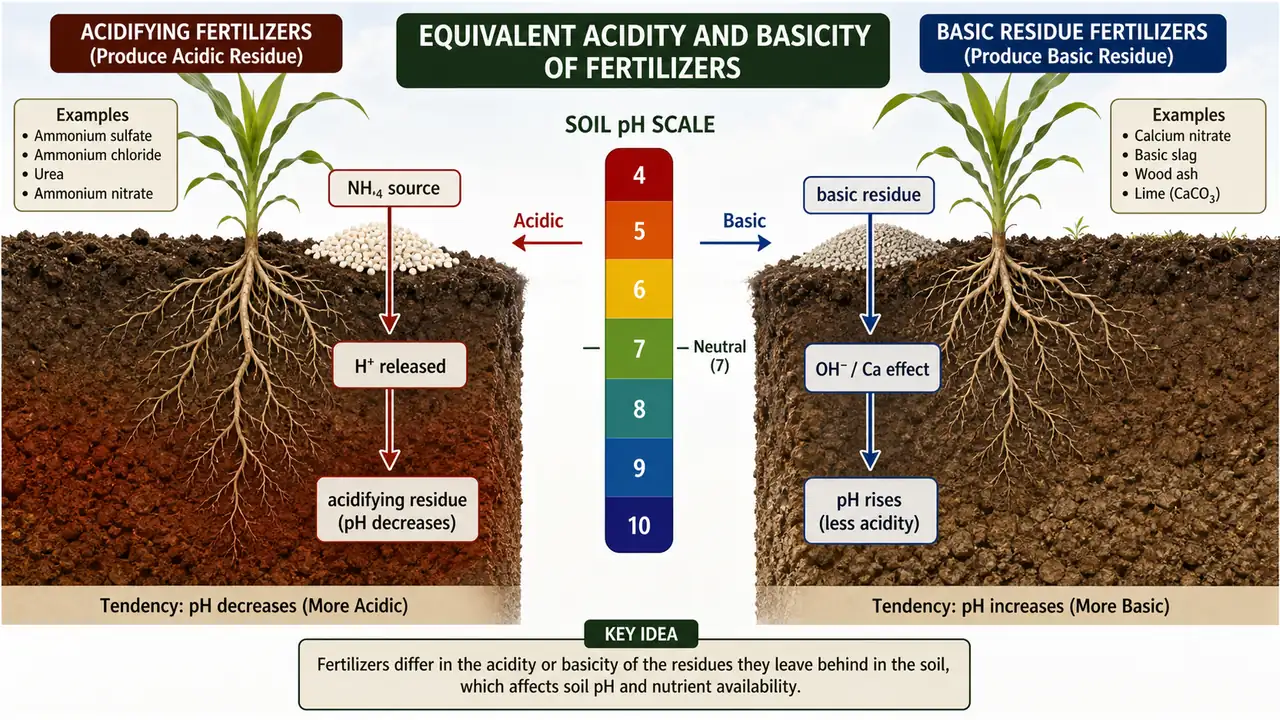
Equivalent Acidity
The amount of CaCO3 (in kg) required to neutralize the acid residue left by 100 kg of an acidic fertilizer.
Agricultural example: If a tea plantation applies 100 kg of ammonium sulphate, the soil acidity produced requires 110 kg of CaCO3 to neutralize. So the equivalent acidity of (NH4)2SO4 is 110.
Order of acidic residual nature (decreasing):
Anhydrous ammonia > Ammonium chloride > Ammonium sulphate > Urea > Ammonium nitrate (lowest)
TIP
Mnemonic -- "AAUA": Anhydrous ammonia, Ammonium chloride, ammonium sulphate (Urea is lower), Ammonium nitrate (least acidic). Think: "the purest form of ammonia causes the most acidity."
| Fertilizer | Equivalent Acidity (meq/100g) |
|---|---|
| Anhydrous ammonia | 148 |
| Ammonium chloride | 128 |
| Ammonium sulphate | 110 |
| Urea | 80-85 |
| DAP | 77 |
| Ammonium nitrate | 60 |
Equivalent Basicity
The CaCO3 equivalent of basic residue left by a fertilizer (in kg per 100 kg of fertilizer salt). These fertilizers have a liming effect and are suitable for acidic soils.
Order of basic residual nature (decreasing):
Calcium Cyanamid > Sodium Nitrate > Dicalcium phosphate > Calcium nitrate
These fertilizers have zero equivalent acidity.
| Fertilizer | Equivalent Basicity (meq/100g) |
|---|---|
| Calcium Cyanamid (CN) | 63 |
| Sodium Nitrate (NaNO₃) | 29 |
| Di Calcium Phosphate | 27 |
| Calcium Nitrate (Ca(NO₃)₂) | 21 |
Indian Fertilizer Scene
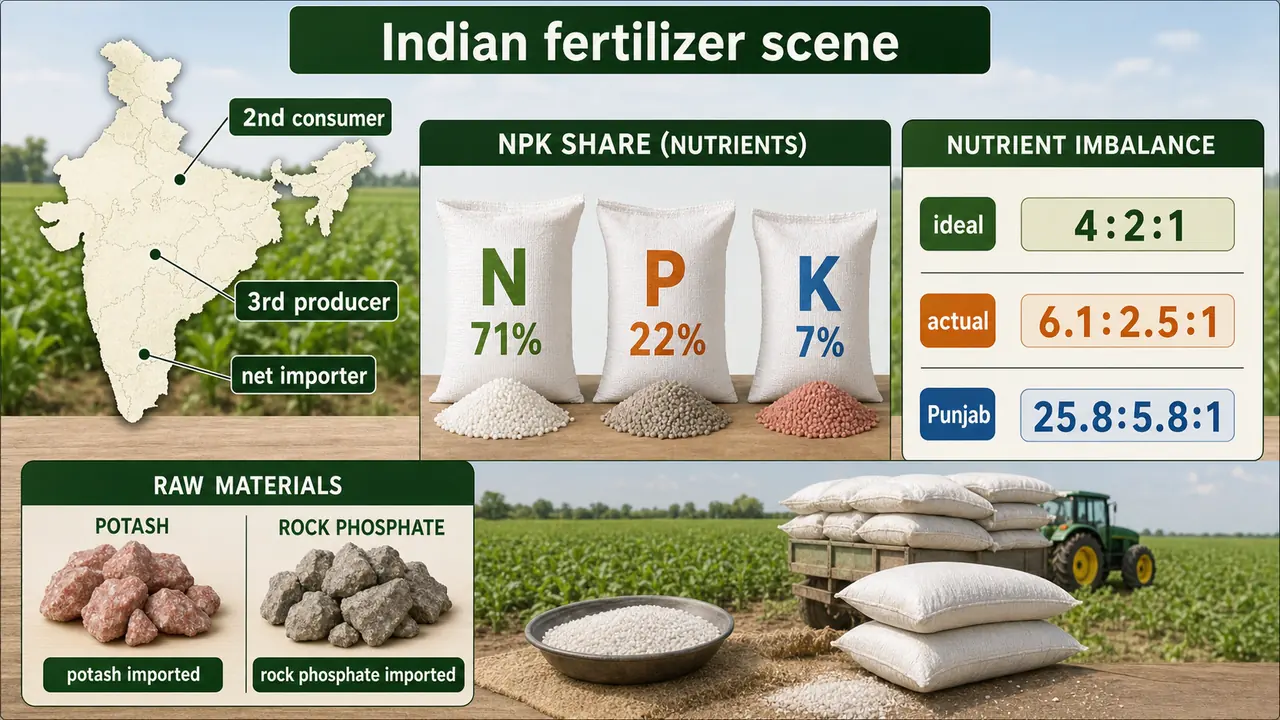
| Indian fertilizer scene fact | Value |
|---|---|
| Global position | 2nd largest consumer, 3rd largest producer, still a net importer |
| NPK nutrient share | N 71%, P 22%, K 7% |
| Imported raw materials | Potash imported, rock phosphate imported |
| Ideal vs actual NPK ratio | 4:2:1 ideal vs 6.1:2.5:1 actual |
| Punjab NPK imbalance | 25.8:5.8:1 |
India's Position
- India is the 2nd largest consumer and 3rd largest producer of finished fertilizers in the world.
- India is a major fertilizer producer but remains a net importer, especially for phosphatic and potassic fertilizer needs.
- The sector is highly subsidized and relies heavily on imports.
Consumption Pattern
| Parameter | Value |
|---|---|
| Average consumption (2016) | 165.8 kg/ha |
| Highest state consumption | Punjab (250 kg/ha) |
| Lowest state consumption | Arunachal Pradesh (2 kg/ha) |
| Among UTs, highest | Pondicherry |
| Top consumer state (by share) | Uttar Pradesh (16.4%) |
| Top 10 states share | ~78% of total consumption |
NPK Consumption Ratio
| Nutrient | Share of Total | Key Fact |
|---|---|---|
| Nitrogen (N) | 71% | Urea alone = 58% of total fertilizer consumption (85% of N fertilizers) |
| Phosphorus (P) | 22% | DAP accounts for 66% of phosphatic fertilizer consumption |
| Potassium (K) | 7% | 100% imported -- India has no significant potash reserves |
| Share of total fertilizer consumption (%) in India | |
|---|---|
| Rice | 40.5 |
| Wheat | 24.2 |
| Sugarcane | 8.7 |
Raw Materials
| Fertilizer Type | Raw Material Source |
|---|---|
| N-based (Urea) | Indigenous feedstock (natural gas to ammonia) |
| P-based (DAP, SSP) | Rock phosphate -- imported |
| K-based (MOP) | Potash -- fully imported |
The Subsidy Problem
The massive urea subsidy has created two serious distortions:
- Huge fiscal burden on the exchequer (fertilizer subsidy is the 2nd largest after food subsidy).
- Imbalanced NPK use -- against the ideal ratio of 4:2:1, India's actual ratio is 6.1:2.5:1, and in Punjab it reaches 25.8:5.8:1. This imbalance reduces crop response ratio and degrades soil health.
Proposed solutions: Bring urea under Nutrient Based Subsidy (NBS) and introduce direct cash transfer per hectare for all fertilizers.
IMPORTANT
Key exam facts: India = 2nd largest consumer and 3rd largest producer of finished fertilizers. Potassic fertilizers = 100% imported. NPK ratio is heavily skewed toward N (71:22:7). Ideal NPK ratio = 4:2:1.
Summary Cheat Sheet
| Concept / Topic | Key Details / Explanation |
|---|---|
| Manure vs Fertilizer vs Amendment | Manure = organic, nutrients + soil improvement; Fertilizer = commercial, concentrated nutrients; Amendment = soil condition improver (gypsum, lime) |
| First fertilizer factory | Lawes, Deptford, 1843 — superphosphate |
| First Agricultural Chemist of ICAR | J.W. Leather |
| Fertilizer–foodgrain ratio (India) | 10:1 (10 kg grain per 1 kg fertilizer) |
| Straight fertilizer | Supplies 1 nutrient only (e.g., Urea = N only) |
| Binary fertilizer | Supplies 2 nutrients (e.g., DAP = N + P) |
| Ternary / Complete fertilizer | Supplies 3 nutrients N + P + K (e.g., NPK 19:19:19) |
| Complex vs Mixed | Complex = chemically combined (each granule fixed ratio); Mixed = physically blended |
| Low vs High analysis | Dividing line = 25% nutrient content |
| Fertilizer grade | Guaranteed minimum % of N : P₂O₅ : K₂O (e.g., 19:19:19) |
| Fertilizer ratio | Relative proportion reduced to smallest whole numbers (e.g., 20:10:10 → 2:1:1) |
| Conditioners in mixed fertilizers | Prevent caking — straw, groundnut husk, paddy husk, peat soil |
| Mixing rule 1 | Never mix hygroscopic fertilizers together |
| Hygroscopic order | NH₄NO₃ > Urea > (NH₄)₂SO₄ > CAN |
| Mixing rule 2 | Never mix ammonium fertilizers with basic materials (lime) — NH₃ volatilization |
| Mixing rule 3 | Never mix SSP with free lime — P becomes insoluble |
| Equivalent acidity | kg CaCO₃ to neutralize acid residue of 100 kg fertilizer |
| Highest equivalent acidity | Anhydrous ammonia (148) |
| Highest equivalent basicity | Calcium cyanamid (63) |
| Alkaline (basic) fertilizers | Calcium cyanamid > Sodium nitrate > Dicalcium phosphate > Calcium nitrate |
| India's fertilizer rank | 2nd largest consumer and 3rd largest producer globally |
| Potassic fertilizer source | 100% imported (no significant domestic reserves) |
| Ideal NPK ratio | 4 : 2 : 1 |
| Actual NPK ratio (India) | 6.1 : 2.5 : 1 |
| Punjab NPK ratio | 25.8 : 5.8 : 1 (extreme imbalance) |
| N share of total consumption | 71% (Urea = 58% of total; 85% of N fertilizers) |
| P share | 22% (DAP = 66% of phosphatic consumption) |
| K share | 7% (100% imported) |
| Top consuming state | Uttar Pradesh (16.4% share) |
| Highest per-hectare consumption | Punjab (250 kg/ha); lowest = Arunachal Pradesh (2 kg/ha) |
| Grade example | NPK 19:19:19 = 19% each of N, P2O5, K2O |
| Most hygroscopic fertilizer | Ammonium nitrate |