💄 Potassic Fertilizers: MOP, SOP, KNO3 -- Properties, Suitability, and Application
Complete guide to potassium fertilizers — Muriate of Potash (KCl), Sulphate of Potash (K2SO4), Potassium Nitrate (KNO3). Covers K2O content, chloride sensitivity, soil suitability, K-fixation, and exam-focused comparisons.
Introduction
A sugarcane farmer in Maharashtra applies KCl (Muriate of Potash) to save money -- it is the cheapest potassium source. But at harvest, the juice quality is poor and sugar recovery drops. The culprit: chloride ions from KCl interfere with sugar accumulation. When the farmer switches to K2SO4 (Sulphate of Potash), sugar recovery improves dramatically. This example illustrates the central lesson of potassic fertilizers: the right source matters as much as the right dose, especially for quality-sensitive crops.
Potassium Basics
- Primary source minerals: Feldspar (orthoclase), Muscovite, Biotite -- these weather slowly over geological time to release K into soil
- India does not produce potassic fertilizers domestically -- relies entirely on imports (the most import-dependent nutrient)
- Highest use of potassic fertilizer: state of Maharashtra
- Heavy K application reduces absorption of Zn and Cu (nutrient antagonism)
The Three Potassic Fertilizers
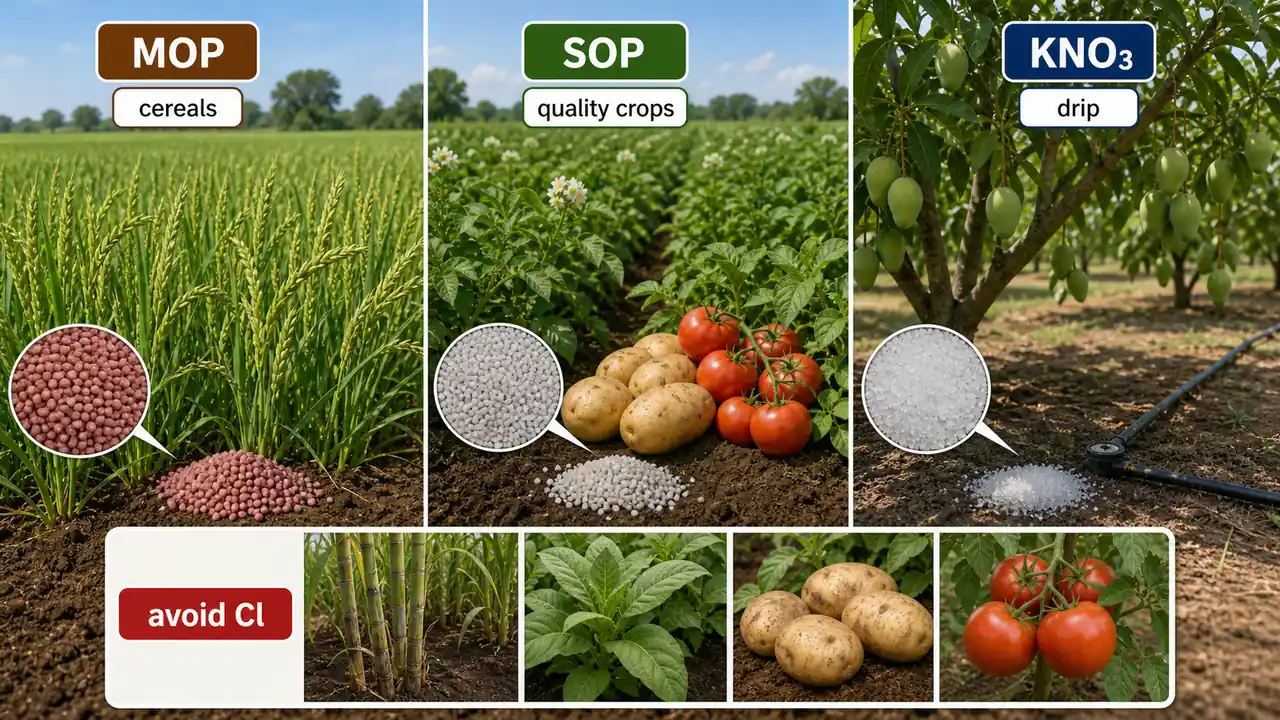
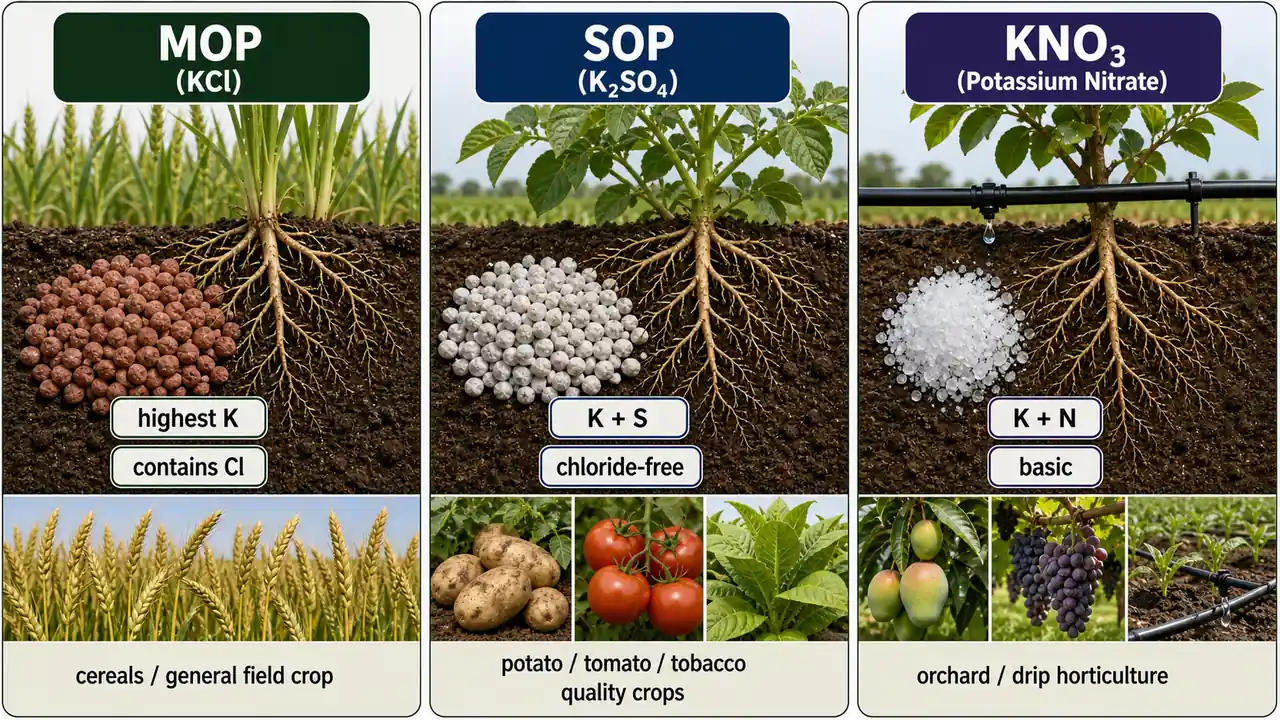
There are only three potassic fertilizers to remember. The key decision factor is whether the crop can tolerate chloride or not.
Pro Content Locked
Upgrade to Pro to access this lesson and all other premium content.
Charged once for one year · ₹1188 total
Save ₹100/month vs ₹2388/year launch price
- All Agriculture & Banking Courses
- AI Lesson Questions (100/day)
- AI Doubt Solver (50/day)
- Glows & Grows Feedback (30/day)
- AI Section Quiz (20/day)
- 22-Language Translation (100/day)
- Recall Questions (20/day)
- AI Quiz (15/day)
- AI Quiz Paper Analysis (100/day)
- AI Step-by-Step Explanations (100/day)
- Spaced Repetition Recall (FSRS)
- AI Tutor
- Immersive Text Questions
- Audio Lessons — Hindi & English
- Mock Tests & Previous Year Papers
- Summary & Mind Maps
- XP, Levels, Leaderboard & Badges
- Generate New Classrooms
- Voice AI Teacher (AgriDots Live)
- AI Revision Assistant
- Knowledge Gap Analysis
- Interactive Revision (LangGraph)
🔒 Secure one-time yearly payment via Razorpay · No hidden fees
Introduction
A sugarcane farmer in Maharashtra applies KCl (Muriate of Potash) to save money -- it is the cheapest potassium source. But at harvest, the juice quality is poor and sugar recovery drops. The culprit: chloride ions from KCl interfere with sugar accumulation. When the farmer switches to K2SO4 (Sulphate of Potash), sugar recovery improves dramatically. This example illustrates the central lesson of potassic fertilizers: the right source matters as much as the right dose, especially for quality-sensitive crops.
Potassium Basics
- Primary source minerals: Feldspar (orthoclase), Muscovite, Biotite -- these weather slowly over geological time to release K into soil
- India does not produce potassic fertilizers domestically -- relies entirely on imports (the most import-dependent nutrient)
- Highest use of potassic fertilizer: state of Maharashtra
- Heavy K application reduces absorption of Zn and Cu (nutrient antagonism)
The Three Potassic Fertilizers
There are only three potassic fertilizers to remember. The key decision factor is whether the crop can tolerate chloride or not.
Quick Decision Guide
Does the crop tolerate chloride?
  YES → Use MOP (KCl) — cheapest, highest K2O
  NO  → Is sulphur also needed?
         YES → Use SOP (K2SO4) — supplies K + S
         NO  → Use KNO3 — supplies K + N, basic reaction
a. KCl -- Muriate of Potash (MOP)
- Contains 60% K2O -- highest among all potassic fertilizers
- Also known as Muriate of Potash (MOP) / Potassium chloride
- Most common and cheapest K-fertilizer
- White or pink crystalline salt, freely soluble in water
- Neutral residual effect on soil (no pH change)
Soil suitability: Best for acidic and heavy (clay) soils. Not for alkaline soils -- chloride can worsen salinity.
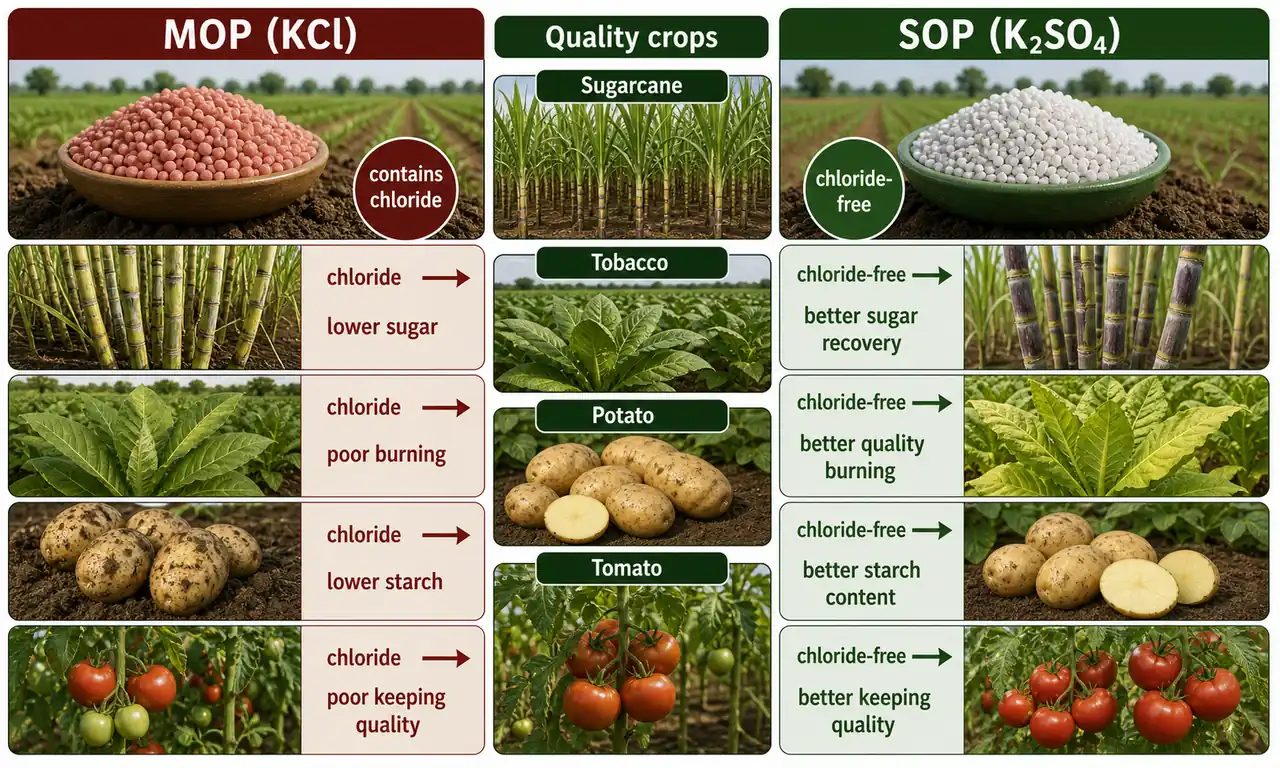
Crop restrictions: Must NOT be used for chloride-sensitive crops:
| Crop | Why Chloride is Harmful |
|---|---|
| Sugarcane, Sugar beet | Reduces sugar accumulation |
| Tobacco | Causes uneven burning, poor quality |
| Potato, Tomato | Reduces starch content in tubers |
| Chloride-Sensitive Crop | Problem with MOP (KCl) | Safer Choice |
|---|---|---|
| Sugarcane / Sugar beet | Chloride reduces sugar accumulation and recovery | SOP or KNO₃ |
| Tobacco | Chloride causes poorer and uneven burning quality | SOP or KNO₃ |
| Potato | Chloride lowers tuber starch quality | SOP or KNO₃ |
| Tomato | Chloride reduces keeping quality and market quality | SOP or KNO₃ |
WARNING
Never use MOP for: sugarcane, sugar beet, tobacco, tomato, and potato. Use K2SO4 (SOP) or KNO3 instead. This is a very commonly tested point.
For cereals (wheat, rice, maize), chloride is not a problem -- most Cl- is retained by straw and not translocated to grain.
b. K2SO4 -- Sulphate of Potash (SOP)
- Contains 48-50% K2O and 17.5% S
- Also known as Sulphate of Potash (SOP)
- Chloride-free -- safe for all crops including chloride-sensitive ones
- Dual-nutrient fertilizer supplying both K and S
- White crystalline salt, freely soluble in water
- Neutral residual effect
- More expensive than MOP -- used selectively for quality crops
Best for:
- Light (sandy) soils where chloride leaches and builds up in root zone
- Quality crops -- fruits, vegetables, cash crops where produce quality affects market price
- Sulphur-deficient soils -- supplies 17.5% S alongside K
Think of a potato farmer in UP: SOP costs more but the higher starch content and better tuber quality more than compensate the extra cost.
c. KNO3 -- Potassium Nitrate
- Contains 44-46% K2O and 13% N
- Also known as saltpetre or nitre
- Chloride-free -- safe for all crops
- Basic residual nature -- suitable for acidic soils
- Dual-nutrient fertilizer (K + N in one application)
- Most expensive among potassic fertilizers
- Equivalent basicity: 29 meq/100g
Best for: Fruit trees, tobacco, vegetables, fertigation, foliar spray programmes
KNO3 is the premium choice for horticulture: a mango farmer using KNO3 through drip irrigation gets both potassium for fruit quality and nitrogen for growth in a single, chloride-free application.
Master Comparison of Potassic Fertilizers
| Property | MOP (KCl) | SOP (K2SO4) | KNO3 |
|---|---|---|---|
| K2O content | 60% (highest) | 48-50% | 44-46% |
| Other nutrient | Cl (47%) | S (17.5%) | N (13%) |
| Contains chloride? | Yes | No | No |
| Cost | Cheapest | Moderate | Most expensive |
| Residual nature | Neutral | Neutral | Basic |
| Sugarcane/sugar beet | Not suitable | Suitable | Suitable |
| Tobacco | Not suitable | Suitable | Suitable |
| Potato/Tomato | Not suitable | Suitable | Suitable |
| Cereals | Suitable | Suitable | Suitable |
| Fertigation/foliar | Not preferred | Good | Excellent |
| Best for | Cereals, general crops | Quality crops, S-deficient soils | Fruits, vegetables, acidic soils |
Potassic Fertilizers - Quick Reference
| Fertilizer | K2O (%) | Other Nutrient | Unsuitable for |
|---|---|---|---|
| KCl (MOP) | 60 | Cl (47%) | Sugar crops, tobacco, potato, tomato |
| K2SO4 (SOP) | 48-50 | 17.5% S | Safe for all crops |
| KNO3 | 44-46 | 13% N | Safe for all crops |
Key points:
- MOP has the highest K2O and is the cheapest
- SOP is the best for quality crops and supplies sulphur
- KNO3 is the only potassic fertilizer with basic reaction
- All three are fully water soluble
Application of Potassic Fertilizers
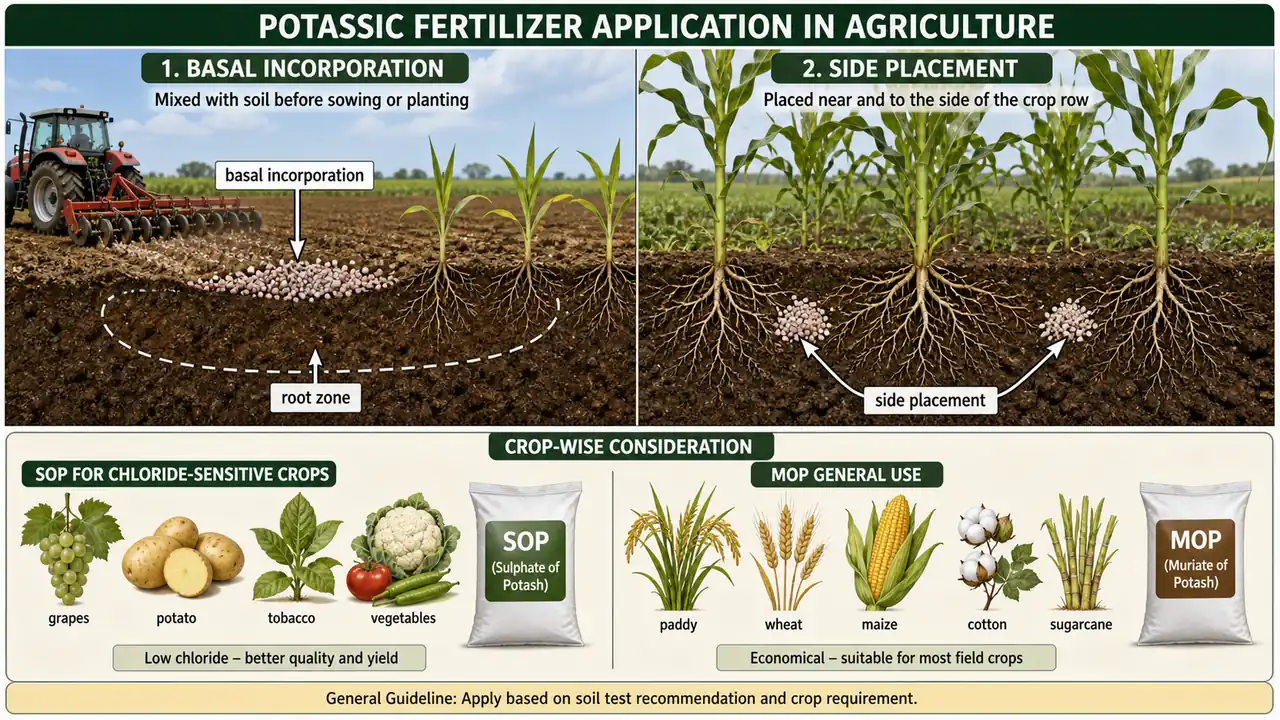
Potassium application in agriculture is simpler than nitrogen because K is relatively stable in soil:
| Aspect | Practice | Reason |
|---|---|---|
| Timing | Basal dressing (before sowing/planting) | K does not leach or volatilize significantly |
| Split application | Generally not needed | K is held on soil colloids (CEC) |
| Exception | Top dressing for vegetables and sandy soils | Sandy soils have low CEC, some leaching possible |
| Advance application | Can be applied well ahead of planting | K remains available in soil |
Unlike nitrogen which must be split-applied to reduce losses, potassium sits on the cation exchange complex of soil colloids and stays available. A single basal dose at planting is usually sufficient.
Potassium Fixation in Soil
Not all applied K remains available. Certain 2:1 type clay minerals can trap potassium:
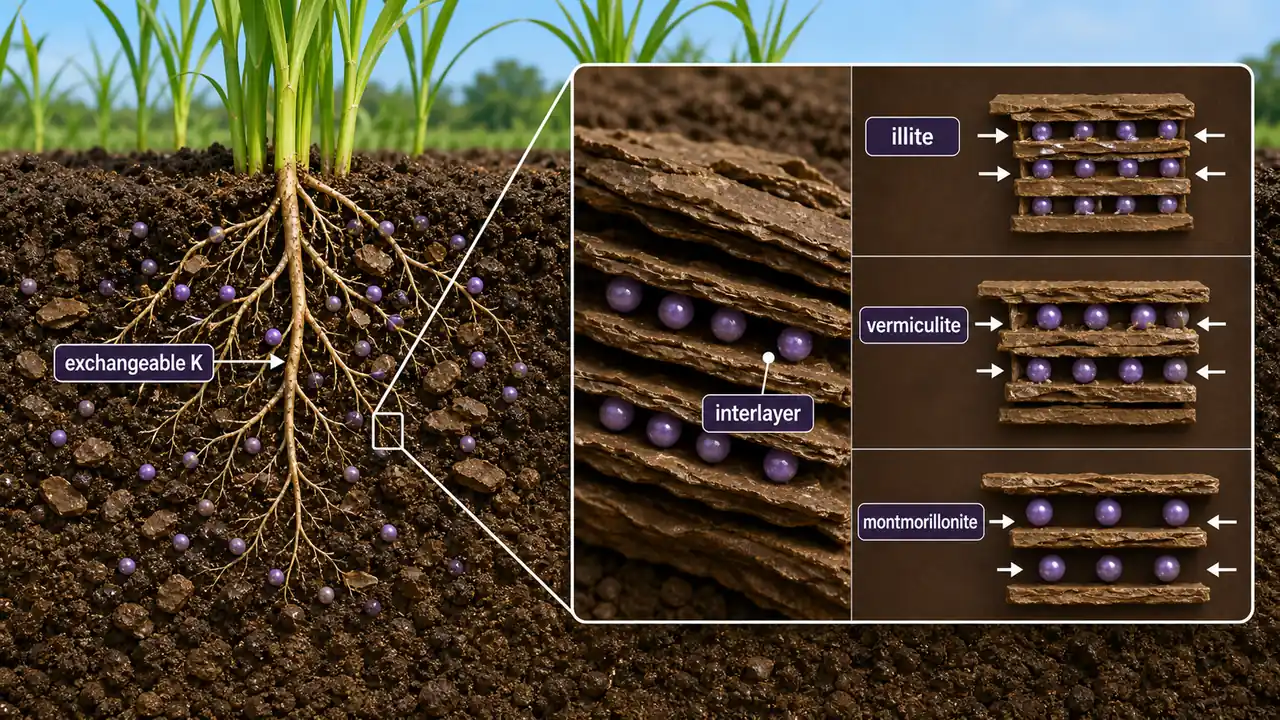
| Clay Mineral | K-Fixation Tendency | Mechanism |
|---|---|---|
| Illite | Highest | Traps K in interlayer spaces |
| Vermiculite | High | Interlayer fixation |
| Montmorillonite | Moderate | Interlayer fixation |
- Fixed K is not lost from soil -- it becomes slowly available over time as clay minerals release it
- Soils rich in illite require higher K fertilizer doses to compensate for fixation
- This is important when planning K application rates for crops like paddy grown on illite-rich soils
Conversion Factors for Potassium
Essential for fertilizer calculations in exams:
| Conversion | Formula | Factor |
|---|---|---|
| Elemental K to oxide form | % K2O = % K x 1.20 | Multiply by 1.20 |
| Oxide form to elemental K | % K = % K2O x 0.83 | Multiply by 0.83 |
TIP
"K to K2O: multiply by 1.20" and "K2O to K: multiply by 0.83". These complement the P conversions (P x 2.29 = P2O5).
Exam Tips and Mnemonics
TIP
"60-50-46" -- K2O content of MOP, SOP, KNO3 (decreasing order)
"MOP = Most K, Most Common, Most Cheap" -- but NOT for quality crops
"5 crops to avoid MOP" -- Sugarcane, Sugar beet, Tobacco, Tomato, Potato (mnemonic: "SS-TTP")
"SOP = Sulphur + Quality" -- best for quality crops and S-deficient soils
"KNO3 = Only Basic K-fertilizer" -- the only one with basic residual nature
"India imports ALL potassic fertilizers" -- zero domestic production
"K to K2O x 1.20; K2O to K x 0.83"
"Illite fixes most K" -- important for K-fertilizer dose planning
"K is stable in soil" -- single basal dose is usually enough (unlike N)
Summary Cheat Sheet
| Concept / Topic | Key Details |
|---|---|
| MOP (KCl) K₂O content | 60% — highest among all potassic fertilizers |
| MOP other name | Muriate of Potash; cheapest and most common K-fertilizer |
| MOP soil suitability | Best for acidic and heavy (clay) soils; NOT for alkaline soils |
| MOP crop restriction (SS-TTP) | NOT for Sugarcane, Sugar beet, Tobacco, Tomato, Potato |
| SOP (K₂SO₄) K₂O content | 48–50% + 17.5% S; chloride-free |
| SOP best use | Quality crops, S-deficient soils, light/sandy soils |
| KNO₃ K₂O content | 44–46% + 13% N; also called saltpetre / nitre |
| KNO₃ residual nature | Only potassic fertilizer with basic reaction; equivalent basicity 29 meq/100g |
| K₂O ranking (descending) | MOP 60 > SOP 48–50 > KNO₃ 44–46 |
| India K production | Zero domestic production — entirely imported |
| Highest K-fertilizer use state | Maharashtra |
| K nutrient antagonism | Heavy K application reduces absorption of Zn and Cu |
| K source minerals | Feldspar (orthoclase), Muscovite, Biotite |
| K application timing | Single basal dressing; no split needed (K held on CEC) |
| K fixation minerals | Illite > Vermiculite > Montmorillonite (2:1 type clays) |
| K fixation mechanism | K⁺ trapped in interlayer spaces of 2:1 clay minerals |
| Cereals and MOP | Safe — Cl⁻ retained by straw, not translocated to grain |
| Fertigation preference | KNO₃ (excellent) > SOP (good) > MOP (not preferred) |
| K → K₂O conversion | Multiply by 1.20 |
| K₂O → K conversion | Multiply by 0.83 |
| All K-fertilizers solubility | Fully water soluble |
| MOP (KCl) K2O content | 60% -- highest among K-fertilizers; Exam tip: Very High |
| SOP (K2SO4) K2O content | 48-50% + 17.5% S; Exam tip: High |
| KNO3 K2O content | 44-46% + 13% N; Exam tip: High |
| KNO3 residual nature | Basic (only basic K-fertilizer); Exam tip: High |
| India K-fertilizer production | Zero -- entirely imported; Exam tip: High |
| K antagonism | Heavy K reduces Zn and Cu absorption; Exam tip: Medium |
| K to K2O conversion | Multiply by 1.20; Exam tip: High |
| K2O to K conversion | Multiply by 0.83; Exam tip: High |