🚶 Phosphatic Fertilizers: Solubility Classes, Key Products, and Soil Suitability
Complete guide to phosphate fertilizers — SSP, DSP, TSP, DAP, MAP, rock phosphate, bone meal, and Bio-super. Covers solubility classification, P2O5 content, conversion factors, and exam-focused comparisons.
Introduction
A wheat farmer in Rajasthan applies DAP at sowing. Within weeks, the crop develops a strong root system and vigorous early growth. Without adequate phosphorus, the roots would remain stunted, tillering would be poor, and flowering would be delayed. Phosphorus is the "root builder" and "energy currency" of the plant -- every cell division, every energy transfer (ATP), and every photosynthetic reaction depends on it.
But here is the challenge: unlike nitrogen, phosphorus does not leach easily. Instead, it gets fixed in the soil -- locked up in insoluble iron, aluminium, or calcium compounds that plants cannot access. The choice of phosphatic fertilizer depends heavily on soil pH and how quickly you need the phosphorus to become available.
The Solubility Principle
The single most important concept for phosphatic fertilizers is solubility. It determines:
- How quickly phosphorus becomes available to plants
- Which soil types the fertilizer suits best
- Whether to apply as a single dose or in splits
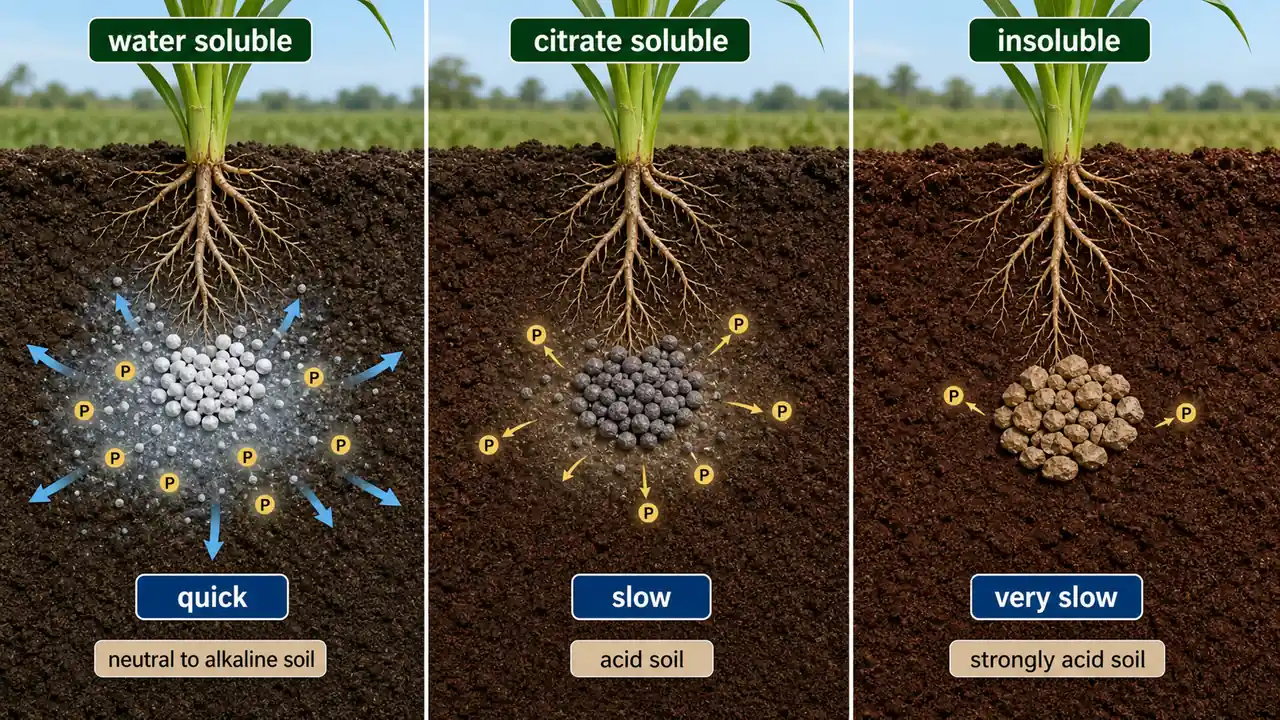
| Solubility Class | Chemical Form | Speed of Availability | Best Soil Type |
|---|---|---|---|
| Water soluble | Ca(H2PO4)2 (Monocalcium phosphate) | Fast (immediate) | Neutral and alkaline soils |
| Citrate soluble | Ca2(HPO4)2 (Dicalcium phosphate) | Slow (weeks-months) | Acid soils |
| Citrate and water insoluble | Ca3(PO4)2 (Tricalcium phosphate) | Very slow (months-years) | Strongly acid soils |
TIP
Pro Content Locked
Upgrade to Pro to access this lesson and all other premium content.
Charged once for one year · ₹1188 total
Save ₹100/month vs ₹2388/year launch price
- All Agriculture & Banking Courses
- AI Lesson Questions (100/day)
- AI Doubt Solver (50/day)
- Glows & Grows Feedback (30/day)
- AI Section Quiz (20/day)
- 22-Language Translation (100/day)
- Recall Questions (20/day)
- AI Quiz (15/day)
- AI Quiz Paper Analysis (100/day)
- AI Step-by-Step Explanations (100/day)
- Spaced Repetition Recall (FSRS)
- AI Tutor
- Immersive Text Questions
- Audio Lessons — Hindi & English
- Mock Tests & Previous Year Papers
- Summary & Mind Maps
- XP, Levels, Leaderboard & Badges
- Generate New Classrooms
- Voice AI Teacher (AgriDots Live)
- AI Revision Assistant
- Knowledge Gap Analysis
- Interactive Revision (LangGraph)
🔒 Secure one-time yearly payment via Razorpay · No hidden fees
Introduction
A wheat farmer in Rajasthan applies DAP at sowing. Within weeks, the crop develops a strong root system and vigorous early growth. Without adequate phosphorus, the roots would remain stunted, tillering would be poor, and flowering would be delayed. Phosphorus is the "root builder" and "energy currency" of the plant -- every cell division, every energy transfer (ATP), and every photosynthetic reaction depends on it.
But here is the challenge: unlike nitrogen, phosphorus does not leach easily. Instead, it gets fixed in the soil -- locked up in insoluble iron, aluminium, or calcium compounds that plants cannot access. The choice of phosphatic fertilizer depends heavily on soil pH and how quickly you need the phosphorus to become available.
The Solubility Principle
The single most important concept for phosphatic fertilizers is solubility. It determines:
- How quickly phosphorus becomes available to plants
- Which soil types the fertilizer suits best
- Whether to apply as a single dose or in splits
| Solubility Class | Chemical Form | Speed of Availability | Best Soil Type |
|---|---|---|---|
| Water soluble | Ca(H2PO4)2 (Monocalcium phosphate) | Fast (immediate) | Neutral and alkaline soils |
| Citrate soluble | Ca2(HPO4)2 (Dicalcium phosphate) | Slow (weeks-months) | Acid soils |
| Citrate and water insoluble | Ca3(PO4)2 (Tricalcium phosphate) | Very slow (months-years) | Strongly acid soils |
TIP
Mnemonic -- "WCA" (Water-Citrate-Acid):
- Water soluble = quick start, neutral/alkaline soils (SSP, DSP, TSP, DAP, MAP)
- Citrate soluble = slow release, acid soils (DCP, Basic slag)
- Acid-only soluble = very slow, strongly acid soils (Rock phosphate, Bone meal)
Water Soluble Phosphatic Fertilizers
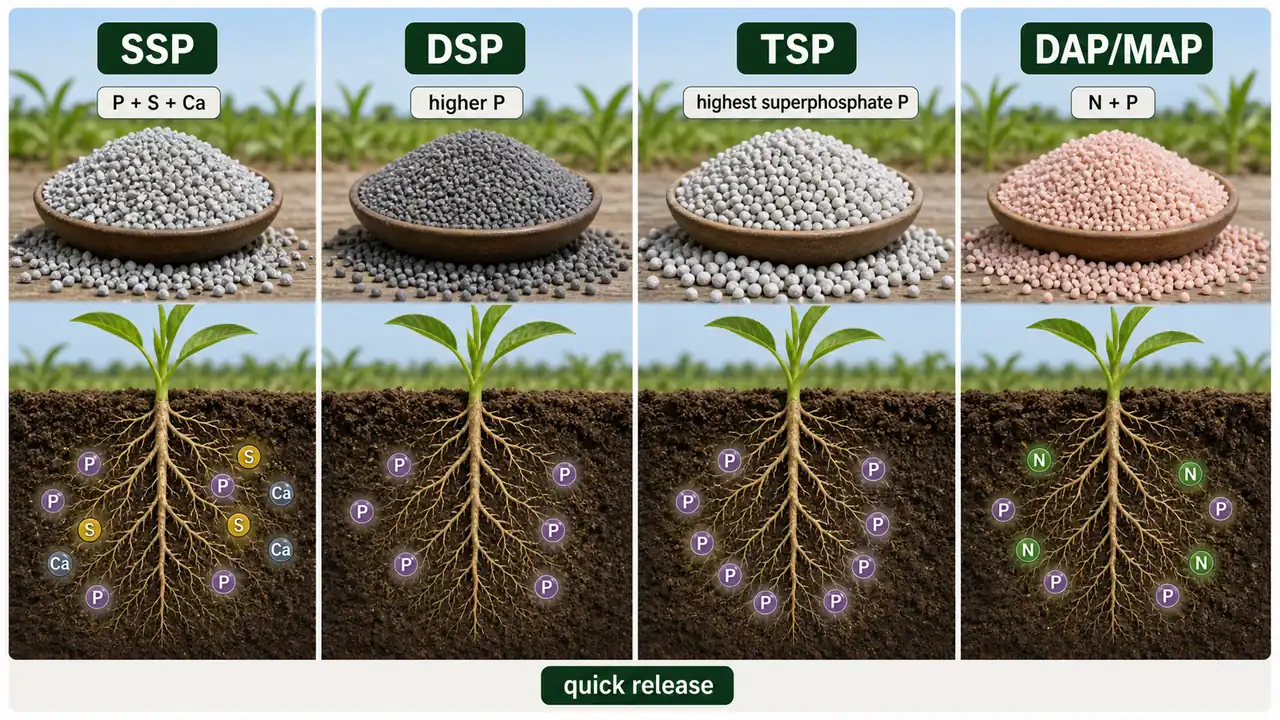
In alkaline or acidic soils, the dissolved phosphorus eventually forms calcium phosphate, iron phosphate, or aluminium phosphate (phosphorus fixation). Because of this fixation, the entire dose is applied as a single basal application at or before sowing -- no split application needed.
SSP (Single Super Phosphate) -- India's First Manufactured Fertilizer
- Contains 16% P2O5, 12% S, 19% Ca
- The first manufactured fertilizer in India
- A low analysis fertilizer (< 25% primary nutrient) but supplies three nutrients -- P, S, and Ca
- Prepared by treating rock phosphate with equal amount of H2SO4
- Product is a mixture of monocalcium phosphate and calcium sulphate (gypsum)
- Suitable for all crops and all soils -- the most versatile P-fertilizer
IMPORTANT
SSP supplies P + S + Ca in one product. For sulphur-deficient soils (common in Indian agriculture), SSP is often preferred over DAP despite its lower P content, because DAP provides no sulphur.
Quality standards: Moisture: 12% max; Free H3PO4: 4% max; Water-soluble P2O5: 16% min.
Think of the sugarcane farmer who needs both phosphorus and sulphur -- SSP is the ideal single-product solution.
DSP (Double Super Phosphate)
- Contains 32% P2O5 (double the P of SSP)
- Does not contain gypsum (unlike SSP)
- Prepared by treating rock phosphate with a mixture of H2SO4 and H3PO4
TSP (Triple Super Phosphate)
- Contains 46-48% P2O5 -- highest P content among superphosphate fertilizers
- Produced by treating rock phosphate with H3PO4 (phosphoric acid, not sulphuric acid)
- Does not contain sulphur -- supplement separately in S-deficient soils
- Chemical formula: Ca(H2PO4)2.H2O
TIP
P2O5 content doubles at each step: SSP (16%) -> DSP (32%) -> TSP (46-48%). Each is roughly double the previous.
DAP (Diammonium Phosphate) -- India's Most Popular Complex Fertilizer
- Contains 18% N and 46% P2O5 (Grade: 18:46:0)
- The most widely used complex fertilizer in India
- High analysis fertilizer (> 25% primary nutrient)
- Chemical formula: (NH4)2HPO4
- Alkaline in initial reaction but becomes acidic over time as ammonium is nitrified
- Equivalent acidity: 77 meq/100g
DAP is the default choice for Indian farmers at sowing -- one bag provides both nitrogen and phosphorus for early crop establishment. A rice farmer drilling DAP at transplanting gives the seedlings a strong start with immediate N and P supply.
MAP (Mono Ammonium Phosphate)
- Contains 12% N and 48% P2O5 (Grade: 12:48:0; some sources: 11:52:0)
- Highest P2O5 among ammonium phosphate fertilizers
- Slightly acidic -- particularly suitable for alkaline soils
- Chemical formula: NH4H2PO4
- Fully water soluble -- ideal for fertigation and drip irrigation
Citrate Soluble Phosphatic Fertilizers
These are not water soluble but dissolve in weak acids (like citric acid produced by plant roots). They release phosphorus slowly over an extended period -- ideal for acid soils and long-duration crops like sugarcane, lowland rice, tapioca, and tea.
DCP (Dicalcium Phosphate)
- Contains 34-40% P2O5
- Prepared by neutralizing phosphoric acid with lime
- Equally suitable for acidic, neutral, and alkaline soils (near-neutral reaction)
- Especially useful for acidic soils where it does not form insoluble compounds
Basic Slag
- Contains 14-18% P2O5
- By-product of the steel industry
- Also supplies calcium, magnesium, and micronutrients (iron, manganese)
- Useful for acid soils (basic reaction helps correct acidity)
Rhenania Phosphate
- Contains 23-26% P2O5
Citrate and Water Insoluble Phosphatic Fertilizers
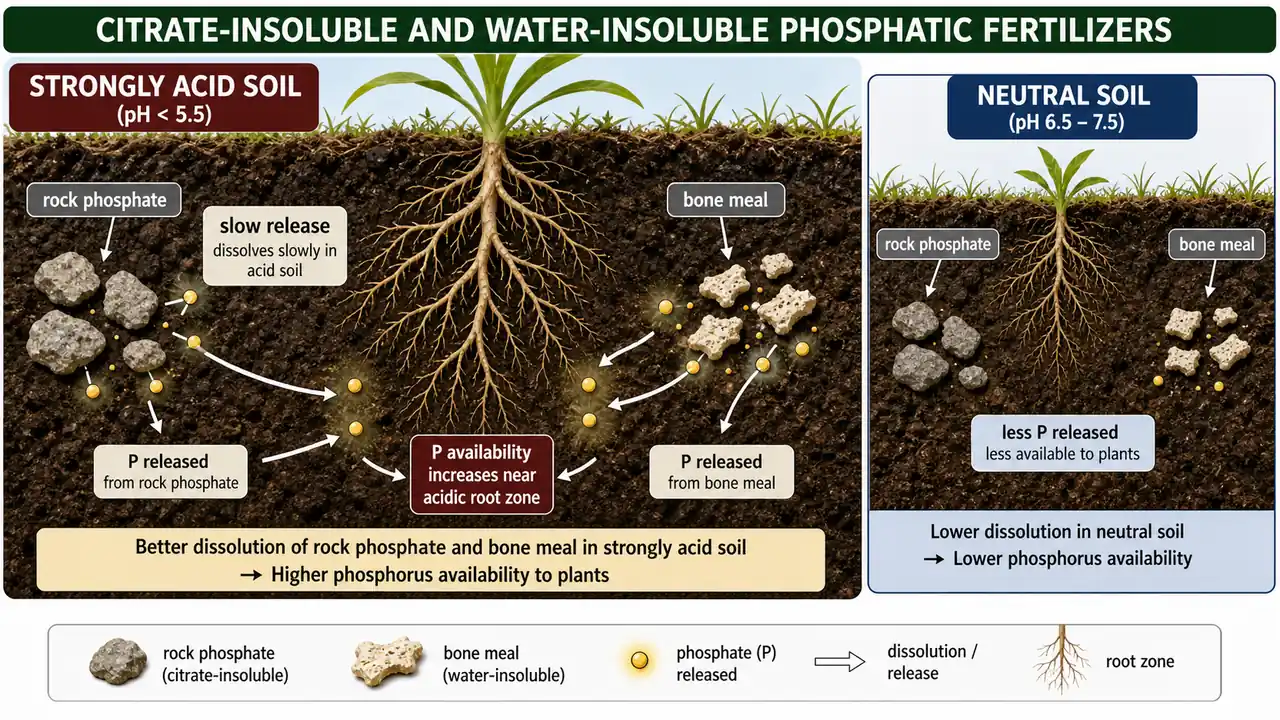
These are the least soluble category. They release phosphorus very slowly and are effective only in strongly acidic soils where the low pH gradually dissolves the phosphate. Best for plantation crops with long growing periods.
Rock Phosphate
- Contains 20-30% P2O5
- A natural mineral -- the raw material for manufacturing most phosphatic fertilizers
- Used for acidic soil reclamation
- Applied directly to strongly acidic soils for long-term P supply
TIP
Rock phosphate is both a fertilizer (for acid soils) and the raw material for SSP, DSP, TSP, and DAP manufacturing. Its direct use is limited to strongly acid soils (pH < 5.5).
Bone Meal
| Type | P2O5 (%) | N (%) | Key Feature |
|---|---|---|---|
| Raw bone meal | 20-25 | 3-4 | Organic P source; best for acid soils |
| Steamed bone meal | 25-30 | 1-2 | Steaming removes fat, increases P concentration |
Both are citrate and water insoluble and work best in acid soils.
Master Comparison Table of Phosphatic Fertilizers
| Fertilizer | P2O5 (%) | Other Nutrients | Solubility | Preparation | Best For |
|---|---|---|---|---|---|
| MAP | 48 | 12% N | Water soluble | NH3 + H3PO4 | Alkaline soils, fertigation |
| TSP | 46-48 | - | Water soluble | Rock phosphate + H3PO4 | Neutral/alkaline soils |
| DAP | 46 | 18% N | Water soluble | NH3 + H3PO4 | All soils (most widely used) |
| DCP | 34-40 | Ca | Citrate soluble | H3PO4 + Lime | Acid soils |
| DSP | 32 | - | Water soluble | Rock phosphate + H2SO4 + H3PO4 | Neutral/alkaline soils |
| Rock phosphate | 20-30 | Ca | Insoluble | Natural mineral | Strongly acid soils |
| Steamed bone meal | 25-30 | 1-2% N | Insoluble | Steaming of bones | Acid soils |
| Raw bone meal | 20-25 | 3-4% N | Insoluble | Ground animal bones | Acid soils |
| SSP | 16 | 12% S, 19% Ca | Water soluble | Rock phosphate + H2SO4 | All soils (also supplies S, Ca) |
| Basic slag | 14-18 | Ca, Mg, Fe, Mn | Citrate soluble | Steel industry by-product | Acid soils |
Bio-super: A Biological Approach
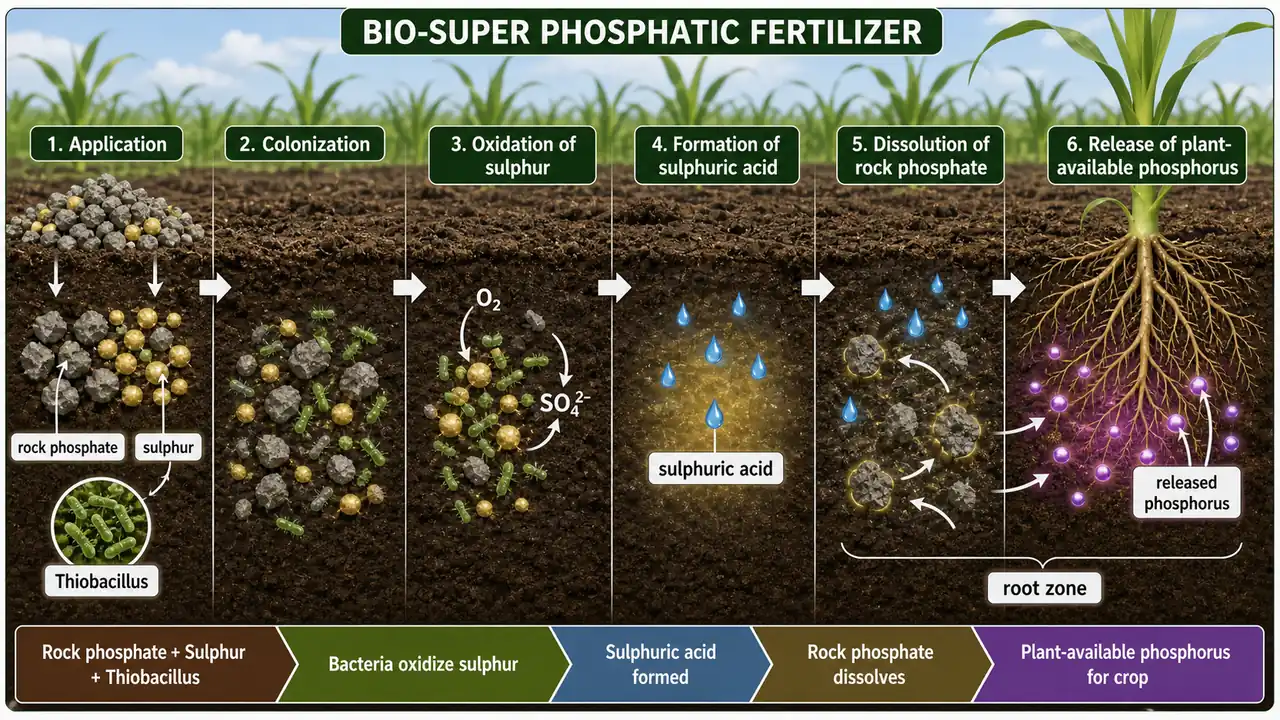
| Bio-super Step | What Happens | Why It Matters |
|---|---|---|
| Starting mixture | Rock phosphate is mixed with sulphur and Thiobacillus | Combines a poorly soluble P source with a biological acid-producing system |
| Biological oxidation | Thiobacillus oxidizes sulphur | Generates the chemistry needed to unlock phosphorus |
| Acid formation | Sulphur oxidation produces sulphuric acid | The acid dissolves otherwise slow-release rock phosphate |
| P release in root zone | Dissolved phosphate becomes available near crop roots | Converts a slow natural mineral into a more usable phosphorus source over time |
- Used mainly in Australia
- Bio-super = Rock phosphate + Sulphur + S-oxidizing bacteria (Thiobacillus)
- Bacteria oxidize sulphur to produce sulphuric acid, which dissolves rock phosphate
- Slowly releases plant-available phosphorus through combined biological and chemical processes
Conversion Factors for Phosphorus
These are essential for fertilizer calculations and exam questions:
| Conversion | Formula | Factor |
|---|---|---|
| Elemental P to oxide form | % P2O5 = % P x 2.29 | Multiply by 2.29 |
| Oxide form to elemental P | % P = % P2O5 x 0.43 | Multiply by 0.43 |
TIP
"P to P2O5: multiply by 2.29" and "P2O5 to P: multiply by 0.43". Remember: 0.43 is roughly the inverse of 2.29 (1/2.29 = 0.437).
Phosphatic Fertilizers - P2O5 Content Quick Reference
| Fertilizer | P2O5 (%) | Solubility | Best for |
|---|---|---|---|
| MAP | 48 | Water soluble | Alkaline soils, fertigation |
| TSP | 46-48 | Water soluble | Neutral/alkaline soils |
| DAP | 46 | Water soluble | All soils (most widely used) |
| DCP | 34-40 | Citrate soluble | Acid soils |
| DSP | 32 | Water soluble | Neutral/alkaline soils |
| Rock phosphate | 20-30 | Insoluble | Strongly acid soils |
| SSP | 16 | Water soluble | All soils (also supplies S and Ca) |
| Basic slag | 14-18 | Citrate soluble | Acid soils |
Highest P2O5: MAP (48%) and TSP (46-48%). Most widely used: DAP. First manufactured in India: SSP.
Exam Tips and Mnemonics
TIP
"16-32-48" -- SSP, DSP, TSP P2O5 content (each doubles)
"DAP = 18:46:0 = Most used complex fertilizer" -- the single most tested fact
"SSP = 3 nutrients in 1" -- P (16%) + S (12%) + Ca (19%)
"SSP = India's first manufactured fertilizer"
"WCA" for solubility: Water soluble (neutral/alkaline), Citrate soluble (acid), Acid-only (strongly acid)
"Rock phosphate for acid soil reclamation"
"MAP for fertigation" -- fully water soluble, highest P among ammonium phosphates
Conversion: P x 2.29 = P2O5; P2O5 x 0.43 = P
Summary Cheat Sheet
| Concept / Topic | Key Details |
|---|---|
| SSP (Single Super Phosphate) | 16% P₂O₅, 12% S, 19% Ca; first manufactured fertilizer in India |
| SSP preparation | Rock phosphate + H₂SO₄ → monocalcium phosphate + gypsum |
| DSP (Double Super Phosphate) | 32% P₂O₅; no gypsum; rock phosphate + H₂SO₄ + H₃PO₄ |
| TSP (Triple Super Phosphate) | 46–48% P₂O₅ — highest among superphosphates; rock phosphate + H₃PO₄ |
| P₂O₅ doubling pattern | SSP 16 → DSP 32 → TSP 46–48 |
| DAP grade & significance | 18:46:0 (18% N, 46% P₂O₅); most widely used complex fertilizer in India |
| DAP reaction | Initially alkaline, becomes acidic over time; equivalent acidity 77 meq/100g |
| MAP grade | 12:48:0; highest P₂O₅ among ammonium phosphates; fully water soluble |
| MAP best use | Fertigation, drip irrigation, alkaline soils |
| Water soluble P-fertilizers | SSP, DSP, TSP, DAP, MAP → best for neutral/alkaline soils; fast acting |
| Citrate soluble P-fertilizers | DCP (34–40% P₂O₅), Basic slag (14–18%), Rhenania (23–26%) → acid soils |
| Insoluble P-fertilizers | Rock phosphate (20–30%), Bone meal (20–30%) → strongly acid soils |
| Rock phosphate | Natural mineral; raw material for SSP/DSP/TSP/DAP; used for acid soil reclamation |
| Bone meal (raw vs steamed) | Raw: 20–25% P₂O₅, 3–4% N; Steamed: 25–30% P₂O₅, 1–2% N |
| Basic slag | Steel industry by-product; 14–18% P₂O₅; supplies Ca, Mg, Fe, Mn |
| Bio-super | Rock phosphate + S + Thiobacillus; used in Australia |
| DCP (Dicalcium Phosphate) | 34–40% P₂O₅; citrate soluble; suits acidic, neutral, and alkaline soils |
| Solubility mnemonic (WCA) | Water = neutral/alkaline; Citrate = acid; Acid-only = strongly acid |
| P application method | Single basal dose (no split); P gets fixed so place near roots |
| P → P₂O₅ conversion | Multiply by 2.29 |
| P₂O₅ → P conversion | Multiply by 0.43 |
| SSP advantage over DAP | SSP supplies S and Ca alongside P; DAP provides no sulphur |
| SSP P2O5 content | 16%; also 12% S and 19% Ca; Exam tip: Very High |
| SSP significance | First manufactured fertilizer in India; Exam tip: High |
| DSP P2O5 content | 32% (no gypsum); Exam tip: Medium |
| TSP P2O5 content | 46-48% (highest among superphosphates); Exam tip: High |
| DAP equivalent acidity | 77 meq/100g; Exam tip: Medium |
| MAP suitability | Alkaline soils, fertigation, drip irrigation; Exam tip: Medium |
| DCP P2O5 content | 34-40%; citrate soluble; all soil types; Exam tip: Medium |
| Raw bone meal | 20-25% P2O5; organic; acid soils; Exam tip: Medium |
| P to P2O5 conversion | Multiply by 2.29; Exam tip: High |
| P2O5 to P conversion | Multiply by 0.43; Exam tip: High |