🚶 Nitrogenous Fertilizers: Forms, Properties, and Slow-Release Technologies
Complete guide to nitrogen fertilizers — nitrate, ammoniacal, amide forms, urea, CAN, neem-coated urea, nitrification inhibitors, and slow-release fertilizers. Covers N content, equivalent acidity, and exam-focused comparisons.
Introduction
A paddy farmer in Uttar Pradesh applies urea to his crop but finds that much of the nitrogen is lost -- some evaporates as ammonia gas, some leaches below the root zone, and some escapes as N2 gas through denitrification. Only 30-40% of applied nitrogen actually reaches the plant. Understanding which form of nitrogen to use, when to apply it, and how to reduce losses is the difference between a profitable harvest and a costly failure.
Sources of Nitrogen in Nature
| Source | Contribution |
|---|---|
| Atmosphere | Ultimate source (78% N2 by volume, but plants cannot use it directly) |
| Soil organic matter | Main immediate source |
| Symbiotic organisms | 300-350 kg N/year/acre |
| Non-symbiotic bacteria | 50-55 kg N/year/acre |
| Rainwater | 10-12 kg N/year/acre |
| Mineral deposits | Chile saltpeter (NaNO3) in Chile, Peru, Bolivia; Niter (KNO3) in Spain, Egypt, India |
| Industrial processes | Arc process, Cyanamid process, Direct synthetic ammonia (Haber-Bosch) |
Maximum consumption of N and P is in the state of Uttar Pradesh.
Pro Content Locked
Upgrade to Pro to access this lesson and all other premium content.
Charged once for one year · ₹1188 total
Save ₹100/month vs ₹2388/year launch price
- All Agriculture & Banking Courses
- AI Lesson Questions (100/day)
- AI Doubt Solver (50/day)
- Glows & Grows Feedback (30/day)
- AI Section Quiz (20/day)
- 22-Language Translation (100/day)
- Recall Questions (20/day)
- AI Quiz (15/day)
- AI Quiz Paper Analysis (100/day)
- AI Step-by-Step Explanations (100/day)
- Spaced Repetition Recall (FSRS)
- AI Tutor
- Immersive Text Questions
- Audio Lessons — Hindi & English
- Mock Tests & Previous Year Papers
- Summary & Mind Maps
- XP, Levels, Leaderboard & Badges
- Generate New Classrooms
- Voice AI Teacher (AgriDots Live)
- AI Revision Assistant
- Knowledge Gap Analysis
- Interactive Revision (LangGraph)
🔒 Secure one-time yearly payment via Razorpay · No hidden fees
Introduction
A paddy farmer in Uttar Pradesh applies urea to his crop but finds that much of the nitrogen is lost -- some evaporates as ammonia gas, some leaches below the root zone, and some escapes as N2 gas through denitrification. Only 30-40% of applied nitrogen actually reaches the plant. Understanding which form of nitrogen to use, when to apply it, and how to reduce losses is the difference between a profitable harvest and a costly failure.
Sources of Nitrogen in Nature
| Source | Contribution |
|---|---|
| Atmosphere | Ultimate source (78% N2 by volume, but plants cannot use it directly) |
| Soil organic matter | Main immediate source |
| Symbiotic organisms | 300-350 kg N/year/acre |
| Non-symbiotic bacteria | 50-55 kg N/year/acre |
| Rainwater | 10-12 kg N/year/acre |
| Mineral deposits | Chile saltpeter (NaNO3) in Chile, Peru, Bolivia; Niter (KNO3) in Spain, Egypt, India |
| Industrial processes | Arc process, Cyanamid process, Direct synthetic ammonia (Haber-Bosch) |
Maximum consumption of N and P is in the state of Uttar Pradesh.
Basic Classification of Fertilizers
Before studying nitrogen fertilizers specifically, understand the general fertilizer categories:
| Type | Definition | Example |
|---|---|---|
| Straight fertilizer | Supplies only one primary nutrient | Urea (N), KCl (K), Ammonium sulphate (N) |
| Complex fertilizer | Supplies two or more nutrients (chemically combined) | DAP (N+P), Nitro phosphates, Ammonium phosphate |
| Mixed fertilizer | Physical mixing of two or more fertilizers | NPK mixtures |
| Complete fertilizer | Contains all three primary nutrients (N, P, K) | NPK grades |
| Low analysis | Less than 25% total primary nutrient | SSP (16% P2O5) |
| High analysis | More than 25% total primary nutrient | Urea (46% N), DAP (64% N+P) |
Classification of Nitrogen Fertilizers
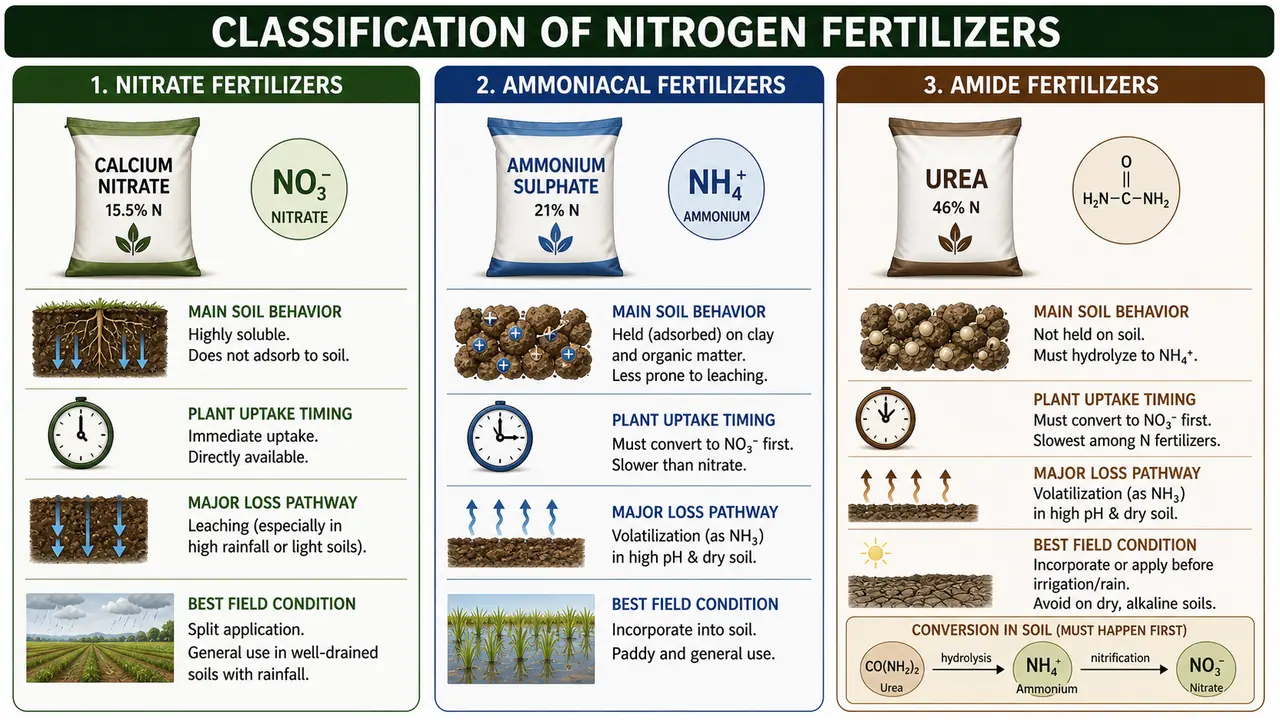
Nitrogen fertilizers are classified by the chemical form of nitrogen present. Each form behaves differently in soil.
Quick Comparison: Forms of Nitrogen in Fertilizers
| Property | Nitrate (NO3-) | Ammoniacal (NH4+) | Amide (-NH2) |
|---|---|---|---|
| Soil mobility | Highly mobile (not held by soil colloids) | Low mobility (adsorbed on clay) | Must convert first |
| Plant absorption | Immediate (most crops absorb NO3-) | Direct by rice and potato only | After 2-step conversion |
| Residual nature | Basic | Acidic | Urea: Acidic; CaCN: Basic |
| Main loss | Leaching, denitrification | Volatilization | Volatilization |
| Best for | Dry/well-drained soils, top dressing | Waterlogged soils (paddy) | General use (urea) |
| Conversion path | Already plant-available | NH4+ -> NO3- (nitrification) | Amide -> NH4+ -> NO3- |
NOTE
Quick rule: Nitrate fertilizers = basic. Ammoniacal/Amide fertilizers = acidic. CAN = the only neutral N-fertilizer.
Nitrate Fertilizers
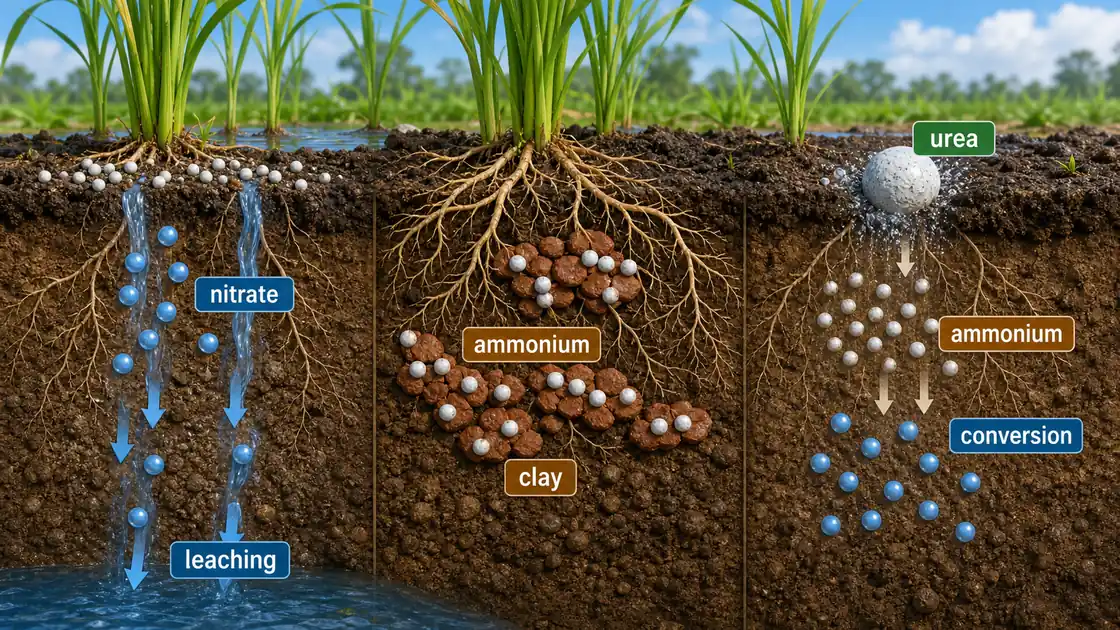
Nitrate fertilizers contain nitrogen as NO3-. The nitrate ion is negatively charged, so it is not held by negatively charged soil colloids -- making it highly mobile and prone to leaching.
Key properties:
- Readily available to plants (no conversion needed)
- Suitable for top dressing and dry soils
- Basic residual nature
- Losses: Leaching in wet soils, denitrification in waterlogged soils
Nitrate Fertilizer Examples
| Fertilizer | N Content | Key Feature |
|---|---|---|
| Sodium Nitrate (NaNO3) | 16% N | Pioneer nitrogenous fertilizer (Chilean nitrate); basic; useful for acidic soils; continuous use causes deflocculation (soil structure breakdown) in low-rainfall areas |
| Calcium Nitrate (Ca(NO3)2) | 15.5% N | Basic; supplies calcium |
| Potassium Nitrate (KNO3) | 13% N, 44-46% K2O | Dual-nutrient fertilizer (N + K); basic |
Ammoniacal Fertilizers
Ammoniacal fertilizers contain nitrogen as NH4+. The ammonium ion is positively charged, so it is adsorbed on clay colloids -- reducing leaching.
Key properties:
- Less leaching than nitrate (held by soil colloids)
- Best for waterlogged soils (NH4+ is stable under anaerobic conditions)
- Acidic residual nature
- Losses: Volatilization (especially on alkaline soils), denitrification after nitrification
- Except rice and potato, crops absorb N mainly as nitrate -- so NH4+ must first be converted
a. Ammonium Sulphate ((NH4)2SO4)

- Contains 20.6% N and 24.5% Sulphur (highest S content among N-fertilizers) UPPSC 2021
- Best N-fertilizer for paddy and waterlogged soils (NH4+ stays stable under anaerobic conditions)
- Also suited for tea, jute, groundnut, sugarcane
- White crystalline salt, hygroscopic, very soluble -- quick-acting fertilizer
- Continuous use depletes soil calcium and increases acidity (needs periodic liming)
- Equivalent acidity: 110 meq/100g
Think of ammonium sulphate as the "rice farmer's friend" -- ideal for waterlogged paddy fields where nitrate fertilizers would be lost through denitrification.
Other important ammoniacal sources include ammonium chloride, anhydrous ammonia, and aqueous ammonia. These are usually compared for nitrogen percentage, acidity, and suitability under different field conditions.
b. Ammonium Chloride (NH4Cl)

- Contains 25.5% N (some sources: 26%)
- Extensively used for paddy in Japan
- Not recommended for: tomatoes, tobacco (chloride harms quality)
- Cereals are unaffected -- Cl- is mostly retained by straw, not translocated to grain
- For potato and sweet potato, use K2SO4 or KNO3 instead (avoid high chloride)
- Equivalent acidity: 128 meq/100g
c. Anhydrous Ammonia (NH3)

- Contains 82% N -- the highest nitrogen content among all fertilizers
- Liquid under pressure; used as fertigation (applied through irrigation water)
- Equivalent acidity: 148 meq/100g (highest among all N-fertilizers)
d. Aqueous Ammonia
- Contains 80% N; used as fertigation
- Most concentrated liquid nitrogen form
Ammonium + Nitrate Fertilizers
These provide both forms of nitrogen: NO3- for immediate uptake and NH4+ for sustained supply.
(i) Ammonium Nitrate (NH4NO3)

- Contains 33% N (16.5% as NH4+ + 16.5% as NO3-)
- Most hygroscopic among all fertilizers (absorbs moisture rapidly from air)
- Explosive -- requires careful storage and strict regulations Exams
- Equivalent acidity: 60 meq/100g
(ii) Calcium Ammonium Nitrate (CAN) -- "Kishan Khad"

- Contains 26% N (half ammoniacal form) Exams
- Neutral in reaction -- does not change soil pH (suitable for all soil types)
- Most suitable for vegetables
- Made from ammonium nitrate + ground limestone (safer than pure ammonium nitrate, also supplies calcium)
- Standards: moisture < 1% by weight, calcium nitrate < 0.5% by weight
TIP
CAN = "Kishan Khad" = Neutral = Best for vegetables. It is the only neutral N-fertilizer -- a favourite exam question.
(iii) Ammonium Sulphate Nitrate
- Contains 25.6% N (NH4+: 19.5%, NO3-: 6.6%)
- Provides both immediate and sustained nitrogen supply
Amide Fertilizers
Amide fertilizers are organic in form. Nitrogen must undergo a two-step conversion in soil before plants can use it:
Amide -> (NH4)2CO3 (ammoniacal form) -> NO3- (nitrate form)
Urea (NH2CONH2) -- India's Most Important Fertilizer

- Most commonly used fertilizer in India (high N, low cost per unit N, government subsidy)
- Cheapest source of nitrogen
- Contains 46% N -- highest N among solid fertilizers
- Hygroscopic -- produced in granular/pellet form coated with inert material
- Acidic in residual effect; continuous use reduces soil pH
Quality standards:
- Maximum moisture: 1% by weight
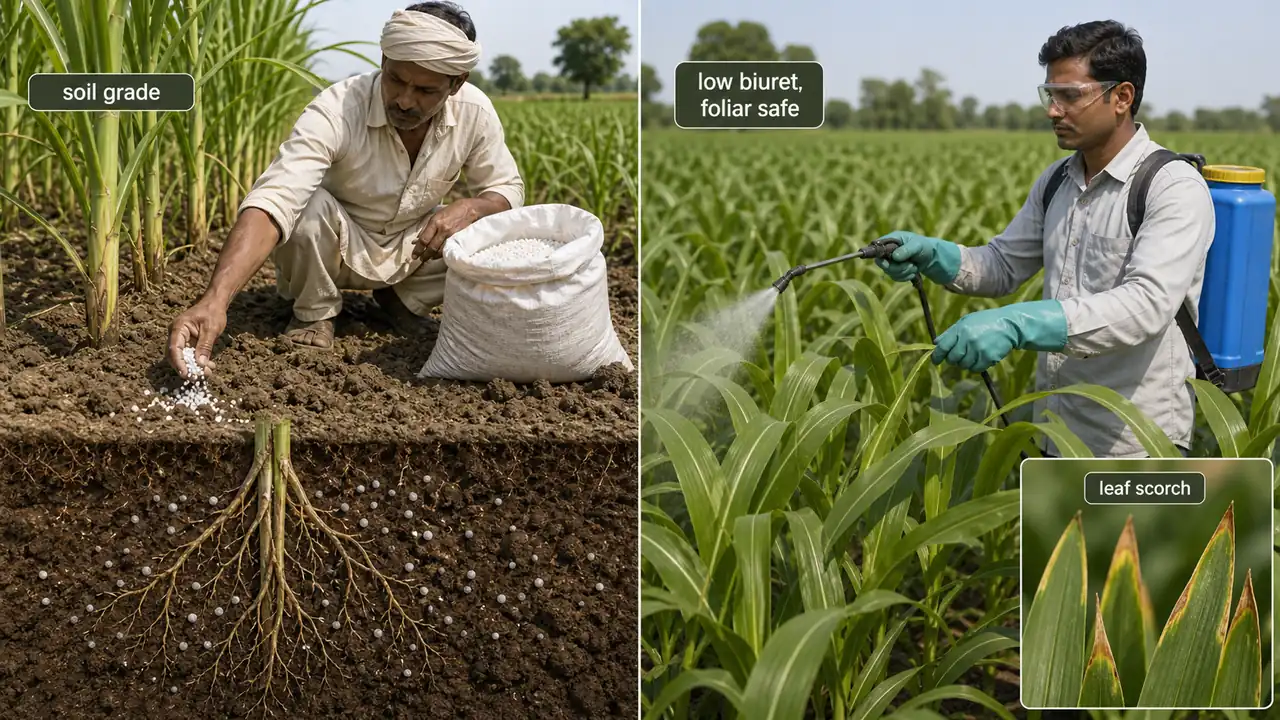
- Biuret content: < 1.5% (biuret forms above 150 degree C during manufacturing and is toxic to plants above 2%)
- For foliar spray, biuret must not exceed 0.25% (higher levels cause leaf burn)
- General foliar spray concentration: 2% (range 2-6%)
Soil conversion: Urea is hydrolysed by the enzyme urease to form ammonium carbamate, which then converts to nitrate. The entire process takes 4-7 days. Apply urea 3-4 days before sowing to allow conversion.
- Equivalent acidity: 80 meq/100g
Neem Coated Urea (NCU)
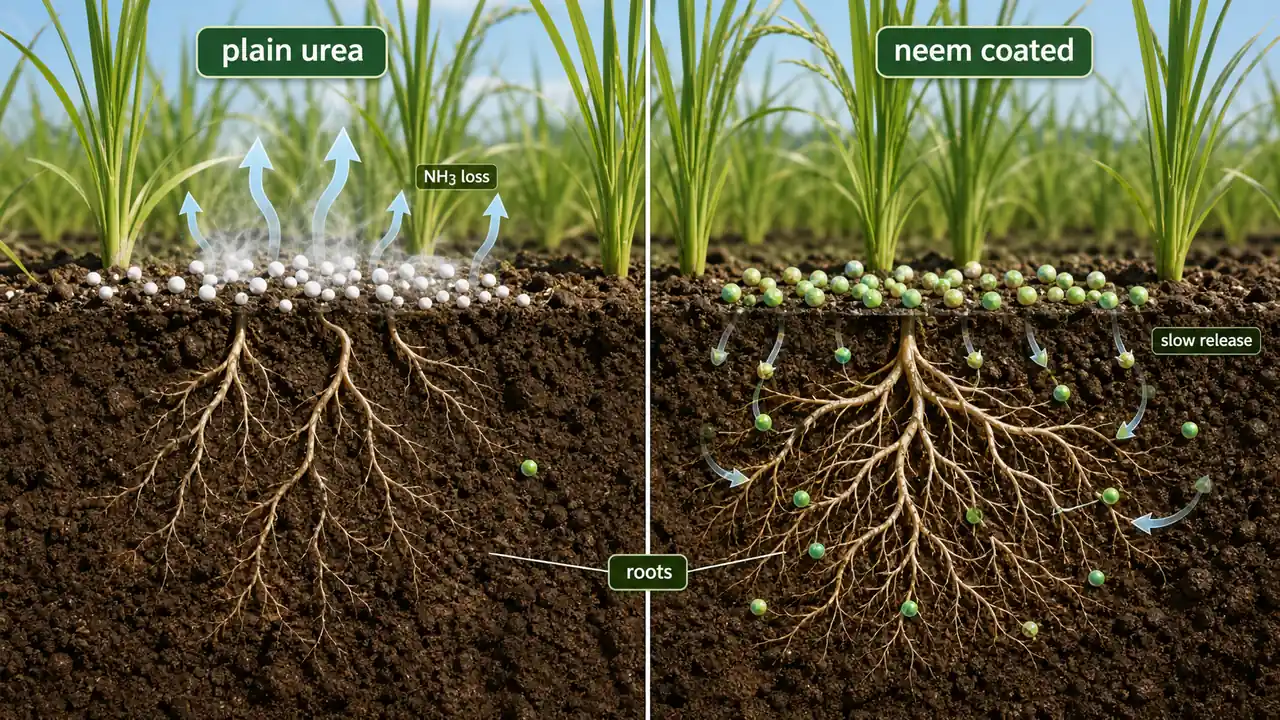
- Urea coated with neem oil -- acts as a natural nitrification inhibitor
- Azadirachtin content: 150 PPM
- Slow-release properties increase nitrogen use efficiency (NUE)
- Only 30-40% of urea-N is utilized by plants; neem coating reduces losses
IMPORTANT
The Government of India mandated 100% neem coating of domestically produced urea (from January 2015). The primary motive was to prevent illegal diversion of subsidized urea for industrial use -- neem-coated urea is unfit for industrial purposes.
Besides urea, calcium cyanamide is another important amide fertilizer, but its field behavior is very different and much more restrictive.
Calcium Cyanamide (CaCN2)
- Contains 21% N
- Basic in reaction (one of the few basic N-fertilizers)
- Intermediary decomposition products injure seedlings -- apply at least a week before sowing
- Produces lime during decomposition -- valuable for acid soils
- Neither imported nor manufactured in India
Equivalent Acidity and Basicity of Fertilizers
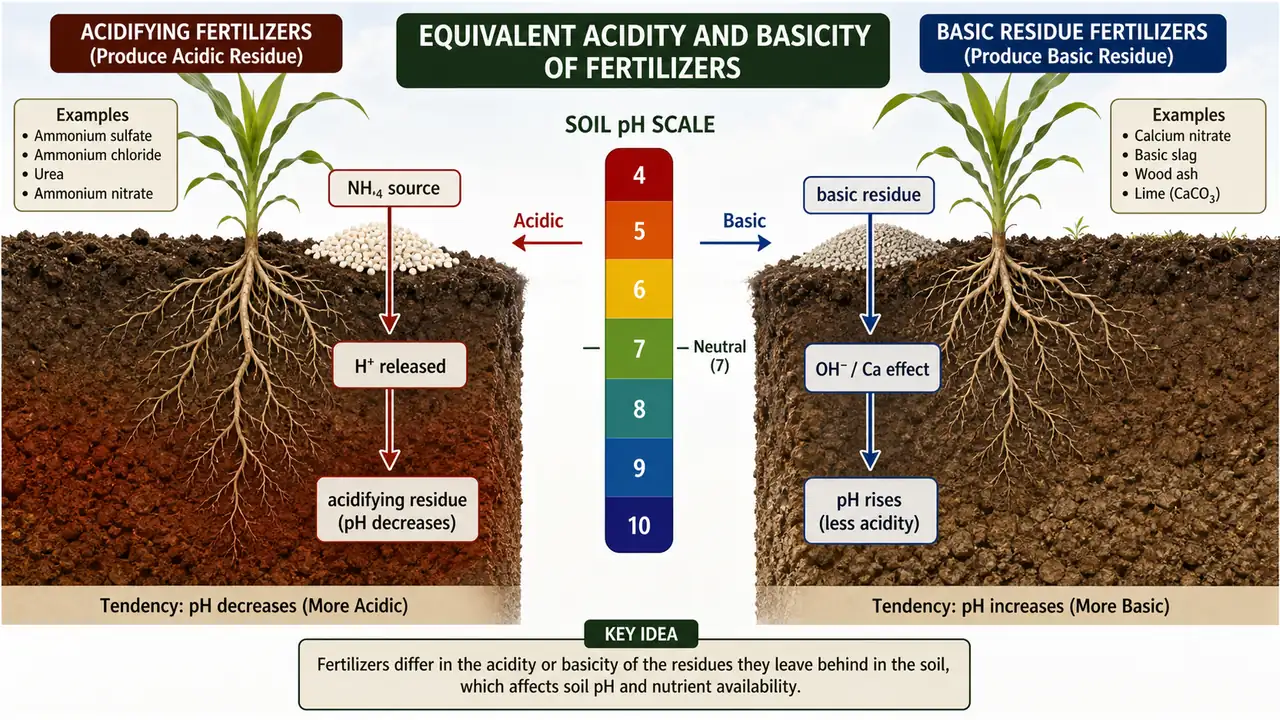
Acidic Fertilizers (ranked by acidity)
| Fertilizer | Equivalent Acidity (meq/100g) |
|---|---|
| Anhydrous ammonia | 148 (highest) |
| Ammonium chloride | 128 |
| Ammonium sulphate | 110 |
| Urea | 80 |
| DAP | 77 |
| Ammonium nitrate | 60 |
Basic Fertilizers (ranked by basicity)
| Fertilizer | Equivalent Basicity (meq/100g) |
|---|---|
| Calcium cyanamide | 63 |
| Sodium nitrate | 29 |
| Potassium nitrate | 29 |
| Calcium nitrate | 21 |
TIP
Mnemonic for equivalent acidity ranking: "Anhydrous Ammonia Always Acidifies Agressively" -- 148 is the highest. For basicity: "CaCN2 is the most Basic" at 63.
Complete Nitrogen Content Summary
| Rank | Fertilizer | N (%) | Form of N | Key Feature |
|---|---|---|---|---|
| 1 | Anhydrous Ammonia (NH3) | 82.0 | NH4 | Highest N content; liquid |
| 2 | Aqueous Ammonia | 80.0 | NH4 | Most concentrated liquid |
| 3 | Urea (CO(NH2)2) | 46.0 | Amide | Most commonly used; cheapest |
| 4 | Ammonium Nitrate (NH4NO3) | 33.0 | NH4 + NO3 | Most hygroscopic; explosive |
| 5 | CAN | 26.0 | NH4 + NO3 | Neutral; best for vegetables |
| 6 | Ammonium Chloride (NH4Cl) | 26.0 | NH4 | Popular for paddy in Japan |
| 7 | Ammonium Sulphate Nitrate | 25.6 | NH4 + NO3 | Dual form |
| 8 | Ammonium Sulphate ((NH4)2SO4) | 20.6 | NH4 | Best for paddy/waterlogged; highest S |
| 9 | Calcium Cyanamide (CaCN2) | 20.6 | Amide | Basic; not used in India |
| 10 | Sodium Nitrate (NaNO3) | 16.0 | NO3 | Pioneer N-fertilizer |
| 11 | Ammophos-B | 16.0 | NH4 | Also supplies P |
| 12 | Potassium Nitrate (KNO3) | 12.5-13.5 | NO3 | Also supplies K2O |
| 13 | Ammophos-A | 11.0 | NH4 | Also supplies P |
Nitrogenous Fertilizer - Quick Revision Summary
| Fertilizer | N (%) | Residual Nature | Key Feature |
|---|---|---|---|
| Anhydrous ammonia | 82 | Acidic | Highest N content, liquid |
| Aqueous ammonia | 80 | Acidic | Most concentrated liquid |
| Urea | 46 | Acidic | Most commonly used |
| Ammonium nitrate | 33 | Acidic | Most hygroscopic, explosive |
| CAN | 26 | Neutral | Best for vegetables (Kishan Khad) |
| Ammonium chloride | 25.5 | Acidic | Used in Japan for paddy |
| Ammonium sulphate | 20.6 | Acidic | Best for paddy/waterlogged, highest S |
| Calcium cyanamide | 21 | Basic | Not used in India |
| Sodium nitrate | 16 | Basic | Pioneer N-fertilizer |
| Calcium nitrate | 15.5 | Basic | Supplies Ca |
| Potassium nitrate | 13 | Basic | Also supplies K |
Nitrification Inhibitors and Slow-Release Fertilizers
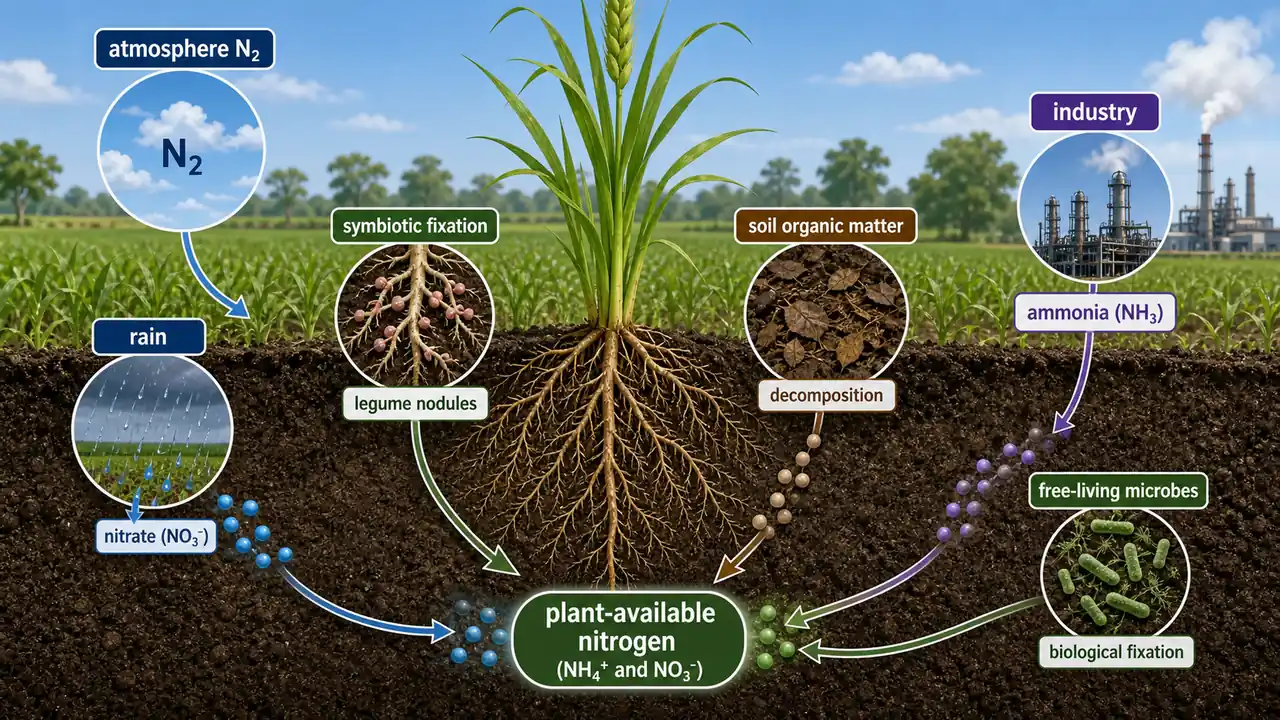
Nitrogen is the most mobile major nutrient. Losses occur through:
- Leaching -- NO3- washes below root zone
- Volatilization -- NH3 escapes as gas (especially from alkaline soils)
- Denitrification -- bacteria convert NO3- to N2 gas in waterlogged soils
Traditional solution: split application at critical growth stages. But this increases labour cost. Better solution: use nitrification inhibitors or slow-release fertilizers.
Advantages of Slow-Release Technology
- Slow, uniform nutrient release improves uptake
- Labour saving -- no need for split application
- Higher efficiency -- reduces fertilizer dose needed
- Low pollution -- minimal leaching into water bodies
- Flexible timing -- can apply as basal or top dressing
Nitrification Inhibitors
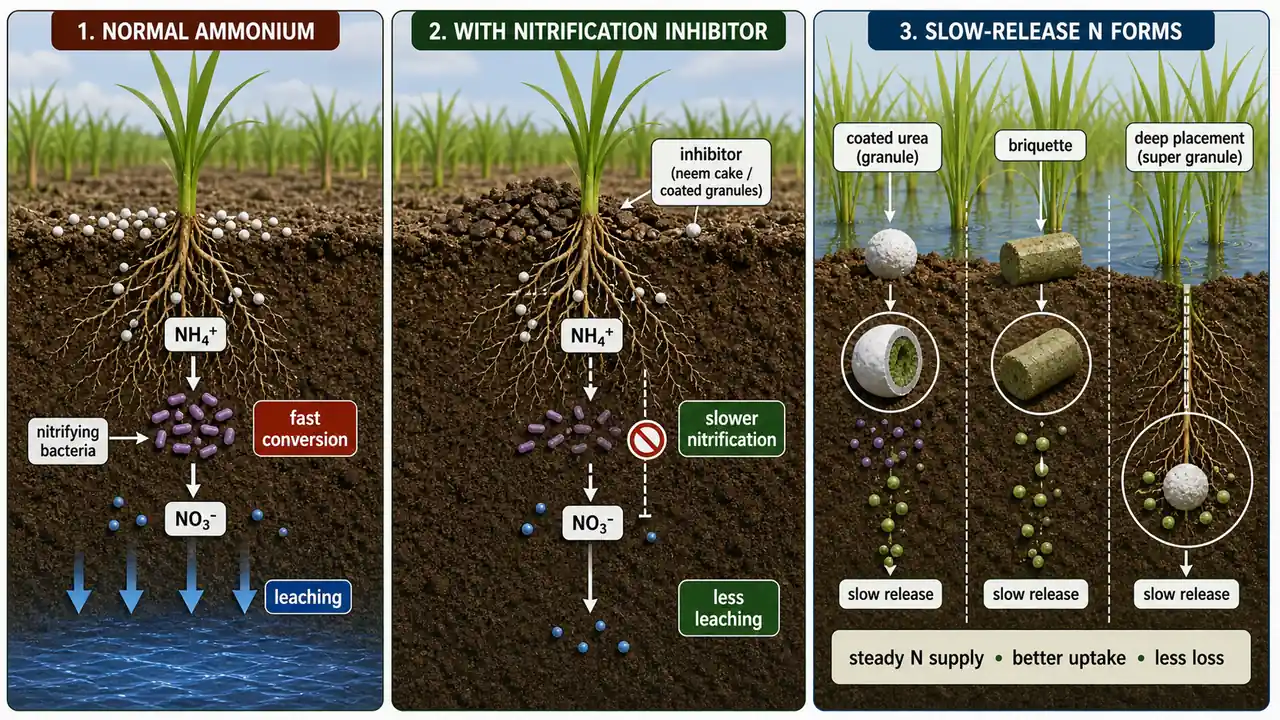
These slow down the conversion of NH4+ to NO3- by inhibiting nitrifying bacteria (Nitrosomonas and Nitrobacter). This keeps nitrogen in the less mobile ammonium form for longer.
| Use | Inhibitor | N Content |
|---|---|---|
| Lowland | Oxamide (NH2CO-CONH2) | 31% N |
| Lowland | Dicyandiamide (DD) | 42% N |
| Lowland | Thiourea (TU) | 36.8% N |
| Lowland | Urea pyrolyzate | 48% N |
| Upland | AM (2-amino-4-chloro-6-methyl pyrimidine) | - |
| Upland | N-Serve (2-chloro-6-trichloromethyl pyridine) | - |
| Natural | Neem Cake | Cost-effective, readily available in India |
| Others | ASU (Guanyl thiourea), Nitrapyrin, ST, DCS, ATC | - |
Slow-Release Fertilizers exams-2020
Three approaches to reduce nitrogen solubility and slow its release:
(A) Inherently Less Soluble Compounds
| Fertilizer | N Content | Key Feature |
|---|---|---|
| Urea Formaldehyde (UF) | 38-42% N | Less hygroscopic than urea; most commercially successful |
| Crotonylidene diurea (CDU) | 32.5% N | Slowly soluble |
| Isobutylidene diurea (IBDU) | 32.2% N | Slowly soluble |
| Guanyl urea sulphate (GUS) | - | Slowly soluble |
| Oxamide | 31% N | Not hygroscopic |
(B) Coated Fertilizers
| Fertilizer | Key Feature |
|---|---|
| Neem coated urea | Most widely used in India; government mandated |
| Sulphur coated urea | S coating gradually breaks down |
| Sulfonyl-urea | Chemical coating |
| Lac/shellac coated urea | 34.2% N; natural coating |
(C) Super Granules / Modified Form
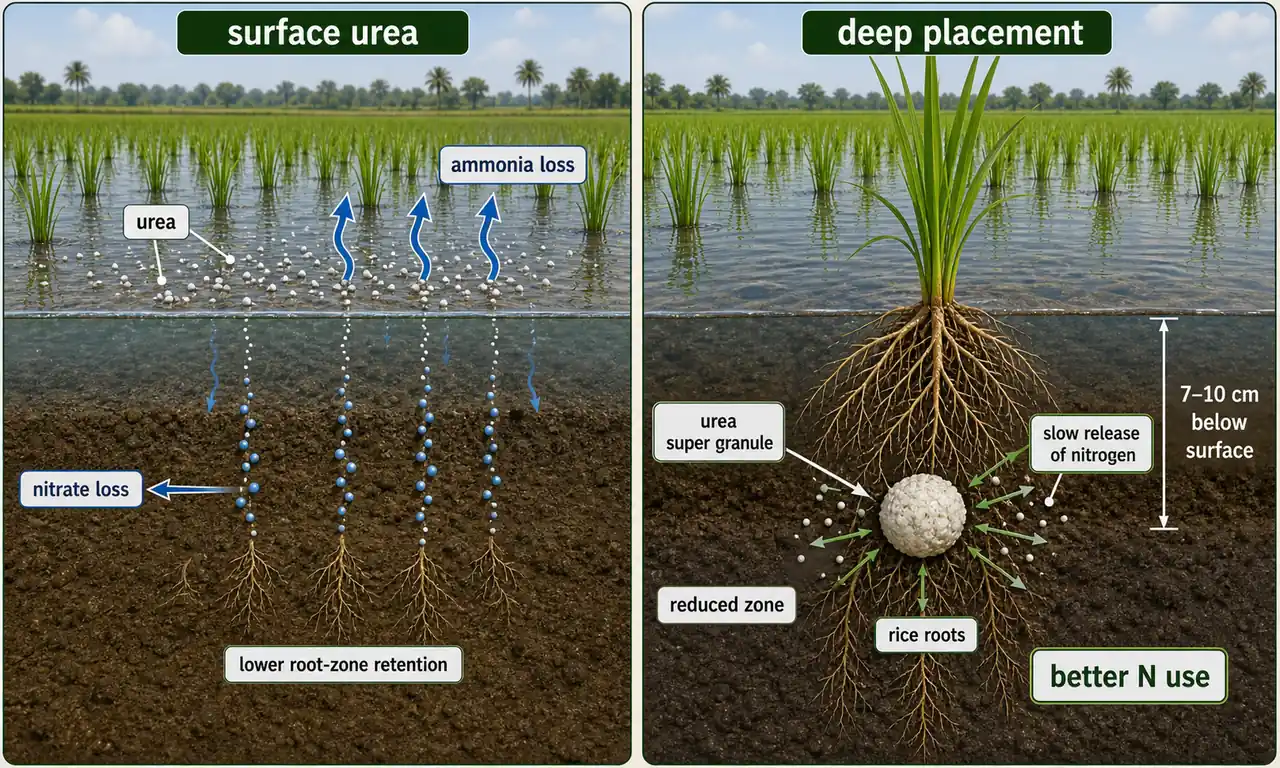
| Method Shown | Placement | Main Effect | Best Recall Cue |
|---|---|---|---|
| Surface urea | Broadcast on flooded soil surface | More ammonia loss, more nitrate movement, lower root-zone retention | Higher N losses from paddy surface |
| Deep placement | Urea super granule or briquette placed 7-10 cm below surface | Slower release near roots, reduced losses, better N-use efficiency | Best for paddy reduced zone |
| Modified forms | Super granules, briquettes, urea-mud balls | Large units reduce exposed surface area and keep N concentrated below the water layer | Deep placement minimizes losses substantially |
- Big granules of urea (1-4 g each) placed in the reduced zone of paddy soil
- Deep placement minimizes losses substantially
- Forms: super granules, briquettes, or urea-mud balls
- Especially effective for paddy cultivation
Other products:
- GROMOR: Trade name for urea-ammonium phosphate, grade 29:29:0
- Ammophos-B: Ammonium phosphate sulphate, grade 20:20:0
Controlled-Release Fertilizers Using Zeolites
Zeolites are porous minerals with high cation-exchange capacity that can control nutrient release in soil. Their porous structure acts like a natural slow-release mechanism -- holding nutrients and releasing them gradually as plants need them.
Benefits:
- Reduce nitrogen leaching (especially in sandy soils)
- Free soluble nutrients already locked in soil
- Improve soil fertility and water retention
- Common minerals -- potentially useful for large-scale agriculture
Exam Tips and Mnemonics
TIP
"82-46-33-26" -- Top 4 N-fertilizers by N content: Anhydrous ammonia (82%), Urea (46%), Ammonium nitrate (33%), CAN (26%)
"Urea = 46% N = Cheapest = Most used" -- the most important single fact
"CAN = Neutral = Kishan Khad = Vegetables" -- only neutral N-fertilizer
"Ammonium sulphate = Paddy's best friend" -- best for waterlogged soils + highest S (24.5%)
"Ammonium nitrate = Explosive + Most hygroscopic" -- two dangerous properties
"Nitrate = Basic = Top dressing = Dry soils" "Ammoniacal = Acidic = Basal = Waterlogged soils"
"Biuret > 2% = Toxic; > 150 degree C = Biuret forms"
"Neem coating = 100% mandatory in India" -- stops diversion of subsidized urea
"Apply urea 3-4 days before sowing" -- conversion takes 4-7 days
Summary Cheat Sheet
| Concept / Topic | Key Details / Explanation |
|---|---|
| Highest N fertilizer | Anhydrous ammonia — 82% N |
| Most used fertilizer in India | Urea — 46% N; cheapest N source |
| Only neutral N-fertilizer | CAN (Calcium Ammonium Nitrate) — 26% N; "Kishan Khad"; best for vegetables |
| Best for paddy / waterlogged soils | Ammonium sulphate — 20.6% N; highest S content (24.5%) |
| Pioneer / first N-fertilizer | Sodium nitrate — 16% N |
| Most hygroscopic N-fertilizer | Ammonium nitrate — 33% N; also explosive |
| Residual nature | Nitrate fertilizers → basic; Ammoniacal fertilizers → acidic |
| Application method | Nitrate → top dressing (dry soils); Ammoniacal → basal (waterlogged soils) |
| Equivalent acidity order | Anhydrous NH₃ (148) > NH₄Cl (128) > (NH₄)₂SO₄ (110) > Urea (80–85) > DAP (77) > NH₄NO₃ (60) |
| Urea conversion in soil | Takes 4–7 days via urease; apply 3–4 days before sowing |
| Biuret — soil limit | ≤ 1.5% (safe for soil application) |
| Biuret — foliar limit | ≤ 0.25% (higher causes leaf-tip scorch) |
| Biuret formation temperature | Above 150°C during urea manufacture |
| Neem Coated Urea (NCU) | 100% mandatory for all domestic production since Jan 2015; azadirachtin ≥ 150 PPM |
| NCU benefit | Inhibits urease → slows urea hydrolysis → reduces N losses; prevents diversion of subsidized urea |
| Urea formaldehyde | 38–42% N; slow-release; less hygroscopic |
| Zeolites | Porous minerals for controlled slow release |
| Highest N+P consuming state | Uttar Pradesh |
| Cheapest N source | Urea; Exam tip: High |
| Highest S in N-fertilizer | Ammonium sulphate (24.5% S); Exam tip: High |
| Pioneer N-fertilizer | Sodium nitrate (16% N); Exam tip: Medium |
| Explosive fertilizer | Ammonium nitrate; Exam tip: High |
| Highest equivalent acidity | Anhydrous ammonia (148 meq/100g); Exam tip: Medium |
| Urea conversion time | 4-7 days; apply 3-4 days before sowing; Exam tip: High |
| Biuret toxic limit | >2% in soil; >0.25% for foliar spray; Exam tip: High |
| Neem coated urea mandate | 100% of domestic production; Exam tip: High |
| NCU azadirachtin content | 150 PPM; Exam tip: Medium |
| Nitrate fertilizers | Basic residual nature; Exam tip: High |
| Ammoniacal fertilizers | Acidic residual nature; Exam tip: High |
| Max N+P consuming state | Uttar Pradesh; Exam tip: Medium |