🧱 Introduction to Soil Science: Composition, Structure & Earth's Crust
Understanding soil as a natural resource -- its definition, composition, branches of soil science, and the relationship between earth's interior and soil formation
A farmer in Punjab ploughs his field after the monsoon and notices the top layer is dark, crumbly and moist, while the deeper layer is hard and pale. Why does the same field show such different soil layers? The answer lies in understanding what soil truly is -- not just "dirt" but a complex, living natural resource formed over thousands of years that sustains all agriculture.
What is Soil Science?
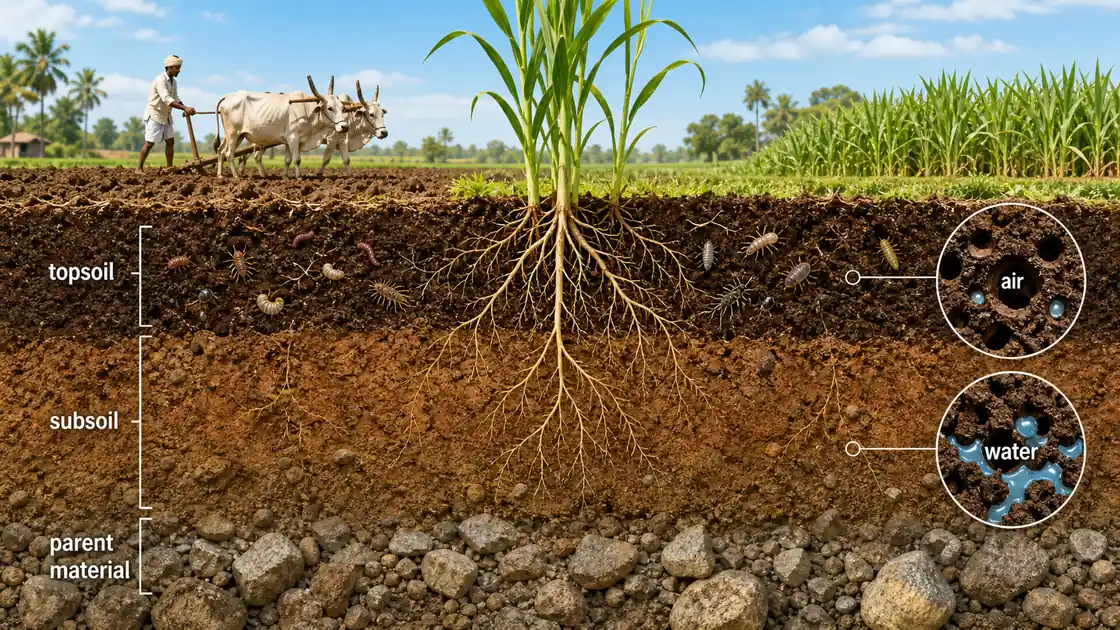
The term SOIL comes from the Latin word "SOLUM" meaning FLOOR.
Different people view soil differently:
Pro Content Locked
Upgrade to Pro to access this lesson and all other premium content.
Charged once for one year · ₹1188 total
Save ₹100/month vs ₹2388/year launch price
- All Agriculture & Banking Courses
- AI Lesson Questions (100/day)
- AI Doubt Solver (50/day)
- Glows & Grows Feedback (30/day)
- AI Section Quiz (20/day)
- 22-Language Translation (100/day)
- Recall Questions (20/day)
- AI Quiz (15/day)
- AI Quiz Paper Analysis (100/day)
- AI Step-by-Step Explanations (100/day)
- Spaced Repetition Recall (FSRS)
- AI Tutor
- Immersive Text Questions
- Audio Lessons — Hindi & English
- Mock Tests & Previous Year Papers
- Summary & Mind Maps
- XP, Levels, Leaderboard & Badges
- Generate New Classrooms
- Voice AI Teacher (AgriDots Live)
- AI Revision Assistant
- Knowledge Gap Analysis
- Interactive Revision (LangGraph)
🔒 Secure one-time yearly payment via Razorpay · No hidden fees
A farmer in Punjab ploughs his field after the monsoon and notices the top layer is dark, crumbly and moist, while the deeper layer is hard and pale. Why does the same field show such different soil layers? The answer lies in understanding what soil truly is -- not just "dirt" but a complex, living natural resource formed over thousands of years that sustains all agriculture.
What is Soil Science?
The term SOIL comes from the Latin word "SOLUM" meaning FLOOR.
Different people view soil differently:
| Professional | View of Soil | Agricultural Relevance |
|---|---|---|
| Farmer | Medium for growing crops | Directly linked to food production |
| Layman | Dirt or debris | -- |
| Mining Engineer | Debris covering rocks | -- |
| Civil Engineer | Material for road/house beds | -- |
| Soil Scientist | Natural body formed by specific factors | Basis of soil management |
From an agricultural standpoint, soil is most importantly a medium for plant growth that provides nutrients, water, air and anchorage.
TIP
Remember: SOIL = Soul of Infinite Life. This captures the idea that soil is the foundation of all terrestrial life and agriculture.
Soil Science Society of America (1970) Definition
Soil is the unconsolidated mineral matter on the surface of the earth that has been subjected to and influenced by genetic and environmental factors of parent material, climate, macro and microorganisms and topography, all acting over a period of time, producing a product that differs from the material from which it is derived in many physical, chemical, biological and morphological properties.
Two Approaches: Pedology vs Edaphology
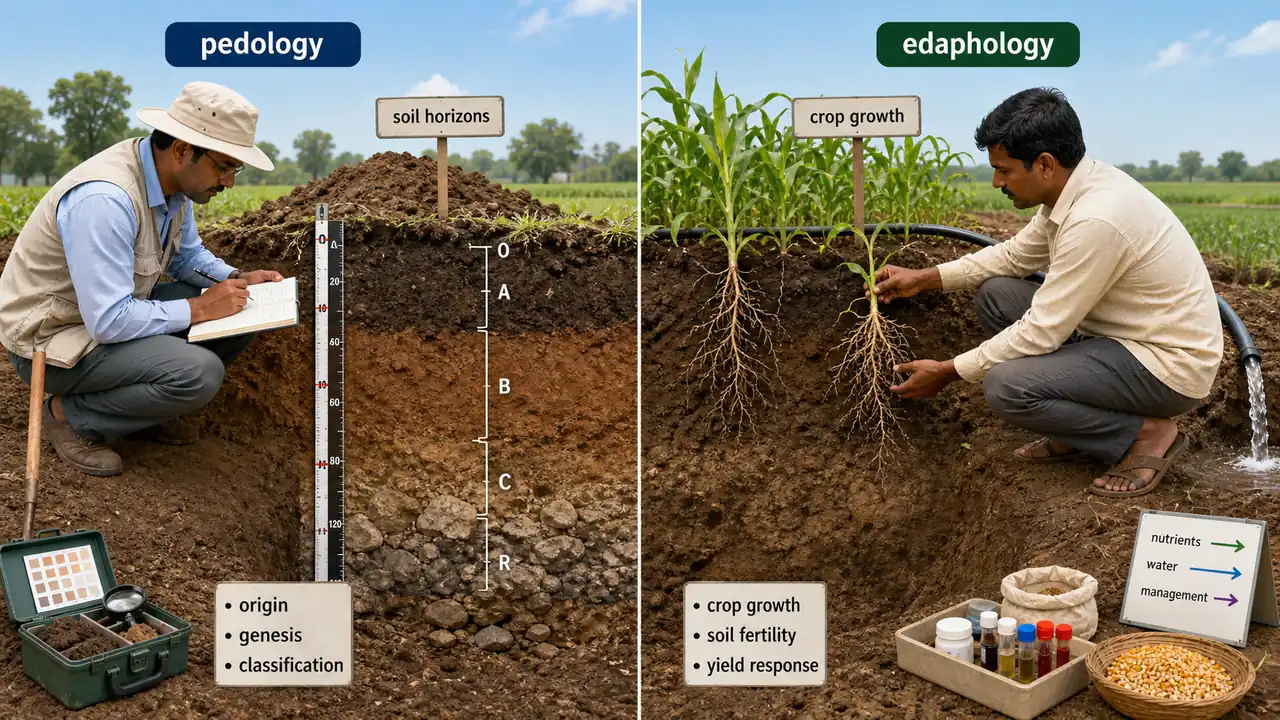
| Feature | Edaphology | Pedology |
|---|---|---|
| Greek root | Edaphos (soil) + Logos (discourse) | Pedon (soil) + Logos (study) |
| Focus | Soil in relation to crop growth, nutrition and yield | Origin, formation and classification of soil |
| Nature | Applied science (agriculture-focused) | Pure science (theoretical) |
| Goal | Improve soil productivity for food and fibre | Understand soil as a natural body |
| Example | Studying why wheat yields drop in saline soils | Classifying black cotton soils of Deccan |
TIP
Exam Mnemonic: Pedology = Pure science (classification, genesis). Edaphology = Earning from soil (crop production, management).
Six Branches of Soil Science
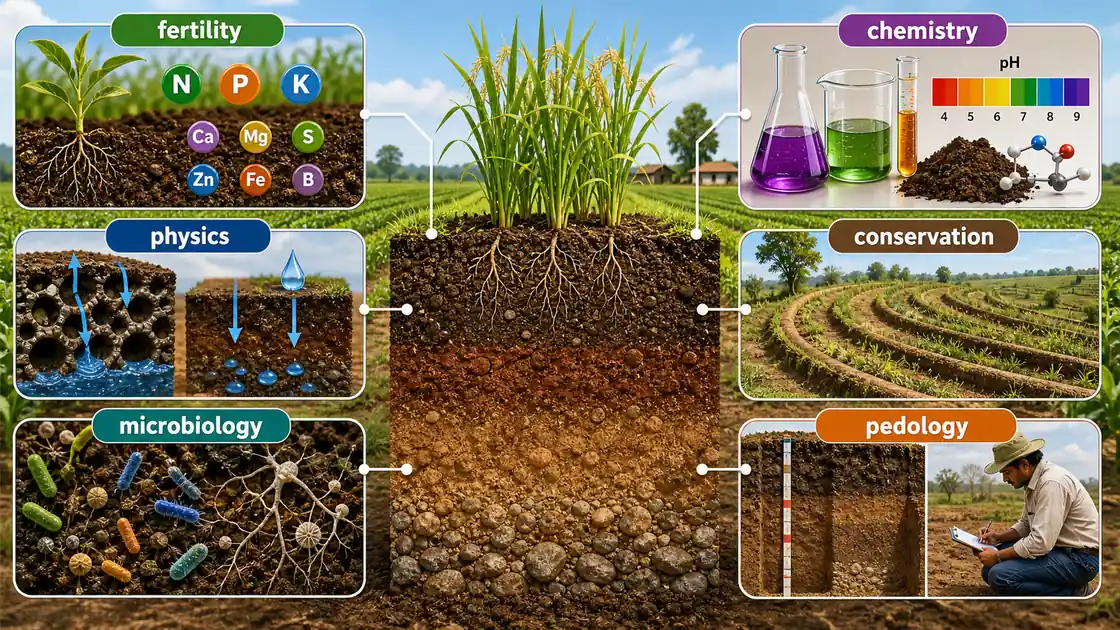
| Branch | Focus | Agricultural Example |
|---|---|---|
| Soil Fertility | Nutrient supplying properties | Testing NPK levels before sowing wheat |
| Soil Chemistry | Chemical constituents and reactions | Understanding why acidic soil locks up phosphorus |
| Soil Physics | Texture, structure, density, water movement | Choosing irrigation method based on soil porosity |
| Soil Microbiology | Microorganisms and nutrient cycling | Rhizobium bacteria fixing nitrogen in legume roots |
| Soil Conservation | Protection against erosion and nutrient loss | Terrace farming on Himalayan slopes |
| Soil Pedology | Genesis, survey and classification | Mapping soil types across different agro-climatic zones |
TIP
Mnemonic for six branches: "Fertile Chemicals Physically Micro-Conserve Pedons" -- Fertility, Chemistry, Physics, Microbiology, Conservation, Pedology.
Interior of the Earth
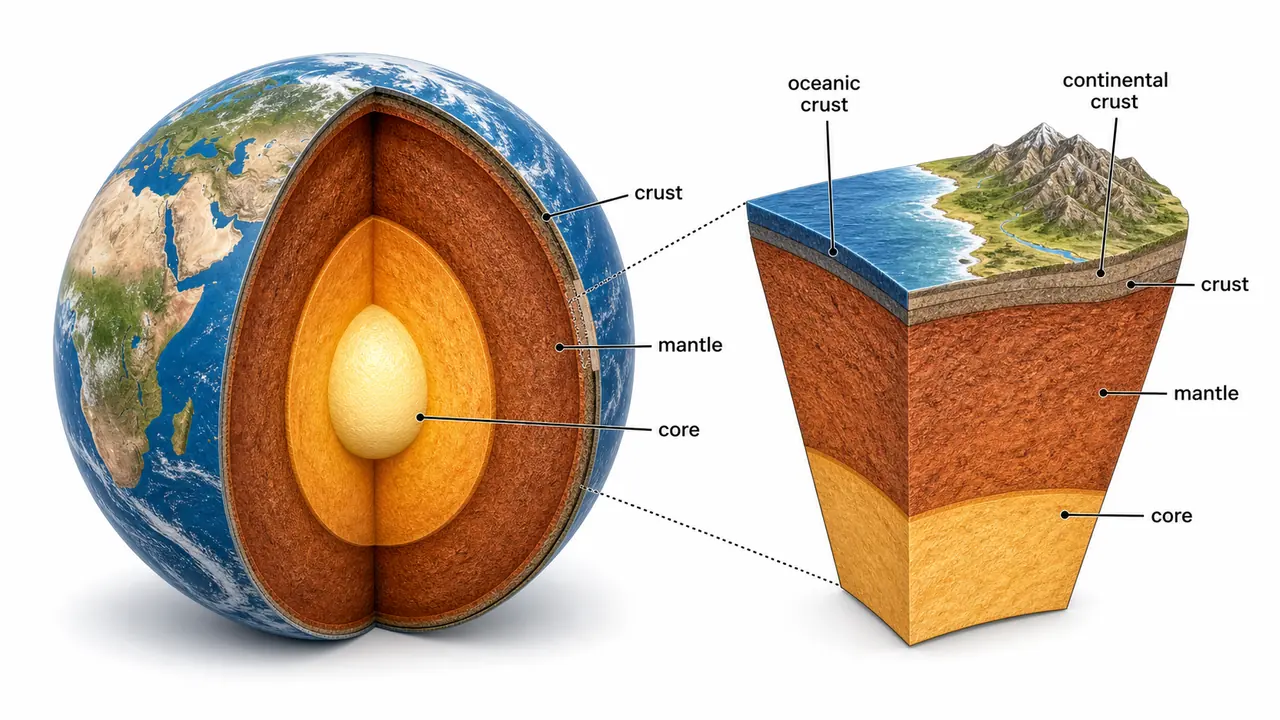
| Earth Layer Visual Item | Full Content |
|---|---|
| Crust | Outermost solid layer of the earth; the zone from which soil-forming minerals are ultimately derived |
| Mantle | Thick middle layer below the crust; denser than the crust and largely composed of silicate material |
| Core | Innermost layer; mainly nickel and iron and much denser than the outer layers |
| Oceanic crust | Thinner crust below oceans, usually around 5 to 11 km thick |
| Continental crust | Thicker crust below continents, usually around 35 to 56 km thick |
The earth consists of 3 concentric rings: Crust, Mantle and Core. Understanding earth's interior is essential because soil ultimately originates from the minerals in the crust.
The Three Layers
| Layer | Thickness | Density (g/cc) | Key Features |
|---|---|---|---|
| Crust | 5 to 56 km | 2.6 - 3.0 | Two sub-zones: Sial (65-75% silica) and Sima (plastic layer) |
| Mantle | 2900 km | 3.0 - 4.5 | Solid to semi-solid; mixed metals and silicate rocks |
| Core | 3500 km | 9.0 - 12.0 | Molten Nickel and Iron |
- The crust is 5 to 11 km in oceans and 35 to 56 km in continents
- Sial floats on Sima, which floats on the mantle
IMPORTANT
Density increases progressively towards the centre: Crust (2.6-3.0) < Mantle (3.0-4.5) < Core (9.0-12.0).
The Pedosphere
Soil occupies the pedosphere -- the outermost layer of Earth composed of soil and subject to soil-forming processes. It exists at the interface where four spheres meet:

| Sphere | Nature | Role in Soil Formation |
|---|---|---|
| Lithosphere | Solid rock | Provides parent material through weathering |
| Atmosphere | Gaseous envelope | Supplies O2, CO2, temperature changes |
| Hydrosphere | Water bodies | Provides water for weathering and plant growth |
| Biosphere | Living organisms | Adds organic matter, drives biological weathering |
Exterior of Earth
- Atmosphere extends 320 km above the lithosphere/hydrosphere
- 70% of Earth's surface is covered by water (Hydrosphere)
| Sphere | Key Facts |
|---|---|
| Hydrosphere | Covers 70% of Earth; sea water contains 3.5% salts; density 1.026 |
| Lithosphere | Heaviest sphere; mean density 5.5; temperature rises 1 degree F per 64 feet depth |
Composition of Atmospheric Air vs Soil Air
A paddy farmer notices that waterlogged rice fields sometimes smell different from well-drained wheat fields. This is because soil air differs from atmospheric air -- particularly in CO2 and O2 levels, which directly affect root respiration and microbial activity.
| Gas | Atmospheric Air (by volume) | Soil Air (by volume) | Difference |
|---|---|---|---|
| Nitrogen | 78.08% | 79.2% | Slightly higher in soil |
| Oxygen | 20.9% | 20.6% | Less in soil (used by roots and microbes) |
| Carbon dioxide | 0.033% | 0.30% | ~10 times higher in soil |
IMPORTANT
Soil air has less O2 and more CO2 than atmospheric air. CO2 in soil is about 10 times higher (0.30% vs 0.033%) due to root respiration and microbial decomposition of organic matter. This is important for nutrient availability -- dissolved CO2 forms carbonic acid that helps dissolve minerals.
| Gasses | By volume (%) | By weight (%) |
|---|---|---|
| N₂ | 78.08 | 76.5 |
| O₂ | 20.9 | 23.1 |
| CO₂ | 0.033 | 0.04 |
| Other gases (H₂, NH₃, H₂S, SO₂, O₃, He, Argon, Neon, Krypton, Xenon) | 0.93 | 1.36 |

| Air Composition Visual Item | Full Content |
|---|---|
| Nitrogen | Dominant gas in atmospheric air at about 78% by volume |
| Oxygen | About 20.9% by volume; supports root and microbial respiration |
| Argon gases | Around 0.90% by volume |
| Carbon dioxide | Only about 0.03% by volume in atmospheric air |
| Other gases | Roughly 0.17% by volume when minor gases are grouped together |
| Soil air oxygen | Slightly lower than atmospheric air because roots and microbes consume oxygen continuously |
| Soil air carbon dioxide | Much higher than atmospheric air because respiration and decomposition release CO2 in soil pores |
| Main takeaway | Soil air has less O2 and more CO2 than atmospheric air, which strongly affects roots and microbes |
Composition of the Earth's Crust
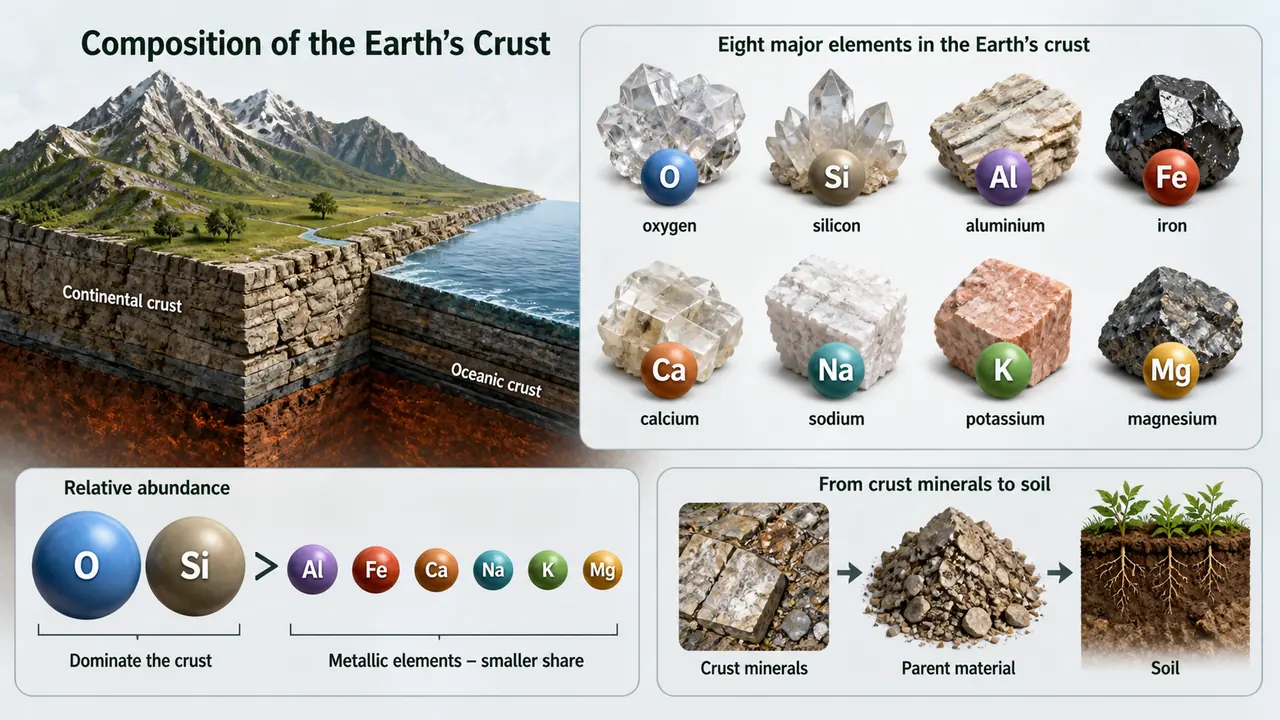
| Earth's Crust Visual Item | Full Content |
|---|---|
| Continental crust | Crust below land masses; thicker than oceanic crust |
| Oceanic crust | Crust below oceans; thinner than continental crust |
| Eight major elements | Oxygen, silicon, aluminium, iron, calcium, sodium, potassium, and magnesium make up about 99% of the crust by weight |
| Relative abundance | Oxygen > Silicon > Aluminium > Iron > Calcium > Sodium > Potassium > Magnesium |
| Crust minerals to soil | Crust minerals weather into parent material, which further develops into soil |
Eight Most Abundant Elements
Out of 106 elements known, 8 are sufficiently abundant to constitute about 99 percent by weight of earth's crust (up to 16 km).
| Category | Element | Ion | % by weight |
|---|---|---|---|
| Non-metallic | Oxygen | O2- | 46.60% |
| Silicon | Si4+ | 27.72% | |
| Aluminium | Al3+ | 8.13% | |
| Metallic | Iron | Fe2+ | 5.00% |
| Calcium | Ca2+ | 3.63% | |
| Sodium | Na+ | 2.83% | |
| Potassium | K+ | 2.59% | |
| Magnesium | Mg2+ | 2.09% |
TIP
Non-metallic elements (O, Si, Al) = ~74% (about 3/4th) of the crust. Metallic elements (Fe, Ca, Na, K, Mg) = remaining ~1/4th. Exam Mnemonic: "O Si Al Fe Ca Na K Mg" -- "Oh Silicon, Aluminium is Feeling Calm, Napping with Kind Mg"
These elements are geochemically grouped into five categories:
| Group | Bonding Character | Agricultural Significance |
|---|---|---|
| Lithophile | Ionize readily or form stable oxyanions | Form soil minerals (Si, Al, Ca, K) |
| Chalcophile | Form covalent bonds with sulphide | Source of S in soils (Cu, Zn) |
| Siderophile | Readily form metallic bonds | Iron in laterite soils |
| Atmosphere | Remain in atmospheric gases | N2, O2 for plant growth |
| Biophile | Associated with living organisms | C, N, P essential for crops |
Oxides of the Earth's Crust
| Oxide | Percentage | Agricultural Significance |
|---|---|---|
| SiO2 | 59.07% | Forms silicate clay minerals |
| Al2O3 | 15.22% | Key component of clay minerals |
| CaO | 5.10% | Source of calcium for crops |
| Fe2O3 + FeO | 6.81% | Gives red colour to laterite soils |
| MgO | 3.45% | Essential plant nutrient |
| K2O | 3.11% | Major source of potassium |
| Na2O | 3.71% | Can cause soil sodicity |
| P2O5 | 0.30% | Primary phosphorus source |
| TiO2 | 1.03% | -- |
| MnO | 0.11% | Micronutrient for plants |
| H2O | 1.30% | -- |
NOTE
SiO2 alone = ~60% of crust. SiO2 + Al2O3 together = ~74%, which is why the upper crust is called SIAL (Silica + Alumina).
From Rocks to Soil
The earth's crust is principally composed of mineral matter. Elements combine to form compounds called minerals. Minerals combine to form rocks. Rocks are the parent material from which soils are ultimately derived through weathering.
Elements --> Minerals --> Rocks --> Weathering --> Soil
Soil is the porous, powdery and unconsolidated outer layer of the earth's crust formed by weathering of minerals and decomposition of organic substances. It is a dynamic product of physical, chemical, and biological transformations acting on rock over time.
Soil as a Three-Dimensional Body
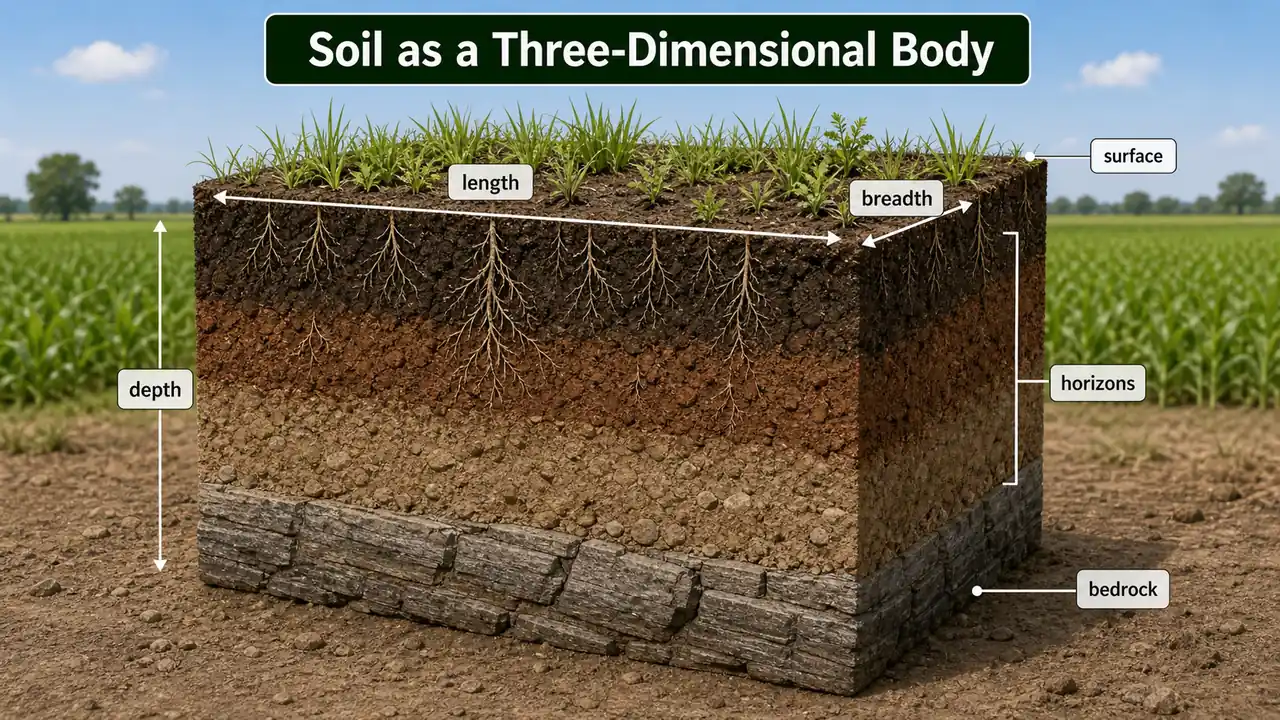
| Soil Body Visual Item | Full Content |
|---|---|
| Length | Horizontal extension of soil in one direction across the land surface |
| Breadth | Horizontal extension of soil in the other direction across the land surface |
| Depth | Vertical extension of soil downward from the surface |
| Surface | Upper boundary of the soil body, exposed to air or covered by water |
| Horizons | Distinct soil layers formed by pedogenic processes |
| Bedrock | Lower solid rock boundary beneath the soil body |
Soil has length, breadth and depth. It extends downward through various horizons to the parent material or bedrock.
- Upper boundary: air or water
- Lower boundary: rock (lithosphere)
- Properties differ from place to place across the landscape
Composition of Ideal Soil
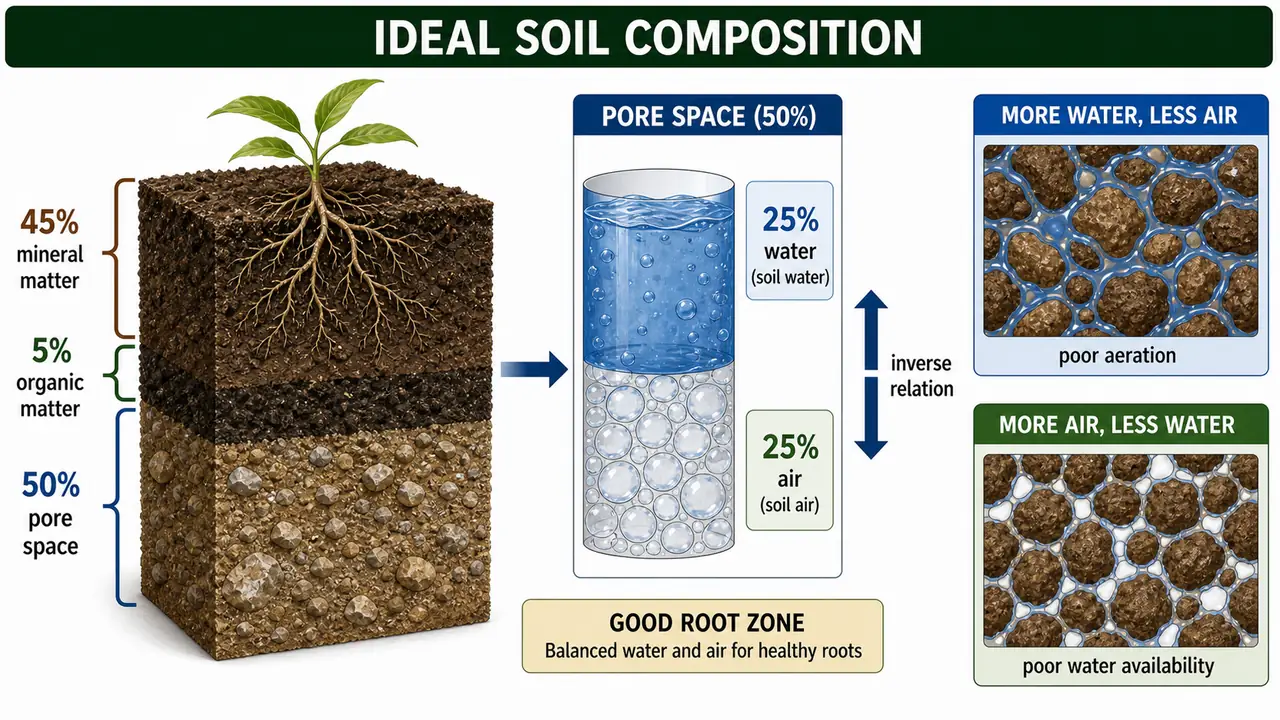
| Ideal Soil Image Item | Full Content |
|---|---|
| Mineral matter | About 45% of ideal soil volume; forms the physical framework and supplies mineral nutrients |
| Organic matter | About 5% of ideal soil volume; improves aggregation, nutrient cycling, and water holding |
| Pore space | About 50% of ideal soil volume in total |
| Soil water | About 25% of ideal soil volume under ideal conditions |
| Soil air | About 25% of ideal soil volume under ideal conditions |
| More water, less air | When pores fill with excess water, aeration becomes poor and roots suffer from low oxygen |
| More air, less water | When pores contain too much air and too little water, water availability becomes limiting for roots |
| Good root zone | Best crop growth occurs when water and air stay balanced inside pore space |
Just as a balanced diet is essential for human health, a balanced composition is essential for healthy soil. An ideal soil on a volume basis contains:
| Component | Volume (%) | Source | Role in Agriculture |
|---|---|---|---|
| Mineral matter | 45% | Weathering of rocks | Provides physical framework and nutrients |
| Organic matter | 5% | Decomposition of plant/animal residues | Nutrient cycling, water retention, soil structure |
| Soil water | 25% | Rainfall, irrigation | Dissolves nutrients for plant uptake |
| Soil air | 25% | Atmosphere | Root respiration, microbial activity |
IMPORTANT
The ideal soil composition 45:5:25:25 is frequently tested. Mineral matter dominates at 45%. Organic matter is the smallest solid fraction at 5%. Water and air together fill 50% and are inversely related -- when pores fill with water, air is displaced, and vice versa.
Soil Compared to Animal Systems
| Animal System | Soil Equivalent | Agricultural Significance |
|---|---|---|
| Digestive System | Organic matter decomposition | Nutrient release for crops |
| Respiratory System | Air circulation and gas exchange | Root respiration |
| Circulatory System | Water movement | Nutrient transport to roots |
| Excretory System | Leaching of excess salts | Prevents salt toxicity |
| Brain | Soil Clay | Controls chemical reactions |
| Colour | Soil colour | Indicates drainage and fertility |
| Height | Soil depth | Determines rooting volume |
Summary Cheat Sheet
| Concept / Topic | Key Details / Explanation |
|---|---|
| Soil — Latin origin | From SOLUM = floor |
| SOIL acronym | "Soul of Infinite Life" |
| Soil Science (SSSA, 1970) | Unconsolidated mineral matter influenced by parent material, climate, macro/micro organisms, topography — over time |
| Pedology | Pure science; study of soil genesis, classification, mapping |
| Edaphology | Applied science; soil in relation to crop growth, yield, nutrition |
| Mnemonic | Pedology = Pure; Edaphology = Earning (applied) |
| 6 branches of soil science | Fertility, Chemistry, Physics, Microbiology, Conservation, Pedology ("Fertile Chemicals Physically Micro-Conserve Pedons") |
| Earth's 3 layers | Crust (5–56 km, density 2.6–3.0) → Mantle (2900 km, 3.0–4.5) → Core (3500 km, 9.0–12.0) |
| Sial | Upper crust: 65–75% silica (Si + Al) |
| Sima | Lower crust/mantle: plastic layer |
| Pedosphere | Outermost soil layer; interface of Lithosphere, Atmosphere, Hydrosphere, Biosphere |
| Atmosphere extent | 320 km above lithosphere/hydrosphere |
| Hydrosphere covers | 70% of Earth; sea water = 3.5% salts; density 1.026 |
| Lithosphere | Heaviest sphere; mean density 5.5; temp rises 1°F per 64 feet depth |
| 8 most abundant elements (crust) | O (46.6%) > Si (27.7%) > Al (8.1%) > Fe > Ca > Na > K > Mg = ~99% of crust |
| Mnemonic for elements | "O Si Al Fe Ca Na K Mg" |
| Most abundant non-metallic | O, Si, Al = ~74% of crust |
| Most abundant oxide | SiO₂ (59.07%) — upper crust called SIAL |
| Soil air vs atmosphere — CO₂ | Soil CO₂ is ~10× higher (0.30% vs 0.033%) due to root respiration and microbial activity |
| Soil air — O₂ | Less in soil (used by roots and microbes) |
| Geochemical groups | Lithophile, Chalcophile, Siderophile, Atmosphere, Biophile |
| Rock formation pathway | Elements → Minerals → Rocks → Weathering → Soil |
| Ideal soil composition | 45% mineral : 5% OM : 25% water : 25% air |
| Water and air in soil | Inversely related — when water increases, air decreases |
| Soil as 3D body | Has length, breadth, depth; upper boundary = air/water; lower = bedrock |
| Soil origin | Latin "Solum" = floor; Exam tip: Frequently asked in prelims |
| Earth's layers | Crust, Mantle, Core; Exam tip: Density increases towards centre |
| Soil definition (SSSA) | Unconsolidated mineral matter + 5 factors; Exam tip: Parent material, climate, organisms, topography, time |