🍪 Soil Texture: Sand, Silt, Clay & Textural Classes
Soil separates, classification systems (USDA, ISSS), Stokes' Law, textural triangle, 12 textural classes and their agricultural importance
A groundnut farmer in Gujarat works his sandy soil easily with a light plough, while a cotton farmer in Maharashtra struggles to break the hard, cracking black clay. Both are growing profitable crops -- but on vastly different soils. The difference lies in soil texture, the relative proportion of sand, silt and clay particles. Texture is the most fundamental physical property of soil because it controls water holding, drainage, aeration, nutrient retention, and tillage behaviour.
Physical Properties of Soil
Physical properties influence plant support, root penetration, drainage, aeration, moisture retention and nutrient availability. The key physical properties are:
- Soil texture
- Soil structure
- Surface area
- Soil density
- Soil porosity
- Soil colour
- Soil consistence
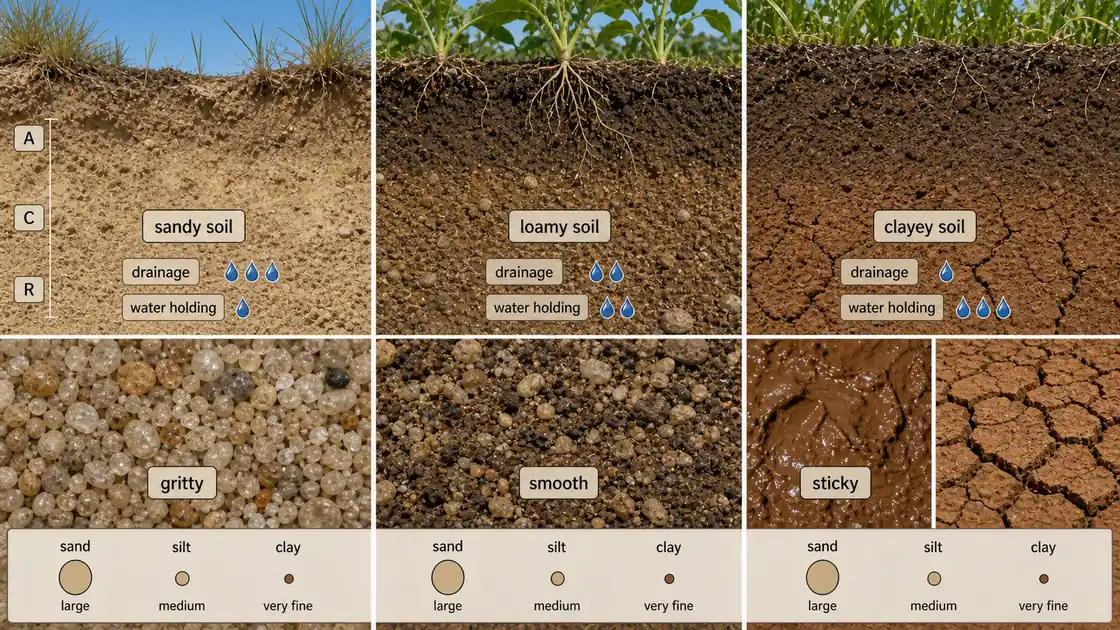
What is Soil Texture?
| Particle | Size |
|---|---|
| Gravels | 2 – 4 mm |
| Pebbles | 4 – 64 mm |
| Cobbles | 64 – 256 mm |
| Boulders | > 256 mm |
NOTE
Pro Content Locked
Upgrade to Pro to access this lesson and all other premium content.
Charged once for one year · ₹1188 total
Save ₹100/month vs ₹2388/year launch price
- All Agriculture & Banking Courses
- AI Lesson Questions (100/day)
- AI Doubt Solver (50/day)
- Glows & Grows Feedback (30/day)
- AI Section Quiz (20/day)
- 22-Language Translation (100/day)
- Recall Questions (20/day)
- AI Quiz (15/day)
- AI Quiz Paper Analysis (100/day)
- AI Step-by-Step Explanations (100/day)
- Spaced Repetition Recall (FSRS)
- AI Tutor
- Immersive Text Questions
- Audio Lessons — Hindi & English
- Mock Tests & Previous Year Papers
- Summary & Mind Maps
- XP, Levels, Leaderboard & Badges
- Generate New Classrooms
- Voice AI Teacher (AgriDots Live)
- AI Revision Assistant
- Knowledge Gap Analysis
- Interactive Revision (LangGraph)
🔒 Secure one-time yearly payment via Razorpay · No hidden fees
A groundnut farmer in Gujarat works his sandy soil easily with a light plough, while a cotton farmer in Maharashtra struggles to break the hard, cracking black clay. Both are growing profitable crops -- but on vastly different soils. The difference lies in soil texture, the relative proportion of sand, silt and clay particles. Texture is the most fundamental physical property of soil because it controls water holding, drainage, aeration, nutrient retention, and tillage behaviour.
Physical Properties of Soil
Physical properties influence plant support, root penetration, drainage, aeration, moisture retention and nutrient availability. The key physical properties are:
- Soil texture
- Soil structure
- Surface area
- Soil density
- Soil porosity
- Soil colour
- Soil consistence
What is Soil Texture?
| Particle | Size |
|---|---|
| Gravels | 2 – 4 mm |
| Pebbles | 4 – 64 mm |
| Cobbles | 64 – 256 mm |
| Boulders | > 256 mm |
NOTE
Particles larger than 2 mm: Gravels (2-4 mm), Pebbles (4-64 mm), Cobbles (64-256 mm), Boulders (>250 mm). These are excluded from textural determination but affect tillage.
The Three Soil Separates
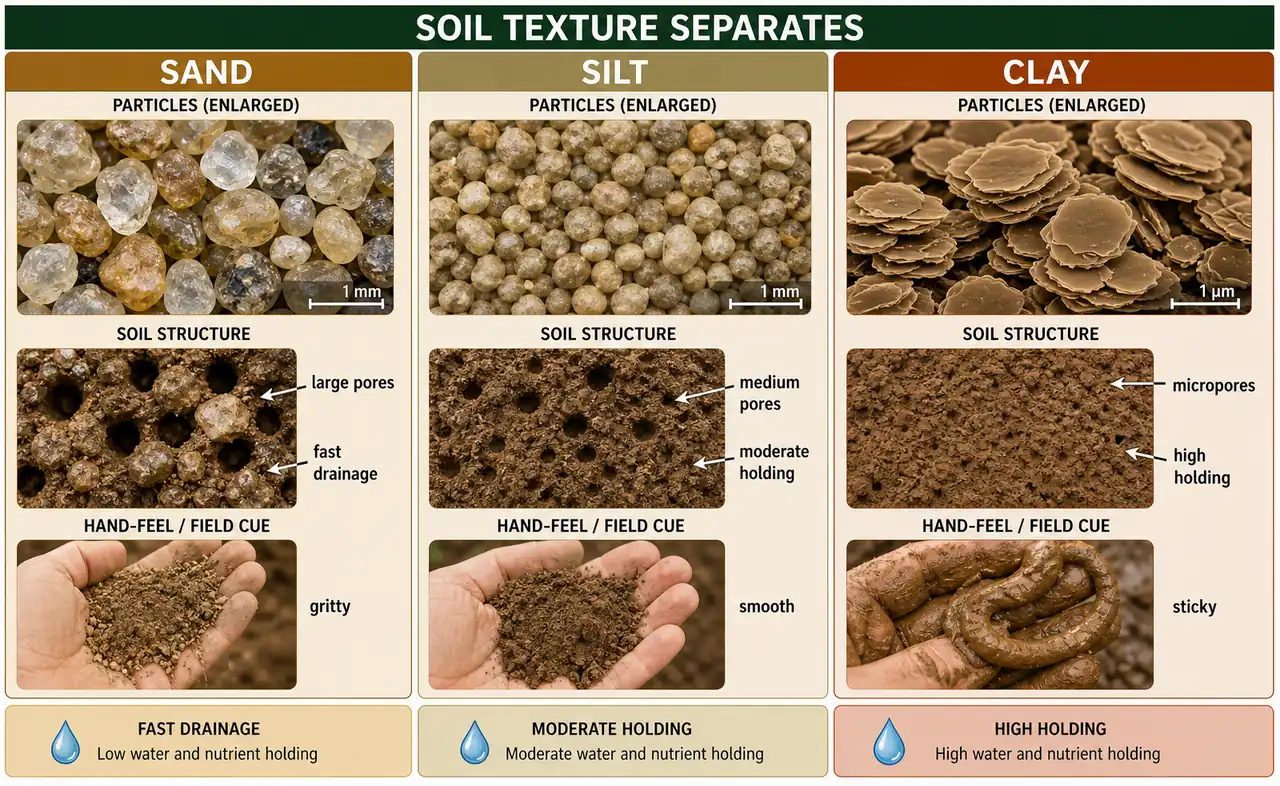
| Separate | Size | Shape | Feel | Dominant Mineral | Role in Soil |
|---|---|---|---|---|---|
| Sand | 0.05 - 2.0 mm (USDA) | Spherical, jagged surface | Gritty | Quartz | Good drainage and aeration; poor water and nutrient holding |
| Silt | 0.002 - 0.05 mm (USDA) | Irregular, coated with clay | Smooth, floury (like talcum powder) | Quartz, Feldspar | Intermediate properties; moderate water holding |
| Clay | < 0.002 mm | Platy, needle-like | Sticky, plastic | Secondary minerals (Kaolinite, Montmorillonite) | Highest surface area; holds water and nutrients; most chemically active |
- Sand and Silt form the SKELETON of soil (structural framework)
- Clay is the FLESH of soil (gives cohesive properties, drives soil chemistry)
- Marling = application of clay to sandy soils to improve water and nutrient retention
- Clay soils have the highest pore space compared to other textural classes
Classification Systems
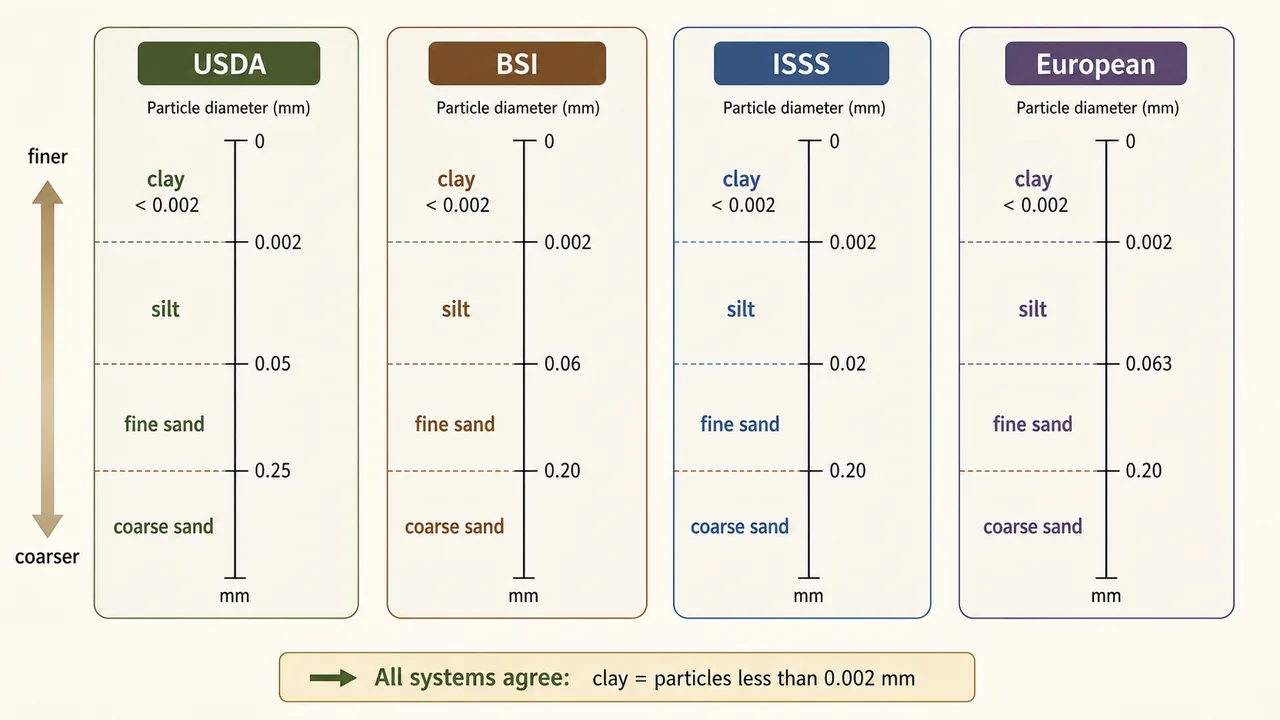
Comparison of Systems
| System | Key Feature | Exam Relevance |
|---|---|---|
| USDA | Most subdivisions (5 sand classes); most common in India | Primary for exams |
| BSI (British) | 3 silt + 3 sand classes | Rarely asked |
| ISSS (International) | Simplest -- only 4 separates | Second most important |
| European | Most detailed -- subdivides clay into 3 classes | Least asked |
TIP
For exams, focus on USDA (most common in India) and ISSS (simplest). Both agree: Clay < 0.002 mm.
(A) USDA System
| Soil Separate | Diameter (mm) |
|---|---|
| Clay | < 0.002 |
| Silt | 0.002 - 0.05 |
| Very Fine Sand | 0.05 - 0.10 |
| Fine Sand | 0.10 - 0.25 |
| Medium Sand | 0.25 - 0.50 |
| Coarse Sand | 0.50 - 1.00 |
| Very Coarse Sand | 1.0 - 2.00 |
(B) BSI (British) System
| Soil Separate | Diameter (mm) |
|---|---|
| Clay | < 0.002 |
| Fine Silt | 0.002 - 0.01 |
| Medium Silt | 0.01 - 0.04 |
| Coarse Silt | 0.04 - 0.06 |
| Fine Sand | 0.06 - 0.20 |
| Medium Sand | 0.20 - 1.00 |
| Coarse Sand | 1.0 - 2.00 |
(C) ISSS (International) System
| Soil Separate | Diameter (mm) |
|---|---|
| Clay | < 0.002 |
| Silt | 0.002 - 0.02 |
| Fine Sand | 0.02 - 0.2 |
| Coarse Sand | 0.2 - 2.0 |
(D) European System
| Soil Separate | Diameter (mm) |
|---|---|
| Fine Clay | < 0.0002 |
| Medium Clay | 0.0002 - 0.0006 |
| Coarse Clay | 0.0006 - 0.002 |
| Fine Silt | 0.002 - 0.006 |
| Medium Silt | 0.006 - 0.02 |
| Coarse Silt | 0.02 - 0.06 |
| Fine Sand | 0.06 - 0.20 |
| Medium Sand | 0.20 - 0.60 |
| Coarse Sand | 0.60 - 2.00 |
Particle Size Analysis (Mechanical Analysis)
Determination of the relative distribution of individual soil particles below 2 mm is called Particle size analysis or Mechanical analysis.
Done by the Hydrometric method.
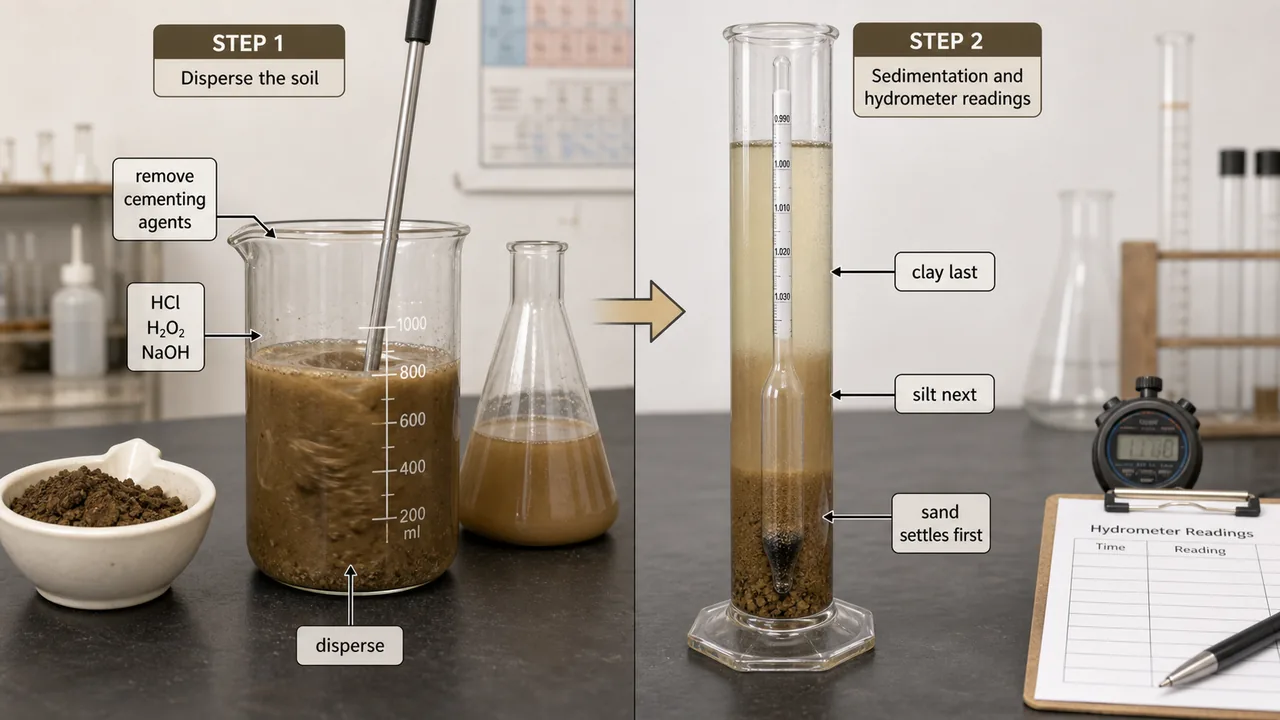
Two Steps
| Step | Method | Details |
|---|---|---|
| 1. Separation | Remove cementing agents + disperse with NaOH | Breaks aggregates into individual particles |
| 2. Measurement | Sieving (coarse fractions) + Settling (fine fractions) | Based on Stokes' Law |
| S. N. | Aggregating agents | Dispersion method |
|---|---|---|
| 1. | Lime and Oxides of Fe & Al | Dissolving in HCl |
| 2. | Organic matter | Oxidizes with H₂O₂ |
| 3. | High conc. of electrolytes (soluble salts) | Precipitate and decant or filter with suction |
| 4. | Surface tension | Elimination of air by stirring with water or boiling |
- Coarser fractions: Sieving with screens (2 mm, 1 mm, 0.5 mm)
- Finer fractions: Settling in water -- based on how quickly particles sink
Stokes' Law
The fundamental principle behind particle size analysis:
V = kr2 -- The velocity (V) of a settling particle is proportional to the square of its radius (r).
This means a particle twice as large settles four times as fast.
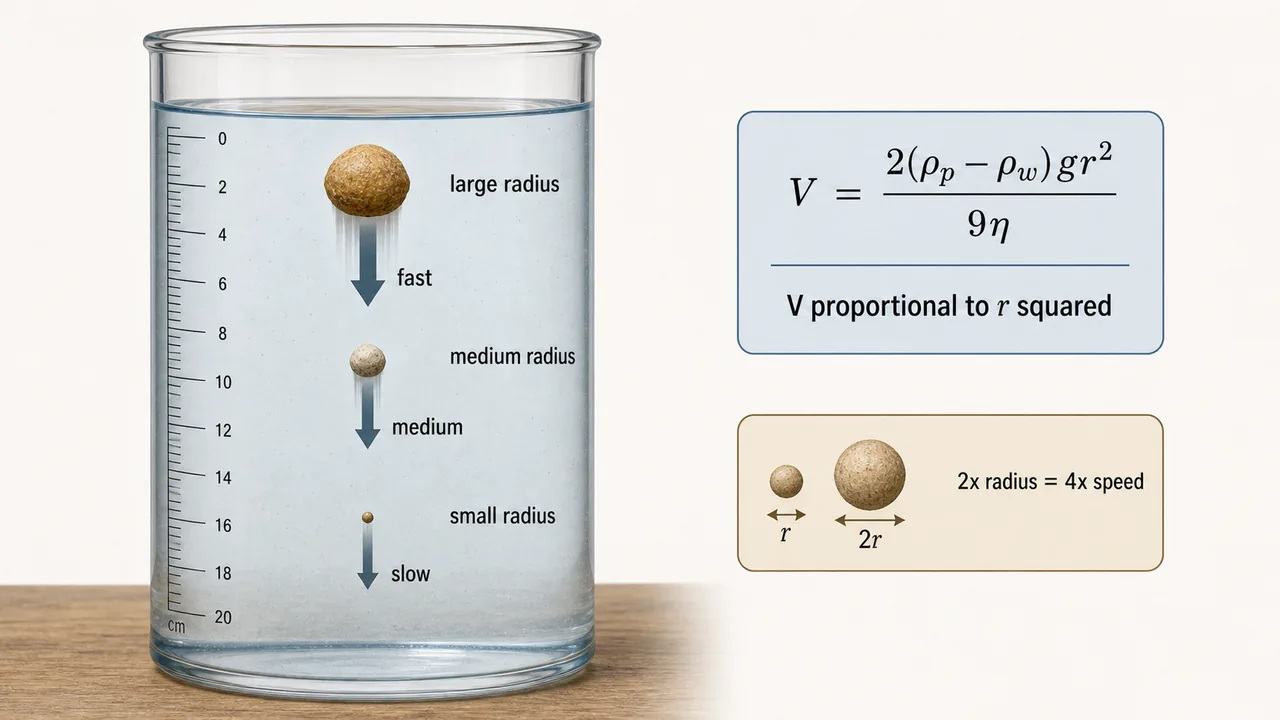
| Variable | Meaning | Standard Value |
|---|---|---|
| V | Velocity of settling (cm/sec) | Calculated |
| g | Acceleration due to gravity (cm/sec2) | 981 |
| ds | Density of soil particle | 2.65 g/cm3 |
| dw | Density of water | 1 |
| n | Viscosity of water | 0.0015 at 4 degrees C |
| r | Radius of particle (cm) | Measured |
Assumptions and Limitations
| Assumption | Limitation in Practice |
|---|---|
| Particles are rigid and spherical | Particles are irregularly shaped (platy clay) |
| Particles are large enough to avoid Brownian movement | Particles <0.0002 mm show Brownian movement |
| Fall is not affected by vessel walls or adjacent particles | Fast particles may drag fine particles down |
| Density and viscosity remain constant | Varies with mineral composition |
| Suspension must be still | Large particles (>0.08 mm) create turbulence |
| Temperature must be constant | Convection currents can form |
Despite these limitations, Stokes' Law remains the most widely used principle for particle size analysis.
Methods of Textural Determination

| Textural Determination Image Item | Full Content |
|---|---|
| Elutriation | Laboratory method that uses moving water or air to separate particles according to size and settling behavior |
| Pipette method | Standard laboratory method with high precision, based on sedimentation and timed sampling from suspension |
| Decantation or beaker method | Simple laboratory settling method in which finer particles remain longer in suspension while coarser ones settle first |
| Test tube shaking | Quick laboratory estimation method based on relative settling of sand, silt, and clay in a narrow tube |
| Feel method | Field method that estimates texture by grittiness, smoothness, stickiness, cohesion, and ribbon formation between fingers |
| Main idea | Coarse fractions are identified more easily by feel or sieving, while fine fractions require settling-based laboratory methods |
| Method | Type | Details |
|---|---|---|
| Elutriation | Laboratory | Uses water and air |
| Pipette | Laboratory | Standard precision method |
| Decantation/Beaker | Laboratory | Simple settling |
| Test tube shaking | Laboratory | Quick estimation |
| Feel method | Field | Quick; by feeling soil between fingers |
Feel Method (Field Assessment)
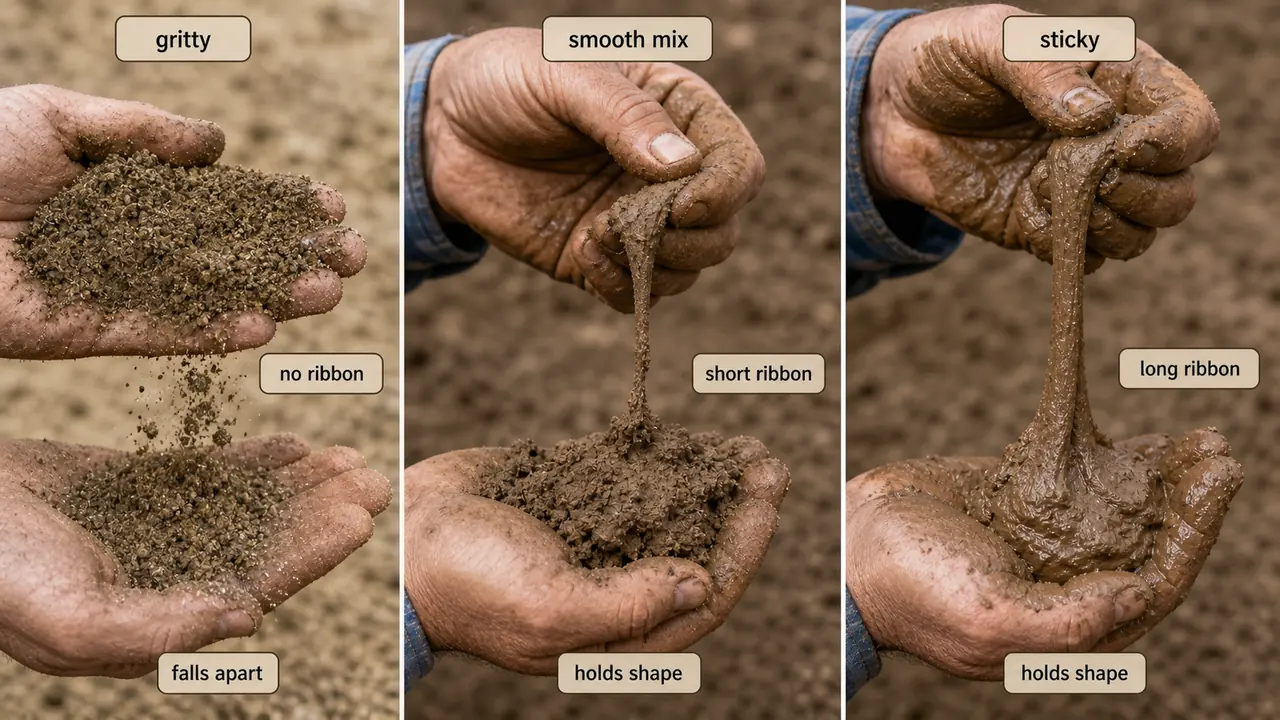
Evaluate by squeezing moistened soil into a thin ribbon between thumb and finger:
| Criterion | Sandy Soil | Loamy Soil | Clayey Soil |
|---|---|---|---|
| Feel | Gritty | Smooth mix | Sticky, plastic |
| Ball formation | Falls apart | Holds loosely | Firm, holds shape |
| Stickiness | Non-sticky | Slightly sticky | Very sticky |
| Ribbon formation | No ribbon | Short ribbon | Long, flexible ribbon |
12 Textural Classes (USDA)
There are 12 textural classes in 3 main groups: Sand, Loam, and Clay.
The Textural Triangle
The triangle is used to determine textural class after laboratory analysis. Sand + Silt + Clay = 100% (organic matter is not included).
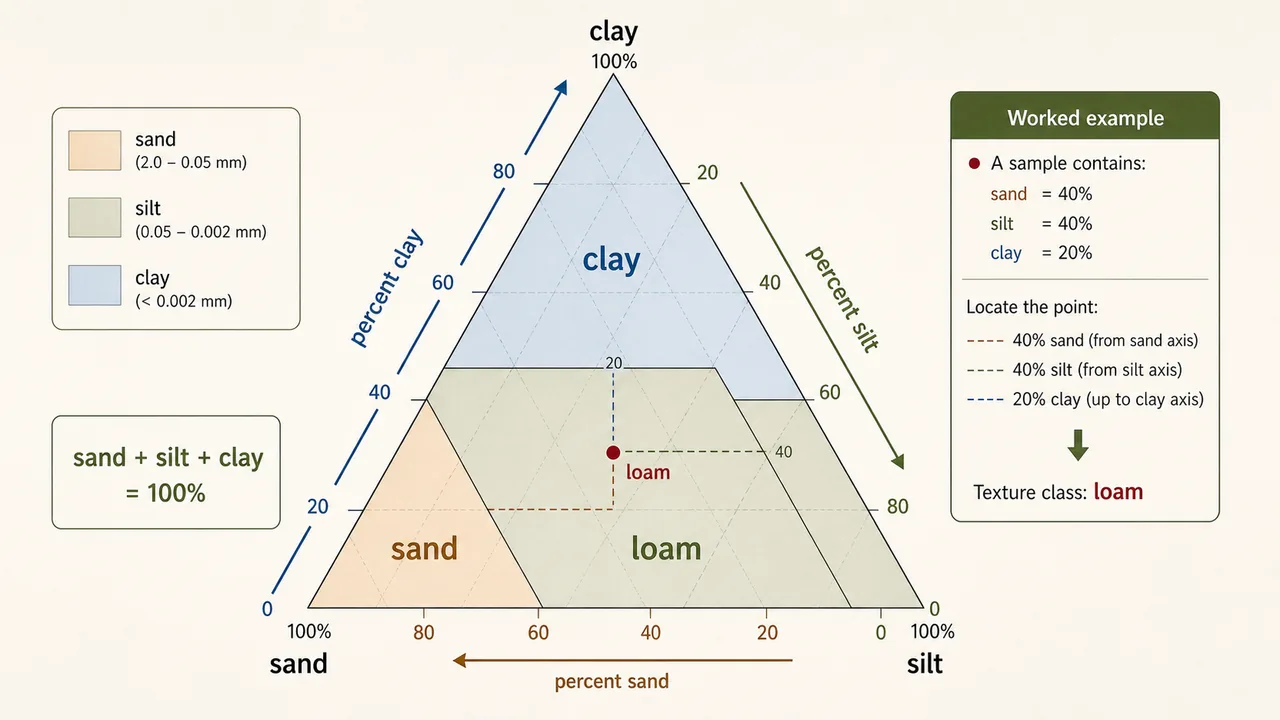
All 12 Classes
An ideal loam = mixture of Sand, Silt and Clay in approximately 40:20:20 ratio.
| # | Textural Class | Sand (%) | Silt (%) | Clay (%) | Agricultural Use |
|---|---|---|---|---|---|
| 1 | Sandy | 85-100 | 0-15 | 0-10 | Potato, groundnut, watermelon |
| 2 | Loamy Sand | 70-90 | 0-30 | 0-15 | Groundnut, cucumber |
| 3 | Sandy Loam | 43-80 | 0-50 | 0-20 | Tobacco, vegetables |
| 4 | Loam | 23-52 | 28-50 | 7-27 | Most crops (ideal) |
| 5 | Silt Loam | 0-50 | 50-88 | 0-27 | Wheat, barley |
| 6 | Silt | 0-20 | 40-100 | 0-12 | Wheat, rice |
| 7 | Sandy Clay Loam | 45-80 | 0-28 | 20-35 | Millets, sorghum |
| 8 | Clay Loam | 20-45 | 15-33 | 27-40 | Wheat, sugarcane |
| 9 | Silty Clay Loam | 0-20 | 40-73 | 27-40 | Rice, jute |
| 10 | Sandy Clay | 45-65 | 0-20 | 35-45 | Cotton, sorghum |
| 11 | Silty Clay | 0-20 | 40-60 | 40-60 | Rice, sugarcane |
| 12 | Clay | 0-45 | 0-40 | 40-100 | Rice, cotton, jute |
| Textural class | Sand | Silt | Clay |
|---|---|---|---|
| Sand | 85-100 | 0-15 | 0-10 |
| Loamy sand | 70-90 | 0-30 | 0-15 |
| Sandy loam | 43-80 | 0-50 | 0-20 |
| Loam | 23-52 | 28-50 | 7-27 |
| Silt loam | 0-50 | 50-88 | 0-27 |
| Silt | 0-20 | 88-100 | 0-12 |
| Sandy clay loam | 45-80 | 0-28 | 20-55 |
| Clay loam | 20-45 | 15-53 | 27-40 |
| Silty clay loam | 0-20 | 40-73 | 27-40 |
| Sandy clay | 40-65 | 0-20 | 35-45 |
| Silty clay | 0-20 | 40-60 | 40-60 |
| Clay | 0-40 | 0-40 | 40-60 |
Textural Group Thresholds
| Group | Threshold | Agricultural Character |
|---|---|---|
| Sandy soils | >70% sand, <=15% clay | Light; easy to till; poor water/nutrient retention |
| Silt soils | >80% silt | Smooth; moderate properties |
| Clay soils | >35% clay | Heavy; high water/nutrient retention; difficult to till |
Organic Soil Textures
| Term | Description | Organic Matter |
|---|---|---|
| Peat (Fibric) | Raw, undecomposed organic material | > 50% |
| Muck (Sapric) | Well-decomposed organic material | 20-50% |
| Mucky Peat | Intermediate between muck and peat | -- |
Agricultural Importance of Texture
IMPORTANT
Loamy soils are best for agriculture because they combine the drainage of sand, nutrient retention of clay, and moisture-holding of silt. This is the most frequently tested concept in soil texture.
Sandy Soils vs Clayey Soils
| Property | Sandy Soils ("Light") | Clayey Soils ("Heavy") |
|---|---|---|
| Tillage | Easy; loose and friable | Difficult; requires skill and timing |
| Drainage | Rapid; good aeration | Poor; fine pores |
| Water holding | Very low -- unsuitable for dryland farming | Very high -- prone to waterlogging |
| Nutrient retention | Poor; high leaching | Good; high CEC |
| Organic matter | Low | Higher |
| When wet | Drains quickly | Exceedingly sticky |
| When dry | Loose | Very hard, cracks |
| Suitable crops | Potato, groundnut, cucumber, watermelon | Rice, cotton, jute, sugarcane |
NOTE
The terms "heavy" and "light" refer to resistance offered to implements, not actual weight. Heavy clay soil actually weighs less per unit volume than light sandy soil because of more pore space.
Crops by Soil Texture
| Texture Group | Soil Types | Suitable Crops |
|---|---|---|
| Heavy (>35% clay) | Clay loam, silty clay, clay | Rice, cotton, sorghum, coriander |
| Medium | Loam, silt loam, silt, sandy loam | Most crops -- wheat, maize, vegetables |
| Light (<20% clay) | Sandy, loamy sand, sandy clay loam | Groundnut, potato, tobacco, pearl millet, leguminous fodders |
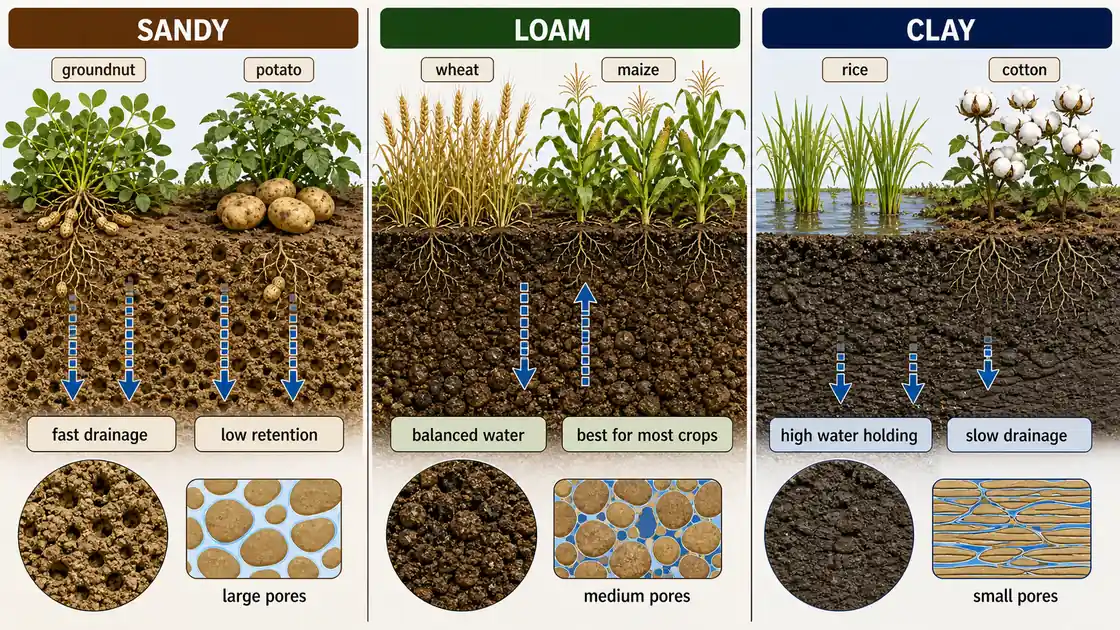
| Texture Panel | Full Content |
|---|---|
| Sandy | Large pores, fast drainage, low water and nutrient retention; suitable for crops such as groundnut and potato |
| Loam | Balanced pore space, balanced water supply, and generally best for most crops; typical crops include wheat and maize |
| Clay | Small pores, high water holding, slow drainage; suitable for crops such as rice and cotton |
IMPORTANT
The best agricultural soils contain 10-20% clay, 5-10% organic matter, and the rest equally shared by silt and sand with about 30% silt.
Summary Cheat Sheet
| Concept / Topic | Key Details |
|---|---|
| Soil texture | Relative proportion of sand, silt, and clay |
| Cannot be easily altered | Unlike structure, texture is permanent |
| Fine earth fraction | Particles <2 mm — basis for textural analysis |
| Clay size | <0.002 mm (same in all classification systems) |
| Sand role | Skeleton of soil; drainage and aeration; dominant mineral: quartz |
| Clay role | Flesh of soil; holds water and nutrients; highest surface area |
| Silt role | Intermediate; contributes to water holding |
| Marling | Adding clay to sandy soils to improve retention |
| Stokes' Law | V = kr²; velocity proportional to square of radius |
| Standard particle density | 2.65 g/cm³ (used in Stokes' Law) |
| 12 textural classes (USDA) | 3 groups: sand, loam, clay |
| Textural triangle | Graphical tool; Sand + Silt + Clay = 100%; OM not included |
| Best texture for agriculture | Loam — combines benefits of all three separates |
| Ideal loam ratio | ~40:20:20 (Sand:Silt:Clay approx.) |
| Best agricultural soil | 10–20% clay, 5–10% OM, ~30% silt |
| Heavy soil | Clay — resists implements (not about weight) |
| Light soil | Sandy — easy to work |
| Sandy soil crops | Potato, groundnut, cucumber, watermelon, tobacco |
| Clay soil crops | Rice, cotton, jute, sugarcane, sorghum |
| Peat (Fibric) | >50% OM; undecomposed organic material |
| Muck (Sapric) | 20–50% OM; well-decomposed |
| Heavy clay soil actually | Weighs less per unit volume than sandy (more pore space) |
| Best agricultural texture | Loam; Exam tip: Combines benefits of all three separates |