💩 Soil Colloids: The Powerhouse of Soil Chemistry
General properties of soil colloids including size, surface area, charge, adsorption, swelling, flocculation, CEC, and phosphorus fixation
Why does a handful of black cotton soil (Vertisol) feel sticky and hold water like a sponge, while the same amount of sandy soil from Rajasthan feels gritty and lets water drain instantly? The answer lies in soil colloids -- the tiniest but most chemically active particles in soil. Colloids govern nutrient retention, water holding, and structural stability, making them the true powerhouse behind soil fertility.
What are Soil Colloids?
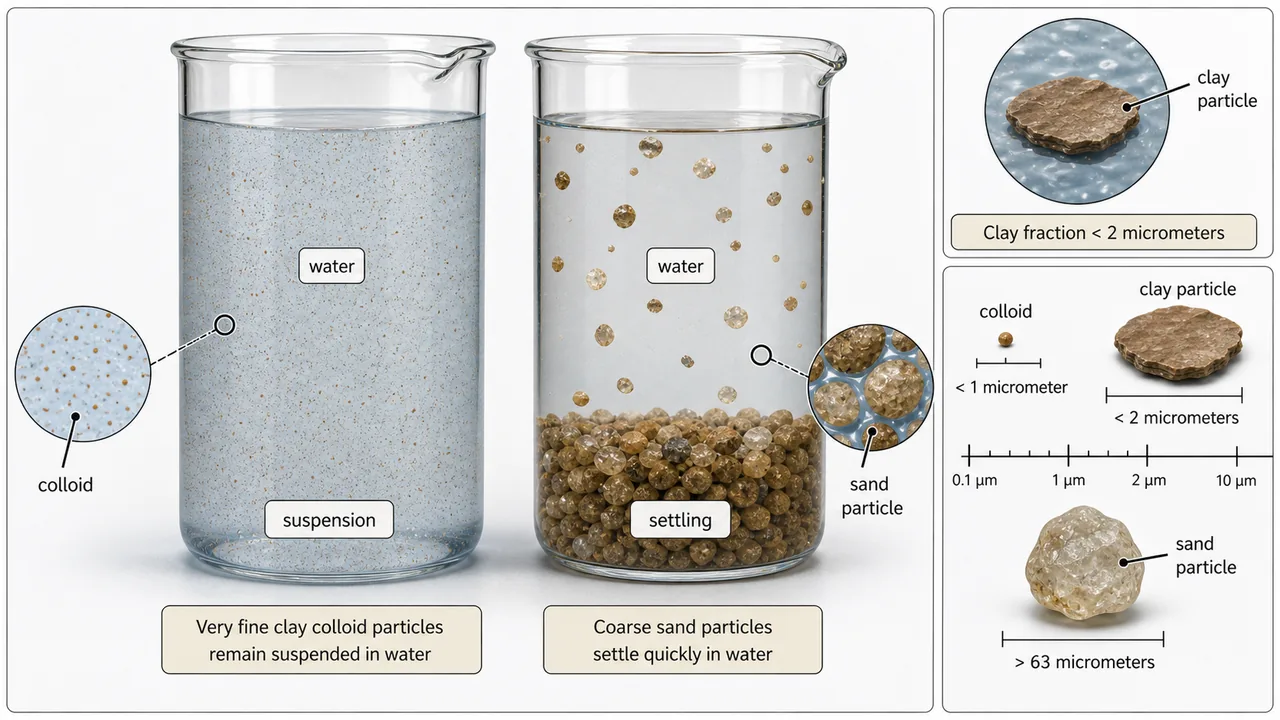
| Example | Dispersed Phase | Medium |
|---|---|---|
| Clay in water | Solid | Liquid |
| Fog or clouds | Liquid | Gas |
Colloidal particles are generally smaller than 1 micrometer (um) in diameter. Since the clay fraction of soil is less than 2 um, all clay exhibits colloidal properties even though some particles are slightly larger than the strict colloidal size limit.
Pro Content Locked
Upgrade to Pro to access this lesson and all other premium content.
Charged once for one year · ₹1188 total
Save ₹100/month vs ₹2388/year launch price
- All Agriculture & Banking Courses
- AI Lesson Questions (100/day)
- AI Doubt Solver (50/day)
- Glows & Grows Feedback (30/day)
- AI Section Quiz (20/day)
- 22-Language Translation (100/day)
- Recall Questions (20/day)
- AI Quiz (15/day)
- AI Quiz Paper Analysis (100/day)
- AI Step-by-Step Explanations (100/day)
- Spaced Repetition Recall (FSRS)
- AI Tutor
- Immersive Text Questions
- Audio Lessons — Hindi & English
- Mock Tests & Previous Year Papers
- Summary & Mind Maps
- XP, Levels, Leaderboard & Badges
- Generate New Classrooms
- Voice AI Teacher (AgriDots Live)
- AI Revision Assistant
- Knowledge Gap Analysis
- Interactive Revision (LangGraph)
🔒 Secure one-time yearly payment via Razorpay · No hidden fees
Why does a handful of black cotton soil (Vertisol) feel sticky and hold water like a sponge, while the same amount of sandy soil from Rajasthan feels gritty and lets water drain instantly? The answer lies in soil colloids -- the tiniest but most chemically active particles in soil. Colloids govern nutrient retention, water holding, and structural stability, making them the true powerhouse behind soil fertility.
What are Soil Colloids?
| Example | Dispersed Phase | Medium |
|---|---|---|
| Clay in water | Solid | Liquid |
| Fog or clouds | Liquid | Gas |
Colloidal particles are generally smaller than 1 micrometer (um) in diameter. Since the clay fraction of soil is less than 2 um, all clay exhibits colloidal properties even though some particles are slightly larger than the strict colloidal size limit.
General Properties of Soil Colloids
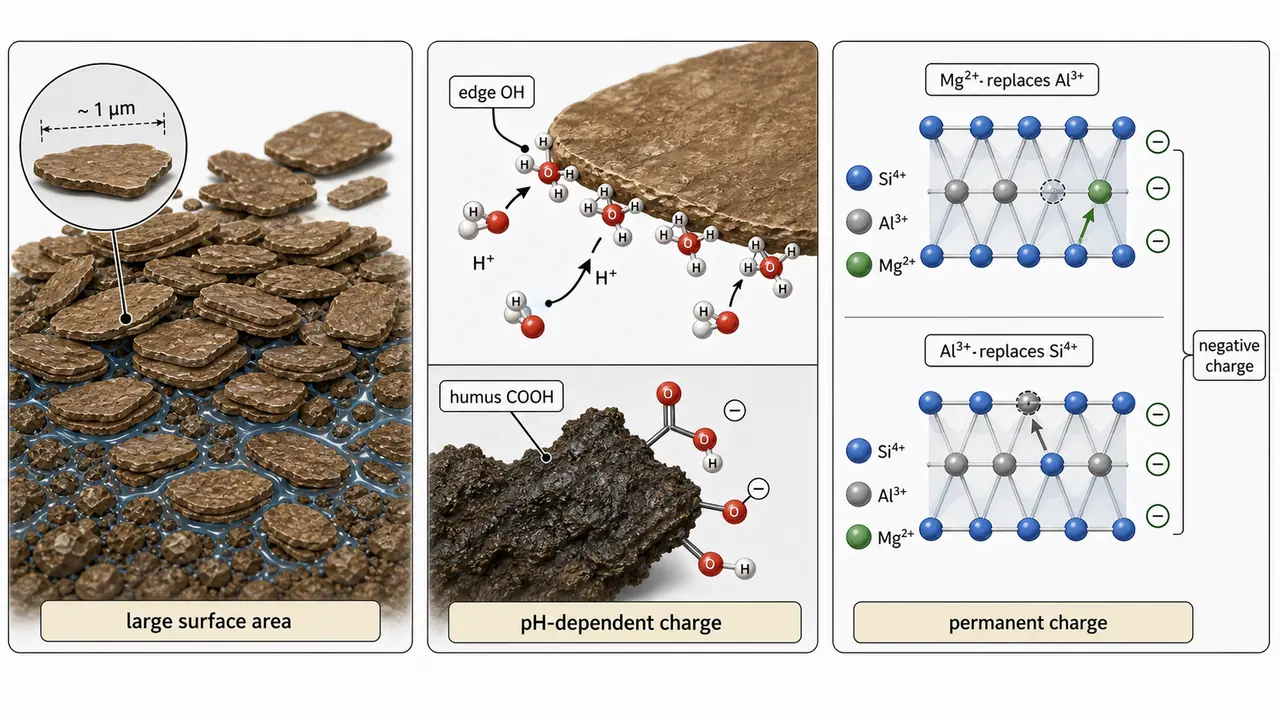
| Soil Colloid Charge Image Item | Full Content |
|---|---|
| Large surface area | Colloids expose a very large surface per unit mass, which allows them to adsorb large amounts of water and nutrients |
| Edge charge | Broken crystal edges carry pH-dependent charge because hydroxyl groups can gain or lose hydrogen ions |
| Humus functional groups | Organic colloids develop variable negative charge mainly from carboxyl and phenolic groups |
| Permanent negative charge | 2:1 clays develop internal negative charge through isomorphous substitution in tetrahedral and octahedral sheets |
| pH effect | Increasing pH usually increases negative charge on variable-charge colloids by promoting dissociation of H⁺ |
| Main lesson | Surface area and charge together explain why soil colloids hold cations, water, and much of the soil’s fertility |
1. Size
Inorganic and organic colloids are extremely small -- smaller than 2 micrometers in diameter. They cannot be seen with an ordinary light microscope; only an electron microscope can reveal them. Their tiny size is what gives colloids their unique and powerful properties.
2. Surface Area
Because of their small size, colloids have an enormous external surface area per unit mass. The external surface area of 1 g of colloidal clay is 1000 times that of 1 g of coarse sand. This enormous surface is what allows colloids to interact with so many ions and water molecules.
Certain silicate clays (like montmorillonite) also have extensive internal surfaces between plate-like crystal units, which often greatly exceed external surface area.
Surface Area by Clay Mineral Type
| Clay Mineral | Type | Total Surface Area (m²/g) | Internal Surface |
|---|---|---|---|
| Kaolinite | 1:1 | 37-45 | None |
| Illite | 2:1 non-expanding | 120-170 | Low |
| Montmorillonite | 2:1 expanding | 580-750 | High |
| Vermiculite | 2:1 limited expanding | 780-900 | Less than montmorillonite |
| Humus | Organic | 1200 | - |
IMPORTANT
Vermiculite has the highest surface area among silicate clays (780-900 m²/g), even higher than montmorillonite. Humus has the highest overall surface area at 1200 m²/g.
Farm example: Black cotton soils of Maharashtra (rich in montmorillonite) retain more nutrients than sandy soils of Rajasthan because of the vastly greater surface area available for ion adsorption.
3. Surface Charges
Both external and internal colloid surfaces carry negative and/or positive charges. Most organic and inorganic soil colloids carry a net negative charge. When electric current is passed through a colloidal suspension, particles migrate to the anode (positive electrode), confirming their negative charge.
The magnitude of this charge is called zeta potential.
Sources of Negative Charge
A. pH-Dependent (Variable) Charge
Arises from ionization of:
- Hydroxyl groups (-OH) at broken crystal edges (important in kaolinite, 1:1 clays)
- Carboxyl (-COOH) and phenolic (-C₆H₅OH) groups (chief source of charge in humus)
As soil pH increases, more H⁺ dissociates, increasing the negative charge. This is why it is called pH-dependent or variable charge.
Farm example: Liming an acid laterite soil (raising pH) increases the CEC because more pH-dependent negative charges are activated.
B. Permanent Charge (from Isomorphous Substitution)
Occurs when a cation of higher valence is replaced by a cation of lower valence (but similar size) in the clay crystal structure during mineral formation.
| Substitution | Location | Result |
|---|---|---|
| Al³⁺ replaces Si⁴⁺ | Tetrahedral sheet | One unsatisfied negative charge |
| Mg²⁺ replaces Al³⁺ | Octahedral sheet | One unsatisfied negative charge |
This charge is not dependent on pH -- it is called permanent charge. Isomorphous substitution is most significant in 2:1 type clays (montmorillonite, vermiculite).
| Climate Zone | Dominant Clay | Dominant Charge Type |
|---|---|---|
| Temperate regions | 2:1 type clays | Permanent negative charges |
| Tropical regions | 1:1 clays, Fe/Al oxides, high OM | Variable negative charges |
4. Adsorption of Cations
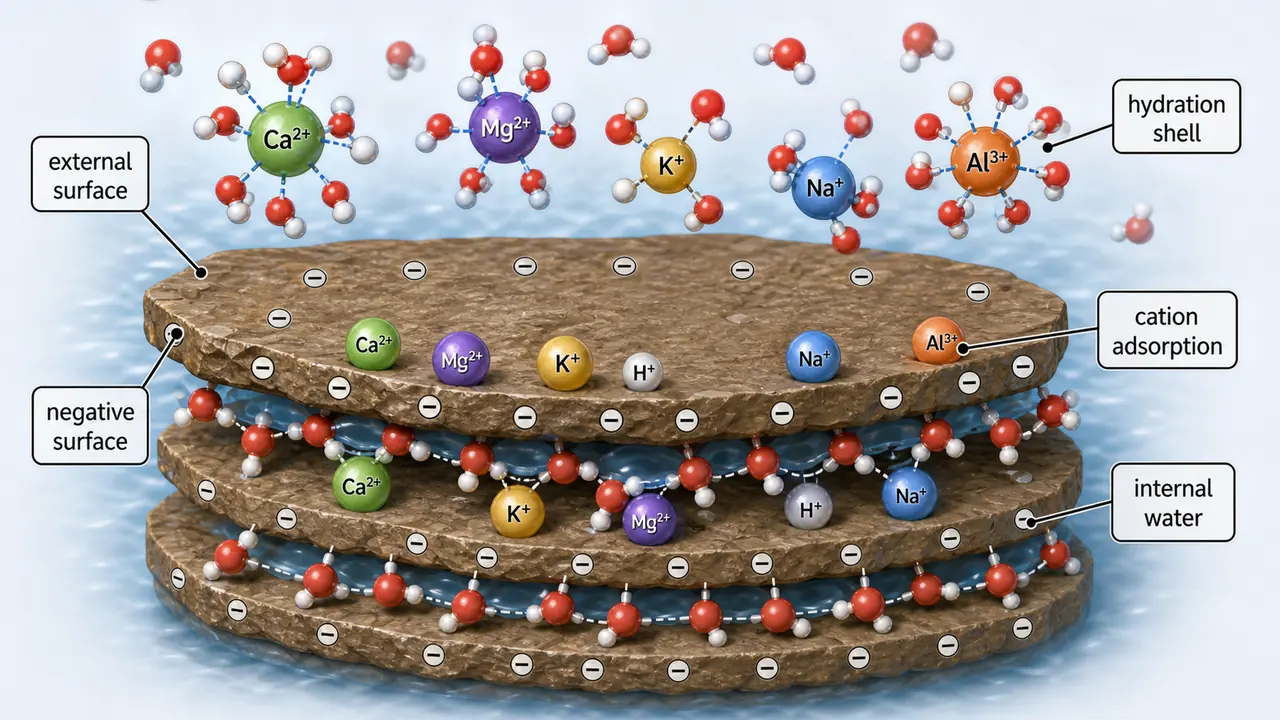
Since soil colloids are negatively charged, they attract and hold positively charged ions (cations) on their surfaces. This creates an ionic double layer: the negatively charged colloid forms the inner layer, and the swarm of attracted cations (H⁺, Al³⁺, Ca²⁺, Mg²⁺, K⁺, Na⁺) forms the outer layer.
CEC Values by Clay Mineral
| Colloid Type | CEC (meq/100 g) | Charge Type |
|---|---|---|
| Kaolinite | 1-15 | Mostly pH-dependent (variable) |
| Illite | 30-40 | Mostly permanent |
| Montmorillonite | 80-150 | Mostly permanent (isomorphous substitution) |
| Vermiculite | 100-150 | Mostly permanent |
| Humus | >200 | Entirely pH-dependent (variable) |
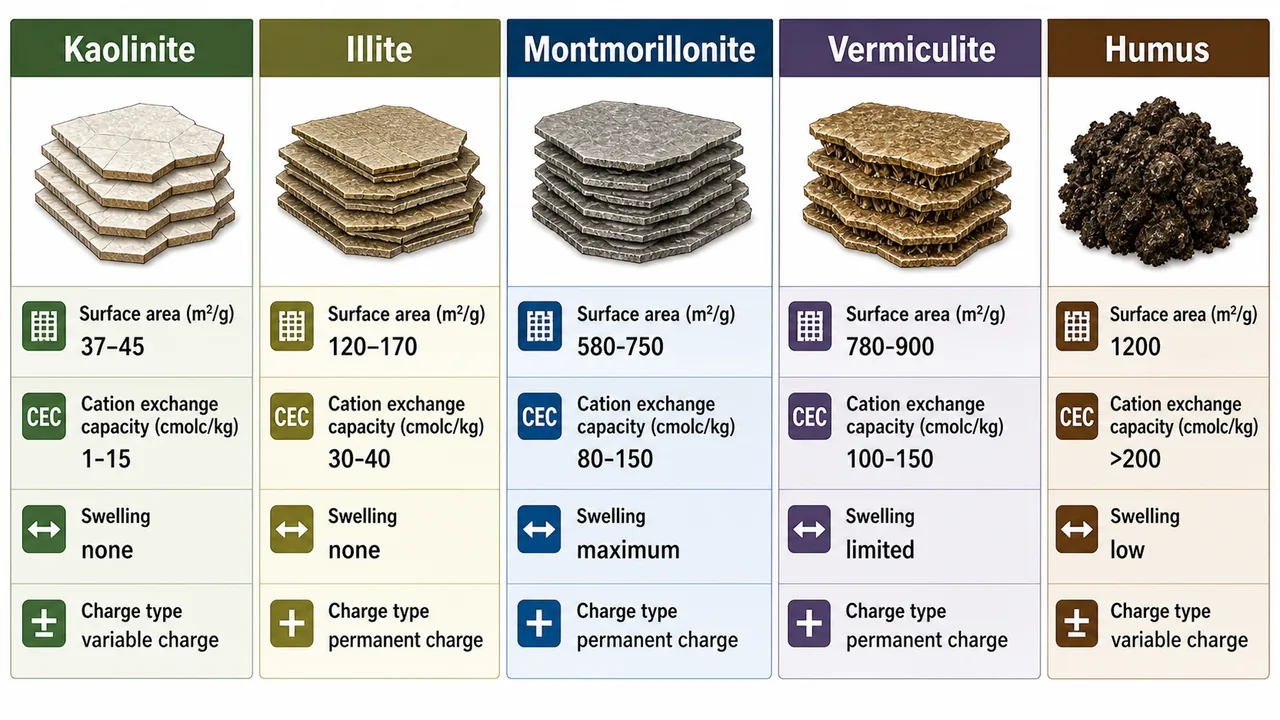
| Colloid Type | Surface area (m²/g) | CEC (meq/100 g) | Swelling | Dominant charge type |
|---|---|---|---|---|
| Kaolinite | 37-45 | 1-15 | None | Variable (pH-dependent) |
| Illite | 120-170 | 30-40 | None | Mostly permanent |
| Montmorillonite | 580-750 | 80-150 | Maximum | Mostly permanent |
| Vermiculite | 780-900 | 100-150 | Limited | Mostly permanent |
| Humus | 1200 | >200 | Low | Variable (pH-dependent) |
TIP
Humus has the highest CEC (>200 meq/100 g) but its charge is entirely pH-dependent. Among clay minerals, Vermiculite and Montmorillonite have the highest CEC (100-150 and 80-150 respectively), with mostly permanent charge.
Farm example: Adding well-decomposed FYM (humus) to sandy soils dramatically increases CEC, allowing the soil to hold more fertilizer nutrients instead of losing them to leaching.
5. Adsorption of Water
A large number of water molecules are associated with soil colloidal particles:
- Some are attracted to adsorbed cations (hydrated state -- each cation carries a shell of water)
- Others are held in the internal surfaces of clay particles
This water adsorption determines both physical and chemical properties of the soil.
6. Cohesion
Cohesion is the attractive force between similar molecules or materials. Clay particles tend to stick together because of the attraction for water molecules held between them. Cohesion is a major contributor to soil strength and consistency when wet.
| Clay Mineral | Cohesion, Plasticity, Swelling |
|---|---|
| Kaolinite | Very low |
| Illite | Low |
| Vermiculite | Medium |
| Montmorillonite | High |
| Humus | Low |
7. Adhesion
Adhesion is the attractive force between different molecules or materials. Colloidal materials stick to any surface they contact. This is why wet clay sticks to boots, ploughs, and tractor tires.
Farm example: Ploughing black cotton soil at the wrong moisture content makes it stick to implements, wasting energy and time.
8. Swelling and Shrinkage
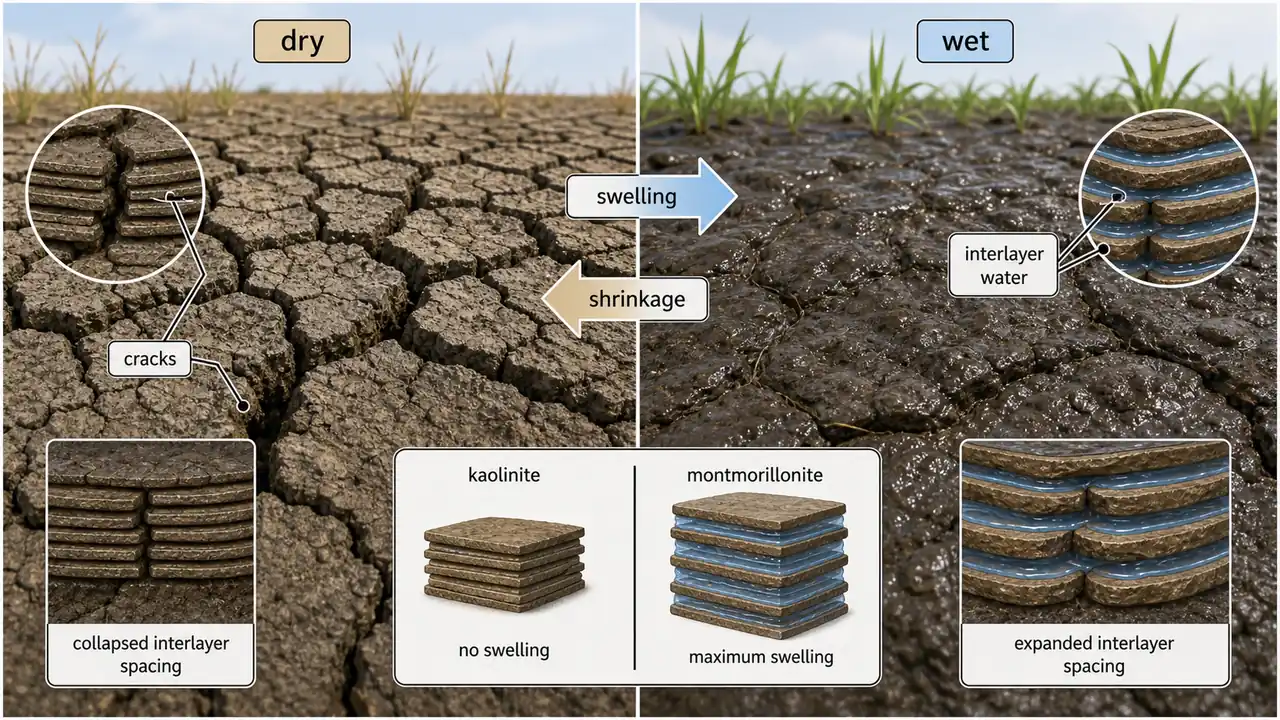
Some clay colloids of the smectite group (montmorillonite) swell when wet and shrink when dry. Water molecules enter between crystal layers, pushing them apart.
Swelling Behavior by Clay Mineral
| Clay Mineral | Type | Swelling | Reason |
|---|---|---|---|
| Kaolinite | 1:1 non-expanding | No swelling | Layers held by H-bonds |
| Illite | 2:1 non-expanding | No swelling | K⁺ ions lock layers |
| Montmorillonite | 2:1 fully expanding | Maximum swelling | Weak interlayer bonds |
| Vermiculite | 2:1 partially expanding | Limited swelling | Partial expansion |
| Chlorite | 2:2 non-expanding | No swelling | Mg(OH)₂ interlayer brace |
IMPORTANT
Montmorillonite is the only clay that shows full expansion. This is why black cotton soils (Vertisols) develop deep cracks in summer and swell shut during monsoon. Vermiculite shows only partial expansion.
Farm example: After a prolonged dry spell, black soil fields of central India show criss-cross cracks 30-45 cm deep. These cracks allow initial rain to penetrate rapidly, but once the soil swells, the cracks close and the surface becomes impervious, causing waterlogging.
9. Dispersion and Flocculation
| Process | Definition | Key Cation | Effect on Soil |
|---|---|---|---|
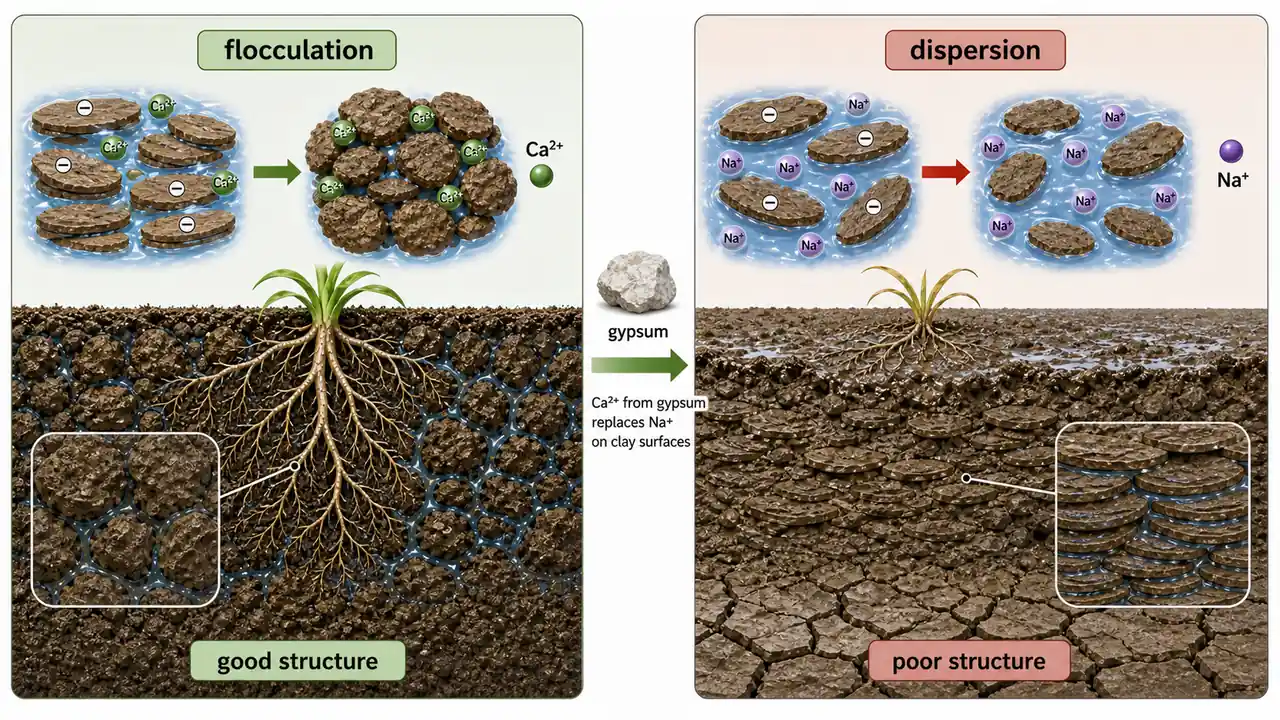
| Flocculation | Colloidal particles lose charge, coalesce into aggregates, settle down | Ca²⁺ (most effective) | Good structure -- first step toward aggregation |
| Dispersion (De-flocculation) | Aggregates break into individual particles | Na⁺ (promotes dispersion) | Poor structure -- sodic soils |
IMPORTANT
Flocculation vs Dispersion is a high-yield concept: Ca²⁺ → flocculation → good structure; Na⁺ → dispersion → poor structure. This is the basis for reclaiming sodic soils with gypsum (CaSO₄).
Farm example: Sodic soils in UP and Haryana have poor structure because Na⁺ disperses clay particles. Applying gypsum replaces Na⁺ with Ca²⁺, promoting flocculation and restoring soil structure.
10. Brownian Movement
When colloidal particles in suspension are examined under a microscope, they appear to oscillate. This motion results from collision with water molecules. The smaller the particle, the more rapid its movement. This keeps colloids in suspension and facilitates their interaction with dissolved ions.
11. Non-Permeability
Colloids are unable to pass through a semi-permeable membrane, unlike dissolved crystalloids. This property is the basis of dialysis -- a laboratory technique to separate colloids from true solutions.
12. Acid Nature of Clay
Clay migrates to the positive anode in electrolysis, behaving like an acid radical. Clay is sometimes called clay-acid.
| Climate | Dominant Cations | Clay Type | Soil Reaction |
|---|---|---|---|
| Humid regions | H⁺ and Al³⁺ | Acid clay (Al-H clay) | Acidic |
| Arid regions | Ca²⁺ and Mg²⁺ | Calcium clay | Neutral |
| Highly arid (limited leaching) | Na⁺ dominates over Ca²⁺ | Sodium-calcium clay | Alkaline |
| Region | Predominant Cations |
|---|---|
| Humid | Ca²⁺, Al³⁺ and H⁺ |
| Arid | Ca²⁺, Mg²⁺, K⁺ and Na⁺ |
Phosphorus Fixation by Clay Minerals
| Clay Mineral | P-Fixing Capacity | Reason |
|---|---|---|
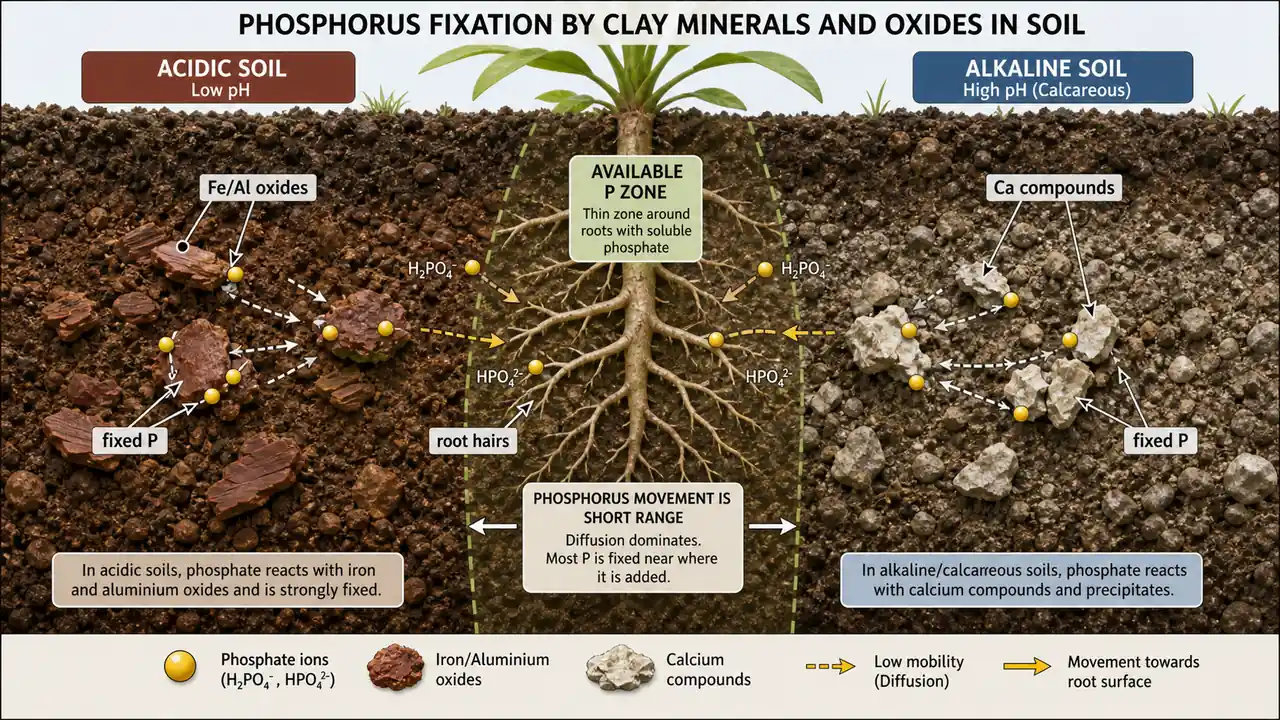
| Kaolinite | Highest (among silicate clays) | Exposed hydroxyl groups on edges |
| Illite | Low | Limited edge sites |
| Vermiculite | Medium | Moderate edge exposure |
| Sesquioxide clays (Fe/Al oxides) | Very High | Fe and Al react directly with P |
TIP
Kaolinite has the highest P-fixing capacity among silicate clays. In tropical soils rich in sesquioxides (Fe/Al oxides), phosphorus fixation is even more severe -- the biggest fertility challenge in deeply weathered laterite soils of Kerala and Karnataka.
Farm example: Farmers on red laterite soils of Karnataka must apply much higher doses of phosphatic fertilizers because a large portion gets "fixed" by iron and aluminum oxides and becomes unavailable to crops.
Exam Tips and Mnemonics
- Surface area order: Humus (1200) > Vermiculite (780-900) > Montmorillonite (580-750) > Illite (120-170) > Kaolinite (37-45) -- remember "HVMIK" (decreasing)
- CEC order: Humus (>200) > Vermiculite (100-150) > Montmorillonite (80-150) > Illite (30-40) > Kaolinite (1-15)
- Swelling order: Montmorillonite > Vermiculite > Illite/Kaolinite/Chlorite (none)
- Flocculation = Ca²⁺ = Good structure vs Dispersion = Na⁺ = Poor structure -- remember "Calcium Creates, Sodium Scatters"
- Permanent charge = Isomorphous substitution (2:1 clays); Variable charge = pH-dependent (1:1 clays, humus)
- P-fixation: Kaolinite > Sesquioxides (very high) in tropical soils
- Highest overall surface area: Humus; Highest among silicate clays: Vermiculite
Summary Cheat Sheet
| Concept / Topic | Key Details |
|---|---|
| Colloid size | Smaller than 1 μm (clay fraction <2 μm exhibits colloidal properties) |
| Visible only under | Electron microscope |
| Surface area — Humus | 1200 m²/g (highest overall) |
| Surface area — Vermiculite | 780–900 m²/g (highest among silicate clays) |
| Surface area — Montmorillonite | 580–750 m²/g |
| Surface area — Illite | 120–170 m²/g |
| Surface area — Kaolinite | 37–45 m²/g (lowest) |
| CEC — Humus | >200 meq/100g (entirely pH-dependent charge) |
| CEC — Vermiculite | 100–150 (mostly permanent charge) |
| CEC — Montmorillonite | 80–150 (mostly permanent — isomorphous substitution) |
| CEC — Illite | 30–40 |
| CEC — Kaolinite | 1–15 (mostly variable charge) |
| Isomorphous substitution | Al³⁺ replaces Si⁴⁺ (tetrahedral) or Mg²⁺ replaces Al³⁺ (octahedral) → permanent negative charge |
| pH-dependent charge | From –OH, –COOH, phenolic groups; increases with pH; dominant in kaolinite and humus |
| Zeta potential | Magnitude of charge on colloid surface |
| Swelling order | Montmorillonite (maximum) > Vermiculite (limited) > Illite/Kaolinite/Chlorite (none) |
| Flocculation | Ca²⁺ promotes → good structure; "Calcium Creates" |
| Dispersion | Na⁺ promotes → poor structure; "Sodium Scatters" |
| Gypsum reclamation | CaSO₄ replaces Na⁺ with Ca²⁺ → restores structure |
| Cohesion highest | Montmorillonite (high plasticity, stickiness) |
| P-fixation — silicate clays | Kaolinite highest (exposed –OH groups) |
| P-fixation — oxides | Sesquioxides (Fe/Al oxides) very high; laterite soils |
| Brownian movement | Oscillation of colloids from water molecule collisions |
| Dialysis | Colloids cannot pass through semi-permeable membrane |
| Acid clay (humid) | Dominated by H⁺ and Al³⁺ → acidic reaction |
| Calcium clay (arid) | Dominated by Ca²⁺ and Mg²⁺ → neutral reaction |
| Sodium clay (highly arid) | Na⁺ dominates → alkaline reaction |
| Type | 1:1 non-expanding; Exam tip: 2:1 non-expanding |
| Surface area (m²/g) | 37-45; Exam tip: 120-170 |
| CEC (meq/100 g) | 1-15; Exam tip: 30-40 |
| Cohesion/Swelling | Very low; Exam tip: Low |
| Charge type | Variable (pH); Exam tip: Mostly permanent |
| Internal surface | None; Exam tip: Low |
| Size (micron) | 0.1-5.0; Exam tip: 0.1-2.0 |