🏝 Soil Water: The Lifeline of Crop Production
Importance, classification, soil water potential, moisture constants, water movement, infiltration, percolation, and measurement methods for competitive exams
A farmer in Rajasthan watches his mustard crop wilt under blazing sun, while another farmer in Punjab, with the same variety, harvests a bumper crop. The critical difference? Soil water. Water is the single most important factor determining crop yield -- more often than any nutrient deficiency, it is the amount of available water that decides whether a crop thrives or fails.
Importance of Soil Water
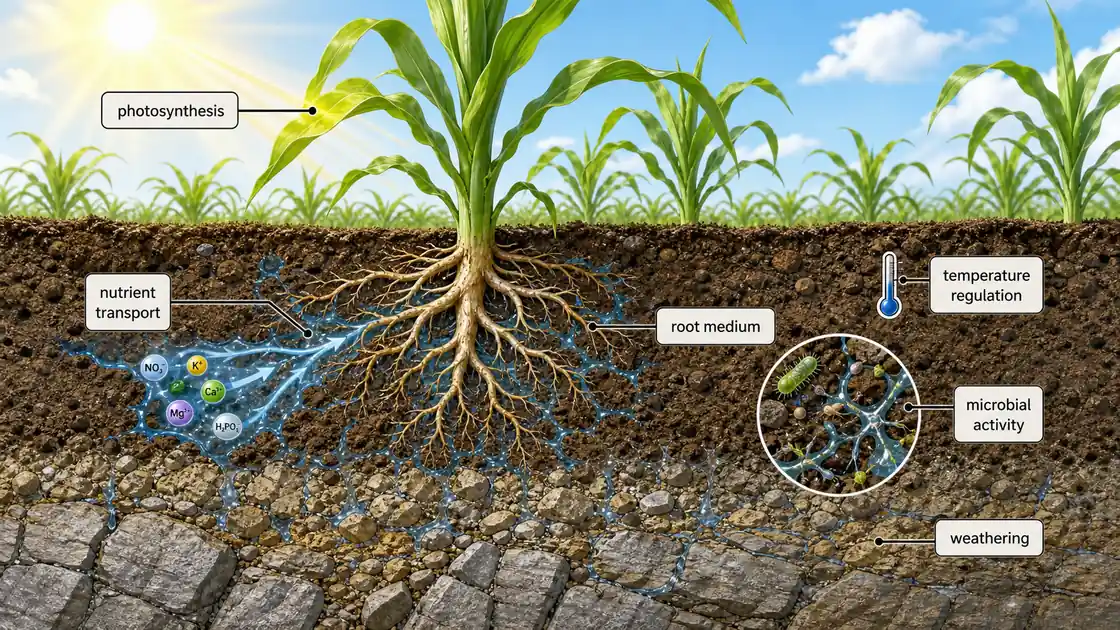
| Function | How it Helps |
|---|---|
| Solvent and carrier | Dissolves and transports nutrients to plant roots |
| Nutrient itself | Hydrogen from water is incorporated into plant tissues |
| Photosynthesis | Essential raw material (6CO₂ + 6H₂O → C₆H₁₂O₆) |
| Temperature regulator | Moderates soil temperature through evaporation and heat capacity |
| Weathering agent | Drives soil formation and mineral breakdown |
| Microbial medium | Microorganisms need water for metabolic activities |
| Plant constituent | Makes up 85-95% of plant protoplasm |
Farm example: Yield of irrigated wheat in Haryana (4-5 t/ha) is 3-4 times higher than rainfed wheat in Madhya Pradesh (1-1.5 t/ha) -- the difference is entirely water availability.
Pro Content Locked
Upgrade to Pro to access this lesson and all other premium content.
Charged once for one year · ₹1188 total
Save ₹100/month vs ₹2388/year launch price
- All Agriculture & Banking Courses
- AI Lesson Questions (100/day)
- AI Doubt Solver (50/day)
- Glows & Grows Feedback (30/day)
- AI Section Quiz (20/day)
- 22-Language Translation (100/day)
- Recall Questions (20/day)
- AI Quiz (15/day)
- AI Quiz Paper Analysis (100/day)
- AI Step-by-Step Explanations (100/day)
- Spaced Repetition Recall (FSRS)
- AI Tutor
- Immersive Text Questions
- Audio Lessons — Hindi & English
- Mock Tests & Previous Year Papers
- Summary & Mind Maps
- XP, Levels, Leaderboard & Badges
- Generate New Classrooms
- Voice AI Teacher (AgriDots Live)
- AI Revision Assistant
- Knowledge Gap Analysis
- Interactive Revision (LangGraph)
🔒 Secure one-time yearly payment via Razorpay · No hidden fees
A farmer in Rajasthan watches his mustard crop wilt under blazing sun, while another farmer in Punjab, with the same variety, harvests a bumper crop. The critical difference? Soil water. Water is the single most important factor determining crop yield -- more often than any nutrient deficiency, it is the amount of available water that decides whether a crop thrives or fails.
Importance of Soil Water
| Function | How it Helps |
|---|---|
| Solvent and carrier | Dissolves and transports nutrients to plant roots |
| Nutrient itself | Hydrogen from water is incorporated into plant tissues |
| Photosynthesis | Essential raw material (6CO₂ + 6H₂O → C₆H₁₂O₆) |
| Temperature regulator | Moderates soil temperature through evaporation and heat capacity |
| Weathering agent | Drives soil formation and mineral breakdown |
| Microbial medium | Microorganisms need water for metabolic activities |
| Plant constituent | Makes up 85-95% of plant protoplasm |
Farm example: Yield of irrigated wheat in Haryana (4-5 t/ha) is 3-4 times higher than rainfed wheat in Madhya Pradesh (1-1.5 t/ha) -- the difference is entirely water availability.
Structure of Water
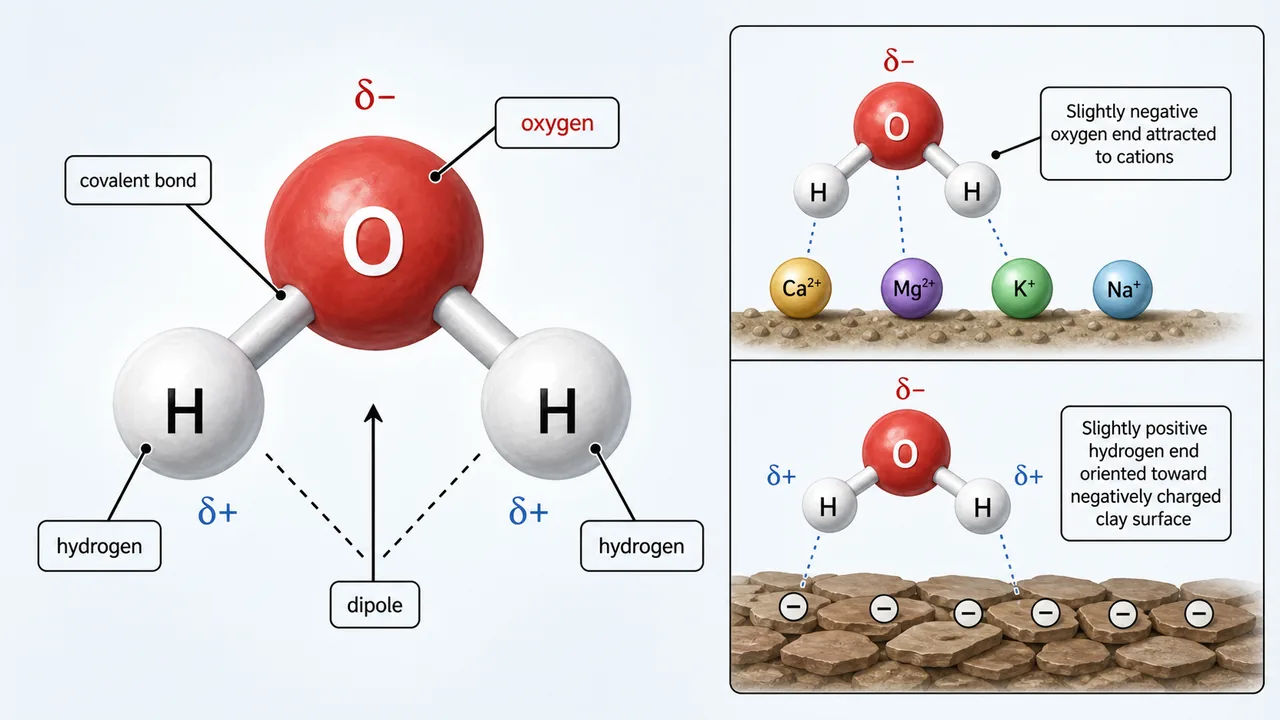
This polarity makes water an excellent solvent for salts, enables it to adhere to soil particles, and allows participation in ion exchange -- all critical for plant nutrition.
Forces Acting on Soil Water
Three primary forces control how water behaves in soil:
| Force | What it Does | Agricultural Significance |
|---|---|---|
| Adhesion | Attraction of water to soil particles | Binds water tightly to solid surfaces |
| Cohesion | Attraction of water molecules to each other | Allows water films to extend outward from particles |
| Capillarity | Water movement against gravity through fine pores | Enables water to rise from deeper layers to roots |
Together, adhesion and cohesion create surface tension that drives capillary rise and holds water in soil pores against gravity.
Factors Affecting Soil Water Retention
| Factor | Effect on Water Retention | Example |
|---|---|---|
| Texture | Finer texture = more retention | Clay > Silt > Sand Exams |
| Structure | Well-aggregated = better retention | Granular structure retains more than massive |
| Organic matter | More OM = more retention | OM holds up to 20 times its own weight in water |
| Density | Higher density = lower moisture | Compacted soils hold less water per unit volume |
| Temperature | Cooler = higher retention | Cold soils hold moisture longer |
| Salt content | More salt = less available water | Salts increase osmotic potential, making water harder for roots to extract |
| Depth | Greater depth = more water storage | Deep soils store more plant-available water |
| Type of clay | 2:1 clays hold more water | Montmorillonite holds water between crystal layers (interlayer water) |
Classification of Soil Water
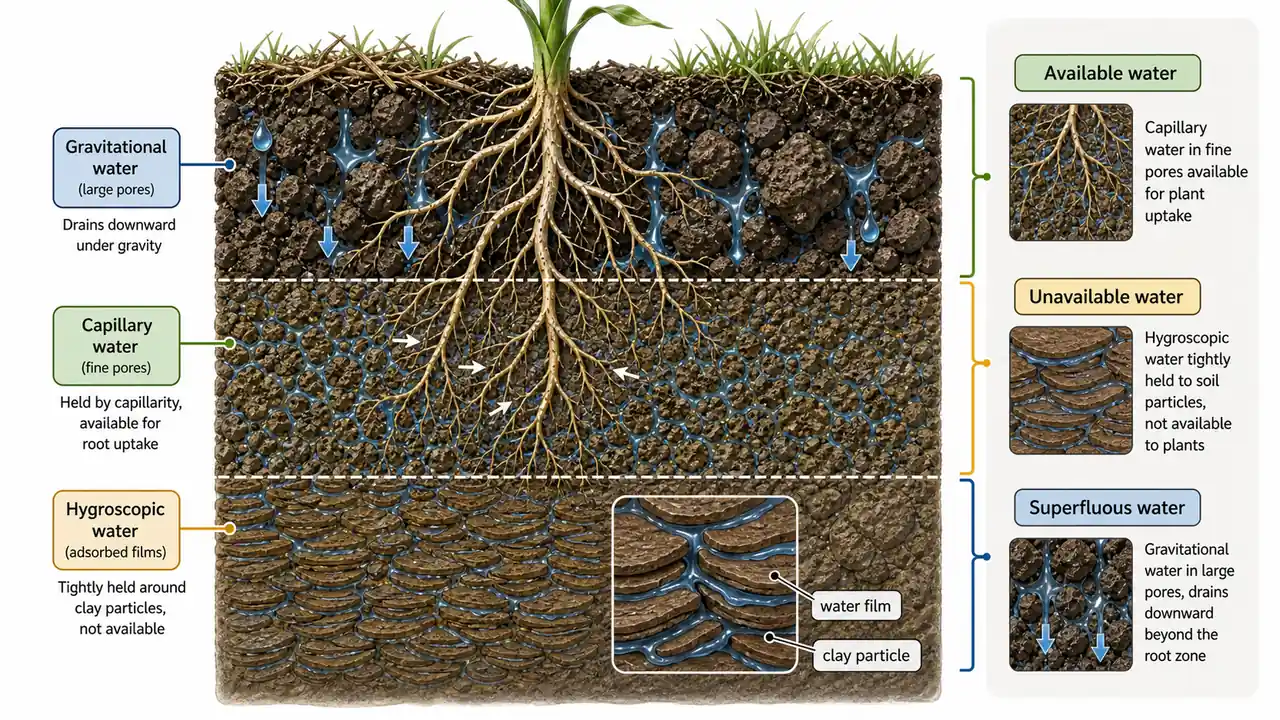
Soil water is classified from both physical and biological perspectives.
A. Physical Classification
1. Gravitational Water
- Occupies macro pores (large pores)
- Moves downward under the force of gravity
- Water in excess of field capacity
- Moisture tension: zero or less than 1/3 atmosphere
- Present between saturation and field capacity
| Feature | Detail |
|---|---|
| Availability to plants | Not available -- moves too quickly for roots to absorb |
| Other name | Drainage water |
| Harmful effects | Reduces aeration, causes nutrient leaching |
| Texture effect | Drains faster in sandy soils than clay soils |
| Structure effect | Granular/crumby structure improves drainage; platy structure causes waterlogging |
Farm example: After heavy irrigation of a cotton field, water draining below the root zone is gravitational water. It carries away nitrate nitrogen, wasting expensive fertilizer.
2. Capillary Water -- The Most Important Water for Crops
- Held in micro pores (capillary pores)
- Retained by surface forces -- gravity cannot remove it
- Molecules are free, mobile, and in liquid state
- Functions as the soil solution -- the primary form available to crops
- Pressure range: 1/3 to 31 atmosphere (-1/3 to -31 bars)
| Subdivision | Pressure Range | Availability |
|---|---|---|
| Field capacity to PWP (1/3 to 15 atm) | -1/3 to -15 bars | Available to plants |
| PWP to Hygroscopic coefficient (15 to 31 atm) | -15 to -31 bars | Unavailable to plants |
Capillary action allows water to flow upward through fine soil pores against gravity, due to intermolecular forces between water and soil surfaces.
Factors affecting capillary water:
| Factor | Effect |
|---|---|
| Surface tension | Higher surface tension = more capillary water |
| Finer texture | More capillary water (greater surface area, more micropores) |
| Platy structure | Holds more capillary water than granular |
| Organic matter | Increases capillary capacity (humus absorbs and holds water) |
Farm example: In dryland agriculture of Deccan plateau, crops survive dry spells because capillary water rises from deeper moist layers to the root zone.
3. Hygroscopic Water
- Held tightly on the surface of soil colloidal particles
- Adsorbed from atmospheric water vapour
- Essentially non-liquid -- moves primarily in vapour form Exams
- Pressure range: 31 to 10,000 atmosphere (-31 to -10,000 bars)
- Not available to plants (some bacteria may use it)
- Can only be removed by oven drying at 105 degree C
| Factor | Effect on Hygroscopic Water |
|---|---|
| Smaller particles | Greater amount of hygroscopic water |
| Montmorillonite clay | Adsorbs more (large surface area) |
| Kaolinite clay | Adsorbs less |
| Illite clay | Intermediate |
B. Biological Classification
Based on availability to plants, soil water is divided into three categories:
| Category | Pressure Range | Description |
|---|---|---|
| Available water | FC (1/3 atm) to PWP (15 atm) | Water plants can actually use. Available water = FC - PWP |
| Unavailable water | 15 to 10,000 atm | Hygroscopic water + part of capillary water below wilting point |
| Superfluous water (Super available) | Less than 1/3 atm | Gravitational water -- harmful to plants due to lack of air |
Factors affecting available water:
| Factor | Effect |
|---|---|
| Fine texture | More available water |
| Well-aggregated structure | More available water |
| High organic matter | More available water |
| Less compaction | More pore space, more retention |
| High soluble salts | Less available water (higher osmotic potential) |
| Greater soil depth | More available water |
Retention of Water by Soil
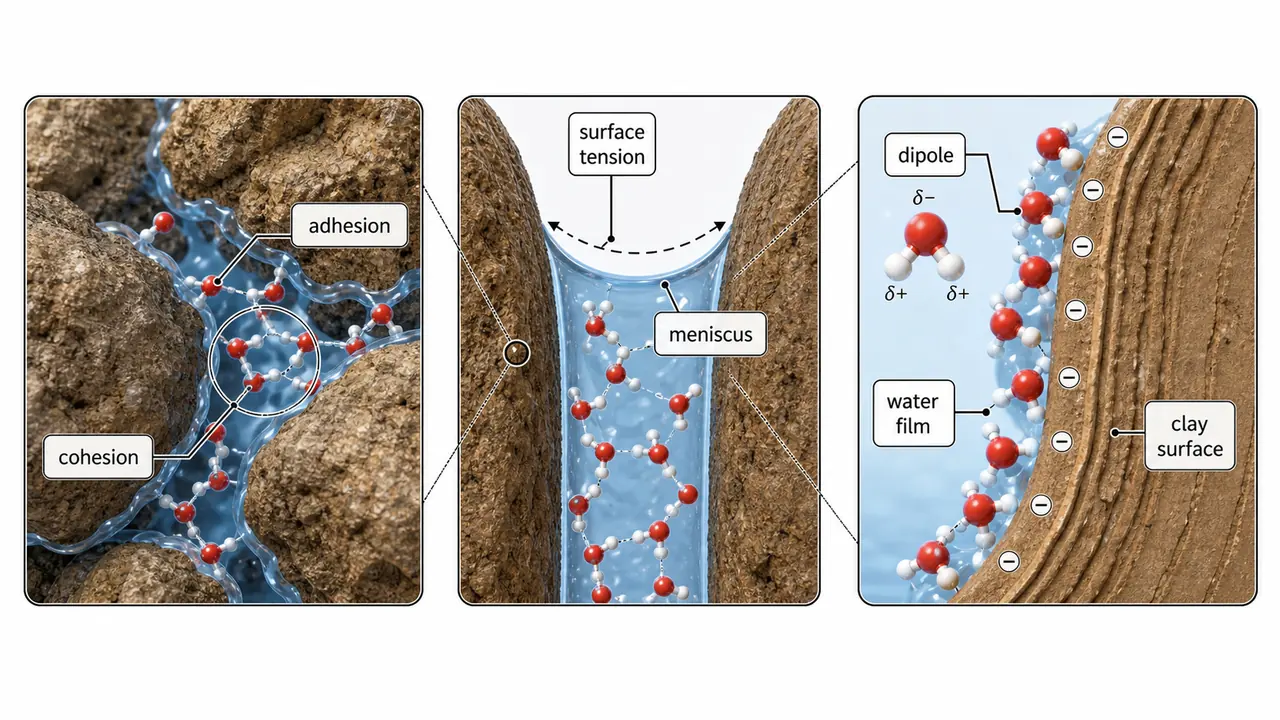
Water is held in soil by three forces:
1. Cohesion and Adhesion
Adhesion binds water molecules to soil particle surfaces. Cohesion binds water molecules to each other. Together, they enable soil to retain water.
2. Surface Tension
At the water-air interface, water molecules are pulled inward by cohesion, creating a stretched elastic membrane effect. This creates the meniscus (curved surface) in capillary pores that drives capillary rise.
3. Polarity (Dipole Character)
Water molecules orient themselves on clay surfaces due to electrostatic forces. The positive end of water attaches to the negatively charged clay surface, forming successive molecular layers. Beyond a certain distance, orientation weakens and capillary (liquid) water begins to appear.
Clay particles carry negative charge. The positive (hydrogen) end of water molecules attaches to the negative clay surface, leaving the negative (oxygen) end outward. This creates successive oriented layers. As layers thicken, orientation weakens until free (capillary) water appears. The balance between surface attraction force (which holds water) and gravity (which pulls it down) determines whether water stays attached to particles or drains away.
Soil Water Potential
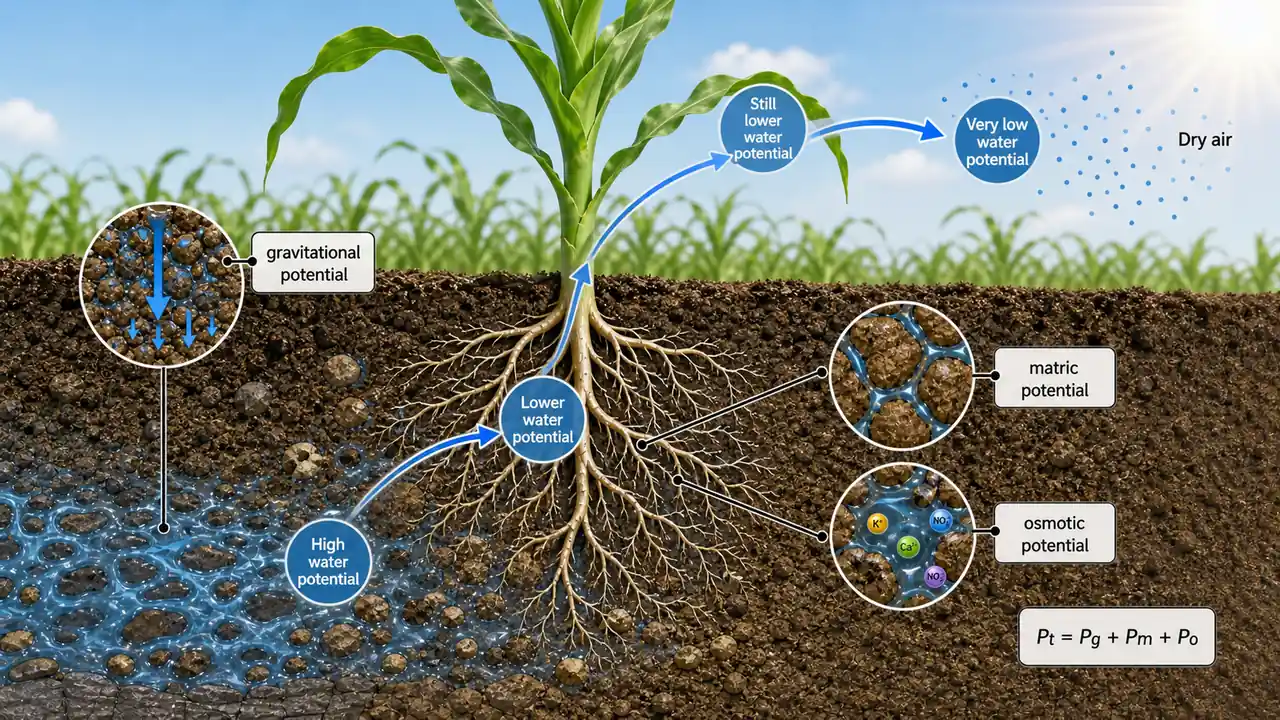
The retention and movement of water in soils, its uptake by plants, and its loss to the atmosphere are all energy-related phenomena. Water moves from zones of higher free energy (wet soil, water table) to zones of lower free energy (dry soil, plant roots).
The difference between the energy states of soil water and pure free water is called soil water potential.
Components of Soil Water Potential
Pt = Pg + Pm + Po
| Component | Symbol | Description | Sign |
|---|---|---|---|
| Gravitational potential | Pg | Pulls water downward toward earth's center | Always positive |
| Matric potential | Pm | Attraction of soil solids for water (adsorption) | Negative (reduces free energy) |
| Osmotic potential | Po | Attraction of dissolved salts for water | Negative (reduces free energy) |
Water always moves from higher potential to lower potential -- this principle governs all water movement in the soil-plant-atmosphere continuum.
Units of Soil Water Potential
| Basis | Unit |
|---|---|
| Mass basis | Joules/kg |
| Volume basis | Pascal |
| Weight basis | Meters or mm |
Other common units: bars and atmospheres (atm). 1 bar = 0.987 atm. The pF scale expresses tension as the logarithm of the height (cm) of a water column.
Soil Water Potential Reference Table
| Condition | Potential |
|---|---|
| Saturation | Zero |
| Field Capacity | -1/3 bar |
| Permanent Wilting Point | -15 bar |
| Hygroscopic Coefficient | -31 bar |
| Air dry soil | -1000 bar |
| Oven dry soil | -10,000 bar |
| Available water range | -1/3 bar to -15 bar (FC to PWP) |
| Gravitational water | Less than -1/3 bar |
| Capillary water | -1/3 bar to -31 bar |
| Pressure plate apparatus measures up to | -15 bar |
| Pressure membrane apparatus measures up to | -100 bar |
| Gypsum block measures | FC to PWP |
| Saturated flow | More than 1/3 bar |
| Unsaturated flow | Less than -1/3 bar |
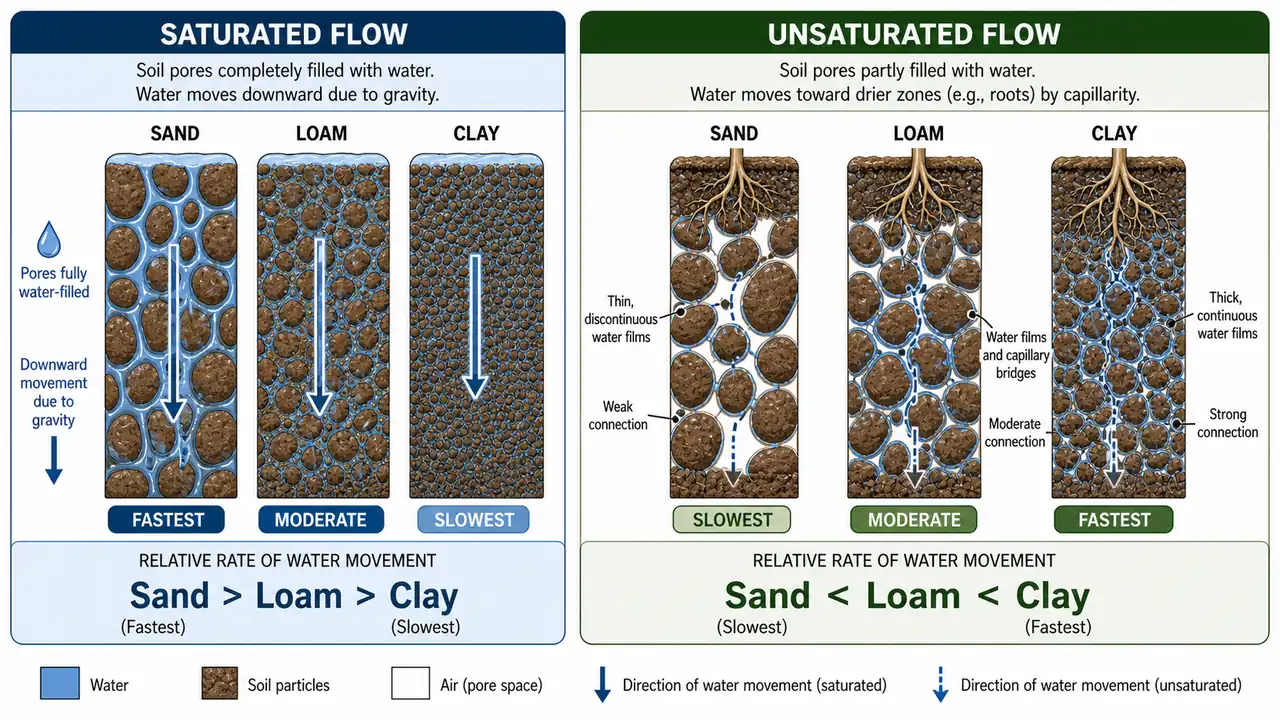
| Flow condition | Main pore-water state | Relative movement order | Full takeaway |
|---|---|---|---|
| Saturated flow | Pores are fully filled with water | Sand > Loam > Clay | Large, continuous pores in sand let water move downward fastest under gravity |
| Unsaturated flow | Pores are only partly filled; water moves through films and capillary bridges | Sand < Loam < Clay | Fine-textured clay keeps more connected water films, so capillary movement is strongest there |
IMPORTANT
Movement of water under saturated conditions: Sand > Loam > Clay. Movement under unsaturated conditions: Sand < Loam < Clay. This reversal is frequently tested.
Soil Moisture Constants
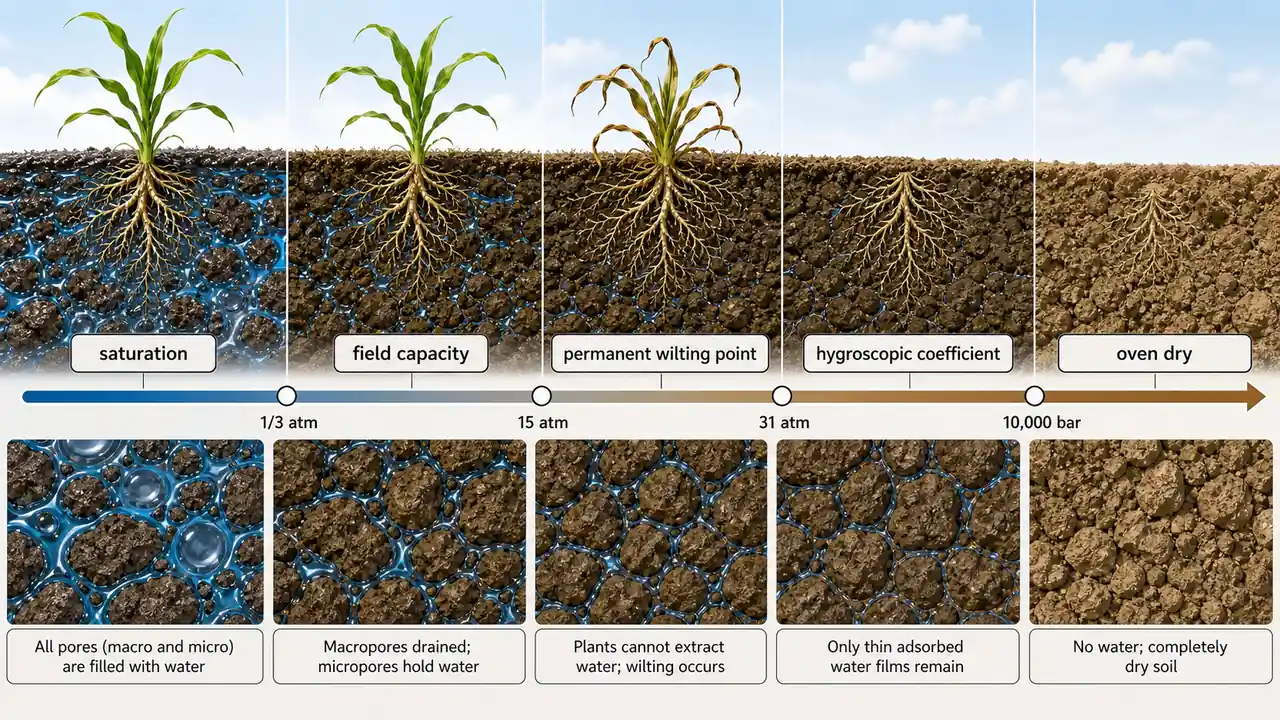
| Soil Moisture Constant Image Item | Full Content |
|---|---|
| Saturation / maximum water holding capacity | All pores are filled with water; this is the uppermost wet condition of soil |
| Field capacity | Gravitational water has drained away and the soil still holds water in micropores; this is the upper limit of available water |
| Permanent wilting point | Plants can no longer extract enough water to recover turgidity; this is the lower limit of available water |
| Hygroscopic coefficient | Water is held very tightly as thin films on particle surfaces and is not available to plants |
| Oven dry soil | Nearly all removable water has been driven off, leaving an extremely dry soil condition |
| Main lesson | As soil tension increases, water becomes progressively more tightly held and less available to plants |
Soil moisture constants represent definite equilibrium points in the soil-water relationship. They are essential for irrigation scheduling and crop management.
Key Moisture Constants
1. Maximum Water Holding Capacity (Saturation)
- All pores (micro and macro) completely filled with water
- Rough measure of total pore space
- Moisture tension: very low (1/100th to 1/1000th atmosphere, pF 0-1)
2. Field Capacity (FC)
After irrigation or rain, when all gravitational water has drained away (usually in 2-3 days), the remaining water is field capacity.
| Feature | Detail |
|---|---|
| Definition | Water held against gravity; only micropores filled |
| Moisture tension | 1/3 atmosphere (-1/3 bar) |
| Significance | Upper limit of available water |
| Measurement | Pressure Plate Apparatus |
| Availability | Readily available to plants and microorganisms |
Farm example: Two days after irrigating a wheat field in Haryana, the moisture content at root zone represents field capacity -- the ideal moisture for crop growth.
3. Permanent Wilting Point (PWP)
The moisture content at which plant roots cannot extract water fast enough to meet transpirational needs. Plants lose turgidity and show symptoms of wilting.
| Feature | Detail |
|---|---|
| Moisture tension | 15 atmosphere (-15 bars) |
| Significance | Lower limit of available water |
| Concept by | Briggs and Shantz |
| Indicator plant | Dwarf Sunflower (most sensitive to water stress) |
| Recovery | Plant cannot recover turgidity even in saturated atmosphere |
IMPORTANT
Field Capacity (1/3 atm) = upper limit of available water. Permanent Wilting Point (15 atm) = lower limit. Available water = FC - PWP. These are the most critical constants for irrigation scheduling.
4. Ultimate Wilting Point (UWP)
- Wilting is complete and the plant dies
- Moisture tension: 60 bars
5. Hygroscopic Coefficient
- Maximum hygroscopic water absorbed by 100 g dry soil at 50% RH and 15 degree C
- Tension: 31 atmospheres
- Water not available to plants (may be available to certain bacteria)
6. Available Water Capacity
Available Water = FC - PWP
This is the water plants can actually use. It determines the irrigation interval and water requirement of crops.
7. Moisture Equivalent
- Water held by 1 cm thick moist soil layer subjected to centrifugal force of 1000 times gravity for 30 minutes
- Introduced by Briggs and McLane (1907)
- Relationship: WP = Moisture Equivalent / 1.84 (Briggs and Shantz, 1912)
- pF at Moisture Equivalent (1/3 atm) is about 2.54
8. Seepage
Horizontal flow of water through a channel. Also includes vertical infiltration and lateral movement from reservoirs or canals.
9. Leaching
Downward movement of nutrients and salts with water. A major cause of nitrogen and potassium loss in sandy soils.
10. Sticky Point Moisture
Moisture content at which soil no longer sticks to a foreign object. Represents the maximum moisture at which soil remains friable.
Maximum Capillary Capacity (MCC)
MCC = Water Holding Capacity - Hygroscopic Coefficient
Soil Moisture Constants and pF Values
UPPSC 2021
| S.No. | Moisture Class | Tension (atm) | pF |
|---|---|---|---|
| 1 | Chemically combined | Very high | --- |
| 2 | Water vapour | Held at saturation point | --- |
| 3 | Hygroscopic | 31 to 10,000 | 4.50 to 7.00 |
| 4 | Hygroscopic coefficient | 31 | 4.50 |
| 5 | Wilting point | 15 | 4.20 |
| 6 | Capillary | 1/3 to 31 | 2.54 to 4.50 |
| 7 | Moisture equivalent | 1/3 to 1 | 2.70 to 3.00 |
| 8 | Field capacity | 1/3 | 2.54 |
| 9 | Sticky point | ~1/3 | 2.54 |
| 10 | Gravitational | Zero or less than 1/3 | <2.54 |
| 11 | Maximum water holding capacity | Almost zero | --- |
Soil Water Movement
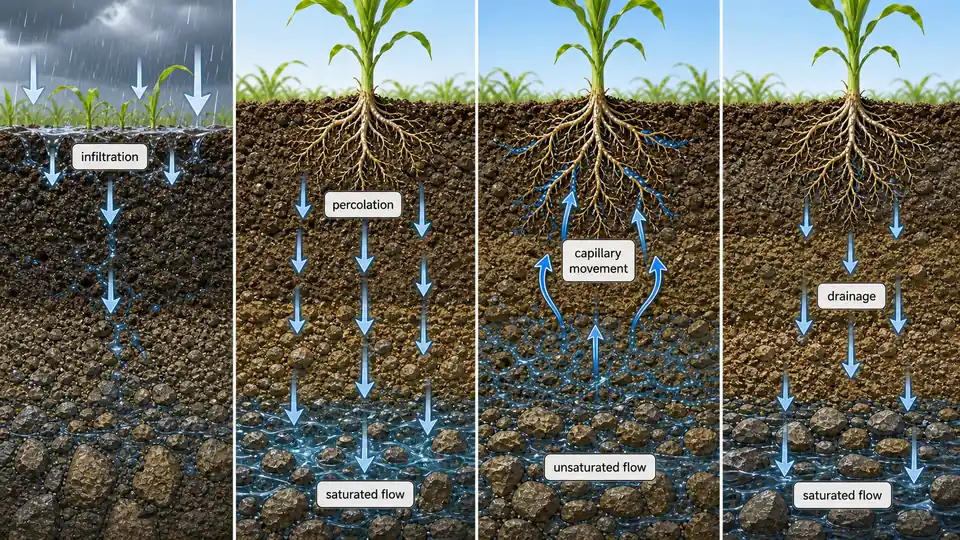
- Occurs when all soil pores are filled with water (water potential > -33 kPa)
- Driven by gravity's pull
- Begins with infiltration (water entering soil surface), followed by percolation (movement through wetted soil)
- Most water is not available to plants under saturation due to lack of oxygen
Hydraulic conductivity: V = kf (where V = volume of water per unit time, f = water-moving force, k = hydraulic conductivity)
Saturated flow rate: Sand > Loam > Clay
2. Unsaturated Flow
- Water held at potentials lower than -1/3 bar
- Moves from wetter to drier areas (higher to lower potential)
- Movement can be in any direction, including upward against gravity
- Driven by adhesion and capillarity
- Most plant water uptake occurs under unsaturated conditions
Unsaturated flow rate: Sand < Loam < Clay (reversed from saturated flow)
Farm example: During dry spells, water moves upward by capillarity from deeper moist layers to the root zone, sustaining crops in dryland areas of Karnataka.
3. Water Vapour Movement
Occurs in two ways:
- Internal movement: Liquid water evaporates within soil pores
- External movement: Evaporation at the land surface, lost to atmosphere by diffusion
Movement is from moist soil (high vapour pressure) to dry soil (low vapour pressure), and from warmer to cooler soil regions. Vapour movement supplies water to drought-resistant plants in dry soils.
Entry of Water into Soil
Infiltration
Downward entry of water into the soil surface. It is a surface characteristic.
| Factor | Effect on Infiltration |
|---|---|
| Vegetative cover | Increases infiltration (vs bare soil) |
| Warm soils | Absorb more water than cold soils |
| Coarse texture, granular structure | Increases infiltration |
| High organic matter | Increases infiltration |
| Wet soils | Lower infiltration than dry soils |
| High infiltration rate | Reduces erosion (less runoff) |
Farm example: A farmer who maintains crop residue mulch on the surface finds less runoff and more water soaking into the soil compared to a bare, tilled field.
Percolation
Movement of water through a column of soil, driven by gravity through saturated or nearly saturated soil.
| Feature | Significance |
|---|---|
| Recharges groundwater | Source for well irrigation |
| Causes leaching | Carries nutrients below root zone |
| Sandy soils | Greater percolation |
| High water table / vegetation | Reduces percolation loss |
Permeability
The relative ease with which water moves within the soil. Also called hydraulic conductivity -- how readily soil transmits fluids.
Drainage
Frequency and duration of periods when soil is free from saturation. Controls water-nutrient relationship.
Drainage classes: Very poorly drained → Poorly drained → Imperfect → Moderately well → Well → Somewhat excessive → Excessive
Hysteresis
The moisture content at a given tension differs during wetting versus drying. Soil holds more water during drying than it absorbs at the same tension during wetting.
- Moisture is always low during sorption (wetting) and high during desorption (drying)
- Main cause: Entrapment of air during rewetting
Methods of Measuring Soil Moisture
A. Direct Methods
| Method | Principle | Key Feature |
|---|---|---|
| Thermo-gravimetric (Oven drying) | Dry at 105 degree C for 24 hours, calculate weight loss | Simplest, most accurate, most widely used; range 0 to -100 bars; standard reference method |
| Volumetric method | Measures volume of water per unit volume of soil | Used for bulk density calculations |
B. Indirect Methods
| Method | Principle | Limitation |
|---|---|---|
| Gypsum block (Electrical resistance) | Conductivity changes with moisture; measured with Wheatstone bridge | Affected by salt concentration |
| Neutron probe | Fast neutrons slowed by hydrogen atoms in water | Requires radioactive source; calibration needed |
| TDR (Time Domain Reflectometry) | Electromagnetic pulse speed changes with dielectric constant | Expensive but accurate |
C. Field Measurement of Soil Moisture Potential
| Method | Capacity | Key Feature |
|---|---|---|
| Tensiometer exams | Up to ~0.8 bar (80 kPa) | Porous cup + mercury manometer; best for sandy soils; used for irrigation scheduling |
| Pressure Plate Apparatus | Up to -15 bar | Laboratory method; determines FC and PWP |
| Pressure Membrane Apparatus | Up to -100 bar | Extends range for research |
Farm example: Drip irrigation farmers in Maharashtra use tensiometers to decide exactly when to irrigate their pomegranate orchards, saving 30-40% water.
Instruments for Soil Water Measurement
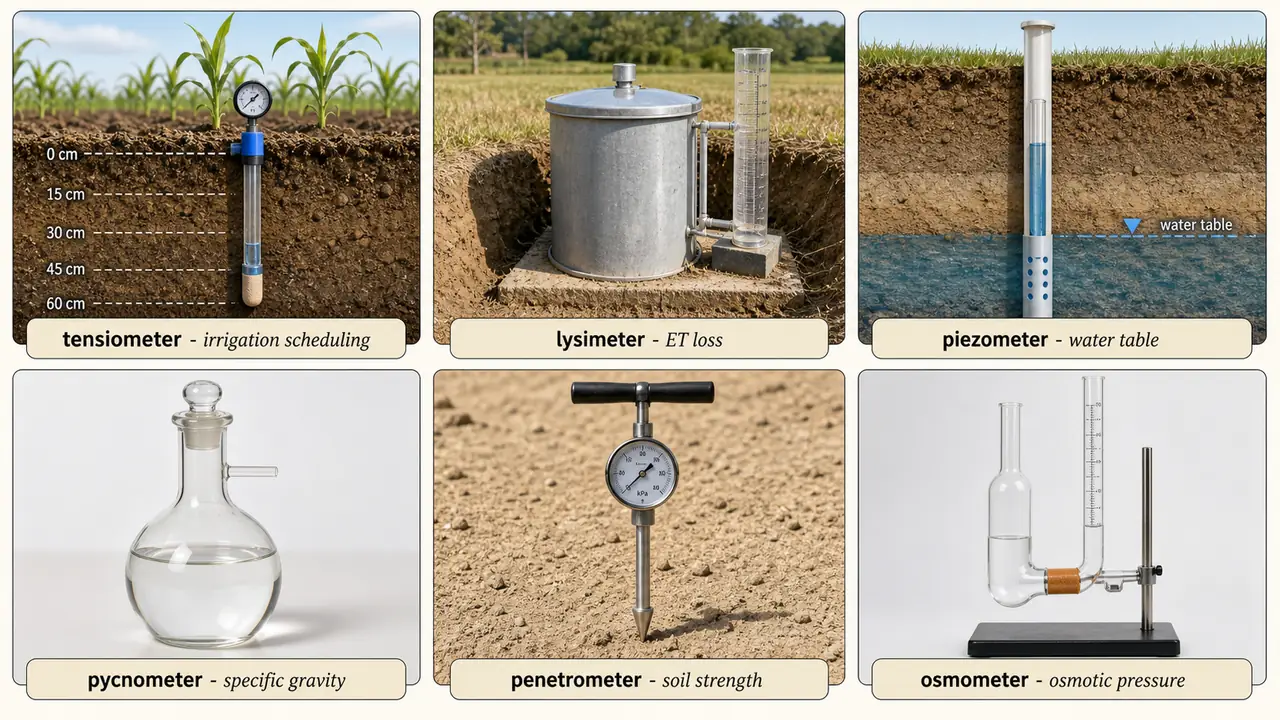
| Instrument | What It Measures | Agricultural Use |
|---|---|---|
| Tensiometer / Irrometer | Soil moisture tension (up to ~0.8 bar) | Decides when to irrigate; best for sandy soils |
| Lysimeter | Evapotranspiration and leaching losses | Calculates crop water requirement |
| Piezometer | Depth of water table / hydrostatic pressure | Groundwater monitoring |
| Pycnometer | Specific gravity of soil | Soil physical properties (particle density) |
| Penetrometer | Soil strength / compaction Exams | Identifies hard pan and tillage needs |
| Osmometer | Osmotic pressure of soil solution | Salt-affected soil assessment |
TIP
Most asked: Lysimeter = ET losses. Tensiometer = soil moisture tension (irrigation scheduling, exams). Penetrometer = soil strength (exams 2020). Pycnometer = particle density.
Exam Tips and Mnemonics
- FC-PWP formula: Available Water = FC (1/3 atm) - PWP (15 atm) -- remember "one-third to fifteen"
- PWP indicator plant: Dwarf Sunflower (Briggs and Shantz)
- Saturated flow: Sand > Loam > Clay. Unsaturated flow: Sand < Loam < Clay -- "saturated reverses"
- Water retention order: Clay > Silt > Sand
- Specific heat of water: 1.00 cal/g (5 times that of dry soil)
- Oven drying temperature: 105 degree C for 24 hours
- pF at FC: 2.54; pF at PWP: 4.20; pF at Hygroscopic coefficient: 4.50
- Tensiometer works only up to 0.8 bar -- suitable for sandy soils only
- Moisture equivalent factor: WP = ME / 1.84 (Briggs and Shantz)
- Van Bemmelen factor for OM: 1.724 (OM = OC x 1.724)
Summary Cheat Sheet
| Concept / Topic | Key Details |
|---|---|
| Field Capacity (FC) | Tension 1/3 atm (−1/3 bar), pF 2.54; appears 2–3 days after irrigation |
| Permanent Wilting Point (PWP) | Tension 15 atm (−15 bar), pF 4.20 |
| Available water | FC − PWP |
| Hygroscopic coefficient | 31 atm, pF 4.50 |
| Ultimate Wilting Point (UWP) | 60 bars |
| Oven dry soil tension | −10,000 bar |
| PWP indicator plant | Dwarf Sunflower (Briggs and Shantz) |
| Oven drying method | 105°C for 24 hours — simplest, most accurate, most widely used |
| Tensiometer range | Up to ~0.8 bar; best for sandy soils; used for irrigation scheduling |
| Pressure plate range | Up to −15 bar (determines FC and PWP) |
| Pressure membrane range | Up to −100 bar |
| Saturated flow order | Sand > Loam > Clay |
| Unsaturated flow order | Sand < Loam < Clay (reverses!) |
| Water retention order | Clay > Silt > Sand |
| Hygroscopic water — clay order | Montmorillonite > Illite > Kaolinite |
| Hysteresis | Soil holds more water during drying than wetting; main cause: air entrapment |
| Specific heat of water | 1.00 cal/g (5× that of dry soil) |
| Moisture equivalent | WP = ME / 1.84 (Briggs and Shantz) |
| Gypsum block method | Electrical resistance; affected by salt concentration |
| Neutron probe | Fast neutrons slowed by H atoms in water |
| TDR | Electromagnetic pulse; dielectric constant changes with moisture |
| Gravitational water | Drains freely; not available to plants; tension 0 to −1/3 bar |
| Capillary water | Held between FC and PWP; plant-available |
| Hygroscopic water | Tightly held; not available to plants |
| Field Capacity tension | 1/3 atm (-1/3 bar), pF 2.54 |
| PWP tension | 15 atm (-15 bar), pF 4.20 |
| UWP tension | 60 bars |
| PWP concept by | Briggs and Shantz |
| FC appears after irrigation | 2-3 days |
| pH concept by | SPL Sorenson |
| pF concept by | Schoefield |
| Tensiometer invented by | Richard & Gardner |