🌬 Soil Air and Aeration: Breathing Life into Crops
Composition of soil air, gas exchange mechanisms, oxygen diffusion rate, aeration effects on plant growth, and soil temperature influence on crops
After heavy monsoon rains, rice survives in waterlogged fields while wheat plants wilt and die within days. Why? The answer lies in soil air. Rice has evolved to grow with almost no soil oxygen, but wheat roots need a constant oxygen supply for respiration. Understanding soil aeration is essential for every farmer deciding when to irrigate, when to drain, and which crops to plant.
What is Soil Air?
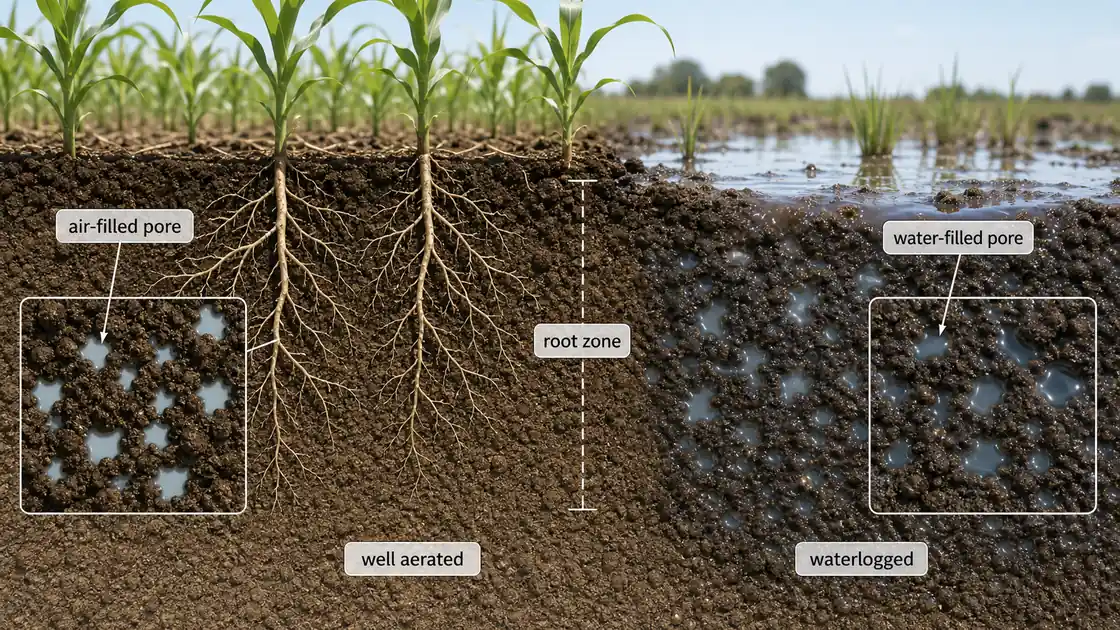
The constant movement or circulation of air in the soil mass, resulting in the renewal of its component gases, is called soil aeration.
Pro Content Locked
Upgrade to Pro to access this lesson and all other premium content.
Charged once for one year · ₹1188 total
Save ₹100/month vs ₹2388/year launch price
- All Agriculture & Banking Courses
- AI Lesson Questions (100/day)
- AI Doubt Solver (50/day)
- Glows & Grows Feedback (30/day)
- AI Section Quiz (20/day)
- 22-Language Translation (100/day)
- Recall Questions (20/day)
- AI Quiz (15/day)
- AI Quiz Paper Analysis (100/day)
- AI Step-by-Step Explanations (100/day)
- Spaced Repetition Recall (FSRS)
- AI Tutor
- Immersive Text Questions
- Audio Lessons — Hindi & English
- Mock Tests & Previous Year Papers
- Summary & Mind Maps
- XP, Levels, Leaderboard & Badges
- Generate New Classrooms
- Voice AI Teacher (AgriDots Live)
- AI Revision Assistant
- Knowledge Gap Analysis
- Interactive Revision (LangGraph)
🔒 Secure one-time yearly payment via Razorpay · No hidden fees
After heavy monsoon rains, rice survives in waterlogged fields while wheat plants wilt and die within days. Why? The answer lies in soil air. Rice has evolved to grow with almost no soil oxygen, but wheat roots need a constant oxygen supply for respiration. Understanding soil aeration is essential for every farmer deciding when to irrigate, when to drain, and which crops to plant.
What is Soil Air?
The constant movement or circulation of air in the soil mass, resulting in the renewal of its component gases, is called soil aeration.
Composition of Soil Air vs Atmospheric Air
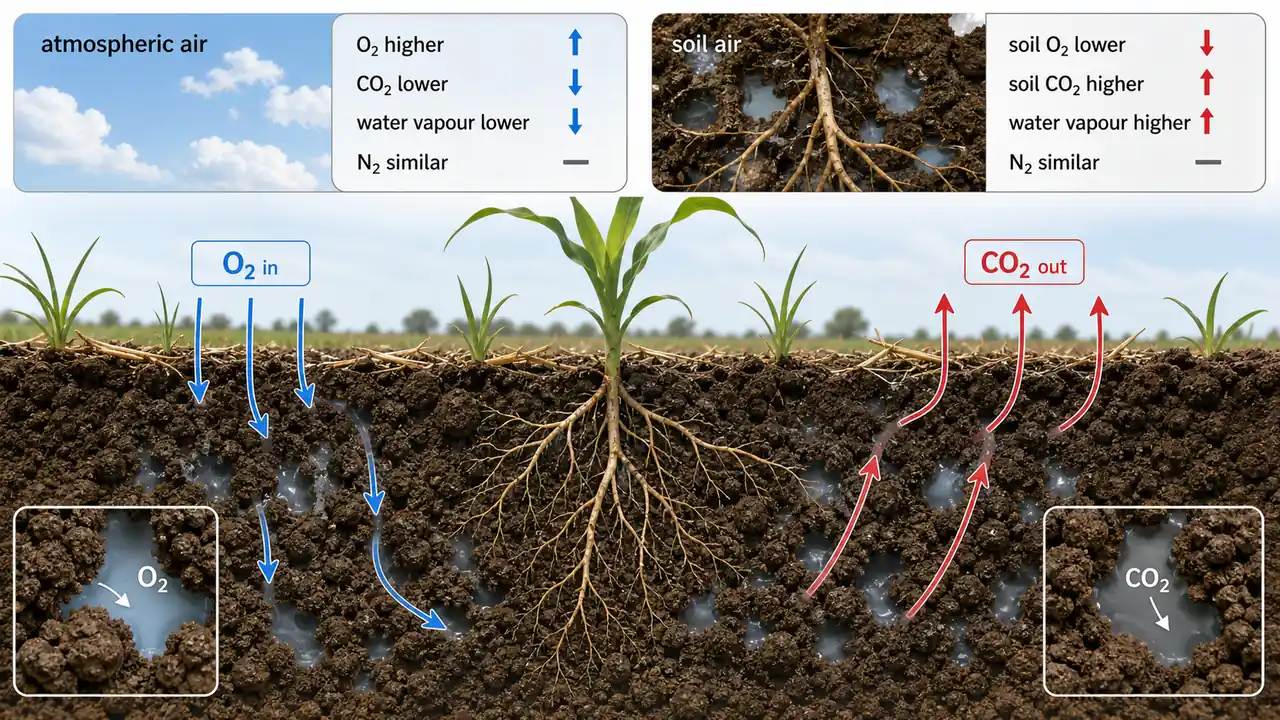
| Gas | Atmospheric Air | Soil Air | Reason for Difference |
|---|---|---|---|
| Nitrogen (N₂) | ~78% | ~78% | Almost the same -- N₂ is inert |
| Oxygen (O₂) | ~21% | 10-20% (lower) | Consumed by roots and microbes |
| Carbon dioxide (CO₂) | ~0.03% | 0.15-0.65% (higher) | Released by root and microbial respiration |
| Water vapour | Variable (lower) | Higher | Enclosed soil environment traps moisture |
Key point: Soil air has more CO₂, less O₂, and more water vapour than atmospheric air. Nitrogen remains nearly the same.
Factors Affecting Soil Air Composition
1. Nature and Condition of Soil (Texture)
Field air capacity is the fractional volume of air in soil at field capacity.
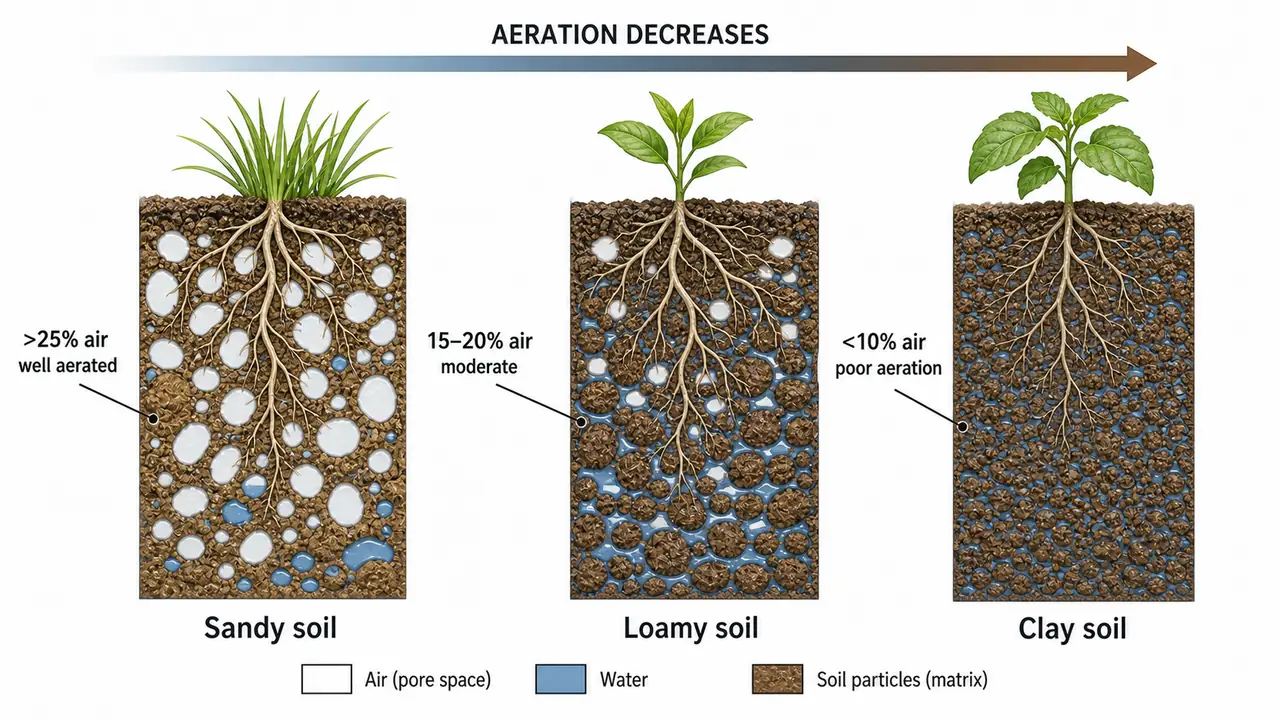
| Soil Type | Air Content (% of total volume) | Aeration Status |
|---|---|---|
| Sandy soil | >25% | Well aerated |
| Loamy soil | 15-20% | Moderately aerated |
| Clay soil | <10% | Poorly aerated |
| Soil Type | Pore-space cue | Full field air capacity takeaway |
|---|---|---|
| Sandy soil | Many large air-filled pores | Usually more than 25% air, so aeration is good |
| Loamy soil | Balanced air and water pores | Usually 15-20% air, so aeration is moderate |
| Clay soil | Small pores, more water-filled space | Usually less than 10% air, so aeration is poor |
Clay soils retain more water, leaving less room for air. This is why clay soils are more prone to waterlogging and poor aeration than sandy soils.
Farm example: Sandy loam soils of Punjab are ideal for wheat because they provide good aeration, while heavy clay soils of deltaic regions suit paddy which tolerates low oxygen.
2. Type of Crop
Plant roots consume oxygen and release CO₂. Soils under crops contain more CO₂ than fallow lands. The CO₂ concentration is highest near roots due to root respiration.
Farm example: A vigorously growing maize crop depletes soil oxygen faster than a dormant fallow field.
3. Microbial Activity
Soil microorganisms require oxygen for respiration. Soils rich in organic matter have higher CO₂ due to increased microbial decomposition. When fresh FYM or crop residues are added, microbial respiration surges, sometimes creating temporary oxygen-deficient zones.
4. Seasonal Variation
| Season | Oxygen Level | CO₂ Level | Reason |
|---|---|---|---|
| Dry/Summer | Higher | Lower | Drier soil allows more gas exchange |
| Monsoon/Wet | Lower | Higher | Water fills pores; high temperature increases microbial activity |
Exchange of Gases Between Soil and Atmosphere
Two mechanisms facilitate gas exchange:
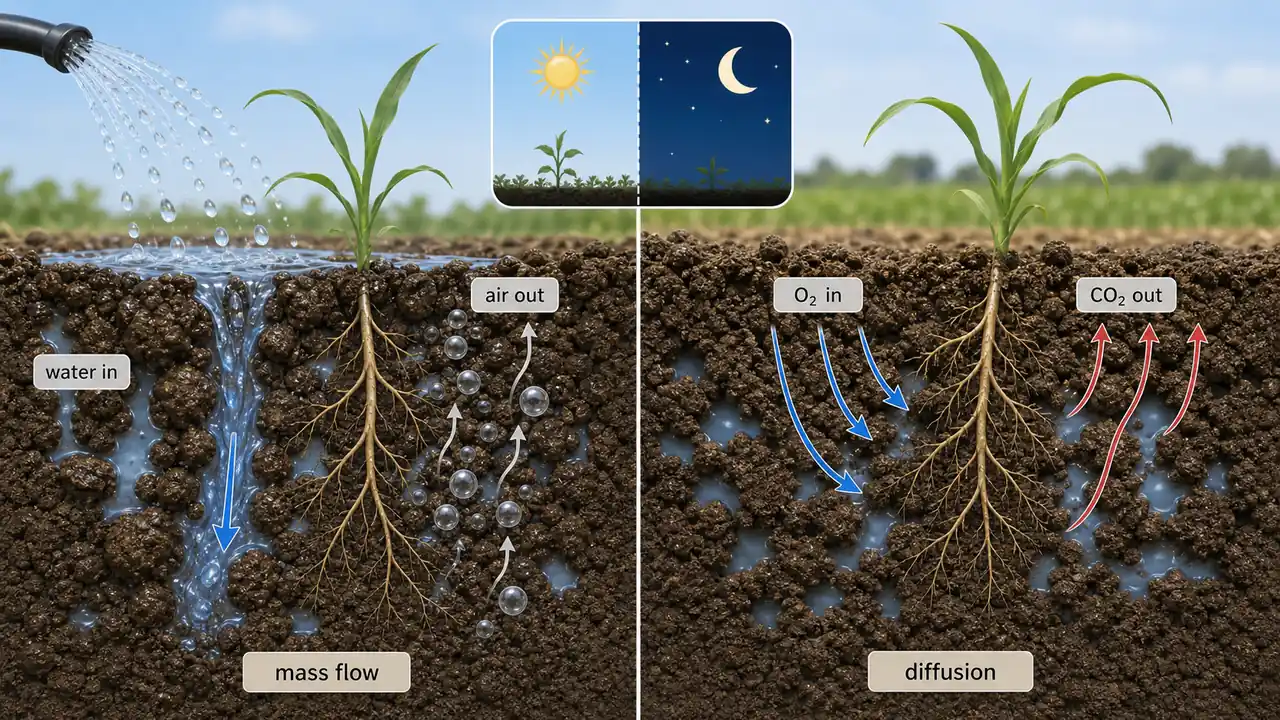
1. Mass Flow
With every rain or irrigation, soil air is displaced by incoming water and moves out into the atmosphere. As moisture is lost by evaporation and transpiration, atmospheric air enters soil pores.
Temperature changes also drive mass flow. During the day, heated soil air expands and moves out. At night, cooling soil air contracts and draws in atmospheric air. This rhythmic process is called the "breathing of soil".
Farm example: When a farmer irrigates a sugarcane field, bubbles rising from the soil surface are displaced soil air being pushed out by water.
2. Diffusion (Most Important Mechanism)
Most gaseous interchange occurs by diffusion, driven by partial pressure differences.
| Gas | Partial Pressure in Soil | Movement Direction |
|---|---|---|
| CO₂ | Higher in soil air | Moves out to atmosphere |
| O₂ | Lower in soil air | Moves in from atmosphere |
Diffusion continues until equilibrium is established. Oxygen and carbon dioxide are the two most important gases involved in diffusion.
Oxygen Diffusion Rate (ODR)
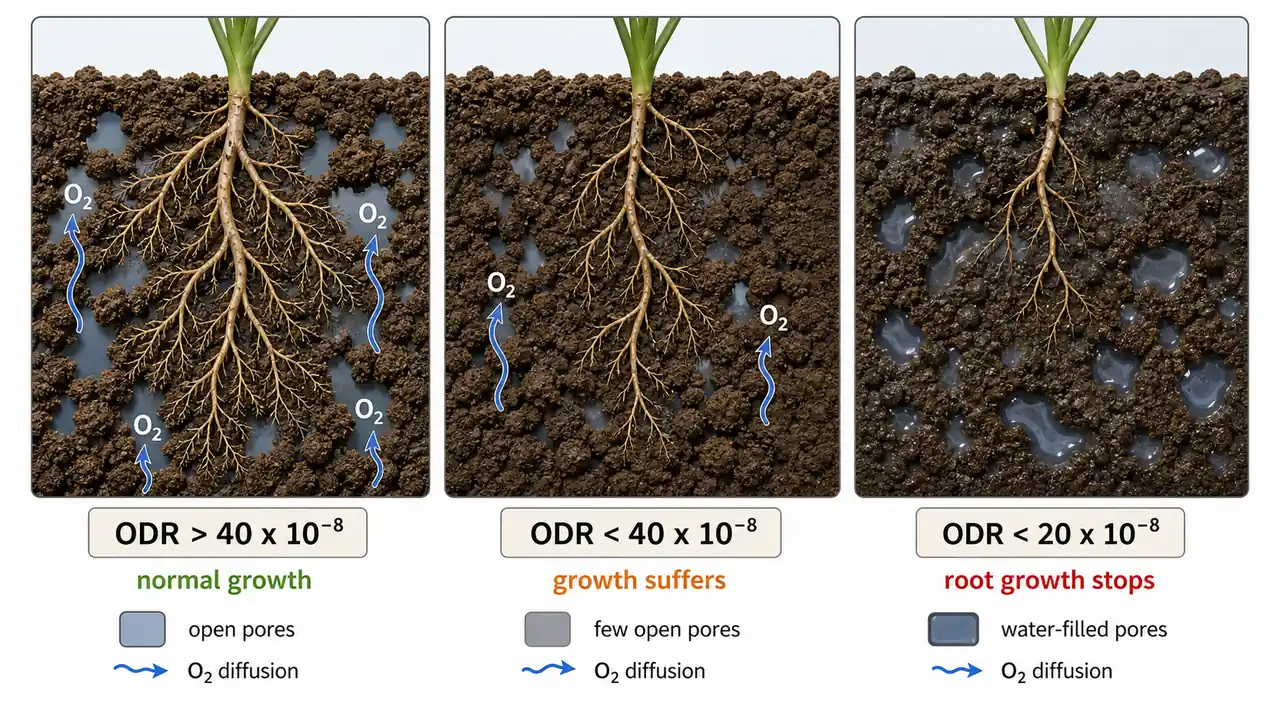
| ODR Value (g/cm²/min) | Effect on Plants |
|---|---|
| Above 40 x 10⁻⁸ | Normal plant growth |
| Below 40 x 10⁻⁸ | Plant growth suffers |
| Below 20 x 10⁻⁸ | Root growth ceases |
Farm example: Before transplanting vegetable seedlings, agronomists check ODR to ensure adequate oxygen for root development.
Importance of Soil Aeration
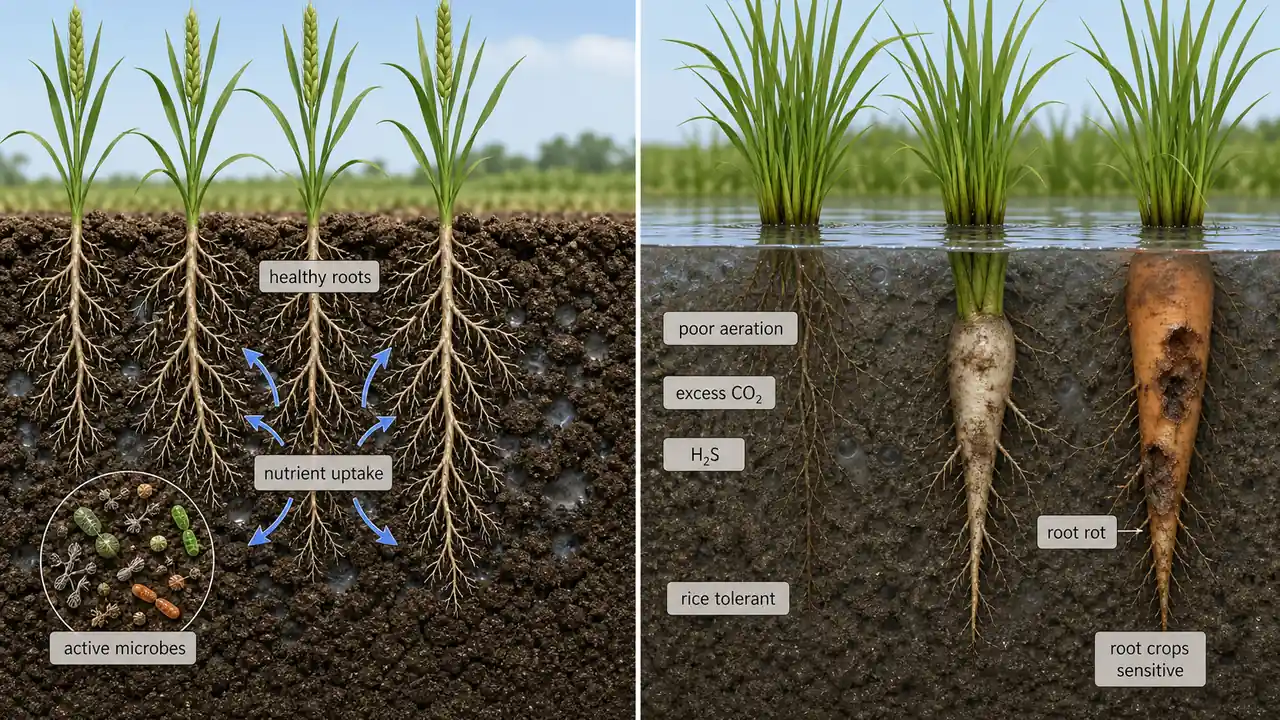
| Soil Aeration Importance Image Item | Full Content |
|---|---|
| Healthy aerated root zone | Open pores supply oxygen to roots and let excess carbon dioxide escape, supporting normal growth |
| Poorly aerated or waterlogged zone | Water-filled pores block oxygen entry and slow gas exchange, creating stress conditions for roots |
| Root growth effect | Good aeration supports normal root elongation, while poor aeration causes weak or abnormally shaped roots |
| Microbial activity effect | Aerobic microbes remain active in well-aerated soil, but poor aeration slows decomposition and nitrification |
| Toxic products | Anaerobic conditions encourage buildup of harmful substances like Fe²⁺, H₂S, and excess CO₂ |
| Sensitive crops | Root crops and many upland crops are damaged quickly by low oxygen, while rice tolerates much lower oxygen levels |
| Main lesson | Soil aeration controls root health, microbial processes, nutrient uptake, and disease pressure through oxygen supply |
1. Plant and Root Growth
Adequate oxygen supply to roots and removal of CO₂ from soil are essential for healthy growth. Insufficient aeration causes:
- Retarded or ceased plant growth
- Abnormally shaped roots in root crops (carrots, radish, potato)
- Inhibited seed germination
| Crop | Oxygen Requirement |
|---|---|
| Most cereals (wheat, maize) | Intermediate O₂ requirement |
| Rice | Can tolerate very low or even complete absence of O₂ |
| Root crops (carrot, radish) | High O₂ requirement -- most affected by poor aeration |
Farm example: Poorly shaped carrots and radishes in compact clay soils are a direct result of poor aeration.
2. Microorganism Activity
Important microbial processes depend on soil oxygen:
- Decomposition of organic matter
- Nitrification (conversion of NH₄⁺ to NO₃⁻)
- Sulphur oxidation
Poor aeration slows decomposition, arrests nitrification, and reduces microbial populations.
3. Formation of Toxic Materials
Under poor aeration (anaerobic conditions), harmful substances accumulate:
- Ferrous oxide (Fe²⁺)
- Hydrogen sulphide gas (H₂S)
- Excess CO₂
These toxic compounds damage roots and reduce nutrient uptake.
Farm example: The foul smell in waterlogged paddy fields is due to H₂S produced under anaerobic conditions.
4. Water and Nutrient Absorption
Plants need energy from respiration to absorb water and nutrients. Under waterlogged conditions (poor aeration), plants show water and nutrient deficiency even when surrounded by water.
This is the waterlogging paradox -- plants wilt in waterlogged soil because roots cannot absorb water without energy from aerobic respiration.
Farm example: Wheat plants in waterlogged fields of UP show yellowing (nitrogen deficiency) despite adequate fertilizer application.
5. Plant Diseases
Insufficient aeration favours soil-borne pathogens:
- Wilt of gram (Fusarium)
- Dieback of citrus and peach
- Root rot caused by Phytophthora and Pythium
Farm example: Chickpea wilt is more severe in poorly drained, heavy clay soils where aeration is limited.
Effect of Soil Temperature on Plant Growth
Temperature Ranges for Plant Growth
| Range | Definition |
|---|---|
| Optimum range | Temperature at which a plant produces best growth |
| Growth range | Entire range under which a plant can grow (includes optimum) |
| Survival limits | Maximum and minimum temperatures beyond which the plant dies |
Effect on Water and Nutrient Availability
- Free energy of water increases with temperature -- warming soil increases water availability up to the wilting point
- Low temperatures reduce nutrient availability, microbial activity, root growth, and nutrient absorption
Farm example: Crops sown too early in cold soils (late October wheat) often show nutrient deficiency symptoms even with adequate fertilizer, because cold roots cannot absorb nutrients efficiently.
Soil Temperature Management
| Practice | Mechanism | Agricultural Example |
|---|---|---|
| Organic mulch (straw, leaves) | Insulating layer reduces temperature extremes | Straw mulch keeps potato soil cooler in summer, warmer in winter |
| Synthetic mulch (polythene) | Warms soil, conserves moisture | Black plastic mulch for early vegetable nurseries |
| Drainage | Removing excess water allows faster warming | Draining paddy fields before rabi wheat sowing |
| Tillage | Breaking compaction reduces heat conductance | Ploughing loosens soil, reducing heat loss |
Methods of Measuring Soil Temperature
| Instrument | Use |
|---|---|
| Mercury soil thermometers | Buried at different depths |
| Thermocouple / Thermistor | Electronic measurement |
| Infrared thermometers | Surface temperature (remote) |
| Automatic thermographs | Continuous recording over time |
The International Meteorological Organization (IMO) recommends standard measurement depths: 10, 20, 50, and 100 cm.
Exam Tips and Mnemonics
- Soil air vs atmospheric air: More CO₂, less O₂, more moisture, same N₂ -- remember "CLM-N" (CO₂ up, Less O₂, More moisture, N₂ same)
- Air capacity: Sandy (>25%) > Loamy (15-20%) > Clay (<10%) -- "SLC decreasing"
- ODR critical values: Growth suffers below 40 x 10⁻⁸, roots stop at 20 x 10⁻⁸ -- remember "40-20 rule"
- Rice is the exception -- tolerates zero oxygen
- Diffusion is the most important gas exchange mechanism (not mass flow)
- Waterlogging paradox: Plants wilt in excess water because roots lack oxygen for absorption
- IMO soil temperature depths: 10, 20, 50, 100 cm
Summary Cheat Sheet
| Concept / Topic | Key Details |
|---|---|
| Soil air definition | Air occupying pore spaces not filled with water |
| Soil aeration | Constant circulation/renewal of soil air gases |
| Soil air vs atmosphere — O₂ | 10–20% (lower); consumed by roots and microbes |
| Soil air vs atmosphere — CO₂ | 0.15–0.65% (higher); from root/microbial respiration |
| Soil air vs atmosphere — N₂ | ~78% (same); N₂ is inert |
| Soil air vs atmosphere — H₂O vapour | Higher in soil air |
| Air content — sandy soil | >25% (well aerated) |
| Air content — loamy soil | 15–20% (moderate) |
| Air content — clay soil | <10% (poorly aerated) |
| Most important gas exchange mechanism | Diffusion (driven by partial pressure differences) |
| Mass flow | Displaced by irrigation; "breathing of soil" (day/night) |
| ODR for normal growth | Above 40 × 10⁻⁸ g/cm²/min |
| ODR — growth suffers | Below 40 × 10⁻⁸ |
| ODR — root growth ceases | Below 20 × 10⁻⁸ |
| Crop tolerating zero O₂ | Rice |
| Root crops (carrot, radish) | Highest O₂ requirement; most affected by poor aeration |
| Waterlogging paradox | Plants wilt despite excess water — no O₂ for absorption |
| Toxic anaerobic products | Fe²⁺, H₂S, excess CO₂ |
| Diseases from poor aeration | Wilt of gram (Fusarium), root rot (Phytophthora, Pythium) |
| IMO measurement depths | 10, 20, 50, 100 cm |
| Soil temp vs air temp | ~1°C higher on average |
| Organic mulch effect | Reduces temperature extremes (insulation) |
| Soil temperature instruments | Mercury thermometers, thermocouple, IR thermometer, thermograph |
| Air in sandy soil | >25% of total volume |
| Air in clay soil | <10% of total volume |
| Critical ODR for plant growth | 40 x 10⁻⁸ g/cm²/min |
| ODR when root growth ceases | 20 x 10⁻⁸ g/cm²/min |
| Toxic products of anaerobic conditions | Fe²⁺, H₂S, excess CO₂ |