🌡 Soil Temperature: How Heat Controls Crop Growth
Thermal properties of soil, sources of soil heat, factors affecting soil temperature, and management practices for optimal crop production
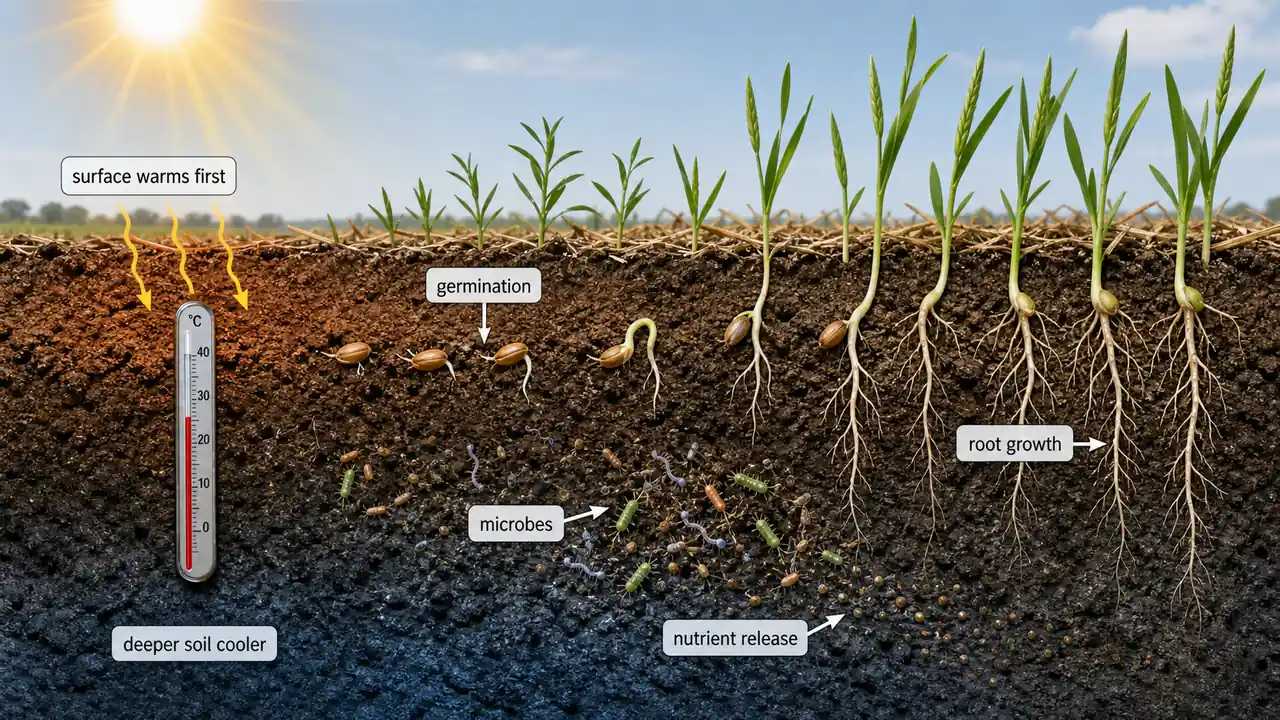
Have you noticed that wheat sown in November germinates quickly, but the same seed sown in January takes much longer? The difference is soil temperature. A farmer in Punjab drains waterlogged fields in early spring so the soil warms up faster for timely wheat sowing. Soil temperature silently governs germination, root growth, nutrient uptake, and microbial activity -- making it one of the most important yet overlooked factors in agriculture.
What is Soil Temperature?
Thermal Properties of Soils
Heat transfer through soil occurs by radiation, conduction, and convection.
Pro Content Locked
Upgrade to Pro to access this lesson and all other premium content.
Charged once for one year · ₹1188 total
Save ₹100/month vs ₹2388/year launch price
- All Agriculture & Banking Courses
- AI Lesson Questions (100/day)
- AI Doubt Solver (50/day)
- Glows & Grows Feedback (30/day)
- AI Section Quiz (20/day)
- 22-Language Translation (100/day)
- Recall Questions (20/day)
- AI Quiz (15/day)
- AI Quiz Paper Analysis (100/day)
- AI Step-by-Step Explanations (100/day)
- Spaced Repetition Recall (FSRS)
- AI Tutor
- Immersive Text Questions
- Audio Lessons — Hindi & English
- Mock Tests & Previous Year Papers
- Summary & Mind Maps
- XP, Levels, Leaderboard & Badges
- Generate New Classrooms
- Voice AI Teacher (AgriDots Live)
- AI Revision Assistant
- Knowledge Gap Analysis
- Interactive Revision (LangGraph)
🔒 Secure one-time yearly payment via Razorpay · No hidden fees
Have you noticed that wheat sown in November germinates quickly, but the same seed sown in January takes much longer? The difference is soil temperature. A farmer in Punjab drains waterlogged fields in early spring so the soil warms up faster for timely wheat sowing. Soil temperature silently governs germination, root growth, nutrient uptake, and microbial activity -- making it one of the most important yet overlooked factors in agriculture.
What is Soil Temperature?
Thermal Properties of Soils
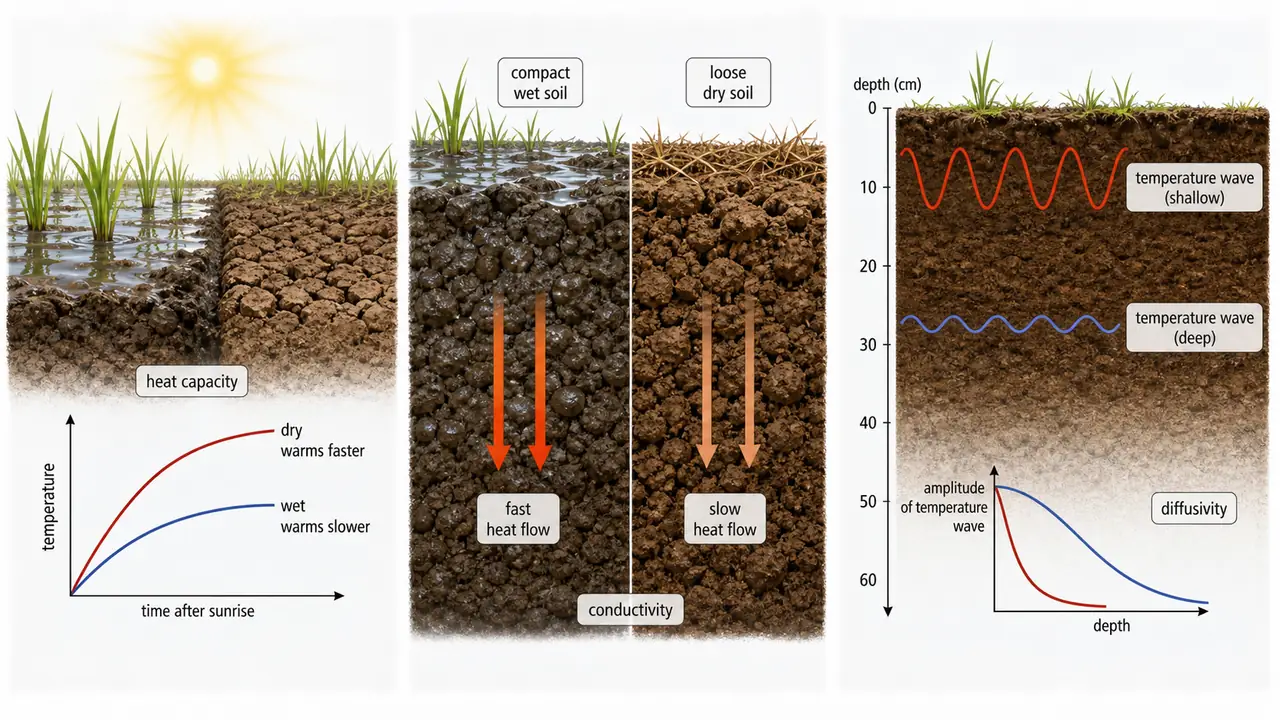
Heat transfer through soil occurs by radiation, conduction, and convection.
Three Main Thermal Properties
| Property | SI Unit | What it Measures | Agricultural Significance |
|---|---|---|---|
| Volumetric Heat Capacity | J m⁻³ K⁻¹ | Energy needed to raise temperature of a unit volume by 1 degree | Wet paddy soils have high heat capacity -- they warm up slowly in spring |
| Thermal Conductivity | W m⁻¹ K⁻¹ | How readily heat flows through soil | Compact, wet soils conduct heat faster; dry sandy soils are poor conductors |
| Thermal Diffusivity | m² s⁻¹ | Speed at which temperature changes propagate through soil | High diffusivity means temperature waves reach deeper roots faster |
Specific Heat of Soil Components
| Material | Specific Heat (cal/g) |
|---|---|
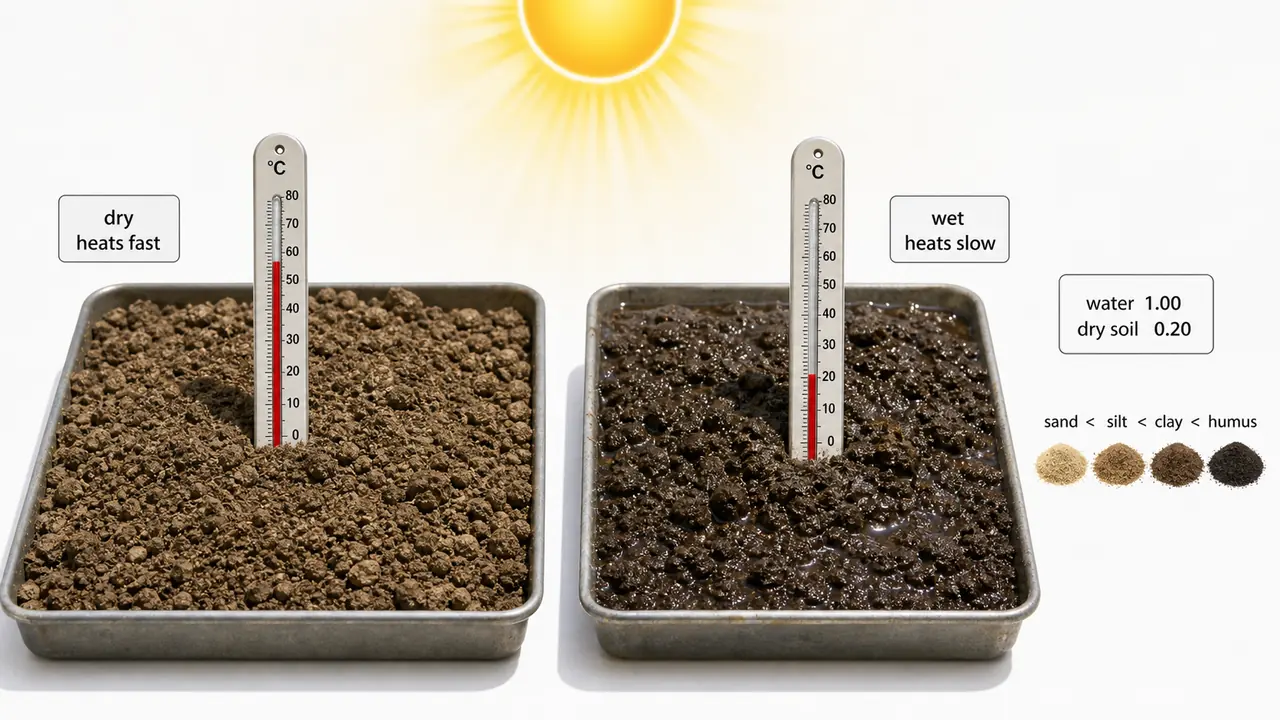
| Water | 1.00 |
| Dry Soil | 0.20 |
Specific heat order: Sand < Silt < Clay < Humus
Because water has 5 times the specific heat of dry soil, a dry soil heats up much faster than a moist soil. This is why farmers drain paddy fields before sowing rabi wheat -- removing water allows the soil to warm up quickly for germination.
Crop-Specific Soil Temperature Requirements
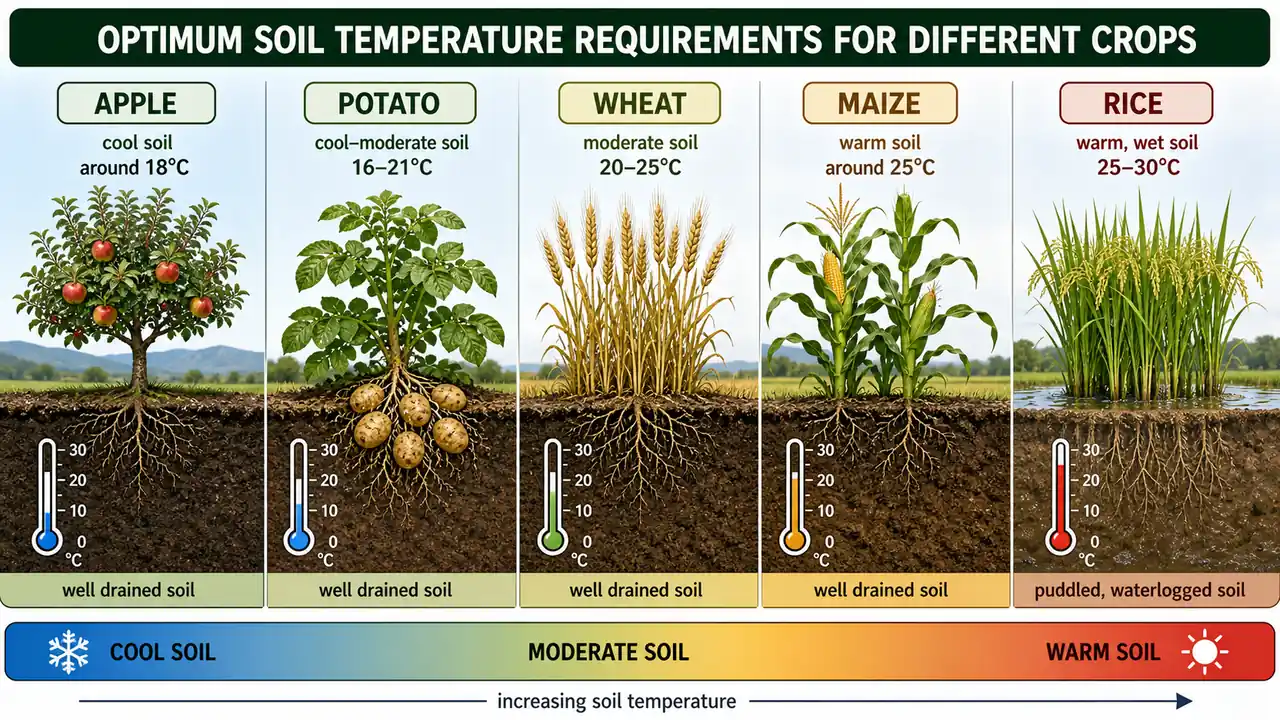
Different crops need different soil temperatures for optimum growth. Each crop has a minimum, optimum, and maximum soil temperature range.
| Crop | Optimum Soil Temperature |
|---|---|
| Apple | ~18 degree C |
| Potato | 16-21 degree C |
| Maize | ~25 degree C |
| Rice | 25-30 degree C |
| Wheat | 20-25 degree C |
| Crop | Soil condition cue | Full temperature takeaway |
|---|---|---|
| Apple | Cool soil | Best around 18 degree C |
| Potato | Cool to moderately warm, well-drained soil | Best in the 16-21 degree C range |
| Wheat | Moderate, well-drained soil | Best in the 20-25 degree C range |
| Maize | Warm, well-drained soil | Best around 25 degree C |
| Rice | Warm, wet or puddled soil | Best in the 25-30 degree C range |
Sources of Soil Heat
| Source | Type | Contribution |
|---|---|---|
| Solar radiation | External | Dominant source -- provides the vast majority of thermal energy |
| Microbial decomposition of organic matter | Internal (biological) | Significant in compost heaps (can reach 60-70 degree C) |
| Root and organism respiration | Internal (biological) | Minor but measurable |
| Earth's interior (geothermal) | Internal | Negligible for agriculture |
The rate of solar radiation reaching the earth's atmosphere is called the solar constant: 2 Cal cm⁻² min⁻¹.
Most of this energy is absorbed by the atmosphere, plants, and scattered. Only a small fraction reaches the soil surface as thermal infrared radiation.
Factors Affecting Soil Temperature
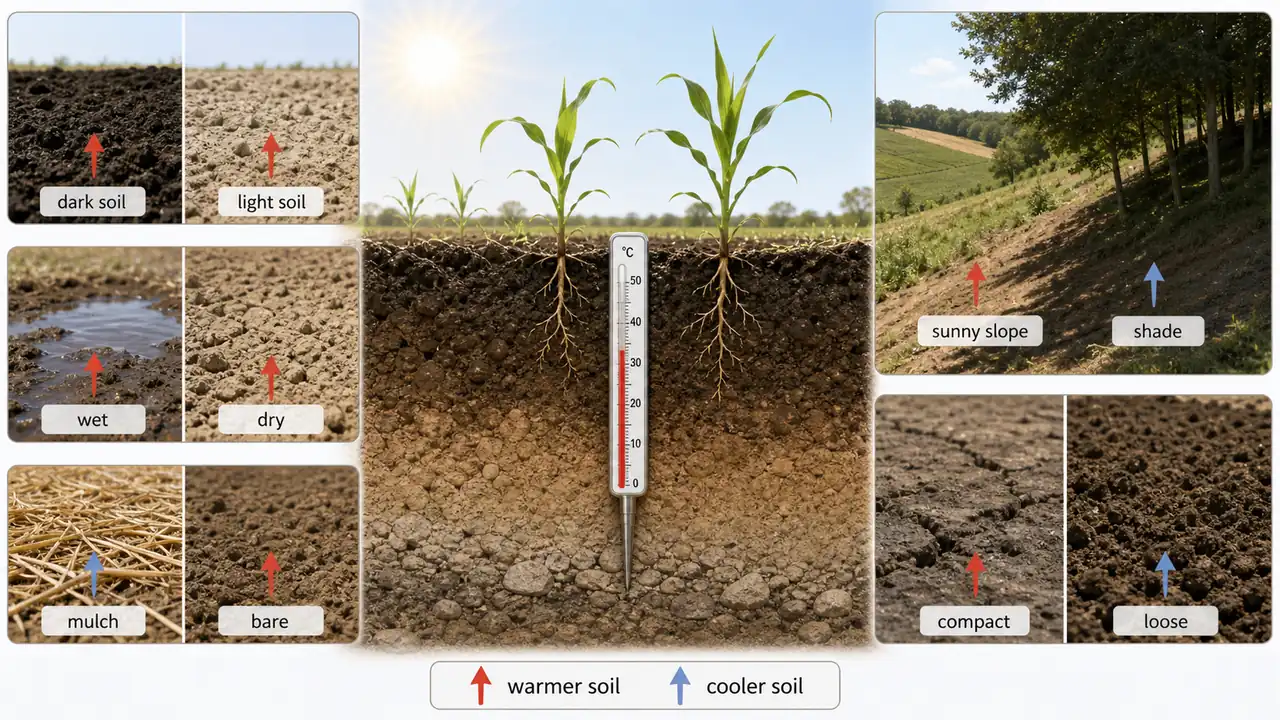
| Soil Temperature Factor Image Item | Full Content |
|---|---|
| Dark versus light soil | Dark soil has lower albedo and absorbs more radiation, while light soil reflects more and stays cooler |
| Wet versus dry soil | Wet soil warms more slowly because water has high specific heat; dry soil heats faster |
| Mulch versus bare surface | Mulch buffers temperature extremes, while bare soil responds more directly to heating and cooling |
| Sunny versus shaded slope | Sun-facing slopes receive more direct solar radiation and usually warm more than shaded slopes |
| Compact versus loose soil | Compact soil conducts heat more readily than loose, disturbed soil |
| Main lesson | Soil temperature is controlled jointly by radiation, water content, cover, slope exposure, colour, and soil physical condition |
The average annual soil temperature is about 1 degree C higher than mean annual air temperature.
A. Environmental Factors
Solar radiation is the primary driver. The amount of heat reaching the soil depends on:
- Angle of incident radiation and latitude
- Season and time of day
- Slope steepness and direction -- south-facing slopes in the Northern Hemisphere receive more direct sunlight and are warmer (important for tea gardens on hill slopes)
- Altitude -- higher elevation means cooler soil
- Insulation by air, water vapour, clouds, dust, snow, plant cover, and mulch reduces heat transfer
B. Soil Factors
1. Heat Capacity of Soil
The amount of energy needed to raise soil temperature by 1 degree C is its heat capacity. Since water has high specific heat (1.00 cal/g) and dry soil has low specific heat (0.20 cal/g), increasing soil moisture increases heat capacity. This means dry soil heats up quickly while wet soil warms slowly.
Farm example: Draining waterlogged fields in spring helps soils warm faster for early sowing of wheat and potato.
2. Heat of Vaporization
Evaporation of water from soil requires 540 kilocalories/kg of energy. This energy is taken from the soil, thereby cooling it. Surface soil temperatures can be 1-6 degree C lower than sub-surface soil temperature due to this evaporative cooling.
Farm example: In irrigated sugarcane fields, surface soil stays cooler than deeper layers because of continuous evaporation.
3. Thermal Conductivity and Diffusivity
Heat moves through soil mainly by conduction. Heat passes from soil to water about 150 times faster than from soil to air.
| Soil Condition | Heat Conduction |
|---|---|
| Wet, compact soil | Fast conduction |
| Dry, loose soil | Slow conduction |
Farm example: A puddled paddy field (compact, wet) conducts heat uniformly, while a freshly ploughed dry field shows large temperature differences between surface and depth.
4. Biological Activity
Respiration by soil animals, microbes, and plant roots generates heat. More biological activity means higher soil temperature. In compost heaps, microbial activity raises temperature to 60-70 degree C.
5. Radiation from Soil
| Radiation Type | Source | Wavelength |
|---|---|---|
| Short waves (0.3-2.2 um) | Sun (high temperature) | Penetrate easily |
| Long waves (6.8-100 um) | Soil (low temperature) | Cannot penetrate water vapour, glass |
Long-wave radiation from soil gets trapped by water vapour and glass, keeping soil warm during night, cloudy days, and inside greenhouses. This is the basis of the greenhouse effect used in protected cultivation of vegetables and flowers.
6. Soil Colour and Albedo
Albedo is the ratio of reflected radiation to incoming radiation. The larger the albedo, the cooler the soil.
| Soil Type | Albedo | Temperature |
|---|---|---|
| Dark soils (black cotton soil) | Low albedo | Warmer -- absorb more heat |
| Light soils (sandy desert soil) | High albedo | Cooler -- reflect more heat |
| Rough surface | Lower albedo | Absorbs more radiation |
| Smooth surface | Higher albedo | Reflects more radiation |
Farm example: Black soil (Vertisol) regions of Maharashtra retain more heat than sandy soils of Rajasthan, affecting sowing dates and crop choice.
7. Soil Structure, Texture, and Moisture
| Factor | Effect on Temperature |
|---|---|
| Compact soils | Higher thermal conductivity than loose soils |
| Mineral soils | Higher conductivity than organic soils |
| Moist soils | Uniform temperature over depth (good conductivity) |
| Natural structure | Higher conductivity than disturbed soil |
8. Soluble Salts
Soluble salts indirectly affect soil temperature by influencing biological activity and evaporation. High salt concentrations reduce microbial activity and alter water movement, both affecting temperature regulation.
Soil Temperature Management
| Practice | Effect | Agricultural Example |
|---|---|---|
| Organic mulch (straw, crop residues) | Keeps soil cooler in summer, warmer in winter | Straw mulch in potato fields reduces temperature extremes |
| Synthetic mulch (plastic film) | Warms soil in cool season, conserves moisture | Black polythene mulch in vegetable nurseries |
| Soil water management | Draining excess water helps soil warm up | Draining paddy fields before rabi sowing |
| Tillage management | Breaking natural structure reduces heat conductance | Ploughing before summer reduces heat loss |
Methods of Measuring Soil Temperature
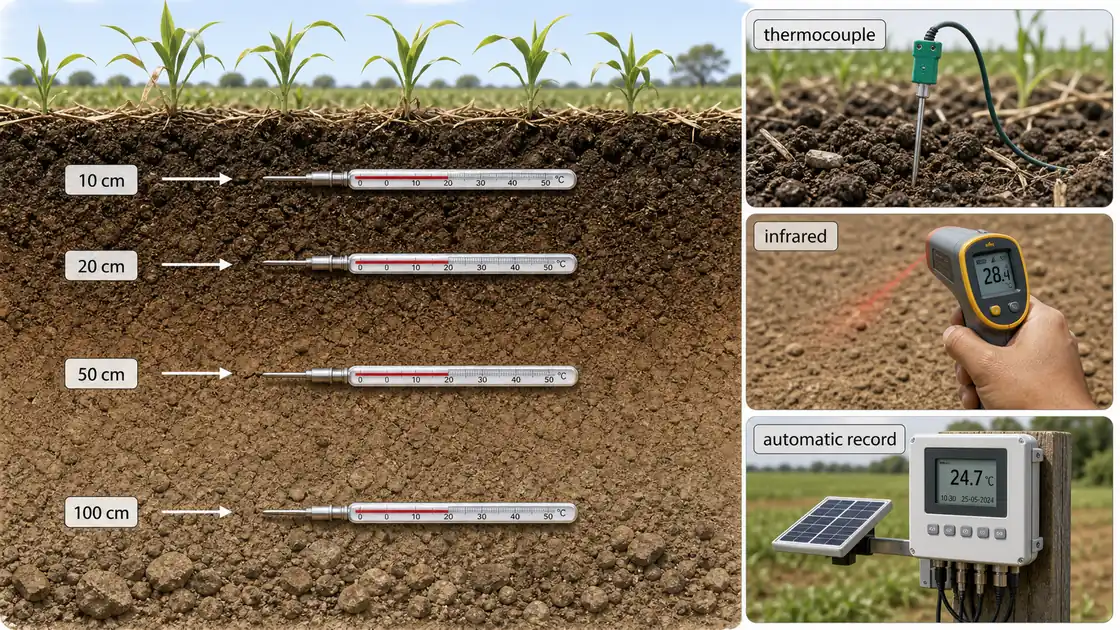
| Method | Principle |
|---|---|
| Mercury soil thermometers | Buried at different depths with protective cover |
| Thermocouple and thermistor | Electrical resistance changes with temperature |
| Infrared thermometers | Measure surface soil temperature remotely |
| Automatic continuous thermographs | Record temperatures on a time scale |
The International Meteorological Organization (IMO) recommends measuring soil temperature at standard depths: 10, 20, 50, and 100 cm.
Exam Tips and Mnemonics
- Solar constant = 2 Cal cm⁻² min⁻¹ -- remember "2 calories per minute"
- Specific heat: Water (1.00) is 5 times that of dry soil (0.20)
- Heat of vaporization = 540 kcal/kg
- IMO depths = 10, 20, 50, 100 cm -- remember "1-2-5-10" (multiply by 10)
- Dry soil heats fast, wet soil heats slow -- think of how a dry pan heats faster than one with water
- Dark soil = warm, light soil = cool (low albedo absorbs more)
- Soil temperature is 1 degree C higher than air temperature on average
Summary Cheat Sheet
| Concept / Topic | Key Details |
|---|---|
| Solar constant | 2 Cal cm⁻² min⁻¹ |
| Specific heat — water | 1.00 cal/g (highest; heats slowest) |
| Specific heat — dry soil | 0.20 cal/g (heats fastest) |
| Specific heat order | Sand < Silt < Clay < Humus (< Water) |
| Heat of vaporization | 540 kcal/kg — cooling effect of evaporation |
| Surface cooling by evaporation | 1–6°C lower than sub-surface |
| Heat conduction: soil vs air | 150 times faster through water than air |
| Albedo rule | Higher albedo = cooler soil (more reflection) |
| Dark soil vs light soil | Dark absorbs more heat; warms faster |
| Dry soil vs wet soil | Dry heats faster (lower specific heat) |
| Avg. soil temp vs air temp | ~1°C higher |
| IMO measurement depths | 10, 20, 50, 100 cm |
| Organic mulch effect | Keeps soil cooler in summer, warmer in winter |
| Plastic mulch effect | Warms soil in cool season; conserves moisture |
| Drainage effect | Removing water helps soil warm up faster |
| Compost heap temperature | 60–70°C (microbial heat generation) |
| Temperature and OM | Low temp → slow decomposition → OM accumulates |
| Temperature and nutrients | Low temp → reduced nutrient availability and root uptake |
| Temperature and microbes | Microbial activity increases with warmth (optimum 24–35°C) |
| Soluble salts effect | Influence biological activity and evaporation indirectly |
| Heat conduction: soil to water vs soil to air | 150 times faster through water |