🌈 Soil Colour: Causes, Munsell System & Diagnostic Use
Factors affecting soil colour (organic matter, iron oxides, drainage), Munsell colour notation (Hue, Value, Chroma), and using colour as a diagnostic tool for soil health
Walk through any Indian landscape and you will see soils of many colours. The black cotton soils of Maharashtra, the red laterites of Kerala, the yellow soils of Odisha, and the white saline patches of Rajasthan -- each colour tells a story. A seasoned farmer can judge drainage, fertility and organic matter content simply by looking at the soil colour. It is the easiest physical property to observe and one of the most informative.
Why Soil Colour Matters
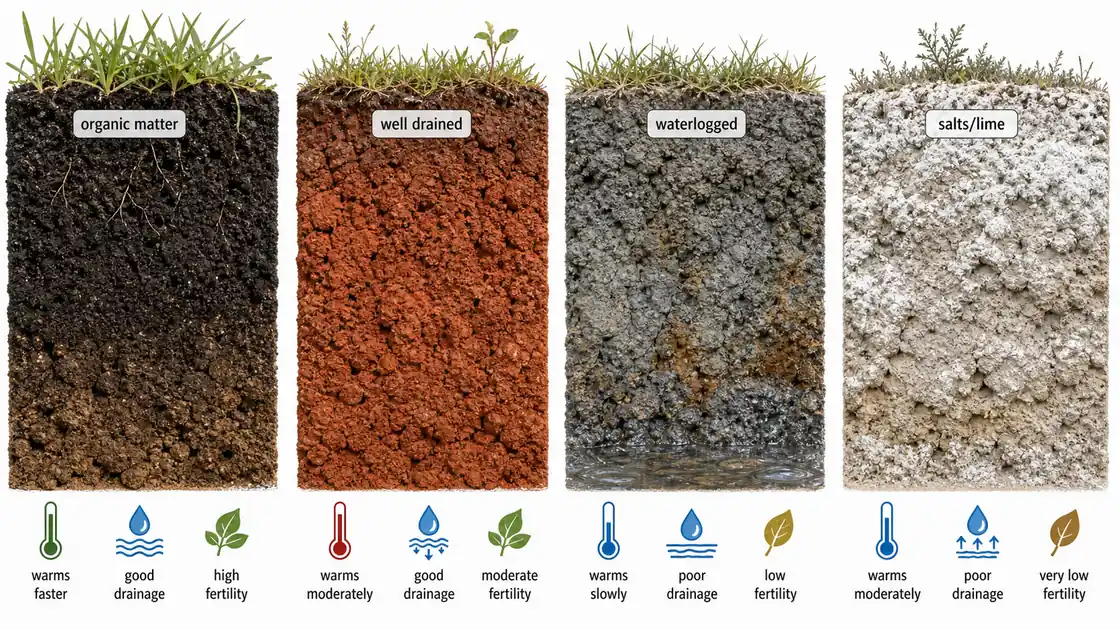
| Soil Colour Field Clue | Full Content |
|---|---|
| Dark humus-rich soil | Usually indicates higher organic matter and often better fertility in the surface horizon |
| Red well-drained soil | Usually reflects oxidized iron under well-aerated and well-drained conditions |
| Grey waterlogged soil | Suggests poor drainage, reduced iron, and prolonged or repeated anaerobic conditions |
| Pale salt-affected soil | Often points to salts, lime, or silica accumulation and may indicate reclamation needs |
| Dark surface warms faster | Dark soils absorb more solar radiation and can heat faster than pale soils |
| Main diagnostic value | Soil colour quickly signals drainage, organic matter status, parent material influence, and management constraints |
- Soil colour indicates mineral origin (parent material), soil development, drainage status, and organic matter content
- It is the most readily observable soil property -- no lab needed
- Dark-coloured soils absorb more solar radiation and heat up faster than light-coloured soils
- Wet soil appears darker than dry soil
- Colour directly influences soil temperature, which affects seed germination and microbial activity
Two Origins of Soil Colour
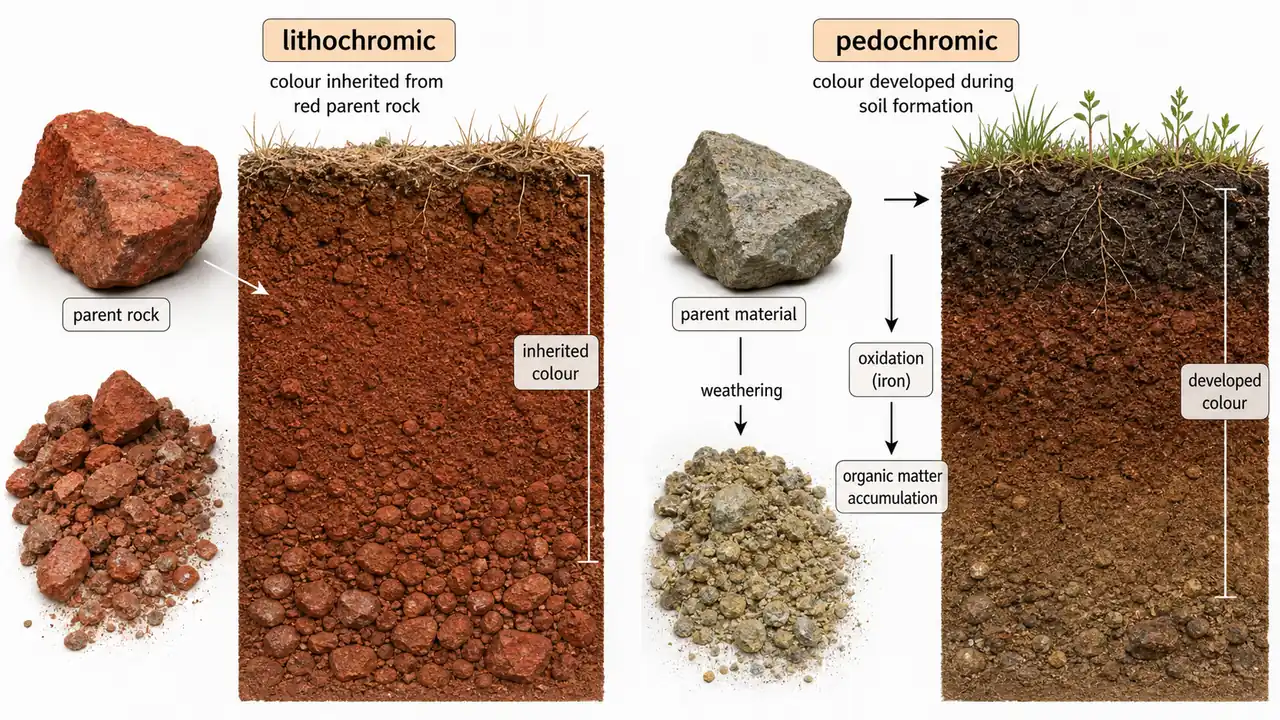
| Type | Definition | Example |
|---|---|---|
| Lithochromic (inherited) | Colour inherited directly from parent material | Red soils from red sandstone |
| Pedochromic (acquired) | Colour develops during soil formation through weathering, oxidation, OM accumulation | Red soils from granite or schist (not originally red) |
NOTE
Pro Content Locked
Upgrade to Pro to access this lesson and all other premium content.
Charged once for one year · ₹1188 total
Save ₹100/month vs ₹2388/year launch price
- All Agriculture & Banking Courses
- AI Lesson Questions (100/day)
- AI Doubt Solver (50/day)
- Glows & Grows Feedback (30/day)
- AI Section Quiz (20/day)
- 22-Language Translation (100/day)
- Recall Questions (20/day)
- AI Quiz (15/day)
- AI Quiz Paper Analysis (100/day)
- AI Step-by-Step Explanations (100/day)
- Spaced Repetition Recall (FSRS)
- AI Tutor
- Immersive Text Questions
- Audio Lessons — Hindi & English
- Mock Tests & Previous Year Papers
- Summary & Mind Maps
- XP, Levels, Leaderboard & Badges
- Generate New Classrooms
- Voice AI Teacher (AgriDots Live)
- AI Revision Assistant
- Knowledge Gap Analysis
- Interactive Revision (LangGraph)
🔒 Secure one-time yearly payment via Razorpay · No hidden fees
Walk through any Indian landscape and you will see soils of many colours. The black cotton soils of Maharashtra, the red laterites of Kerala, the yellow soils of Odisha, and the white saline patches of Rajasthan -- each colour tells a story. A seasoned farmer can judge drainage, fertility and organic matter content simply by looking at the soil colour. It is the easiest physical property to observe and one of the most informative.
Why Soil Colour Matters
| Soil Colour Field Clue | Full Content |
|---|---|
| Dark humus-rich soil | Usually indicates higher organic matter and often better fertility in the surface horizon |
| Red well-drained soil | Usually reflects oxidized iron under well-aerated and well-drained conditions |
| Grey waterlogged soil | Suggests poor drainage, reduced iron, and prolonged or repeated anaerobic conditions |
| Pale salt-affected soil | Often points to salts, lime, or silica accumulation and may indicate reclamation needs |
| Dark surface warms faster | Dark soils absorb more solar radiation and can heat faster than pale soils |
| Main diagnostic value | Soil colour quickly signals drainage, organic matter status, parent material influence, and management constraints |
- Soil colour indicates mineral origin (parent material), soil development, drainage status, and organic matter content
- It is the most readily observable soil property -- no lab needed
- Dark-coloured soils absorb more solar radiation and heat up faster than light-coloured soils
- Wet soil appears darker than dry soil
- Colour directly influences soil temperature, which affects seed germination and microbial activity
Two Origins of Soil Colour
| Type | Definition | Example |
|---|---|---|
| Lithochromic (inherited) | Colour inherited directly from parent material | Red soils from red sandstone |
| Pedochromic (acquired) | Colour develops during soil formation through weathering, oxidation, OM accumulation | Red soils from granite or schist (not originally red) |
NOTE
"Lithochromic" comes from Greek lithos (stone) + chroma (colour). "Pedochromic" comes from pedon (soil) + chroma (colour).
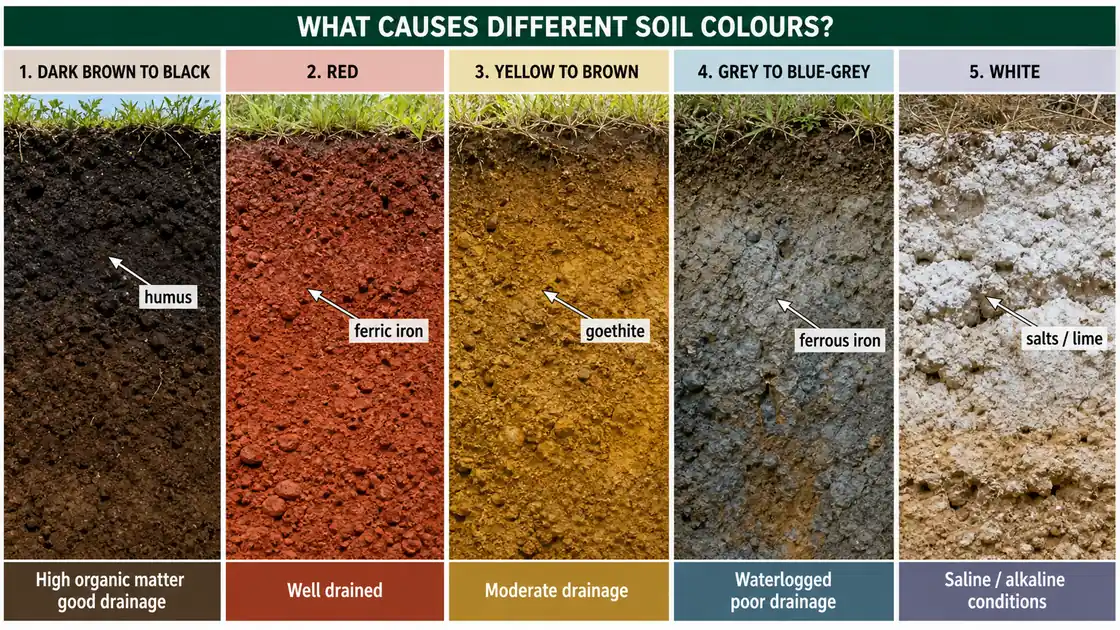
What Causes Different Soil Colours?
This is the core concept. Each colour has a specific cause that reveals important information about the soil.
IMPORTANT
This table is one of the most frequently asked topics in competitive exams. Memorize the relationship between soil colour and its cause.
| Soil Colour | Cause / Indicator | Drainage Status | Agricultural Significance |
|---|---|---|---|
| Dark brown to Black | High organic matter (humus) | Variable | Fertile topsoil; good nutrient supply |
| Red | Oxidized ferric iron (Fe2O3 -- Hematite) | Well-drained, well-aerated | Good drainage; laterite soils of Kerala, Tamil Nadu |
| Yellow / Yellow-brown | Goethite (FeOOH) -- hydrated ferric iron | Moderately drained | Moderate drainage; yellow soils of Odisha |
| Grey / Greenish / Bluish | Reduced ferrous iron (Fe2+) | Poorly drained, waterlogged | Gleyed soils; paddy fields; anaerobic conditions |
| White / Light | Silica, lime (CaCO3), salts | Variable | Saline/calcareous soils; salt crusts in arid regions |
| Brown | Mixture of organic matter + iron oxides | Moderate | Most common soil colour; moderate fertility |
| Black | Manganese oxide | Variable | Can indicate Mn-rich parent material |
| Green | Glauconite mineral | Variable | Rare; marine-derived soils |
| Mottled / Variegated | Alternate wetting and drying; fluctuating water table | Fluctuating | Seasonal waterlogging; iron and manganese residues |
Detailed Explanations
Organic Matter and Colour
- High OM = black to dark brown colour
- Darker soil = higher humus content
- Topsoils (A-horizon) are usually darker than subsoils
- Agricultural link: Dark topsoil in Indo-Gangetic plains indicates high fertility from centuries of alluvial deposition and organic accumulation
Iron Compounds and Colour
- Ferric oxide (Fe2O3 -- Hematite): Red colour
- Goethite (FeOOH): Yellow-brown colour
- Ferrous compounds (Fe2+): Grey/blue/green colour
- Agricultural link: Red soils of Chhattisgarh and Tamil Nadu owe their colour to oxidized iron; well-drained and suitable for millets and groundnut
Silica, Lime and Salts
- Large amounts of silica, lime (CaCO3) or both make soil white or light-coloured
- Common in calcareous soils and saline soils
- White salt crusts form on surface in arid regions
- Agricultural link: White patches in Haryana and Rajasthan fields indicate salt-affected soils needing reclamation
Mixed Colours (Brown)
- Most common soil colour worldwide
- Blending of dark organic pigments with reddish-brown iron pigments
- Agricultural link: Brown alluvial soils of river valleys are among the most productive agricultural soils
Mottled Colours
- Result of alternating oxidation and reduction (monsoon wetting, dry-season drying)
- Residual products of iron and manganese compounds create spots of different colours
- Agricultural link: Mottled soil in a rice field indicates the fluctuating water table -- important for deciding irrigation scheduling and crop rotation
Gleyed Soils (Blue-Grey)
- Prolonged waterlogging creates permanent reduced conditions
- Ferrous compounds (Fe2+) give bluish and greenish colours
- Reliable indicator of prolonged anaerobic conditions
- Agricultural link: Continuously waterlogged paddy soils show grey-blue colours; draining between rice crops allows re-oxidation
Munsell Colour System
Soil colours are determined using the Munsell colour chart -- the international standard for soil colour description.
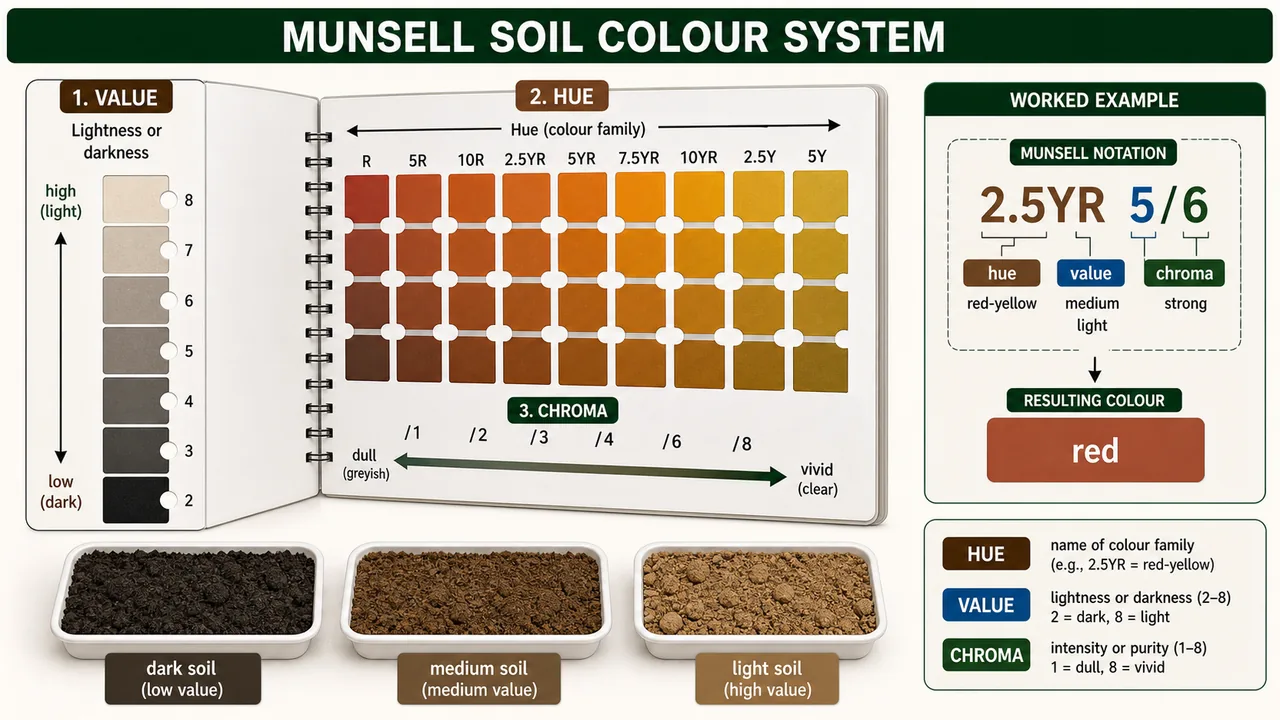
| Worked Example Item | Full Content |
|---|---|
| 2.5YR | The hue, meaning the soil lies in the red-yellow colour family |
| 5 | The value, meaning medium lightness or darkness |
| 6 | The chroma, meaning a moderately strong or vivid colour |
| 2.5YR 5/6 | Interpreted in the lesson as a red soil colour reading |
Three Components of Colour
| Component | What It Measures | Range | What It Tells You |
|---|---|---|---|
| Hue | Dominant spectral colour (Red, Yellow, Blue, Green) | Letter-number combinations (e.g., 10YR, 2.5Y) | What colour the soil is |
| Value | Lightness or darkness (amount of reflected light) | 0 (absolute black) to 10 (pure white) | Low = dark (high OM); High = light (low OM) |
| Chroma | Purity or strength of the colour | Low = dull, greyish; High = vivid, saturated | Low chroma = poorly drained; High chroma = well-drained |
Munsell Notation Format
Written as: Hue Value/Chroma
Example: 2.5 YR 5/6
- Hue = 2.5 YR (yellow-red)
- Value = 5 (medium lightness)
- Chroma = 6 (moderately vivid)
- Soil colour name = Red
TIP
Exam Mnemonic: Remember the Munsell order: H V/C -- Hue (what colour), Value (how light/dark), Chroma (how pure). Think: "Hue Varies in Chroma".
Interpreting Munsell Values in Agriculture
| Munsell Reading | Interpretation | Agricultural Significance |
|---|---|---|
| Low Value (dark) | High organic matter | Fertile; good nutrient supply |
| High Value (light) | Low OM; salts or lime | May need organic amendments |
| Low Chroma (grey/dull) | Poor drainage; reduced conditions | May need drainage improvement |
| High Chroma (vivid red/yellow) | Good drainage; oxidized conditions | Well-aerated; suitable for upland crops |
Colour as a Quick Diagnostic Tool
| Observation | Diagnosis | Recommended Action |
|---|---|---|
| Dark topsoil | High organic matter; fertile | Maintain OM inputs |
| Red subsoil | Good drainage; well-aerated; Fe3+ present | Suitable for dryland crops |
| Yellow subsoil | Moderate drainage; hydrated iron oxides | Monitor drainage |
| Grey/blue colours | Poor drainage; waterlogging; Fe2+ present | Install drainage; grow rice |
| White deposits | Salt accumulation; lime; silica | Leach salts; apply gypsum if sodic |
| Mottling (mixed colours) | Fluctuating water table; seasonal waterlogging | Improve drainage; choose water-tolerant crops |
Agricultural tip: Before buying or leasing agricultural land, dig a shallow pit and observe the soil colour profile. Dark topsoil grading to reddish-brown subsoil indicates healthy, well-drained soil. Grey or mottled subsoil warns of drainage problems that will limit crop choice.

Summary Cheat Sheet
| Concept / Topic | Key Details |
|---|---|
| Most observable soil property | Soil colour — no lab needed |
| Dark brown / Black soil | High organic matter (humus); fertile topsoil |
| Red soil | Hematite (Fe₂O₃) — oxidized ferric iron; well-drained |
| Yellow / Yellow-brown soil | Goethite (FeOOH) — hydrated ferric iron; moderately drained |
| Grey / Blue / Green soil | Ferrous iron (Fe²⁺) — reduced; poorly drained / waterlogged |
| White / Light soil | Silica, lime (CaCO₃), salts; saline/calcareous soils |
| Brown soil | Mixture of OM + iron oxides; most common colour |
| Black (not OM) | Manganese oxide |
| Green soil | Glauconite mineral; marine-derived soils |
| Mottled / Variegated | Alternate wetting–drying; fluctuating water table |
| Lithochromic colour | Inherited from parent material |
| Pedochromic colour | Acquired during soil formation processes |
| Munsell colour chart | International standard for soil colour description |
| Hue | Dominant spectral colour (e.g., 10YR, 2.5Y) |
| Value | Lightness: 0 = black, 10 = white; low value = high OM |
| Chroma | Colour purity/strength; low chroma = grey = poor drainage |
| Munsell notation format | Hue Value/Chroma (e.g., 2.5 YR 5/6 = Red) |
| Dark soil and temperature | Absorbs more heat; warms faster |
| Wet vs dry soil | Wet soil appears darker |
| Gleyed soils | Prolonged waterlogging → bluish/greenish (Fe²⁺) |
| Most observable property | Soil colour -- no lab needed; Exam tip: Quick visual diagnostic |
| Yellow soil | Goethite (FeOOH) -- hydrated iron; Exam tip: Moderately drained |
| White soil | Silica, lime, salts; Exam tip: Saline/calcareous soils |
| Mottled soil | Fluctuating water table; Exam tip: Seasonal waterlogging indicator |
| Munsell system | International standard for soil colour; Exam tip: Hue Value/Chroma format |
| Example notation | 2.5 YR 5/6 = Red; Exam tip: H V/C format |