🫐 Types of Soil Colloids: From Clay Minerals to Humus
Four major types of soil colloids -- layer silicate clays, sesquioxides, allophane, and humus -- their structure, classification, and properties
When a farmer in the Deccan plateau ploughs black cotton soil, it sticks to the plough blade like glue. But when a farmer in Kerala ploughs red laterite soil, it crumbles easily. Both soils contain clay, yet they behave completely differently. The reason is that different types of clay colloids dominate each soil -- montmorillonite in black soil versus kaolinite and iron oxides in laterite. Understanding these four types of colloids is essential for managing soil fertility and structure.
Four Major Types of Soil Colloids
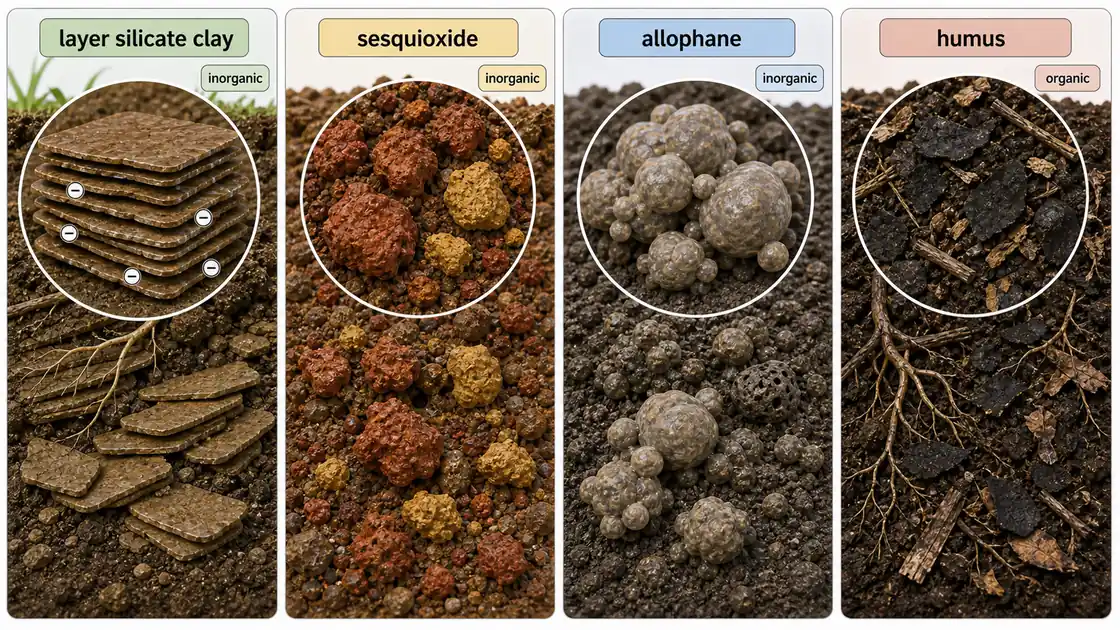
| Type | Nature | Example |
|---|---|---|
| 1. Layer silicate clays (Phyllosilicates) | Inorganic | Kaolinite, Illite, Montmorillonite, Vermiculite, Chlorite |
| 2. Iron and aluminum oxide clays (Sesquioxides) | Inorganic | Fe₂O₃, Al₂O₃ (laterite soils) |
| 3. Allophane and amorphous clays | Inorganic | Allophane (volcanic ash soils) |
| 4. Humus | Organic | Decomposed plant/animal remains |
Each type behaves differently in terms of charge, surface area, swelling, and nutrient retention. The type that dominates in a given soil largely determines its chemical and physical character.
Pro Content Locked
Upgrade to Pro to access this lesson and all other premium content.
Charged once for one year · ₹1188 total
Save ₹100/month vs ₹2388/year launch price
- All Agriculture & Banking Courses
- AI Lesson Questions (100/day)
- AI Doubt Solver (50/day)
- Glows & Grows Feedback (30/day)
- AI Section Quiz (20/day)
- 22-Language Translation (100/day)
- Recall Questions (20/day)
- AI Quiz (15/day)
- AI Quiz Paper Analysis (100/day)
- AI Step-by-Step Explanations (100/day)
- Spaced Repetition Recall (FSRS)
- AI Tutor
- Immersive Text Questions
- Audio Lessons — Hindi & English
- Mock Tests & Previous Year Papers
- Summary & Mind Maps
- XP, Levels, Leaderboard & Badges
- Generate New Classrooms
- Voice AI Teacher (AgriDots Live)
- AI Revision Assistant
- Knowledge Gap Analysis
- Interactive Revision (LangGraph)
🔒 Secure one-time yearly payment via Razorpay · No hidden fees
When a farmer in the Deccan plateau ploughs black cotton soil, it sticks to the plough blade like glue. But when a farmer in Kerala ploughs red laterite soil, it crumbles easily. Both soils contain clay, yet they behave completely differently. The reason is that different types of clay colloids dominate each soil -- montmorillonite in black soil versus kaolinite and iron oxides in laterite. Understanding these four types of colloids is essential for managing soil fertility and structure.
Four Major Types of Soil Colloids
| Type | Nature | Example |
|---|---|---|
| 1. Layer silicate clays (Phyllosilicates) | Inorganic | Kaolinite, Illite, Montmorillonite, Vermiculite, Chlorite |
| 2. Iron and aluminum oxide clays (Sesquioxides) | Inorganic | Fe₂O₃, Al₂O₃ (laterite soils) |
| 3. Allophane and amorphous clays | Inorganic | Allophane (volcanic ash soils) |
| 4. Humus | Organic | Decomposed plant/animal remains |
Each type behaves differently in terms of charge, surface area, swelling, and nutrient retention. The type that dominates in a given soil largely determines its chemical and physical character.
1. Layer Silicate Clays (Phyllosilicates)
Also called phyllosilicates (Greek: phyllon = leaf) because of their leaf-like or plate-like structure. These are the most common clay minerals in agricultural soils.
Building Blocks
| Building Block | Composition | Shape | Sheet Name |
|---|---|---|---|
| Silica tetrahedron | 1 Silicon + 4 Oxygen atoms | Four-sided pyramid | Tetrahedral sheet (Si sheet) |
| Alumina octahedron | 1 Al/Mg + 6 Oxygen/OH atoms | Eight-sided block | Octahedral sheet (Al sheet) |
- Di-octahedral sheet: Aluminum-dominated (2 of 3 positions filled)
- Tri-octahedral sheet: Magnesium-dominated (all 3 positions filled)
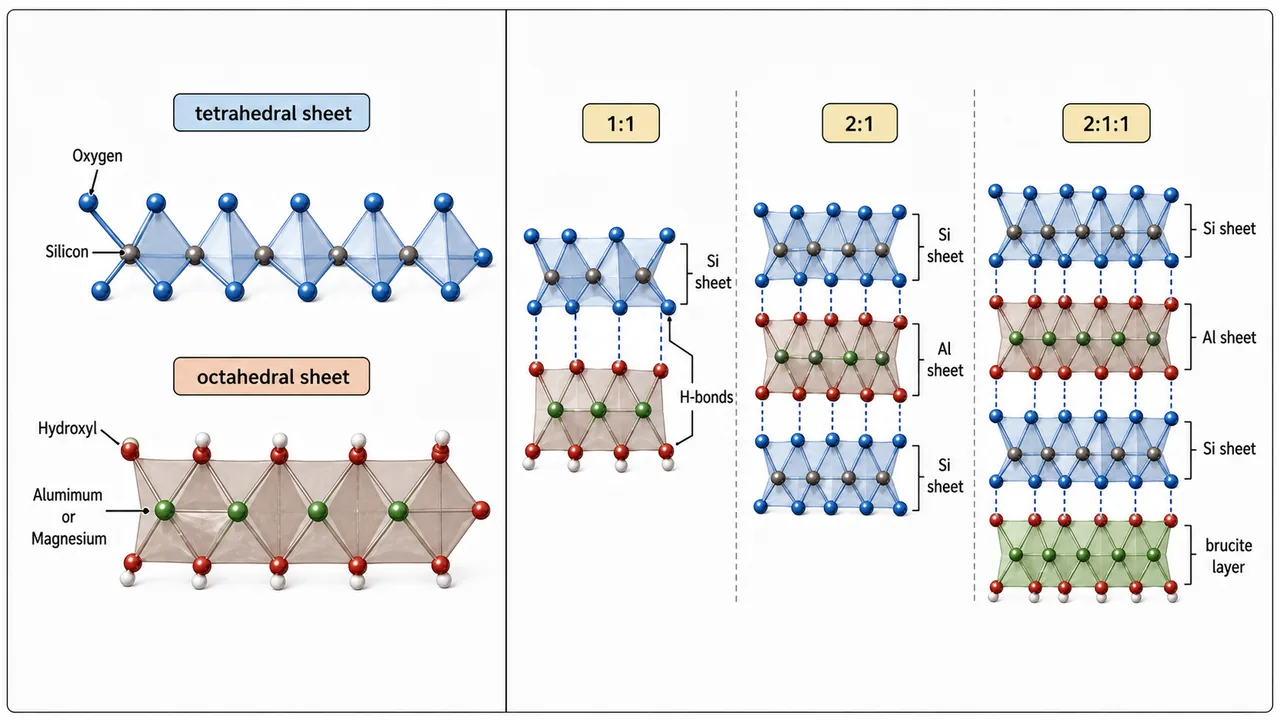
| Layer Silicate Clay Image Item | Full Content |
|---|---|
| Silica tetrahedron | A silicon atom surrounded by four oxygen atoms forms the tetrahedral sheet |
| Alumina octahedron | An aluminium or magnesium center surrounded by oxygen or hydroxyl forms the octahedral sheet |
| 1:1 arrangement | One tetrahedral sheet joined to one octahedral sheet forms the kaolinite-type structure |
| 2:1 arrangement | Two tetrahedral sheets surrounding one octahedral sheet form the illite, montmorillonite, and vermiculite-type structure |
| 2:1:1 arrangement | A 2:1 layer plus an extra hydroxide interlayer forms the chlorite-type structure |
| Main lesson | The way tetrahedral and octahedral sheets stack controls expansion, charge behavior, and nutrient-holding properties of clay minerals |
Classification of Silicate Clays
Based on the number and arrangement of tetrahedral (Si) and octahedral (Al) sheets:
A. 1:1 Type Clay Minerals
One tetrahedral sheet bonded to one octahedral sheet. Layers are held tightly together by hydrogen bonds, leaving no space for water to enter.
| Property | Detail |
|---|---|
| Classic example | Kaolinite |
| Expansion | Non-expanding |
| Shrink-swell | Low |
| CEC | Low (1-15 meq/100g) |
| Surface area | Low (37-45 m²/g) |
| Dominant in | Red laterite soils of south India |
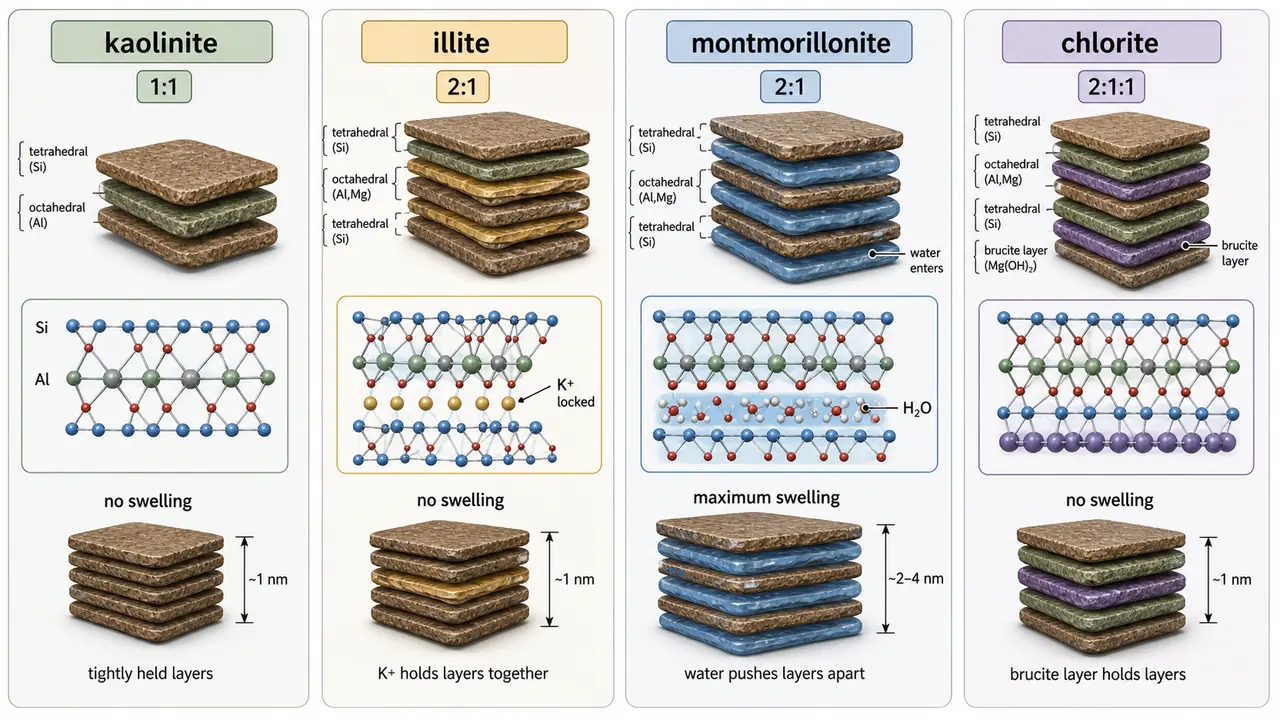
Farm example: Kaolinite-dominated red soils of Tamil Nadu have low nutrient retention (low CEC), requiring split application of fertilizers to avoid leaching losses.
B. 2:1 Type Clay Minerals
One octahedral sheet sandwiched between two tetrahedral sheets (2 Si sheets + 1 Al sheet).
B1. 2:1 Non-Expanding (Mica Group / Illite)
In illite, potassium ions (K⁺) are tightly wedged between layers, holding them firmly together and preventing expansion.
| Mineral | Found in |
|---|---|
| Biotite (Black Mica) | Sand and Silt fractions |
| Muscovite (White Mica) | Sand and Silt fractions |
| Illite (Weathered Mica) | Clay fraction -- common in alluvial soils of Indo-Gangetic plains |
Farm example: Alluvial soils of Punjab and Haryana are rich in illite, which provides moderate CEC (30-40 meq/100g) and a slow-release reservoir of potassium from between its layers.
B2. 2:1 Expanding (Smectite Group)
Bonds between successive layers are weak, allowing water and cations to enter the interlayer space. This causes dramatic swelling when wet and shrinking when dry.
| Mineral | Expansion | Where Found |
|---|---|---|
| Vermiculite | Partially expanding (limited) | Moderately weathered soils |
| Montmorillonite | Fully expanding (extensive) | Black cotton soils (Vertisols) of Maharashtra, MP, Gujarat |
Farm example: Montmorillonite-rich black soils develop deep cracks (30-45 cm) during summer. These cracks allow initial rain to penetrate rapidly but close up when soil swells, causing waterlogging if drainage is poor.
C. 2:1:1 (or 2:2) Type Clay Minerals
A 2:1 layer plus an additional hydroxide interlayer (typically Mg(OH)₂). Chlorite is the main example. The interlayer hydroxide sheet acts as a brace, preventing expansion.
| Property | Detail |
|---|---|
| Example | Chlorite |
| Expansion | Non-expanding |
| Interlayer | Mg(OH)₂ brucite sheet |
Weathering Resistance Sequence

Quartz > Muscovite > Feldspar > Biotite > Hornblende & Augite > Olivine > Dolomite > Gypsum
| Mineral | Resistance | Key Fact |
|---|---|---|
| Quartz (SiO₂) | Most resistant | 12-13% of Earth's crust; chief constituent of sand |
| Feldspars | Moderate | 61% of Earth's crust; weather to form clay |
| Micas | Moderate-high | 4% of Earth's crust |
| Gypsum | Least resistant | Weathers most easily |
Farm example: Sandy soils in river beds are dominated by quartz because it resists weathering. Feldspars in granite rocks break down into clay minerals, enriching soils over thousands of years.
Comprehensive Properties Comparison Table
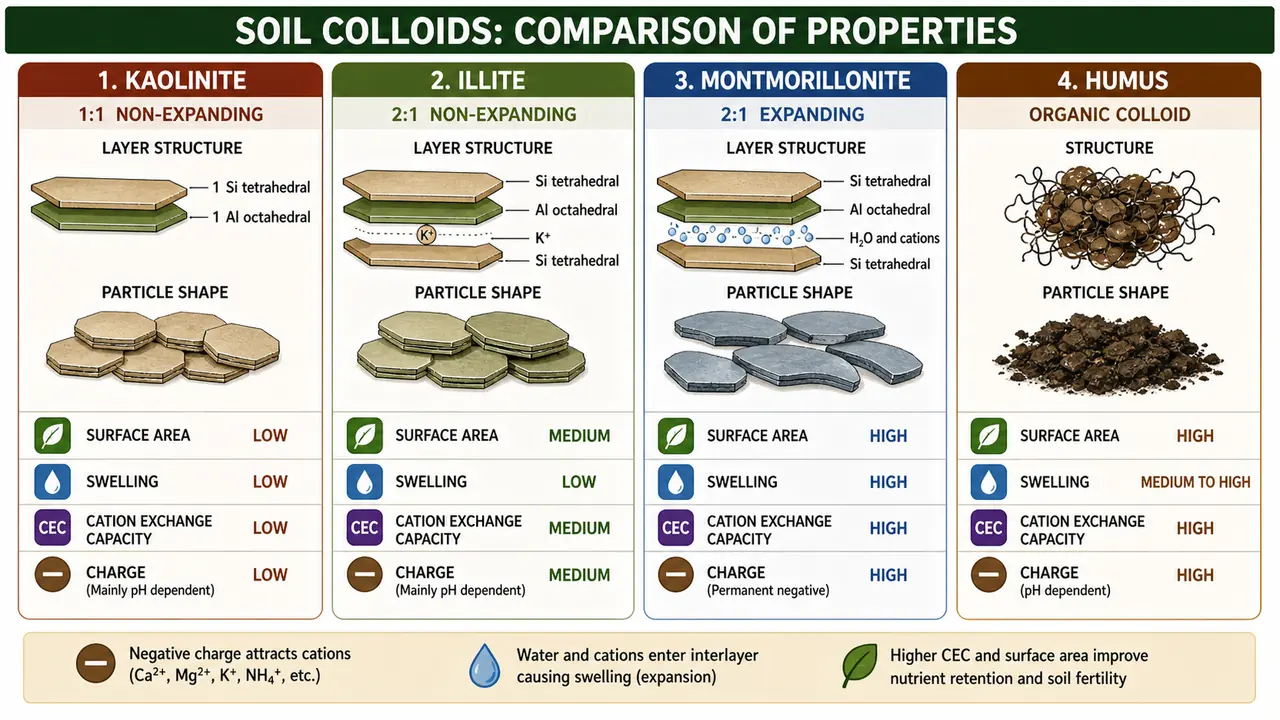
| Property | Kaolinite | Illite | Montmorillonite | Vermiculite | Humus |
|---|---|---|---|---|---|
| Type | 1:1 non-expanding | 2:1 non-expanding | 2:1 expanding | 2:1 limited expanding | Organic |
| Surface area (m²/g) | 37-45 | 120-170 | 580-750 | 780-900 (Highest among silicates) | 1200 |
| Internal surface | None | Low | High | Less than montmorillonite | - |
| Cohesion/Plasticity/Swelling | Very low | Low | High | Medium | Low |
| CEC (meq/100 g) | 1-15 | 30-40 | 80-150 | 100-150 | >200 |
| Size (micron) | 0.1-5.0 | 0.1-2.0 | 0.01-1.0 | - | - |
| P-Fixation | Highest | Low | - | Medium | - |
| Charge type | Variable (pH) | Mostly permanent | Mostly permanent | Mostly permanent | Variable (pH) |
| Interlayer bonding | H-bonds (tight) | K⁺ ions (tight) | Weak (water enters) | Moderate | - |
IMPORTANT
For exams: Vermiculite has the highest surface area among silicate clays (780-900 m²/g), but Humus has the highest overall (1200 m²/g). Montmorillonite has the highest cohesion and swelling. Humus has the highest CEC (>200).
| SN | Property | Kaolinite | Illite | Montmorillonite | Vermiculite | Humus |
|---|---|---|---|---|---|---|
| 1 | Type of silicate clay | 1:1 type, non-expanding | 2:1 type, non-expanding | 2:1 type, expanding | 2:1 type limited, expanding | - |
| 2 | Total surface area | 37-45 | 120-170 | 580-750 | 780-900 (highest among Silicates) | 1200 |
| 3 | External surface | Very low | Low | Low | Medium | - |
| 4 | Internal surface | None | Low | High | Less than montmorillonite | - |
| 5 | Cohesion, plasticity, swelling | Very Low | Low | High | Medium | - |
| 6 | CEC (meq/100g soil) | 3-15 | 30-40 | 80-150 | 100-150 | >200 |
| 7 | Anion Exchange Capacity | High | Medium | Low | - | - |
| 8 | Size (in micro m) | 0.1-5.0 | 0.1-1.0 | 0.01-1.0 | - | - |
| 9 | P Fixing | Highest | Medium | - | - | - |
2. Iron and Aluminum Oxide Clays (Sesquioxides)
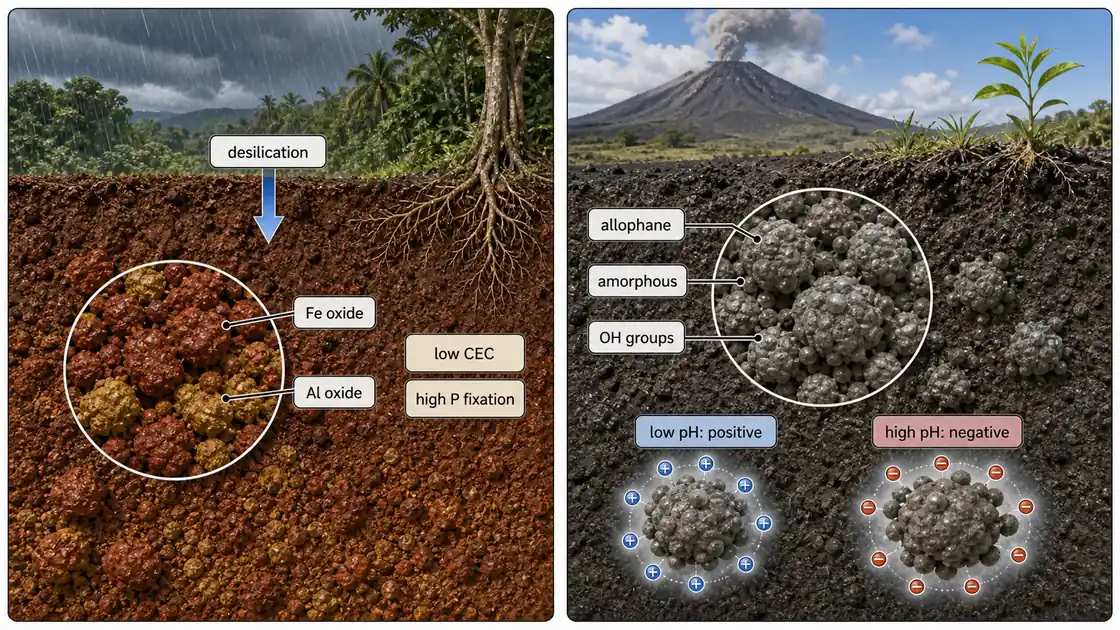
The Latin word sesqui means "one and one-half times" -- referring to the 3:2 oxygen-to-metal ratio (e.g., Fe₂O₃).
| Property | Sesquioxide Clays |
|---|---|
| Plasticity and cohesion | Absent |
| CEC | Low |
| Fertility | Low |
| P-fixation | Very high (Fe and Al phosphates) |
| Structure | Amorphous to crystalline |
| Colour | Red (hematite), yellow (limonite) |
Farm example: Laterite soils of Kerala and Karnataka are dominated by sesquioxides. Phosphorus applied as fertilizer gets quickly fixed as iron and aluminum phosphates, making it the biggest fertility challenge. Farmers must apply P in bands near roots or use rock phosphate for slow release.
3. Allophane and Amorphous Minerals
Amorphous means they lack organized crystal structure (unlike phyllosilicates). They are mixtures of silica, alumina, and sometimes iron oxides.
| Property | Allophane |
|---|---|
| Common in | Soils from volcanic ash |
| CEC | High (variable) |
| AEC | High |
| Surface area | Extremely high |
| Charge source | Accessible hydroxyl ions (OH⁻) |
| Charge behavior | Amphoteric -- positive charge at low pH, negative at high pH |
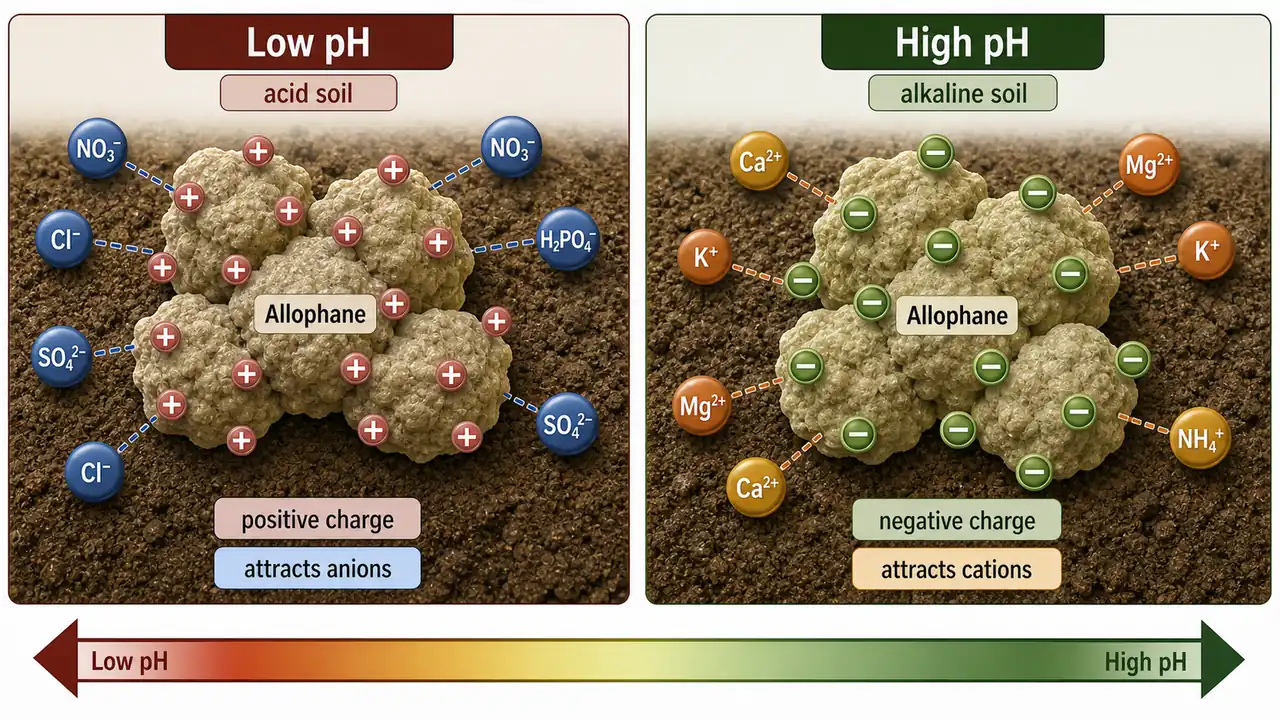
| pH condition | Net charge on allophane | What it attracts | Full takeaway |
|---|---|---|---|
| Low pH | Positive | Anions | In acid soil, allophane develops positive charge, so it can attract anions such as phosphate and nitrate |
| High pH | Negative | Cations | In higher-pH soil, allophane develops negative charge, so it can attract cations such as potassium, calcium, and ammonium |
At low pH, allophane carries a net positive charge (attracting anions). At high pH, it carries a net negative charge (attracting cations). This dual behavior is called amphoteric character.
Farm example: Volcanic ash soils in parts of the Andaman Islands have allophane clays with high water-holding capacity but severe phosphorus fixation.
4. Humus (Organic Colloid)
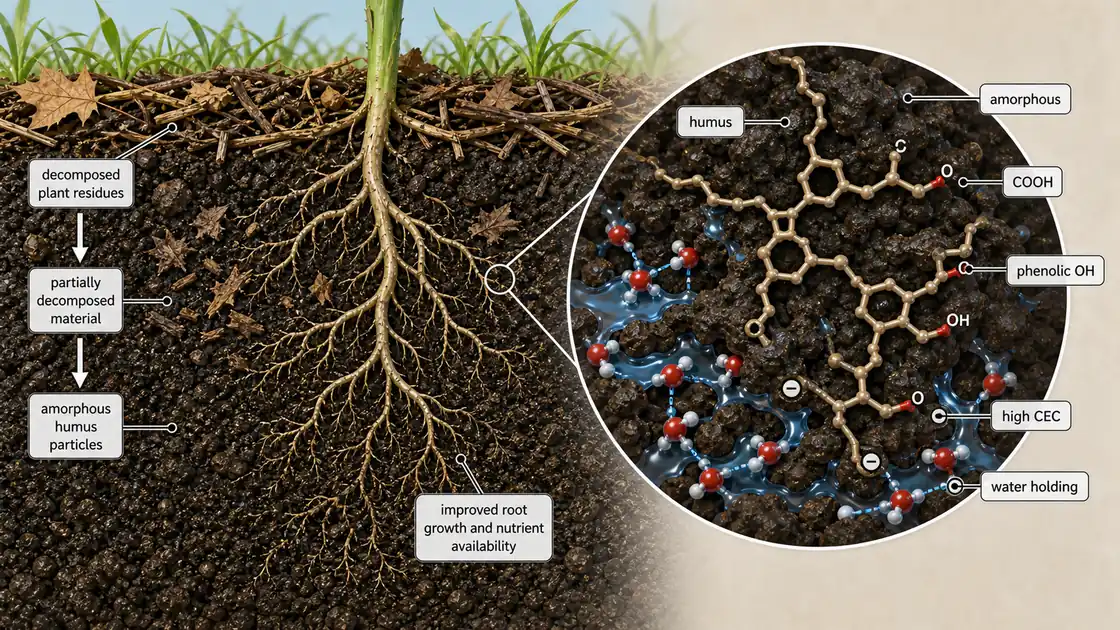
| Property | Detail |
|---|---|
| Appearance | Amorphous, dark brown to black |
| Solubility | Nearly insoluble in water; mostly soluble in dilute alkali (NaOH, KOH) |
| Nature | Temporary intermediate product of decomposition |
| Composition | Chains and loops of linked carbon atoms (C, H, O) |
| Charge source | Dissociation of enolic (-OH), carboxyl (-COOH), and phenolic groups |
| CEC | Strongly pH-dependent -- increases dramatically as pH rises |
| Crystallinity | Not crystalline |
| Turnover time | Decades to centuries |
Farm example: Adding well-decomposed FYM (rich in humus) to sandy soils in Rajasthan dramatically improves both CEC and water-holding capacity, because humus has the highest surface area (1200 m²/g) and CEC (>200 meq/100g) of any colloid.
| Humus | Clay |
|---|---|
| Made up of C, H, O | Made up of Si, Al, O |
| Complex amorphous organic colloid | Inorganic and crystalline |
| More dynamic, formed and destroyed more rapidly | Clays are stable relatively |
| Complex structure not well known | Clays have definite and well known structure |
Exam Tips and Mnemonics
- Four types of colloids: "LSAH" -- Layer silicates, Sesquioxides, Allophane, Humus
- 1:1 clay = Kaolinite = Non-expanding = H-bonds = Low CEC = High P-fixation
- 2:1 expanding = Montmorillonite (full) and Vermiculite (partial) = High CEC
- 2:1 non-expanding = Illite (K⁺ locks layers) = Moderate CEC
- 2:2 = Chlorite = Mg(OH)₂ interlayer = Non-expanding
- Weathering resistance: "Queen Must Follow Before Hitching A Ride On Dusty Ground" (Quartz > Muscovite > Feldspar > Biotite > Hornblende/Augite > Olivine > Dolomite > Gypsum)
- Quartz = most resistant; Gypsum = least resistant
- Feldspar = 61% of crust (largest); Quartz = 12-13% but most resistant
- Sesquioxide = sesqui (1.5) = Fe₂O₃ has 3 O for 2 Fe = 1.5 ratio
- Allophane = amphoteric = positive charge at low pH, negative at high pH
Summary Cheat Sheet
| Concept / Topic | Key Details |
|---|---|
| 4 types of soil colloids | Layer silicates, Sesquioxides, Allophane, Humus ("LSAH") |
| Kaolinite (1:1) | Non-expanding; H-bonds; CEC 1–15; highest P-fixation among silicate clays |
| Kaolinite dominant in | Red/laterite soils of south India |
| Illite (2:1 non-expanding) | K⁺ locks layers; CEC 30–40; no swelling |
| Illite dominant in | Alluvial soils of Indo-Gangetic plains |
| Montmorillonite (2:1 expanding) | Weak interlayer bonds; CEC 80–150; maximum swelling |
| Montmorillonite dominant in | Black cotton soils (Vertisols) |
| Vermiculite (2:1 partial) | CEC 100–150 (highest among clay minerals); limited swelling |
| Chlorite (2:2) | Extra Mg(OH)₂ brucite layer; non-expanding; CEC 25–30 |
| Sesquioxides (Fe₂O₃, Al₂O₃) | Amorphous to crystalline; CEC very low; P-fixation very high |
| Sesquioxides dominant in | Laterite soils (Kerala, Karnataka) |
| Sesqui meaning | 1.5 ratio (Fe₂O₃ → 3 O for 2 Fe = 1.5) |
| Allophane | Amorphous; from volcanic ash; amphoteric (+ charge at low pH, − at high pH) |
| Allophane — P fixation | High |
| Humus (organic colloid) | Amorphous; CEC >200 (highest); surface area 1200 m²/g |
| Humus charge | Entirely pH-dependent (from −COOH, −OH, phenolic groups) |
| Humus not crystalline | Dark brown to black; nearly insoluble in water |
| Weathering resistance order | Quartz (most) > Muscovite > Feldspar > Biotite > Hornblende > Olivine > Gypsum (least) |
| Feldspar | 61% of crust (most abundant); weathers to clay minerals |
| Quartz | 12–13% of crust but most resistant |
| CEC order (colloids) | Humus > Vermiculite > Montmorillonite > Illite > Chlorite > Kaolinite > Sesquioxides |