🐜Soil Biology: The Living World Beneath Our Crops
Soil microorganisms (bacteria, actinomycetes, fungi, algae), soil fauna (earthworms, nematodes, protozoa), and their roles in agriculture
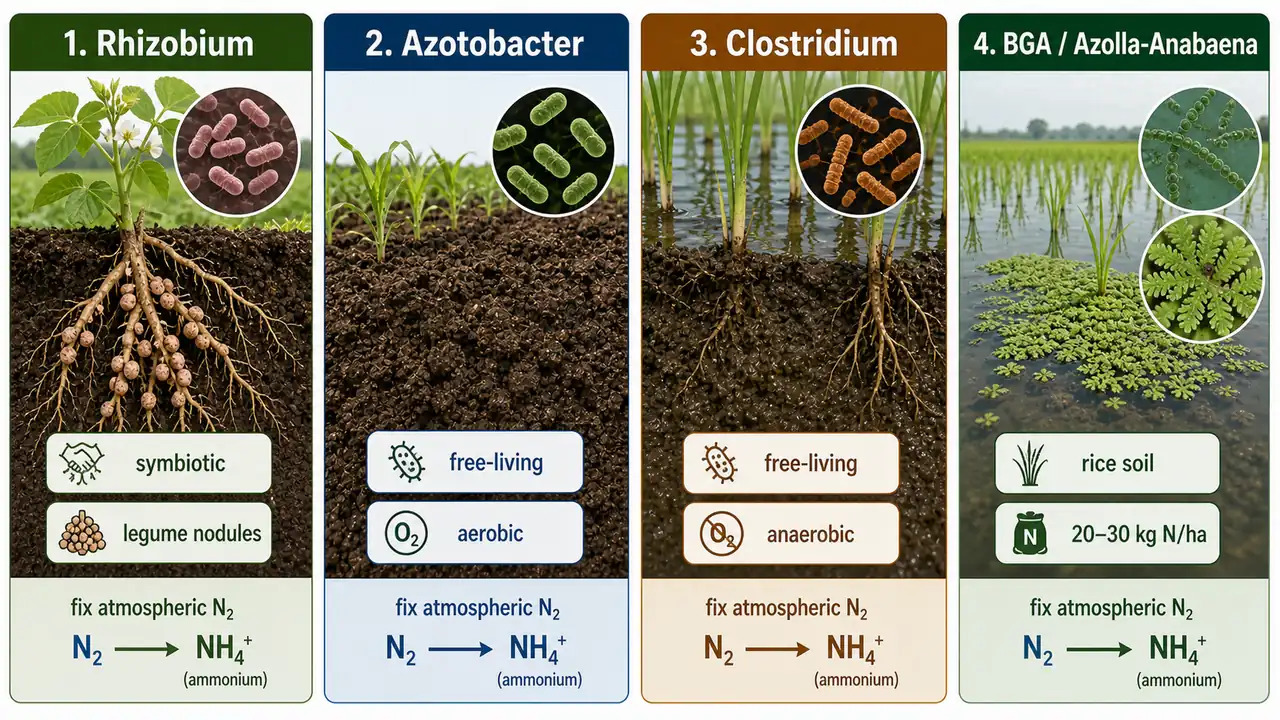
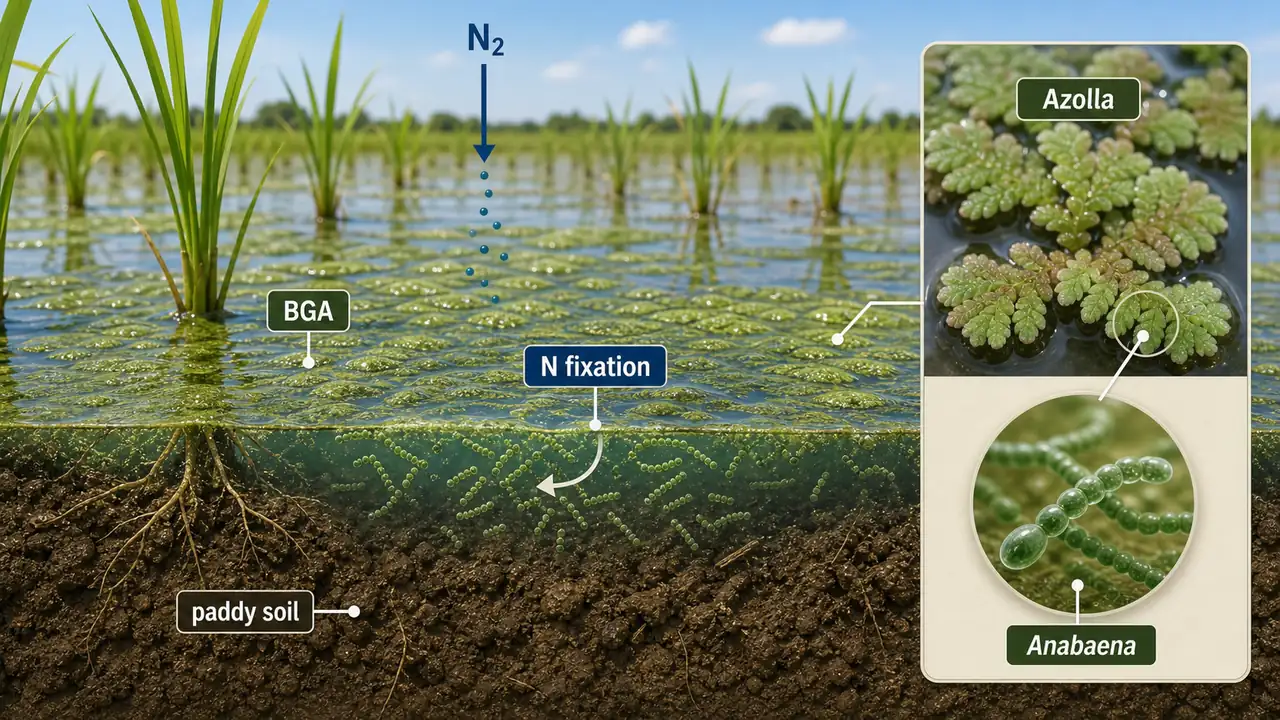
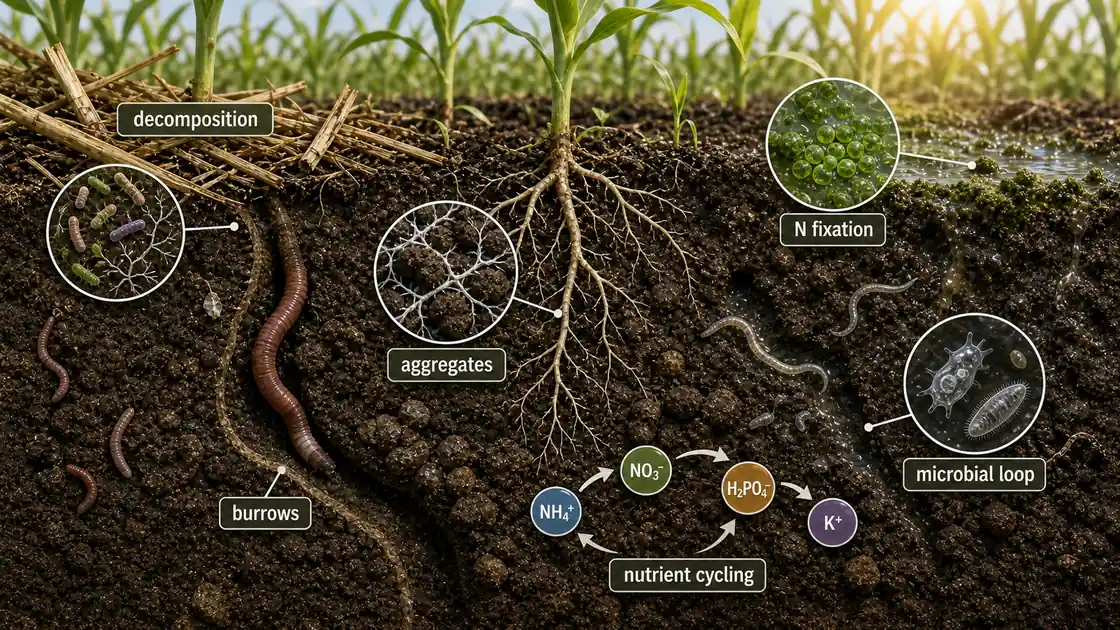
A paddy farmer in Kerala notices that his fields receiving no nitrogen fertilizer still produce reasonable yields year after year. The secret? Blue-green algae (BGA) thriving in the waterlogged rice soil fix atmospheric nitrogen, adding an estimated 20-30 kg N/ha per crop season — free of cost. Beneath every productive field is a hidden army of billions of organisms that decompose organic matter, fix nitrogen, cycle nutrients, and build soil structure. Understanding soil biology is essential for sustainable farming.
What is Soil Biology?
Soil biology studies microbial and faunal activity and ecology in soil. A single teaspoon of healthy soil can contain billions of microorganisms. These organisms include bacteria, actinomycetes, fungi, algae, earthworms, nematodes, and protozoa. The Father of Soil Microbiology is S.N. Winogradsky, who pioneered the study of nitrifying bacteria and chemolithotrophy.
Roles of Soil Organisms
| Role | Agricultural Significance |
|---|---|
| Organic matter decomposition | Releases nutrients from crop residues and FYM |
| Nutrient transformation | Nitrification, N-fixation, S-oxidation, P-solubilization |
| Soil structure | Aggregate formation and stabilization |
| CO₂ production | Drives weathering and root environment |
| Soil formation | Primary and secondary mineral breakdown |
| N utilization | Symbiotic and free-living N-fixation for crops |
Classification of Soil Organisms
| Category | Sub-category | Examples |
|---|---|---|
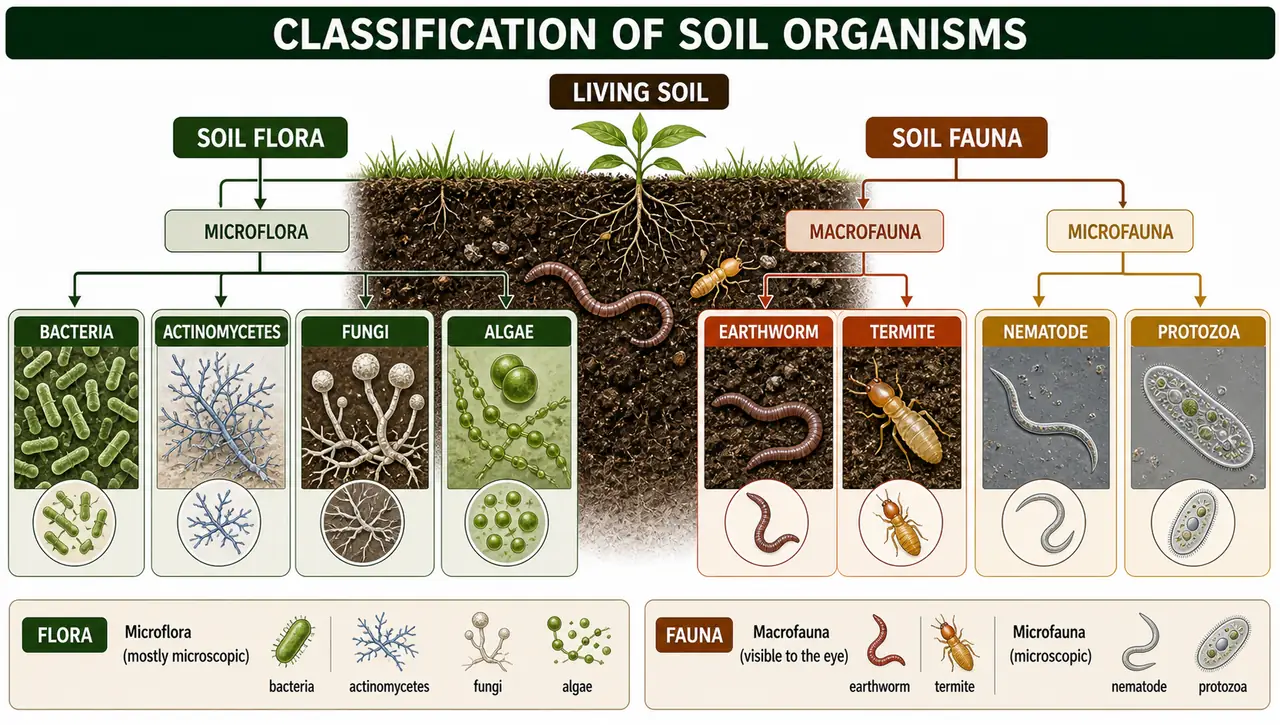
| Soil Flora | Micro flora | Bacteria, Actinomycetes, Fungi, Algae |
| Soil Fauna | Macro fauna | Earthworms, Ants, Termites |
| Soil Fauna | Micro fauna | Nematodes, Protozoa, Rotifers |
Classification by Oxygen Requirement
| Type | Description |
|---|---|
| Aerobes | Grow in the presence of O₂ |
| Anaerobes | Grow in the absence of O₂ |
| Facultative | Can grow with or without O₂ |
Classification by Temperature
| Type | Temperature Range | Significance |
|---|---|---|
| Psychrophiles | Below 20 degree C | Active in cold hill soils |
| Mesophiles | 20-45 degree C | Most common in agricultural soils |
| Thermophiles | Above 45 degree C | Important in composting |
Soil Microflora
1. Bacteria — The Most Abundant Soil Organisms
| Feature | Detail |
|---|---|
| Cell type | Single-celled |
| Shape | Rod-shaped (~1 um wide, 3 um long) or spherical (~2 um diameter) |
| Abundance | Most abundant group in soil |
| Population | 10⁸ - 10⁹ per gram of soil |
| Biomass | 450-4500 kg/ha |
| Optimum pH | 6.0-8.0 |
| Optimum temperature | 25-30 degree C |
Classification of Bacteria
By food preparation:
| Type | Description | Examples |
|---|---|---|
| Autotroph | Produce own food from inorganic sources | Nitrifiers, S-oxidizers |
| Heterotroph | Depend on organic matter for food | Symbiotic N-fixers, decomposers |
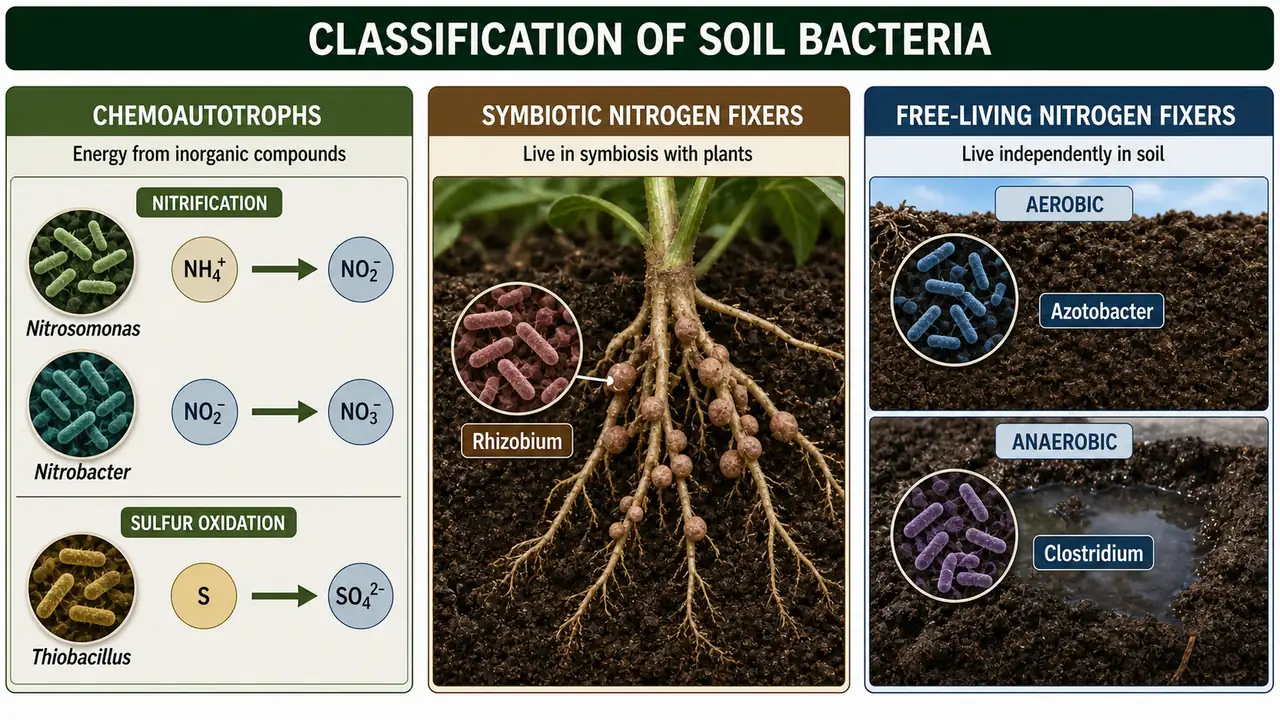
| Chemoautotroph | Derive energy from chemical reactions of inorganic substances | See below |
Key chemoautotrophic bacteria:
| Bacterium | Substrate | Reaction |
|---|---|---|
| Nitrosomonas | Ammonia | NH₄⁺ → NO₂⁻ (Step 1 of nitrification) |
| Nitrobacter | Nitrite | NO₂⁻ → NO₃⁻ (Step 2 of nitrification) |
| Thiobacillus | Sulphur compounds | S → SO₄²⁻ |
| Ferrobacillus | Ferrous iron | Fe²⁺ → Fe³⁺ |
By symbiotic relationship:
| Type | Association | Examples | Function |
|---|---|---|---|
| Symbiotic N-fixers | Associated with host plant | Rhizobium in legume root nodules | Fix atmospheric N₂; both partners benefit |
| Non-symbiotic N-fixers | Free-living (no plant association) | Azotobacter (aerobic), Clostridium (anaerobic) | Fix atmospheric N₂ independently |
Classification summary: Symbiotic, non-symbiotic, and cellulose decomposers are heterotrophs. Nitrifiers, denitrifiers, and sulphur oxidizers are autotrophs.
Role of Bacteria
| Function | Agricultural Example |
|---|---|
| Decomposition of organic matter and humus synthesis | Breaking down FYM and crop residues |
| Enzymatic transformations | Converting unavailable nutrients to available forms |
| N-fixation | Rhizobium in chickpea, soybean, groundnut nodules |
| Nitrification | NH₄⁺ → NO₃⁻ (making N plant-available) |
| Sulphur oxidation | Converting elemental S to plant-available SO₄²⁻ |
Growth conditions: Optimal at pH 6.0-8.0; exchangeable Ca is more important than pH for bacterial populations.
2. Actinomycetes — The Filamentous Bacteria
| Feature | Detail |
|---|---|
| Cell type | Unicellular like bacteria, same size |
| Structure | Filamentous and profusely branched |
| Mycelial threads | Smaller than those of fungi |
| Nuclear membrane | Absent (like bacteria) |
| Alternative name | Filamentous bacteria |
| Optimum | Temperature 25-30 degree C; pH 6.5-8.0 |
| Metabolism | Heterotrophic |
Key Facts about Actinomycetes
| Fact | Detail |
|---|---|
| Sensitive to | Acid soils |
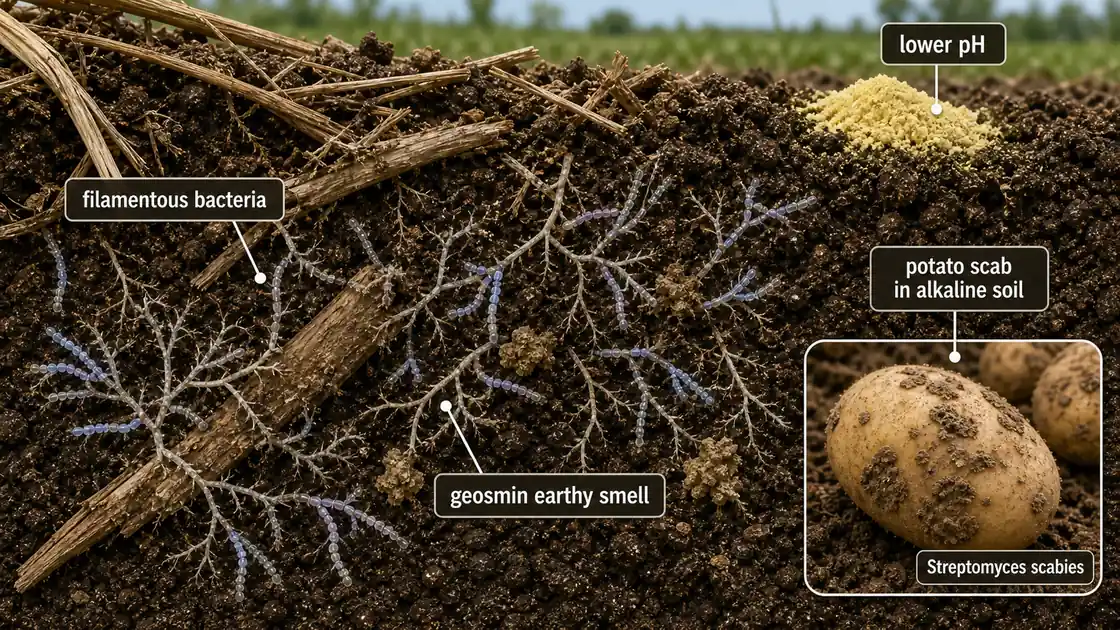
| Potato scab disease | Caused by Streptomyces scabies; controlled by lowering soil pH using sulphur |
| Earthy smell | The aroma of freshly ploughed land is due to geosmin produced by actinomycetes |
| Population | Second only to bacteria; proportion increases with soil depth |
| Functions | Decompose chitin, phospholipids, and other complex organic compounds |
Farm example: Potato scab is a major disease in alkaline soils. Farmers apply elemental sulphur to lower pH below 5.5, which suppresses Streptomyces scabies.
3. Fungi — Dominant in Acid Soils
| Feature | Detail |
|---|---|
| Structure | Mycelium of individual hyphae (5-20 um diameter, several cm long) |
| Metabolism | Most are heterotrophic |
| Oxygen | Strictly aerobic |
| pH preference | Dominant in acid soils (can tolerate up to pH 9.0) |
| Lifestyle | Parasitic or Saprophytic |
| Classification | Phycomycetes, Ascomycetes, Basidiomycetes, Fungi imperfecti |
| Also classified as | Molds, Yeasts, Mushrooms |
Molds
| Feature | Detail |
|---|---|
| Common genera | Mucor, Fusarium, Aspergillus |
| Population | 10-200 billion/m² |
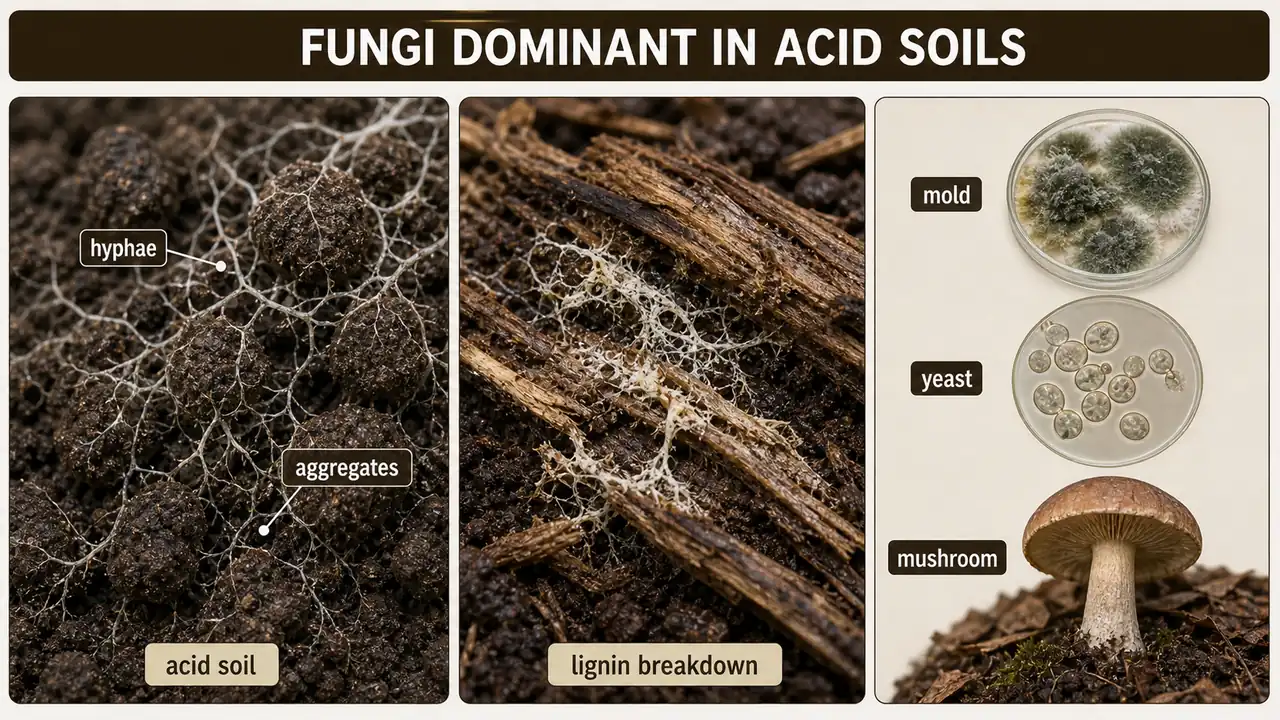
| Key role | Humus formation and aggregate stabilization — more important than bacteria |
| Unique ability | Continue decomposing complex substances (especially lignin) after bacteria have stopped |
| Mechanism | Hyphae physically bind soil particles together, creating stable aggregates |
Farm example: In acid forest soils of the Western Ghats, fungi are the primary decomposers because bacteria cannot thrive at low pH.
Yeasts
| Feature | Detail |
|---|---|
| Structure | Unicellular fungi |
| Reproduction | By fission or budding |
| Soil occurrence | Not common in soils |
| Use | Food supplement; production of alcoholic beverages |
Mushrooms
| Feature | Detail |
|---|---|
| Habitat | Forests and grasslands with ample moisture and organic residues |
| Edibility | Some species are edible |
| Soil occurrence | Not common in cultivated soils |
| Structure | Visible part is the fruiting body (above ground); main body is underground mycelium network |
4. Algae — The Photosynthetic Soil Organisms
| Feature | Detail |
|---|---|
| Structure | Filamentous, ~10 um diameter |
| Population | 1-10 billion/m² |
| Biomass | 50-600 kg/ha of furrow slice |
| Nutrition | Photo-autotrophs (produce own food using sunlight) |
| Groups | Blue-green, Green, Yellow-green, Diatoms |
Blue-Green Algae (BGA) in Agriculture
| Fact | Detail |
|---|---|
| Most numerous in | Rice (paddy) soils |
| N-fixation | 20-30 kg N/ha per crop season |
| Azolla association | BGA (Anabaena) growing within leaves of aquatic fern Azolla fix atmospheric N₂ |
TIP
Key N-fixation associations to remember:
- Rhizobium = symbiotic N-fixer in legumes
- Azotobacter = free-living aerobic N-fixer
- Clostridium = free-living anaerobic N-fixer
- BGA/Azolla = N-fixers in rice paddies
Farm example: Paddy farmers in Tamil Nadu use Azolla as a green manure in rice fields. The Azolla-Anabaena association fixes atmospheric nitrogen, reducing the need for urea by 20-30 kg N/ha.
Soil Fauna
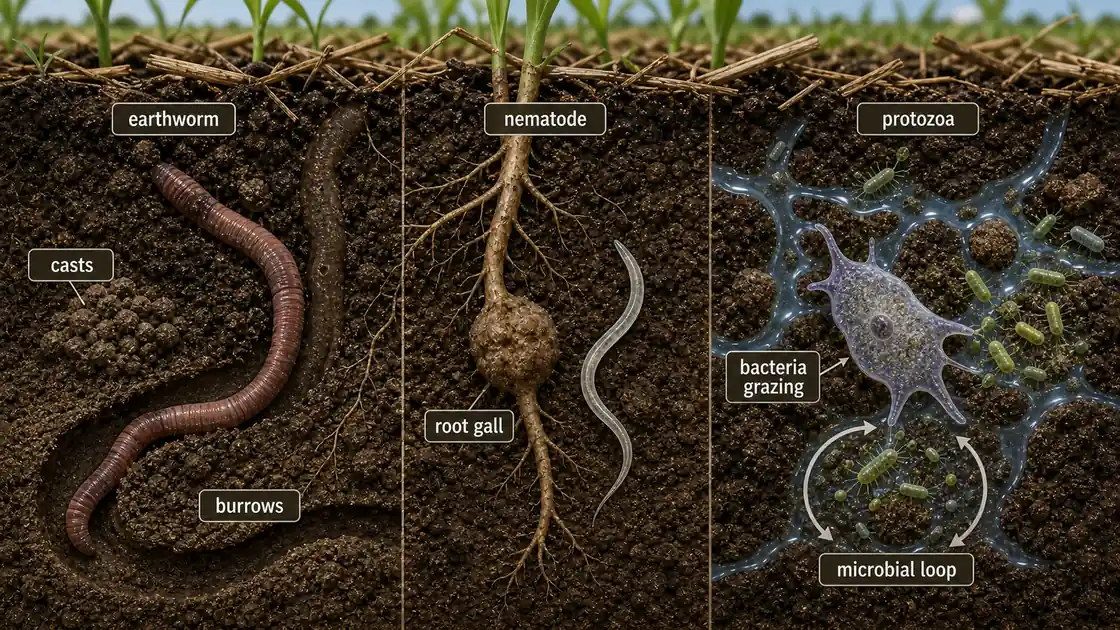
1. Earthworms — “Nature’s Plough” (Macro Fauna)
| Feature | Detail |
|---|---|
| Known species | ~1800 species worldwide |
| Common Indian species | Pheretima posthuma, P. elongata, Lampita mauritii |
| Population | 1,25,000 to 10,00,000/ha |
| Biomass | 110-1100 kg/ha |
| Preferred temperature | 21 degree C |
| Preferred conditions | Warm, well-aerated soils with organic matter |
| Active season | Monsoon |
| C:N ratio of casts | Low (nutrient-rich) |
Benefits of Earthworms
| Benefit | Mechanism |
|---|---|
| Nutrient-rich castings | Casts are richer in N, P, K, and Ca than surrounding soil (enzymatic processing during digestion) |
| Aeration and drainage | Create extensive burrows that increase soil porosity |
| Aggregate stability | Increase size and stability of soil aggregates |
| Soil mixing | Ingest and eject soil, mixing organic matter into deeper layers |
Farm example: Vermicompost produced by earthworms is widely used in organic farming across India. The castings have a low C:N ratio, making nutrients readily available to plants.
2. Ants and Termites
| Feature | Detail |
|---|---|
| Effect | Local but significant soil turnover |
| Ants | Some break down woody materials; produce mounds or underground nests |
| Termites | Can move enormous quantities of soil; create characteristic mounds |
| Both | Modify soil structure and effectively till the soil |
Farm example: Termite mounds in tropical soils of Chhattisgarh and Jharkhand significantly alter soil profiles, bringing subsoil minerals to the surface.
3. Nematodes (Thread Worms / Eelworms)
| Feature | Detail |
|---|---|
| Size | Microscopic |
| Feeding | Most are saprophytes; some feed on bacteria, algae, protozoa, and other nematodes |
| Plant parasites | Heterodera (cyst nematode), Meloidogyne (root-knot nematode) |
| Major damage | Vegetable crops — severe root galling and yield loss |
Farm example: Root-knot nematodes (Meloidogyne) cause severe damage in tomato, brinjal, and okra fields, forming characteristic galls on roots that block water and nutrient uptake.
4. Protozoa (Micro Fauna)
| Feature | Detail |
|---|---|
| Cell type | Single-celled, larger and more complex than bacteria |
| Types | Amoeba, Ciliates, Flagellates |
| Species in soil | More than 250 |
| Biomass | 15-175 kg/ha |
| Habitat | Moist, well-drained soils |
| Key role | Grazing on bacteria releases nutrients back into soil solution (microbial loop) |
5. Rotifers
| Feature | Detail |
|---|---|
| Species | ~100 species studied |
| Habitat | Peat bogs and wet areas of mineral soils |
Plant Roots as Soil Organisms
Plant roots are themselves important contributors to soil biology:
| Contribution | Detail |
|---|---|
| Food and energy | Roots supply food for microflora and fauna as they grow and die |
| Soil modification | Push through cracks, create new openings |
| Aggregation | Moisture removal creates physical stress that stimulates aggregate formation |
| Root exudates | Chemicals that stabilize soil structure |
| Humus synthesis | Decaying roots supply material for humus formation |
| Proportion | Roots = 15-40% of above-ground crop biomass |
Mycorrhizae
This topic will be covered in the manures lesson.
Exam Tips and Mnemonics
- Most abundant soil organisms: Bacteria (10⁸-10⁹/g)
- Dominant in acid soils: Fungi (not bacteria)
- Earthy smell of ploughed land: Actinomycetes (geosmin)
- Potato scab: Streptomyces scabies — controlled by lowering pH with sulphur
- N-fixation mnemonic “RACE”: Rhizobium (symbiotic-legumes), Azotobacter (free-aerobic), Clostridium (free-anaerobic), Extra: BGA/Azolla (rice)
- Nitrification: Nitrosomonas (NH₄→NO₂) then Nitrobacter (NO₂→NO₃) — “SO first, BAC second”
- BGA in paddy: Fixes 20-30 kg N/ha
- Earthworm = “Nature’s Plough” — active at 21 degree C, monsoon season
- Nematode damage: Heterodera (cyst), Meloidogyne (root-knot) — worst in vegetables
- Actinomycetes: Increase with depth; second most abundant after bacteria
Summary Table
| Organism | Population/Biomass | Key Role | Key Fact |
|---|---|---|---|
| Bacteria | 10⁸-10⁹/g; 450-4500 kg/ha | Decomposition, N-fixation, nitrification | Most abundant; optimal pH 6-8 |
| Actinomycetes | Equal to bacteria | Decompose chitin, phospholipids | Earthy smell (geosmin); potato scab |
| Fungi | 10-200 billion/m² | Lignin decomposition, humus formation, aggregation | Dominant in acid soils; strictly aerobic |
| Algae (BGA) | 50-600 kg/ha | N-fixation in paddy | Fix 20-30 kg N/ha in rice |
| Earthworms | 1.25-10 lakh/ha; 110-1100 kg/ha | Aeration, nutrient-rich castings, aggregation | ”Nature’s Plough”; prefer 21 degree C |
| Nematodes | Widespread | Saprophytic feeding; some parasitic | Root-knot (Meloidogyne) damages vegetables |
| Protozoa | 15-175 kg/ha | Bacterial grazing (microbial loop) | Single-celled; >250 species |
| Rhizobium | In legume nodules | Symbiotic N-fixation | Most important biofertilizer for pulses |
| Azotobacter | Free-living | Aerobic N-fixation | Used as biofertilizer in cereals |
| Clostridium | Free-living | Anaerobic N-fixation | Important in waterlogged soils |
Summary Cheat Sheet
| Concept / Topic | Key Details / Explanation |
|---|---|
| Father of Soil Microbiology | S.N. Winogradsky |
| Most abundant soil organisms | Bacteria (10⁸–10⁹ per gram; 450–4500 kg/ha) |
| Second most abundant | Actinomycetes (proportion increases with soil depth) |
| Bacteria optimum pH | 6.0–8.0 |
| Dominant in acid soils | Fungi (not bacteria) |
| Earthy smell of freshly ploughed soil | Geosmin produced by actinomycetes |
| Potato scab disease | Streptomyces scabies — controlled by lowering pH with sulphur |
| Nitrification Step 1 | Nitrosomonas: NH₄⁺ → NO₂⁻ |
| Nitrification Step 2 | Nitrobacter: NO₂⁻ → NO₃⁻ |
| Denitrification | Pseudomonas (anaerobic); NO₃⁻ → N₂/N₂O; favoured by waterlogging + high pH |
| Symbiotic N-fixer | Rhizobium — in legume root nodules |
| Free-living aerobic N-fixer | Azotobacter |
| Free-living anaerobic N-fixer | Clostridium |
| BGA/Azolla N-fixation in rice | Anabaena in Azolla fern; fixes 20–30 kg N/ha per crop season |
| N-fixation mnemonic | ”RACE” — Rhizobium, Azotobacter, Clostridium, Extra (BGA/Azolla) |
| Actinomycetes | Filamentous bacteria; no nuclear membrane; decompose chitin, phospholipids |
| Actinomycetes pH optimum | 6.5–8.0 (sensitive to acid soils) |
| Fungi classification | Phycomycetes, Ascomycetes, Basidiomycetes, Fungi imperfecti (molds, yeasts, mushrooms) |
| Fungi — key roles | Lignin decomposition, humus formation, aggregate stabilization |
| Algae in paddy | Most numerous BGA; photo-autotrophs; 1–10 billion/m² |
| Temperature groups | Psychrophiles (<20°C), Mesophiles (20–45°C), Thermophiles (>45°C — important in composting) |
| Earthworms | ”Nature’s Plough”; ~1800 species; preferred temp 21°C; active in monsoon |
| Earthworm population | 1.25–10 lakh/ha; biomass 110–1100 kg/ha |
| Earthworm casts | Richer in N, P, K, Ca; low C:N ratio |
| Root-knot nematode | Meloidogyne — damages vegetables (tomato, brinjal, okra) |
| Cyst nematode | Heterodera |
| Protozoa | Single-celled; >250 species; graze on bacteria (microbial loop); 15–175 kg/ha |
| Plant roots | Supply 15–40% of above-ground biomass as organic matter; produce exudates that stabilize structure |
| Fungi: lignin decomposition | White-rot fungi (Molds: Mucor, Fusarium, Aspergillus) |
| Actinomycetes: wood decomposition | Actinomycetes decompose wood |
Pro Content Locked
Upgrade to Pro to access this lesson and all other premium content.
₹2388 billed yearly
- All Agriculture & Banking Courses
- AI Lesson Questions (100/day)
- AI Doubt Solver (50/day)
- Glows & Grows Feedback (30/day)
- AI Section Quiz (20/day)
- 22-Language Translation (30/day)
- Recall Questions (20/day)
- AI Quiz (15/day)
- AI Quiz Paper Analysis
- AI Step-by-Step Explanations
- Spaced Repetition Recall (FSRS)
- AI Tutor
- Immersive Text Questions
- Audio Lessons — Hindi & English
- Mock Tests & Previous Year Papers
- Summary & Mind Maps
- XP, Levels, Leaderboard & Badges
- Generate New Classrooms
- Voice AI Teacher (AgriDots Live)
- AI Revision Assistant
- Knowledge Gap Analysis
- Interactive Revision (LangGraph)
🔒 Secure via Razorpay · Cancel anytime · No hidden fees
A paddy farmer in Kerala notices that his fields receiving no nitrogen fertilizer still produce reasonable yields year after year. The secret? Blue-green algae (BGA) thriving in the waterlogged rice soil fix atmospheric nitrogen, adding an estimated 20-30 kg N/ha per crop season — free of cost. Beneath every productive field is a hidden army of billions of organisms that decompose organic matter, fix nitrogen, cycle nutrients, and build soil structure. Understanding soil biology is essential for sustainable farming.
What is Soil Biology?
Soil biology studies microbial and faunal activity and ecology in soil. A single teaspoon of healthy soil can contain billions of microorganisms. These organisms include bacteria, actinomycetes, fungi, algae, earthworms, nematodes, and protozoa. The Father of Soil Microbiology is S.N. Winogradsky, who pioneered the study of nitrifying bacteria and chemolithotrophy.
Roles of Soil Organisms
| Role | Agricultural Significance |
|---|---|
| Organic matter decomposition | Releases nutrients from crop residues and FYM |
| Nutrient transformation | Nitrification, N-fixation, S-oxidation, P-solubilization |
| Soil structure | Aggregate formation and stabilization |
| CO₂ production | Drives weathering and root environment |
| Soil formation | Primary and secondary mineral breakdown |
| N utilization | Symbiotic and free-living N-fixation for crops |
Classification of Soil Organisms
| Category | Sub-category | Examples |
|---|---|---|
| Soil Flora | Micro flora | Bacteria, Actinomycetes, Fungi, Algae |
| Soil Fauna | Macro fauna | Earthworms, Ants, Termites |
| Soil Fauna | Micro fauna | Nematodes, Protozoa, Rotifers |
Classification by Oxygen Requirement
| Type | Description |
|---|---|
| Aerobes | Grow in the presence of O₂ |
| Anaerobes | Grow in the absence of O₂ |
| Facultative | Can grow with or without O₂ |
Classification by Temperature
| Type | Temperature Range | Significance |
|---|---|---|
| Psychrophiles | Below 20 degree C | Active in cold hill soils |
| Mesophiles | 20-45 degree C | Most common in agricultural soils |
| Thermophiles | Above 45 degree C | Important in composting |
Soil Microflora
1. Bacteria — The Most Abundant Soil Organisms
| Feature | Detail |
|---|---|
| Cell type | Single-celled |
| Shape | Rod-shaped (~1 um wide, 3 um long) or spherical (~2 um diameter) |
| Abundance | Most abundant group in soil |
| Population | 10⁸ - 10⁹ per gram of soil |
| Biomass | 450-4500 kg/ha |
| Optimum pH | 6.0-8.0 |
| Optimum temperature | 25-30 degree C |
Classification of Bacteria
By food preparation:
| Type | Description | Examples |
|---|---|---|
| Autotroph | Produce own food from inorganic sources | Nitrifiers, S-oxidizers |
| Heterotroph | Depend on organic matter for food | Symbiotic N-fixers, decomposers |
| Chemoautotroph | Derive energy from chemical reactions of inorganic substances | See below |
Key chemoautotrophic bacteria:
| Bacterium | Substrate | Reaction |
|---|---|---|
| Nitrosomonas | Ammonia | NH₄⁺ → NO₂⁻ (Step 1 of nitrification) |
| Nitrobacter | Nitrite | NO₂⁻ → NO₃⁻ (Step 2 of nitrification) |
| Thiobacillus | Sulphur compounds | S → SO₄²⁻ |
| Ferrobacillus | Ferrous iron | Fe²⁺ → Fe³⁺ |
By symbiotic relationship:
| Type | Association | Examples | Function |
|---|---|---|---|
| Symbiotic N-fixers | Associated with host plant | Rhizobium in legume root nodules | Fix atmospheric N₂; both partners benefit |
| Non-symbiotic N-fixers | Free-living (no plant association) | Azotobacter (aerobic), Clostridium (anaerobic) | Fix atmospheric N₂ independently |
Classification summary: Symbiotic, non-symbiotic, and cellulose decomposers are heterotrophs. Nitrifiers, denitrifiers, and sulphur oxidizers are autotrophs.
Role of Bacteria
| Function | Agricultural Example |
|---|---|
| Decomposition of organic matter and humus synthesis | Breaking down FYM and crop residues |
| Enzymatic transformations | Converting unavailable nutrients to available forms |
| N-fixation | Rhizobium in chickpea, soybean, groundnut nodules |
| Nitrification | NH₄⁺ → NO₃⁻ (making N plant-available) |
| Sulphur oxidation | Converting elemental S to plant-available SO₄²⁻ |
Growth conditions: Optimal at pH 6.0-8.0; exchangeable Ca is more important than pH for bacterial populations.
2. Actinomycetes — The Filamentous Bacteria
| Feature | Detail |
|---|---|
| Cell type | Unicellular like bacteria, same size |
| Structure | Filamentous and profusely branched |
| Mycelial threads | Smaller than those of fungi |
| Nuclear membrane | Absent (like bacteria) |
| Alternative name | Filamentous bacteria |
| Optimum | Temperature 25-30 degree C; pH 6.5-8.0 |
| Metabolism | Heterotrophic |
Key Facts about Actinomycetes
| Fact | Detail |
|---|---|
| Sensitive to | Acid soils |
| Potato scab disease | Caused by Streptomyces scabies; controlled by lowering soil pH using sulphur |
| Earthy smell | The aroma of freshly ploughed land is due to geosmin produced by actinomycetes |
| Population | Second only to bacteria; proportion increases with soil depth |
| Functions | Decompose chitin, phospholipids, and other complex organic compounds |
Farm example: Potato scab is a major disease in alkaline soils. Farmers apply elemental sulphur to lower pH below 5.5, which suppresses Streptomyces scabies.
3. Fungi — Dominant in Acid Soils
| Feature | Detail |
|---|---|
| Structure | Mycelium of individual hyphae (5-20 um diameter, several cm long) |
| Metabolism | Most are heterotrophic |
| Oxygen | Strictly aerobic |
| pH preference | Dominant in acid soils (can tolerate up to pH 9.0) |
| Lifestyle | Parasitic or Saprophytic |
| Classification | Phycomycetes, Ascomycetes, Basidiomycetes, Fungi imperfecti |
| Also classified as | Molds, Yeasts, Mushrooms |
Molds
| Feature | Detail |
|---|---|
| Common genera | Mucor, Fusarium, Aspergillus |
| Population | 10-200 billion/m² |
| Key role | Humus formation and aggregate stabilization — more important than bacteria |
| Unique ability | Continue decomposing complex substances (especially lignin) after bacteria have stopped |
| Mechanism | Hyphae physically bind soil particles together, creating stable aggregates |
Farm example: In acid forest soils of the Western Ghats, fungi are the primary decomposers because bacteria cannot thrive at low pH.
Yeasts
| Feature | Detail |
|---|---|
| Structure | Unicellular fungi |
| Reproduction | By fission or budding |
| Soil occurrence | Not common in soils |
| Use | Food supplement; production of alcoholic beverages |
Mushrooms
| Feature | Detail |
|---|---|
| Habitat | Forests and grasslands with ample moisture and organic residues |
| Edibility | Some species are edible |
| Soil occurrence | Not common in cultivated soils |
| Structure | Visible part is the fruiting body (above ground); main body is underground mycelium network |
4. Algae — The Photosynthetic Soil Organisms
| Feature | Detail |
|---|---|
| Structure | Filamentous, ~10 um diameter |
| Population | 1-10 billion/m² |
| Biomass | 50-600 kg/ha of furrow slice |
| Nutrition | Photo-autotrophs (produce own food using sunlight) |
| Groups | Blue-green, Green, Yellow-green, Diatoms |
Blue-Green Algae (BGA) in Agriculture
| Fact | Detail |
|---|---|
| Most numerous in | Rice (paddy) soils |
| N-fixation | 20-30 kg N/ha per crop season |
| Azolla association | BGA (Anabaena) growing within leaves of aquatic fern Azolla fix atmospheric N₂ |
TIP
Key N-fixation associations to remember:
- Rhizobium = symbiotic N-fixer in legumes
- Azotobacter = free-living aerobic N-fixer
- Clostridium = free-living anaerobic N-fixer
- BGA/Azolla = N-fixers in rice paddies
Farm example: Paddy farmers in Tamil Nadu use Azolla as a green manure in rice fields. The Azolla-Anabaena association fixes atmospheric nitrogen, reducing the need for urea by 20-30 kg N/ha.
Soil Fauna
1. Earthworms — “Nature’s Plough” (Macro Fauna)
| Feature | Detail |
|---|---|
| Known species | ~1800 species worldwide |
| Common Indian species | Pheretima posthuma, P. elongata, Lampita mauritii |
| Population | 1,25,000 to 10,00,000/ha |
| Biomass | 110-1100 kg/ha |
| Preferred temperature | 21 degree C |
| Preferred conditions | Warm, well-aerated soils with organic matter |
| Active season | Monsoon |
| C:N ratio of casts | Low (nutrient-rich) |
Benefits of Earthworms
| Benefit | Mechanism |
|---|---|
| Nutrient-rich castings | Casts are richer in N, P, K, and Ca than surrounding soil (enzymatic processing during digestion) |
| Aeration and drainage | Create extensive burrows that increase soil porosity |
| Aggregate stability | Increase size and stability of soil aggregates |
| Soil mixing | Ingest and eject soil, mixing organic matter into deeper layers |
Farm example: Vermicompost produced by earthworms is widely used in organic farming across India. The castings have a low C:N ratio, making nutrients readily available to plants.
2. Ants and Termites
| Feature | Detail |
|---|---|
| Effect | Local but significant soil turnover |
| Ants | Some break down woody materials; produce mounds or underground nests |
| Termites | Can move enormous quantities of soil; create characteristic mounds |
| Both | Modify soil structure and effectively till the soil |
Farm example: Termite mounds in tropical soils of Chhattisgarh and Jharkhand significantly alter soil profiles, bringing subsoil minerals to the surface.
3. Nematodes (Thread Worms / Eelworms)
| Feature | Detail |
|---|---|
| Size | Microscopic |
| Feeding | Most are saprophytes; some feed on bacteria, algae, protozoa, and other nematodes |
| Plant parasites | Heterodera (cyst nematode), Meloidogyne (root-knot nematode) |
| Major damage | Vegetable crops — severe root galling and yield loss |
Farm example: Root-knot nematodes (Meloidogyne) cause severe damage in tomato, brinjal, and okra fields, forming characteristic galls on roots that block water and nutrient uptake.
4. Protozoa (Micro Fauna)
| Feature | Detail |
|---|---|
| Cell type | Single-celled, larger and more complex than bacteria |
| Types | Amoeba, Ciliates, Flagellates |
| Species in soil | More than 250 |
| Biomass | 15-175 kg/ha |
| Habitat | Moist, well-drained soils |
| Key role | Grazing on bacteria releases nutrients back into soil solution (microbial loop) |
5. Rotifers
| Feature | Detail |
|---|---|
| Species | ~100 species studied |
| Habitat | Peat bogs and wet areas of mineral soils |
Plant Roots as Soil Organisms
Plant roots are themselves important contributors to soil biology:
| Contribution | Detail |
|---|---|
| Food and energy | Roots supply food for microflora and fauna as they grow and die |
| Soil modification | Push through cracks, create new openings |
| Aggregation | Moisture removal creates physical stress that stimulates aggregate formation |
| Root exudates | Chemicals that stabilize soil structure |
| Humus synthesis | Decaying roots supply material for humus formation |
| Proportion | Roots = 15-40% of above-ground crop biomass |
Mycorrhizae
This topic will be covered in the manures lesson.
Exam Tips and Mnemonics
- Most abundant soil organisms: Bacteria (10⁸-10⁹/g)
- Dominant in acid soils: Fungi (not bacteria)
- Earthy smell of ploughed land: Actinomycetes (geosmin)
- Potato scab: Streptomyces scabies — controlled by lowering pH with sulphur
- N-fixation mnemonic “RACE”: Rhizobium (symbiotic-legumes), Azotobacter (free-aerobic), Clostridium (free-anaerobic), Extra: BGA/Azolla (rice)
- Nitrification: Nitrosomonas (NH₄→NO₂) then Nitrobacter (NO₂→NO₃) — “SO first, BAC second”
- BGA in paddy: Fixes 20-30 kg N/ha
- Earthworm = “Nature’s Plough” — active at 21 degree C, monsoon season
- Nematode damage: Heterodera (cyst), Meloidogyne (root-knot) — worst in vegetables
- Actinomycetes: Increase with depth; second most abundant after bacteria
Summary Table
| Organism | Population/Biomass | Key Role | Key Fact |
|---|---|---|---|
| Bacteria | 10⁸-10⁹/g; 450-4500 kg/ha | Decomposition, N-fixation, nitrification | Most abundant; optimal pH 6-8 |
| Actinomycetes | Equal to bacteria | Decompose chitin, phospholipids | Earthy smell (geosmin); potato scab |
| Fungi | 10-200 billion/m² | Lignin decomposition, humus formation, aggregation | Dominant in acid soils; strictly aerobic |
| Algae (BGA) | 50-600 kg/ha | N-fixation in paddy | Fix 20-30 kg N/ha in rice |
| Earthworms | 1.25-10 lakh/ha; 110-1100 kg/ha | Aeration, nutrient-rich castings, aggregation | ”Nature’s Plough”; prefer 21 degree C |
| Nematodes | Widespread | Saprophytic feeding; some parasitic | Root-knot (Meloidogyne) damages vegetables |
| Protozoa | 15-175 kg/ha | Bacterial grazing (microbial loop) | Single-celled; >250 species |
| Rhizobium | In legume nodules | Symbiotic N-fixation | Most important biofertilizer for pulses |
| Azotobacter | Free-living | Aerobic N-fixation | Used as biofertilizer in cereals |
| Clostridium | Free-living | Anaerobic N-fixation | Important in waterlogged soils |
Summary Cheat Sheet
| Concept / Topic | Key Details / Explanation |
|---|---|
| Father of Soil Microbiology | S.N. Winogradsky |
| Most abundant soil organisms | Bacteria (10⁸–10⁹ per gram; 450–4500 kg/ha) |
| Second most abundant | Actinomycetes (proportion increases with soil depth) |
| Bacteria optimum pH | 6.0–8.0 |
| Dominant in acid soils | Fungi (not bacteria) |
| Earthy smell of freshly ploughed soil | Geosmin produced by actinomycetes |
| Potato scab disease | Streptomyces scabies — controlled by lowering pH with sulphur |
| Nitrification Step 1 | Nitrosomonas: NH₄⁺ → NO₂⁻ |
| Nitrification Step 2 | Nitrobacter: NO₂⁻ → NO₃⁻ |
| Denitrification | Pseudomonas (anaerobic); NO₃⁻ → N₂/N₂O; favoured by waterlogging + high pH |
| Symbiotic N-fixer | Rhizobium — in legume root nodules |
| Free-living aerobic N-fixer | Azotobacter |
| Free-living anaerobic N-fixer | Clostridium |
| BGA/Azolla N-fixation in rice | Anabaena in Azolla fern; fixes 20–30 kg N/ha per crop season |
| N-fixation mnemonic | ”RACE” — Rhizobium, Azotobacter, Clostridium, Extra (BGA/Azolla) |
| Actinomycetes | Filamentous bacteria; no nuclear membrane; decompose chitin, phospholipids |
| Actinomycetes pH optimum | 6.5–8.0 (sensitive to acid soils) |
| Fungi classification | Phycomycetes, Ascomycetes, Basidiomycetes, Fungi imperfecti (molds, yeasts, mushrooms) |
| Fungi — key roles | Lignin decomposition, humus formation, aggregate stabilization |
| Algae in paddy | Most numerous BGA; photo-autotrophs; 1–10 billion/m² |
| Temperature groups | Psychrophiles (<20°C), Mesophiles (20–45°C), Thermophiles (>45°C — important in composting) |
| Earthworms | ”Nature’s Plough”; ~1800 species; preferred temp 21°C; active in monsoon |
| Earthworm population | 1.25–10 lakh/ha; biomass 110–1100 kg/ha |
| Earthworm casts | Richer in N, P, K, Ca; low C:N ratio |
| Root-knot nematode | Meloidogyne — damages vegetables (tomato, brinjal, okra) |
| Cyst nematode | Heterodera |
| Protozoa | Single-celled; >250 species; graze on bacteria (microbial loop); 15–175 kg/ha |
| Plant roots | Supply 15–40% of above-ground biomass as organic matter; produce exudates that stabilize structure |
| Fungi: lignin decomposition | White-rot fungi (Molds: Mucor, Fusarium, Aspergillus) |
| Actinomycetes: wood decomposition | Actinomycetes decompose wood |
Knowledge Check
Take a dynamically generated quiz based on the material you just read to test your understanding and get personalized feedback.
Lesson Doubts
Ask questions, get expert answers