🇮🇳Soils of India: Eight Major Soil Groups and Their Management
ICAR classification of Indian soils -- alluvial, black, red, laterite, desert, peaty, forest, and salt-affected soils with their properties, crops, and management
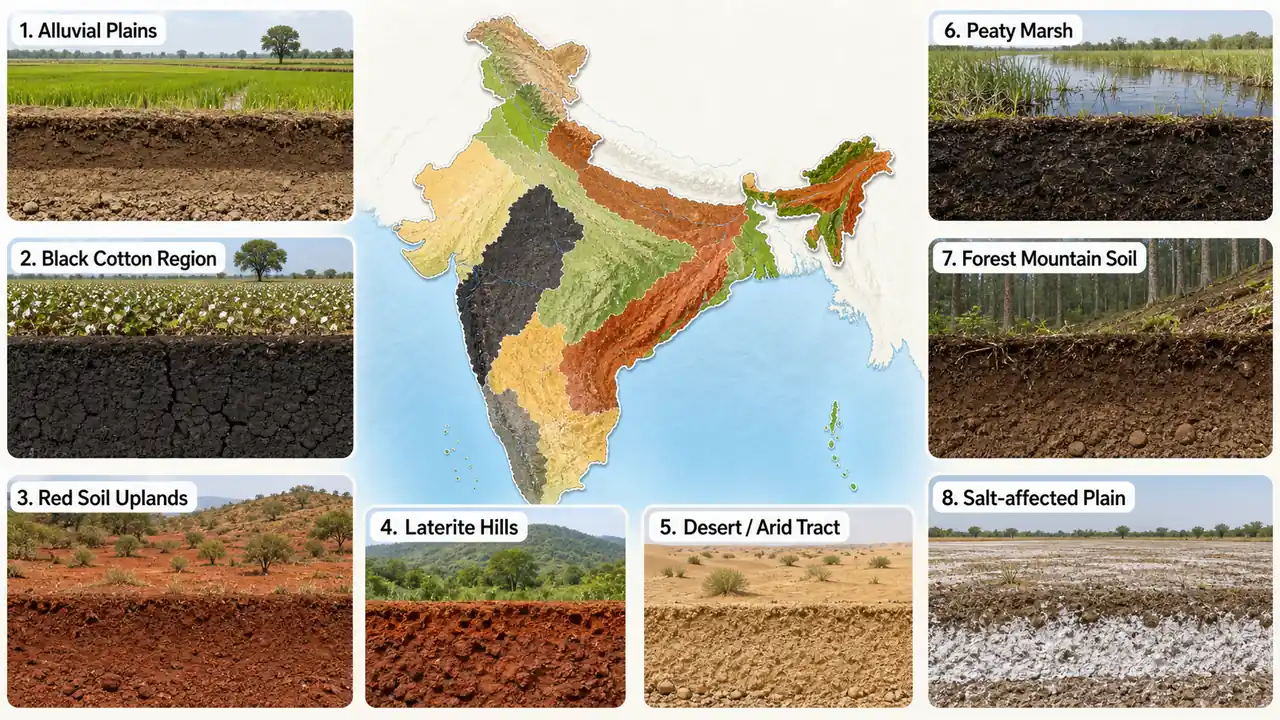
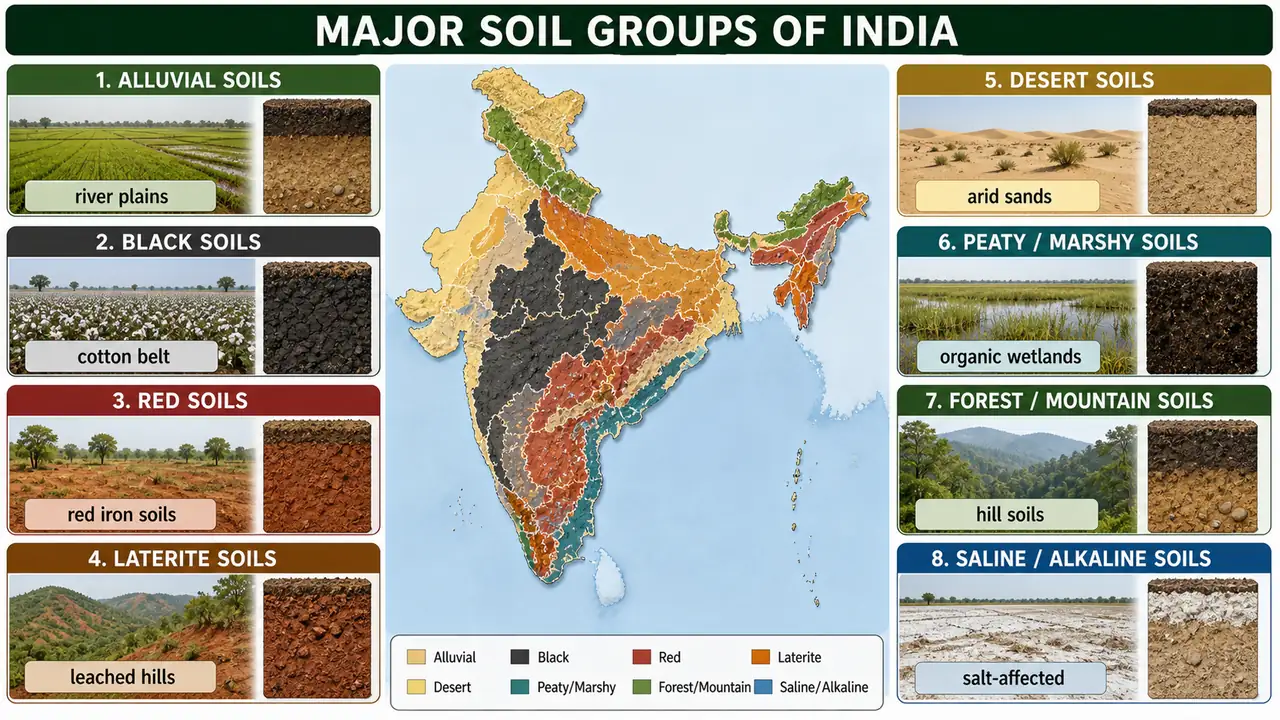
India grows rice in the alluvial plains of Punjab, cotton in the black soils of Maharashtra, groundnut in the red soils of Tamil Nadu, and tea in the acidic forest soils of Assam. Each crop thrives on a specific soil type because of its unique physical, chemical, and biological properties. The Indian Council of Agricultural Research (ICAR) classified India’s diverse soils into eight major groups in 1953, covering a total area of 329 mha.
Quick Comparison of Indian Soils
| Soil Type | Area (mha) | % of Total | USDA Order | Dominant Clay | pH Range | Rich in | Deficient in |
|---|---|---|---|---|---|---|---|
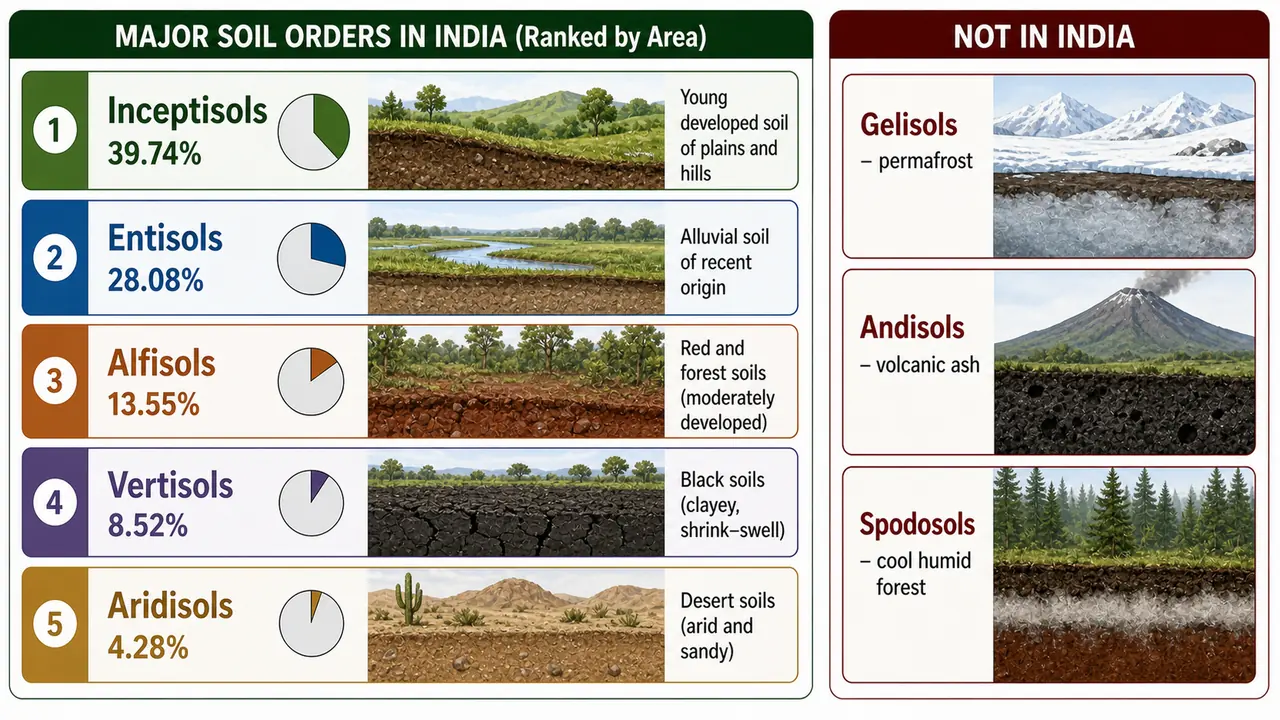
| Alluvial | 113 | 43% | Entisols, Inceptisols | Illite | Neutral-Alkaline | K | P, N, OM |
| Black (Regur) | 55 | 15% | Vertisols | Montmorillonite | 7.5-8.5 | Fe, Ca, K, Mg | N, P, OM |
| Red | 87.5 | 18.5% | Alfisols | Kaolinite | 6.5-7.5 | Mn, Fe | N, P, K, OM |
| Laterite | 18 | 3.7% | Ultisols, Oxisols | Kaolinite | 5-6 | Fe, Al | N, K, Lime, OM |
| Desert/Arid | — | — | Aridisols, Entisols | — | 8-8.5 | CaCO₃ | N, OM, Moisture |
| Forest/Hill | 28.56 | 8.67% | Mollisols | Illite | Acidic | Humus | K, P, Lime |
| Peaty/Marshy | — | — | Histosols | — | ~3.9 | OM (40-50%) | Most nutrients |
| Salt-affected | 6.74 | — | Entisols, Inceptisols | — | >8.5 | Na, K, Mg salts | All nutrients |
IMPORTANT
Key facts: Alluvial = largest area (43%), rich in K, poor in P. Black = highest CEC (montmorillonite), self-ploughing, best for dryland farming. Red = high P-fixation (kaolinite), highest sand content. Laterite = rich in Fe/Al, shifting cultivation.
1. Alluvial Soils — India’s Largest Soil Group
Formation
| Feature | Detail |
|---|---|
| Parent material | River alluviums, coastal sands, deltaic sediments |
| Deposited by | Rivers in floodplains |
| USDA Order | Entisols (recent alluvium) and Inceptisols (old alluvium); also Alfisols |
| Dominant clay | Illite |
| Area | 113 mha (43% of total) — largest soil group NABARD 2018 |
| Highest area in | UP, followed by Haryana, Delhi, Rajasthan, western Gujarat |
| pH | Neutral to alkaline (acidic in high rainfall areas) |
| Nature | Azonal soil (no distinct horizons) — too young for horizon development |
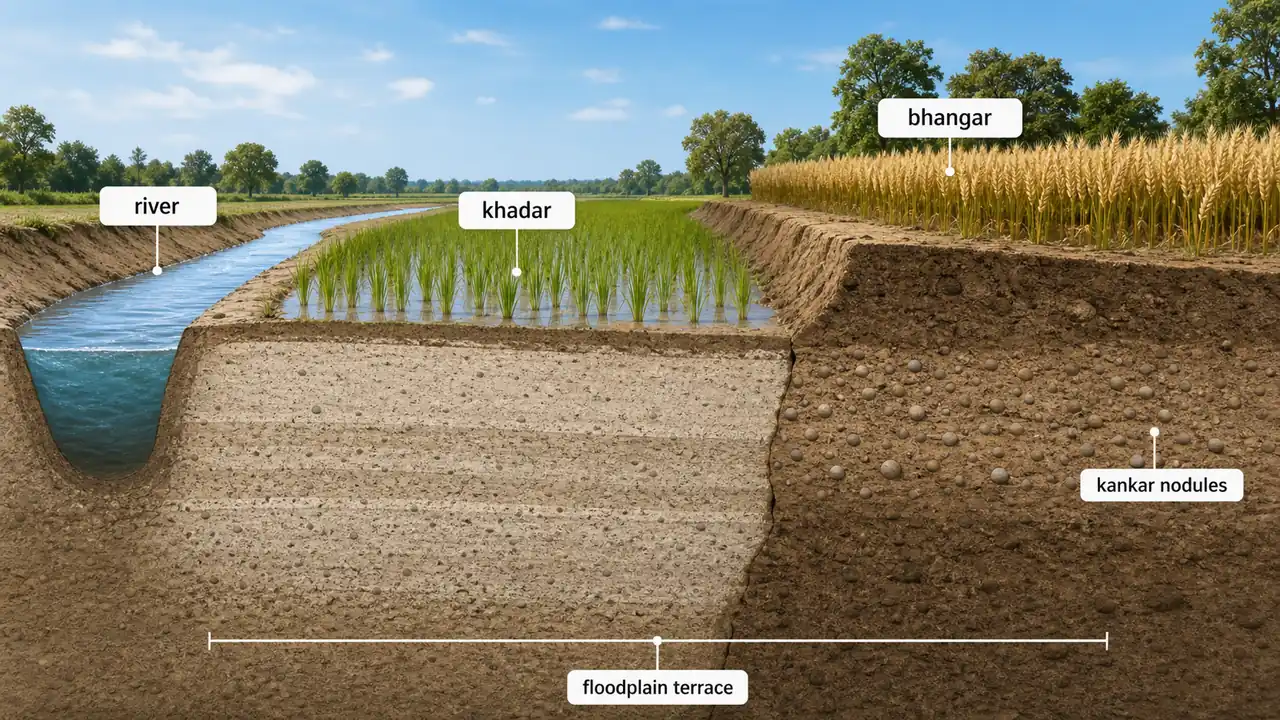
Khadar vs Bhangar (Two Types of Alluvium)
| Feature | Khadar (New Alluvium) | Bhangar (Old Alluvium) |
|---|---|---|
| Age | Recently deposited | Older deposits |
| Location | Active floodplains | Higher terraces above floodplain |
| Texture | More sandy, light in colour | More clayey, dark coloured |
| Kankar nodules | Less | Full of kankar nodules |
| Fertility | Highly fertile (replenished by annual floods) | Less fertile, more compact |
| Horizon development | No horizons | Some horizon development |
Nutrient Status and Crops
| Nutrient Status | Detail |
|---|---|
| Rich in | Potassium (K) |
| Poor in | Phosphorus, Nitrogen, Humus (OM) |
| Major crops | Rice, Wheat, Sugarcane, Cotton, Jute, Maize, Oilseeds, Tobacco, Millets, Vegetables, Pulses |
| Management | Judicious use of fertilizers; provide drainage |
Farm example: The Indo-Gangetic alluvial plains are among the most productive agricultural regions in the world, supporting the rice-wheat cropping system that feeds hundreds of millions.
2. Black Soils (Regur / Black Cotton Soils)
Formation
| Feature | Detail |
|---|---|
| USDA Order | Vertisols RRB-SO-19; also Inceptisols, Entisols |
| Area | 55 mha (15%) |
| Parent material | Deccan trap basalt |
| Dominant clay | Montmorillonite |
| Local names | Regur (Central India), Karail (UP), Bhal (Gujarat), Kanhar (Chhattisgarh) |
| Occurrence | Maharashtra (highest), West MP, Andhra Pradesh, Gujarat, parts of TN |
Properties
| Property | Detail |
|---|---|
| Texture | High clay content |
| CEC | 40-60 meq/100 g — highest CEC among Indian soils FCI AGM 2021, NABARD 2018 |
| Water holding | Very high (due to montmorillonite) but poor drainage |
| pH | 7.5-8.5 (alkaline) |
| Colour | Deep black to light black (due to titaniferous magnetite) |
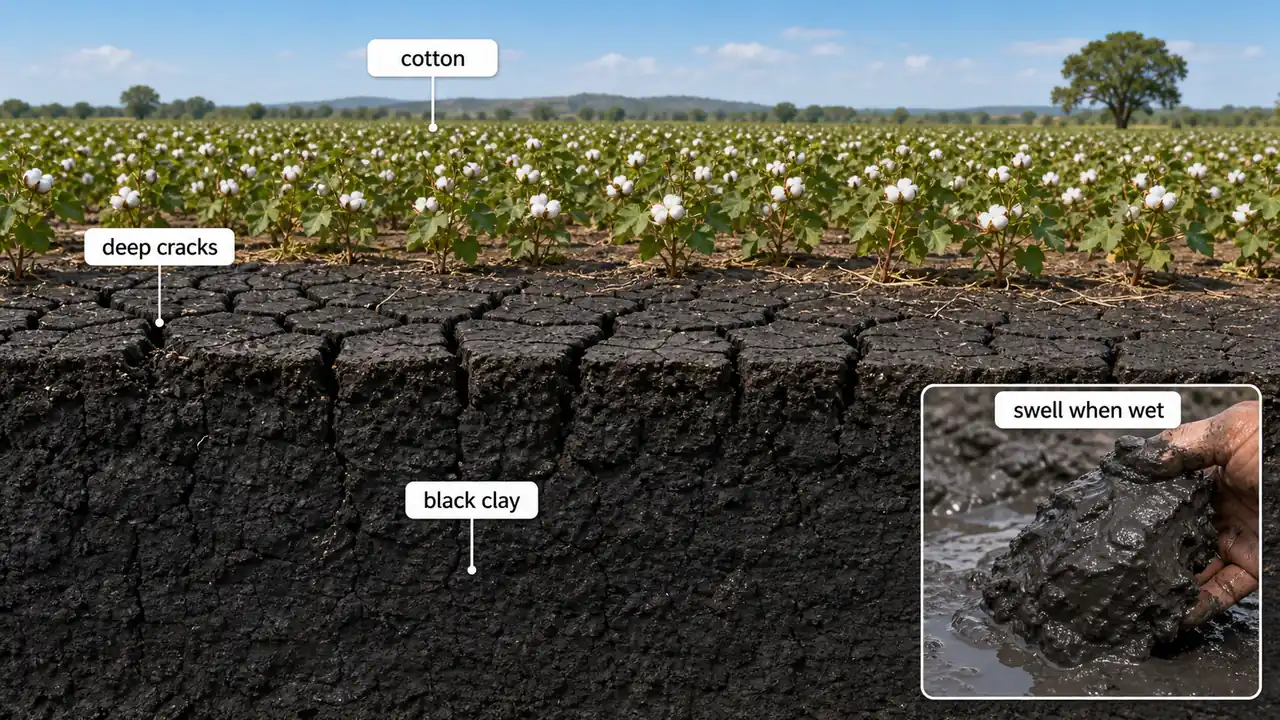
| Self-ploughing | Wide cracks (30-45 cm deep) when dry; swells and becomes sticky when wet NABARD Pre 2020 |
| Eluviation/Illuviation | Absent — churning process prevents it |
| Rich in | Iron, Lime, Calcium, Potassium, Aluminum, Magnesium |
| Deficient in | Nitrogen, Phosphorus, Organic matter |
Special Features
| Feature | Significance |
|---|---|
| Best soil for dryland agriculture | High water-holding capacity sustains crops during dry spells |
| Best soil for cotton | Hence the name “black cotton soil” |
| Self-ploughing | Surface soil falls into cracks; swelling pushes material up — natural mixing |
| Management | Pre-monsoon sowing; Broad Bed and Furrow (BBF) system (ICRISAT) |
| Major crops | Cotton, Wheat, Jowar, Linseed, Virginia Tobacco, Castor, Sunflower, Millets |
Farm example: Cotton farmers in Maharashtra rely on the high water-holding capacity of black soils to sustain rainfed cotton through the monsoon without irrigation.
3. Red Soils
Formation
| Feature | Detail |
|---|---|
| USDA Order | Alfisols; also Ultisols, Inceptisols |
| Area | 87.5 mha (18.5%) |
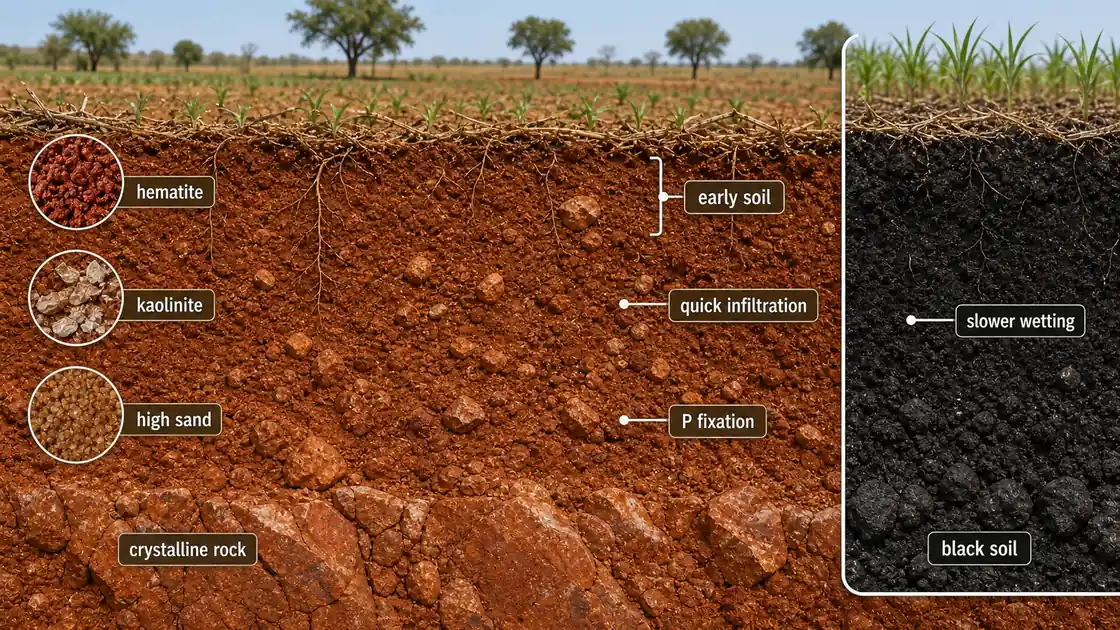
| Parent material | Ancient crystalline and metamorphic rocks |
| Dominant clay | Kaolinite |
| Largest area in | Tamil Nadu, followed by Karnataka, Goa, Maharashtra, AP, MP, Chhattisgarh, Orissa, Jharkhand |
| Colour | Red (due to ferric oxides / hematite); Yellow (due to limonite) |
Properties
| Property | Detail |
|---|---|
| P-fixation | High (due to kaolinite and Fe/Al oxides) |
| Sand content | Highest among Indian soils |
| Kankar nodules | Mostly found in red soils |
| Rich in | Manganese (Mn) and Iron (Fe) |
| Deficient in | Nitrogen, P₂O₅, Humus, Potash |
| Climate | Mostly found in low rainfall, semi-arid areas |
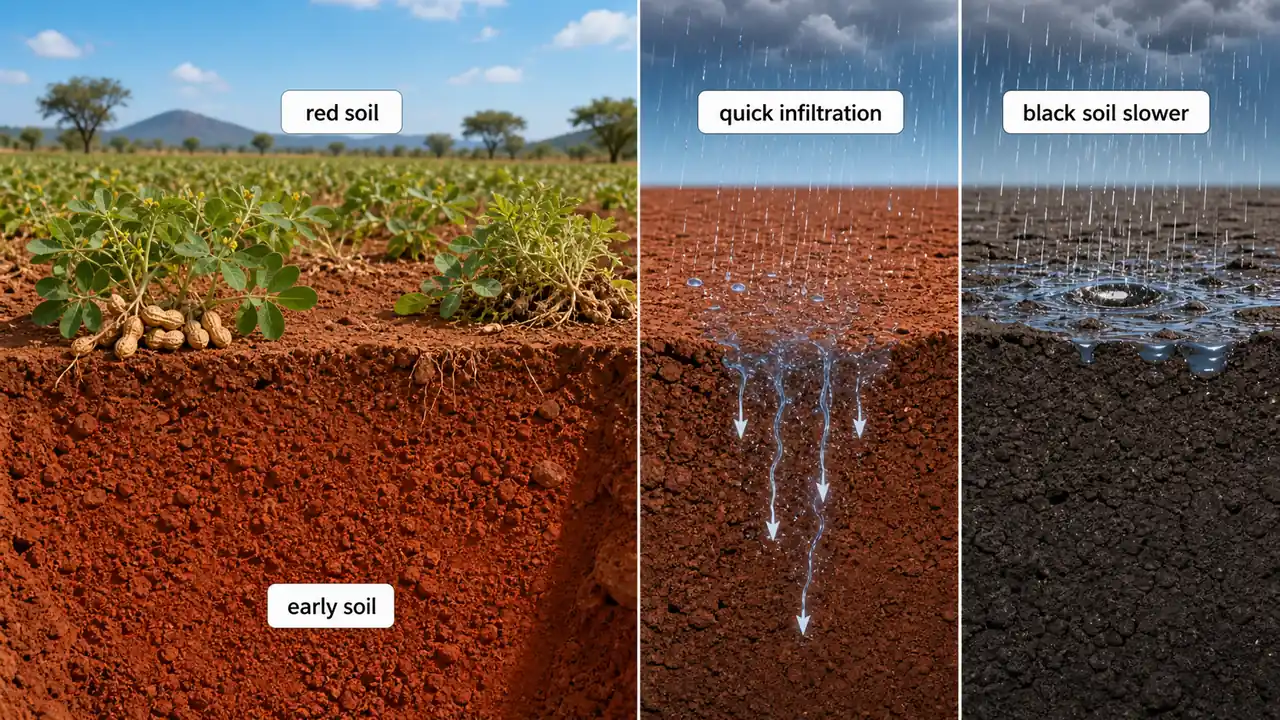
| Permeability | Good — absorbs light showers quickly |
”Early Soil” vs “Late Soil”
| Type | Soil | Reason |
|---|---|---|
| ”Early soil” | Red soils | Good permeability allows early sowing during light SW monsoon rains |
| ”Late soil” | Black soils | Lower permeability; moistened sufficiently only later in the season |
Crops and Management
| Feature | Detail |
|---|---|
| Alternative name | Omnibus group of soil (versatile — supports many crops with good management) |
| Major crops | Groundnut, Pulses, Oilseeds, Millets, Tuber crops (cassava) |
| Suitable for | Agriculture, horticulture, and plantation crops |
| Management | Application of organic materials and proper fertilization (especially P) |
Farm example: Groundnut farmers in Anantapur (AP) on red soils must apply higher P doses because a large portion gets fixed by iron and aluminum oxides.
4. Laterite Soils
Formation
| Feature | Detail |
|---|---|
| Name origin | Latin later = brick (hardens on air exposure — used as building bricks) |
| USDA Order | Ultisols and Oxisols |
| Dominant clay | Kaolinite |
| Area | 18 mha (3.7%) |
| pH | 5-6 (acidic) |
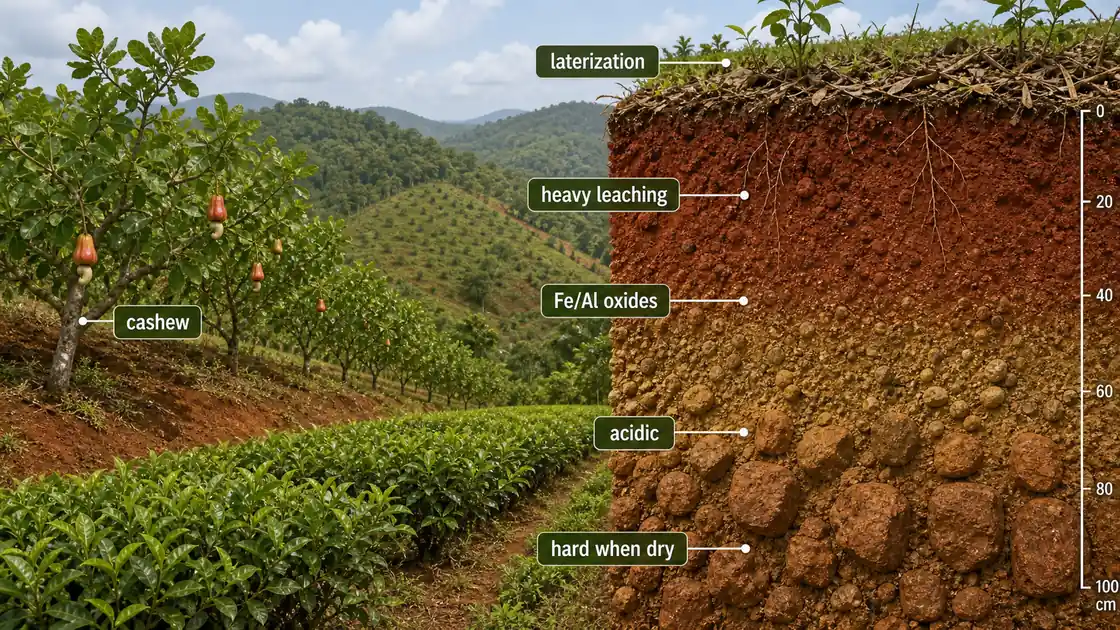
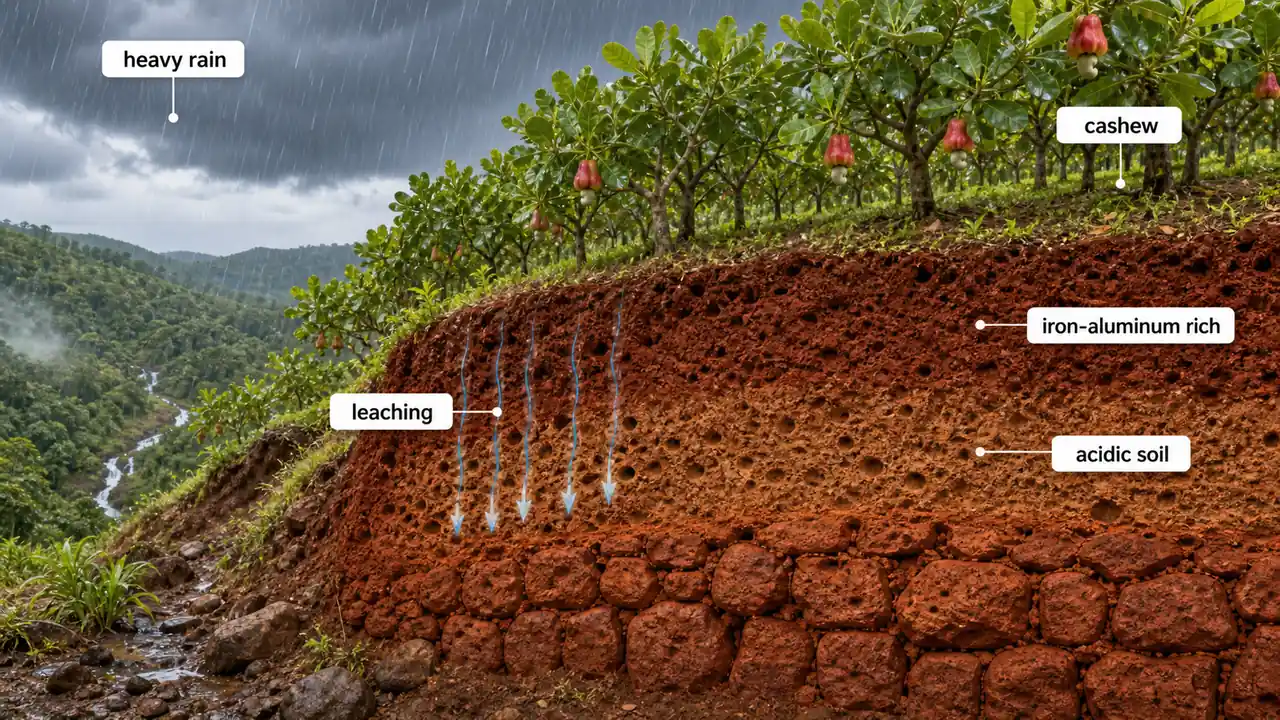
| Process | Laterization — intense leaching of silica and bases under heavy rainfall and high temperature |
| Location | Hills of Kerala, Karnataka, Orissa, Assam; coastal Goa, Maharashtra |
Properties
| Property | Detail |
|---|---|
| Formation process | Leaching removes silica and bases; Fe and Al oxides remain |
| Colour | Red/pink (from iron oxide) |
| Physical condition | Good (due to Fe/Al hydroxides); soft when wet, hard when dry |
| Rich in | Iron, Aluminum |
| Deficient in | Nitrogen, Potash, Lime, Humus — multi-nutrient deficient |
| Humus | Low (rapid microbial decomposition at high temperatures; rapid uptake by vegetation) |
| Cultivation practice | Shifting cultivation (Jhum) common in NE India |
Crops and Management
| Feature | Detail |
|---|---|
| Major crops | Rice, Ragi, Sugarcane, Cashew nuts |
| Suitable for | Plantation crops (tea, coffee, rubber) and rice cultivation |
| Acid-loving crops | Pineapple, Avocado |
| Management | Lime application to correct acidity; organic matter addition |
Farm example: Cashew plantations on laterite hillslopes of Goa thrive because cashew tolerates acidic, well-drained, nutrient-poor soils that would be unsuitable for most field crops.
5. Desert / Arid Soils
| Feature | Detail |
|---|---|
| USDA Order | Aridisols and Entisols |
| Location | West Rajasthan (Thar Desert), Haryana, Punjab (between Indus and Aravali range) |
| Deposited by | Wind activities |
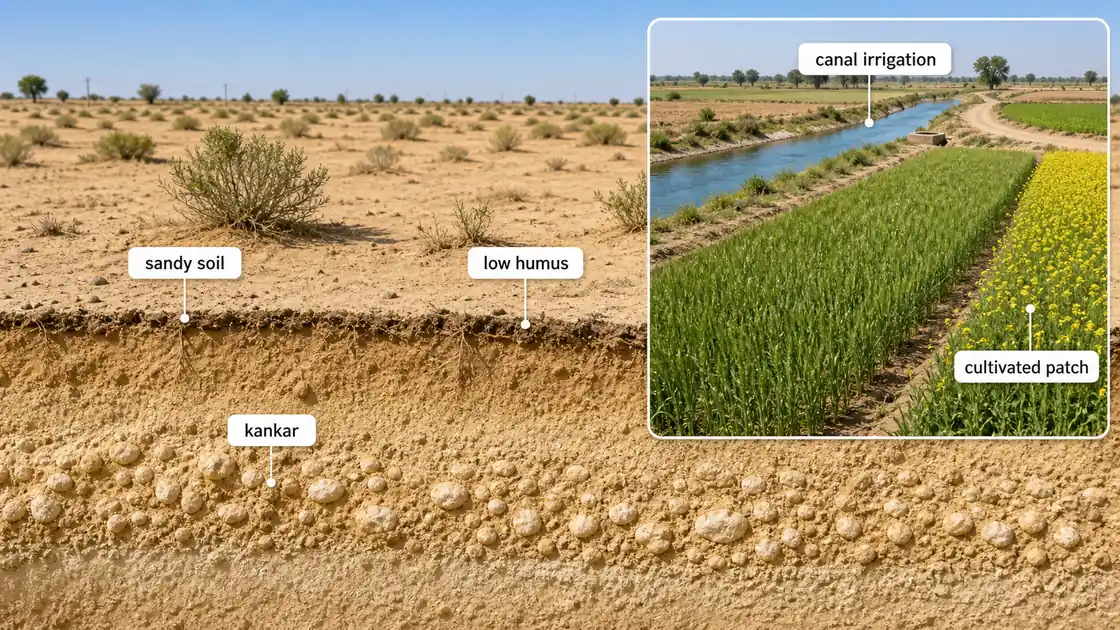
| Texture | Sandy — clay content <8% |
| Colour | Red to Brown |
| pH | 8-8.5 (alkaline) |
Properties and Crops
| Property | Detail |
|---|---|
| Composition | Quartz with feldspar and hornblende grains |
| Salt content | High; Na salts cause alkalinity |
| Kankar/CaCO₃ | High — restricts infiltration and root penetration |
| Nitrogen | Insufficient |
| Phosphate | Normal |
| Moisture and Humus | Very low |
| Crops | Date palm, Cucumber, Millets |
Farm example: With irrigation from the Indira Gandhi Canal, desert soils of western Rajasthan now grow wheat, mustard, and vegetables — demonstrating that water is the primary limiting factor, not inherent infertility.
6. Peaty / Marshy Soils
| Feature | Detail |
|---|---|
| USDA Order | Histosols |
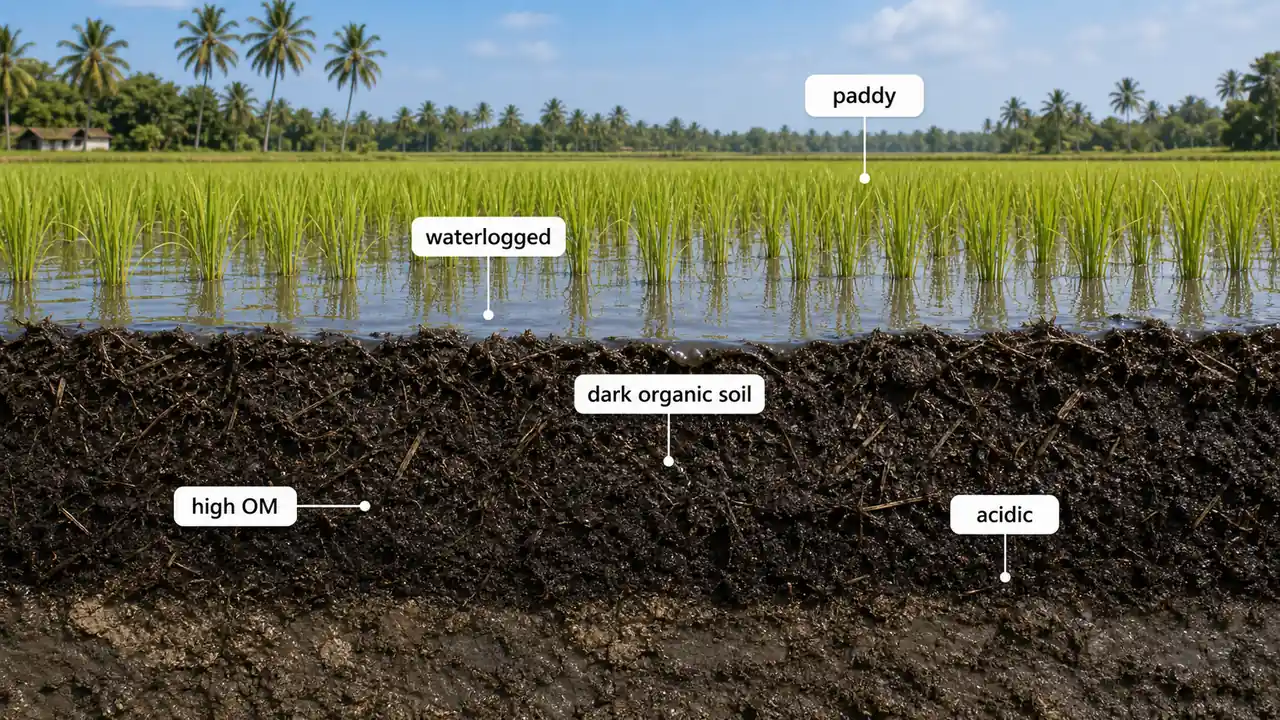
| Formation | Heavy rainfall + high humidity → lush vegetation → dead organic matter accumulates under waterlogged conditions |
| OM content | Up to 40-50% |
| Colour | Heavy and black |
| pH | 3.9 — highly acidic |
| Location | Northern Bihar, southern Uttarakhand, coastal West Bengal, Kerala, Orissa, Tamil Nadu |
Types
| Type | Description |
|---|---|
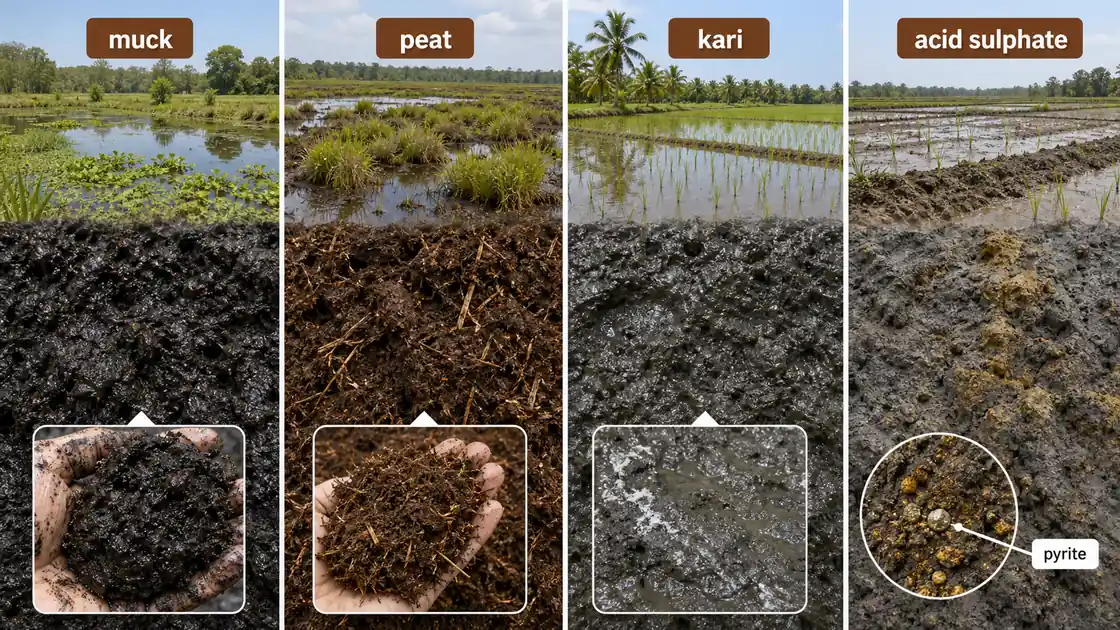
| Muck soil | Highly decomposed OM; original plant structures not recognizable |
| Peat soil | Partially decomposed OM; plant fibers still visible; excessive moisture |
| Kari soils | Saline peat soils of Kerala (salts + organic matter) |
| Acid sulphate soils (Cat clays) | Contain pyrites (FeS₂); become extremely acidic when drained |
Suitability: Paddy when water recedes.
Farm example: The Kuttanad region of Kerala (below sea level) has peaty/marshy soils where paddy is cultivated using unique water management practices.
7. Forest and Mountain Soils
| Feature | Detail |
|---|---|
| USDA Order | Mollisols |
| Dominant clay | Illite |
| Area | 28.56 mha (8.67%) |
| Formation | Decomposition of organic matter under forest cover |
| Location | Himalayan region, Western Ghats, Eastern Ghats |
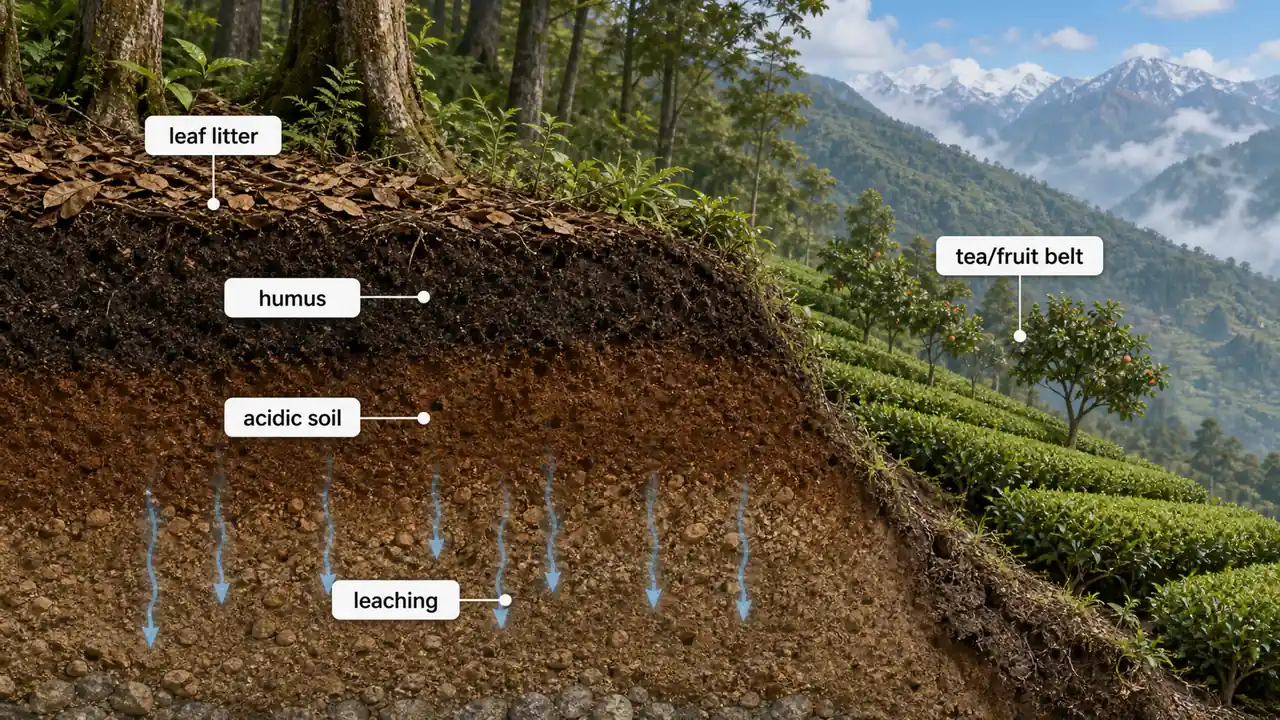
| pH | Acidic (heavy rainfall causes intense leaching of bases) |
Properties and Crops
| Property | Detail |
|---|---|
| Rich in | Humus (surface layer) |
| Deficient in | Potash, Phosphorus, Lime |
| Characteristics | Heterogeneous — change with parent rock and climate |
| Crops | Temperate fruits (apple, pear), Spices, Tea, Coffee |
Farm example: Tea gardens of Darjeeling and Assam thrive on acidic forest soils because tea requires acidic pH (4.5-5.5) and good drainage.
8. Saline and Alkaline Soils (Salt-Affected Soils)
| Feature | Detail |
|---|---|
| Alternative name | Usar/Usara soils |
| USDA Order | Entisols and Inceptisols |
| Area | 6.74 mha |
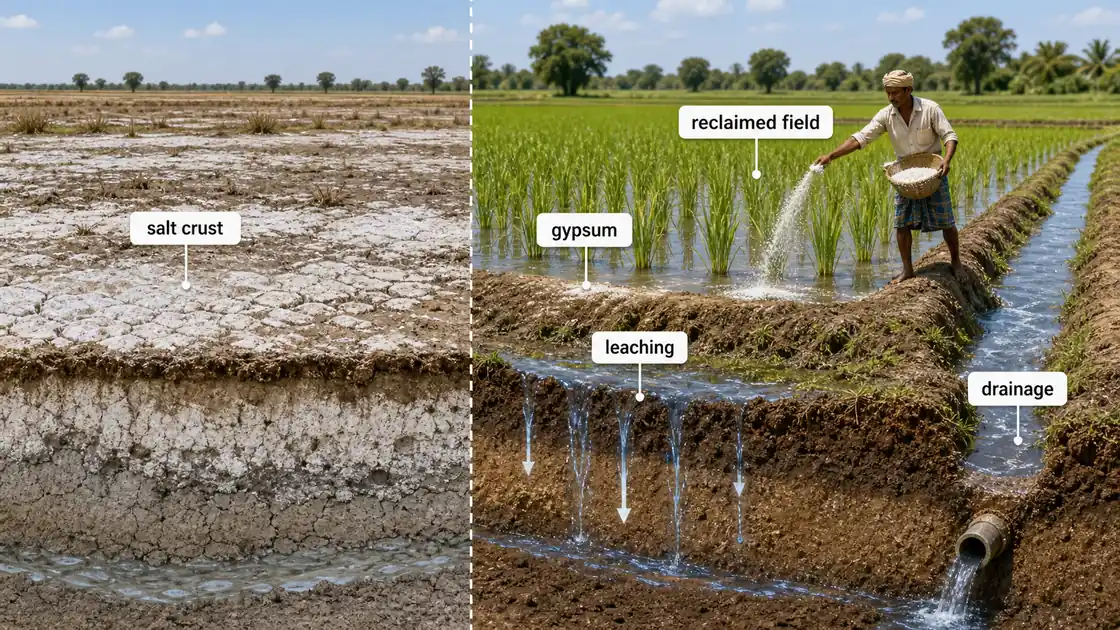
| Cause | Dry climate + poor drainage → salt accumulation |
| Location | Arid/semi-arid regions; waterlogged/swampy areas |
| Dominant salts | Sodium, Potassium, Magnesium |
| Fertility | Infertile — do not support vegetative growth |
Management
| Problem | Reclamation Strategy |
|---|---|
| Sodic soils (high Na) | Apply gypsum (CaSO₄) to replace Na⁺ with Ca²⁺ |
| Saline soils (high total salts) | Leaching with good quality water + adequate drainage |
Farm example: Usar (sodic) soils of eastern UP are reclaimed by applying gypsum at 5-10 t/ha, followed by rice cultivation. Within 2-3 years, these soils become productive.
Exam Tips and Mnemonics
- Largest soil group: Alluvial (113 mha, 43%) — “Alluvial is A-number-one”
- Highest CEC: Black soil (montmorillonite, 40-60 meq/100g)
- Best for dryland: Black soil (high water-holding)
- Best for cotton: Black soil (Regur)
- Self-ploughing: Black soil (Vertisol cracks)
- Highest sand: Red soil
- High P-fixation: Red soil (kaolinite)
- “Early soil”: Red soil (quick absorption of light rain)
- “Late soil”: Black soil (slow wetting)
- Shifting cultivation: Laterite soils (NE India)
- Laterite = Latin for Brick (hardens on exposure)
- Khadar = new alluvium (floodplain, fertile); Bhangar = old alluvium (terrace, kankar)
- Kari soils = saline peat soils of Kerala
- Black soil colour: Due to titaniferous magnetite (NOT high OM)
- Omnibus soil: Red soil (versatile)
- Alluvial soil: Rich in K, poor in P
Summary Table
| Soil Type | Area | USDA Order | Dominant Clay | pH | Best Crops | Key Feature |
|---|---|---|---|---|---|---|
| Alluvial | 113 mha (43%) | Entisols/Inceptisols | Illite | Neutral-Alkaline | Rice, Wheat, Sugarcane | Largest; Khadar/Bhangar |
| Black | 55 mha (15%) | Vertisols | Montmorillonite | 7.5-8.5 | Cotton, Jowar, Wheat | Highest CEC; self-ploughing |
| Red | 87.5 mha (18.5%) | Alfisols | Kaolinite | 6.5-7.5 | Groundnut, Millets, Pulses | Highest sand; high P-fixation |
| Laterite | 18 mha (3.7%) | Ultisols/Oxisols | Kaolinite | 5-6 | Rice, Cashew, Plantation | Fe/Al rich; hardens like brick |
| Desert | — | Aridisols/Entisols | — | 8-8.5 | Date palm, Millets | Sandy; <8% clay; wind-deposited |
| Peaty | — | Histosols | — | ~3.9 | Paddy | 40-50% OM; highly acidic |
| Forest | 28.56 mha (8.67%) | Mollisols | Illite | Acidic | Tea, Coffee, Temperate fruits | Humus-rich; heterogeneous |
| Salt-affected | 6.74 mha | Entisols/Inceptisols | — | >8.5 | After reclamation: Rice | Infertile; needs gypsum/leaching |
Summary Cheat Sheet
| Concept / Topic | Key Details |
|---|---|
| Alluvial soils | 113 mha (43%) — largest; Entisols/Inceptisols; illite clay; rich in K, poor in P |
| Khadar vs Bhangar | Khadar = new alluvium (floodplain, fertile); Bhangar = old alluvium (terrace, kankar) |
| Black (Regur) soils | 55 mha (15%); Vertisols; montmorillonite; CEC 40–60 meq/100g (highest) |
| Black soil colour | Due to titaniferous magnetite (NOT high OM) |
| Black soil — self-ploughing | Deep cracks when dry; shrink-swell from montmorillonite |
| Black soil — best for | Cotton, jowar, wheat; best for dryland farming (high WHC) |
| Red soils | 87.5 mha (18.5%); Alfisols; kaolinite; highest sand content |
| Red soil — P fixation | High (kaolinite + Fe/Al oxides) |
| Red soil — “Early soil” | Quick absorption of light rain |
| Black soil — “Late soil” | Slow wetting |
| Red soil — “Omnibus soil” | Versatile; grows many crops |
| Laterite soils | 18 mha (3.7%); Ultisols/Oxisols; Fe/Al rich; hardens like brick (Latin: later = brick) |
| Laterite — shifting cultivation | Common in NE India on laterite soils |
| Desert soils | Aridisols/Entisols; pH 8–8.5; sandy; <8% clay; wind-deposited |
| Peaty soils | Histosols; 40–50% OM; pH ~3.9 (highly acidic); paddy when water recedes |
| Kari soils | Saline peat soils of Kerala |
| Forest soils | 28.56 mha (8.67%); Mollisols; illite; acidic; humus-rich; tea, coffee |
| Salt-affected soils | 6.74 mha; pH >8.5; infertile |
| Sodic reclamation | Apply gypsum (CaSO₄) at 5–10 t/ha → replaces Na⁺ with Ca²⁺ |
| Saline reclamation | Leaching with good water + adequate drainage |
| Alluvial soil minerals | Rich in K; poor in P and N |
Pro Content Locked
Upgrade to Pro to access this lesson and all other premium content.
₹2388 billed yearly
- All Agriculture & Banking Courses
- AI Lesson Questions (100/day)
- AI Doubt Solver (50/day)
- Glows & Grows Feedback (30/day)
- AI Section Quiz (20/day)
- 22-Language Translation (30/day)
- Recall Questions (20/day)
- AI Quiz (15/day)
- AI Quiz Paper Analysis
- AI Step-by-Step Explanations
- Spaced Repetition Recall (FSRS)
- AI Tutor
- Immersive Text Questions
- Audio Lessons — Hindi & English
- Mock Tests & Previous Year Papers
- Summary & Mind Maps
- XP, Levels, Leaderboard & Badges
- Generate New Classrooms
- Voice AI Teacher (AgriDots Live)
- AI Revision Assistant
- Knowledge Gap Analysis
- Interactive Revision (LangGraph)
🔒 Secure via Razorpay · Cancel anytime · No hidden fees
India grows rice in the alluvial plains of Punjab, cotton in the black soils of Maharashtra, groundnut in the red soils of Tamil Nadu, and tea in the acidic forest soils of Assam. Each crop thrives on a specific soil type because of its unique physical, chemical, and biological properties. The Indian Council of Agricultural Research (ICAR) classified India’s diverse soils into eight major groups in 1953, covering a total area of 329 mha.
Quick Comparison of Indian Soils
| Soil Type | Area (mha) | % of Total | USDA Order | Dominant Clay | pH Range | Rich in | Deficient in |
|---|---|---|---|---|---|---|---|
| Alluvial | 113 | 43% | Entisols, Inceptisols | Illite | Neutral-Alkaline | K | P, N, OM |
| Black (Regur) | 55 | 15% | Vertisols | Montmorillonite | 7.5-8.5 | Fe, Ca, K, Mg | N, P, OM |
| Red | 87.5 | 18.5% | Alfisols | Kaolinite | 6.5-7.5 | Mn, Fe | N, P, K, OM |
| Laterite | 18 | 3.7% | Ultisols, Oxisols | Kaolinite | 5-6 | Fe, Al | N, K, Lime, OM |
| Desert/Arid | — | — | Aridisols, Entisols | — | 8-8.5 | CaCO₃ | N, OM, Moisture |
| Forest/Hill | 28.56 | 8.67% | Mollisols | Illite | Acidic | Humus | K, P, Lime |
| Peaty/Marshy | — | — | Histosols | — | ~3.9 | OM (40-50%) | Most nutrients |
| Salt-affected | 6.74 | — | Entisols, Inceptisols | — | >8.5 | Na, K, Mg salts | All nutrients |
IMPORTANT
Key facts: Alluvial = largest area (43%), rich in K, poor in P. Black = highest CEC (montmorillonite), self-ploughing, best for dryland farming. Red = high P-fixation (kaolinite), highest sand content. Laterite = rich in Fe/Al, shifting cultivation.
1. Alluvial Soils — India’s Largest Soil Group
Formation
| Feature | Detail |
|---|---|
| Parent material | River alluviums, coastal sands, deltaic sediments |
| Deposited by | Rivers in floodplains |
| USDA Order | Entisols (recent alluvium) and Inceptisols (old alluvium); also Alfisols |
| Dominant clay | Illite |
| Area | 113 mha (43% of total) — largest soil group NABARD 2018 |
| Highest area in | UP, followed by Haryana, Delhi, Rajasthan, western Gujarat |
| pH | Neutral to alkaline (acidic in high rainfall areas) |
| Nature | Azonal soil (no distinct horizons) — too young for horizon development |
Khadar vs Bhangar (Two Types of Alluvium)
| Feature | Khadar (New Alluvium) | Bhangar (Old Alluvium) |
|---|---|---|
| Age | Recently deposited | Older deposits |
| Location | Active floodplains | Higher terraces above floodplain |
| Texture | More sandy, light in colour | More clayey, dark coloured |
| Kankar nodules | Less | Full of kankar nodules |
| Fertility | Highly fertile (replenished by annual floods) | Less fertile, more compact |
| Horizon development | No horizons | Some horizon development |
Nutrient Status and Crops
| Nutrient Status | Detail |
|---|---|
| Rich in | Potassium (K) |
| Poor in | Phosphorus, Nitrogen, Humus (OM) |
| Major crops | Rice, Wheat, Sugarcane, Cotton, Jute, Maize, Oilseeds, Tobacco, Millets, Vegetables, Pulses |
| Management | Judicious use of fertilizers; provide drainage |
Farm example: The Indo-Gangetic alluvial plains are among the most productive agricultural regions in the world, supporting the rice-wheat cropping system that feeds hundreds of millions.
2. Black Soils (Regur / Black Cotton Soils)
Formation
| Feature | Detail |
|---|---|
| USDA Order | Vertisols RRB-SO-19; also Inceptisols, Entisols |
| Area | 55 mha (15%) |
| Parent material | Deccan trap basalt |
| Dominant clay | Montmorillonite |
| Local names | Regur (Central India), Karail (UP), Bhal (Gujarat), Kanhar (Chhattisgarh) |
| Occurrence | Maharashtra (highest), West MP, Andhra Pradesh, Gujarat, parts of TN |
Properties
| Property | Detail |
|---|---|
| Texture | High clay content |
| CEC | 40-60 meq/100 g — highest CEC among Indian soils FCI AGM 2021, NABARD 2018 |
| Water holding | Very high (due to montmorillonite) but poor drainage |
| pH | 7.5-8.5 (alkaline) |
| Colour | Deep black to light black (due to titaniferous magnetite) |
| Self-ploughing | Wide cracks (30-45 cm deep) when dry; swells and becomes sticky when wet NABARD Pre 2020 |
| Eluviation/Illuviation | Absent — churning process prevents it |
| Rich in | Iron, Lime, Calcium, Potassium, Aluminum, Magnesium |
| Deficient in | Nitrogen, Phosphorus, Organic matter |
Special Features
| Feature | Significance |
|---|---|
| Best soil for dryland agriculture | High water-holding capacity sustains crops during dry spells |
| Best soil for cotton | Hence the name “black cotton soil” |
| Self-ploughing | Surface soil falls into cracks; swelling pushes material up — natural mixing |
| Management | Pre-monsoon sowing; Broad Bed and Furrow (BBF) system (ICRISAT) |
| Major crops | Cotton, Wheat, Jowar, Linseed, Virginia Tobacco, Castor, Sunflower, Millets |
Farm example: Cotton farmers in Maharashtra rely on the high water-holding capacity of black soils to sustain rainfed cotton through the monsoon without irrigation.
3. Red Soils
Formation
| Feature | Detail |
|---|---|
| USDA Order | Alfisols; also Ultisols, Inceptisols |
| Area | 87.5 mha (18.5%) |
| Parent material | Ancient crystalline and metamorphic rocks |
| Dominant clay | Kaolinite |
| Largest area in | Tamil Nadu, followed by Karnataka, Goa, Maharashtra, AP, MP, Chhattisgarh, Orissa, Jharkhand |
| Colour | Red (due to ferric oxides / hematite); Yellow (due to limonite) |
Properties
| Property | Detail |
|---|---|
| P-fixation | High (due to kaolinite and Fe/Al oxides) |
| Sand content | Highest among Indian soils |
| Kankar nodules | Mostly found in red soils |
| Rich in | Manganese (Mn) and Iron (Fe) |
| Deficient in | Nitrogen, P₂O₅, Humus, Potash |
| Climate | Mostly found in low rainfall, semi-arid areas |
| Permeability | Good — absorbs light showers quickly |
”Early Soil” vs “Late Soil”
| Type | Soil | Reason |
|---|---|---|
| ”Early soil” | Red soils | Good permeability allows early sowing during light SW monsoon rains |
| ”Late soil” | Black soils | Lower permeability; moistened sufficiently only later in the season |
Crops and Management
| Feature | Detail |
|---|---|
| Alternative name | Omnibus group of soil (versatile — supports many crops with good management) |
| Major crops | Groundnut, Pulses, Oilseeds, Millets, Tuber crops (cassava) |
| Suitable for | Agriculture, horticulture, and plantation crops |
| Management | Application of organic materials and proper fertilization (especially P) |
Farm example: Groundnut farmers in Anantapur (AP) on red soils must apply higher P doses because a large portion gets fixed by iron and aluminum oxides.
4. Laterite Soils
Formation
| Feature | Detail |
|---|---|
| Name origin | Latin later = brick (hardens on air exposure — used as building bricks) |
| USDA Order | Ultisols and Oxisols |
| Dominant clay | Kaolinite |
| Area | 18 mha (3.7%) |
| pH | 5-6 (acidic) |
| Process | Laterization — intense leaching of silica and bases under heavy rainfall and high temperature |
| Location | Hills of Kerala, Karnataka, Orissa, Assam; coastal Goa, Maharashtra |
Properties
| Property | Detail |
|---|---|
| Formation process | Leaching removes silica and bases; Fe and Al oxides remain |
| Colour | Red/pink (from iron oxide) |
| Physical condition | Good (due to Fe/Al hydroxides); soft when wet, hard when dry |
| Rich in | Iron, Aluminum |
| Deficient in | Nitrogen, Potash, Lime, Humus — multi-nutrient deficient |
| Humus | Low (rapid microbial decomposition at high temperatures; rapid uptake by vegetation) |
| Cultivation practice | Shifting cultivation (Jhum) common in NE India |
Crops and Management
| Feature | Detail |
|---|---|
| Major crops | Rice, Ragi, Sugarcane, Cashew nuts |
| Suitable for | Plantation crops (tea, coffee, rubber) and rice cultivation |
| Acid-loving crops | Pineapple, Avocado |
| Management | Lime application to correct acidity; organic matter addition |
Farm example: Cashew plantations on laterite hillslopes of Goa thrive because cashew tolerates acidic, well-drained, nutrient-poor soils that would be unsuitable for most field crops.
5. Desert / Arid Soils
| Feature | Detail |
|---|---|
| USDA Order | Aridisols and Entisols |
| Location | West Rajasthan (Thar Desert), Haryana, Punjab (between Indus and Aravali range) |
| Deposited by | Wind activities |
| Texture | Sandy — clay content <8% |
| Colour | Red to Brown |
| pH | 8-8.5 (alkaline) |
Properties and Crops
| Property | Detail |
|---|---|
| Composition | Quartz with feldspar and hornblende grains |
| Salt content | High; Na salts cause alkalinity |
| Kankar/CaCO₃ | High — restricts infiltration and root penetration |
| Nitrogen | Insufficient |
| Phosphate | Normal |
| Moisture and Humus | Very low |
| Crops | Date palm, Cucumber, Millets |
Farm example: With irrigation from the Indira Gandhi Canal, desert soils of western Rajasthan now grow wheat, mustard, and vegetables — demonstrating that water is the primary limiting factor, not inherent infertility.
6. Peaty / Marshy Soils
| Feature | Detail |
|---|---|
| USDA Order | Histosols |
| Formation | Heavy rainfall + high humidity → lush vegetation → dead organic matter accumulates under waterlogged conditions |
| OM content | Up to 40-50% |
| Colour | Heavy and black |
| pH | 3.9 — highly acidic |
| Location | Northern Bihar, southern Uttarakhand, coastal West Bengal, Kerala, Orissa, Tamil Nadu |
Types
| Type | Description |
|---|---|
| Muck soil | Highly decomposed OM; original plant structures not recognizable |
| Peat soil | Partially decomposed OM; plant fibers still visible; excessive moisture |
| Kari soils | Saline peat soils of Kerala (salts + organic matter) |
| Acid sulphate soils (Cat clays) | Contain pyrites (FeS₂); become extremely acidic when drained |
Suitability: Paddy when water recedes.
Farm example: The Kuttanad region of Kerala (below sea level) has peaty/marshy soils where paddy is cultivated using unique water management practices.
7. Forest and Mountain Soils
| Feature | Detail |
|---|---|
| USDA Order | Mollisols |
| Dominant clay | Illite |
| Area | 28.56 mha (8.67%) |
| Formation | Decomposition of organic matter under forest cover |
| Location | Himalayan region, Western Ghats, Eastern Ghats |
| pH | Acidic (heavy rainfall causes intense leaching of bases) |
Properties and Crops
| Property | Detail |
|---|---|
| Rich in | Humus (surface layer) |
| Deficient in | Potash, Phosphorus, Lime |
| Characteristics | Heterogeneous — change with parent rock and climate |
| Crops | Temperate fruits (apple, pear), Spices, Tea, Coffee |
Farm example: Tea gardens of Darjeeling and Assam thrive on acidic forest soils because tea requires acidic pH (4.5-5.5) and good drainage.
8. Saline and Alkaline Soils (Salt-Affected Soils)
| Feature | Detail |
|---|---|
| Alternative name | Usar/Usara soils |
| USDA Order | Entisols and Inceptisols |
| Area | 6.74 mha |
| Cause | Dry climate + poor drainage → salt accumulation |
| Location | Arid/semi-arid regions; waterlogged/swampy areas |
| Dominant salts | Sodium, Potassium, Magnesium |
| Fertility | Infertile — do not support vegetative growth |
Management
| Problem | Reclamation Strategy |
|---|---|
| Sodic soils (high Na) | Apply gypsum (CaSO₄) to replace Na⁺ with Ca²⁺ |
| Saline soils (high total salts) | Leaching with good quality water + adequate drainage |
Farm example: Usar (sodic) soils of eastern UP are reclaimed by applying gypsum at 5-10 t/ha, followed by rice cultivation. Within 2-3 years, these soils become productive.
Exam Tips and Mnemonics
- Largest soil group: Alluvial (113 mha, 43%) — “Alluvial is A-number-one”
- Highest CEC: Black soil (montmorillonite, 40-60 meq/100g)
- Best for dryland: Black soil (high water-holding)
- Best for cotton: Black soil (Regur)
- Self-ploughing: Black soil (Vertisol cracks)
- Highest sand: Red soil
- High P-fixation: Red soil (kaolinite)
- “Early soil”: Red soil (quick absorption of light rain)
- “Late soil”: Black soil (slow wetting)
- Shifting cultivation: Laterite soils (NE India)
- Laterite = Latin for Brick (hardens on exposure)
- Khadar = new alluvium (floodplain, fertile); Bhangar = old alluvium (terrace, kankar)
- Kari soils = saline peat soils of Kerala
- Black soil colour: Due to titaniferous magnetite (NOT high OM)
- Omnibus soil: Red soil (versatile)
- Alluvial soil: Rich in K, poor in P
Summary Table
| Soil Type | Area | USDA Order | Dominant Clay | pH | Best Crops | Key Feature |
|---|---|---|---|---|---|---|
| Alluvial | 113 mha (43%) | Entisols/Inceptisols | Illite | Neutral-Alkaline | Rice, Wheat, Sugarcane | Largest; Khadar/Bhangar |
| Black | 55 mha (15%) | Vertisols | Montmorillonite | 7.5-8.5 | Cotton, Jowar, Wheat | Highest CEC; self-ploughing |
| Red | 87.5 mha (18.5%) | Alfisols | Kaolinite | 6.5-7.5 | Groundnut, Millets, Pulses | Highest sand; high P-fixation |
| Laterite | 18 mha (3.7%) | Ultisols/Oxisols | Kaolinite | 5-6 | Rice, Cashew, Plantation | Fe/Al rich; hardens like brick |
| Desert | — | Aridisols/Entisols | — | 8-8.5 | Date palm, Millets | Sandy; <8% clay; wind-deposited |
| Peaty | — | Histosols | — | ~3.9 | Paddy | 40-50% OM; highly acidic |
| Forest | 28.56 mha (8.67%) | Mollisols | Illite | Acidic | Tea, Coffee, Temperate fruits | Humus-rich; heterogeneous |
| Salt-affected | 6.74 mha | Entisols/Inceptisols | — | >8.5 | After reclamation: Rice | Infertile; needs gypsum/leaching |
Summary Cheat Sheet
| Concept / Topic | Key Details |
|---|---|
| Alluvial soils | 113 mha (43%) — largest; Entisols/Inceptisols; illite clay; rich in K, poor in P |
| Khadar vs Bhangar | Khadar = new alluvium (floodplain, fertile); Bhangar = old alluvium (terrace, kankar) |
| Black (Regur) soils | 55 mha (15%); Vertisols; montmorillonite; CEC 40–60 meq/100g (highest) |
| Black soil colour | Due to titaniferous magnetite (NOT high OM) |
| Black soil — self-ploughing | Deep cracks when dry; shrink-swell from montmorillonite |
| Black soil — best for | Cotton, jowar, wheat; best for dryland farming (high WHC) |
| Red soils | 87.5 mha (18.5%); Alfisols; kaolinite; highest sand content |
| Red soil — P fixation | High (kaolinite + Fe/Al oxides) |
| Red soil — “Early soil” | Quick absorption of light rain |
| Black soil — “Late soil” | Slow wetting |
| Red soil — “Omnibus soil” | Versatile; grows many crops |
| Laterite soils | 18 mha (3.7%); Ultisols/Oxisols; Fe/Al rich; hardens like brick (Latin: later = brick) |
| Laterite — shifting cultivation | Common in NE India on laterite soils |
| Desert soils | Aridisols/Entisols; pH 8–8.5; sandy; <8% clay; wind-deposited |
| Peaty soils | Histosols; 40–50% OM; pH ~3.9 (highly acidic); paddy when water recedes |
| Kari soils | Saline peat soils of Kerala |
| Forest soils | 28.56 mha (8.67%); Mollisols; illite; acidic; humus-rich; tea, coffee |
| Salt-affected soils | 6.74 mha; pH >8.5; infertile |
| Sodic reclamation | Apply gypsum (CaSO₄) at 5–10 t/ha → replaces Na⁺ with Ca²⁺ |
| Saline reclamation | Leaching with good water + adequate drainage |
| Alluvial soil minerals | Rich in K; poor in P and N |
Knowledge Check
Take a dynamically generated quiz based on the material you just read to test your understanding and get personalized feedback.
Lesson Doubts
Ask questions, get expert answers