🦀 Weathering: How Rocks Become Soil
Physical, chemical and biological weathering processes that transform rocks into parent material for soil formation
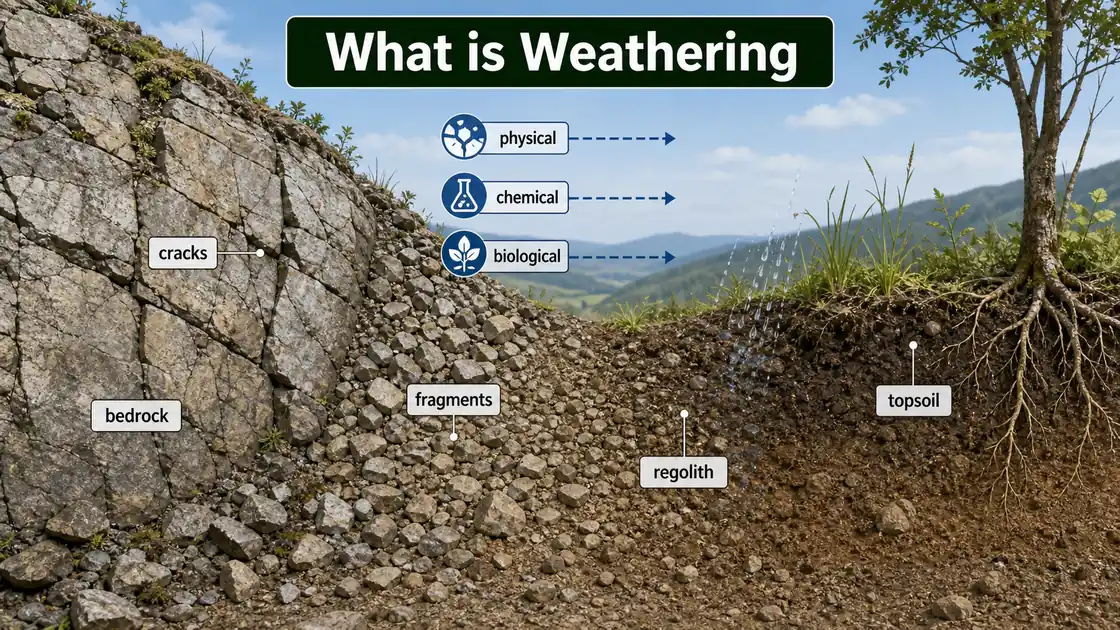
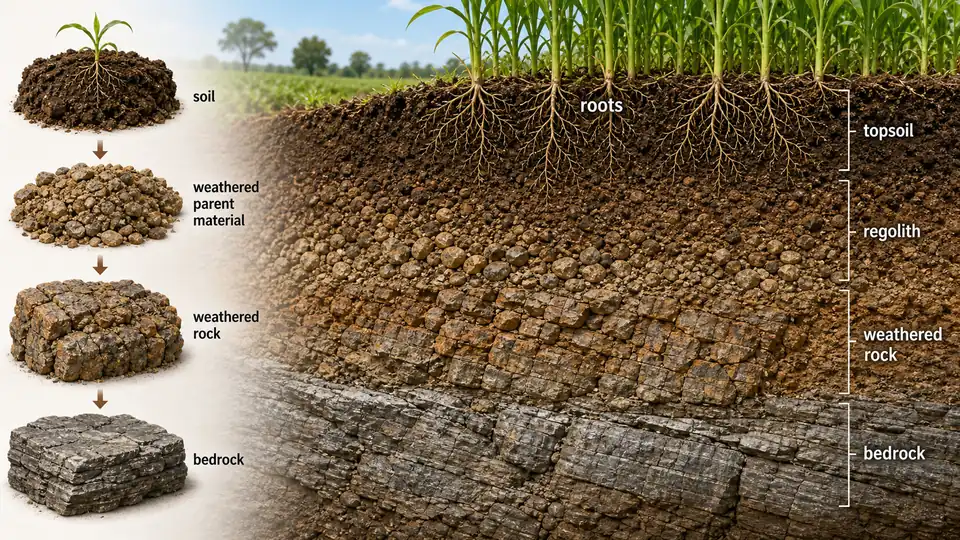
Walk through a sugarcane field in Maharashtra and dig down. Below the dark topsoil, you find brownish weathered basalt, and deeper still, solid rock. This gradual transition from hard rock to loose soil material did not happen overnight -- it took thousands of years of weathering. Weathering is the process that converts solid rock into the loose, unconsolidated material called regolith, which eventually becomes soil.
What is Weathering?
Factors Affecting Weathering Rate
| Factor | Effect on Weathering | Agricultural Example |
|---|---|---|
| Mineral composition | Complex minerals weather faster | Basalt weathers faster than granite |
| Rock type | Basic igneous > Acid igneous; Limestone > Sandstone | Black cotton soils from basalt vs sandy soils from granite |
| Rock texture | Porous rocks weather faster | Sandstone weathers faster than solid basalt |
| Climate | Warm, humid climates accelerate weathering | Laterite soils in Kerala vs desert soils in Rajasthan |
Parent Material
Parent material is the regolith or its upper portion -- the unconsolidated, chemically weathered mineral material from which soils develop. It is the starting point for all soil formation.
Pro Content Locked
Upgrade to Pro to access this lesson and all other premium content.
Charged once for one year · ₹1188 total
Save ₹100/month vs ₹2388/year launch price
- All Agriculture & Banking Courses
- AI Lesson Questions (100/day)
- AI Doubt Solver (50/day)
- Glows & Grows Feedback (30/day)
- AI Section Quiz (20/day)
- 22-Language Translation (100/day)
- Recall Questions (20/day)
- AI Quiz (15/day)
- AI Quiz Paper Analysis (100/day)
- AI Step-by-Step Explanations (100/day)
- Spaced Repetition Recall (FSRS)
- AI Tutor
- Immersive Text Questions
- Audio Lessons — Hindi & English
- Mock Tests & Previous Year Papers
- Summary & Mind Maps
- XP, Levels, Leaderboard & Badges
- Generate New Classrooms
- Voice AI Teacher (AgriDots Live)
- AI Revision Assistant
- Knowledge Gap Analysis
- Interactive Revision (LangGraph)
🔒 Secure one-time yearly payment via Razorpay · No hidden fees
Walk through a sugarcane field in Maharashtra and dig down. Below the dark topsoil, you find brownish weathered basalt, and deeper still, solid rock. This gradual transition from hard rock to loose soil material did not happen overnight -- it took thousands of years of weathering. Weathering is the process that converts solid rock into the loose, unconsolidated material called regolith, which eventually becomes soil.
What is Weathering?
Factors Affecting Weathering Rate
| Factor | Effect on Weathering | Agricultural Example |
|---|---|---|
| Mineral composition | Complex minerals weather faster | Basalt weathers faster than granite |
| Rock type | Basic igneous > Acid igneous; Limestone > Sandstone | Black cotton soils from basalt vs sandy soils from granite |
| Rock texture | Porous rocks weather faster | Sandstone weathers faster than solid basalt |
| Climate | Warm, humid climates accelerate weathering | Laterite soils in Kerala vs desert soils in Rajasthan |
Parent Material
Parent material is the regolith or its upper portion -- the unconsolidated, chemically weathered mineral material from which soils develop. It is the starting point for all soil formation.
| Physical Weathering Image Item | Full Content |
|---|---|
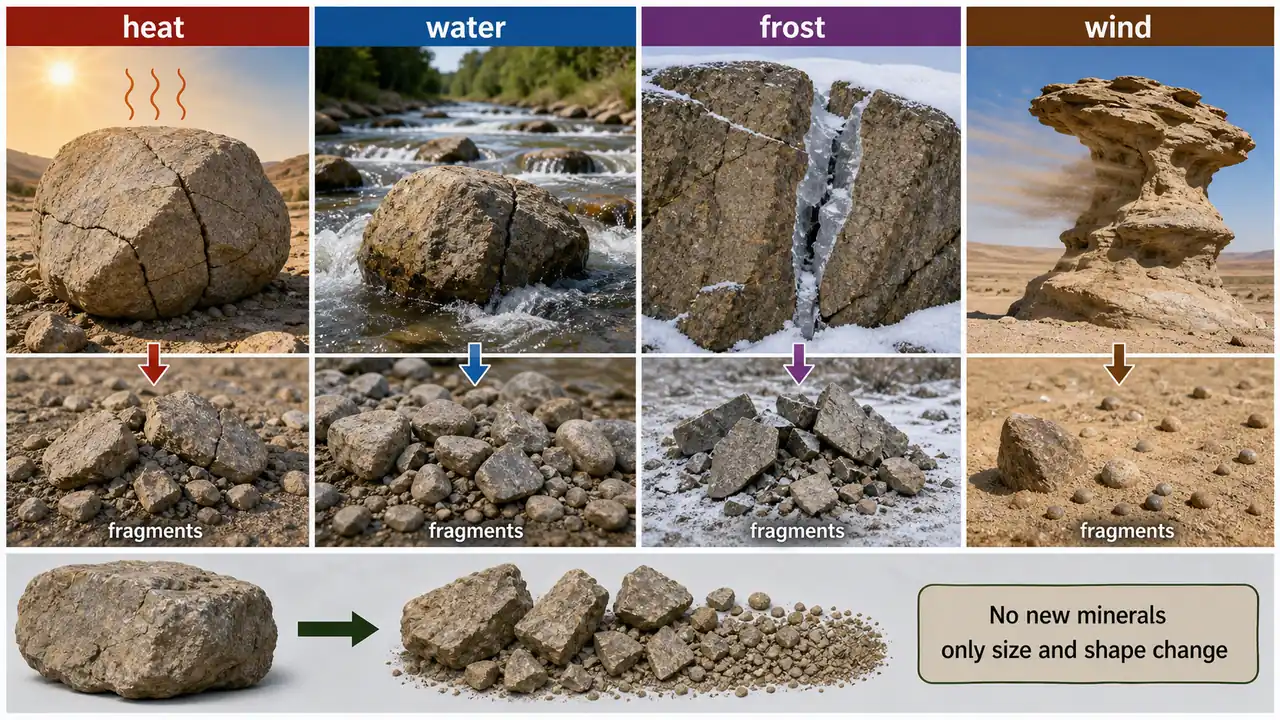
| Heat and cooling | Repeated daytime heating and nighttime cooling cause expansion and contraction, creating stress that can peel off outer rock layers |
| Water action | Moving water abrades rock surfaces, carries fragments away, and deepens gullies or ravines |
| Freezing and thawing | Water enters cracks, freezes, expands, and wedges the rock apart into smaller fragments |
| Wind abrasion | Sand-laden winds strike exposed rock surfaces and gradually wear them down |
| No new minerals | Physical weathering changes only the size and shape of rock fragments; mineral composition remains unchanged |
| Main result | Produces coarse fragments and increases surface area, preparing rocks for faster chemical weathering later |
I. Physical (Mechanical) Weathering
Rocks are broken into smaller pieces without producing any new substances. The chemical composition remains unchanged -- only the size decreases, increasing surface area for further weathering.
NOTE
Physical weathering produces skeletal soils -- coarse-textured, shallow soils with poorly developed profiles. These are typical in deserts, arctic and alpine regions.
Agents of Physical Weathering
1. Physical Condition of Rocks
- Permeability is the most important single factor
- Porous sandstone weathers more readily than solid basalt
- Rocks with cracks, joints and pores are more susceptible
- Agricultural link: Soils from porous parent rocks tend to be better drained
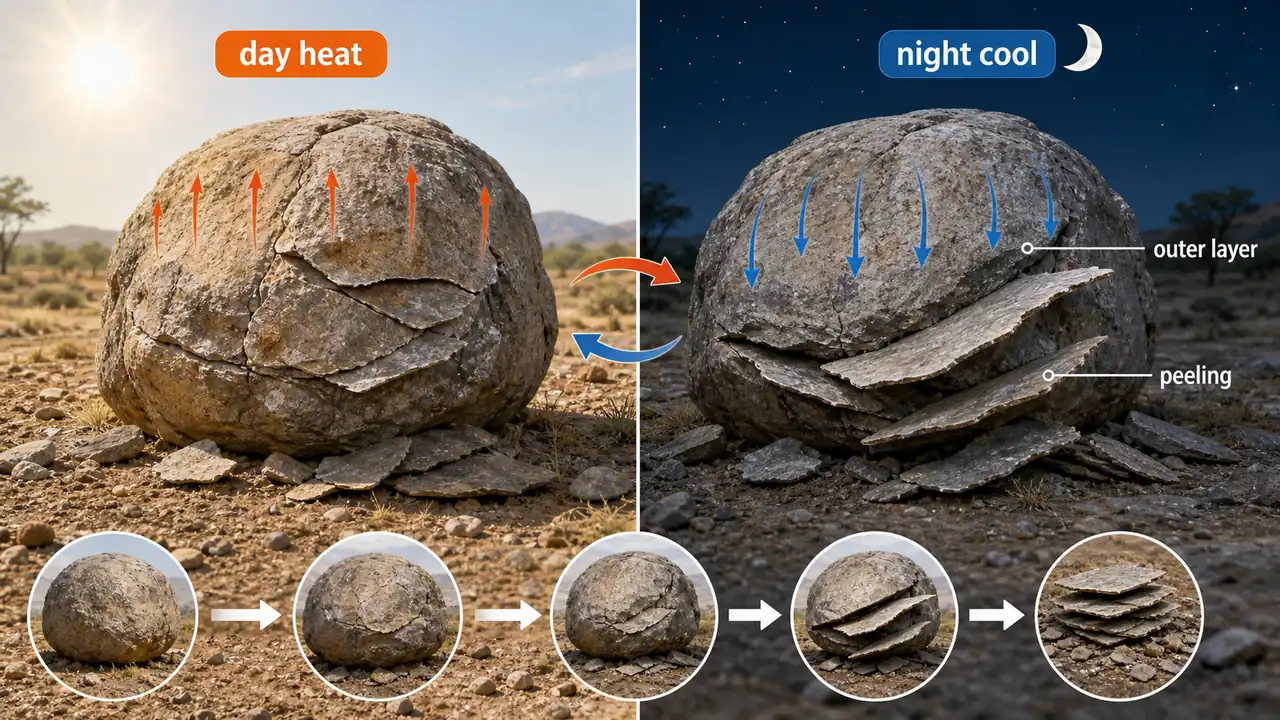
2. Temperature Changes (Exfoliation)
- Day: rocks expand with heat; Night: rocks contract with cold
- Outer layers heat and cool faster than inner layers, creating differential stress
- Quartz expands twice as fast as feldspar
- Dark-coloured rocks experience faster temperature changes than light ones
- Surface layers peel off from the parent mass -- this process is called Exfoliation
- Agricultural link: Exfoliation is common in arid and semi-arid regions like Rajasthan, producing coarse sandy soils
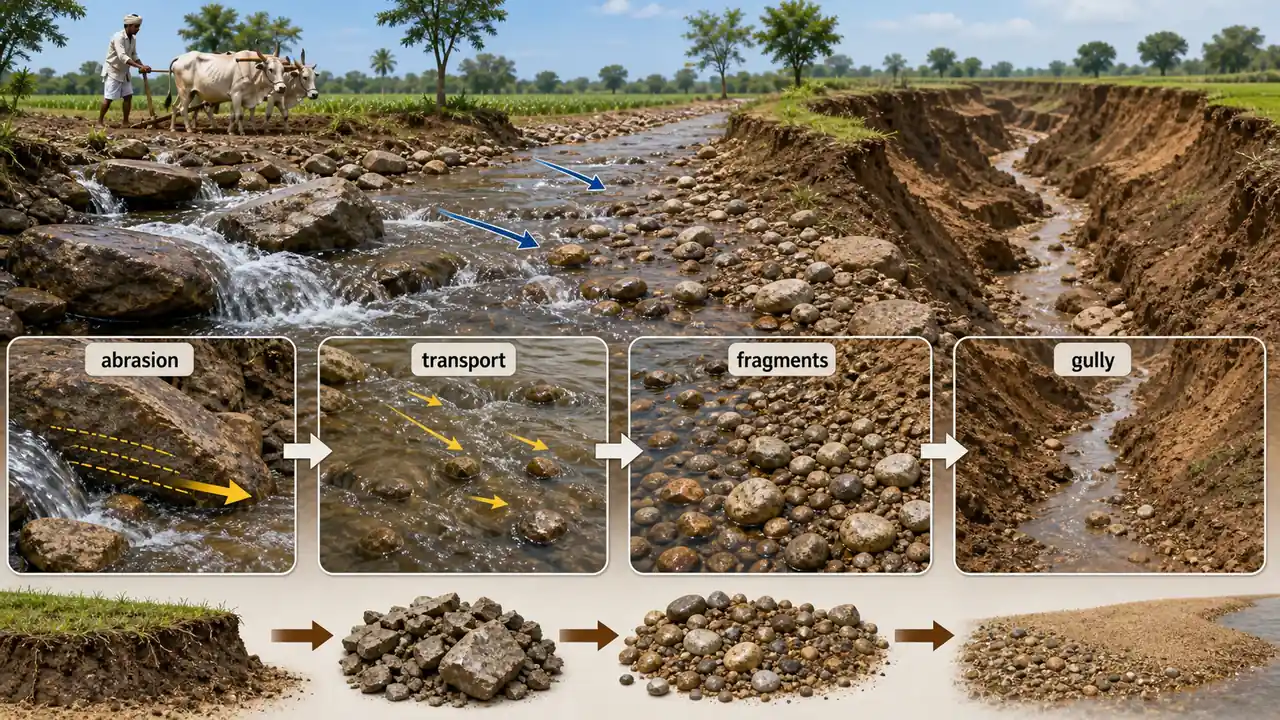
3. Action of Water
- Water acts as a disintegrating, transporting and depositing agent
- Moving water has great cutting and carrying force
- Forms gullies and ravines -- a major problem in the Chambal ravines of Madhya Pradesh
- Agricultural link: Water erosion removes fertile topsoil, reducing crop productivity
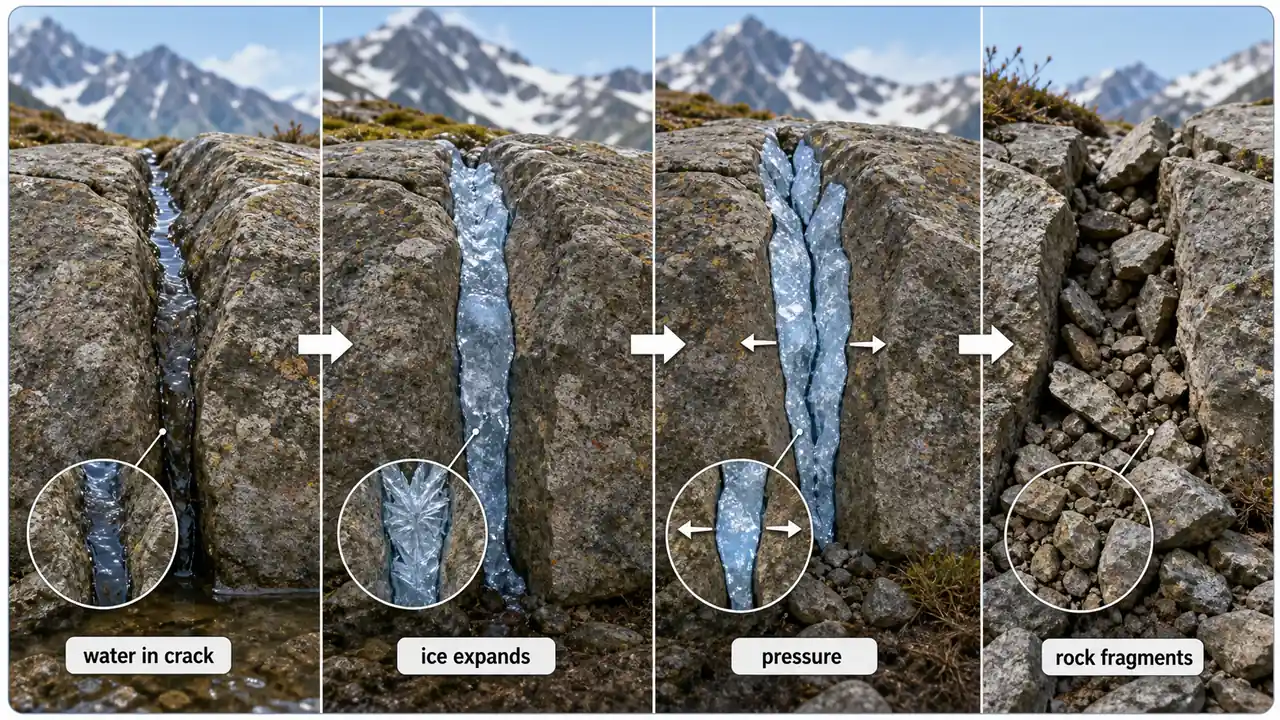
4. Freezing and Thawing (Frost Wedging)
- When water freezes, volume increases by 9%
- Force exerted: 150 tons per square foot
- Freezing starts from top -- no upward expansion possible -- creates enormous outward pressure
- Agricultural link: Important in Himalayan regions where repeated freeze-thaw cycles produce rocky soils
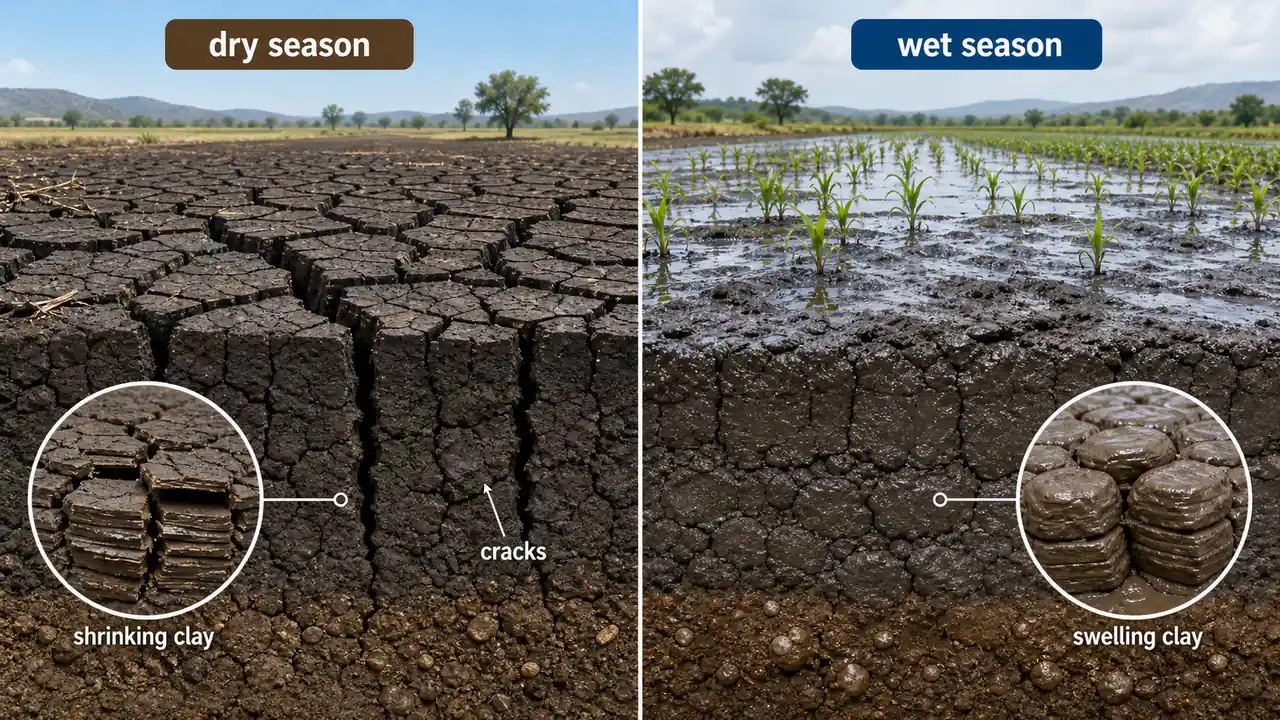
5. Alternate Wetting and Drying
- Expansive clays (smectite, montmorillonite) swell on wetting and shrink on drying
- Deep cracks form during dry seasons; swelling occurs on rewetting
- This cycle loosens and eventually breaks clay-rich rocks
- Agricultural link: This is why black cotton soils (Vertisols) develop deep cracks in summer -- a characteristic feature of Deccan plateau soils
6. Action of Glaciers
- Ice sheets move due to temperature changes and gradient
- Exert tremendous pressure, grinding rocks (called abrasion)
- Deposits left behind are called moraines
- Agricultural link: Glacial deposits in the Tarai belt of Uttarakhand produce fertile alluvial soils
7. Action of Wind (Aeolian Erosion)
- Sand-laden winds have a serious abrasive effect on rocks
- Dust storms transport tons of material
- Agricultural link: Wind erosion in Rajasthan deserts degrades cultivated land; windblown silt (loess) can form very fertile soils
8. Atmospheric Electrical Phenomenon
- Lightning breaks rocks and widens cracks during rainy seasons
II. Chemical Weathering
Decomposition of rocks and minerals by various chemical processes. It is the most important process for soil formation because it transforms mineral composition entirely, creating new secondary minerals (clays) from primary minerals.
- Chemical weathering occurs mainly at rock surfaces
- Effectiveness increases as surface area increases (smaller fragments = more surface)
- Quartz responds far more slowly to chemical attack than olivine or pyroxene
Feldspar + Water --> Clay mineral + Soluble Cations and Anions
IMPORTANT
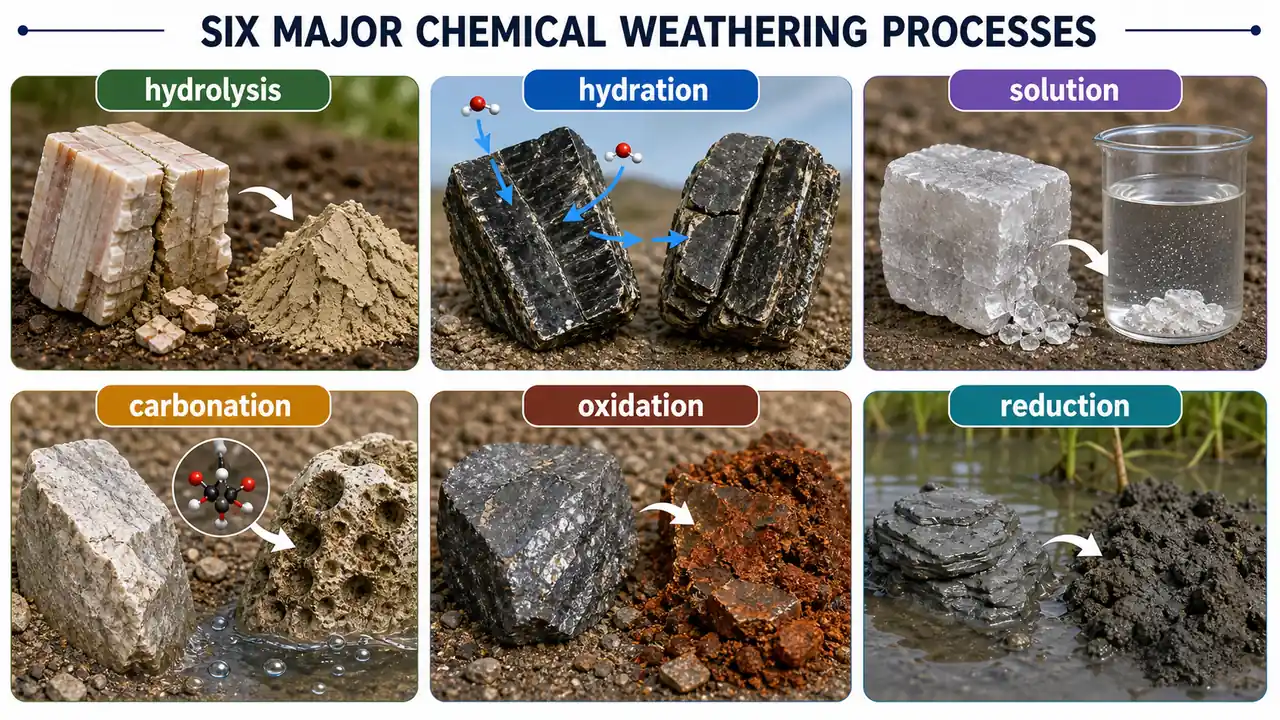
There are 6 major chemical weathering processes. Among all, Hydrolysis is the most important and is the forerunner for clay mineral (secondary mineral) formation.
The Six Chemical Weathering Processes
| Process | Definition | Key Reaction | Agricultural Significance |
|---|---|---|---|
| Hydrolysis | Splitting of minerals by H+ and OH- ions | Feldspar + H2O --> Clay + Cations | Most important; creates clay minerals that hold nutrients |
| Hydration | Water molecules join mineral's crystal structure | Al2O3 + 3H2O --> Gibbsite | Minerals swell and soften; laterite soil formation |
| Solution | Substances dissolve directly in water | NaCl dissolves in water | Removes soluble salts; affects saline soils |
| Carbonation | CO2 + water forms carbonic acid that attacks rocks | CaCO3 + H2CO3 --> Ca(HCO3)2 | Forms Kankar nodules in Indian soils |
| Oxidation | Addition of oxygen to minerals | 4FeO + O2 --> 2Fe2O3 | Gives red/yellow colour to well-drained soils |
| Reduction | Removal of oxygen from minerals | 2Fe2O3 - O2 --> 4FeO | Gives grey/blue colour to waterlogged soils |
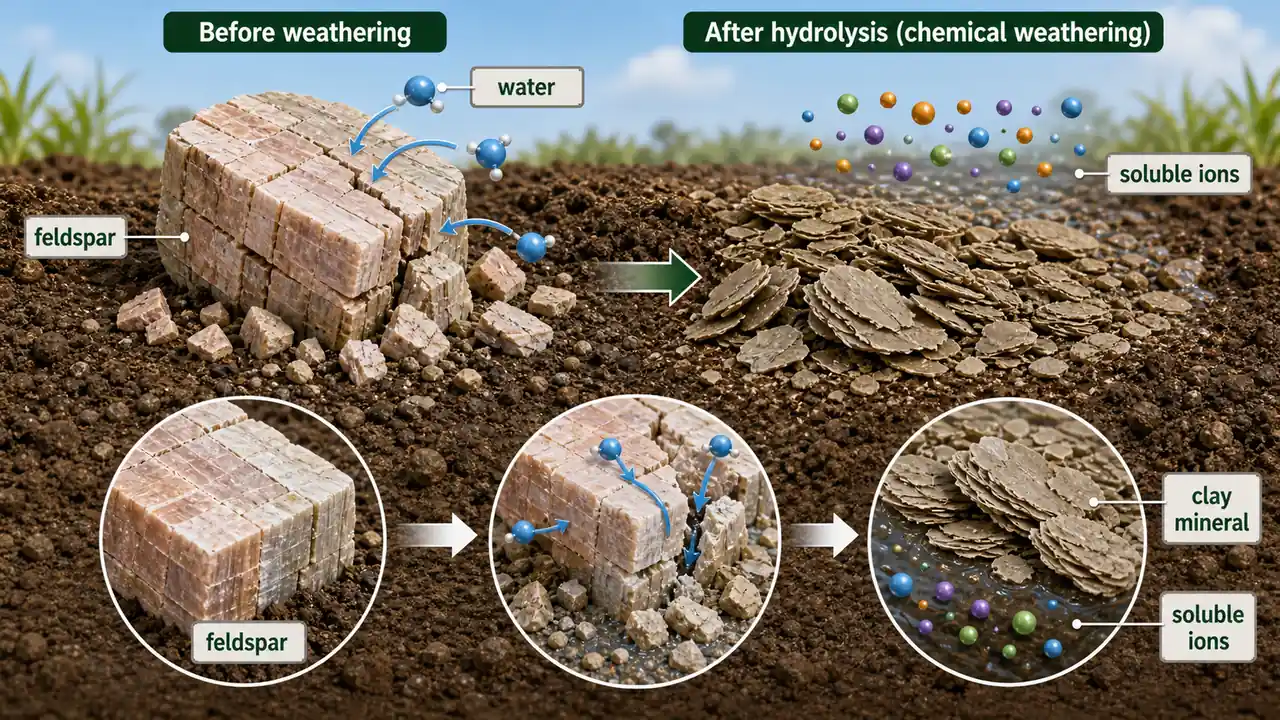
1. Hydrolysis (Most Important)
- Most important process in chemical weathering
- H2O dissociates into H+ and OH- ions that chemically combine with minerals
- Water acts as a weak acid on silicate minerals
- Hydrolysis reactions are the forerunner for clay formation (secondary minerals)
- This is why soils develop their nutrient-holding capacity -- the clays formed through hydrolysis are the "storehouse" of plant nutrients
TIP
Hydrolysis creates clay minerals from primary silicate minerals. This is the single most important fact about chemical weathering for competitive exams.
2. Hydration
- Chemical combination of water molecules with minerals, changing their structure
- Different from simply wetting -- water becomes part of the crystal structure
- Minerals lose lustre, become soft, swell and increase in volume
Example reactions:
- Al2O3 + 3H2O --> Al2O3.3H2O (Alumina --> Gibbsite)
- 2Fe2O3 + 3H2O --> 2Fe2O3.3H2O (Haematite --> Limonite)
- CaSO4 + 2H2O --> CaSO4.2H2O (Anhydrite --> Gypsum)
- Agricultural link: Gypsum formed through hydration is used to reclaim sodic soils
3. Solution
- Some rock substances dissolve directly in water
- Continuous water action removes soluble substances, leaving holes and rough surfaces
- Action increases when water is acidified by organic or inorganic acids
- Example: Halite (NaCl) dissolves readily
- Agricultural link: Excessive solution leads to salt accumulation in low-lying fields
4. Carbonation
- CO2 dissolved in water forms carbonic acid (H2CO3)
- This acid attacks rocks, especially limestone and dolomite
2H2O + CO2 --> H2CO3
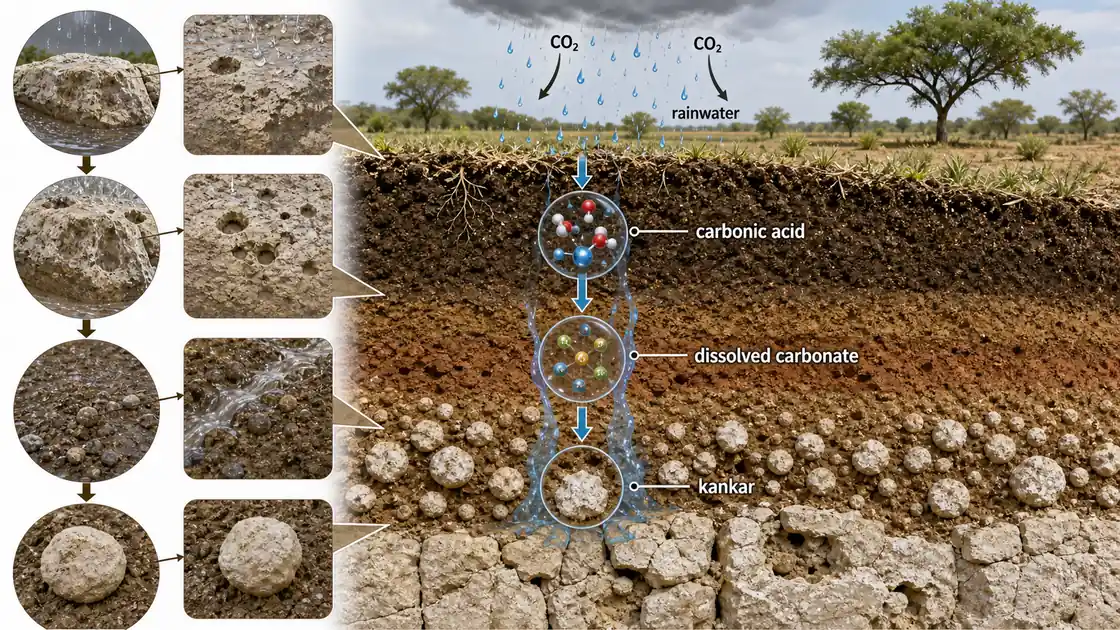
- Soluble bicarbonate is leached to lower layers where CO2 is released and insoluble CaCO3 precipitates
- These precipitates form nodules called Kankar
NOTE
Kankar nodules are found in most red soils and black cotton soils in South India. In red soils: 1-2 ft from surface. In black soils: deeper at 3-4 ft. Kankar is used as lime for construction.
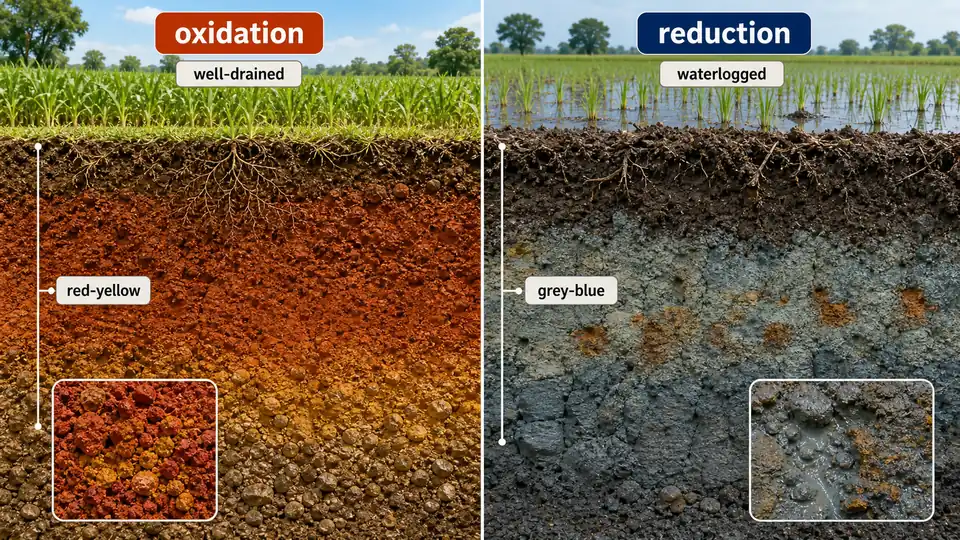
5. Oxidation
- Addition of oxygen to minerals, especially those containing iron and manganese
- More active in the presence of moisture
- Produces hydrated oxides that give soils their characteristic colours
- 4FeO (Ferrous oxide) + O2 --> 2Fe2O3 (Haematite): Red colour
- 4Fe3O4 (Magnetite) + O2 --> 6Fe2O3 (Haematite)
- Agricultural link: Red soils of Tamil Nadu and Chhattisgarh owe their colour to oxidized iron
6. Reduction
- Removal of oxygen -- reverse of oxidation
- Occurs in waterlogged or poorly drained soils where oxygen is depleted
- Ferric iron (Fe3+) converts to ferrous iron (Fe2+)
2Fe2O3 (Haematite) - O2 --> 4FeO (Ferrous Oxide): Grey/blue colour
IMPORTANT
Oxidation vs Reduction -- a key pair for exams:
- Oxidation (O2 present, well-drained) --> Fe3+ --> Red/Yellow soils
- Reduction (O2 absent, waterlogged) --> Fe2+ --> Grey/Blue/Green soils (Gleyed soils)
Agricultural link: Paddy fields show grey-blue (reduced) colours due to prolonged waterlogging, while well-drained upland fields show red-yellow (oxidized) colours.
Mineral Resistance to Chemical Weathering
| Resistance | Minerals | Soil Implication |
|---|---|---|
| Most resistant | Quartz, Muscovite | Persist in soils; sandy soils are quartz-rich but infertile |
| Moderately resistant | Alkali feldspars (Orthoclase), Biotite | Slowly release K, Mg to soil |
| Least resistant | Olivine, Pyroxene, Ca-plagioclase | Weather rapidly; release Ca, Mg, Fe for crops |
TIP
Quartz is the most resistant mineral, which is why sandy soils (rich in quartz) are infertile -- the nutrient-rich minerals have already weathered away. Olivine weathers fastest.
III. Biological Weathering
Living organisms cause both physical and chemical changes simultaneously, making biological weathering unique.
1. Animals and Humans
| Agent | Physical Action | Chemical Action | Agricultural Example |
|---|---|---|---|
| Earthworms | Pass soil through alimentary canal; create channels | Mix and transform soil material | Called "nature's plough"; improve soil structure |
| Ants/Termites | Build galleries; carry material from lower to upper layers | Excrete acids | Active in tropical plantation soils |
| Burrowing animals | Rabbits, moles destroy soft rocks | Decaying bodies provide reactive substances | Mix soil horizons |
| Humans | Cut rocks for dams, roads | Increase surface area for chemical attack | Land clearing for agriculture |
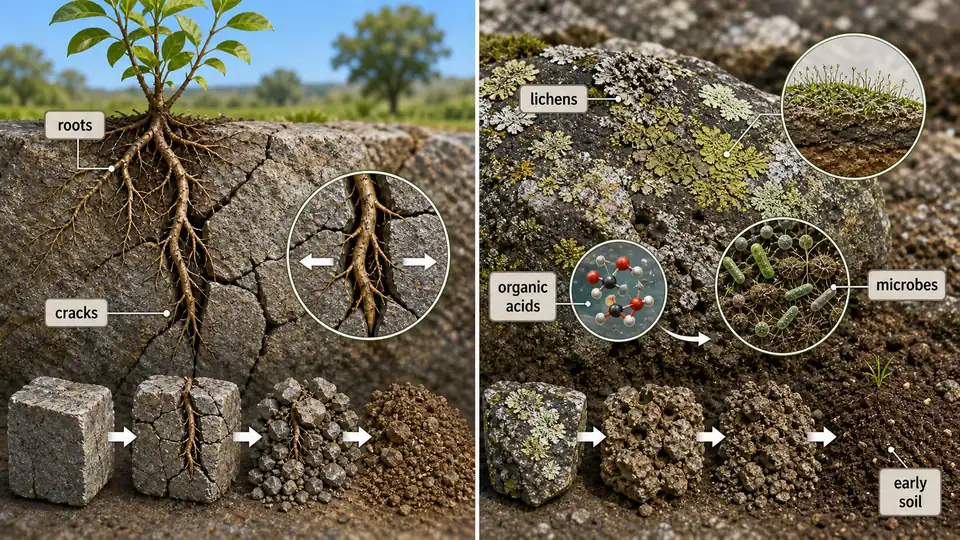
2. Higher Plants and Roots
- Roots penetrate cracks and exert enormous disruptive force (root wedging)
- Example: Pipal trees growing on walls and rocks
- Grass roots form a sponge-like mass that conserves moisture and prevents erosion
- Roots produce organic acids that dissolve minerals
- Dead roots produce CO2 which dissolves in water to form carbonic acid
Agricultural link: Deep-rooted crops like pigeon pea and mustard can physically break through compacted layers and chemically weather subsoil minerals, releasing nutrients for subsequent crops.
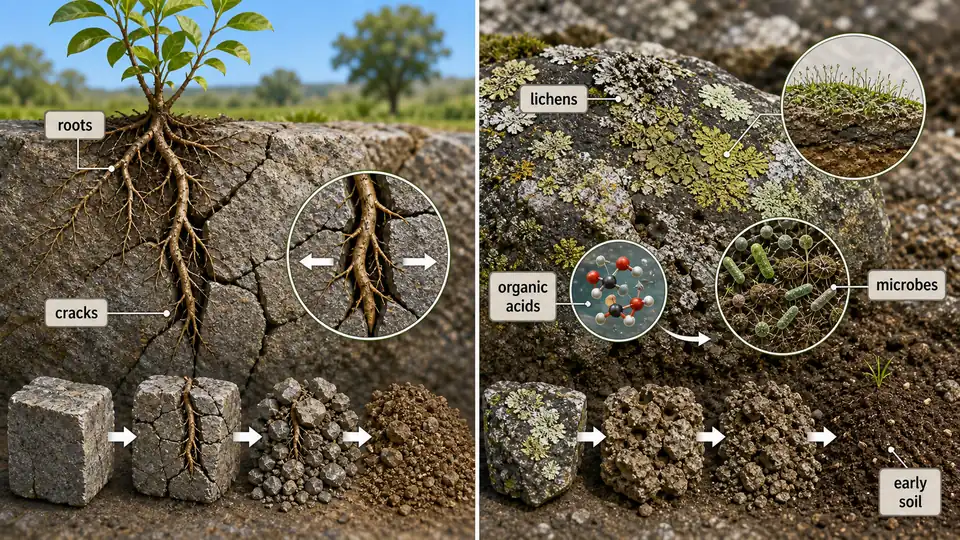
3. Micro-organisms
- Lichens (algae + fungi) are the first colonizers of bare rock surfaces
- Bacteria, fungi and actinomycetes extract nutrients from rock and fix N from air
- Produce organic acids (oxalic, citric, humic) that dissolve minerals
- Agricultural link: Mycorrhizal fungi in crop roots accelerate mineral weathering, making phosphorus and micronutrients available to plants
NOTE
Lichens are among the first biological agents to colonize bare rock. They produce acids that slowly dissolve the rock surface, initiating biological weathering that eventually leads to soil formation.
Comparison: Physical vs Chemical vs Biological Weathering
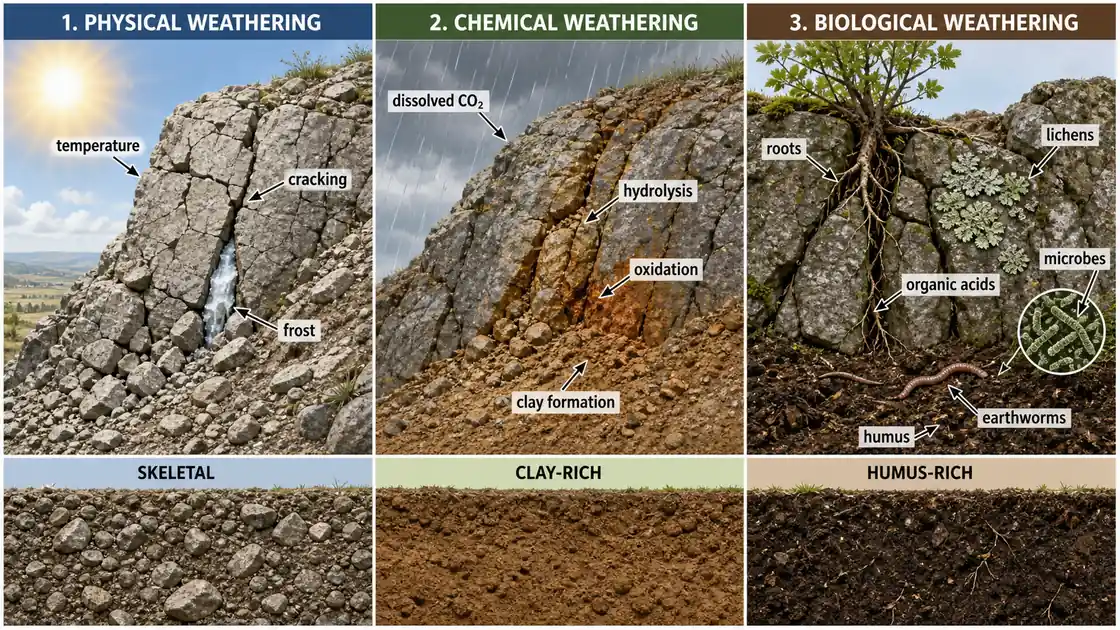
| Feature | Physical Weathering | Chemical Weathering | Biological Weathering |
|---|---|---|---|
| Nature | Disintegration (mechanical) | Decomposition (chemical) | Both disintegration and decomposition |
| New substances? | No | Yes (secondary minerals) | Yes (organic acids, CO2) |
| Key agents | Temperature, water, frost, wind, glaciers | Water (H+, OH-), O2, CO2 | Plants, animals, microorganisms |
| Most important process | Exfoliation, frost wedging | Hydrolysis | Root wedging, organic acid production |
| Soil type produced | Skeletal soils (coarse, shallow) | Mature soils with clay | Organic matter-rich soils |
| Dominant regions | Arid, arctic, alpine | Humid tropical | Tropical, subtropical |
| Agricultural example | Rocky soils of Ladakh | Laterite soils of Kerala | Humus-rich forest soils |
Summary Cheat Sheet
| Concept / Topic | Key Details |
|---|---|
| Weathering result | Forms regolith — starting material for soil |
| Most important weathering type | Chemical weathering — creates soil from minerals |
| Physical weathering | Disintegration (mechanical); no new substances formed |
| Chemical weathering | Decomposition; creates secondary minerals (clays) |
| Biological weathering | Both disintegration and decomposition; organic acids, CO₂ |
| Frost wedging force | 150 tons/sq ft; water expands 9% on freezing |
| Exfoliation | Peeling of surface layers due to temperature changes; arid/semi-arid |
| Most important chemical process | Hydrolysis — forerunner of clay formation |
| Carbonation product | Kankar (CaCO₃ nodules); found in red and black soils of India |
| Oxidation | Fe²⁺ → Fe³⁺ = Red/Yellow soils; well-drained conditions |
| Reduction | Fe³⁺ → Fe²⁺ = Grey/Blue soils; waterlogged conditions |
| Goldich's stability series | Quartz (most resistant) to Calcite (least); reverse of Bowen's series |
| Lichens | First colonizers of bare rock; algae + fungi; pioneer organisms |
| Earthworms | "Nature's plough"; physical + chemical weathering |
| Root wedging | Roots penetrate cracks; exert enormous disruptive force |
| Skeletal soils | Formed mainly by physical weathering; desert, arctic, alpine |
| Physical weathering dominant | Arid, arctic, alpine regions |
| Chemical weathering dominant | Humid tropical regions |
| Hydration | Water molecules attach to mineral → expansion → weakening |
| Solution / Dissolution | Minerals dissolve directly in water (e.g., halite, gypsum) |
| Biological agents | Plants (root wedging), animals (earthworms, termites), microbes (organic acids) |
| Pipal tree example | Classic root wedging — grows on walls and rocks |
| Goldich's series | Quartz (most resistant) to Calcite (least); Exam tip: Reverse of Bowen's series |