𝍀 Soil Density & Porosity: Particle Density, Bulk Density & Pore Space
Particle density, bulk density, porosity, macro and micro pores, and their relationship to soil texture, organic matter and agricultural management
A farmer applies heavy compost to his vegetable garden every year. Over time, he notices the soil becomes lighter, fluffier, and holds more water. Meanwhile, a frequently trafficked farm path next to the garden becomes so hard that even weeds struggle to grow. The garden soil has low bulk density (lots of pore space), while the compacted path has high bulk density (minimal pore space). Understanding soil density and porosity helps farmers manage soil health for better crop production.
Two Types of Soil Density
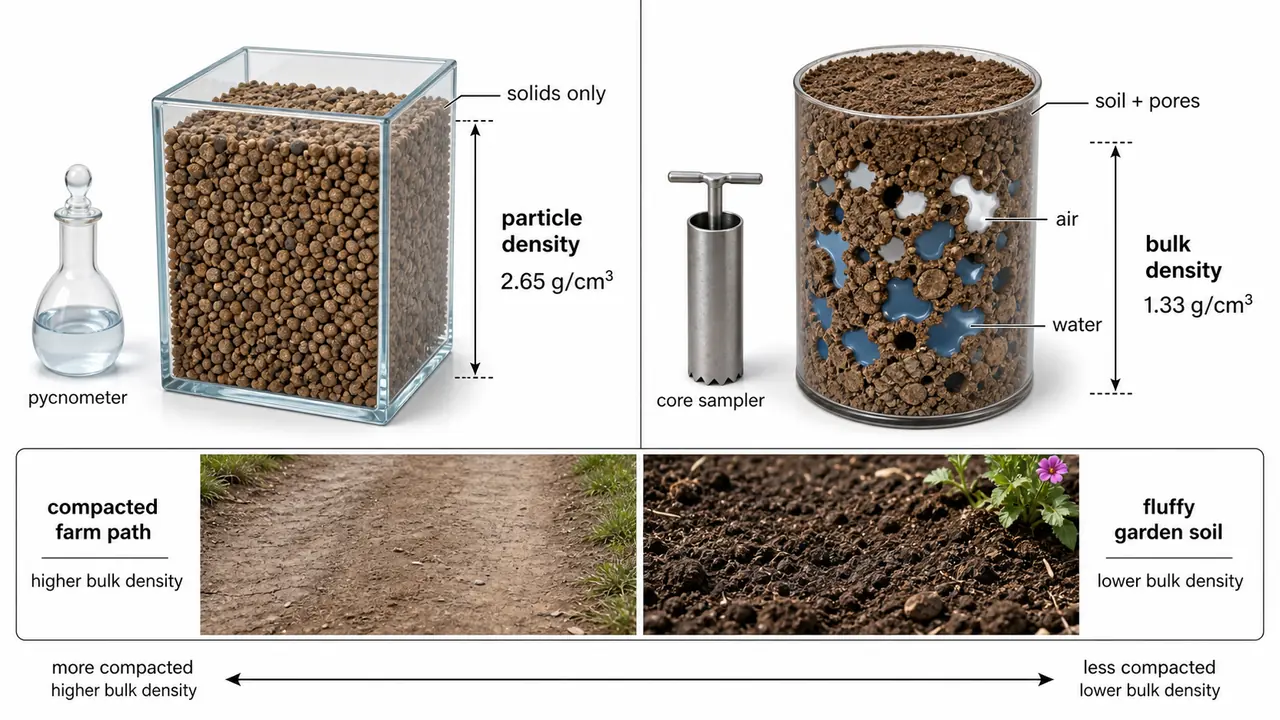
| Property | What It Measures | Includes Pore Space? | Key Value |
|---|---|---|---|
| Particle Density (True Density) | Weight per unit volume of solid particles only | No | 2.65 g/cm3 |
| Bulk Density (Apparent Density) | Weight per unit volume of soil including pore spaces | Yes | 1.33 g/cm3 |
IMPORTANT
Key values to memorize: Particle Density = 2.65 g/cm3; Bulk Density = 1.33 g/cm3 (approximately half of PD). Bulk density is always less than particle density because it includes pore spaces.
Pro Content Locked
Upgrade to Pro to access this lesson and all other premium content.
Charged once for one year · ₹1188 total
Save ₹100/month vs ₹2388/year launch price
- All Agriculture & Banking Courses
- AI Lesson Questions (100/day)
- AI Doubt Solver (50/day)
- Glows & Grows Feedback (30/day)
- AI Section Quiz (20/day)
- 22-Language Translation (100/day)
- Recall Questions (20/day)
- AI Quiz (15/day)
- AI Quiz Paper Analysis (100/day)
- AI Step-by-Step Explanations (100/day)
- Spaced Repetition Recall (FSRS)
- AI Tutor
- Immersive Text Questions
- Audio Lessons — Hindi & English
- Mock Tests & Previous Year Papers
- Summary & Mind Maps
- XP, Levels, Leaderboard & Badges
- Generate New Classrooms
- Voice AI Teacher (AgriDots Live)
- AI Revision Assistant
- Knowledge Gap Analysis
- Interactive Revision (LangGraph)
🔒 Secure one-time yearly payment via Razorpay · No hidden fees
A farmer applies heavy compost to his vegetable garden every year. Over time, he notices the soil becomes lighter, fluffier, and holds more water. Meanwhile, a frequently trafficked farm path next to the garden becomes so hard that even weeds struggle to grow. The garden soil has low bulk density (lots of pore space), while the compacted path has high bulk density (minimal pore space). Understanding soil density and porosity helps farmers manage soil health for better crop production.
Two Types of Soil Density
| Property | What It Measures | Includes Pore Space? | Key Value |
|---|---|---|---|
| Particle Density (True Density) | Weight per unit volume of solid particles only | No | 2.65 g/cm3 |
| Bulk Density (Apparent Density) | Weight per unit volume of soil including pore spaces | Yes | 1.33 g/cm3 |
IMPORTANT
Key values to memorize: Particle Density = 2.65 g/cm3; Bulk Density = 1.33 g/cm3 (approximately half of PD). Bulk density is always less than particle density because it includes pore spaces.
Particle Density (Real Specific Gravity)
Definition
Weight per unit volume of the solid portion of soil, excluding pore spaces.
Formula
P.D. = Weight of soil solids / Volume of soil solids
Key Facts
| Fact | Detail | Agricultural Significance |
|---|---|---|
| Standard value | 2.65 g/cm3 (close to quartz density) | Reference standard for calculations |
| Heavy minerals increase PD | Magnetite, limonite, hematite (density > 2.65) | Laterite soils may have higher PD |
| Organic matter decreases PD | OM density = 1.2 - 1.5 g/cm3 | Peaty soils have lower PD |
| Determined by | Pycnometer | Laboratory method |
| Also called | True density or Real specific gravity | -- |
Particle Density by Textural Class
| Soil Textural Class | Particle Density (g/cm3) |
|---|---|
| Coarse Sand | 2.655 |
| Fine Sand | 2.659 |
| Silt | 2.798 |
| Clay | 2.837 |
| Organic Matter | 1.1 - 1.4 |
| Textural class | Particle density (g/cm³) |
|---|---|
| Coarse sand | 2.655 |
| Fine sand | 2.659 |
| Silt | 2.798 |
| Clay | 2.837 |
TIP
Particle density increases from sand to clay because clay minerals (montmorillonite, kaolinite) contain heavier elements (Fe, Al) compared to quartz-dominated sand.
Bulk Density (Apparent Specific Gravity)
Definition
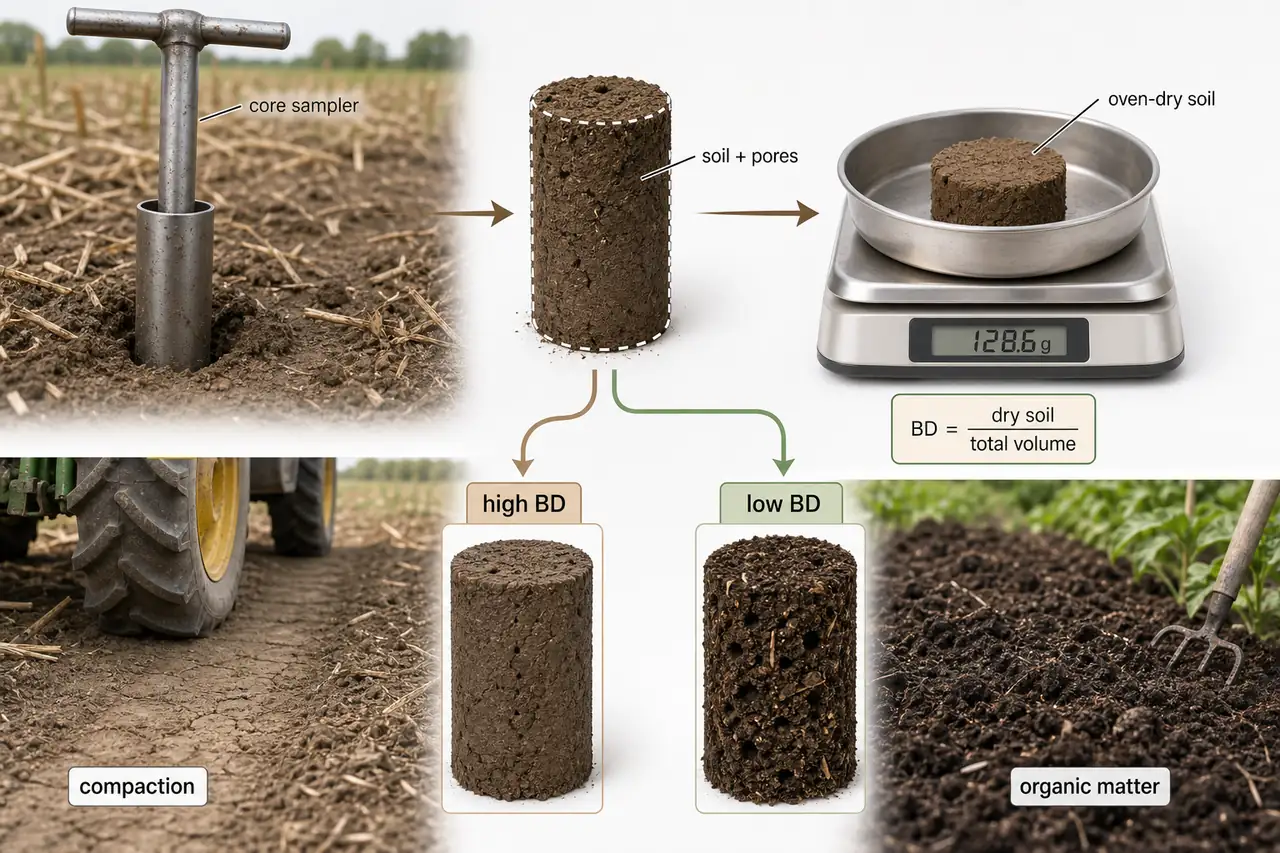
The oven-dry weight of a unit volume of soil inclusive of pore spaces.
Formula
B.D. = Weight of oven-dry soil / Volume of soil (including pore space)
Key Facts
| Fact | Detail | Agricultural Significance |
|---|---|---|
| Standard value | 1.33 g/cm3 (half of PD) | Reference for calculations |
| Always less than PD | Because total volume > volume of solids alone | -- |
| OM value | ~0.5 g/cm3 | Adding OM reduces BD |
| Decreases with finer texture | Clay soils have lower BD than sandy soils | More pore space in clay |
| Determined by | Core sampler | Field method |
| Also called | Apparent specific gravity | -- |
Bulk Density by Textural Class
| Soil Textural Class | Bulk Density (g/cm3) | Pore Space (%) |
|---|---|---|
| Sandy soil | 1.6 | 40 |
| Loam | 1.4 | 47 |
| Silt Loam | 1.3 | 50 |
| Clay | 1.1 - 1.19 | 55-58 |
Particle Density vs Bulk Density -- Complete Comparison
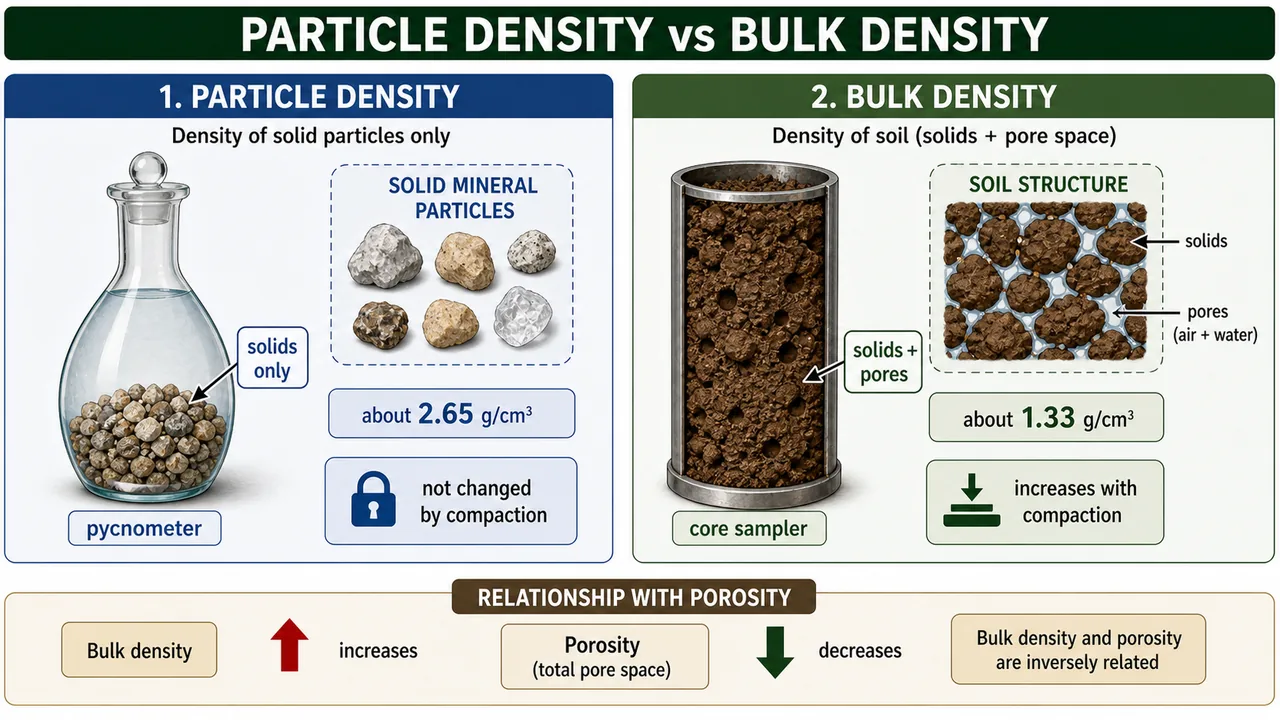
| Property | Particle Density | Bulk Density |
|---|---|---|
| Definition | Weight per unit volume of solids only | Weight per unit volume of soil + pore space |
| Normal soil value | 2.65 g/cm3 | 1.33 g/cm3 |
| Organic matter value | 1.1 - 1.4 g/cm3 | 0.5 g/cm3 |
| Sandy soil | 2.655 | 1.6 |
| Loam soil | -- | 1.4 |
| Silt loam | 2.798 | 1.3 |
| Clay soil | 2.837 | 1.19 |
| Determined by | Pycnometer | Core sampler |
| Effect of OM | Decreases | Decreases |
| Effect of compaction | No change | Increases |
| Effect of tillage | No change | Decreases |
| Textural class | Bulk density | Pore space (%) |
|---|---|---|
| Sandy soil | 1.6 | 40 |
| Loam | 1.4 | 47 |
| Silt loam | 1.3 | 50 |
| Clay | 1.1 | 58 |
Factors Affecting Bulk Density
| Factor | Effect on BD | Agricultural Example |
|---|---|---|
| Pore space | More pores = lower BD | Well-structured soils have low BD |
| Texture | Fine-textured (clay) = lower BD than sand | Clay soils have more aggregate porosity |
| Organic matter | More OM = lower BD | Adding FYM reduces BD, improves root growth |
| Compaction | Increases BD | Heavy tractor traffic on wet soil |
| Tillage | Decreases BD (increases pore space) | Ploughing loosens compacted soil |
| Microorganisms | Promote aggregation = lower BD | Earthworm activity creates macropores |
IMPORTANT
- Tillage decreases BD because it increases pore space
- Exception: Puddling increases BD from about 1.4 to 1.7 g/cm3 (intentional for rice)
- Heavy minerals increase particle density
- Compaction increases bulk density
Agricultural rule: Low BD = good physical condition = easier root growth, better aeration, higher water holding capacity.
Porosity
Definition
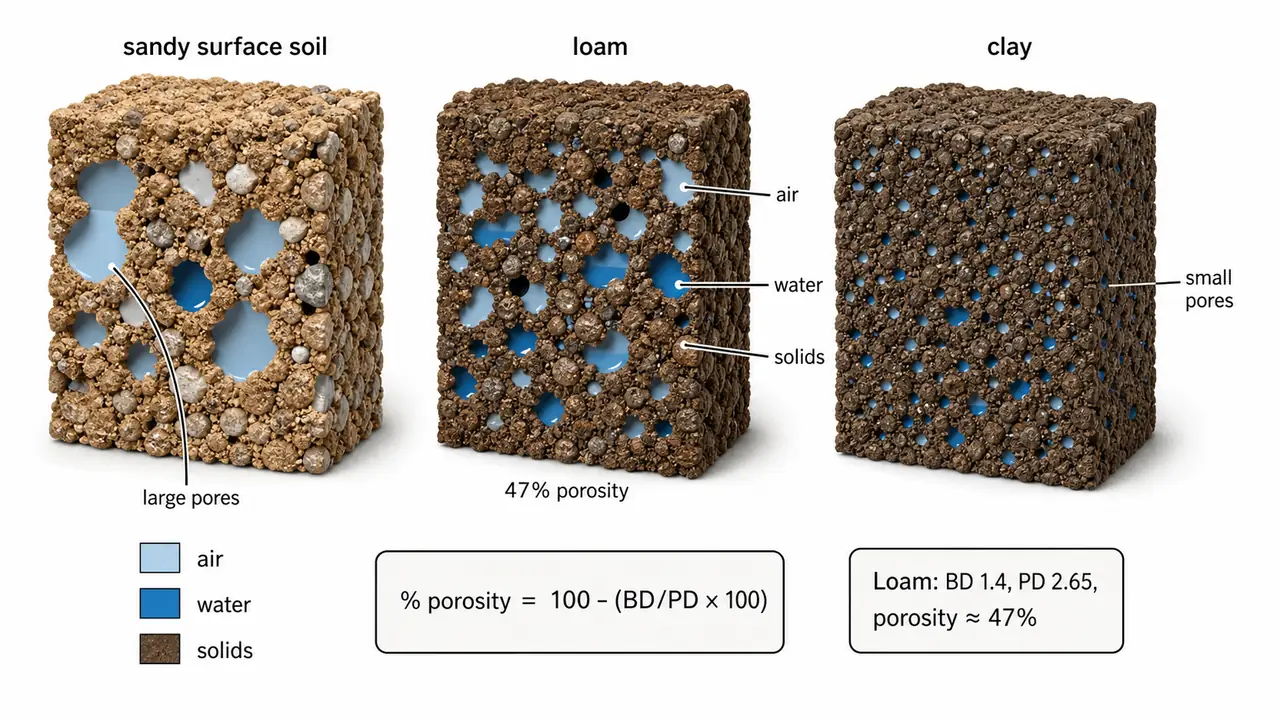
Soil porosity is the fraction of soil volume not occupied by solid particles -- the space available for air and water.
Formula
% Porosity = 100 - (BD/PD x 100)
Example calculation: For a loam soil with BD = 1.4 and PD = 2.65:
- Porosity = 100 - (1.4/2.65 x 100) = 100 - 52.8 = 47.2%
Porosity by Soil Texture
| Soil Texture | Pore Space (%) | BD (g/cm3) |
|---|---|---|
| Sandy surface soil | 35 to 50% | 1.6 |
| Medium to fine textured | 50 to 60% | 1.3 |
| Compact subsoils | 25 to 30% | >1.7 |
| Loamy soils | ~50% | 1.4 |
IMPORTANT
Porosity range: 30 - 60%. Loamy soils have about 50% porosity -- the ideal for most crops.
Macro Pores vs Micro Pores
| Pore Type | Diameter | Also Called | Water Movement | Dominant in |
|---|---|---|---|---|
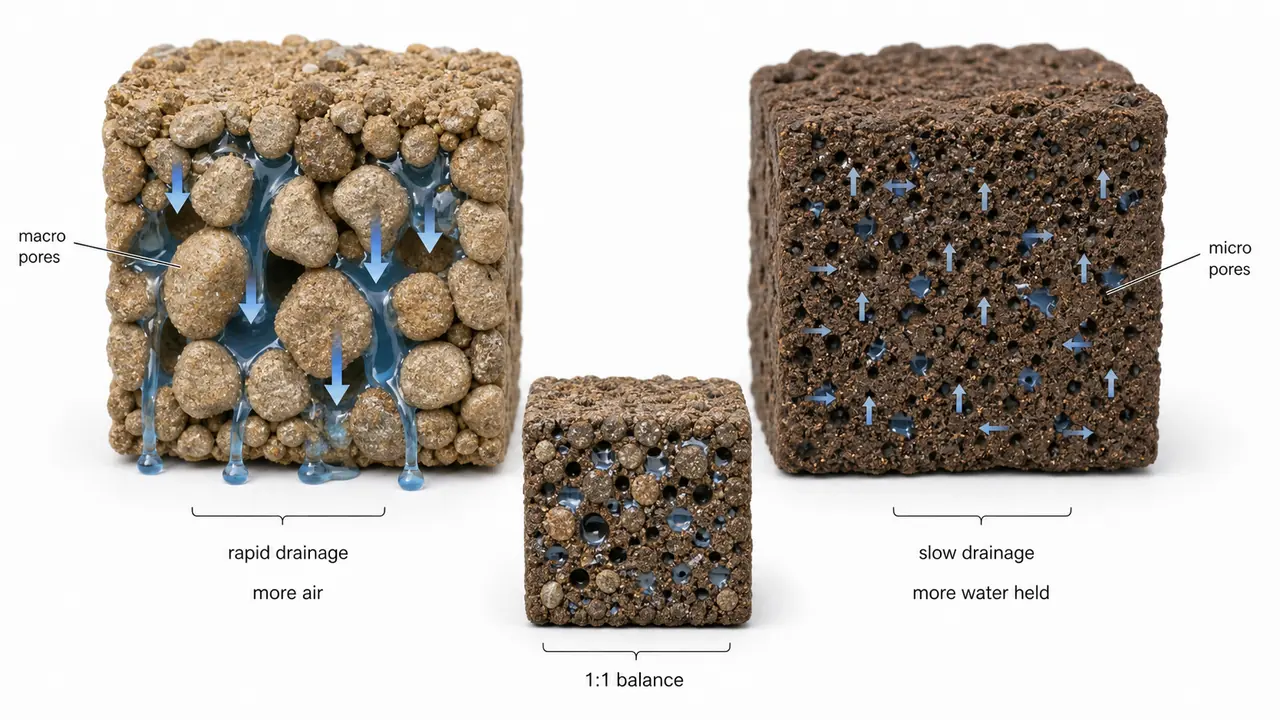
| Macro pores | > 0.05 mm | Non-capillary pores | Gravitational and mass flow (free movement) | Sandy soils |
| Micro pores | < 0.05 mm | Capillary pores | Capillary movement and diffusion (slow) | Clay soils |
| Soil Type | Total Pore Space | Dominant Pore Type | Water/Air Behaviour |
|---|---|---|---|
| Sandy | Less total pores | More macro pores | Rapid drainage; poor water retention |
| Clay | More total pores | More micro pores | Slow drainage; high water retention |
| Loam | ~50% | Equal macro and micro | Ideal balance of drainage and retention |
IMPORTANT
The ideal ratio of micro to macro pores is 1:1. This ensures both adequate water retention (micro pores) and proper drainage/aeration (macro pores). Loamy soils naturally achieve this balance.
Pore Numbers by Texture
| Soil | Pores per m2 | Pore Size |
|---|---|---|
| Sandy | 25,000 | Large (macro) |
| Clay | 25 x 106 (25 million) | Small (micro) |
Factors Influencing Pore Space
| Pore Space Image Item | Full Content |
|---|---|
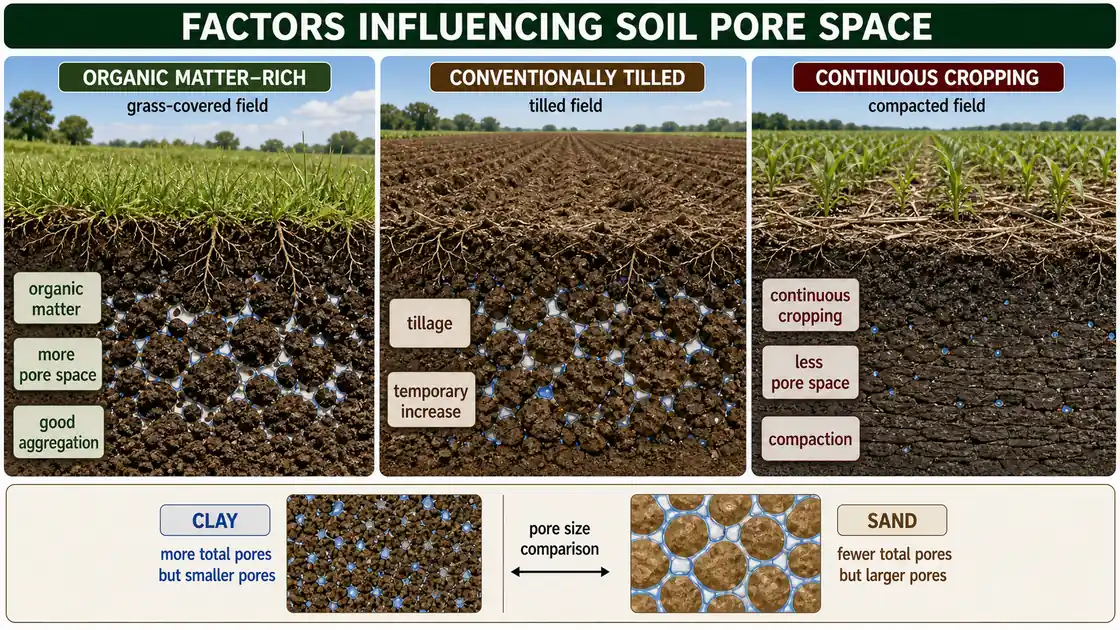
| Organic matter-rich field | Better aggregation creates more stable pore space and improves long-term soil physical condition |
| Grass-covered or residue-rich soil | Roots and organic residues help maintain structure and support higher porosity |
| Conventional tillage | Can increase pore space temporarily by loosening soil, but repeated tillage may reduce organic matter over time |
| Continuous cropping and compaction | Repeated traffic and low organic matter tend to produce less pore space and denser soil |
| Clay vs sand | Clay soils have more total pores but they are smaller, while sandy soils have fewer total pores but they are larger |
| Main lesson | The most sustainable way to maintain healthy pore space is to protect structure and rebuild organic matter |
| Factor | Effect | Agricultural Significance |
|---|---|---|
| Soil texture | Clay has more total pores (but smaller); sand has fewer (but larger) | Choose crops suited to drainage pattern |
| Vegetation | Blue grass can increase porosity to 57.2% from 50% | Crop rotation with grasses improves porosity |
| Continuous cropping | Reduces OM and granulation = less pore space | Rotate crops; add organic amendments |
| Conservation/No tillage | May reduce porosity but preserves OM | Trade-off between porosity and OM stability |
| Conventional tillage | Temporarily increases porosity but reduces OM | Short-term benefit, long-term risk |
| Organic matter | Promotes aggregation = more pore space | Best long-term strategy for healthy porosity |
| Management Cue | Full Content |
|---|---|
| Organic matter-rich / grass-covered field | Better aggregation and more pore space over the long term |
| Conventionally tilled field | Pore space may increase temporarily, but repeated tillage can reduce organic matter later |
| Continuous cropping / compaction | Soil tends toward less pore space and denser structure unless organic matter is rebuilt |
| Clay vs sand | Clay has more total pores but they are smaller; sand has fewer total pores but they are larger |
TIP
Virgin soils have more pore space than cultivated soils. More crops per year = less macro pore space. The key takeaway: managing organic matter is the most sustainable strategy for maintaining healthy soil porosity.
Crumbly/Granular vs Other Structures
| Structure | Porosity | BD | Best For |
|---|---|---|---|
| Crumbly/Granular (spheroidal) | Highest | Lowest | Most crops; best seedbed |
| Blocky | Moderate | Moderate | Subsoil; adequate drainage |
| Platy | Lowest | Highest | Restricts roots; poor for crops |
Summary Cheat Sheet
| Concept / Topic | Key Details |
|---|---|
| Particle density (PD) | Standard value: 2.65 g/cm3; close to quartz density |
| Bulk density (BD) | Standard value: 1.33 g/cm3; roughly half of PD |
| PD instrument | Pycnometer; used as a lab method |
| BD instrument | Core sampler; used as a field method |
| BD always < PD | Because BD includes pore space |
| Organic matter effect | Decreases both PD and BD; OM density = 1.2-1.5 |
| Compaction effect | Increases BD; no effect on PD; common under heavy machinery on wet soil |
| Tillage effect | Decreases BD by increasing pore space |
| Puddling exception | Increases BD from 1.4 to 1.7; relevant for paddy rice only |
| Porosity formula | 100 - (BD/PD x 100) |
| Porosity range | 30 - 60%; loam is around 50% |
| Macro pores | > 0.05 mm; gravitational flow; dominant in sand |
| Micro pores | < 0.05 mm; capillary flow; dominant in clay |
| Ideal pore ratio | 1:1 (macro:micro); typical of loamy soils |
| Sandy soil BD | About 1.6 g/cm3; higher BD and lower total pores |
| Clay soil BD | About 1.1-1.19 g/cm3; lower BD and higher total pores |