🧉 Ion Adsorption, CEC, Soil pH, and Nutrient Availability
Ion exchange reactions, cation exchange capacity, base saturation, anion exchange, redox potential, soil pH, and nutrient availability for competitive exams
A farmer in Haryana applies urea to his sandy loam soil, but within days most of the nitrogen has leached away with irrigation water. His neighbour on clayey soil retains much more fertilizer nitrogen. Why? Because the clayey soil has a higher Cation Exchange Capacity (CEC) -- it can hold more nutrient ions on its colloid surfaces, acting like a nutrient bank that stores deposits and allows withdrawals by plant roots.
Ion Adsorption -- The Soil Nutrient Bank
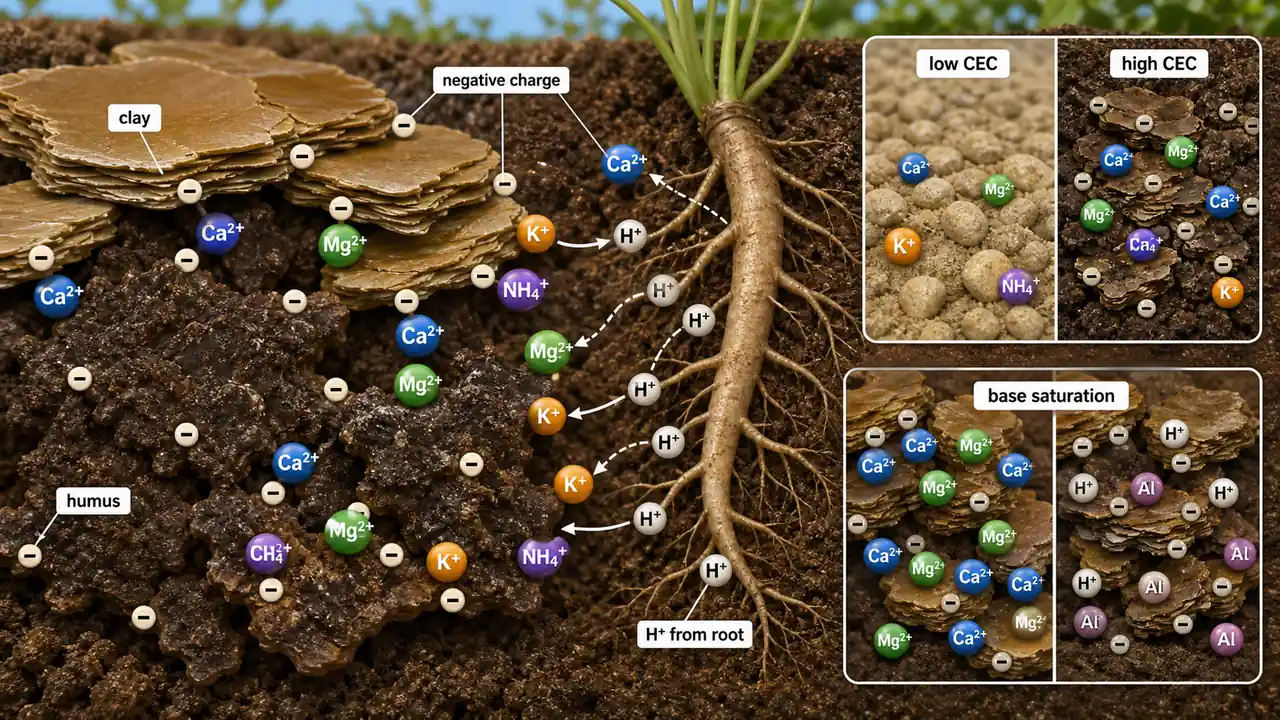
| Banking Analogy | Soil Process |
|---|---|
| Deposits | Nutrients added via fertilizers, lime, manures, crop residues |
| Storage | Nutrients held on colloid surfaces -- protected from leaching |
| Withdrawals | Plant roots extract nutrients from colloid surfaces |
Charge Distribution in Different Soils
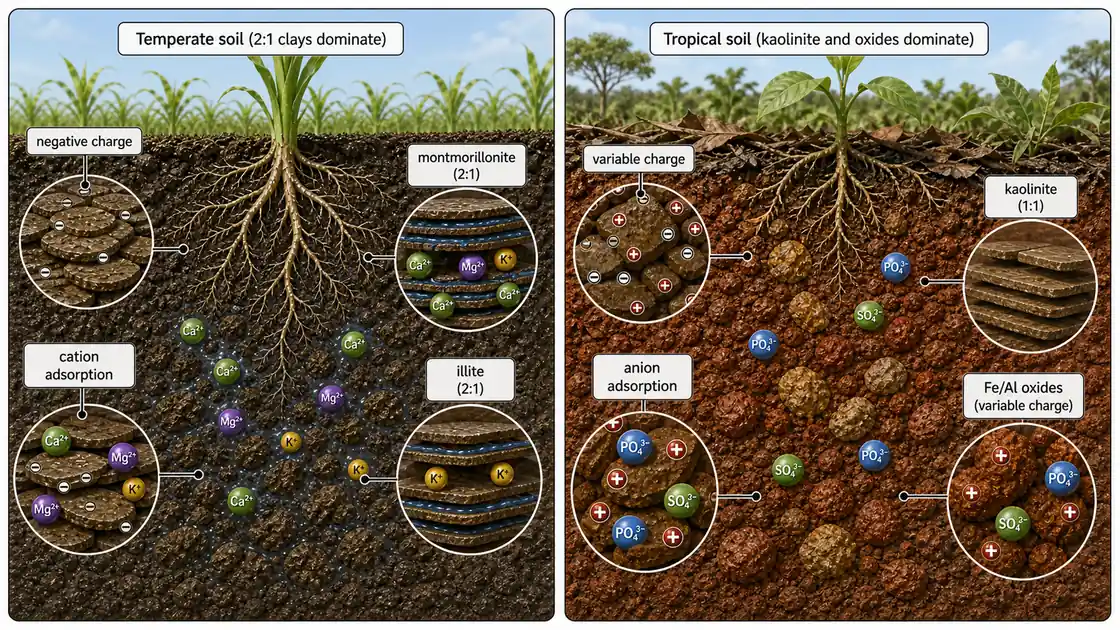
| Region | Dominant Colloids | Dominant Charge | Result |
|---|---|---|---|
| Temperate soils | 2:1 clays (montmorillonite, illite) | Negative charge dominant | Cation adsorption predominates |
| Tropical soils | 1:1 clays (kaolinite), Fe/Al oxides | Significant positive charge | Anion adsorption relatively more important |
Ion Exchange Reactions
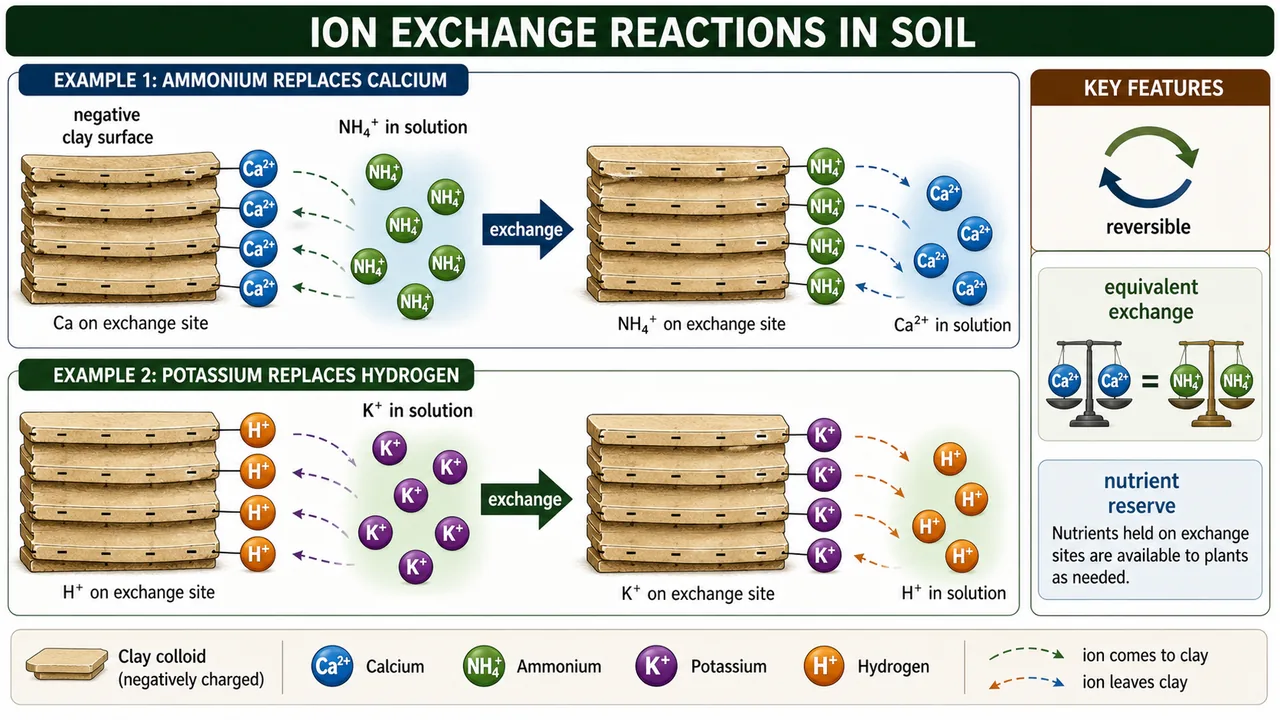
The ion exchange phenomenon was first identified by Harry Stephen Thompson in England during 1850. When soil was leached with ammonium sulphate, calcium sulphate appeared in the leachate -- NH₄⁺ had replaced Ca²⁺ on the soil colloid. This landmark discovery revealed how soil manages its nutrient supply.
Pro Content Locked
Upgrade to Pro to access this lesson and all other premium content.
Charged once for one year · ₹1188 total
Save ₹100/month vs ₹2388/year launch price
- All Agriculture & Banking Courses
- AI Lesson Questions (100/day)
- AI Doubt Solver (50/day)
- Glows & Grows Feedback (30/day)
- AI Section Quiz (20/day)
- 22-Language Translation (100/day)
- Recall Questions (20/day)
- AI Quiz (15/day)
- AI Quiz Paper Analysis (100/day)
- AI Step-by-Step Explanations (100/day)
- Spaced Repetition Recall (FSRS)
- AI Tutor
- Immersive Text Questions
- Audio Lessons — Hindi & English
- Mock Tests & Previous Year Papers
- Summary & Mind Maps
- XP, Levels, Leaderboard & Badges
- Generate New Classrooms
- Voice AI Teacher (AgriDots Live)
- AI Revision Assistant
- Knowledge Gap Analysis
- Interactive Revision (LangGraph)
🔒 Secure one-time yearly payment via Razorpay · No hidden fees
A farmer in Haryana applies urea to his sandy loam soil, but within days most of the nitrogen has leached away with irrigation water. His neighbour on clayey soil retains much more fertilizer nitrogen. Why? Because the clayey soil has a higher Cation Exchange Capacity (CEC) -- it can hold more nutrient ions on its colloid surfaces, acting like a nutrient bank that stores deposits and allows withdrawals by plant roots.
Ion Adsorption -- The Soil Nutrient Bank
| Banking Analogy | Soil Process |
|---|---|
| Deposits | Nutrients added via fertilizers, lime, manures, crop residues |
| Storage | Nutrients held on colloid surfaces -- protected from leaching |
| Withdrawals | Plant roots extract nutrients from colloid surfaces |
Charge Distribution in Different Soils
| Region | Dominant Colloids | Dominant Charge | Result |
|---|---|---|---|
| Temperate soils | 2:1 clays (montmorillonite, illite) | Negative charge dominant | Cation adsorption predominates |
| Tropical soils | 1:1 clays (kaolinite), Fe/Al oxides | Significant positive charge | Anion adsorption relatively more important |
Ion Exchange Reactions
The ion exchange phenomenon was first identified by Harry Stephen Thompson in England during 1850. When soil was leached with ammonium sulphate, calcium sulphate appeared in the leachate -- NH₄⁺ had replaced Ca²⁺ on the soil colloid. This landmark discovery revealed how soil manages its nutrient supply.

Key Characteristics of Ion Exchange
| Feature | Detail |
|---|---|
| Definition | Exchange of ions between solid and liquid phases |
| Nature | Reversible and stoichiometric (equivalent proportions) |
| Discovery | Thomasway (1850) |
| Importance | Second most important reaction in nature (after photosynthesis) |
| Common exchangeable cations | Ca²⁺, Mg²⁺, H⁺, K⁺, NH₄⁺, Na⁺ |
| Common exchangeable anions | SO₄²⁻, Cl⁻, PO₄³⁻, NO₃⁻ |
Ion exchange is driven by residual positive and negative charges on soil colloids, arising from isomorphous substitution and ionization of functional groups.
Cation Exchange Capacity (CEC)
The sum total of exchangeable cations that a soil can adsorb, defined at pH 7.0.
| Unit | Expression |
|---|---|
| Modern | cmol(P⁺)/kg (centimol of positive charge per kg) |
| Old | meq/100 g soil (milliequivalent per 100 g) |
CEC is one of the single most important chemical properties of a soil -- it determines the ability to retain and supply nutrients to plants.
CEC of Different Textural Classes
| Textural Class | CEC (cmol(P⁺)/kg) |
|---|---|
| Sand | 0.5 |
| Sandy loam | 5-10 |
| Loam | 10-15 |
| Clay loam | 15-30 |
| Clay | 30 |
| Humus | 200-400 (Highest) |

Farm example: Sandy soils of Rajasthan (CEC ~0.5) cannot hold fertilizer nutrients, requiring frequent split applications. Clay soils of the Gangetic plain (CEC ~30) can safely receive larger single doses.
CEC of Important Clay Minerals
| Clay Mineral | CEC (cmol(P⁺)/kg) |
|---|---|
| Kaolinite | 7-10 |
| Illite | 25-30 |
| Chlorite | 25-30 |
| Montmorillonite | 80-100 |
| Vermiculite | 100-150 (Highest among clay minerals) |

Factors Influencing CEC
| Factor | Effect | Explanation |
|---|---|---|
| Soil texture | Finer texture = higher CEC | More clay = more surface area = more charge |
| Organic matter | More OM = higher CEC | Humus CEC: 150-300 cmol/kg -- much higher than clay |
| Nature of clay | 2:1 clays > 1:1 clays | Montmorillonite/Vermiculite >> Kaolinite |
| Soil pH | Higher pH = higher CEC | pH-dependent charges increase with pH; most humus CEC is pH-dependent |
Mechanism of Cation Exchange
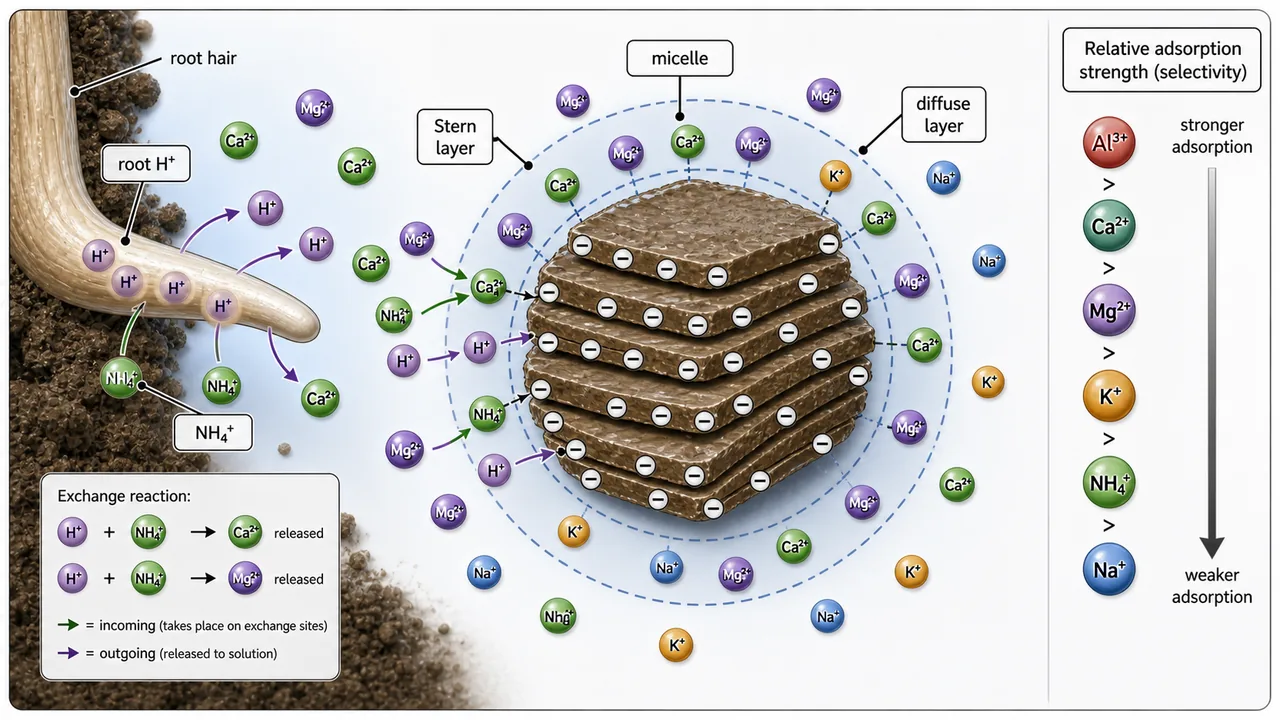
| Cation Exchange Mechanism Image Item | Full Content |
|---|---|
| Negatively charged colloid or micelle | Clay and humus surfaces carry negative charge and attract positively charged nutrient ions |
| Root hydrogen exchange | Roots release H⁺ into the soil solution, which helps displace nutrient cations from exchange sites |
| Reversible cation swap | Adsorbed cations such as Ca²⁺, K⁺, or NH₄⁺ can be replaced by other cations in equivalent proportions |
| Stern layer | The firmly hydrated cations nearest the colloid surface form the Stern layer |
| Gouy or diffuse layer | More loosely held cations spread outward in the diffuse layer, especially around clay surfaces |
| Selectivity order | Higher-valence cations are generally held more strongly than lower-valence cations on colloid surfaces |
| Main lesson | Cation exchange lets soil store nutrient ions, release them to roots, and buffer fertilizer losses against leaching |
Clay colloids carry negative charges. Cations are attracted to clay surfaces electrostatically and held by small particles called Micelle (Micro cell).
Cations attracted to the micelle form an ionic double layer (also called Helmholtz double layer):
- Inner layer: Negatively charged colloid surface
- Outer layer: Diffuse swarm of loosely held (adsorbed) cations

| Layer | Name | Description |
|---|---|---|
| Water shell around adsorbed cations | Stern layer | Definitely hydrated cations |
| Water + cations packed between clay plates | Gouy layer | Internal surface area of 2:1 clays |
Exchangeable vs Non-Exchangeable Cations
| Type | Held by | Availability | Example |
|---|---|---|---|
| Exchangeable | Weakly held on surface | Easily replaced; available to plants | Ca²⁺ on montmorillonite |
| Non-exchangeable | Trapped between clay layers | Not easily released; slow reserve | K⁺ trapped between illite layers |
When fertilizers (Ca²⁺, K⁺, NH₄⁺) are added, they exchange with ions already on the colloid:
Cation Selectivity (Strength of Adsorption)
The order in which cations are held on colloid surfaces (strongest first):
Al³⁺ > Ca²⁺ > Mg²⁺ > K⁺ = NH₄⁺ > Na⁺
Trivalent cations (Al³⁺) are held most tightly; monovalent cations (Na⁺) are held least tightly and are most easily replaced.
Replacing Power of Cations
Replacing power depends on valence, atomic weight, degree of hydration, and concentration.
| Monovalent order | Li < Na < K < Rb < Cs < H |
|---|---|
| Divalent order | Mg < Ca < Sr < Ba |
| Mixed order (as in normal soils) | Na < K < NH₄ < Mg < Ca < H |
Overall replacing power:
H > Ca > Mg > NH₄ > K > Na
Strength of adsorption / ability to flocculate (decreasing order):
Al³⁺ > H⁺ > Ca²⁺ > Mg²⁺ > K⁺ > Na⁺
Hydrogen is an exception -- it is adsorbed more strongly than other monovalent or divalent ions despite being monovalent.
Farm example: This explains why calcium (from gypsum) effectively displaces sodium from sodic soils during reclamation -- Ca²⁺ has much higher replacing power than Na⁺.
Base Saturation
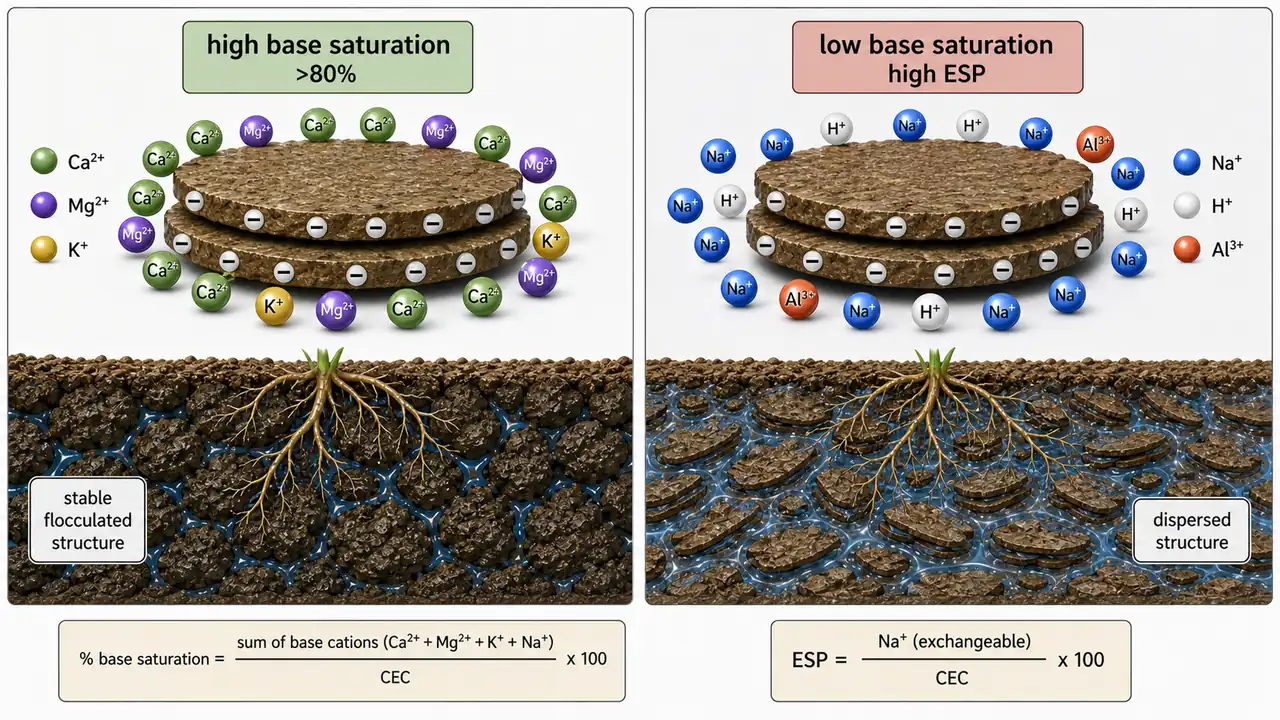
The percentage of CEC occupied by base-forming cations (Ca²⁺, Mg²⁺, K⁺, Na⁺).
% Base Saturation = (Exchangeable Base-Forming Cations / CEC) x 100

| Ion Type | Examples | Classification |
|---|---|---|
| Acid-forming ions (Acidoids) | Al³⁺, H⁺ | Lower base saturation |
| Base-forming ions (Besoids) | Ca²⁺, Mg²⁺, K⁺, Na⁺ | Higher base saturation |
Practical Significance
| Fact | Detail |
|---|---|
| Fertile soil | Base saturation >80% |
| Each 1 unit decrease in pH | 15% decrease in base saturation |
| ESP (Exchangeable Sodium Percentage) | (Na/CEC) x 100 -- used for sodic soil diagnosis |
| Higher base saturation of a specific cation | That cation is more easily released for plant nutrition |
| Helps determine | Quantity of lime needed for acid soil correction |
Anion Exchange
Replacement of one anion by another on positively charged colloids (hydroxyl groups of Fe/Al oxides, 1:1 clays, allophane).
| Feature | Detail |
|---|---|
| pH dependence | Lower pH = greater anion exchange |
| Highest AEC | Soils with kaolinite-dominant clay |
Relative order of anion exchange:
OH⁻ > H₂PO₄⁻ > SO₄²⁻ > NO₃⁻ > Cl⁻
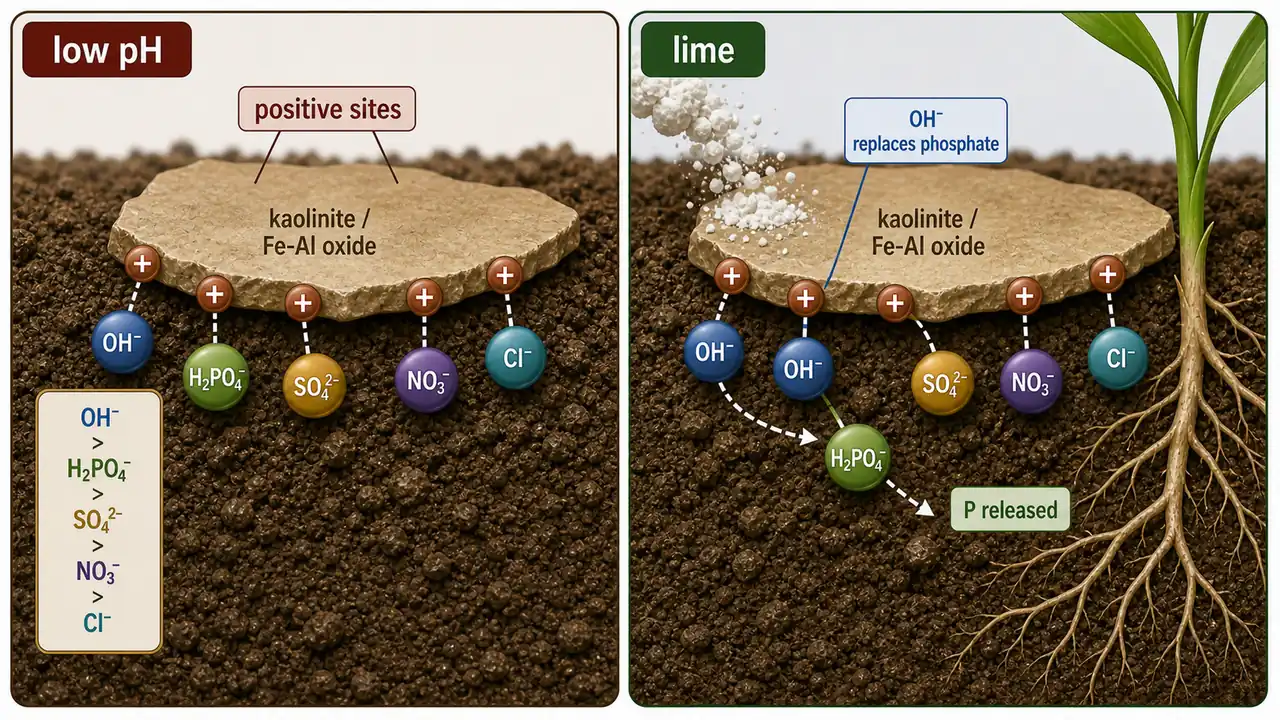
| Condition or rule | Key ion behavior | Full takeaway |
|---|---|---|
| Low-pH anion exchange | Positive sites adsorb anions | In acid soils, kaolinite and Fe/Al oxides can hold anions on positively charged surfaces |
| Anion preference order | OH⁻ > H₂PO₄⁻ > SO₄²⁻ > NO₃⁻ > Cl⁻ | OH⁻ is held most strongly, while chloride is held least strongly |
| Liming effect | OH⁻ replaces fixed phosphate | Lime can release H₂PO₄⁻ from aluminum or iron surfaces, improving phosphorus availability near roots |
Importance of Anion Exchange
Liming acid soils releases fixed phosphorus. OH⁻ ions from lime replace H₂PO₄⁻ from insoluble Al-phosphate, making phosphorus available to plants.


Farm example: When a farmer in Assam limes his acidic tea garden soil, phosphorus availability improves because OH⁻ displaces fixed phosphate from aluminum complexes.
Significance of Ion Exchange in Agriculture
| Significance | Explanation |
|---|---|
| Second most important reaction | After photosynthesis |
| Plant nutrition | Roots exchange H⁺ for nutrient cations on nearby clay/humus (contact exchange) |
| Fertilizer management | High CEC soils can hold larger fertilizer doses; low CEC soils need split applications |
| Toxic metals | Cd, Ni, Pb adsorbed on exchange complex are toxic to crops |
| Soil pH | H⁺-dominated clay = acidic; Na⁺-dominated clay = alkaline |
Effect on Soil Fertility
| Fact | Value |
|---|---|
| Each % of humus contributes | ~2 cmol/kg of CEC |
| Each % of montmorillonite contributes | ~1 cmol/kg of CEC |
| Each % of kaolinite contributes | ~0.08 cmol/kg of CEC |
| Fertile soil base saturation | >80% |
Farm example: In sandy soils, fertilizers should be applied in splits because low CEC means nutrients are easily leached. In clay soils, larger single doses are safe.
Redox (Reduction-Oxidation) Potential
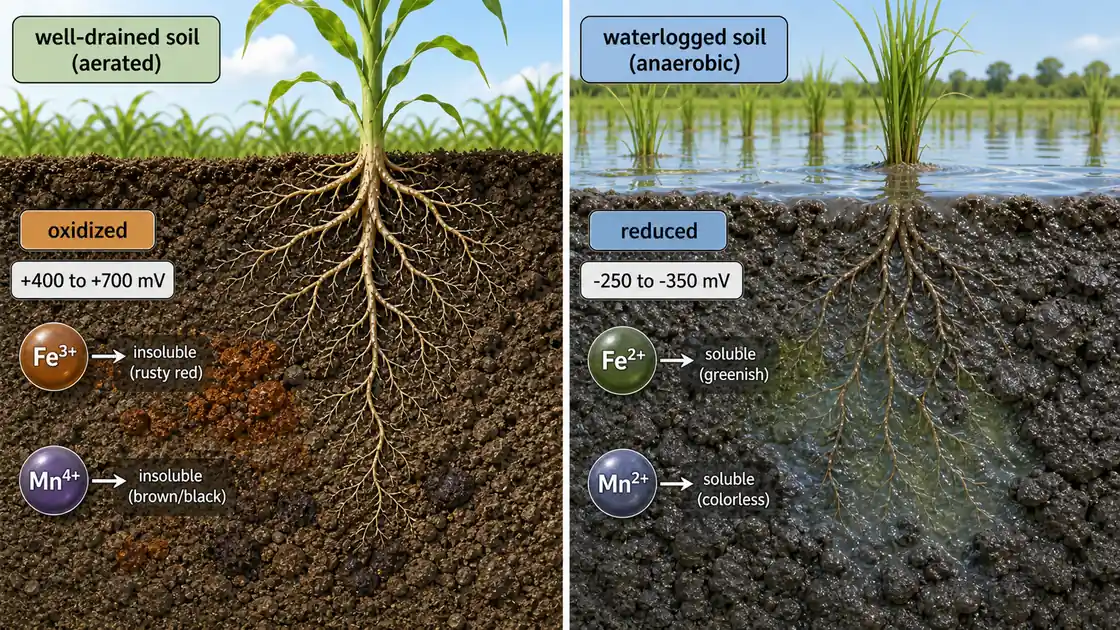
| Soil Condition | Redox Potential (Eh) | Element Forms |
|---|---|---|
| Well-drained (oxidized) | +400 to +700 mV | Fe³⁺, Mn⁴⁺ (insoluble, less available) |
| Waterlogged (reduced) | -250 to -350 mV | Fe²⁺, Mn²⁺ (soluble, can be toxic at high levels) |
Farm example: In waterlogged paddy fields, iron is reduced to Fe²⁺ (soluble), which can cause iron toxicity (bronzing of leaves) if concentrations are too high.
Soil pH
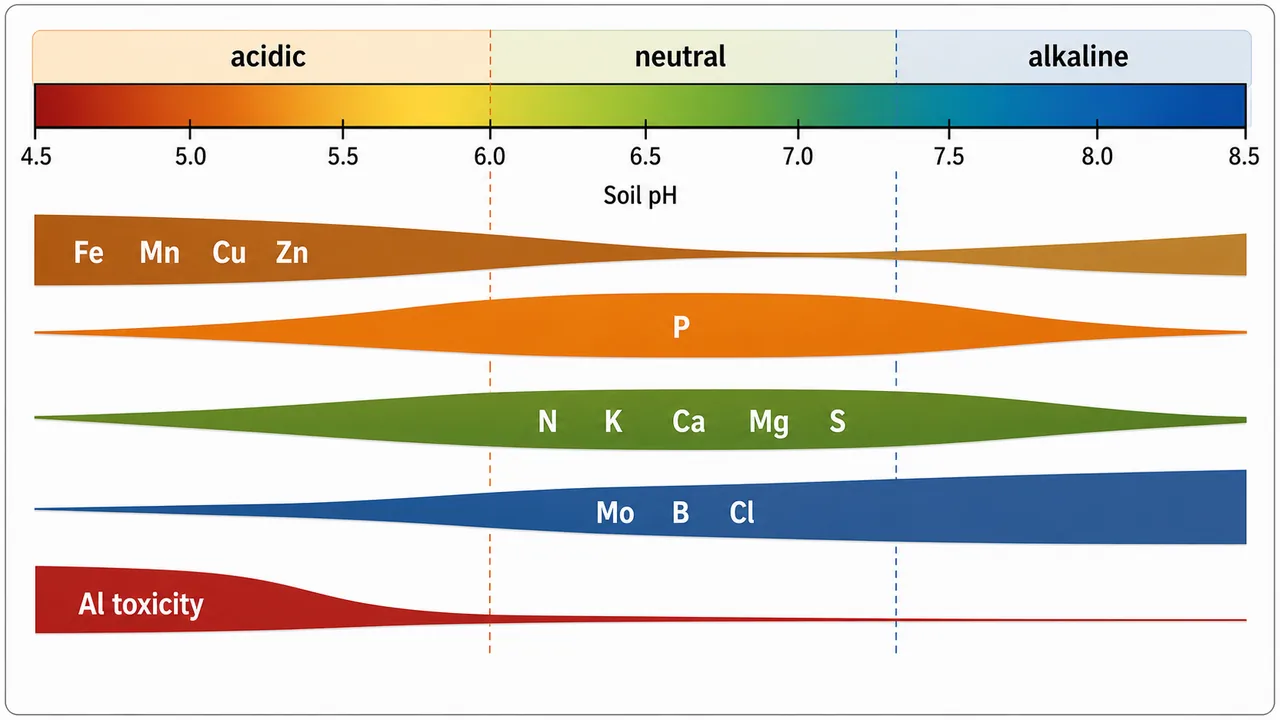
Soil pH measures acidity or alkalinity. pH is the negative logarithm of hydrogen ion concentration.
| pH Value | Classification |
|---|---|
| Below 7.0 | Acidic |
| 7.0 | Neutral |
| Above 7.0 | Alkaline (Basic) |
The pH scale is logarithmic -- each unit change represents a 10-fold change in H⁺ concentration.
Example: A soil at pH 5 is 10 times more acidic than pH 6, and 100 times more acidic than pH 7.
Buffering Capacity
The soil's ability to resist pH change. Highest buffering capacity is between pH 4.5 and 6.0. Soils with high clay and organic matter have greater buffering capacity.
Nutrient Availability and pH
pH determines which nutrients are available and which are locked up. This is one of the most important concepts for exam preparation.
Nutrient Availability vs pH
| Nutrient(s) | pH Effect |
|---|---|
| N, P, K, Ca, Mg, S | Availability decreases below pH 6.0 and above pH 8.0 |
| Fe, Mn, Cu, Zn | Most available in acid range; availability decreases as pH approaches 7.0 |
| Al | Only slightly available between pH 5.5 and 8.0; toxic at very low pH |
| Mo, B, Cl | Availability increases at high pH (alkaline soils) |
| Phosphorus | Maximum availability at pH 6.0-7.5 |
Why P is maximum at pH 6.0-7.5: At low pH, P is precipitated as iron and aluminum phosphates. At high pH, P is precipitated as calcium phosphate. Only in the narrow window of 6.0-7.5 is P most soluble.
Crop pH Preferences
| Crop | Preferred pH | Agricultural Context |
|---|---|---|
| Tea, Blueberries | 4.5-5.5 (acidic) | Acidic hill soils of Assam, Darjeeling |
| Rice | 5.5-6.5 | Slightly acidic paddy soils |
| Grasses | 5.8-6.5 | Pasture lands |
| Wheat, Maize | 6.0-7.0 | Neutral alluvial soils |
| Legumes (chickpea, lentil) | 6.2-7.0 | Prefer slightly higher pH |
| Alfalfa, Sugarcane | 7.0-7.5 (slightly alkaline) | Calcareous soils |
IMPORTANT
Cu, Mn, Zn, Fe are most available in acid range. Mo, B, Cl availability increases at high pH (alkaline). Phosphorus has maximum availability at pH 6.0-7.5.
| Nutrient | Optimum pH range |
|---|---|
| N | 6 to 8 |
| P | 6.0 to 7.5 |
| K | 6 to 7.5 |
| S | 6 and above |
| Ca and Mg | 7 to 8.5 |
| Mo | 7 and above |
| Fe | 6 and below |
| Mn | 5 to 6.5 |
| B, Cu, Zn | 5 to 7 |
Farm example: Micronutrient deficiencies (Zn, Fe, Mn) are common in calcareous sodic soils of western UP because high pH precipitates these metals. Farmers must apply chelated micronutrient sprays.
Exam Tips and Mnemonics
- Ion exchange discovery: Thomasway, 1850 -- "Thomson found it in eighteen-fifty"
- Second most important reaction: Ion exchange (first is photosynthesis)
- CEC order (texture): Sand (0.5) < Sandy loam (5-10) < Loam (10-15) < Clay loam (15-30) < Clay (30) < Humus (200-400)
- CEC order (clay minerals): Kaolinite (7-10) < Illite (25-30) < Chlorite (25-30) < Montmorillonite (80-100) < Vermiculite (100-150)
- Cation selectivity: "ACM KN" -- Al > Ca > Mg > K = NH₄ > Na
- Replacing power: "H Ca Mg A K Na" -- H > Ca > Mg > NH₄ > K > Na
- Anion exchange order: "OH P S N Cl" -- OH > PO₄ > SO₄ > NO₃ > Cl
- Base saturation for fertile soil: >80%
- Each pH unit drop: 15% decrease in base saturation
- Micronutrients in acid range: "Fe Mn Cu Zn" -- available at low pH
- Mo B Cl: Available at HIGH pH
- P availability sweet spot: pH 6.0-7.5
- Redox: Well-drained = +400 to +700 mV; Waterlogged = -250 to -350 mV
Summary Cheat Sheet
| Concept / Topic | Key Details |
|---|---|
| Ion exchange discovery | Thomasway (1850); 2nd most important reaction in nature (after photosynthesis) |
| Ion exchange nature | Reversible and stoichiometric |
| CEC definition | Sum total of exchangeable cations a soil can adsorb at pH 7.0 |
| CEC unit (modern) | cmol(P⁺)/kg |
| CEC — Humus | 200–400 (highest among all soil materials) |
| CEC — Vermiculite | 100–150 (highest among clay minerals) |
| CEC — Montmorillonite | 80–100 |
| CEC — Illite / Chlorite | 25–30 |
| CEC — Kaolinite | 7–10 (lowest) |
| CEC — Sand | 0.5 |
| Factors raising CEC | Finer texture, more OM, 2:1 clays, higher pH |
| Helmholtz double layer | Inner (negative colloid) + Outer (diffuse cation swarm) |
| Stern layer | Hydrated cations around adsorbed ions |
| Gouy layer | Cations packed between 2:1 clay plates |
| Cation selectivity order | Al³⁺ > Ca²⁺ > Mg²⁺ > K⁺ = NH₄⁺ > Na⁺ |
| Replacing power order | H > Ca > Mg > NH₄ > K > Na |
| Anion exchange order | OH⁻ > H₂PO₄⁻ > SO₄²⁻ > NO₃⁻ > Cl⁻ |
| Highest AEC soils | Kaolinite-dominant clays; lower pH = greater AEC |
| Base saturation for fertile soil | >80% |
| Each 1 pH unit drop | 15% decrease in base saturation |
| ESP formula | (Na / CEC) × 100 — used for sodic soil diagnosis |
| Redox — well-drained | +400 to +700 mV (Fe³⁺, Mn⁴⁺ — insoluble) |
| Redox — waterlogged | −250 to −350 mV (Fe²⁺, Mn²⁺ — soluble, possibly toxic) |
| pH scale | Logarithmic — each unit = 10-fold change in H⁺ |
| Buffering capacity highest | pH 4.5–6.0 |
| P availability maximum | pH 6.0–7.5 |
| Fe, Mn, Cu, Zn availability | Most available in acid range |
| Mo, B, Cl availability | Increases at high pH (alkaline) |
| Liming releases fixed P | OH⁻ displaces H₂PO₄⁻ from Al-phosphate complexes |
| Importance of ion exchange | 2nd most important reaction (after photosynthesis) |
| Micronutrients (Fe, Mn, Cu, Zn) | Most available in acid range |