🐾 Soil Structure: Aggregates, Types & Agricultural Importance
Formation of soil aggregates, four structural types (platy, prismatic, blocky, spheroidal), classification by type-class-grade, and the role of structure in crop production
A farmer ploughs his field after adding farmyard manure and notices the soil breaks into small, rounded crumbs that feel soft and porous. His neighbour, who uses only chemical fertilizers and heavy machinery, finds his soil compacted into hard, flat blocks. Both fields have the same texture (clay loam), yet they behave very differently. The difference is soil structure -- the way primary particles arrange into aggregates. Unlike texture, structure can be improved through good management.
What is Soil Structure?
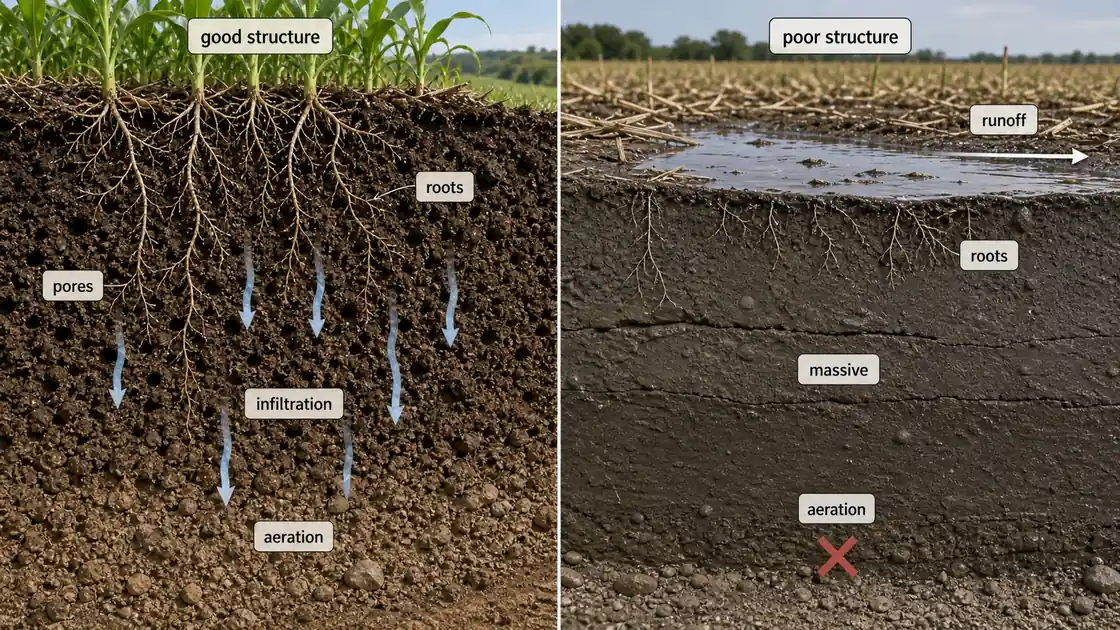
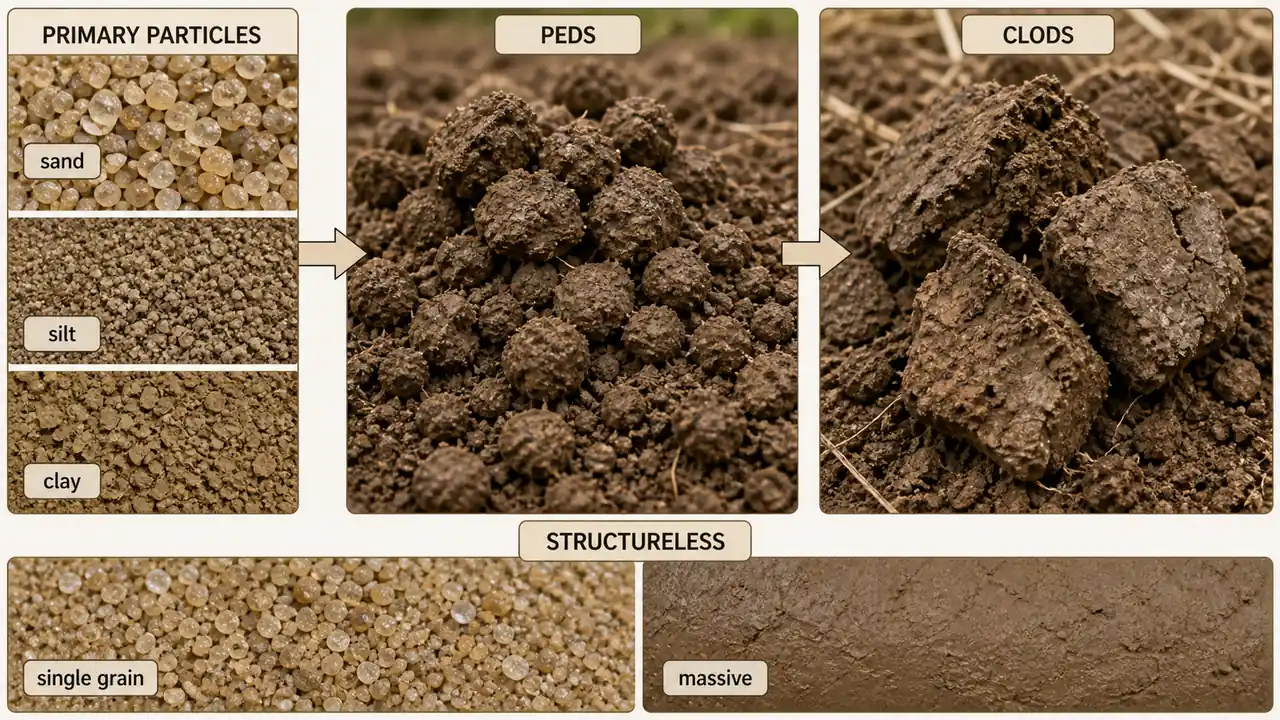
- Individual aggregates are called peds or secondary units
- Soils without natural aggregate boundaries are called structureless
- Structure can be changed by ploughing, cultivating, drainage, liming and manuring
- While texture is permanent, structure is manageable -- this is the farmer's key lever
Key Structural Terms
| Term | Definition | Agricultural Example |
|---|---|---|
| Peds | Naturally formed soil structural units | Crumbs in well-managed topsoil |
| Clods | Artificial aggregates; coherent mass broken into any shape | Chunks created by ploughing wet clay |
| Fragments | A broken ped | Pieces of a crushed soil aggregate |
| Concretions | Coherent mass formed by chemical precipitation | Kankar (CaCO3) nodules in subsoil |
| Aggregates | Group of particles bound together | Any cluster of sand, silt, clay held by OM or clay |
IMPORTANT
Pro Content Locked
Upgrade to Pro to access this lesson and all other premium content.
Charged once for one year · ₹1188 total
Save ₹100/month vs ₹2388/year launch price
- All Agriculture & Banking Courses
- AI Lesson Questions (100/day)
- AI Doubt Solver (50/day)
- Glows & Grows Feedback (30/day)
- AI Section Quiz (20/day)
- 22-Language Translation (100/day)
- Recall Questions (20/day)
- AI Quiz (15/day)
- AI Quiz Paper Analysis (100/day)
- AI Step-by-Step Explanations (100/day)
- Spaced Repetition Recall (FSRS)
- AI Tutor
- Immersive Text Questions
- Audio Lessons — Hindi & English
- Mock Tests & Previous Year Papers
- Summary & Mind Maps
- XP, Levels, Leaderboard & Badges
- Generate New Classrooms
- Voice AI Teacher (AgriDots Live)
- AI Revision Assistant
- Knowledge Gap Analysis
- Interactive Revision (LangGraph)
🔒 Secure one-time yearly payment via Razorpay · No hidden fees
A farmer ploughs his field after adding farmyard manure and notices the soil breaks into small, rounded crumbs that feel soft and porous. His neighbour, who uses only chemical fertilizers and heavy machinery, finds his soil compacted into hard, flat blocks. Both fields have the same texture (clay loam), yet they behave very differently. The difference is soil structure -- the way primary particles arrange into aggregates. Unlike texture, structure can be improved through good management.
What is Soil Structure?
- Individual aggregates are called peds or secondary units
- Soils without natural aggregate boundaries are called structureless
- Structure can be changed by ploughing, cultivating, drainage, liming and manuring
- While texture is permanent, structure is manageable -- this is the farmer's key lever
Key Structural Terms
| Term | Definition | Agricultural Example |
|---|---|---|
| Peds | Naturally formed soil structural units | Crumbs in well-managed topsoil |
| Clods | Artificial aggregates; coherent mass broken into any shape | Chunks created by ploughing wet clay |
| Fragments | A broken ped | Pieces of a crushed soil aggregate |
| Concretions | Coherent mass formed by chemical precipitation | Kankar (CaCO3) nodules in subsoil |
| Aggregates | Group of particles bound together | Any cluster of sand, silt, clay held by OM or clay |
IMPORTANT
These terms are frequently asked in ARS Mains and competitive exams. Remember: Peds = natural; Clods = artificial.
Structureless Conditions
| Type | Description | Agricultural Impact |
|---|---|---|
| Single grain | Each particle acts independently; unattached | Sandy soils; beach sand; maximum air and water movement but no water retention |
| Massive | Particles stick together without planes of weakness | Puddled clay (good for paddy); restricts root penetration and aeration for other crops |
How Structure Forms
Role of Colloidal Clay
- Clay particles have high surface area and surface charge -- key role in aggregate formation
- Sand and silt cannot form aggregates on their own (no adhesion/cohesion)
- Clay particles must be flocculated first (coalescence of colloidal particles)
- Flocculation is the first step in aggregation, but aggregation also requires cementation
Cementing Agents
| Agent | Role | Agricultural Significance |
|---|---|---|
| Ca2+, H+ | Promote better aggregation than Mg2+ or K+ | Liming adds Ca, improving structure |
| Fe and Al oxides (Sesquioxides) | Act as cementing agents binding sand and silt | More stable aggregates than clay alone; red soils have good structure |
| Organic matter | Most effective agent for aggregate formation | FYM, compost, green manure improve structure |
| Fungal hyphae | Physically enmesh particles like tiny threads | Mycorrhizae in crop roots stabilize aggregates |
| Bacterial polysaccharides | Sticky substances that glue particles | More stable than plant polysaccharides |
IMPORTANT
The most practical way to improve soil structure is to add organic matter. OM is more effective than clay in forming aggregates.
Four Types of Soil Structure
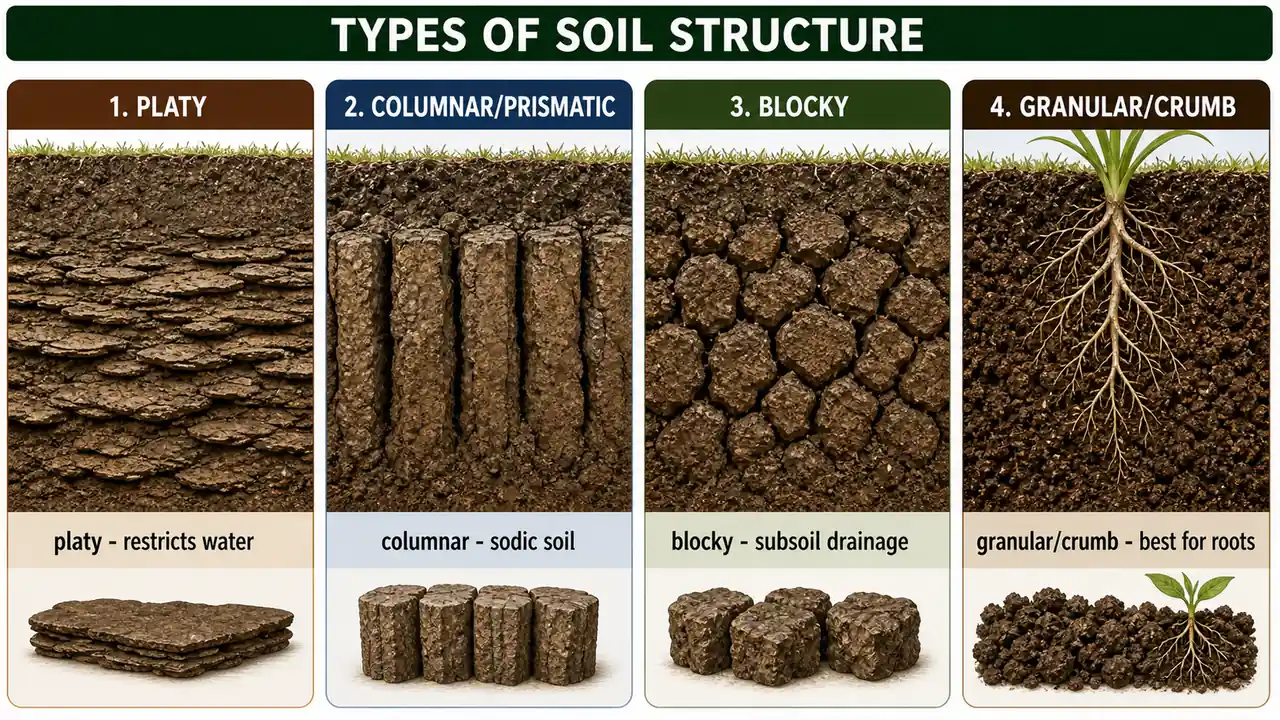
Structure is classified by three categories: Type (shape), Class (size), and Grade (distinctness/durability).
The Four Principal Types
1. Platy (Plate-like)
- Horizontal plates or leaflets; horizontal axis > vertical axis
- Thick plates = platy; thin plates = laminar
- Found in surface layers of virgin soils and sometimes in B horizon
- Impedes vertical water movement and root penetration
- Can result from compaction by heavy machinery

Agricultural impact: Platy structure in a rice-wheat field caused by repeated tractor passes creates a "plough pan" that restricts root growth of wheat.
2. Prism-like (Prismatic and Columnar)
- Vertical axis > horizontal axis; pillar-like shape; 1-10 cm long
- Common in subsoil horizons (B) of arid and semi-arid regions
- Found in high clay soils
| Sub-type | Top Shape | Association |
|---|---|---|
| Prismatic | Flat, level, clear-cut tops | General clay soils |
| Columnar | Rounded tops | Sodic soils (high sodium) |
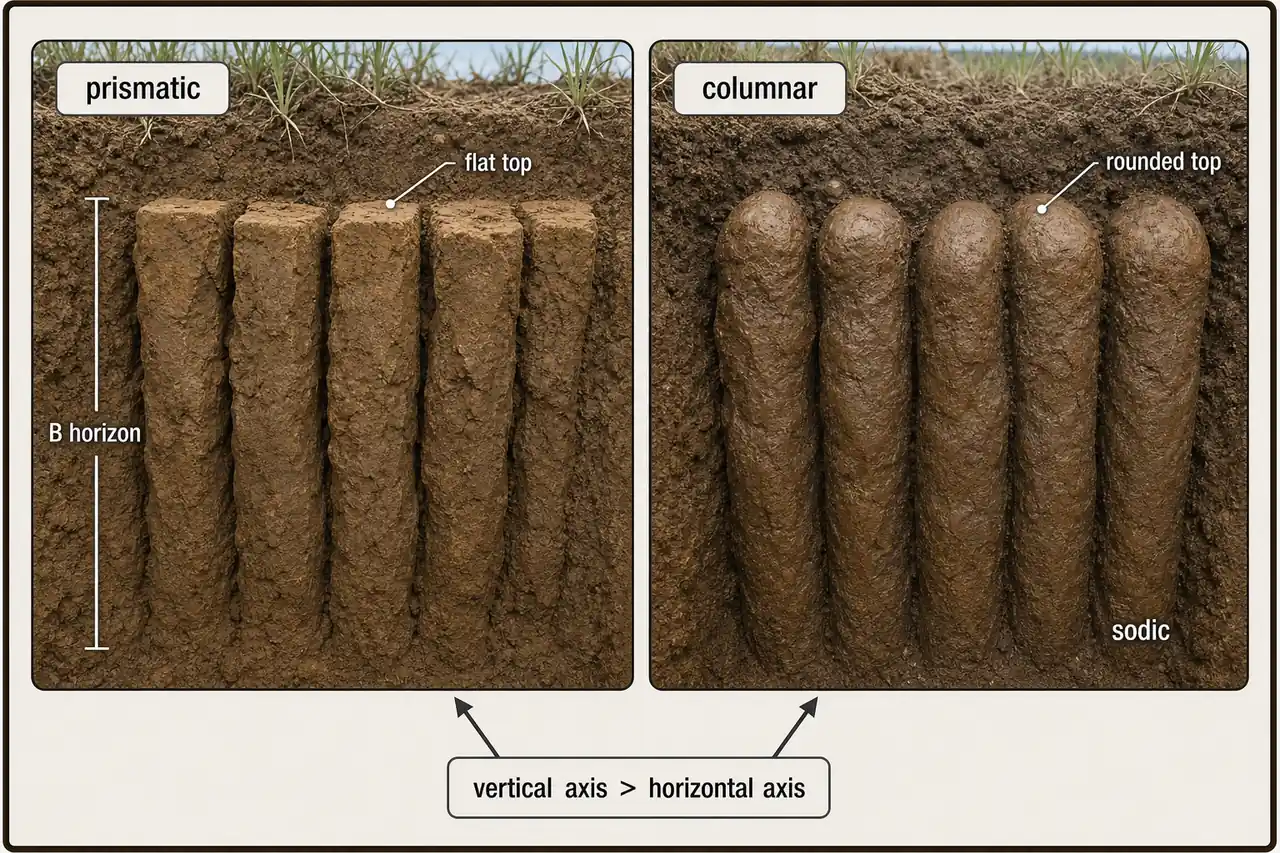
| Prism-like Image Item | Full Content |
|---|---|
| Prismatic | Vertical pillar-like peds with flat tops, common in clayey subsoils |
| Columnar | Vertical pillar-like peds with rounded tops, typically associated with sodic soils |
| B horizon | Prism-like structures are commonly found in subsoil horizons, especially where clay has accumulated |
| Vertical axis > horizontal axis | The defining shape rule for prism-like structure is that the vertical dimension exceeds the horizontal one |
| Sodic clue | Rounded columnar tops are a useful field sign of high sodium and possible need for gypsum-based reclamation |
Agricultural impact: Columnar structure in sodic soils of Haryana indicates high sodium -- requires gypsum application for reclamation.
3. Block-like (Angular and Sub-angular Blocky)
- All three dimensions approximately equal; irregularly six-faced
- Angular blocky: Flat faces, sharp edges
- Sub-angular blocky: Rounded faces and edges
- Common in heavy subsoils of humid regions and upper B horizon
- Provides moderate drainage and aeration

Agricultural impact: Blocky B horizons in laterite soils of Karnataka provide adequate subsoil drainage for coffee plantations.
4. Spheroidal (Granular and Crumb)
- All rounded aggregates; generally < 2 cm diameter
- Found in A horizon (surface soil)
| Sub-type | Porosity | Association |
|---|---|---|
| Granular | Relatively less porous | General surface soils |
| Crumb | Very porous | Soils high in OM; grassland soils |
IMPORTANT
Granular and crumb structures are most favourable for plant growth. They create ideal balance of macro and micro pores for aeration, drainage and water retention. Promoted by organic matter, clay and lime.
Agricultural impact: A farmer who adds compost annually develops crumb structure in the topsoil, giving excellent seedbed for vegetables.
Wedge Structure
- Aggregates resemble wedges -- thinner at one end, thicker at the other
- Found in soils with high expansive clay (montmorillonite)
- Common in Vertisols (black cotton soils)
Structure Types by Horizon
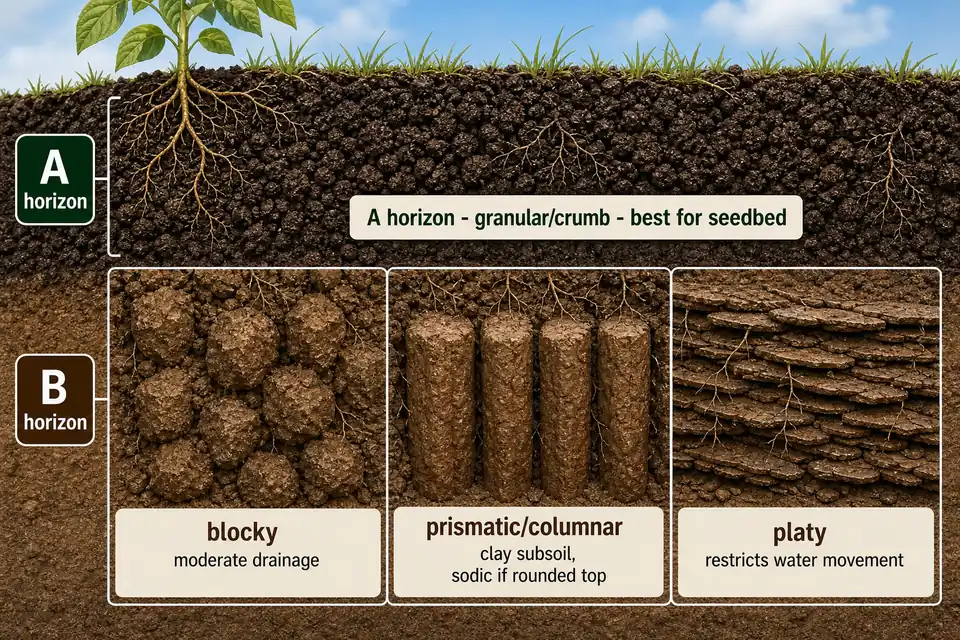
| Structure Type | Typical Horizon | Agricultural Significance |
|---|---|---|
| Granular and Crumb | A-horizon (surface) | Best for seedbed and root growth |
| Platy | A-horizon (virgin soils), B-horizon | Restricts water movement |
| Blocky (Angular/Sub-angular) | B-horizon | Moderate drainage |
| Prismatic and Columnar | B-horizon | Indicates clay accumulation; columnar = sodic |
| Horizon Pattern | Full Content |
|---|---|
| A horizon | Usually granular or crumb structure; best for seedbed, aeration, infiltration, and root growth |
| B horizon - blocky | Common subsoil structure with roughly equal dimensions and moderate drainage |
| B horizon - prismatic/columnar | Vertical clayey subsoil units; columnar form with rounded tops often indicates sodic soil |
| B horizon - platy | Horizontal plates that restrict vertical water movement and root penetration |
- Semi-arid profiles: Granulated A-horizon with prismatic B-horizon
- Humid temperate profiles: Granulated A-horizon with platy or blocky B-horizon
Size Classes of Structure
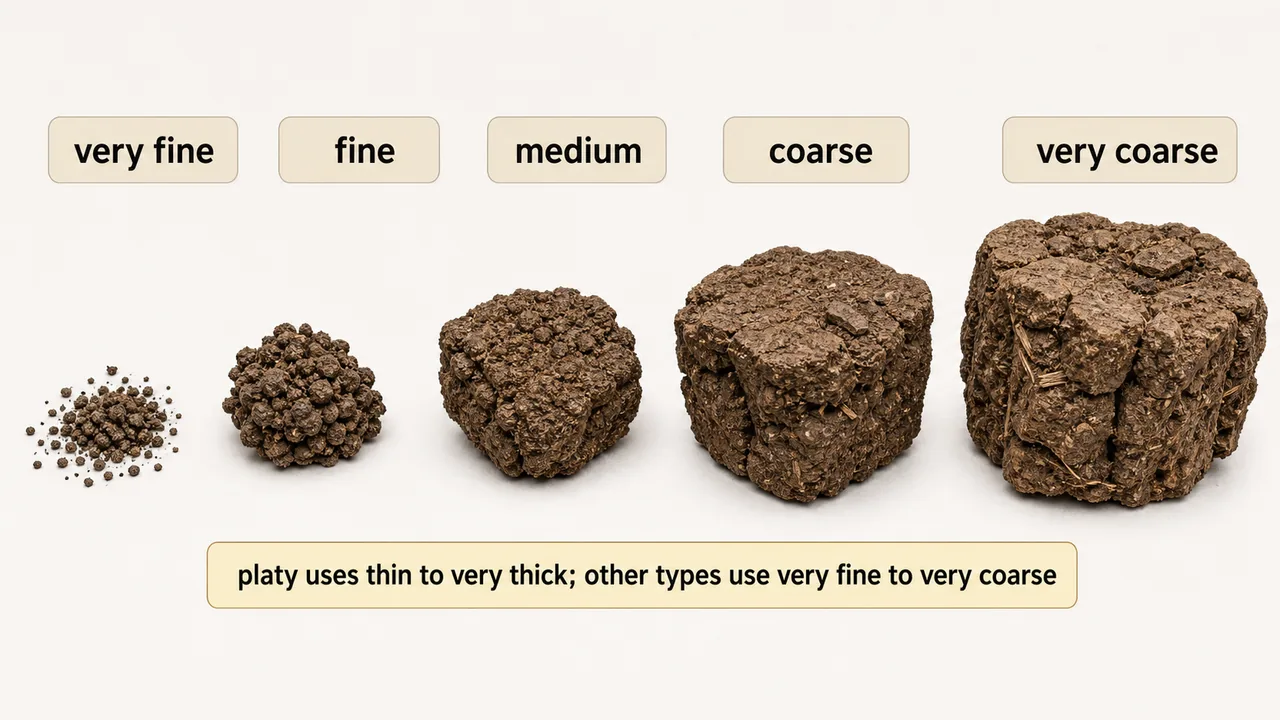
| Class | For Platy Type | For Other Types |
|---|---|---|
| 1 | Very thin | Very fine |
| 2 | Thin | Fine |
| 3 | Medium | Medium |
| 4 | Thick | Coarse |
| 5 | Very thick | Very coarse |
Grades of Structure
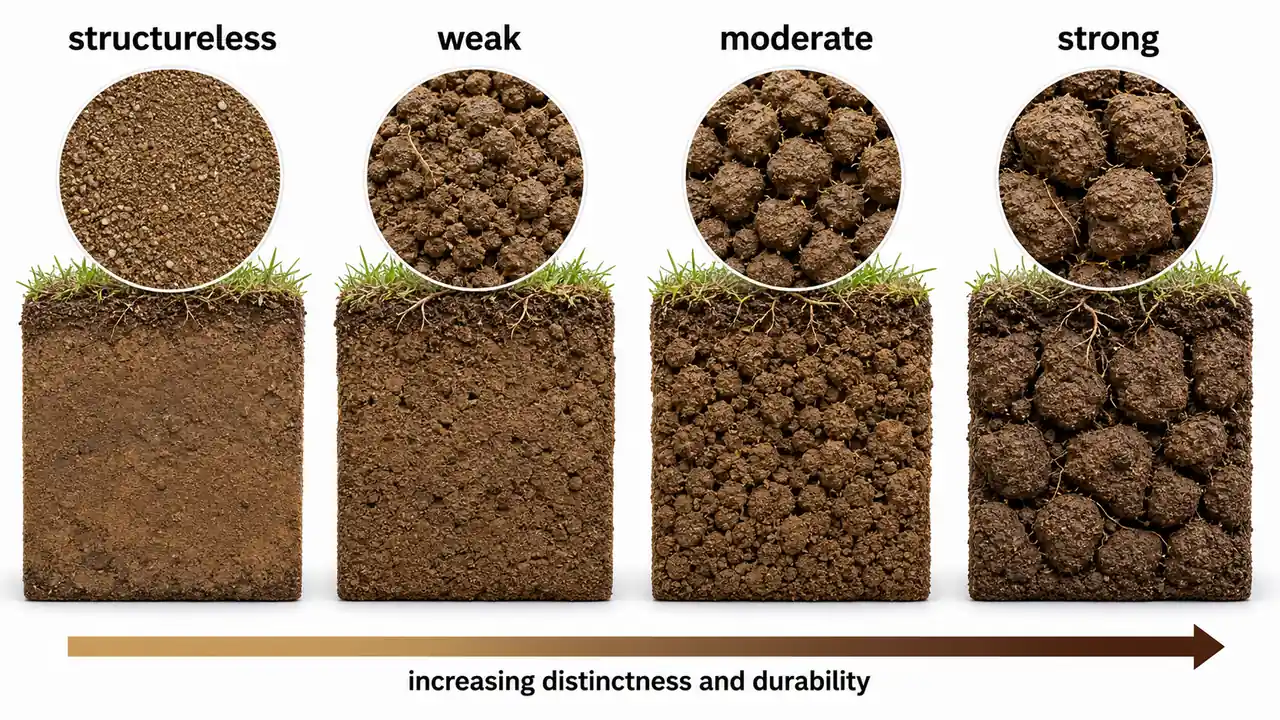
| Grade | Description | Agricultural Implication |
|---|---|---|
| Structureless | No aggregation (single grain or massive) | Sandy soil or puddled clay |
| Weak | Poorly formed, indistinct, not durable | Easily destroyed by tillage |
| Moderate | Moderately well-developed, fairly durable | Good working condition |
| Strong | Very well formed, quite durable and distinct | Stable; resists erosion |
Structure Naming Convention
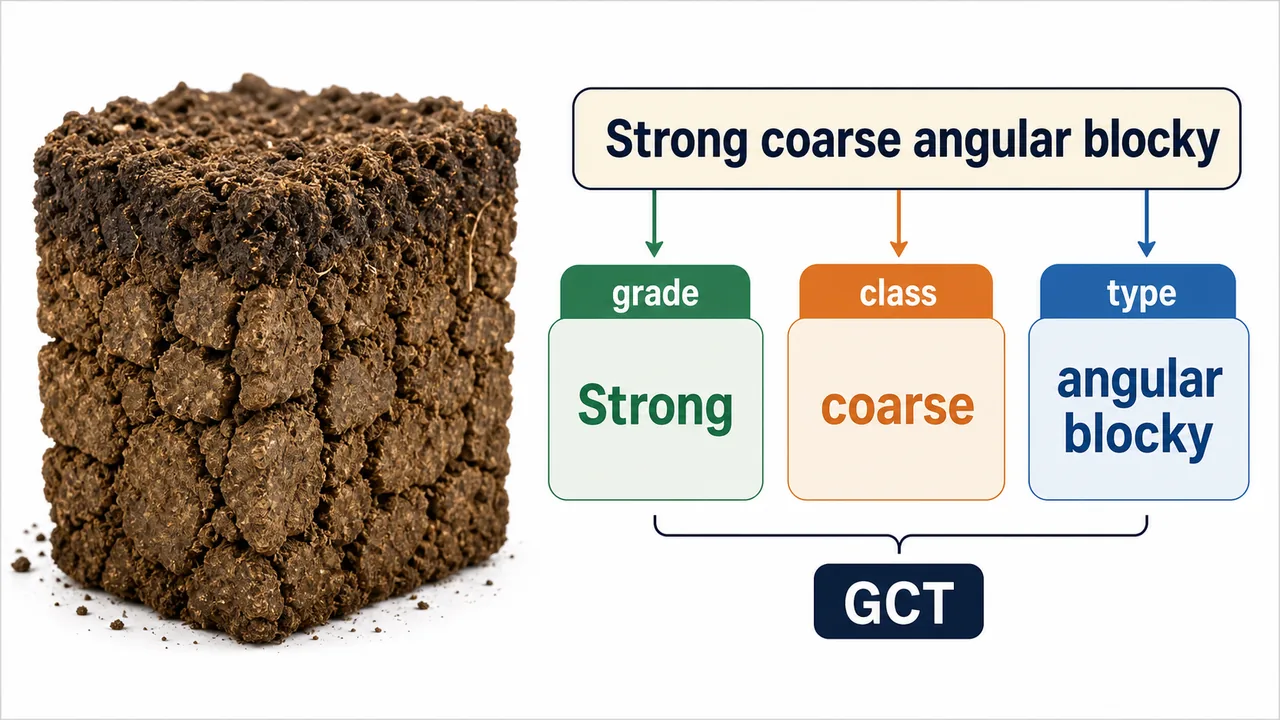
| Example Name | Grade | Class | Type |
|---|---|---|---|
| Strong coarse angular blocky | Strong | Coarse | Angular blocky |
| Moderate thin platy | Moderate | Thin | Platy |
| Weak fine prismatic | Weak | Fine | Prismatic |
TIP
Remember naming order with "GCT" -- Grade first, then Class (size), then Type (shape).
12 Factors Affecting Soil Structure
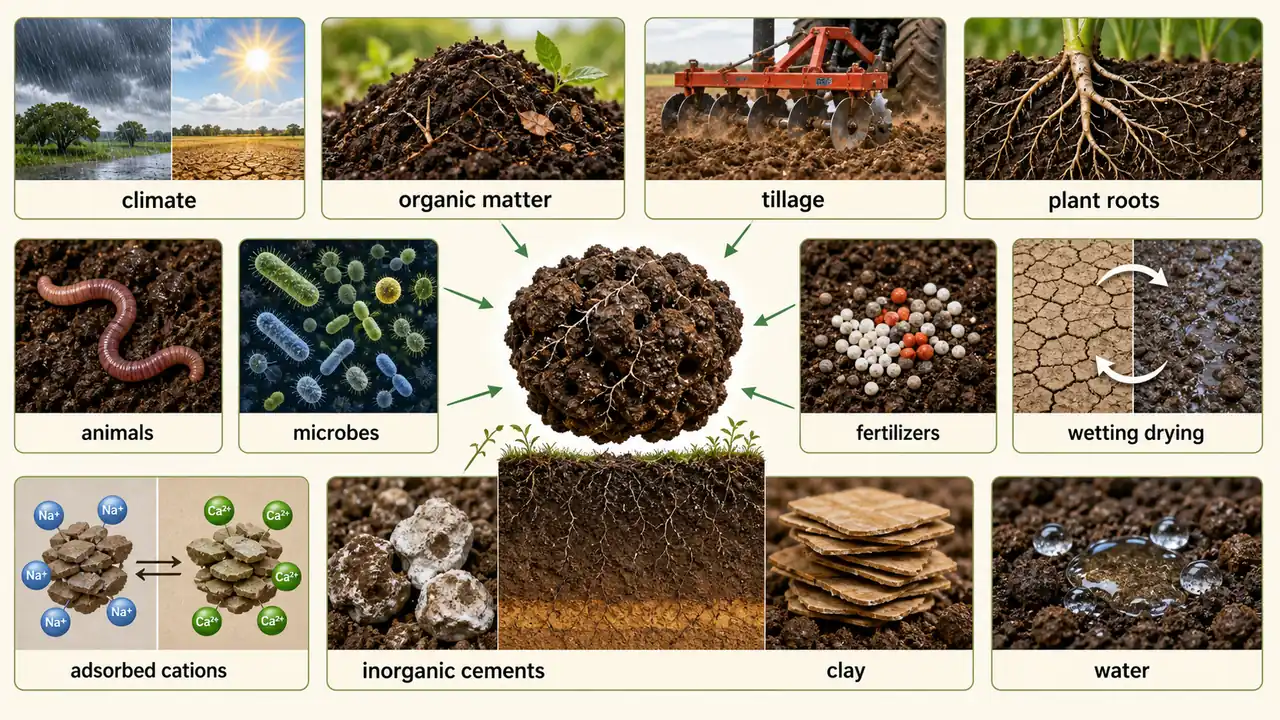
| # | Factor | Effect | Agricultural Practice |
|---|---|---|---|
| 1 | Climate | Arid = little aggregation; humid = more | Wetting-drying cycles promote aggregation |
| 2 | Organic matter | Most effective structure builder | Add FYM, compost, green manure |
| 3 | Tillage | Breaks clods; but over-tillage destroys structure | Plough at optimum moisture |
| 4 | Plant roots | Root exudates and hairs bind particles | Grasses and legumes best for structure |
| 5 | Animals | Earthworms, moles, insects mix and aggregate soil | Promote earthworm activity |
| 6 | Microbes | Fungi and bacteria produce binding substances | Maintain OM for microbial food |
| 7 | Fertilizers | Sodium nitrate destroys structure; CAN improves it | Choose Ca-based fertilizers |
| 8 | Wetting/Drying | Swelling and shrinking creates cracks and granules | Natural process in monsoon climates |
| 9 | Adsorbed cations | Na+, K+ disperse soil; Ca2+, Ba2+ flocculate | Apply gypsum to replace Na with Ca |
| 10 | Inorganic cements | CaCO3, sesquioxides bind particles | Natural cementing in subsoil |
| 11 | Clay | Essential for aggregation; provides cohesion | -- |
| 12 | Water | Needed for wetting clay to form aggregates | Irrigation management |
IMPORTANT
Organic matter increases aggregate formation. Intensive cultivation destroys structure. Grasses and legumes improve granulation. Na+ destroys structure; Ca2+ improves it.
Effect of Structure on Other Properties
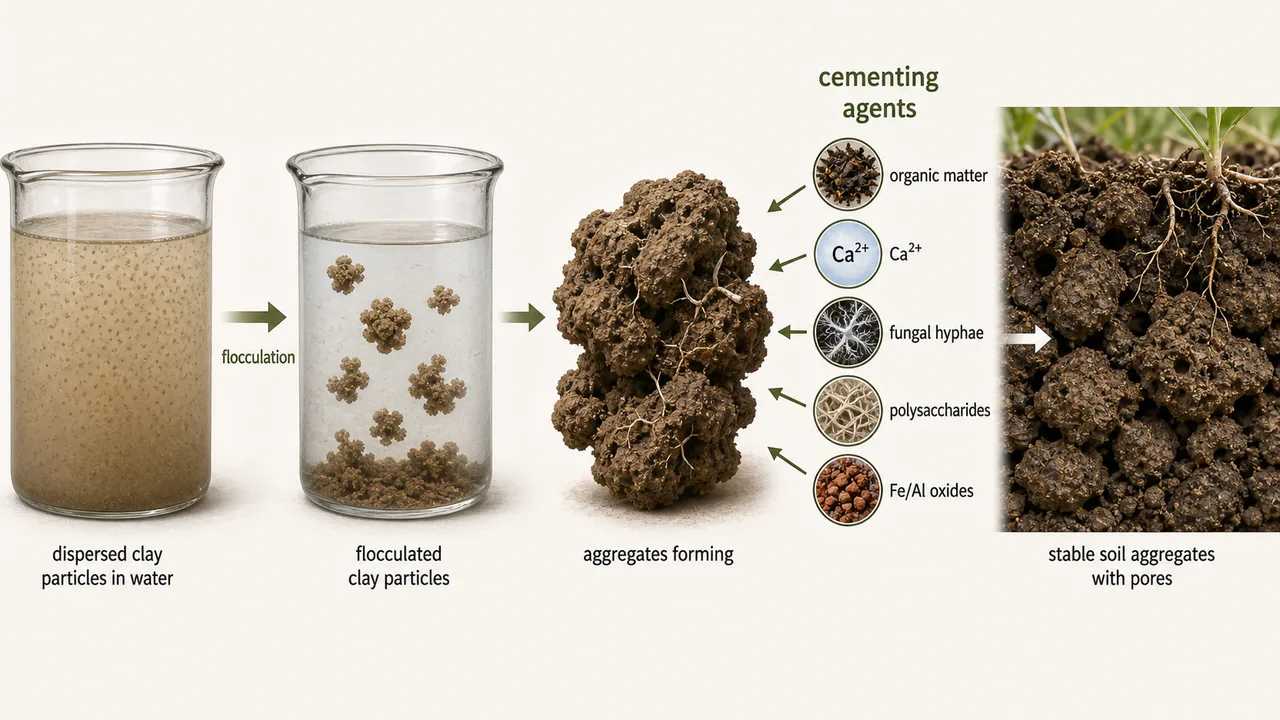
| Property | Good Structure (Crumb/Granular) | Poor Structure (Platy/Massive) |
|---|---|---|
| Porosity | More pore space | Less pore space |
| Temperature | Good aeration; optimum soil temperature | Poor aeration; extreme temperatures |
| Bulk density | Low (more pore space) | High (less pore space) |
| Consistence | Friable, easy to work | Plastic, sticky or hard |
| Colour | Normal | Bluish/greenish (poor drainage) |
| Water movement | Rapid infiltration and percolation | Slow; surface runoff |
Soil Aggregates
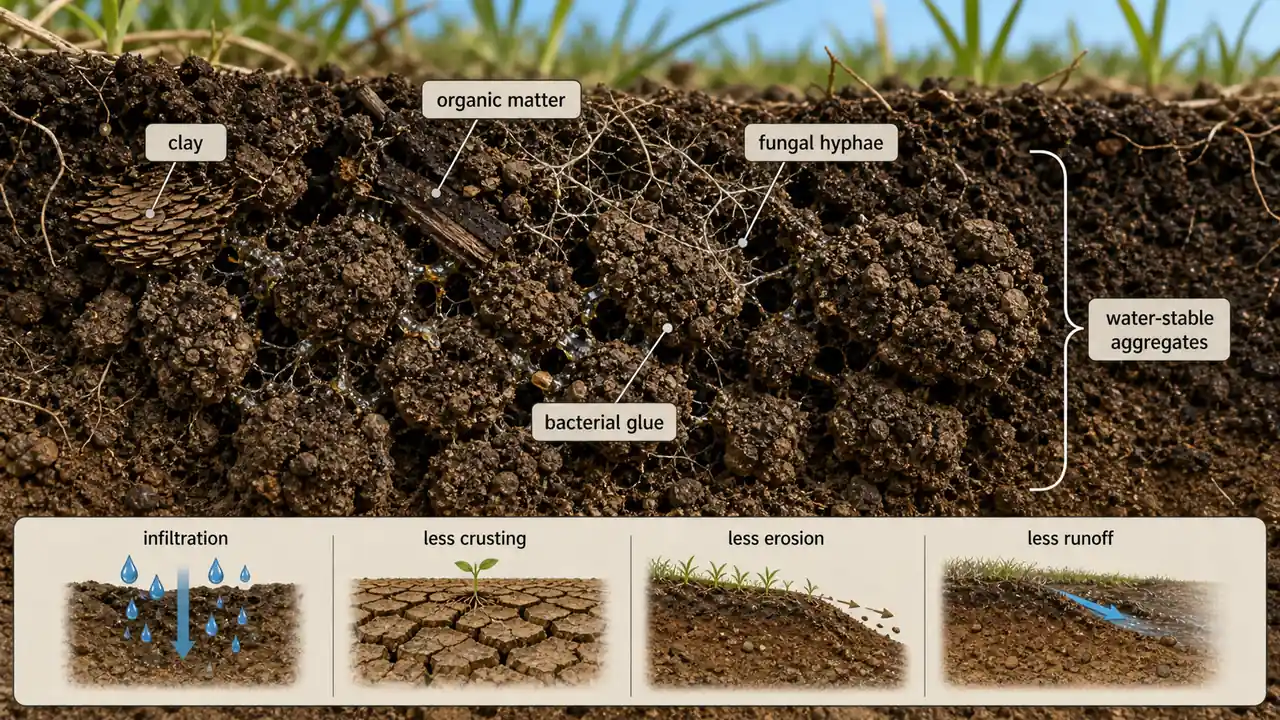
Soil aggregates are "clumps" of particles held together by moist clay, organic matter, organic compounds (from bacteria and fungi), and fungal hyphae. They range from ~0.002 mm to ~2 mm across.
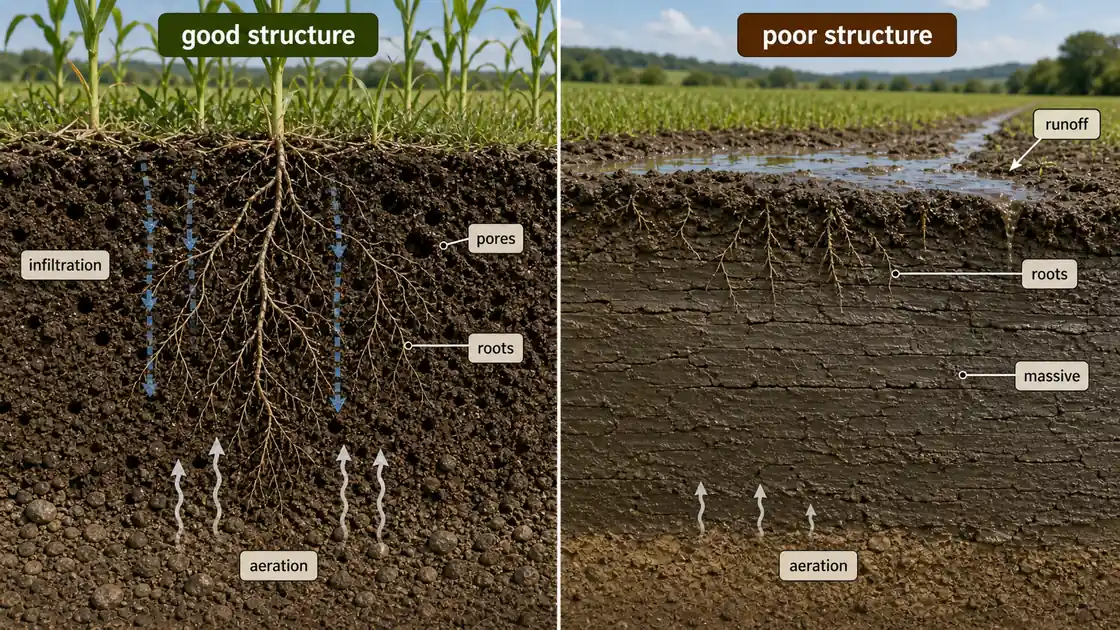
How Aggregates Form
| Binding Agent | Mechanism | Stability |
|---|---|---|
| Bacterial polysaccharides | Sticky glue between particles | More stable than plant polysaccharides |
| Bacterial electrostatic charge | Attracts clay surfaces, bringing small aggregates together | Short-term |
| Fungal hyphae | Physical enmeshment and crosslinks | Long-term; mycorrhizal fungi most important |
Significance of Good Aggregation
With more soil in water-stable aggregates:
| Benefit | Agricultural Impact |
|---|---|
| Increased water infiltration | More water available to crops; less irrigation needed |
| Reduced soil crusting | Better seedling emergence; improved root access to moisture |
| Increased resistance to raindrop splash | Less erosion; topsoil preserved |
| Decreased runoff | More water stored in profile for crops |
Agricultural link: A farmer practising conservation agriculture (residue retention + zero tillage) maintains better aggregate stability than one practising conventional tillage, leading to higher moisture retention during dry spells.
Summary Cheat Sheet
| Concept / Topic | Key Details |
|---|---|
| Soil structure | Arrangement of primary particles into aggregates (peds) |
| Unlike texture | Structure can be changed by management |
| Peds vs Clods | Peds = natural; Clods = artificial (from ploughing) |
| 4 structural types | Platy, Prism-like, Block-like, Spheroidal |
| Best for crops | Granular and Crumb (spheroidal); found in A-horizon |
| Platy | Horizontal plates; impedes vertical water movement; compaction |
| Prismatic | Vertical, flat tops; subsoil of arid regions; high clay |
| Columnar | Vertical, rounded tops; sodic soils (high Na⁺) |
| Blocky | 3 dimensions equal; B-horizon; moderate drainage |
| Wedge | Found in Vertisols (montmorillonite); high expansive clay |
| 5 size classes | Very fine → Fine → Medium → Coarse → Very coarse |
| 4 grades | Structureless, Weak, Moderate, Strong |
| Naming order | Grade → Class → Type ("GCT") |
| Structureless types | Single grain (sandy) or Massive (puddled clay) |
| Best cementing agent | Organic matter — most effective for aggregation |
| Other cementing agents | Ca²⁺, Fe/Al oxides (sesquioxides), fungal hyphae, bacterial polysaccharides |
| Ca²⁺ effect | Improves structure (flocculation) |
| Na⁺ effect | Destroys structure (dispersion) |
| Gypsum | Replaces Na⁺ with Ca²⁺ → restores structure |
| Sodium nitrate | Destroys granulation; avoid in structure-sensitive soils |
| CAN fertilizer | Improves structure (contains Ca) |
| Puddling | Creates massive structure; good only for paddy |
| Earthworms | Major aggregating agent — "Nature's plough" |
| 12 factors affecting structure | Climate, OM, tillage, roots, animals, microbes, fertilizers, wet/dry, cations, inorganic cements, clay, water |
| Best structure for crops | Granular and Crumb (spheroidal); Exam tip: Found in A-horizon |
| Worst for drainage | Platy structure; Exam tip: Creates barriers to water flow |
| Four types | Platy, Prism-like, Block-like, Spheroidal |
| Na+ effect | Destroys structure (dispersion); Exam tip: Apply gypsum to counter |
| Ca2+ effect | Improves structure (flocculation); Exam tip: Liming, gypsum |