🏔 Rocks & Minerals: Parent Materials of Soil
Classification of rocks (igneous, sedimentary, metamorphic), primary and secondary minerals, silicate structures, and physical properties of minerals
Pick up a handful of red laterite soil from a Kerala plantation and a sandy soil from a Rajasthan field. They look and feel completely different. Why? Because they formed from different rocks and minerals. The laterite came from basalt (a basic igneous rock rich in iron), while the sandy soil came from granite (an acid rock rich in quartz). Understanding rocks and minerals is essential because they are the parent material from which all soils originate.
Rocks: The Foundation of Soil
- Rocks are the materials that form the essential part of Earth's solid crust
- "Rocks are hard mass of mineral matter comprising one or more rock-forming minerals"
- Rocks form from molten material known as magma
- The study of rocks is called Petrology (Greek: petra = rock, logos = science)
- Petrogenesis is the study of the origin of rocks
- 95% of the earth's crust is made up of igneous rocks

Three Types of Rocks
| Rock Type | Formation Process | Agricultural Significance |
|---|---|---|
| Igneous (Primary) | Cooling and solidification of molten magma | Form the base for all other rocks; basalt produces fertile black soils |
| Sedimentary (Secondary) | Transportation and cementation of primary rocks | Limestone soils are rich in calcium; sandstone soils are well-drained |
| Metamorphic | Alteration of existing rocks by heat and pressure | Gneiss and schist produce moderately fertile soils |
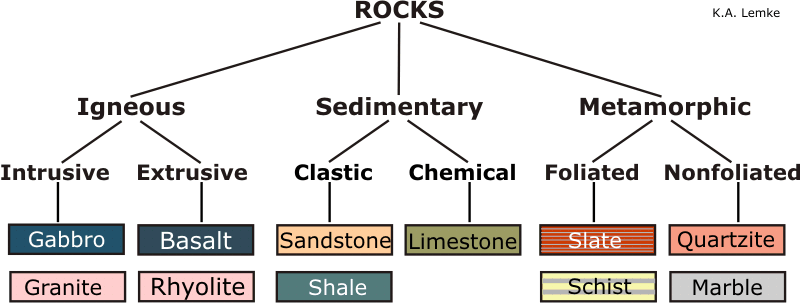
1. Igneous Rocks (Primary or Massive Rocks)
These are the first-formed rocks in the earth's crust, created by solidification of molten magma. They are the starting point of the rock cycle.
Pro Content Locked
Upgrade to Pro to access this lesson and all other premium content.
Charged once for one year · ₹1188 total
Save ₹100/month vs ₹2388/year launch price
- All Agriculture & Banking Courses
- AI Lesson Questions (100/day)
- AI Doubt Solver (50/day)
- Glows & Grows Feedback (30/day)
- AI Section Quiz (20/day)
- 22-Language Translation (100/day)
- Recall Questions (20/day)
- AI Quiz (15/day)
- AI Quiz Paper Analysis (100/day)
- AI Step-by-Step Explanations (100/day)
- Spaced Repetition Recall (FSRS)
- AI Tutor
- Immersive Text Questions
- Audio Lessons — Hindi & English
- Mock Tests & Previous Year Papers
- Summary & Mind Maps
- XP, Levels, Leaderboard & Badges
- Generate New Classrooms
- Voice AI Teacher (AgriDots Live)
- AI Revision Assistant
- Knowledge Gap Analysis
- Interactive Revision (LangGraph)
🔒 Secure one-time yearly payment via Razorpay · No hidden fees
Pick up a handful of red laterite soil from a Kerala plantation and a sandy soil from a Rajasthan field. They look and feel completely different. Why? Because they formed from different rocks and minerals. The laterite came from basalt (a basic igneous rock rich in iron), while the sandy soil came from granite (an acid rock rich in quartz). Understanding rocks and minerals is essential because they are the parent material from which all soils originate.
Rocks: The Foundation of Soil
- Rocks are the materials that form the essential part of Earth's solid crust
- "Rocks are hard mass of mineral matter comprising one or more rock-forming minerals"
- Rocks form from molten material known as magma
- The study of rocks is called Petrology (Greek: petra = rock, logos = science)
- Petrogenesis is the study of the origin of rocks
- 95% of the earth's crust is made up of igneous rocks
Three Types of Rocks
| Rock Type | Formation Process | Agricultural Significance |
|---|---|---|
| Igneous (Primary) | Cooling and solidification of molten magma | Form the base for all other rocks; basalt produces fertile black soils |
| Sedimentary (Secondary) | Transportation and cementation of primary rocks | Limestone soils are rich in calcium; sandstone soils are well-drained |
| Metamorphic | Alteration of existing rocks by heat and pressure | Gneiss and schist produce moderately fertile soils |
1. Igneous Rocks (Primary or Massive Rocks)
These are the first-formed rocks in the earth's crust, created by solidification of molten magma. They are the starting point of the rock cycle.

| Sub-type | Formation | Crystal Size | Examples | Agricultural Link |
|---|---|---|---|---|
| Extrusive (Volcanic) | Rapid cooling on earth's surface | Fine-grained (glassy) | Andesite, Rhyolite, Basalt | Basalt in Deccan trap produces black cotton soils (Vertisols) |
| Intrusive (Plutonic) | Slow cooling inside earth | Coarse-grained (crystalline) | Granite, Gabbro, Syenite, Diorite | Granite produces light-textured red soils (Alfisols) |
| Vesicular | Magma cools on surface with trapped steam | Porous, sponge-like | Pumice (floats on water) | -- |
- Rocks formed in vertical cracks = dykes; in horizontal cracks = sills
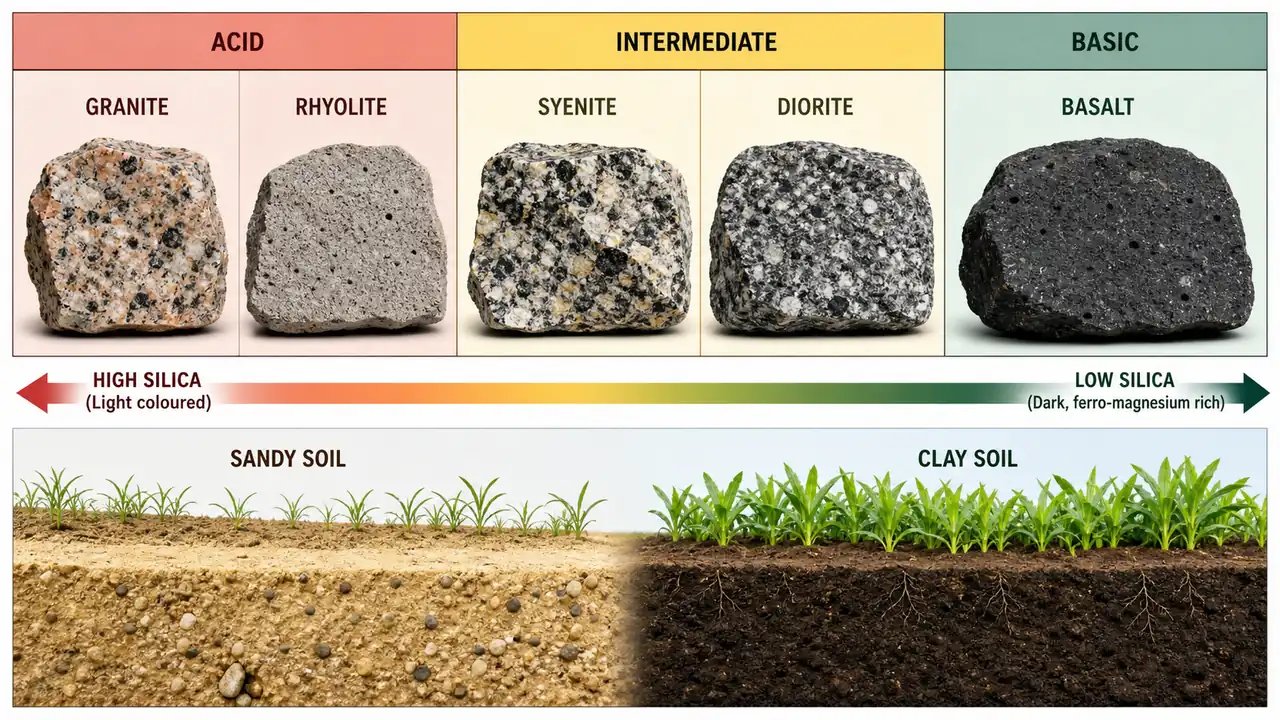
Classification by Silica Content
| Category | SiO2 Content | Examples | Soil Type Produced |
|---|---|---|---|
| Acid rocks | > 65% | Granite, Rhyolite | Light-textured, sandy soils |
| Intermediate (Sub-acid) | 60-65% | Syenite, Trachyte | Medium-textured soils |
| Intermediate (Sub-basic) | 56-60% | Diorite, Andesite | Medium to fine soils |
| Basic rocks | 40-55% | Gabbro, Basalt | Fine-textured, fertile clay soils |
| Type | SiO₂ Content | Examples |
|---|---|---|
| Acid rocks | > 65% SiO₂ | Granite, Rhyolite, Sandstone etc. |
| Intermediate | 56 to 65% SiO₂ | Sub acid rocks 60 to 65% SiO₂ → Syenite and Trachyte; Sub basic rocks 56 to 60% SiO₂ → Diorite and Andesite |
| Basic rocks | 40 to 55% SiO₂ | Gabbro, Basalt, limestone etc. |
NOTE
Acid rocks contain free silica (quartz) in abundance (e.g., Granite). Basic rocks like basalt have little or no free silica but are rich in ferro-magnesium minerals, producing more fertile soils.
Igneous Rocks -- Detailed Table
| Rock | Origin | Essential Minerals | Avg. Sp. Gravity | Colour |
|---|---|---|---|---|
| Granite | Plutonic | Quartz (20-30%), Orthoclase | 2.64 | Light (white/reddish) |
| Syenite | Plutonic | Quartz, Orthoclase | 2.80 | Light |
| Diorite | Plutonic | Quartz, Plagioclase | 2.85 | Darker |
| Gabbro | Plutonic | Labradorite, Augite, Olivine | 3.0 | Blackish |
| Dolerite | Hypabasal | Labradorite, Augite, Olivine | 3.0 | Blackish |
| Basalt | Volcanic | Labradorite, Augite, Olivine | 3.0 | Dark |
2. Sedimentary Rocks (Secondary Rocks)
Derived from igneous rocks through weathering, transport and cementation. Over time, deposited layers become compacted and cemented into solid rock.

- Also called aqueous rocks (formed through the agency of water)
- Deposited in layers or strata -- called stratified rocks
- Cemented by SiO2, Fe2O3 or lime -- called clastic rocks
- Examples: Limestone, Dolomite, Sandstone, Shale, Conglomerate
Classification by Origin
| Category | Type | Examples | Agricultural Link |
|---|---|---|---|
| Residual | Weathered in place | Laterite | Laterite soils of Western Ghats |
| Transported (solids) | Deposited as suspension | Sandstone, Shale | Sandy and clayey soils |
| Transported (chemical) | Chemical precipitation | Limestone, Ironstone | Calcareous soils rich in Ca |
| Transported (organic) | Through organic matter | Peat, Phosphatic deposits | Organic soils, phosphate fertilizers |
Classification by Grain Size
| Grain Size | Type | Rock Name | Soil Produced |
|---|---|---|---|
| Boulder/Pebbles | Rudaceous | Conglomerate | Gravelly soils |
| Sand size | Arenaceous | Sandstone | Sandy soils |
| Silt size | Silt rocks | Siltstone | Silty soils |
| Clay size | Argillaceous | Shale | Heavy clay soils |
Sedimentary Rock Composition
| Rock | Mineral Composition | Colour and Structure |
|---|---|---|
| Sandstone | Mainly quartz with CaCO3, iron oxides, clay | Light to red, granular |
| Shale | Clay minerals, quartz, organic matter | Light to dark, thinly laminated |
| Limestone | Mainly calcite with dolomite, iron oxides, clay | Light grey to yellow, fine grained |
3. Metamorphic Rocks
Formed from igneous and sedimentary rocks under the influence of heat, pressure, and chemically active fluids. The word "metamorphic" means "changed in form."
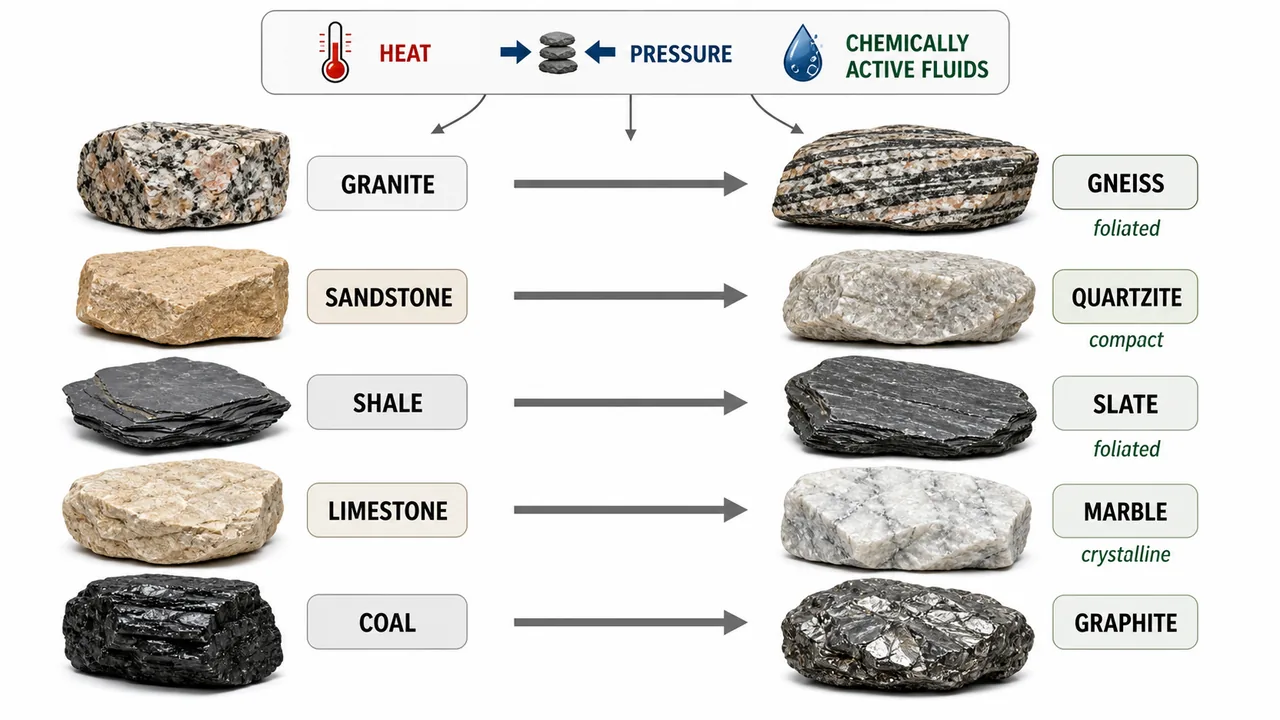

- Changes due to water = hydro metamorphosis
- Changes due to pressure = dynamo metamorphosis
Metamorphic Transformation Pairs
| Original Rock | Metamorphic Rock | Structure |
|---|---|---|
| Granite | Gneiss | Banded and foliated |
| Basalt / Shale | Schist | Foliated |
| Sandstone | Quartzite | Compact, uniform |
| Shale | Slate | Compact, uniform |
| Limestone | Marble | Fine to coarse |
| Coal | Graphite | -- |
| Iron ores | Haematite-schist | -- |
| Metamorphic Rock | Derived From |
|---|---|
| Gneiss | Granite |
| Marble | Lime stone |
| Quartzite | Sand stone |
| Slate | Shale |
| Schist | Basalt |
TIP
Exam Mnemonic for metamorphic pairs: "GG SSS LM CG" -- Granite to Gneiss, Sandstone to Quartzite(Stone), Shale to Slate, Limestone to Marble, Coal to Graphite. Foliated rocks (Slate, Schist, Gneiss) show layered structure. Non-foliated rocks (Quartzite, Marble) have uniform texture.
Rock Minerals
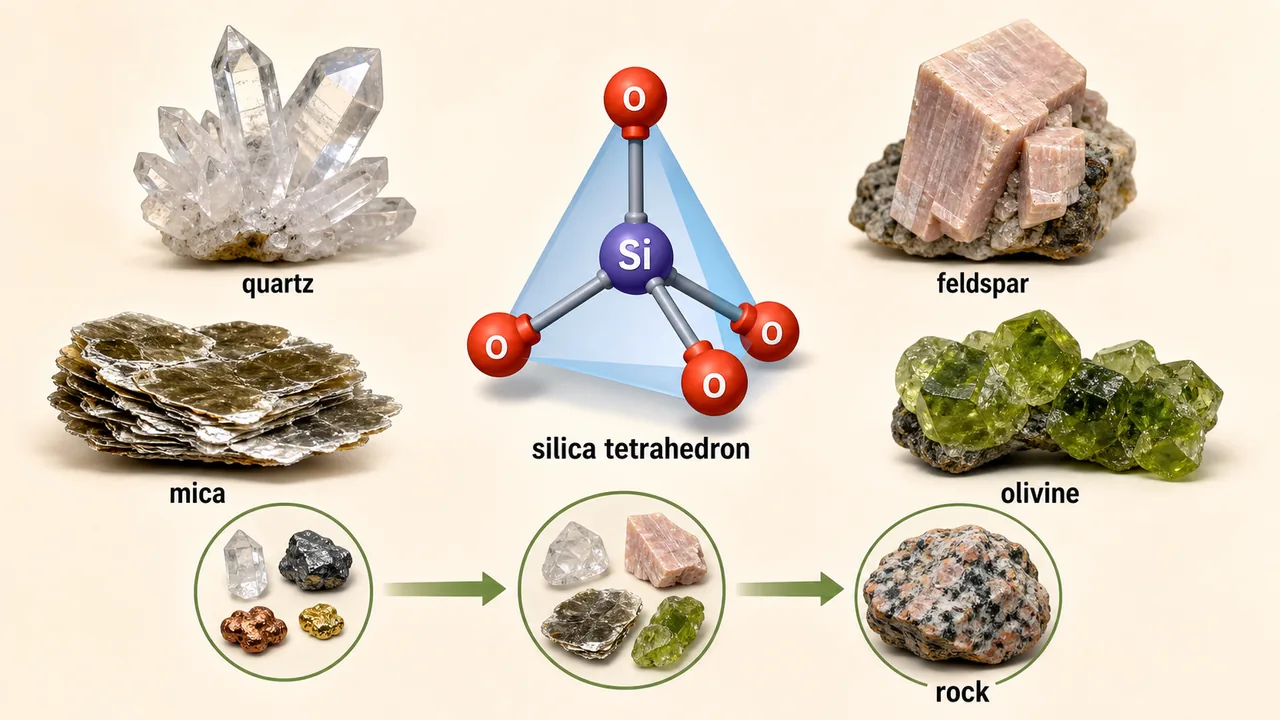
| Rock Minerals Image Item | Full Content |
|---|---|
| Silica tetrahedron | Basic structural unit of silicate minerals, with one silicon atom surrounded by four oxygen atoms in tetrahedral form |
| Silicon atom | Central atom in the silica tetrahedron that links oxygen atoms into silicate structures |
| Four oxygen atoms | Surround the silicon atom and control how tetrahedra stay isolated, form chains, sheets, or frameworks |
| Quartz | Silicon dioxide mineral that is highly resistant to weathering and becomes the chief constituent of sandy soil fractions |
| Feldspar | Most abundant rock-forming mineral group; weathers to form clay minerals and releases K, Na, and Ca |
| Mica | Layered silicate mineral group including muscovite and biotite; important as a source of potassium in soils |
| Olivine | Ferro-magnesium silicate mineral that weathers rapidly because of loose atomic packing |
| Silicate minerals | Main mineral group built from silica tetrahedra; includes ortho-, ino-, phyllo-, and tectosilicates |
| Non-silicate minerals | Minerals outside the silica-tetrahedron family, such as oxides, carbonates, sulphates, and phosphates |
Minerals are naturally occurring solids with a definite chemical composition and crystal structure -- the fundamental building blocks of rocks.
- Silica tetrahedron (SiO2) is the basic building block for formation of different minerals
- One silicon atom is surrounded by four oxygen atoms in a tetrahedral arrangement
- Silicate minerals: ortho silicates, ino-silicates, phyllosilicates and tectosilicates
- Non-silicate minerals: oxides, carbonates, sulphates, phosphates
Primary vs Secondary Minerals

| Feature | Primary Minerals | Secondary Minerals |
|---|---|---|
| Definition | Original components of rock, generally anhydrous | Formed from weathering of primary minerals, hydrous |
| Formation | Crystallization of molten magma | Chemical alteration of primary minerals |
| Found in | Coarser fractions (sand, gravel) | Fine fractions (fine silt, clay) |
| Surface area | Small | Large (retains moisture and nutrients) |
| Examples | Feldspar, Quartz, Mica, Muscovite, Biotite, Hornblende, Olivine | Kaolinite, Montmorillonite, Illite, Goethite, Haematite, Calcite, Gypsum |
| Agricultural role | Slowly release nutrients through weathering | Directly hold water and nutrients for crops |
Detailed Comparison
| Primary Minerals | Secondary Minerals |
|---|---|
| Quartz (SiO2) | Goethite [FeOOH] |
| Muscovite [KAl3Si3O10(OH)2] | Haematite [Fe2O3] |
| Orthoclase | Gibbsite |
| Biotite | Clay minerals |
| Albite | Dolomite |
| Hornblende | Calcite |
| Augite | Gypsum |
| Anorthite | Apatite |
| Olivine | Limonite |
Essential vs Accessory Minerals
| Type | Definition | Examples |
|---|---|---|
| Essential minerals | Chief constituents of rocks; determine rock identity | Feldspars, Pyroxenes, Micas |
| Accessory minerals | Present in small quantities; do not alter rock properties | Tourmaline, Magnetite |
Ferro-Magnesium vs Non-Ferro-Magnesium Minerals
| Ferro-Magnesium Minerals | Non-Ferro-Magnesium Minerals |
|---|---|
| Pyroxenes and Amphiboles | Feldspars |
| Biotite (Black mica) | Quartz |
| Olivine | Muscovite |
NOTE
Ferro-Mg minerals contain iron and/or magnesium -- generally dark-coloured and heavier. Non-Ferro-Mg minerals are light-coloured and lighter. This affects the colour of soils derived from these minerals.
Silicate Mineral Classification
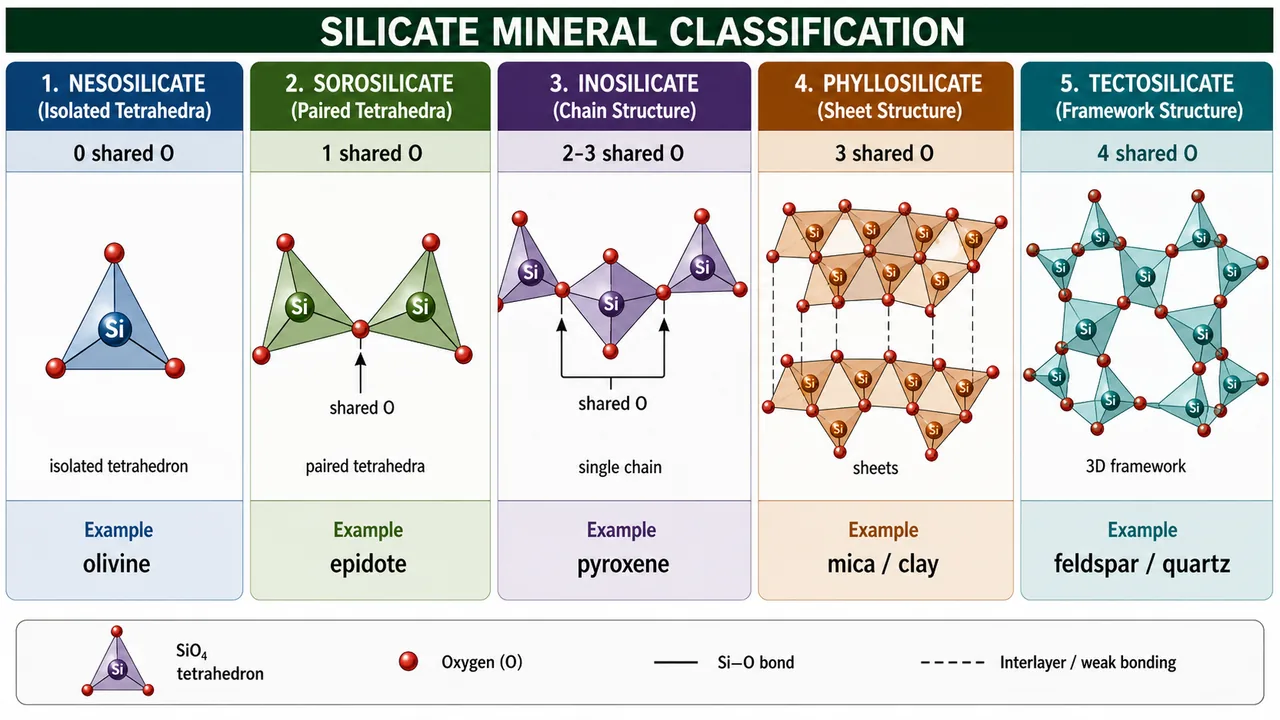
Silicate minerals are classified by the degree of oxygen sharing between adjacent silica tetrahedra:
| Type | O2 Ions Shared | Structure | Examples | Weathering Rate |
|---|---|---|---|---|
| Nesosilicates (Ortho) | 0 | Isolated tetrahedra | Olivine, Zircon, Garnet | Fast (except zircon) |
| Sorosilicates | 1 | Paired tetrahedra | Epidote | Moderate |
| Inosilicates | 2 or 3 | Single/Double chains | Pyroxenes, Amphiboles | Moderate to fast |
| Phyllosilicates | 3 | Sheet/layer (honeycomb) | Micas, Clay minerals | Variable |
| Tectosilicates | 4 (all) | 3D framework | Feldspars, Quartz | Slow (quartz most resistant) |
Ortho/Neosilicates
- Composed of single tetrahedra linked by Mg or Fe
- Olivine weathers fast due to loose packing of oxygens
- Zircon is comparatively hard and resistant
Inosilicates
- Single-chain (pyroxenes) and double-chain (amphiboles) structures
- Linked by Ca, Mg, or Fe -- many weak spots make them weather rapidly
- Elongated, prismatic crystal shapes
Phyllosilicates
- Sheet-like structure (Greek: phyllo = leaf)
- Biotite and muscovite are relatively susceptible to weathering
- Clay minerals are resistant weathering products
- Most important group for soil fertility as clay minerals hold nutrients
Tectosilicates
- Most complex three-dimensional framework
- Feldspars and quartz belong here
- Quartz is extremely resistant; feldspars weather more readily
Non-Silicate Minerals
| Category | Mineral | Formula | Agricultural Significance |
|---|---|---|---|
| Oxides | Hematite | Fe2O3 | Red/brown soil colour |
| Limonite | Fe2O3.3H2O | Yellow/brown soil colour | |
| Goethite | FeO(OH).H2O | Yellow/brown coatings on soil particles | |
| Gibbsite | Al2O3.H2O | Found in laterite soils | |
| Carbonates | Calcite | CaCO3 | Common in calcareous soils; source of Ca for crops |
| Dolomite | CaMgCO3 | Used as liming material | |
| Sulphates | Gypsum | CaSO4.2H2O | Used to reclaim sodic soils |
| Phosphates | Apatite | Rock phosphate | Primary source of phosphorus for fertilizers |

NOTE
The red, yellow or brown colours in soils are due to goethite and hematite coatings on soil particles. A farmer can roughly judge soil drainage from colour -- red soil = well drained, yellow = moderate.
Relative Abundance of Rock-Forming Minerals
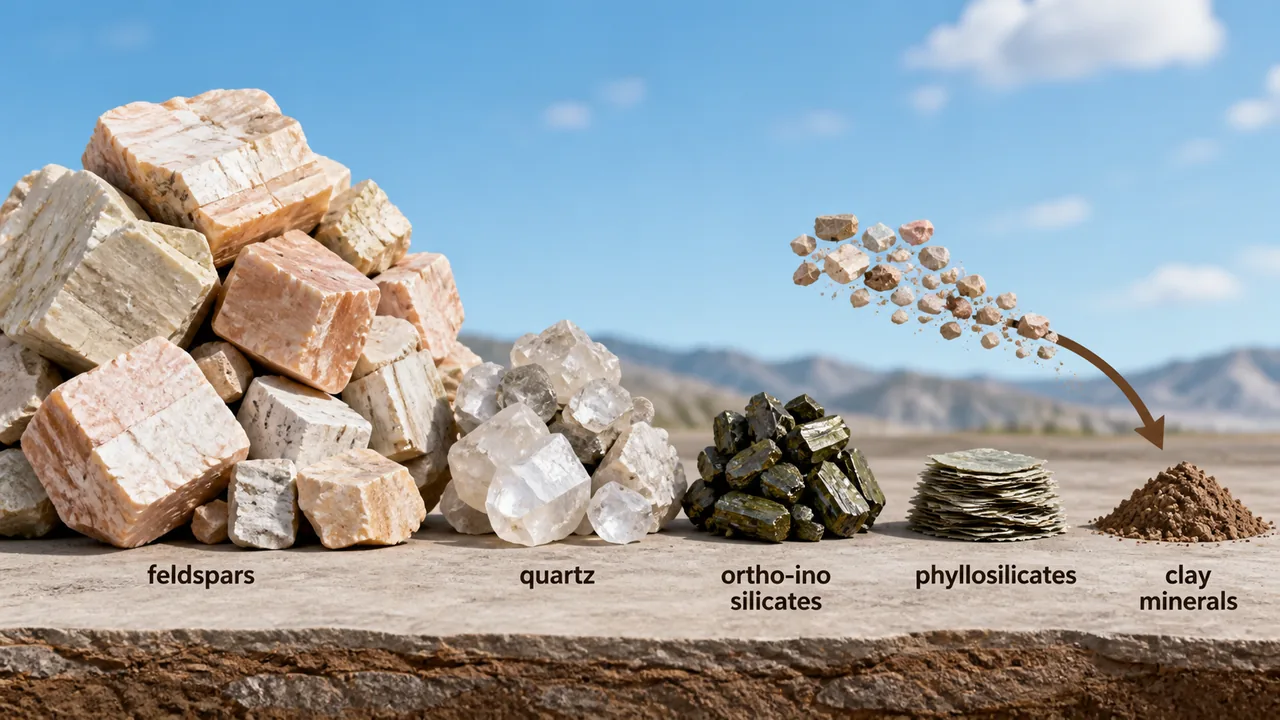
| Mineral Group | Important Constituents | % Distribution |
|---|---|---|
| Primary -- Ferro-Mg (Ortho-Ino silicates) | Olivine, Pyroxenes, Amphiboles | 16.8% |
| Primary -- Ferro-Mg (Phyllo Silicates) | Biotite, Muscovite | 3.6% |
| Primary -- Non-Ferro-Mg (Feldspars) | Anorthite, Albite, Orthoclase | 61.0% |
| Primary -- Non-Ferro-Mg (Quartz) | SiO2 | 12.0% |
| Secondary Clay Minerals | Na, K, Ca, Mg, Fe, Al, OH | Remaining |
IMPORTANT
Feldspars (61%) are the most abundant mineral group, followed by Ortho-Ino silicates (16.8%), Quartz (12%), and Phyllosilicates (3.6%). Feldspars are the main source of clay minerals through hydrolysis.
Key Primary Minerals
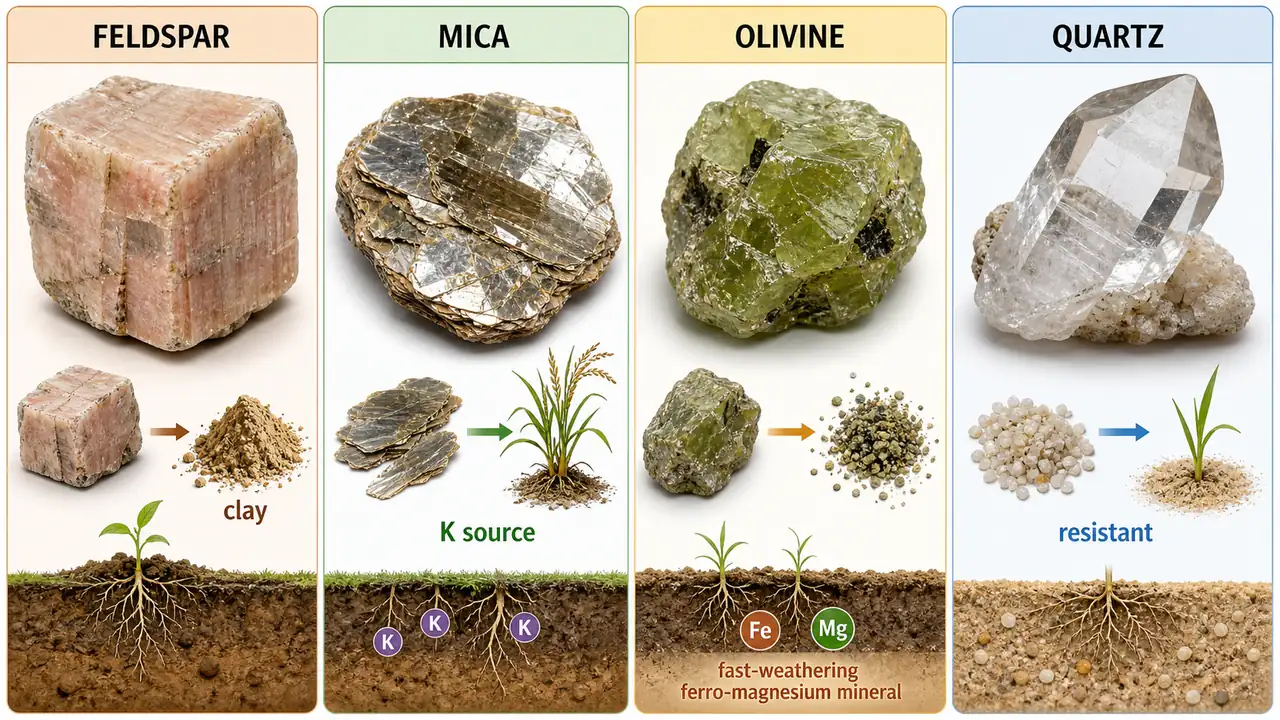
Micas (10% of crust)
| Type | Colour | Also Known As | Formula | Weathering |
|---|---|---|---|---|
| Potash Mica | White, transparent | Muscovite | K(OH)2Al2Si3O10 | More resistant |
| Magnesium Mica | Black | Biotite | K(Mg.Fe)3(OH)2AlSi3O10 | Less resistant (contains Fe, Mg) |
- Micas are more resistant to weathering than feldspars
- Agricultural significance: Source of potassium in soils
Olivine
- Ferro-magnesium silicate: (Fe.Mg)2SiO4
- Weathers rapidly due to loose atomic packing
- Hydrated forms: talc and serpentine
Quartz (12% of crust)
- Formula: SiO2
- Most resistant mineral to weathering -- densely packed, electrically neutral
- Chief constituent of sandy fraction in soils
- Present abundantly in granite (acid rock)
- Agricultural significance: Dominates sandy soils; provides no plant nutrients
Tourmaline
- Boro-alumino-silicate; highly resistant to weathering
- Non-ferromagnesium; found as accessory mineral
Weathering Resistance (Goldich's Stability Series)

| Resistance Level | Minerals | Agricultural Implication |
|---|---|---|
| Most resistant | Quartz, Muscovite | Persist in soils; provide no nutrients |
| Moderately resistant | Feldspar (Orthoclase), Biotite | Slowly release K, Mg |
| Least resistant | Augite, Hornblende, Olivine, Calcite | Weather fast; release Ca, Mg, Fe for crops |
IMPORTANT
Goldich's stability series mirrors the reverse of Bowen's reaction series. Quartz = most resistant; Calcite = least resistant. Sandy soils (rich in quartz) tend to be infertile because nutrient-rich minerals have already weathered away.
Physical Properties of Minerals
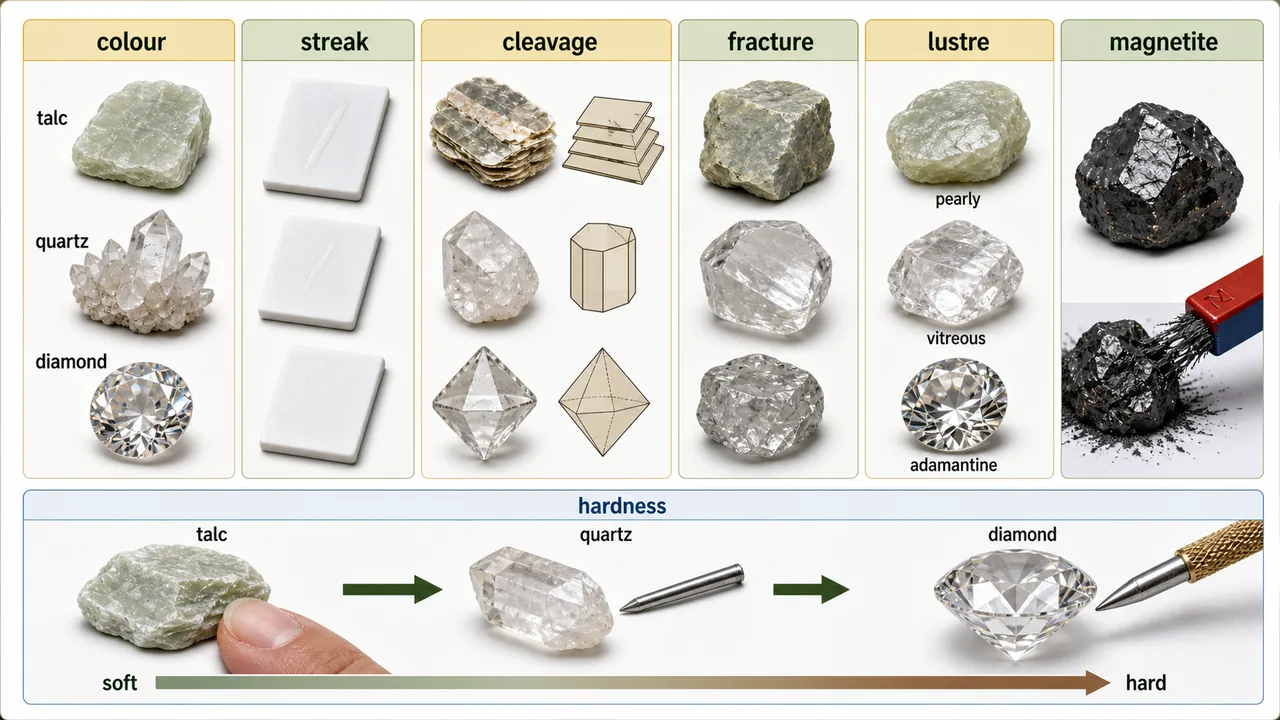
| # | Property | Description | Key Examples |
|---|---|---|---|
| 1 | Colour | Natural colour | Quartz: colourless; Biotite: black; Feldspar: white |
| 2 | Streak | Colour of powdered form on porcelain | Hematite: red; Magnetite: black; Talc: white |
| 3 | Fracture | Breaking along irregular surface | Quartz, Glass |
| 4 | Cleavage | Splitting along smooth planes | Muscovite (1 dir.), Feldspar (2), Calcite (3) |
| 5 | Hardness | Resistance to scratching (Mohs scale) | Talc (1) to Diamond (10) |
| 6 | Lustre | Appearance in reflected light | Metallic (Magnetite), Vitreous (Opal), Adamantine (Diamond) |
| 7 | Crystal Form | Geometric solid shape | 6 forms: Isometric, Tetragonal, Hexagonal, Orthorhombic, Monoclinic, Triclinic |
| 8 | Taste | Identifies halite (NaCl) | Salt taste |
| 9 | Specific Gravity | Density/heaviness | Heavy (>2.85): Pyroxene, Zircon; Light (<2.85): Quartz, Mica |
| 10 | Magnetism | Attraction to magnets | Magnetite |
| 11 | Effervescence | Fizzing with acid (CO2 release) | Calcite fizzes with dilute HCl |
| 12 | Birefringence | Double refraction | Iceland Spar Calcite |
Mohs Scale of Hardness
| Hardness | Mineral | Memory Aid |
|---|---|---|
| 1 | Talc | Softest; scratched by fingernail |
| 2 | Gypsum | Used as soil amendment |
| 3 | Calcite | Found in calcareous soils |
| 4 | Fluorite | -- |
| 5 | Apatite | Source of phosphorus |
| 6 | Feldspar | Most abundant mineral |
| 7 | Quartz | Most resistant soil mineral |
| 8 | Topaz | -- |
| 9 | Corundum | -- |
| 10 | Diamond | Hardest natural substance |
TIP
Exam Mnemonic: The Girls Can Flip And Find Quite Tough Crystal Diamonds (Talc, Gypsum, Calcite, Fluorite, Apatite, Feldspar, Quartz, Topaz, Corundum, Diamond).
Silicate Clay Minerals
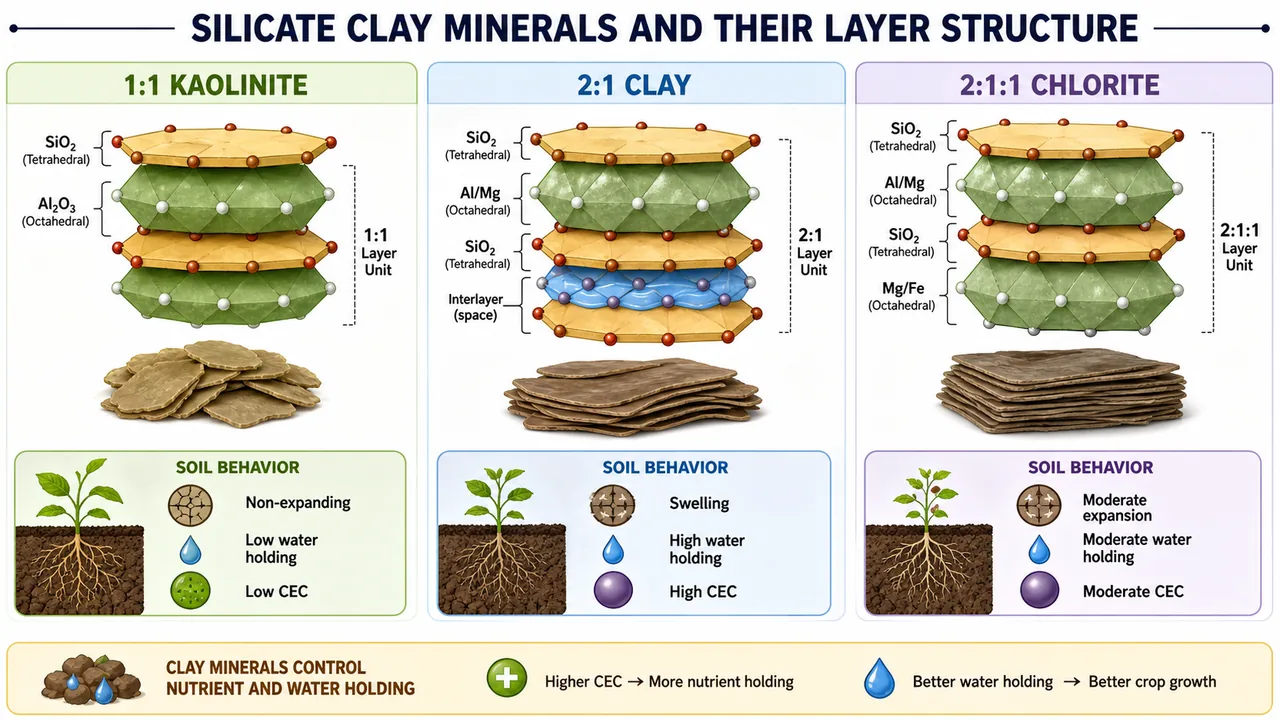
Classification by Layer Structure
| Type | Arrangement | Examples | Key Features | Agricultural Significance |
|---|---|---|---|---|
| 1:1 type | One Si sheet + One Al sheet | Kaolinite | Held tightly by H-bonds; non-expanding | Low CEC; dominant in well-weathered tropical soils |
| 2:1 type | Two Si sheets + One Al sheet | Montmorillonite, Illite, Vermiculite | Al sandwiched between Si sheets | High CEC; shrink-swell in black cotton soils |
| 2:1:1 (2:2) type | Two Si + Two Mg-Al sheets | Chlorites | Extra Brucite layer; non-expanding | Moderate CEC; common in less weathered soils |
Expanding vs Non-Expanding Types
| Type | Minerals | Behaviour | Agricultural Impact |
|---|---|---|---|
| Expanding | Montmorillonite, Vermiculite | Absorb water, swell significantly | Deep cracks in summer (Vertisols); high water and nutrient retention |
| Non-expanding | Illite, Micas | K+ wedged between layers prevents expansion | Moderate nutrient retention; source of potassium |
TIP
Vermiculite has the highest CEC of all silicate clays due to very high negative charges. Montmorillonite swells the most. Kaolinite has the lowest CEC and does not expand. Remember: Vermiculite = Very high CEC.
Sources of Plant Nutrients from Minerals
| Nutrient | Source |
|---|---|
| N | Organic Matter (O.M.) |
| C | Carbamate |
| P | Apatite, Fe/Al Phosphate, Organic Matter |
| K | Micas, Feldspar, Orthoclase, Microline |
| Mg | Dolomite (CaCO₃.MgCO₃), Muscovite, Biotite, Olivine, Hornblende, Brucite, Serpentine, Talc, Vermiculite, Glauconite |
| Ca | Dolomite, Calcite |
| B | Tourmaline (Source of Boron) |
| Mo | Olivine |
| Mn | Pyrolusite |
| Cu | Chalcopyrite, Olivine, Hornblende, Augite, Biotite |
| Zn | Sphalerite, Olivine, Hornblende |
| Cl | Apatite |
| TiO₂ | Rutile (Titanium oxide) |
| Ba | Baryte |
Summary Cheat Sheet
| Concept / Topic | Key Details |
|---|---|
| Petrology | Study of rocks; Petrogenesis = study of rock origin |
| 95% of earth's crust | Made of igneous rocks |
| Igneous rocks | Cooling of molten magma; primary/massive rocks |
| Extrusive (volcanic) | Rapid cooling on surface; fine-grained; Basalt, Rhyolite |
| Intrusive (plutonic) | Slow cooling inside earth; coarse-grained; Granite, Gabbro |
| Acid rocks (>65% SiO₂) | Granite, Rhyolite → light-textured sandy soils |
| Basic rocks (40–55% SiO₂) | Basalt, Gabbro → fine-textured fertile clay soils |
| Basalt → soils | Deccan trap → black cotton soils (Vertisols) |
| Granite → soils | Red soils (Alfisols) |
| Sedimentary rocks | Weathered + cemented; stratified; also called aqueous/clastic |
| Metamorphic pairs | Granite→Gneiss, Sandstone→Quartzite, Shale→Slate, Limestone→Marble, Coal→Graphite |
| Most abundant mineral | Feldspars (61%); source of clay minerals via hydrolysis |
| Most resistant mineral | Quartz (SiO₂); dominates sandy soils; Mohs hardness 7 |
| Least resistant mineral | Calcite; weathers first |
| Goldich's stability series | Reverse of Bowen's reaction series |
| Mohs scale | Talc (1) → Gypsum (2) → Calcite (3) → ... → Quartz (7) → Diamond (10) |
| Primary minerals | Anhydrous; in coarser fractions; Feldspar, Quartz, Mica, Olivine |
| Secondary minerals | Hydrous; in fine clay fraction; Kaolinite, Montmorillonite, Illite |
| Silica tetrahedron | SiO₄ — basic building block of silicate minerals |
| 1:1 clay (Kaolinite) | Non-expanding; H-bonded; low CEC; tropical soils |
| 2:1 clay (Mont., Illite, Verm.) | High CEC; Mont. swells most; Vermiculite highest CEC |
| 2:1:1 clay (Chlorite) | Extra brucite layer; non-expanding; moderate CEC |
| Apatite | Primary source of phosphorus for fertilizers |
| Gypsum | CaSO₄·2H₂O; used to reclaim sodic soils |
| Ferro-Mg minerals | Dark, heavy; Pyroxenes, Amphiboles, Biotite, Olivine |
| Muscovite vs Biotite | Muscovite: white, more resistant; Biotite: black, less resistant |
| Rock study | Petrology; Petrogenesis = origin; Exam tip: 95% crust is igneous |
| Igneous classification | Acid (>65% SiO2) vs Basic (40-55%); Exam tip: Granite = acid; Basalt = basic |
| Basalt soils | Deccan trap; black cotton soils (Vertisols); Exam tip: Fine-textured, fertile |
| Granite soils | Red soils (Alfisols); Exam tip: Light-textured, less fertile |
| Most abundant element | Oxygen (46.6%); Exam tip: O > Si > Al |
| Clay mineral types | 1:1 (Kaolinite), 2:1 (Montmorillonite, Illite), 2:2 (Chlorite); Exam tip: CEC: Vermiculite > Montmorillonite > Illite > Kaolinite |
| Goldich's series | Quartz most resistant; Calcite least; Exam tip: Reverse of Bowen's reaction series |