🚦 Soil Taxonomy: The 12 Soil Orders and Their Classification
USDA Soil Taxonomy, six hierarchical categories, 9 epipedons, 12 soil orders with diagnostic features, area in India, catena, caliche, and cat clays
Walk from the Indo-Gangetic floodplain in Uttar Pradesh to the Deccan plateau in Maharashtra, and then to the laterite hills of Kerala. In each region, the soil looks, feels, and behaves differently -- light sandy alluvium in UP, dark sticky black soil in Maharashtra, and red crumbly laterite in Kerala. To make sense of this diversity, scientists developed Soil Taxonomy -- a universal system that classifies all soils on Earth into just 12 orders based on measurable properties.
What is Soil Taxonomy?
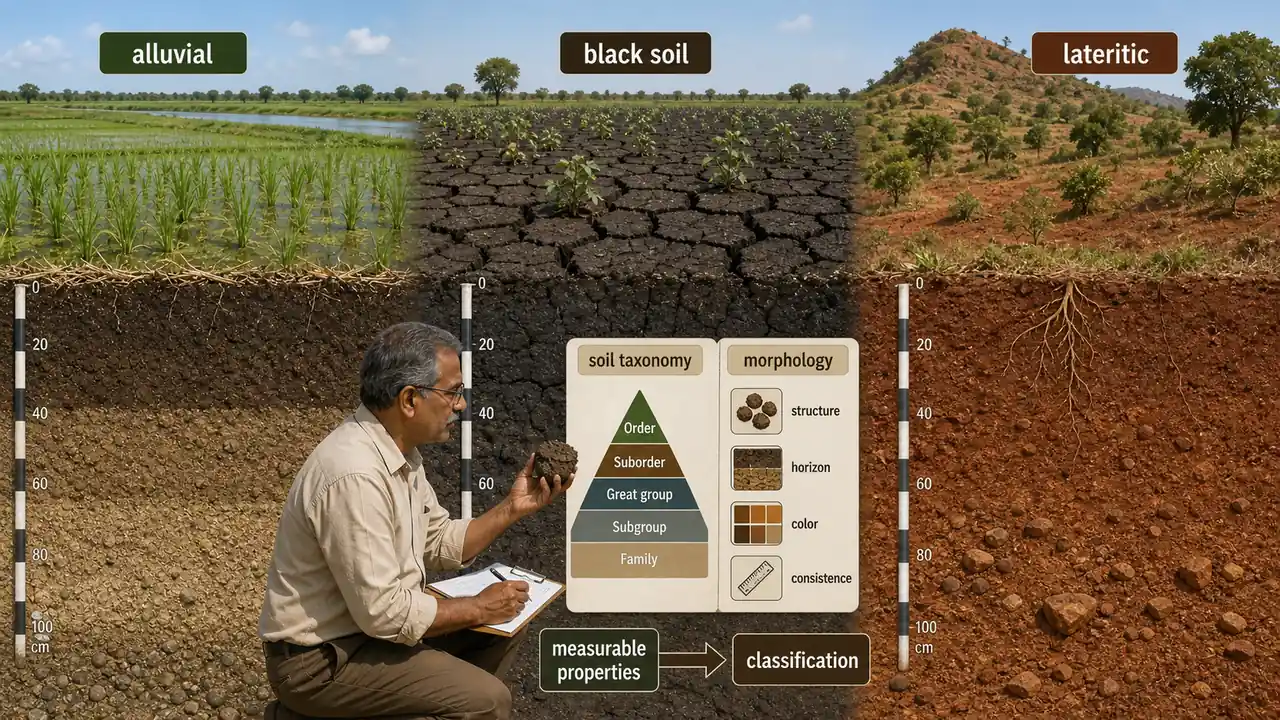
| Soil Taxonomy Image Item | Full Content |
|---|---|
| Alluvial soil example | One field example shows young alluvial soil, reminding us that very different soils can still be compared within one classification system |
| Black soil example | Another example represents shrink-swell black soil, showing that taxonomy covers soils with very different behavior and morphology |
| Lateritic soil example | A lateritic example highlights highly weathered red soils, further showing the diversity that taxonomy must organize |
| Measurable morphology | Soil taxonomy classifies soils by observable and measurable features such as horizons, colour, structure, and diagnostic properties |
| Common classification language | The system gives scientists a universal way to describe and compare soils across regions and countries |
| Main lesson | Soil taxonomy organizes very different field soils into a common framework based on present measurable characteristics rather than origin alone |
Soil Taxonomy is the US Comprehensive Soil Classification System based on the 7th Approximation, developed by the USDA (United States Department of Agriculture).
Pro Content Locked
Upgrade to Pro to access this lesson and all other premium content.
Charged once for one year · ₹1188 total
Save ₹100/month vs ₹2388/year launch price
- All Agriculture & Banking Courses
- AI Lesson Questions (100/day)
- AI Doubt Solver (50/day)
- Glows & Grows Feedback (30/day)
- AI Section Quiz (20/day)
- 22-Language Translation (100/day)
- Recall Questions (20/day)
- AI Quiz (15/day)
- AI Quiz Paper Analysis (100/day)
- AI Step-by-Step Explanations (100/day)
- Spaced Repetition Recall (FSRS)
- AI Tutor
- Immersive Text Questions
- Audio Lessons — Hindi & English
- Mock Tests & Previous Year Papers
- Summary & Mind Maps
- XP, Levels, Leaderboard & Badges
- Generate New Classrooms
- Voice AI Teacher (AgriDots Live)
- AI Revision Assistant
- Knowledge Gap Analysis
- Interactive Revision (LangGraph)
🔒 Secure one-time yearly payment via Razorpay · No hidden fees
Walk from the Indo-Gangetic floodplain in Uttar Pradesh to the Deccan plateau in Maharashtra, and then to the laterite hills of Kerala. In each region, the soil looks, feels, and behaves differently -- light sandy alluvium in UP, dark sticky black soil in Maharashtra, and red crumbly laterite in Kerala. To make sense of this diversity, scientists developed Soil Taxonomy -- a universal system that classifies all soils on Earth into just 12 orders based on measurable properties.
What is Soil Taxonomy?
| Soil Taxonomy Image Item | Full Content |
|---|---|
| Alluvial soil example | One field example shows young alluvial soil, reminding us that very different soils can still be compared within one classification system |
| Black soil example | Another example represents shrink-swell black soil, showing that taxonomy covers soils with very different behavior and morphology |
| Lateritic soil example | A lateritic example highlights highly weathered red soils, further showing the diversity that taxonomy must organize |
| Measurable morphology | Soil taxonomy classifies soils by observable and measurable features such as horizons, colour, structure, and diagnostic properties |
| Common classification language | The system gives scientists a universal way to describe and compare soils across regions and countries |
| Main lesson | Soil taxonomy organizes very different field soils into a common framework based on present measurable characteristics rather than origin alone |
Soil Taxonomy is the US Comprehensive Soil Classification System based on the 7th Approximation, developed by the USDA (United States Department of Agriculture).
| Feature | Detail |
|---|---|
| Published | 1960 |
| Basis | Morphology of soils (measurable properties), not genesis |
| Nomenclature | Latin and Greek words -- universal across languages |
| Key principle | Classification based on what the soil is today, not how it formed |
Six Hierarchical Categories
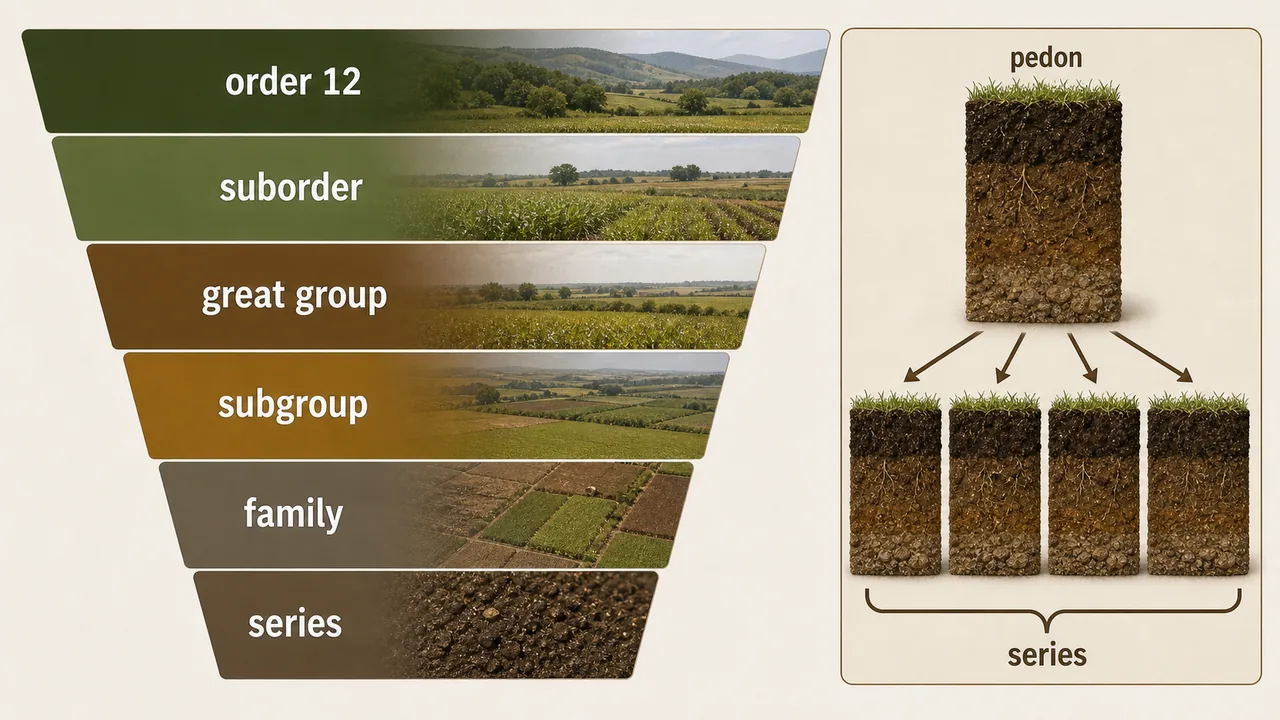
| Category | Level | Description | Number |
|---|---|---|---|
| Order | Broadest | Based on dominant soil-forming process | 12 worldwide |
| Sub-order | 2nd | Based on moisture regime, diagnostic horizons | ~60 |
| Great group | 3rd | Similar horizons and features | ~300 |
| Sub-group | 4th | Central concept or intergrades | ~2,400 |
| Family | 5th | Physical/chemical properties (texture, mineralogy, temperature) | ~8,000 |
| Series | Most specific | Basic unit of soil classification | Thousands |
- The smallest unit of classification is the soil series
- The smallest volume of soil (1-10 m²) is called a pedon -- the three-dimensional unit large enough to represent all horizons
- Many pedons within defined limits make up a soil series
Epipedons (Diagnostic Surface Horizons)
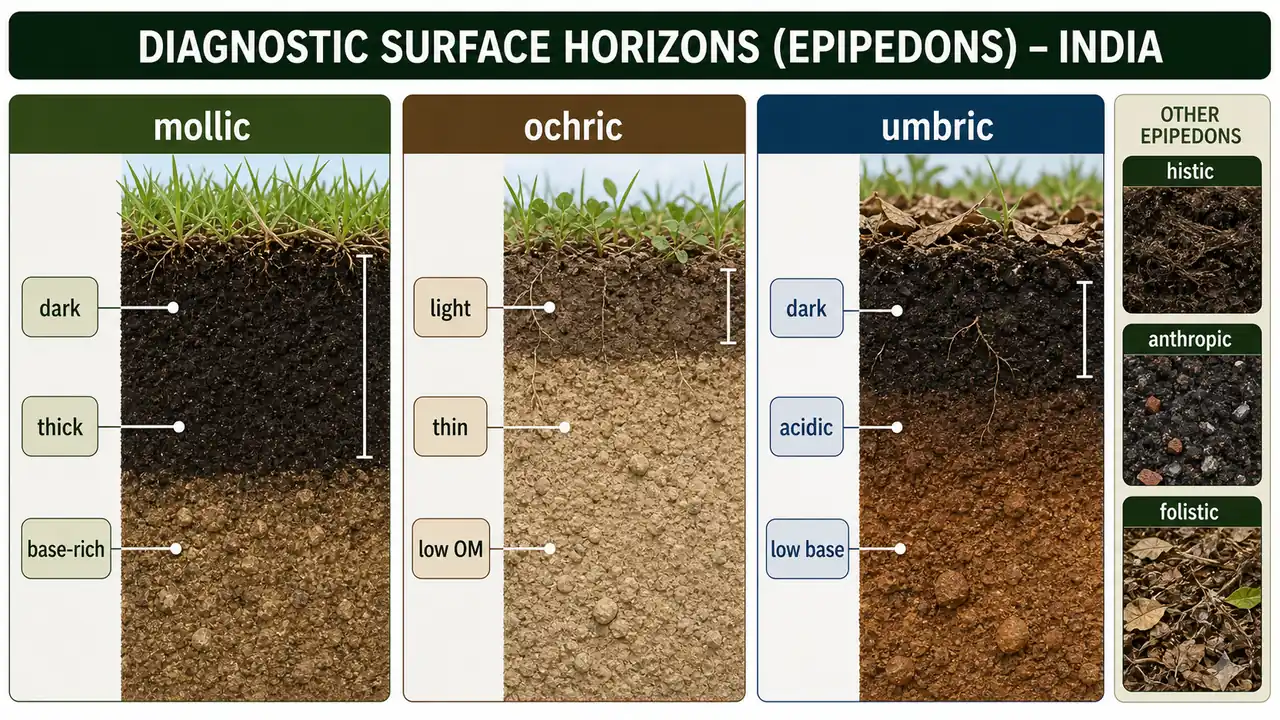
There are 9 epipedons:
| Epipedon | Key Feature | Importance in India |
|---|---|---|
| Mollic | Thick, dark, high base saturation (>50%), humus-rich. Found in Mollisols | Most important |
| Ochric | Too light, too thin, or too low in OM to be mollic | Most common in India |
| Umbric | Similar to mollic but low base saturation (<50%) | Important |
| Histic | Saturated with water; >20% OM. Peaty surface | Found in marshy areas |
| Melanic | Thick, black, high OM; associated with Andisols (volcanic) | Not in India |
| Anthropic | Modified by long-continued human activity | Found in old cultivated areas |
| Folistic | Organic horizon not saturated with water | Forest soils |
| Plaggen | Human-made layer >50 cm from long-term manuring | Europe only |
| Grossarenic | Sandy surface >100 cm thick above argillic horizon | Rare |
IMPORTANT
Among the 9 epipedons, mollic (most important), ochric (most common), and umbric are the three most significant in India.
The 12 Soil Orders
Mnemonic: "A VGHAMI HOUSE" -- Aridisols, Vertisols, Gelisols, Histosols, Alfisols, Mollisols, Inceptisols, Histosols... The full set of 12 is easier to learn from the table below.
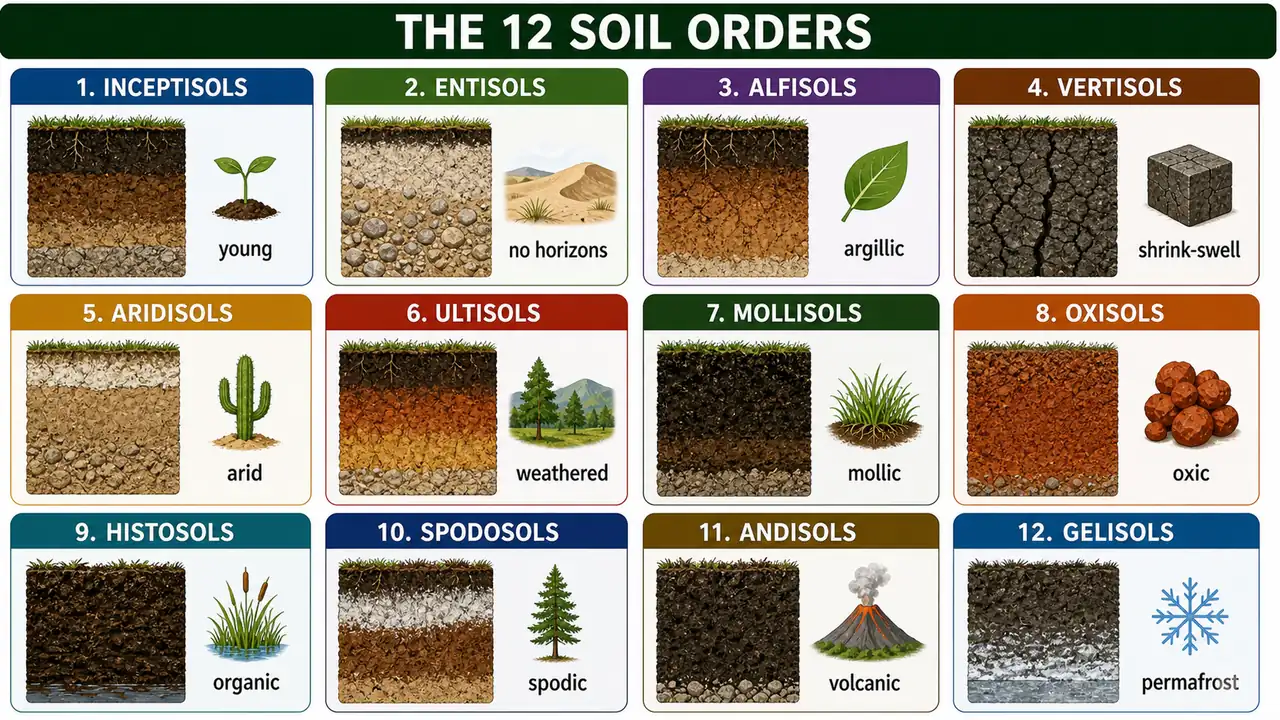
Overview Table
| # | Soil Order | Area in India | % of India | Diagnostic Feature | Key Characteristic |
|---|---|---|---|---|---|
| 1 | Inceptisols | 129.34 mha | 39.74% | Cambic horizon; Ochric/Umbric epipedon | Most widespread in India; young, weakly developed |
| 2 | Entisols | 78.75 mha | 28.08% | No diagnostic horizon; Ochric epipedon | Recently formed; alluvial soils |
| 3 | Alfisols | 42.20 mha | 13.55% | Argillic/nitric horizon; medium-high base saturation | Forest soils; clay-enriched subsoil |
| 4 | Vertisols | 26.62 mha | 8.52% | >30% swelling clay; deep cracks when dry | Black cotton soils; self-ploughing |
| 5 | Aridisols | 13.35 mha | 4.28% | Ochric epipedon; dry soil | Desert soils; salinization |
| 6 | Ultisols | 8.41 mha | 2.51% | Argillic horizon; low base saturation (<35%) | Highly weathered; reddish |
| 7 | Mollisols | 1.64 mha | 0.4% | Mollic epipedon; high base saturation | Most productive soils on Earth |
| 8 | Oxisols | -- | -- | Oxic horizon; highly weathered | Sesquioxide-rich tropical soils |
| 9 | Histosols | -- | -- | >30% organic matter; peat/bog | Organic soils; waterlogged |
| 10 | Spodosols | Not in India | -- | Spodic horizon (Fe, Al, humus accumulation) | Cool humid forests |
| 11 | Andisols | Not in India | -- | Volcanic ash; allophane | High P-fixation |
| 12 | Gelisols | Not in India | -- | Permafrost; cryoturbation | Arctic/Antarctic; permanently frozen |
IMPORTANT
Key soil orders in India by area: Inceptisols (39.74%) > Entisols (28.08%) > Alfisols (13.55%) > Vertisols (8.52%) > Aridisols (4.28%). Gelisols, Andisols, and Spodosols are not found in India.
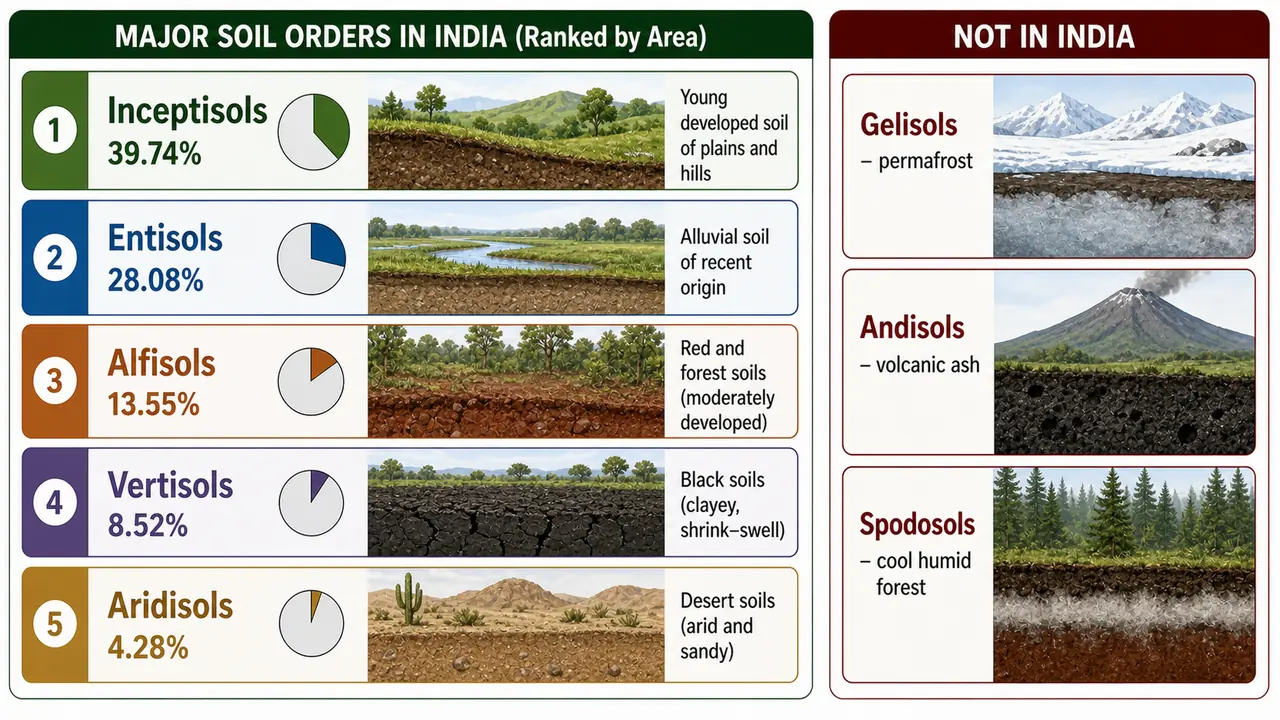
| India recall set | Key fact | Full takeaway |
|---|---|---|
| Inceptisols | 39.74% | Most widespread soil order in India |
| Entisols | 28.08% | Second most widespread; recently formed alluvial soils are a major example |
| Alfisols | 13.55% | Third by area; moderately developed forest-associated soils |
| Vertisols | 8.52% | Fourth by area; black cracking shrink-swell soils |
| Aridisols | 4.28% | Fifth by area; desert soils of arid regions |
| Not in India | Gelisols, Andisols, Spodosols | Remember the exam shorthand: these three soil orders are absent from India |
1. Inceptisols -- The Most Widespread Soil in India
Latin inceptum = beginning. Young soils showing the beginning of horizon formation.
| Feature | Detail |
|---|---|
| Development | Moderate; more developed than Entisols but not fully mature |
| Diagnostic | Ochric/Umbric epipedon; Cambic horizon |
| Climate | Found in humid regions |
| Area in India | 39.74% (129.34 mha) -- largest |

Farm example: The alluvial soils of the middle Gangetic plain (Bihar, eastern UP) are mostly Inceptisols -- young soils with moderate development, suitable for rice-wheat cropping.
2. Entisols -- Recently Formed Soils
From "recent." Soils with virtually no horizon development.
| Feature | Detail |
|---|---|
| Development | Minimal; no diagnostic horizons |
| Common in | Floodplains, steep slopes, sand dunes |
| Diagnostic | Ochric epipedon; no subsurface diagnostic horizon |
| Area in India | 28.08% (78.75 mha) |

Farm example: Fresh alluvial deposits in the Brahmaputra floodplain (Assam) are Entisols -- constantly receiving new sediment prevents horizon development.
3. Alfisols -- Forest Soils with Clay-Enriched Subsoil
| Feature | Detail |
|---|---|
| Development | Moderate; clay-enriched subsoil (argillic horizon) |
| Base saturation | Moderate to high (>35%) |
| Climate | Sub-humid to humid; under deciduous forests |
| More weathered than | Inceptisols; less than Ultisols |
| Area in India | 13.55% (42.20 mha) |

Farm example: Red soils of the Chotanagpur plateau (Jharkhand) are Alfisols -- their clay-enriched subsoil helps retain moisture for upland rice.
4. Vertisols -- The Self-Ploughing Black Soils
Latin verto = to turn. Dark or black swelling clays.
| Feature | Detail |
|---|---|
| Dominant clay | Montmorillonite (smectite) |
| Key property | Shrink-swell; deep cracks (30-45 cm) when dry |
| Self-ploughing | Surface soil falls into cracks; swelling pushes material up |
| Clay content | >30% |
| Area in India | 8.52% (26.62 mha) |

Farm example: The black cotton soils of Maharashtra, MP, and Gujarat are classic Vertisols. ICRISAT developed the Broad Bed and Furrow (BBF) system specifically for managing these difficult soils.
5. Aridisols -- Desert Soils
| Feature | Detail |
|---|---|
| Climate | Arid regions (<250 mm rainfall) |
| Problems | Salinization; low organic matter |
| Diagnostic | Ochric epipedon; sometimes argillic horizon |
| Accumulation | Salts and calcium carbonate |
| Area in India | 4.28% (13.35 mha) |

Farm example: The Thar desert soils of western Rajasthan are Aridisols. With irrigation from the Indira Gandhi Canal, these soils can produce crops if salinity is managed.
6. Ultisols -- Highly Weathered Acidic Soils
| Feature | Detail |
|---|---|
| Weathering | Highly weathered; reddish colour from residual Fe/Al oxides |
| Base saturation | Low (<35%) -- highly leached |
| Diagnostic | Argillic horizon; low base saturation |
| Fertility | Low due to intense leaching |
| Area in India | 2.51% (8.41 mha) |

Farm example: The deeply weathered laterite soils of the Western Ghats (Kerala, Karnataka) are Ultisols. Heavy rainfall has leached away bases, making them acidic and nutrient-poor.
7. Mollisols -- The Most Productive Soils on Earth
| Feature | Detail |
|---|---|
| Key feature | Most productive soils of the Earth |
| Surface | Thick, dark, humus-rich (mollic epipedon) |
| Base saturation | High |
| Vegetation | Steppes and prairies (grasslands) |
| Area in India | 0.4% (1.64 mha) |

Farm example: The foothill soils of the Shivalik range (Uttarakhand) have Mollisol patches -- deep, dark, fertile soils formed under grassland vegetation.
8. Oxisols -- Extremely Weathered Tropical Soils
| Feature | Detail |
|---|---|
| Weathering | Most extreme stage; nearly all weatherable minerals broken down |
| Dominant minerals | Iron and aluminium oxides (sesquioxides) |
| Colour | Red and yellowish |
| Fertility | Low despite deep profiles |
| Diagnostic | Oxic horizon; no argillic horizon |
| In India | Not significant |

9. Histosols -- Organic/Peat Soils
| Feature | Detail |
|---|---|
| OM content | >20% (or >30% by some definitions) |
| Formation | Waterlogged conditions slow decomposition; peat accumulates |
| Properties | Extremely lightweight; very high water-holding capacity |
| Challenges | Acidic; poor bearing strength |
| Greek | Histo = tissue |

Farm example: The Kuttanad (below-sea-level farming) region of Kerala has Histosol-like soils where paddy is cultivated in peaty, waterlogged conditions.
10. Spodosols -- Soils with Subsurface Accumulation
| Feature | Detail |
|---|---|
| Key feature | Spodic horizon -- subsurface accumulation of Fe, Al, and humus |
| Climate | Cool, humid forests with sandy parent material |
| Process | Leaching from surface, redeposition in subsoil |
| In India | Not found |

11. Andisols -- Volcanic Ash Soils
| Feature | Detail |
|---|---|
| Parent material | Volcanic ash |
| Dominant minerals | Allophane or Al-humic complexes |
| Properties | Very low bulk density; high water-holding; high P-fixation |
| In India | Not found |

12. Gelisols -- Permanently Frozen Soils
| Feature | Detail |
|---|---|
| Latin | gelare = to freeze |
| Key feature | Permafrost within 2 m of surface |
| Process | Cryoturbation (frost churning) mixes soil horizons |
| Also known as | Crysols |
| Location | Arctic, Antarctic, extremely high elevations |
| In India | Not found |

Special Soil Features
Cat Clays

Wet clay soils high in reduced forms of sulphur (iron sulphides like pyrite, FeS₂). When drained, pyrite oxidizes to produce sulphuric acid, dropping pH below 3.5. The name comes from the clay-sulphate surface that shines like a cat's eye.
Farm example: Acid sulphate soils (cat clays) in coastal Kerala become extremely acidic when drained, making them hostile for most crops except paddy under submerged conditions.
Catena

A sequence of soils of similar age, parent material, and climate, but with different characteristics due to variation in relief and drainage. Illustrates how topography alone creates different soils on the same landscape -- from well-drained soils on ridges to waterlogged soils in valley bottoms.
Farm example: In a single watershed of the Deccan plateau, the hilltop has thin, gravelly red soil (Alfisol), the midslope has deeper red soil, and the valley bottom has black soil (Vertisol) -- a classic catena.
Caliche

A hardened layer near the surface, cemented by secondary carbonates of Ca and Mg precipitated from soil solution. Forms in arid and semi-arid regions where evaporation exceeds precipitation. When thick, caliche impedes root penetration and water infiltration.
Farm example: In parts of western Rajasthan and Gujarat, caliche (kankar) layers restrict root growth of fruit trees, requiring deep chiseling before planting.
Exam Tips and Mnemonics
- 12 soil orders mnemonic: "I Eat All Vegetables And Understand My Old Home Smells Awful Good" -- Inceptisols, Entisols, Alfisols, Vertisols, Aridisols, Ultisols, Mollisols, Oxisols, Histosols, Spodosols, Andisols, Gelisols
- India's top 5 by area: "I EAT Very Adequate food" -- Inceptisols (39.74%) > Entisols (28.08%) > Alfisols (13.55%) > Vertisols (8.52%) > Aridisols (4.28%)
- Not found in India: Gelisols, Andisols, Spodosols -- "GAS not in India"
- Most productive soil: Mollisols (grassland soils)
- Self-ploughing soil: Vertisols (montmorillonite clays, deep cracks)
- 9 epipedons: Mollic (important), Ochric (most common in India), Umbric (important)
- Pedon = smallest 3D soil unit; Series = basic unit of classification
- Cat clays = acid sulphate soils; pH < 3.5 when drained
- Catena = soil sequence due to topography changes
- Caliche = carbonate-cemented layer in arid soils
Summary Cheat Sheet
| Concept / Topic | Key Details |
|---|---|
| Soil Taxonomy | USDA system based on 7th Approximation; published 1960 |
| Basis | Morphology (measurable properties), not genesis |
| Nomenclature | Latin and Greek words — universal |
| 6 hierarchical categories | Order → Sub-order → Great group → Sub-group → Family → Series (basic unit) |
| 12 soil orders worldwide | Mnemonic: "I Eat All Vegetables And Understand My Old Home Smells Awful Good" |
| Pedon | Smallest 3D soil unit; 1–10 m² |
| 9 epipedons | Mollic (most important), Ochric (most common in India), Umbric |
| Inceptisols | 39.74% of India; most widespread; weakly developed; cambic horizon |
| Entisols | 28.08%; recently formed; no diagnostic horizon; alluvial soils |
| Alfisols | 13.55%; argillic horizon; medium-high base saturation; red/yellow soils |
| Vertisols | 8.52%; >30% swelling clay; deep cracks; self-ploughing; black cotton soils |
| Aridisols | 4.28%; desert soils; dry regime; salinization |
| Ultisols | 2.51%; highly weathered; low BS (<35%); laterite soils |
| Mollisols | 0.4%; most productive soils on Earth; mollic epipedon; grassland soils |
| Oxisols | Extremely weathered; sesquioxide-rich; tropical |
| Histosols | Organic/peat soils; >30% OM |
| Not in India | Gelisols, Andisols, Spodosols ("GAS not in India") |
| India top 5 by area | Inceptisols > Entisols > Alfisols > Vertisols > Aridisols |
| Cat clays | Acid sulphate soils; pyrite (FeS₂); pH <3.5 when drained |
| Catena | Soil sequence due to topography variation; same parent material/climate |
| Caliche | Hardened layer cemented by CaCO₃/MgCO₃; arid/semi-arid regions |
| Series | Basic unit of soil classification |
| Spodosols | Fe/Al/humus subsurface accumulation; Exam tip: Not in India |
| Andisols | Volcanic ash soils; Exam tip: Not in India |
| Gelisols | Permafrost; frozen soils; Exam tip: Not in India |