👾 Soil Organic Matter: The Engine of Soil Fertility
Formation, decomposition, humus, C:N ratio, mineralization, immobilization, carbon cycle, and the Van Bemmelen factor for competitive exams
A farmer in Punjab incorporates rice straw into his field before wheat sowing. Within weeks, his wheat seedlings turn yellow -- showing nitrogen deficiency despite adequate fertilizer. Why? The rice straw has a wide C:N ratio (80:1), causing soil microbes to consume all available nitrogen for decomposition, leaving none for the crop. This phenomenon -- nitrogen immobilization -- is one of many powerful effects of soil organic matter on agriculture.
What is Soil Organic Matter?
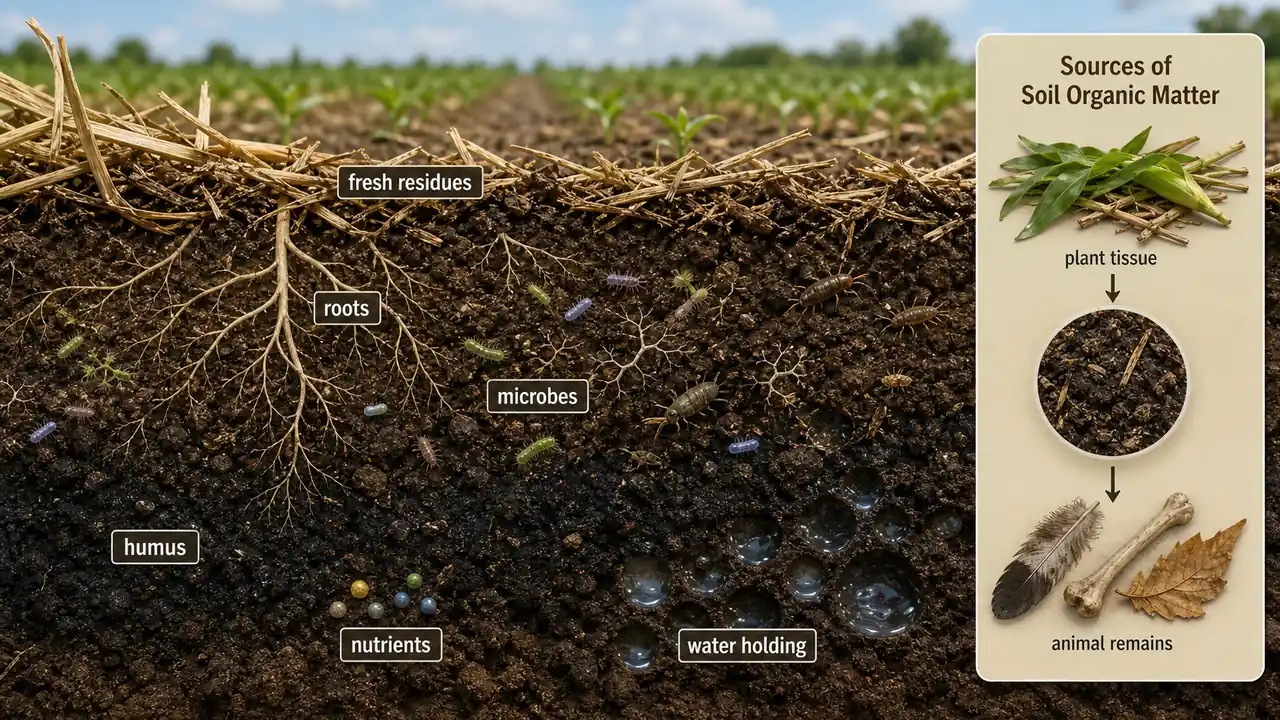
| Role | How it Helps |
|---|---|
| Physical condition | Improves soil structure, drainage, and aeration |
| Chemical properties | Increases CEC and buffering capacity |
| Energy source | Fuels soil microorganisms |
| Nutrient supply | Releases N, P, S, and micronutrients |
| Water holding | Humus holds 4-5 times its weight in water |
Sources of Organic Matter
| Source | Contribution |
|---|---|
| Plant tissue | Major source (roots, leaves, stems, crop residues) |
| Animals | Secondary source (waste products, dead bodies) |
Indian soils have low OM content (~0.5%) because of the high rate of decomposition under tropical and sub-tropical climate. Warm temperatures and intense microbial activity break down organic matter faster than it accumulates.
Pro Content Locked
Upgrade to Pro to access this lesson and all other premium content.
Charged once for one year · ₹1188 total
Save ₹100/month vs ₹2388/year launch price
- All Agriculture & Banking Courses
- AI Lesson Questions (100/day)
- AI Doubt Solver (50/day)
- Glows & Grows Feedback (30/day)
- AI Section Quiz (20/day)
- 22-Language Translation (100/day)
- Recall Questions (20/day)
- AI Quiz (15/day)
- AI Quiz Paper Analysis (100/day)
- AI Step-by-Step Explanations (100/day)
- Spaced Repetition Recall (FSRS)
- AI Tutor
- Immersive Text Questions
- Audio Lessons — Hindi & English
- Mock Tests & Previous Year Papers
- Summary & Mind Maps
- XP, Levels, Leaderboard & Badges
- Generate New Classrooms
- Voice AI Teacher (AgriDots Live)
- AI Revision Assistant
- Knowledge Gap Analysis
- Interactive Revision (LangGraph)
🔒 Secure one-time yearly payment via Razorpay · No hidden fees
A farmer in Punjab incorporates rice straw into his field before wheat sowing. Within weeks, his wheat seedlings turn yellow -- showing nitrogen deficiency despite adequate fertilizer. Why? The rice straw has a wide C:N ratio (80:1), causing soil microbes to consume all available nitrogen for decomposition, leaving none for the crop. This phenomenon -- nitrogen immobilization -- is one of many powerful effects of soil organic matter on agriculture.
What is Soil Organic Matter?
| Role | How it Helps |
|---|---|
| Physical condition | Improves soil structure, drainage, and aeration |
| Chemical properties | Increases CEC and buffering capacity |
| Energy source | Fuels soil microorganisms |
| Nutrient supply | Releases N, P, S, and micronutrients |
| Water holding | Humus holds 4-5 times its weight in water |
Sources of Organic Matter
| Source | Contribution |
|---|---|
| Plant tissue | Major source (roots, leaves, stems, crop residues) |
| Animals | Secondary source (waste products, dead bodies) |
Indian soils have low OM content (~0.5%) because of the high rate of decomposition under tropical and sub-tropical climate. Warm temperatures and intense microbial activity break down organic matter faster than it accumulates.
Fractions of Soil Organic Matter
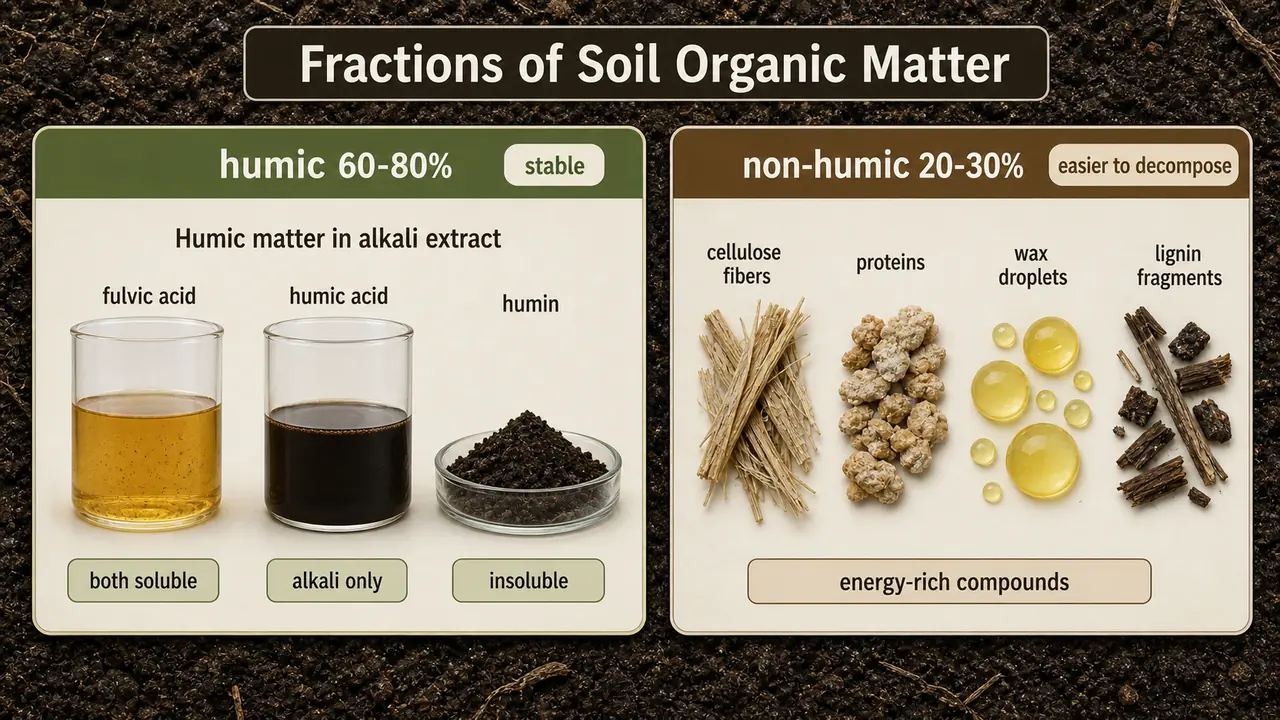
| Fraction | Solubility | Proportion |
|---|---|---|
| Humic matter | Soluble in alkali | 60-80% of SOM |
| Non-humic matter | Insoluble | 20-30% of SOM |
Humic Group (60-80% of SOM)
The most complex and most resistant fraction to microbial attack. Humic substances have aromatic ring structures including polyphenols and polyquinones. Formed by decomposition, synthesis, and polymerization.
| Humic Substance | Molecular Weight | Solubility | Colour | Resistance to Decomposition |
|---|---|---|---|---|
| Fulvic acid | Lowest | Soluble in both acid and alkali | Light yellow | Least resistant; highest CEC per unit weight |
| Humic acid | Medium | Soluble in alkali only (acid insoluble) | Dark brown to black | Intermediate |
| Humin | Highest | Insoluble in both acid and alkali | Dark | Most resistant; most stable |
TIP
Mnemonic for solubility: "Fulvic = Full soluble" (both acid and alkali), "Humic = Half" (alkali only), "Humin = Hardened" (insoluble in both). Resistance increases in the same order: Fulvic < Humic < Humin.
Non-Humic Group (20-30% of SOM)
Less complex and less resistant to microbial attack. Includes polysaccharides, proteins, carbohydrates, lignins, fats, waxes, resins, and tannins. These compounds serve as important energy sources for microbes and contribute to aggregate stability through their sticky, glue-like properties.
Factors Affecting Soil Organic Matter
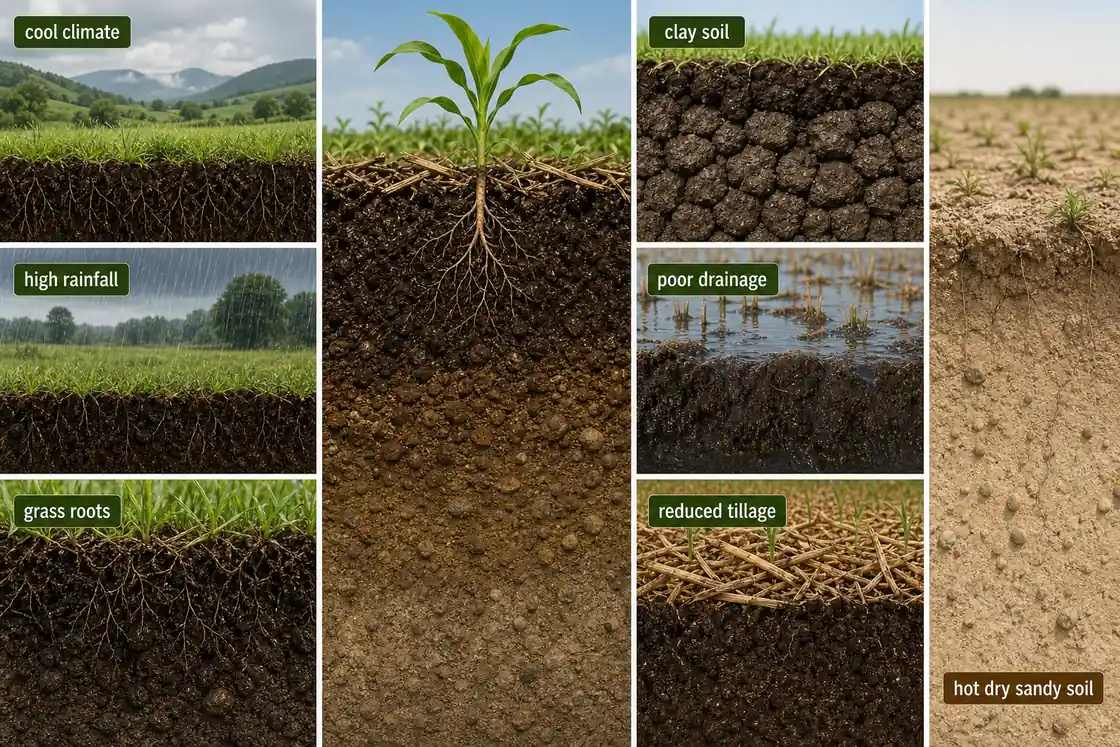
| Factor | Effect | Agricultural Example |
|---|---|---|
| Temperature | For each 10 degree C decline in mean annual temperature, OM increases 2-3 times | Himalayan soils have much higher OM than plains |
| Rainfall | Higher rainfall = more OM | Assam soils are richer in OM than Rajasthan soils |
| Natural vegetation | Grasslands > Forests in OM | Dense fibrous roots of grasses add OM directly into soil |
| Texture | Fine-textured (clay) soils > coarse (sandy) soils | Clay protects OM by adsorption and entrapment in micro-aggregates |
| Drainage | Poorly drained soils > well-drained soils | Peat soils accumulate OM under waterlogged conditions |
| Tillage | Conventional tillage reduces OM; conservation tillage maintains it | Zero-till wheat in IGP preserves soil OM |
| Crop rotation | Cereal-legume rotations > monoculture | Legumes add N through BNF, promoting more biomass and residues |
Decomposition of Soil Organic Matter
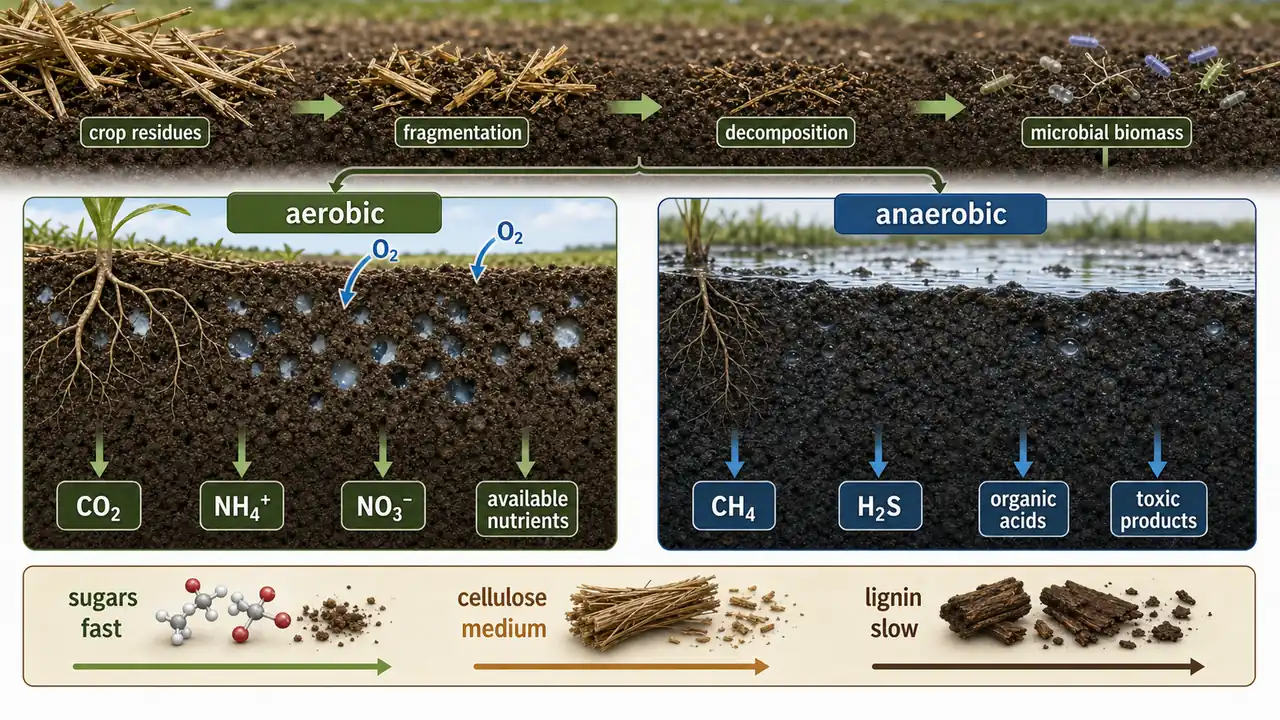
Rate of Decomposition by Compound
| Compound | Decomposition Rate |
|---|---|
| Sugars, starches, simple proteins | Very rapid |
| Hemicellulose, cellulose, proteins | Intermediate |
| Fats, waxes, lignins | Very slow |
General Reactions During Decomposition
- Enzymatic oxidation releases CO₂, water, energy, and heat
- Essential elements released (N, P, S) and immobilized through microbial cycling
- Resistant compounds formed by modification or microbial synthesis
Products of Decomposition
| Condition | Products | Agricultural Significance |
|---|---|---|
| Aerobic | CO₂, NH₄⁺, NO₃⁻, H₂PO₄⁻, SO₄²⁻, H₂O, Ca, Mg, Fe, Cu, Zn | Plant-available forms -- beneficial decomposition |
| Anaerobic | CH₄, organic acids (lactic, butyric), NH₄⁺, H₂S, ethylene | Many products are toxic to plant roots -- harmful |
Farm example: The foul smell in waterlogged paddy fields comes from H₂S produced under anaerobic decomposition. This is why most crops (except rice) suffer in waterlogged conditions.
Key Decomposition Processes
Ammonification
Conversion of organic nitrogenous compounds (amino acids, amides) into ammonia (NH₃/NH₄⁺). Carried out by heterotrophic microbes under aerobic conditions. This is the first step in making organic nitrogen available to plants.
Nitrification
Conversion of ammonia to nitrite (NO₂⁻) and then to nitrate (NO₃⁻) -- an aerobic process by autotrophic bacteria.
| Step | Bacteria | Reaction |
|---|---|---|
| Step 1 | Nitrosomonas | NH₄⁺ → NO₂⁻ |
| Step 2 | Nitrobacter | NO₂⁻ → NO₃⁻ |
Nitrate (NO₃⁻) is the preferred form of nitrogen for most plants.

Denitrification
Conversion of soil nitrate to gaseous nitrogen (N₂) or nitrous oxide (N₂O). Carried out by anaerobic bacteria (like Pseudomonas) using nitrate instead of oxygen for respiration.
| Conditions promoting denitrification | Effect |
|---|---|
| Waterlogging | Major N loss pathway |
| High pH | Increases denitrification rate |

Farm example: In poorly drained paddy fields of eastern UP, significant nitrogen is lost through denitrification, requiring higher fertilizer doses.
Breakdown of Specific Compounds
| Compound | Pathway | Key Agent |
|---|---|---|
| Proteins | Proteins → Amino acids (Aminization) → NH₃ (Ammonification) | Heterotrophic bacteria |
| Cellulose | Cellulose → Cellobiose → Glucose → Organic acids → CO₂ + H₂O | Fungi act first, then bacteria |
| Hemicellulose | Decomposes faster than cellulose; → sugars + uronic acids | Various microbes |
| Starch | Starch → Maltose (by amylase) → Glucose (by maltase) | Bacteria, fungi |
| Lignin | Decomposes slowest; contributes significantly to humus formation | White-rot fungi |
| S-compounds | → SO₄²⁻ + H⁺ + energy | Sulphur oxidizing bacteria |
| P-compounds | → H₂PO₄⁻ and HPO₄²⁻ | Microbes with phosphatase enzymes |
| Wood | Decomposed by | Actinomycetes |


Factors Affecting Decomposition
| Factor | Optimum/Effect |
|---|---|
| Temperature | Most active at 24-35 degree C; cold retards decomposition |
| Moisture | Near or slightly wetter than field capacity is optimal |
| Nutrients | Lack of N slows decomposition (microbes need N for cell proteins) |
| Soil pH | Most microbes grow best at pH 6-8; severely inhibited below 4.5 |
| Texture | Clay soils retain more OM (clay protects from microbial attack) |
| Other | Toxic levels of Al, Mn, B, Se, Cl; excessive salts; shade |
Farm example: OM content of Indian soils is generally low (~0.5%) because tropical temperatures accelerate decomposition. Except in hilly regions, cultivated soils rarely exceed 1% OM.
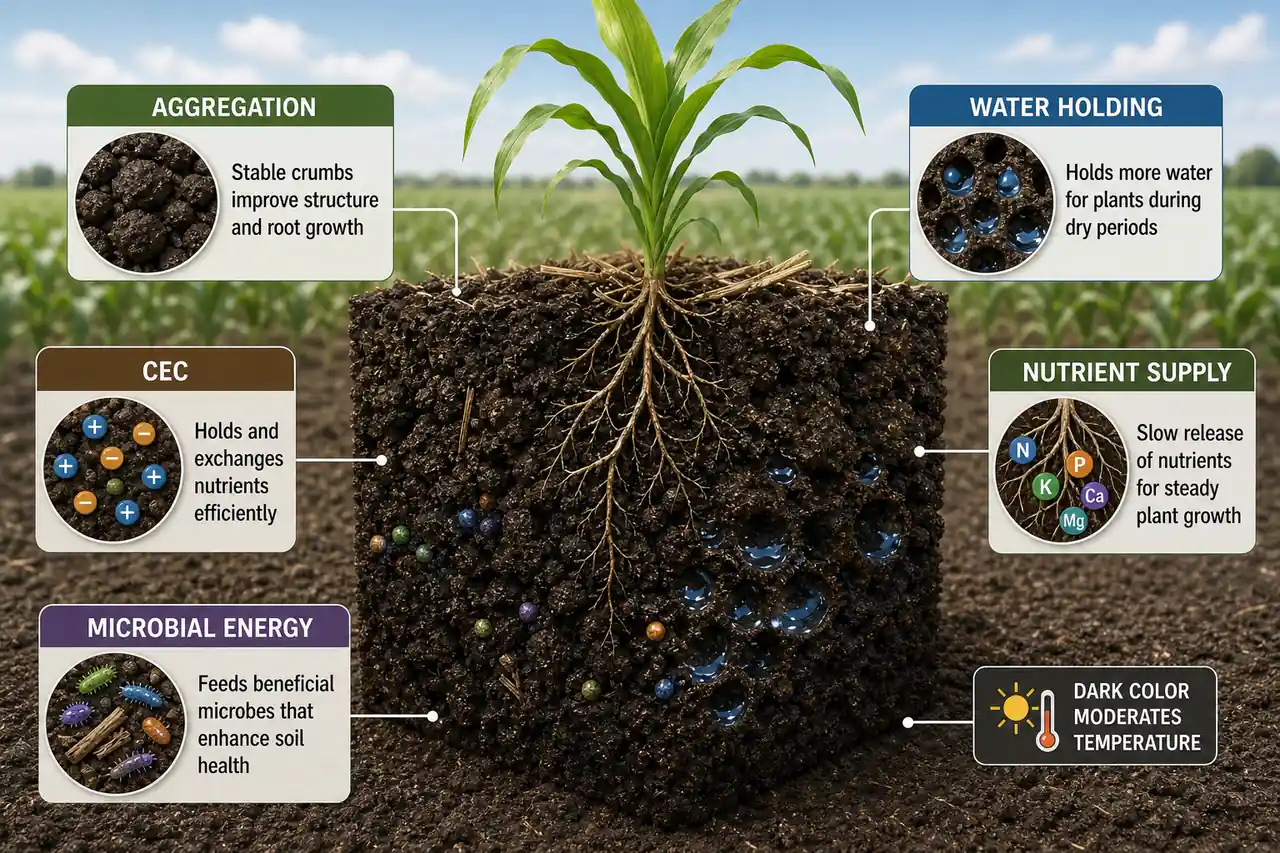
Role of Organic Matter in Agriculture
| Role | Contribution |
|---|---|
| Nutrient supply | 95% of soil N and 33% of soil P come from OM |
| Soil structure | Improves aggregation and stability |
| Water holding | Humus holds 4-5 times its weight in water |
| CEC | Humus CEC: 150-300 cmol/kg -- highest of any colloid |
| Buffering capacity | Resists pH changes |
| Microbial energy | Fuels decomposers and nutrient cyclers |
| Temperature regulation | Dark colour absorbs heat; moisture moderates fluctuations |
Humus
Humus is a complex, resistant mixture of brown or dark brown amorphous colloidal organic substance resulting from microbial decomposition and synthesis.
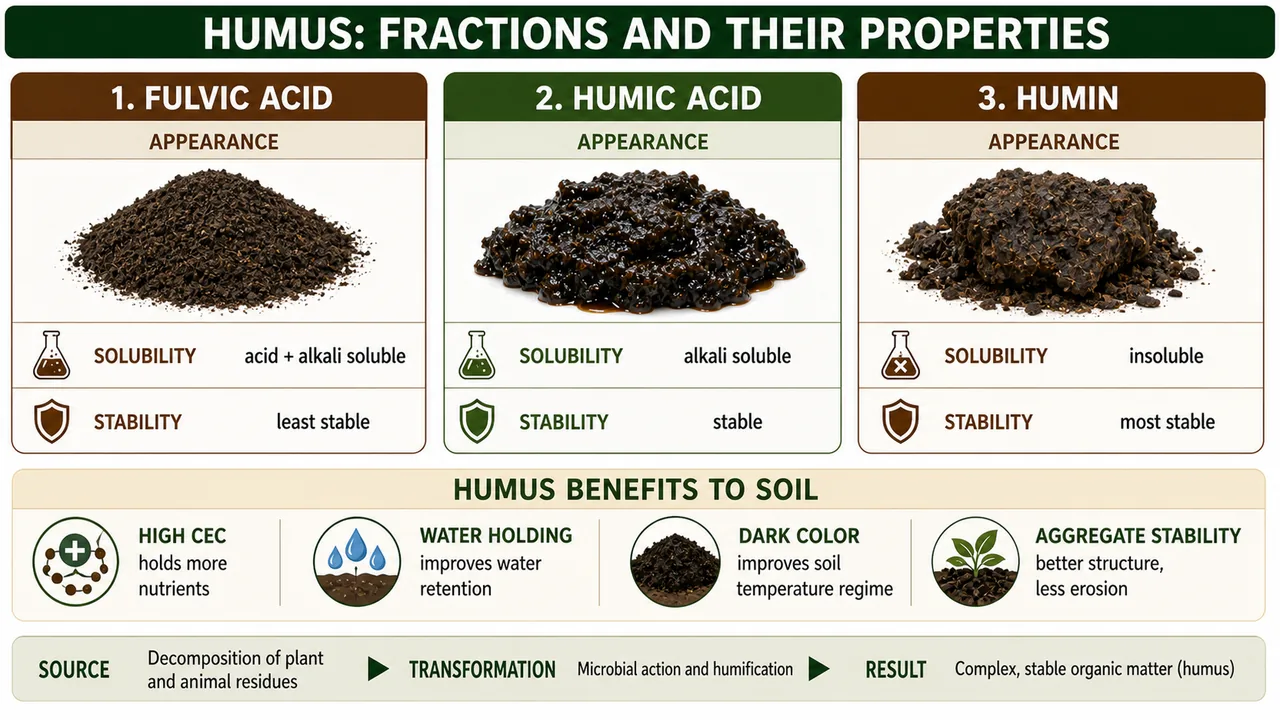
| Property | Detail |
|---|---|
| Composition | 40-45% lignin, 30-33% proteins, rest fats/waxes/residual materials |
| Alternative name | Ligno-Protein Complex (lignin + protein = ~70-80%) |
| C:N ratio | 10:1 |
| CEC | 150-300 cmol/kg |
| WHC | 4-5 times higher than mineral soil |
| Effect on structure | Favourable effect on aggregate formation and stability |
| Colour | Imparts black colour to soils |
| Anion adsorption | Can adsorb PO₃⁻ anions but no other anions |
| Nature | Dynamic -- continuously formed and simultaneously decomposed |
| Mar | Raw humus, a type of forest humus of unincorporated organic material |
Humus Formation
Two types of biochemical reactions:
1. Decomposition: Plant residue chemicals (including lignin) are broken down by soil microbes into simpler organic compounds. These are metabolized into new compounds in microbial body tissue.
2. Synthesis: Breakdown products of lignin (phenols, quinones) undergo polymerization to form polyphenols and polyquinones. These interact with N-containing amino compounds to form resistant humus. Colloidal clays encourage this polymerization.
Humification, Mineralization, and Immobilization
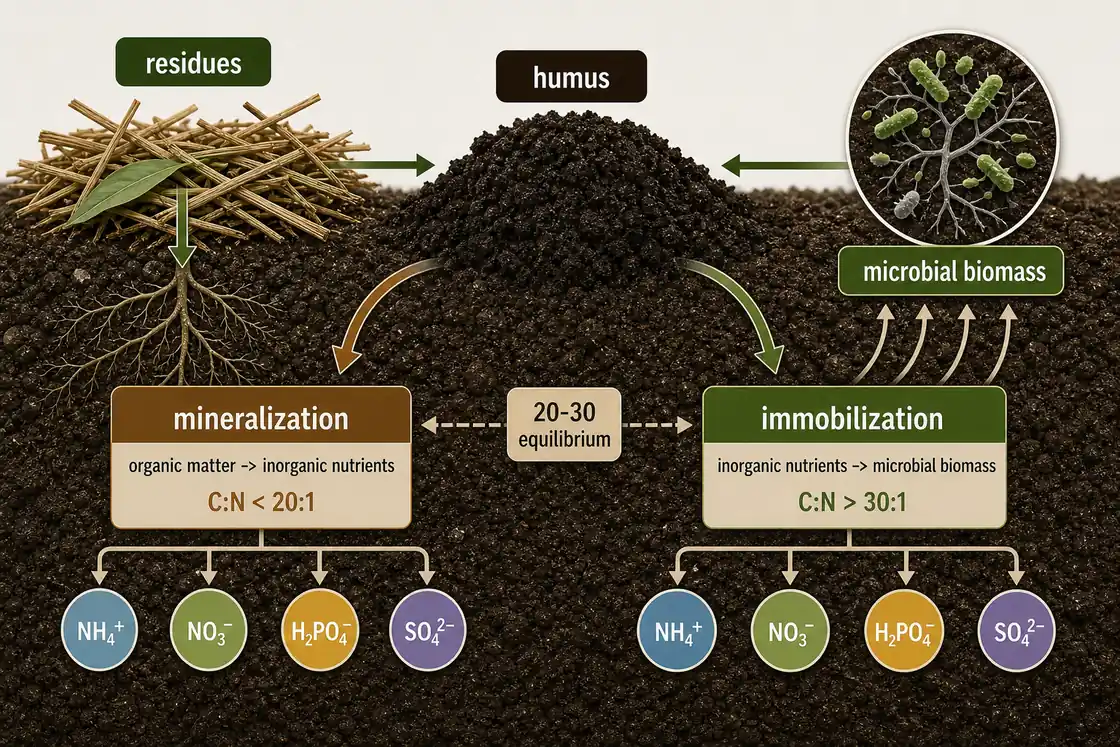
| Organic Matter Process Image Item | Full Content |
|---|---|
| Humification | Fresh residues are transformed into more stable humus, which resists rapid decomposition and improves long-term soil fertility |
| Mineralization | Organic nutrients are converted into plant-available inorganic forms such as ammonium, nitrate, phosphate, and sulphate |
| Immobilization | Soil microbes temporarily lock inorganic nutrients inside their biomass while decomposing residues with a wide C:N ratio |
| Wide C:N residues | High-carbon materials such as straw encourage immobilization and can cause temporary nitrogen deficiency in crops |
| Balanced or narrow C:N residues | Lower C:N materials decompose with less nitrogen stress and favor earlier mineralization |
| Main lesson | Organic matter breakdown can either release nutrients to plants or tie them up temporarily depending on residue quality and microbial demand |
These three processes govern nutrient availability to plants:
| Process | Definition | Direction | C:N Ratio Trigger |
|---|---|---|---|
| Humification | Organic residues transformed into stable humus | Organic → Humus | Continuous process |
| Mineralization | Organic forms of C, N, P, S converted to inorganic (mineral) forms | Organic → Inorganic (releases nutrients) | C:N < 20:1 (net N release) |
| Immobilization | Inorganic forms converted to organic forms by microbes | Inorganic → Organic (locks up nutrients) | C:N > 30:1 (net N consumption) |
IMPORTANT
The critical C:N ratio of 20:1 is frequently tested. Below 20:1 = net mineralization (N released). Above 30:1 = net immobilization (N locked up). Between 20-30 = equilibrium.
TIP
Humification = organic residues turning INTO humus. Mineralization = humus/OM breaking DOWN into inorganic nutrients. They are opposite processes occurring simultaneously.
Humification results in products that are highly resistant to further decomposition (turnover time: hundreds to thousands of years).
Theories of Humus Formation
| Theory | Proposed By | Key Idea |
|---|---|---|
| Lignin theory | Waksman (1936) | Humus from incomplete degradation of lignin; modified lignin + microbial proteins |
| Kononova's theory | Kononova | Humus from cellulose-decomposing mycobacteria before lignin decomposition |
| Polyphenol theory | Flaig and Sochtig (1964) | Phenolic materials from lignin → oxidized to quinones → condensed with amino acids, nucleic acid, phospholipids → humus. Most widely accepted |
Carbon Cycle
Carbon is continuously cycled: atmospheric CO₂ is fixed by plants through photosynthesis, enters soil as organic matter, is decomposed by microbes releasing CO₂, and the cycle repeats.

C:N Ratio
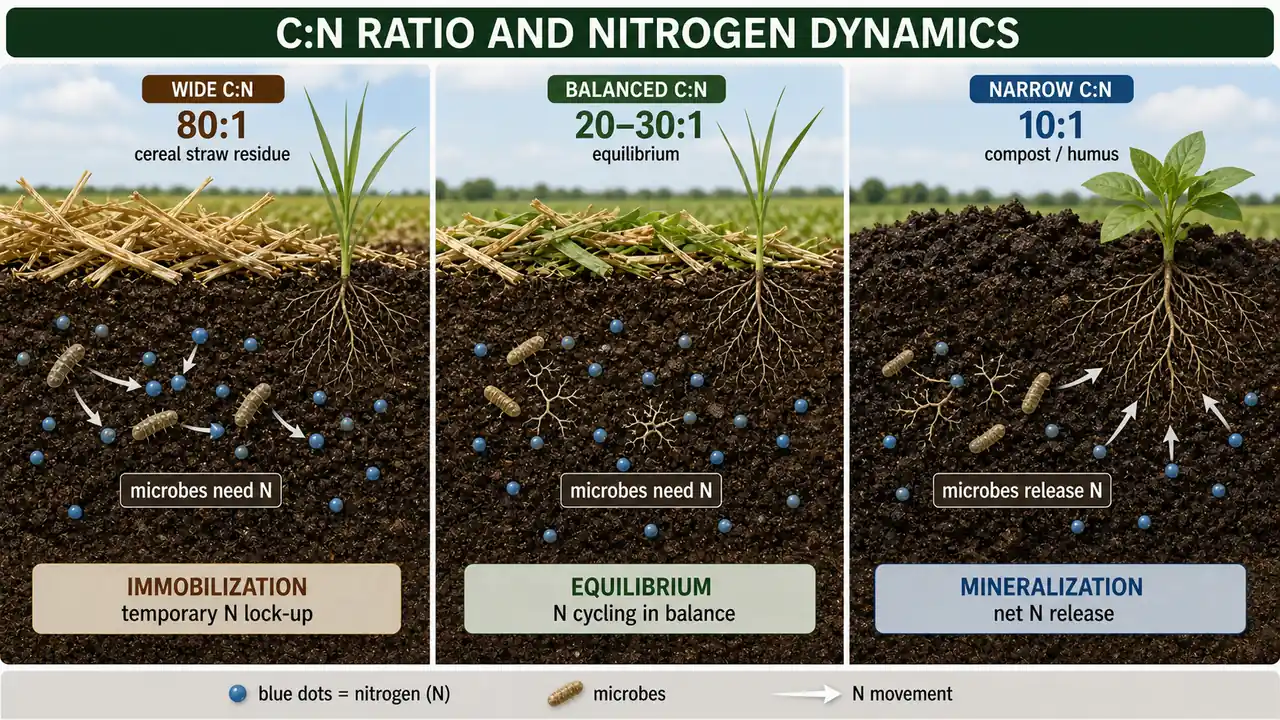
| Event | C:N Ratio | What Happens |
|---|---|---|
| Fresh plant residues added | Wide (40-80:1) | Microbes multiply, consume all available N |
| Decomposition proceeds | Narrows gradually | C lost as CO₂, N conserved |
| Humus stage reached | Narrow (10:1) | Stable; N begins to be released |
C:N Ratios of Various Materials
| Material | C:N Ratio |
|---|---|
| Micro-organisms (Bacteria) | 4-5:1 |
| Fungi | 10:1 |
| Humus / Well decomposed compost | 10:1 |
| Cultivated / Arable soil | 8-15:1 |
| Indian soils | 8.5-12:1 |
| FYM (Farm Yard Manure) | 20-30:1 |
| Legumes & Young green leaves | 20-30:1 |
| Maize / Sorghum straw | 60:1 |
| Oat straw | 70:1 |
| Cereal straw (Wheat / Rice) | 80:1 |
| Rye straw | 82:1 |
| Sawdust (Fresh) | 500-600:1 |
IMPORTANT
Key exam values: Bacteria = 4-5:1, Fungi and Humus = 10:1, FYM and Legumes = 20-30:1, Cereal straw = 80:1, Sawdust = 400-600:1. Optimum C:N ratio = 10-12:1. Lower C:N promotes vegetative growth; higher C:N promotes flowering.
C:N Ratio and Nitrogen Dynamics
| C:N Ratio | N Status | Effect |
|---|---|---|
| < 20:1 | Net mineralization | N released -- available to plants |
| 20-30:1 | Equilibrium | Mineralization and immobilization balance |
| > 30:1 | Net immobilization | N locked up in microbial biomass -- unavailable to plants |
Farm example: When rice straw (C:N 80:1) is incorporated before wheat sowing, microbes consume all available soil N, causing temporary N starvation in wheat seedlings. Adding 20-25 kg N/ha extra compensates for this immobilization.
Practical Significance of C:N Ratio
| Fact | Detail |
|---|---|
| Older plants | Wider C:N ratio → longer period of nitrate suppression |
| Leguminous tissues | Narrow C:N → rapid decomposition → quick N release |
| OM cannot be increased without | Simultaneously increasing organic nitrogen |
| C:N ratio in arid soils | Lower than humid soils |
| C:N ratio in subsoil | Smaller than topsoil |
| Material | C : N Ratio |
|---|---|
| Humus | 10 : 1 |
| Normal Soil / Cultivated soils ranges (Due to climatic variations) | 8 : 1 to 15 : 1; Average: 10 : 1 to 12 : 1 |
| Legumes | 20 : 1 to 30 : 1 |
| Cereals | 90 : 1 |
| FYM | 100 : 1 |
| Sawdust | 400 : 1 (Maximum) |
| Microorganisms | 4 : 1 to 9 : 1 (Minimum) |
Van Bemmelen Factor
58 g of Carbon is present in 100 g of Organic Matter. Therefore:
1 g C = 1.72 g OM
Organic Matter = Organic Carbon x 1.724
1.724 is called the Van Bemmelen Factor, based on the assumption that organic matter contains 58% carbon (100/58 = 1.724).
IMPORTANT
The Van Bemmelen Factor (1.724) is a frequently tested value. OM = OC x 1.724 and C:OM = 1:1.72.
Muck and Peat Soils
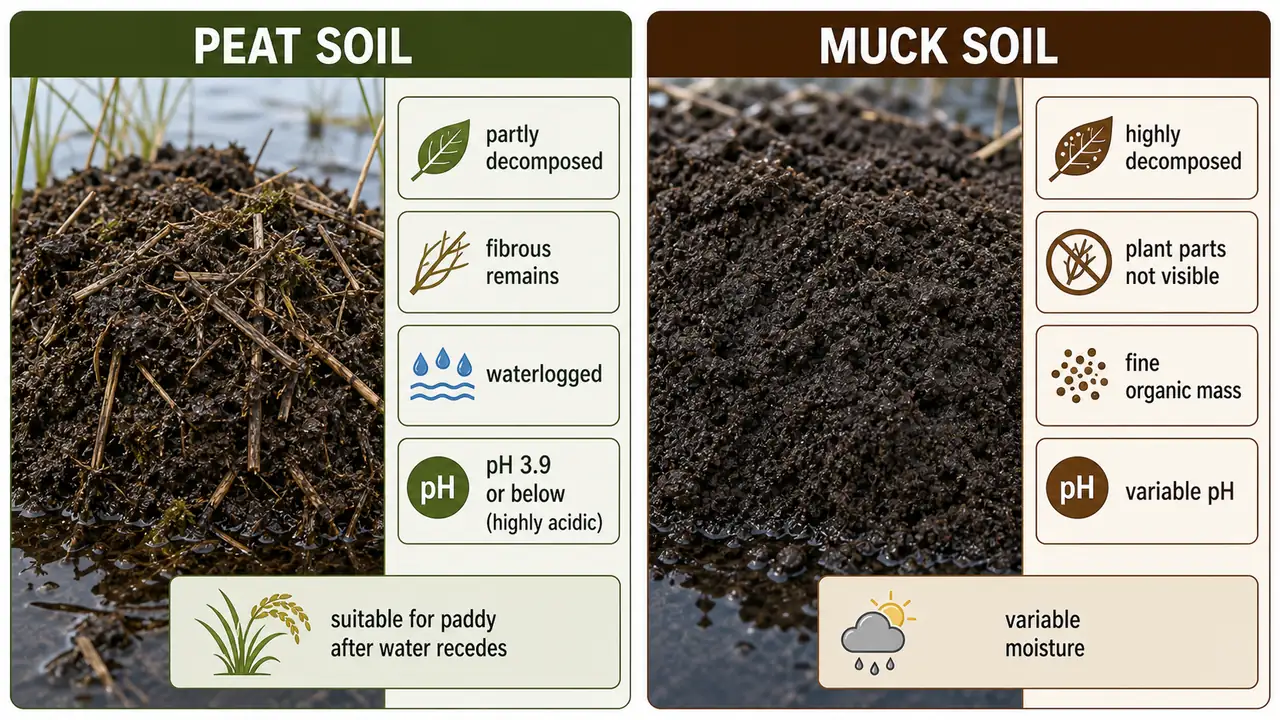
| Feature | Muck Soils | Peat Soils |
|---|---|---|
| Decomposition | Highly decomposed OM | Partially decomposed OM |
| Plant structures | Not recognizable | Still visible (fibrous) |
| Moisture | Variable | Formed under excessive moisture |
| pH | Variable | 3.9 and below (highly acidic) |
| OM content | High | 10-40% OM |
| Suitability | Various crops | Paddy when water recedes |
| Feature | Muck soils | Peat soils | Full comparison takeaway |
|---|---|---|---|
| Decomposition level | Highly decomposed organic matter | Partially decomposed organic matter | Muck is a later, more decomposed stage than peat |
| Plant remains | Usually not recognizable | Often still visible and fibrous | Peat preserves structure better because decomposition is incomplete |
| Moisture setting | Variable | Develops under excessive moisture or waterlogging | Peat forms in wet conditions where breakdown stays slow |
| pH | Variable | 3.9 or below | Peat soils are typically strongly acidic |
| Use after drainage/recession | Can support various crops | Often used for paddy after water recedes | Agricultural use depends heavily on drainage condition |

Exam Tips and Mnemonics
- Van Bemmelen Factor = 1.724 (OM = OC x 1.724; based on 58% C in OM)
- C:N ratio for mineralization: < 20:1 = N released. > 30:1 = N locked up. Remember "20-30 rule"
- C:N of humus: 10:1 -- remember "humus is ten-to-one"
- Humic substance solubility: Fulvic = Full (both), Humic = Half (alkali only), Humin = Hard (neither)
- Humus = Ligno-Protein Complex (40-45% lignin + 30-33% protein)
- Nitrification bacteria: "Nit-ro-SO-mo-nas (NH₄ → NO₂)" and "Nit-ro-BAC-ter (NO₂ → NO₃)"
- Polyphenol theory (Flaig, 1964) = most accepted humus formation theory
- 95% N and 33% P come from organic matter
- Indian soil OM: ~0.5% (low due to tropical climate)
- OM content: Grassland > Forest soils (grasses have dense fibrous roots)
Summary Cheat Sheet
| Concept / Topic | Key Details |
|---|---|
| Indian soil OM content | ~0.5% (low due to tropical climate) |
| Humic substances | 60–80% of SOM; aromatic ring structures |
| Fulvic acid | Lowest MW; soluble in both acid and alkali; highest CEC/unit weight |
| Humic acid | Medium MW; soluble in alkali only; dark brown/black |
| Humin | Highest MW; insoluble in both; most resistant/stable |
| Non-humic fraction | 20–30% of SOM; polysaccharides, proteins, lignins, fats |
| Humus composition | 40–45% lignin, 30–33% proteins = Ligno-Protein Complex |
| Humus C:N ratio | 10:1 |
| Humus CEC | 150–300 cmol/kg (highest of any colloid) |
| Humus WHC | 4–5 times its weight in water |
| Van Bemmelen Factor | 1.724; OM = OC × 1.724 (based on 58% C in OM) |
| 95% of soil N | Comes from organic matter |
| 33% of soil P | Comes from organic matter |
| Temperature effect on OM | Each 10°C decline → OM increases 2–3 times |
| OM content: Grassland vs Forest | Grasslands > Forests (dense fibrous roots) |
| Mineralization threshold | C:N < 20:1 → net N release |
| Immobilization threshold | C:N > 30:1 → net N lock-up |
| C:N — Bacteria | 4–5:1 |
| C:N — Fungi / Humus | 10:1 |
| C:N — FYM / Legumes | 20–30:1 |
| C:N — Cereal straw | 80:1 |
| C:N — Sawdust | 500–600:1 |
| Nitrification Step 1 | Nitrosomonas: NH₄⁺ → NO₂⁻ |
| Nitrification Step 2 | Nitrobacter: NO₂⁻ → NO₃⁻ |
| Denitrification | Pseudomonas; anaerobic; NO₃⁻ → N₂/N₂O |
| Polyphenol theory | Flaig & Sochtig (1964) — most widely accepted humus formation theory |
| Lignin theory | Waksman (1936) — humus from incomplete lignin degradation |
| Aerobic decomposition products | CO₂, NH₄⁺, NO₃⁻, H₂PO₄⁻, SO₄²⁻ — plant-available |
| Anaerobic decomposition products | CH₄, H₂S, organic acids — many toxic |
| Peat soils | Partially decomposed OM; pH ≤ 3.9; 10–40% OM |
| Muck soils | Highly decomposed OM; plant structures not recognizable |
| Decomposition optimum temp | 24–35°C; optimum moisture: near field capacity |
| OM in Indian soils | ~0.5% (low) |
| Humus = | Ligno-Protein Complex |
| OM contains | 58% Carbon |
| Optimum C:N ratio | 10-12:1 |
| N from OM | 95% of soil N |
| P from OM | 33% of soil P |
| Most accepted humus theory | Polyphenol theory (Flaig, 1964) |
| Peat soil pH | 3.9 (highly acidic) |
| Decomposition temperature optimum | 24-35 degree C |