📈 Year Based Puzzles
Master year-based puzzles - given years, base year calculations, age/experience derivation, and math-heavy conditions
Year Based Puzzles
Year-based puzzles are among the most challenging puzzle types. They require both logical reasoning AND mathematical calculation. These are primarily asked in Mains-level exams.
Two Types of Year Puzzles
Type 1: Years Given
- Specific years are provided (e.g., 1965, 1978, 1981, 1988, 1993, 1998, 2003, 2007)
- You assign each person to a year
- Age or experience is calculated from a base year (e.g., 2023 or 2025)
Type 2: Years Not Given (Derive from Clues)
- Years are NOT given directly
- You must calculate the birth/joining years from conditions about age, experience, or age differences
- Requires more mathematical work
Base Year Concept
The base year is the reference point for calculating age or experience:
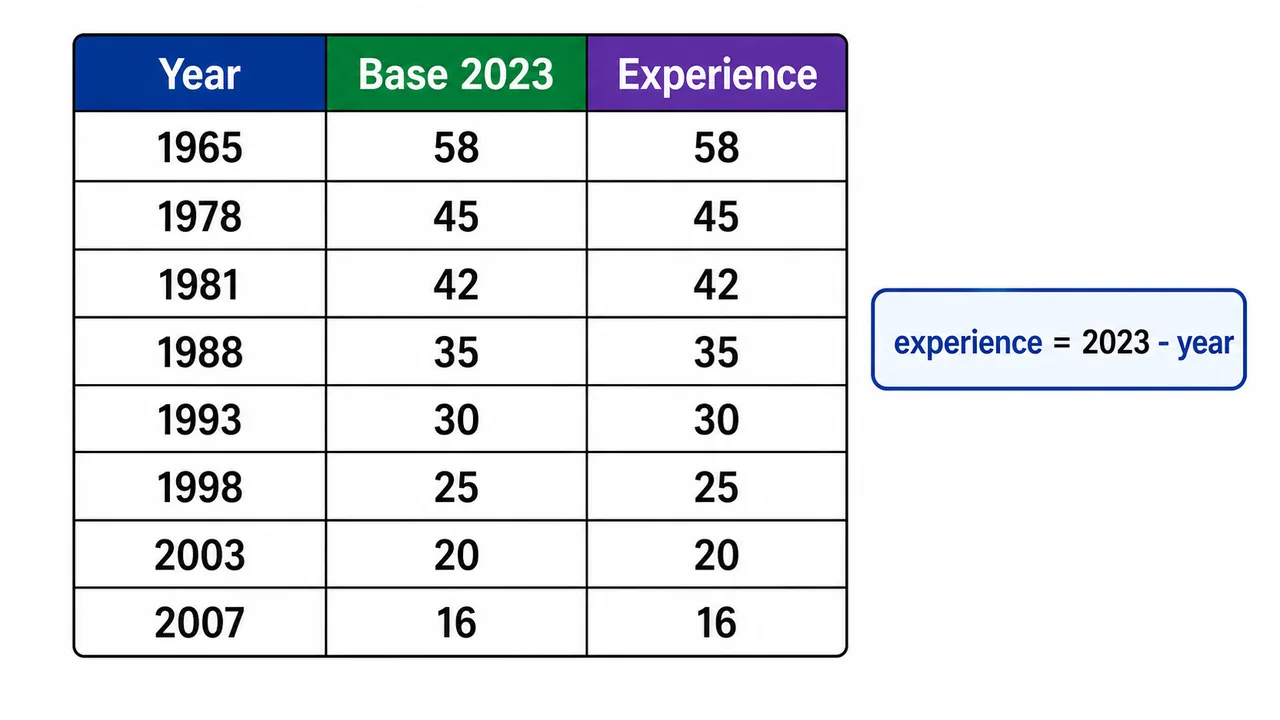
Age = Base Year - Birth Year Experience = Base Year - Joining Year
Example: If base year is 2023 and a person joined in 1988: Experience = 2023 - 1988 = 35 years
Pro Content Locked
Upgrade to Pro to access this lesson and all other premium content.
Charged once for one year · ₹1188 total
Save ₹100/month vs ₹2388/year launch price
- All Agriculture & Banking Courses
- AI Lesson Questions (100/day)
- AI Doubt Solver (50/day)
- Glows & Grows Feedback (30/day)
- AI Section Quiz (20/day)
- 22-Language Translation (100/day)
- Recall Questions (20/day)
- AI Quiz (15/day)
- AI Quiz Paper Analysis (100/day)
- AI Step-by-Step Explanations (100/day)
- Spaced Repetition Recall (FSRS)
- AI Tutor
- Immersive Text Questions
- Audio Lessons — Hindi & English
- Mock Tests & Previous Year Papers
- Summary & Mind Maps
- XP, Levels, Leaderboard & Badges
- Generate New Classrooms
- Voice AI Teacher (AgriDots Live)
- AI Revision Assistant
- Knowledge Gap Analysis
- Interactive Revision (LangGraph)
🔒 Secure one-time yearly payment via Razorpay · No hidden fees
Year Based Puzzles
Year-based puzzles are among the most challenging puzzle types. They require both logical reasoning AND mathematical calculation. These are primarily asked in Mains-level exams.
Two Types of Year Puzzles
Type 1: Years Given
- Specific years are provided (e.g., 1965, 1978, 1981, 1988, 1993, 1998, 2003, 2007)
- You assign each person to a year
- Age or experience is calculated from a base year (e.g., 2023 or 2025)
Type 2: Years Not Given (Derive from Clues)
- Years are NOT given directly
- You must calculate the birth/joining years from conditions about age, experience, or age differences
- Requires more mathematical work
Base Year Concept
The base year is the reference point for calculating age or experience:
Age = Base Year - Birth Year Experience = Base Year - Joining Year
Example: If base year is 2023 and a person joined in 1988: Experience = 2023 - 1988 = 35 years
If base year is 2025 and birth year is 1975: Age = 2025 - 1975 = 50 years
Important: The question will always state the base year. Read it carefully — it could be 2021, 2023, 2025, or any year.
Setting Up the Grid
For "Years Given" puzzles:
| Year | Experience/Age | Person | Variable |
|---|---|---|---|
| 1965 | 58 (if base=2023) | ||
| 1978 | 45 | ||
| 1981 | 42 | ||
| 1988 | 35 | ||
| 1993 | 30 | ||
| 1998 | 25 | ||
| 2003 | 20 | ||
| 2007 | 16 |
Pre-calculate all ages/experiences before reading the conditions. This saves time during solving.
Mathematical Conditions
Year puzzles are math-heavy. Common condition types:
| Condition | How to Use |
|---|---|
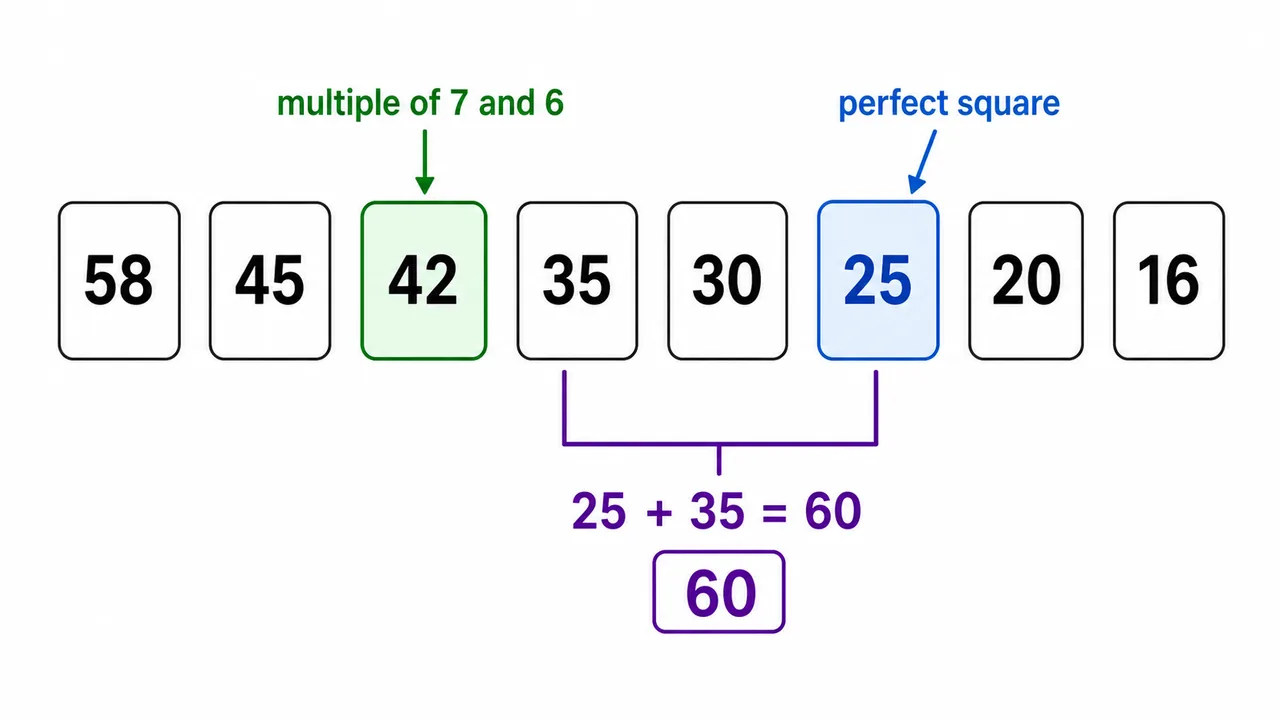
| "V's experience is a perfect square" | Check which experience values are perfect squares (25=5², 36=6², etc.) |
| "Sum of W's and V's experience is 60" | W + V = 60. Try combinations from available values. |
| "T's experience is a multiple of 7 and 6" | T's experience is a multiple of LCM(7,6) = 42 |
| "S has higher experience than T" | S's year < T's year (earlier year = more experience) |
| "Q has more experience than U" | Same: Q joined earlier than U |
| "Y's experience is not a multiple of 6" | Eliminate experience values divisible by 6 |
| "Q does not born in an odd-numbered year" | Q's birth year is even (e.g., 1978, 1988, 1998) |
| "Age is a multiple of 3" | Check which calculated ages are divisible by 3 |
Solved Example: 8 Persons, Given Years
Question: Eight persons Q, S, T, U, V, W, X, Y joined different companies in years: 1965, 1978, 1981, 1988, 1993, 1998, 2003, 2007. Base year = 2023.
Conditions:
- V's experience is a perfect square number
- Sum of W's and V's experience is 60 years
- T's experience year is a multiple of both 7 and 6
- S has higher experience than T
- X has higher experience than W but less than S
- The person who joined in 2007 is not Y
- Q has more experience than U
- Y's experience is not a multiple of 6
Pre-calculate experiences:
| Year | Experience (2023 - Year) |
|---|---|
| 1965 | 58 |
| 1978 | 45 |
| 1981 | 42 |
| 1988 | 35 |
| 1993 | 30 |
| 1998 | 25 |
| 2003 | 20 |
| 2007 | 16 |
Solution:
From (1): V's experience is a perfect square. Perfect squares from the list: 25 (5²). V = 25 years experience, joined 1998.
From (2): W + V = 60. V = 25, so W = 35. W joined 1988.
From (3): T's experience is a multiple of 42 (LCM of 7 and 6). From the list: 42 is available. T = 42 years, joined 1981.
From (4): S > T. T = 42. S must have experience > 42. Options: 45 or 58. From (5): X > W and X < S. W = 35. X > 35 and X < S.
If S = 45: X must be > 35 and < 45. From remaining values: {58, 30, 20, 16}. No value between 35 and 45. Contradiction.
If S = 58: X > 35 and < 58. From remaining: {45, 30, 20, 16}. X = 45 (only value between 35 and 58). S joined 1965, X joined 1978.
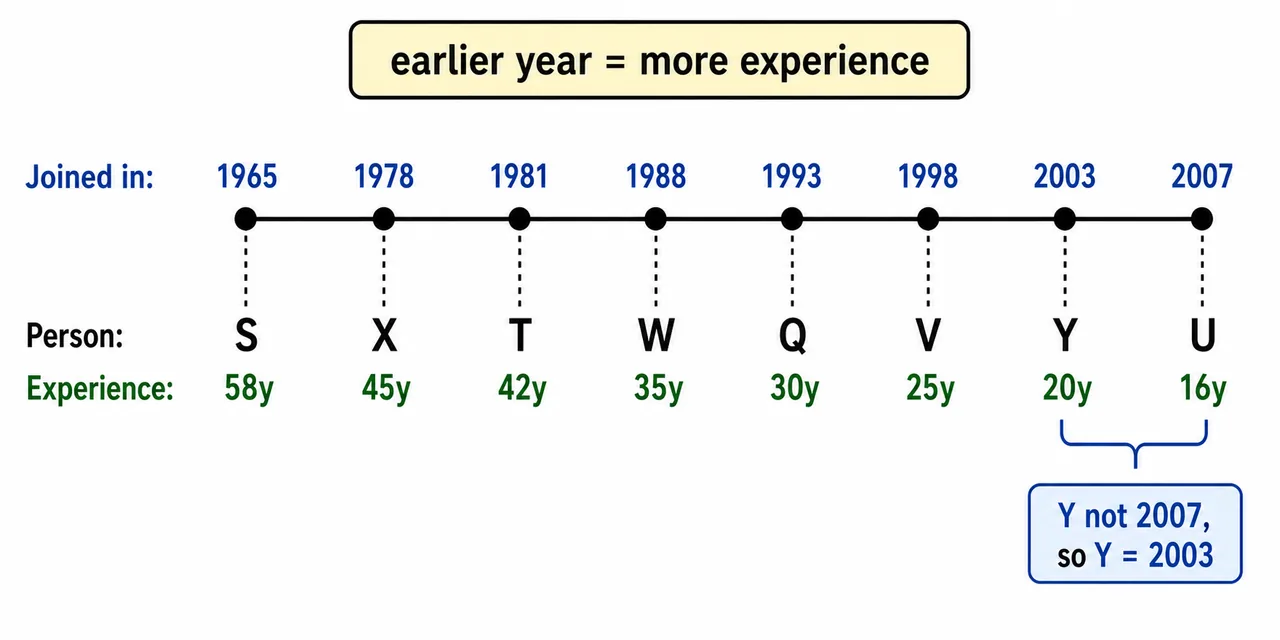
From (6): Person who joined 2007 is not Y. From remaining: {1993, 2003, 2007} for Q, U, Y. So Y is NOT at 2007. Y is at 1993 or 2003.
From (8): Y's experience is not a multiple of 6.
- 1993 -> exp 30 (30/6 = 5, multiple of 6)
- 2003 -> exp 20 (20/6 = 3.33, NOT a multiple of 6)
Y = 2003 (experience 20).
From (7): Q > U (Q has more experience). Remaining: {1993, 2007} for Q and U. Q > U means Q has higher experience = earlier year. Q = 1993 (exp 30), U = 2007 (exp 16).
Final arrangement:
| Person | Year Joined | Experience |
|---|---|---|
| S | 1965 | 58 years |
| X | 1978 | 45 years |
| T | 1981 | 42 years |
| W | 1988 | 35 years |
| Q | 1993 | 30 years |
| V | 1998 | 25 years |
| Y | 2003 | 20 years |
| U | 2007 | 16 years |
Year Puzzles with Colors/Variables
Example: 7 persons born in different years (1952, 1955, 1967, 1976, 1979, 1996, 2006). Base year = 2021. Each likes a different color (Red, Pink, Blue, Green, Yellow, Black, White).
Pre-calculate ages:
| Year | Age (2021 - Year) |
|---|---|
| 1952 | 69 |
| 1955 | 66 |
| 1967 | 54 |
| 1976 | 45 |
| 1979 | 42 |
| 1996 | 25 |
| 2006 | 15 |
Conditions may include:
- "A was born in an even year and his age is a multiple of 5" — Even years: 1952, 1976, 1996, 2006. Ages: 69, 45, 25, 15. Multiple of 5: 45, 25, 15. So A born in 1976(45), 1996(25), or 2006(15).
- "Oldest person likes Black" — person born in 1952 likes Black
- "Youngest person likes Red" — person born in 2006 likes Red
- "Age of F = 2 x (Age of A - Age of G)" — mathematical relationship
Strategy: Pre-calculate ALL ages first, then apply math conditions to narrow down person-to-year assignments, and finally assign colors.
"Years Not Given" Puzzles
In these puzzles, you derive years from conditions:
Example: "M is 3 years older than K. K and U have 14 years age gap. Total age of K and P is one year more than N's age."
Here, ages are interlinked. You need to:
- Set up equations: M = K + 3, |K - U| = 14, K + P = N + 1
- Use additional constraints (multiples, odd/even year) to find exact values
- Work backwards to find birth years
Odd/Even Year Constraints
- "Q was not born in an odd-numbered year" — Q's birth year is even (1952, 1976, 1996, 2006 from the example above)
- "A was born in an even year" — same concept
- "Person who likes White was born in an odd year" — links variable to year parity
Strategy for Year Puzzles
- Pre-calculate all ages/experiences from the base year before anything else
- Apply math conditions first — perfect squares, multiples, sums. These are the strongest constraints.
- Use comparison conditions (S > T, X > W) to order persons
- Handle variables (colors, cities) as a second phase after year assignments
- For "years not given" — set up algebraic equations first, solve for unknowns
Common Traps
- Wrong base year — always double-check which year the question uses for calculations
- "Experience" vs "Age" — experience = base year - joining year, age = base year - birth year. Don't confuse them.
- Multiple of 7 AND 6 means multiple of LCM(7,6) = 42, not just any number divisible by either
- Perfect square check — 25 is a perfect square (5²), but 35 is not. Double-check.
- Odd/even confusion — 1993 is odd, 1992 is even. Be careful with year parity.
Speed Tips
- Always create the year-to-experience/age table as your FIRST step. This takes 30 seconds and is essential.
- For "perfect square" conditions, memorize common perfect squares: 1, 4, 9, 16, 25, 36, 49, 64, 81, 100
- For "multiple of N" conditions, quickly check divisibility of each experience value
- For sum conditions (A + B = X), scan the experience table for pairs that add up to the target
- Year puzzles reward strong mental math — practice quick subtraction from common base years (2023, 2025)
- In the exam, if you're stuck on a year puzzle, skip it and return later. These are time-expensive but high-reward if you can solve them accurately.