🪑 Linear Seating Arrangement — Basics
Master single-row linear seating arrangements - facing directions, left-right conventions, gap formula, definite place & condition methodology, and solved examples
Linear Seating Arrangement -- Basics
Linear seating arrangement is one of the most important topics in reasoning for banking exams (IBPS PO, SBI PO, RRB, NABARD). In these puzzles, persons sit in a straight line (row) and you must determine their positions based on given conditions.
Types of Seating Arrangements
Seating arrangements in competitive exams fall into two broad categories:
| Type | Sub-types |
|---|---|
| Linear | Straight Row (single facing), Straight Row (double facing / North-South), Uncertain Linear, Linear with Relations |
| Parallel | 2 Row, 3 Row, 4 Row |
This lesson covers the Straight Row with Single Facing -- the foundational type.
Understanding Direction & Orientation
When persons sit in a single straight row, the facing direction determines which side is left and which is right.
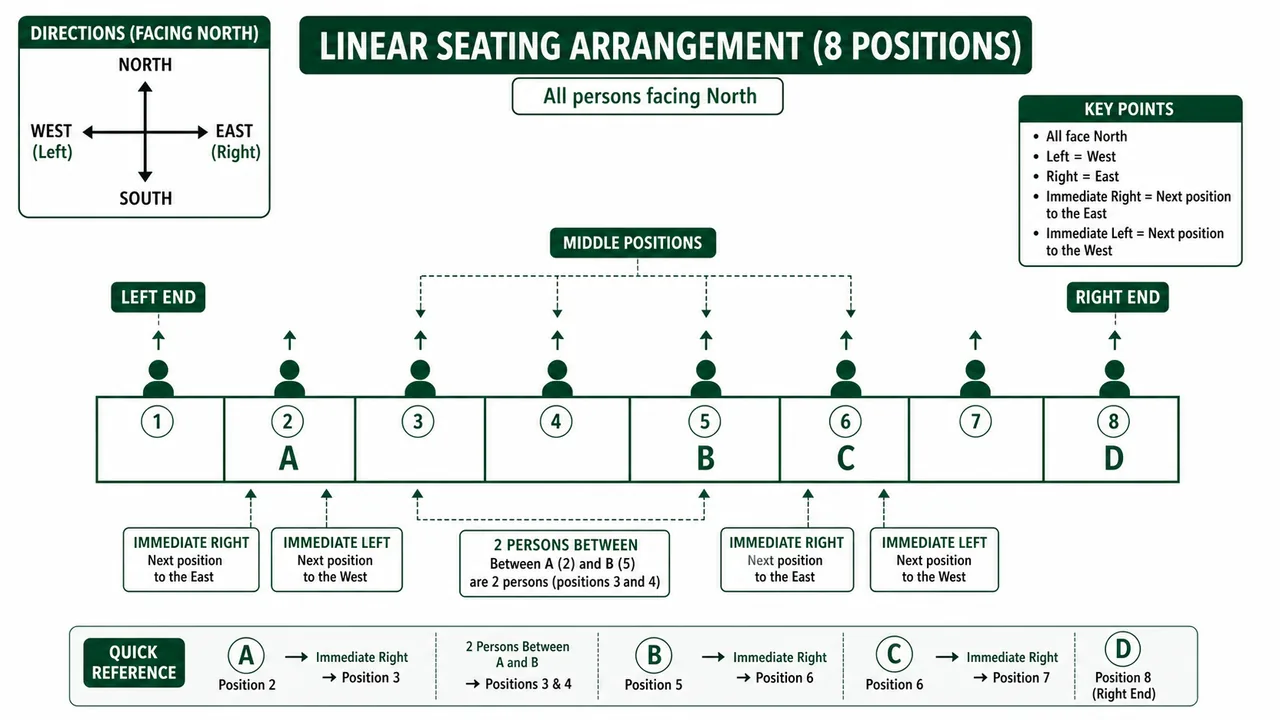
Facing North:
- Left of a person = towards West
- Right of a person = towards East
Facing South:
Pro Content Locked
Upgrade to Pro to access this lesson and all other premium content.
Charged once for one year · ₹1188 total
Save ₹100/month vs ₹2388/year launch price
- All Agriculture & Banking Courses
- AI Lesson Questions (100/day)
- AI Doubt Solver (50/day)
- Glows & Grows Feedback (30/day)
- AI Section Quiz (20/day)
- 22-Language Translation (100/day)
- Recall Questions (20/day)
- AI Quiz (15/day)
- AI Quiz Paper Analysis (100/day)
- AI Step-by-Step Explanations (100/day)
- Spaced Repetition Recall (FSRS)
- AI Tutor
- Immersive Text Questions
- Audio Lessons — Hindi & English
- Mock Tests & Previous Year Papers
- Summary & Mind Maps
- XP, Levels, Leaderboard & Badges
- Generate New Classrooms
- Voice AI Teacher (AgriDots Live)
- AI Revision Assistant
- Knowledge Gap Analysis
- Interactive Revision (LangGraph)
🔒 Secure one-time yearly payment via Razorpay · No hidden fees
Linear Seating Arrangement -- Basics
Linear seating arrangement is one of the most important topics in reasoning for banking exams (IBPS PO, SBI PO, RRB, NABARD). In these puzzles, persons sit in a straight line (row) and you must determine their positions based on given conditions.
Types of Seating Arrangements
Seating arrangements in competitive exams fall into two broad categories:
| Type | Sub-types |
|---|---|
| Linear | Straight Row (single facing), Straight Row (double facing / North-South), Uncertain Linear, Linear with Relations |
| Parallel | 2 Row, 3 Row, 4 Row |
This lesson covers the Straight Row with Single Facing -- the foundational type.
Understanding Direction & Orientation
When persons sit in a single straight row, the facing direction determines which side is left and which is right.
Facing North:
- Left of a person = towards West
- Right of a person = towards East
Facing South:
- Left of a person = towards East
- Right of a person = towards West
Critical Rule: When all persons face North, left = West and right = East. When all face South, it reverses -- left = East and right = West. This is the single most important concept in linear arrangement.
Facing East (Vertical Row)
Sometimes the row is drawn vertically with persons facing East:
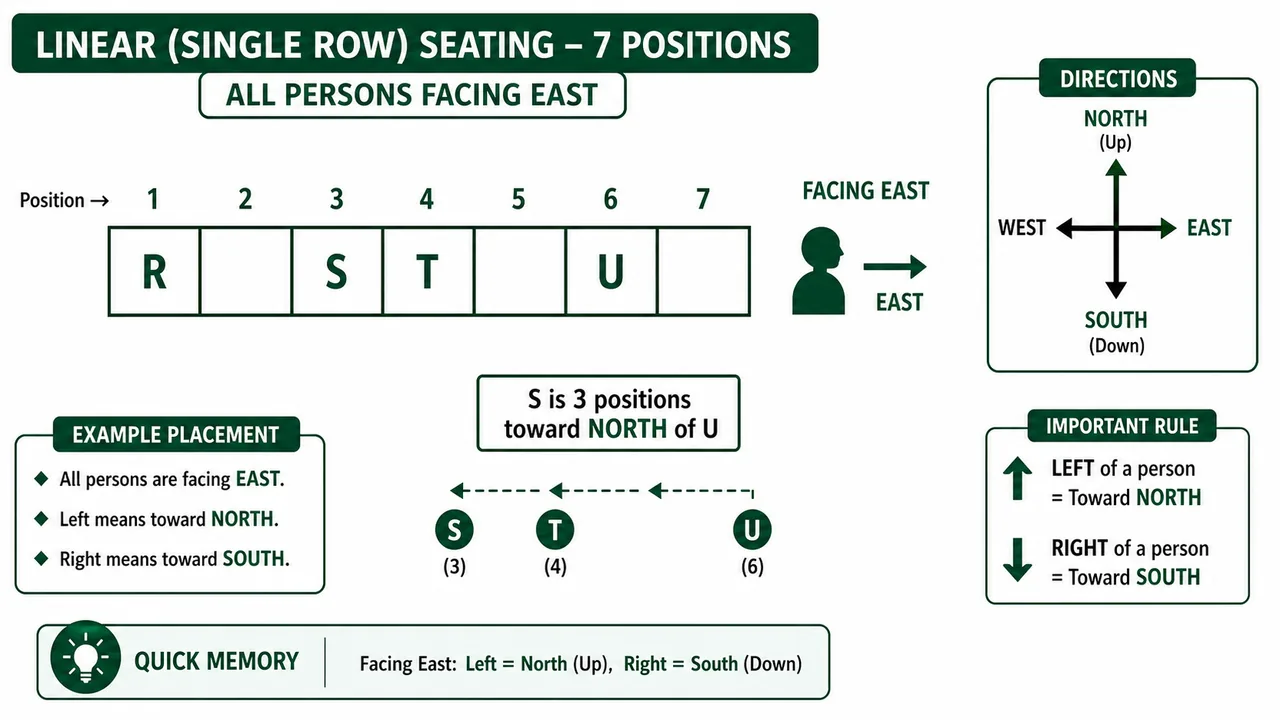
- Left of a person = towards North (upward)
- Right of a person = towards South (downward)
Key Terminology
These exam phrases have precise meanings. Misreading even one can lead to a wrong answer.
| Exam Phrase | Meaning |
|---|---|
| "A sits 3rd to the right of B" | Starting from B, count 3 positions to the right. A is there. |
| "A sits 3rd to the left of B" | Starting from B, count 3 positions to the left. A is there. |
| "A sits immediately to the right of B" | A is in the very next position to B's right (adjacent, no gap) |
| "A sits immediately to the left of B" | A is in the very next position to B's left (adjacent, no gap) |
| "A and B are neighbours / adjacent" | A and B sit next to each other (A immediately left or right of B) |
| "N persons sit between A and B" | There are exactly N positions between A and B |
| "A sits at an extreme end" | A is at position 1 (leftmost) or the last position (rightmost) |
| "A sits exactly in the middle" | A is at the centre position. For 7 persons: position 4. For 8: not possible (no single middle). |
| "A has equal number of persons on either side" | A sits in the exact middle of the row |
| "A is somewhere to the right of B" | A's position number > B's position number (facing North). Could be anywhere to the right, not necessarily adjacent. |
| "A and B are three places away from each other" | There are 2 persons between A and B (gap = 2). This means |Position(A) - Position(B)| = 3 |
| "No two consecutive lettered persons sit together" | Persons with consecutive alphabet letters (like A-B, B-C, C-D) cannot be adjacent |
Gap Formula
The gap formula tells you how many persons sit between two people:
Persons between A and B = |Position(A) - Position(B)| - 1
| A's Position | B's Position | Persons Between |
|---|---|---|
| 1 | 4 | |1-4| - 1 = 2 |
| 2 | 8 | |2-8| - 1 = 5 |
| 3 | 4 | |3-4| - 1 = 0 (adjacent) |
| 1 | 8 | |1-8| - 1 = 6 |
Quick Check: "3 persons between A and B" means |Pos(A) - Pos(B)| = 4. They are 4 positions apart.
Part A / Part B Methodology
This is the standard solving approach for all linear seating puzzles:
Part A -- Place Definite Information:
-
Definite Place -- any condition giving an exact position:
- "A sits at the left end" (Position 1 if facing North)
- "A sits at the right end" (last position)
- "A sits exactly in the middle"
-
Definite Condition -- conditions that link two persons with exact distances:
- "S sits 4th to the right of A" -- gives exact relative position of S from A
- "A and B have 2 persons between them" -- gives exact distance (but two possible arrangements)
Part B -- Place Remaining by Elimination:
- Use negative conditions ("does not sit at extreme end", "is not adjacent to")
- Use "somewhere to the left/right" conditions
- Assign remaining persons to remaining positions
Setting Up the Diagram
For Facing North (horizontal row):
For Facing East (vertical row):
Solved Example 1: 7 Persons Facing East
Question: 7 persons P, Q, R, S, T, U, and W sit in a straight line facing East.
Conditions:
- T has an equal number of persons on either side
- R sits at one of the extreme ends
- Q does not sit at an extreme end
- S sits third toward North of U
- Q sits immediately North of W
Solution:
Step 1 -- Draw the vertical row (facing East):
Step 2 -- Part A (Definite conditions):
From (1): T has equal persons on either side. With 7 persons, middle = position 4. T = position 4.
From (2): R at extreme end. R = position 1 or 7.
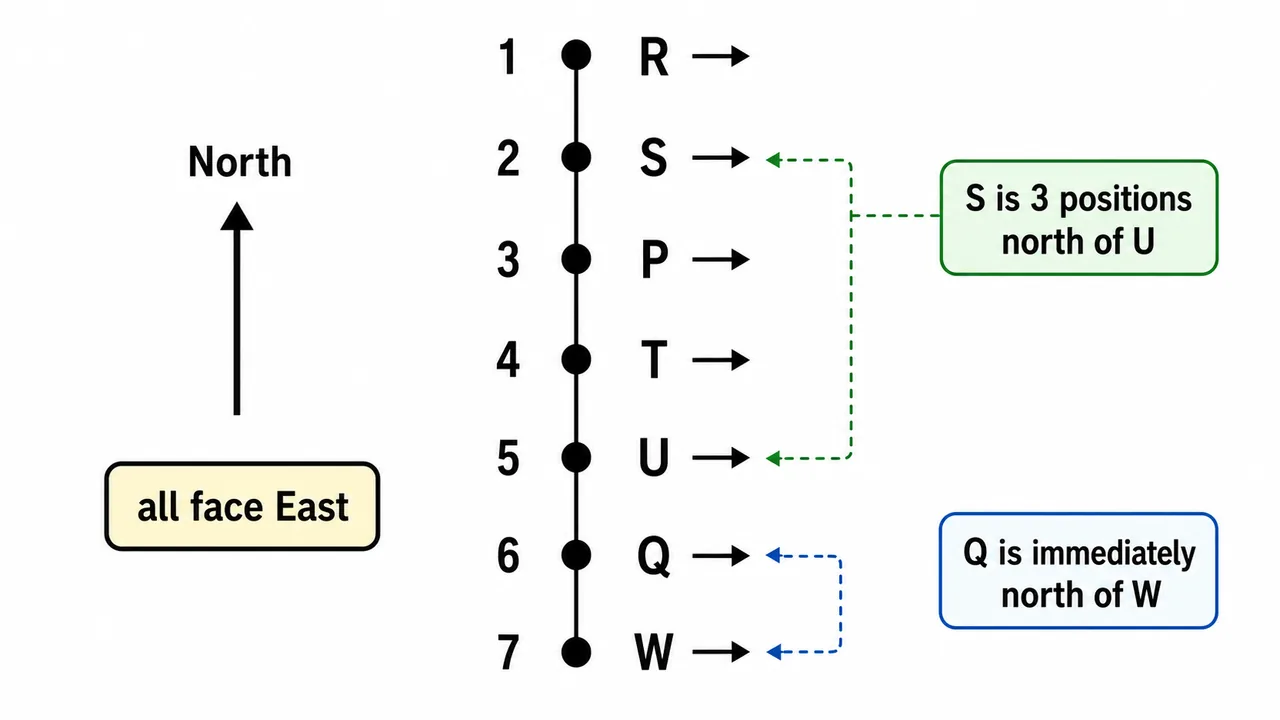
From (4): S is 3rd toward North of U. North = toward position 1 (left). So S is 3 positions above U. S = U - 3.
Possible: U = 7, S = 4 -- but T is at 4. Not possible. U = 6, S = 3. Possible. U = 5, S = 2. Possible.
From (5): Q immediately North of W. Q = W - 1 (one position above W).
Step 3 -- Try U = 6, S = 3:
Placed: T = 4, S = 3, U = 6. R = 1 or 7. From (3): Q not at extreme end. Q is not at 1 or 7. Q immediately North of W: Q and W are consecutive, Q above W.
Remaining positions: 1, 2, 5, 7 for P, Q, R, W. R at extreme: R = 1 or 7.
If R = 7: Remaining 1, 2, 5 for P, Q, W. Q not at 1 (extreme). Q = 2 or 5. If Q = 2, W = 3 -- but S is at 3. Not possible. If Q = 5, W = 6 -- but U is at 6. Not possible.
If R = 1: Remaining 2, 5, 7 for P, Q, W. Q not at 7 (extreme). Q = 2 or 5. If Q = 2, W = 3 -- S is at 3. Not possible. If Q = 5, W = 6 -- U is at 6. Not possible.
Step 4 -- Try U = 5, S = 2:
Placed: T = 4, S = 2, U = 5. R = 1 or 7. Remaining positions: 1, 3, 6, 7 for P, Q, R, W.
If R = 1: Remaining 3, 6, 7 for P, Q, W. Q not at 7 (extreme). Q = 3 or 6. Q immediately above W (Q = W - 1). If Q = 6, W = 7. P = 3. Q(6) not extreme -- valid.
Final Arrangement:
Solved Example 2: 8 Persons, No Consecutive Letters Together
Question: Eight people A, B, C, D, E, F, G, and H sit in a line. No two people with consecutive letters sit together (A-B not adjacent, B-C not adjacent, etc.). B cannot sit with A and C, and so on.
Conditions:
- A sits at an extreme end
- 2 people between A and B
- 2 people between C and D
- C nor D sits at extreme end
- D is somewhere right of B
- B sits second to the left of F
- More than 3 people sit between C and H
Solution:
Step 1: A is at an extreme end. Let A = position 1 (left end).
Step 2: 2 people between A and B. B at position 4 (since A = 1, |1-B|-1 = 2, B = 4).
Step 3: B second to left of F means F = B + 2 = position 6.
Step 4: 2 people between C and D, neither at extreme end. D somewhere right of B(4).
Step 5: More than 3 between C and H means at least 4 people between them.
Working through valid positions with the no-consecutive-letters constraint:
Verify: A(1)-C(2) not consecutive alphabetically. B(4)-D(5) not consecutive (B=2nd, D=4th letter). No adjacent pair has consecutive letters. C and H have 4 persons between them. All conditions satisfied.
Solved Example 3: 10 Persons Facing North (Advanced)
Question: Ten persons A, B, C, D, E, F, G, H, I, and J sit on a bench facing North. No two continuous alphabet persons sit together.
Conditions:
- A sits 2nd left of F
- 3 persons between A and G, where G sits left of A
- Not more than 1 person between I and F
- J sits 2nd left of I
- H sits immediate left of J
- 4 persons between H and C, where C sits right of H
- J does not sit immediate right of A
- B sits 2nd left of D
- Not more than 2 persons between A and D
- 3 persons sit between E and H
Solution:
From (1): A is 2nd to the left of F. So F = A + 2 (F is 2 positions to the right of A).
From (2): 3 persons between A and G, G left of A. G = A - 4.
From (4) and (5): J = I - 2, H = J - 1 = I - 3. So H, J, _, I is the pattern (with one gap between J and I).
From (3): Not more than 1 person between I and F. |I - F| - 1 <= 1, so |I - F| <= 2.
Working through the positions systematically:
Answer: H sits second to the right of G.
"N persons between" vs "Nth to the right/left"
This distinction is critical and a common exam trap:
| Statement | What it means |
|---|---|
| "3 persons between A and B" | |Pos(A) - Pos(B)| = 4. Four positions apart. |
| "A sits 3rd to the right of B" | A = B + 3. Three positions to the right. |
| "A and B are 3 places away" | |Pos(A) - Pos(B)| = 3. Three positions apart. 2 persons between them. |
"Somewhere to the right/left"
- "D is somewhere to the right of B" -- D's position > B's position (facing North). Could be adjacent or far apart.
- This is a weak condition -- use it for elimination in Part B, not for placing in Part A.
Common Traps
- Left-right reversal with facing direction -- facing South reverses left and right. Always draw a compass first.
- "Between" vs "to the right of" -- "3 between" = 4 positions apart. "3rd to the right" = 3 positions apart.
- "Somewhere to the right" is NOT "immediately to the right" -- "somewhere" could be 1, 2, 3, or more positions away.
- Two possible positions from gap conditions -- "2 persons between A and B" means B could be to A's left OR right. Always try both.
- No consecutive letters -- in 8-person sets (A-H), check: A-B, B-C, C-D, D-E, E-F, F-G, G-H. None of these pairs should be adjacent.
- "Equal number on either side" requires odd total -- for 7 persons the middle is position 4, for 9 persons it is position 5. For even numbers (8, 10), no single middle exists.
Speed Tips
- Always draw the row first with numbered positions and mark the facing direction. This takes 5 seconds.
- Start with definite positions -- extreme end, exact middle, or exact numbered positions.
- Process definite conditions next -- "A is 3rd to the right of B" gives exact relative placement.
- Save negative and "somewhere" conditions for last -- these are for elimination, not placement.
- If two possibilities arise from a gap condition, try one. If it leads to a contradiction, the other must be correct. Do not try to keep both in your head.
- For 8-10 person puzzles, expect 3-5 minutes solving time. Budget accordingly in exams.
- Mark the compass (N/S/E/W) at the top of your rough sheet every time, even if you think you remember. Direction errors are the most common source of wrong answers.