↔️ Linear Arrangement — Two Rows & Multiple Variables
Master double-facing single row arrangements, North-South mixed facing, multiple variables (heights, ages, lucky numbers), and solved exam-level examples
Linear Arrangement -- Two Rows & Multiple Variables
Building on the basics of single-row, single-facing linear arrangement, this lesson covers single-row double-facing (some face North, some face South) and arrangements with multiple variables such as heights, ages, lucky numbers, or colors assigned along with seating positions.
Single Row, Double Facing (North/South)
In this type, all persons sit in one straight row but some face North and some face South. This adds a layer of complexity because:
- Left/right depends on EACH person's individual facing direction
- A person facing North has left = West, right = East
- A person facing South has left = East, right = West
Representation on paper:
Use arrows to mark each person's facing direction:
Important: In double-facing arrangements, when the question says "X sits to the right of Y", it means from Y's perspective based on Y's facing direction. However, many exam questions use positional right/left (from the observer's perspective, i.e., standard West-East axis). Read the question carefully to determine which convention is used.
Pro Content Locked
Upgrade to Pro to access this lesson and all other premium content.
Charged once for one year · ₹1188 total
Save ₹100/month vs ₹2388/year launch price
- All Agriculture & Banking Courses
- AI Lesson Questions (100/day)
- AI Doubt Solver (50/day)
- Glows & Grows Feedback (30/day)
- AI Section Quiz (20/day)
- 22-Language Translation (100/day)
- Recall Questions (20/day)
- AI Quiz (15/day)
- AI Quiz Paper Analysis (100/day)
- AI Step-by-Step Explanations (100/day)
- Spaced Repetition Recall (FSRS)
- AI Tutor
- Immersive Text Questions
- Audio Lessons — Hindi & English
- Mock Tests & Previous Year Papers
- Summary & Mind Maps
- XP, Levels, Leaderboard & Badges
- Generate New Classrooms
- Voice AI Teacher (AgriDots Live)
- AI Revision Assistant
- Knowledge Gap Analysis
- Interactive Revision (LangGraph)
🔒 Secure one-time yearly payment via Razorpay · No hidden fees
Linear Arrangement -- Two Rows & Multiple Variables
Building on the basics of single-row, single-facing linear arrangement, this lesson covers single-row double-facing (some face North, some face South) and arrangements with multiple variables such as heights, ages, lucky numbers, or colors assigned along with seating positions.
Single Row, Double Facing (North/South)
In this type, all persons sit in one straight row but some face North and some face South. This adds a layer of complexity because:
- Left/right depends on EACH person's individual facing direction
- A person facing North has left = West, right = East
- A person facing South has left = East, right = West
Representation on paper:
Use arrows to mark each person's facing direction:
Important: In double-facing arrangements, when the question says "X sits to the right of Y", it means from Y's perspective based on Y's facing direction. However, many exam questions use positional right/left (from the observer's perspective, i.e., standard West-East axis). Read the question carefully to determine which convention is used.
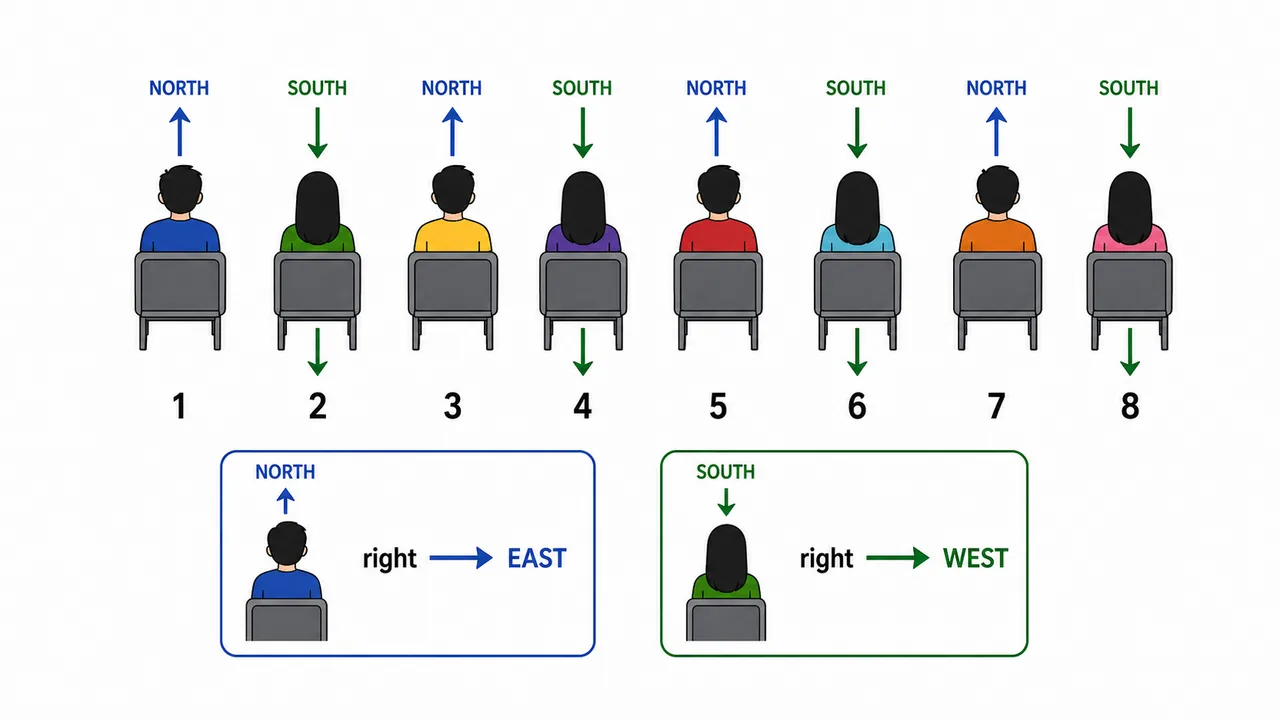
Approach for Double-Facing
Step 1: If facing direction is given (e.g., "some face North, some face South"), treat it as an additional variable to assign.
Step 2: If facing direction is NOT explicitly given but conditions mention it:
- Check conditions that mention facing: "Both immediate neighbours of D face North"
- Check conditions about opposite/same direction: "A faces the same direction as H"
Step 3: Decide positions first (which seat number each person occupies), then assign facing directions, or solve both simultaneously if conditions are interlinked.
Key Terminology for Double-Facing
| Exam Phrase | Meaning |
|---|---|
| "Both immediate neighbours of D face North" | The persons in positions (D-1) and (D+1) both face North |
| "A faces the same direction as H" | If H faces North, A also faces North (and vice versa) |
| "C faces a direction opposite to that of D" | If D faces North, C faces South (and vice versa) |
| "Immediate neighbours of B face opposite directions" | One neighbour faces North, the other faces South |
| "Persons at extreme ends face opposite directions" | Position 1 and last position have different facing directions |
Solved Example 1: 8 Persons with Double Facing
Question: A, B, C, D, E, F, G, and H are seated in a straight line but not necessarily in the same order. Some of them are facing south while some of them are facing north.
Conditions:
- Only two people sit between E and B
- F sits third to the right of H
- H is an immediate neighbor of neither E nor B
- H does not sit at any of the extreme ends of the line
- Both the immediate neighbours of D face north
- D is not an immediate neighbor of H
- Only one person sits between D and A
- A faces the same direction as H
- The immediate neighbours of B face opposite directions (if one faces North, the other faces South)
- Persons sitting at extreme ends face opposite directions
- C faces a direction opposite that of D
- A is not an immediate neighbor of F
- E does not face north
- Only three people sit to the left of E
Solution:
Step 1 -- Part A (positions):
From (14): 3 people to E's left, so E = position 4 (in an 8-person row).
From (1): 2 people between E and B. |E - B| = 3. B = 1 or 7.
From (2): F = H + 3 (F is 3rd to right of H).
From (4): H not at extreme end. So H is at positions 2-7. Since F = H + 3, and F <= 8: H <= 5. So H = 2, 3, 4, or 5.
From (3): H not adjacent to E(4) and not adjacent to B. H not at 3 or 5 (adjacent to E at 4). So H = 2. Then F = 2 + 3 = 5.
From (1): B = 1 or 7. From (3): H(2) not adjacent to B, so B is not at position 1 (adjacent to H at 2) or 3. B = 7.
From (7): 1 person between D and A. |D - A| = 2. From (6): D not adjacent to H(2). D not at 1 or 3. From (12): A not adjacent to F(5). A not at 4 or 6. But E is at 4, so A not at 6.
Placed: E=4, H=2, F=5, B=7. Remaining positions: 1, 3, 6, 8 for A, C, D, G.
D not at 1 or 3 (not adjacent to H at 2). D = 6 or 8. A not at 6. |D - A| = 2.
If D = 6: A = 4 or 8. A = 4 taken by E. A = 8. D = 6. If D = 8: A = 6 or 10 (impossible). A = 6 -- but A not at 6. Dead end.
So D = 6, A = 8. Remaining: C and G at positions 1 and 3.
From (5): Both immediate neighbours of D(6) face North. Neighbours are F(5) and B(7). Both face North.
Step 2 -- Assign facing directions:
From (13): E does NOT face North. E faces South.
From (5): F(5) and B(7) both face North.
From (10): Extreme ends (position 1 and 8) face opposite directions.
From (8): A faces same direction as H.
From (9): Immediate neighbours of B(7) face opposite directions. B's neighbours are D(6) and position 8 (A). One faces N, one faces S.
From (5): D's neighbours face North, so this condition already constrains F(5) and B(7). But what about D's own facing? From (11): C faces opposite to D.
Let us work the facing systematically. From (5): F = North, B = North.
From (9): B's neighbours are D(6) and A(8). They face opposite directions. One N, one S.
From (8): A faces same as H.
From (10): Position 1 and A(8) face opposite.
From (11): C opposite to D.
Let us say A faces North. Then H faces North (from 8). From (9): D and A face opposite, so D faces South. From (11): C faces opposite to D(South), so C faces North. From (10): Position 1 faces opposite to A(8, North), so position 1 faces South.
Check: who is at position 1? C or G. C faces North. So C is NOT at position 1. C = 3, G = 1. G faces South, C faces North. Consistent.
Final Arrangement:
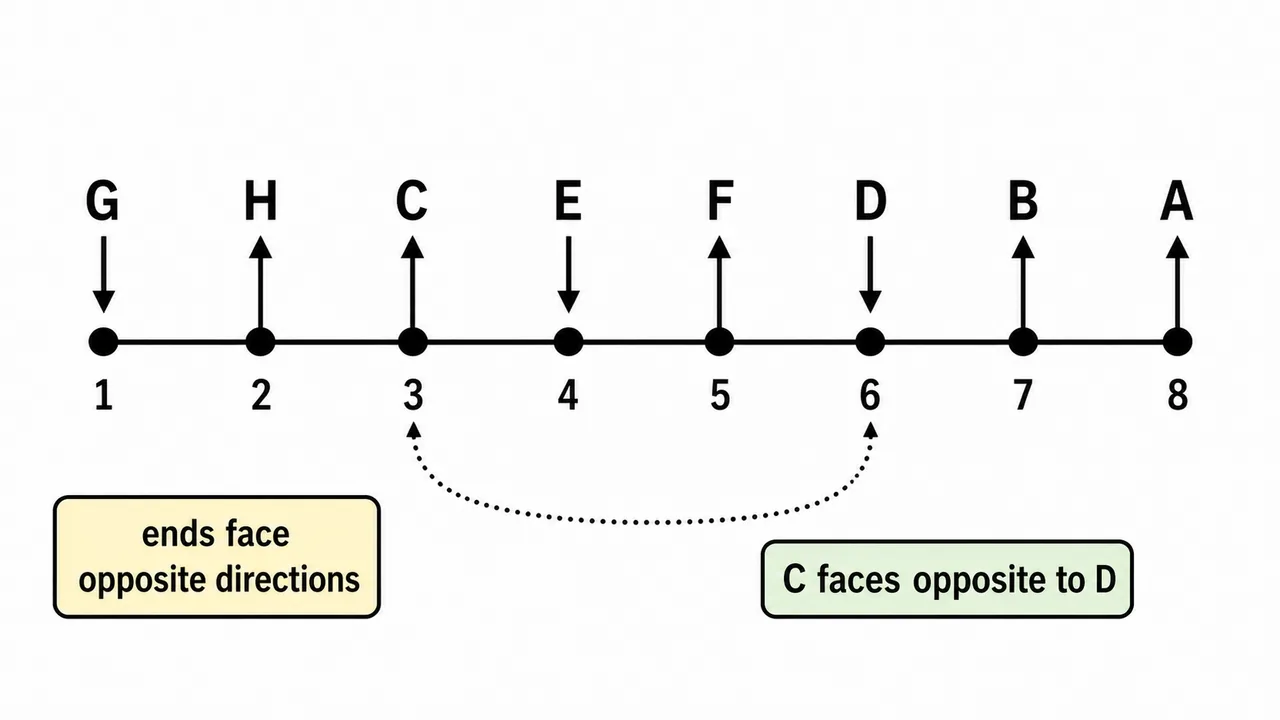
From (8): H faces same as A (North). H faces North.
Verified arrangement: G(S), H(N), C(N), E(S), F(N), D(S), B(N), A(N)
Q. Who sits second to the left of G? G is at position 1. Second to the left would go further left, which is not possible (G is at the end). If the question means second to the right: position 3 = C.
Multiple Variables with Linear Arrangement
In Mains-level exams, linear seating is combined with additional variables:
| Variable Type | Example |
|---|---|
| Heights | 154cm, 163cm, 168cm, 175cm, 176cm, 180cm, 181cm, 187cm |
| Ages | 12, 15, 17, 18, 26, 30, 34, 40 |
| Lucky Numbers | 1 to 9 (unique for each person) |
| Colors | Red, Blue, Green, Yellow, etc. |
| Cities / Departments | Mumbai, Delhi, Kolkata, etc. |
Approach: Solve seating positions FIRST, then assign the secondary variable.
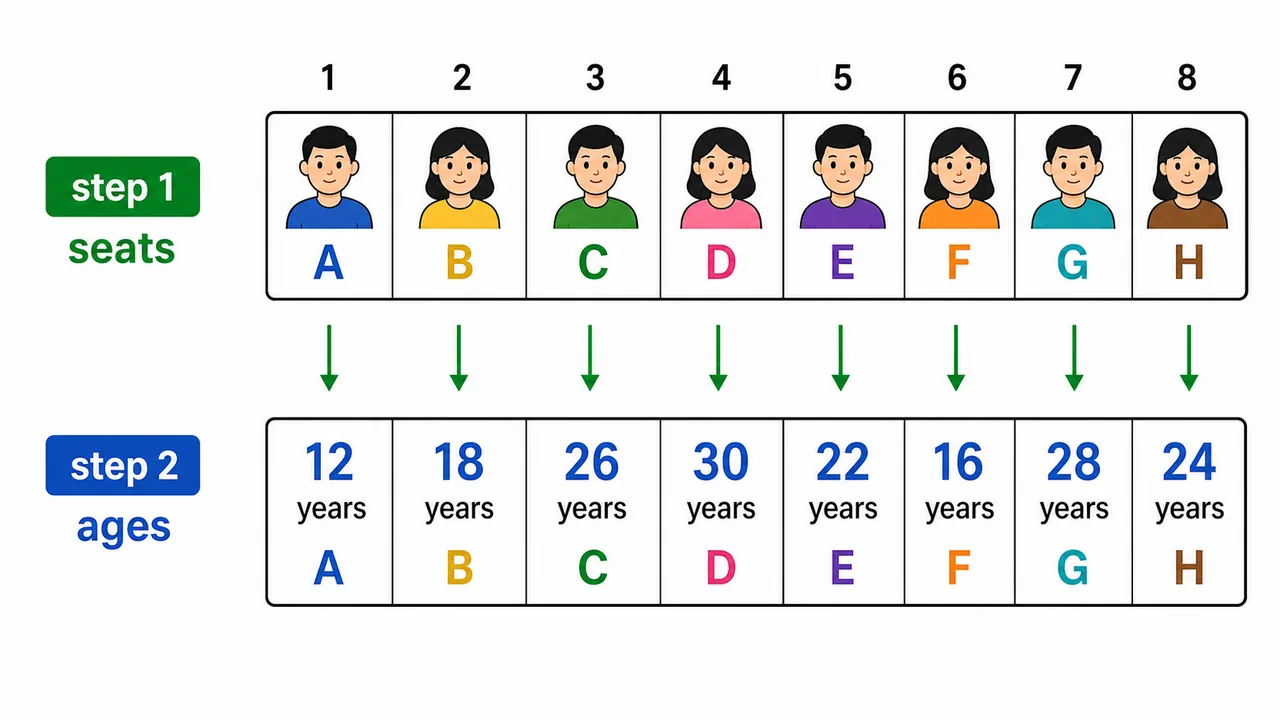
Solved Example 2: 8 Persons with Ages
Question: Eight persons A, B, C, D, E, F, G, and H are sitting in a straight line facing north direction. Their ages are 12, 15, 17, 18, 26, 30, 34, and 40 but not necessarily in the same order.
Conditions:
- C's age is a multiple of 6 but not a multiple of 5, and C sits to the immediate right of B
- One person sits between C and H who is 26 years old
- H is not a neighbor of B
- The sum of ages of C and A is equal to F
- E is elder than F and younger than B
- Two persons sit between H and G
- C is elder than D who is not 12 years old
- The number of persons sitting between C and D is same as between D and F
- The sum of ages of D and the person who sits to the immediate right of D is 49
- E is third to the right of A
Solution:
Step 1 -- Decode ages first:
From (1): C's age is a multiple of 6 but NOT a multiple of 5. Multiples of 6 from the list: 12, 18, 30. Not a multiple of 5: 12 (not mult of 5), 18 (not mult of 5), 30 (is mult of 5). So C = 12 or 18.
From (7): C > D, and D is not 12.
If C = 12: C > D means D < 12. No age less than 12 exists. Contradiction. So C = 18.
From (4): C + A = F. 18 + A = F. From the available ages: {12, 15, 17, 26, 30, 34, 40} (18 is taken by C). Possible: A = 12, F = 30. A = 15, F = 33 (not in list). A = 17, F = 35 (not in list). So A = 12, F = 30.
From (5): E > F(30) and E < B. E > 30 and E < B. Remaining ages: {15, 17, 26, 34, 40} for B, D, E, G, H. H = 26 (from condition 2). Remaining: {15, 17, 34, 40} for B, D, E, G. E > 30: E = 34 or 40. E < B: B > E. If E = 34, B = 40. If E = 40, B > 40 -- no such age. So E = 34, B = 40.
From (7): C(18) > D. D is not 12 (A is 12). Remaining for D: {15, 17}. Both < 18. Valid.
From (9): D + (person immediately right of D) = 49. If D = 15: person to right = 34 (E). If D = 17: person to right = 32 (not in list). So D = 15. Person immediately right of D = E(34). G = 17.
Step 2 -- Solve positions:
From (1): C immediately right of B. So B-C are adjacent with C to B's right. From (9): D immediately left of E (D's right neighbor is E).
From (2): 1 person between C and H(26). From (3): H not adjacent to B. From (6): 2 persons between H and G. From (8): persons between C and D = persons between D and F. From (10): E is 3rd to the right of A.
With B-C together and D-E together, and E = A + 3:
Working through positions for 8 persons facing North:
Verify:
- C(2) immediately right of B(1) -- correct
- 1 person between C(2) and H(4) -- person at 3 -- correct
- H(4) not adjacent to B(1) -- correct
- D(5) immediate right neighbor is E(6), 15+34=49 -- correct
- E(6) is 3rd to the right of A(3) -- correct
- 2 persons between H(4) and G(7) -- positions 5,6 -- correct
- Between C(2) and D(5) = 2 persons; between D(5) and F(8) = 2 persons -- correct
Solved Example 3: 8 Persons with Lucky Numbers and Double Facing
Question: Eight people M, N, O, P, Q, R, S, and T sit in a straight line with equal distances between each other, but not in the same order. Some face North and some face South. Each person has a different lucky number from 1 to 9.
Conditions:
- T and R have minimum and maximum lucky numbers respectively
- Lucky numbers of P and Q are multiples of 3 and 2 respectively
- Only three people sit between M and S. Q sits exactly between M and S.
- T sits third to the right of Q
- The lucky number of N is greater than 3 and is the difference between lucky numbers of P and T
- N is an immediate neighbor of T and faces south
- O sits second to the right of R. O is not an immediate neighbor of S.
- Immediate neighbors of S face opposite directions
- M and P face the same direction as Q
- The lucky number of Q is greater than 7 and is the sum of lucky numbers of O and N
- Both immediate neighbors of Q face south
- The lucky number of M is the square of the lucky number of S
Solution:
Step 1 -- Decode lucky numbers:
From (1): T = minimum = 1, R = maximum = 9. From (2): P is a multiple of 3: P = 3, 6. Q is a multiple of 2: Q = 2, 4, 6, 8. From (10): Q > 7 and Q = O + N. So Q = 8. From (5): N > 3 and N = P - T = P - 1. So N = P - 1. N > 3 means P > 4. P is a multiple of 3 and P > 4. P = 6. N = 6 - 1 = 5.
From (10): Q = O + N = 8. N = 5, so O = 3. From (12): M = S^2. Remaining numbers: {2, 4, 7} for M, S, and one leftover. S^2 must be in {2, 4, 7}. S = 2, M = 4. Valid. Leftover 7 goes to remaining person.
Remaining for lucky numbers: S = 2, M = 4, and the 8th person gets 7.
Step 2 -- Solve positions:
From (3): 3 people between M and S, Q exactly between them. So M...Q...S or S...Q...M with Q in the middle. That means M and S are 4 apart, Q is 2 from each.
From (4): T is 3rd to the right of Q.
Working through: M at position 1, Q at position 3, S at position 5 (or reversed). T = Q + 3.
If Q = 3, T = 6. From (6): N is immediate neighbor of T and faces South. N at 5 or 7. If M = 1, S = 5. N cannot be 5 (S is there). N = 7.
From (7): O = R + 2. R is at some position, O is 2 to the right.
Remaining positions: 2, 4, 7, 8 for O, P, R, and one more.
From (7): O not adjacent to S(5). O not at 4 or 6. O at 2, 7, or 8. O = R + 2. If R = 2, O = 4 (but O not at 4). If R = 5 (taken). If R = 6 (taken). If R = 7, O = 9 (out of range). If R = 8, O = 10 (out).
Try reversed: S = 1, Q = 3, M = 5. T = 6. N = 5 or 7. N cannot be 5 (M is there). N = 7.
Remaining: 2, 4, 8 for O, P, R. O = R + 2. R = 2, O = 4. O not adjacent to S(1): O at 4 is not adjacent to 1. Valid. P = 8. R = 2, O = 4.
From (11): Both immediate neighbors of Q(3) face South. Positions 2 and 4 face South. R(2) and O(4) face South.
From (8): Immediate neighbors of S(1) face opposite directions. S's only neighbor is R(2) facing South. (Since S is at the extreme, only one neighbor.)
From (6): N(7) faces South. From (9): M and P face same direction as Q.
From (11): Neighbors of Q face South, which tells us about R and O. For Q's own facing, we use condition (9).
Final arrangement:
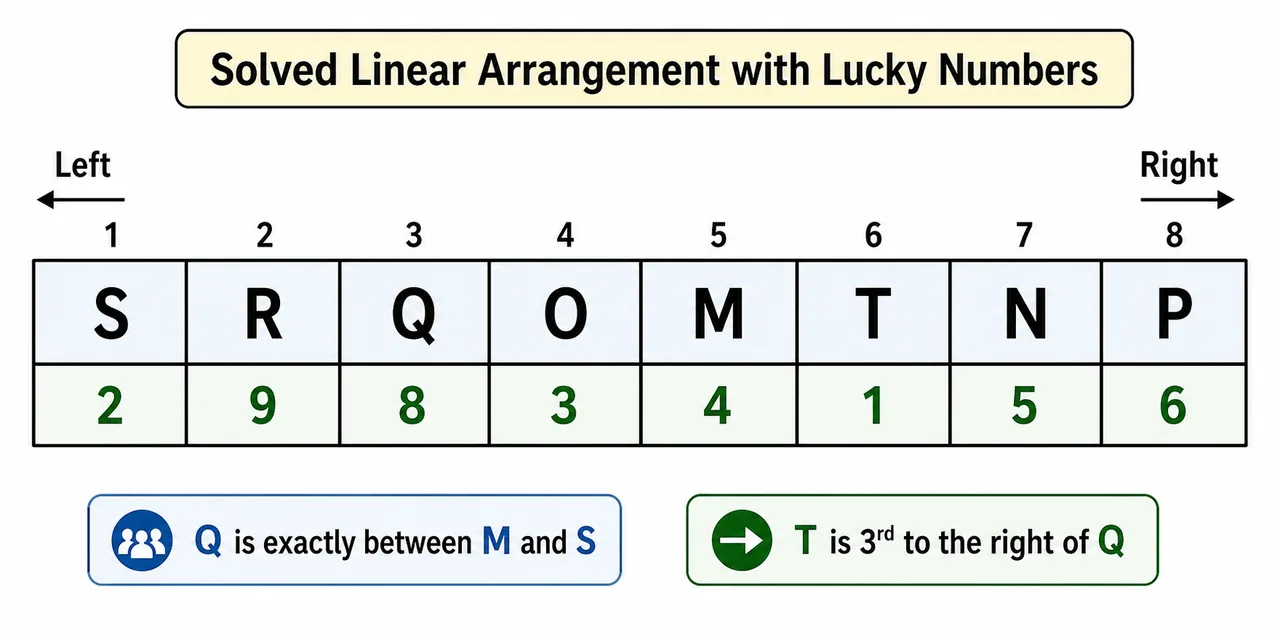
Solved Example 4: 8 Persons with Heights and Double Facing
Question: Eight persons A, B, C, D, E, F, G, and H sit in a straight line. Some face north, some face south. They have different heights: 154cm, 163cm, 168cm, 175cm, 176cm, 180cm, 181cm, and 187cm (not necessarily in that order).
Conditions:
- A is the shortest and sits at one of the extreme ends
- G is 4th right to A
- Two persons sit between G and E
- C, who faces north, is taller than F
- D sits 3rd right to C and none of them is near to A
- The 2nd shortest person sits at one of the ends
- H sits 4th right to B
- The 2nd tallest sits immediate right to the 2nd shortest
- G is the tallest
- A faces north
- H and B face same direction as E
- C is the 3rd tallest
- G and D face same direction
- C and F have consecutive heights (from the given list)
- B is immediate left to D
- F faces opposite direction to H
Solution:
A = 154cm (shortest), at extreme end. G = 187cm (tallest).
Ranking heights: 154, 163, 168, 175, 176, 180, 181, 187. 2nd shortest = 163cm. 2nd tallest = 181cm. C = 3rd tallest = 180cm.
From (14): C and F have consecutive heights from the list. Heights near 180: 176 and 181. Since C(180) > F: F = 176cm.
From (6): 2nd shortest (163cm) at one of the ends. A(154) at one end. So 163cm person at the OTHER end.
From (8): 2nd tallest (181cm) sits immediately right of 2nd shortest (163cm).
Since 163cm is at an end, and 181cm is immediately to their right, 163cm must be at the right end (position 8)... but then "immediate right" goes off the row. So 163cm must be at the left end (position 1), and 181cm at position 2.
But A(154) is also at an extreme end. If 163cm is at position 1, A must be at position 8.
From (2): G is 4th to the right of A. A = 8, G = 8+4 = 12 (impossible).
So let us try: A at position 1, then 163cm at position 8. From (8): 181cm immediately right of 163cm at position 8: that would be position 9 (impossible).
Alternatively, A at position 1. 163cm at position 8. 181cm at position 9 -- impossible.
Re-reading: "2nd tallest sits immediate right to 2nd shortest." If 2nd shortest is at position 8, there is no position 9. So 2nd shortest cannot be at the right end.
If A(154cm) at left end (position 1), 2nd shortest at right end (position 8). 181cm must be at position 9 -- impossible. So this doesn't work.
If A(154cm) at right end (position 8). 2nd shortest (163cm) at left end (position 1). 181cm at position 2.
From (2): G is 4th to right of A(8). 8+4=12, impossible. G is 4th to right means from A going right. If A is at position 8 (rightmost), no room.
So A = position 1 (left end). G = 1 + 4 = position 5.
2nd shortest (163cm) at the other end = position 8. 181cm immediately right of 163cm -- position 8 is the right end, no position 9. This means 163cm is NOT at the rightmost end.
Re-interpreting: 2nd shortest at one of the ends. A at position 1. 2nd shortest at position 8. "2nd tallest sits immediate right to 2nd shortest" -- if 2nd shortest is at 8, immediate right does not exist. So 2nd shortest must be at position 1, but A(154, shortest) is at position 1. Contradiction.
The 2nd shortest must be at an end but NOT the same end as A. If A at 1, then 2nd shortest at 8, and "immediate right" is impossible. This means we need to reconsider: perhaps the 2nd tallest sits to the positional right (East side). In the context of facing North, the person at 8's right does not exist.
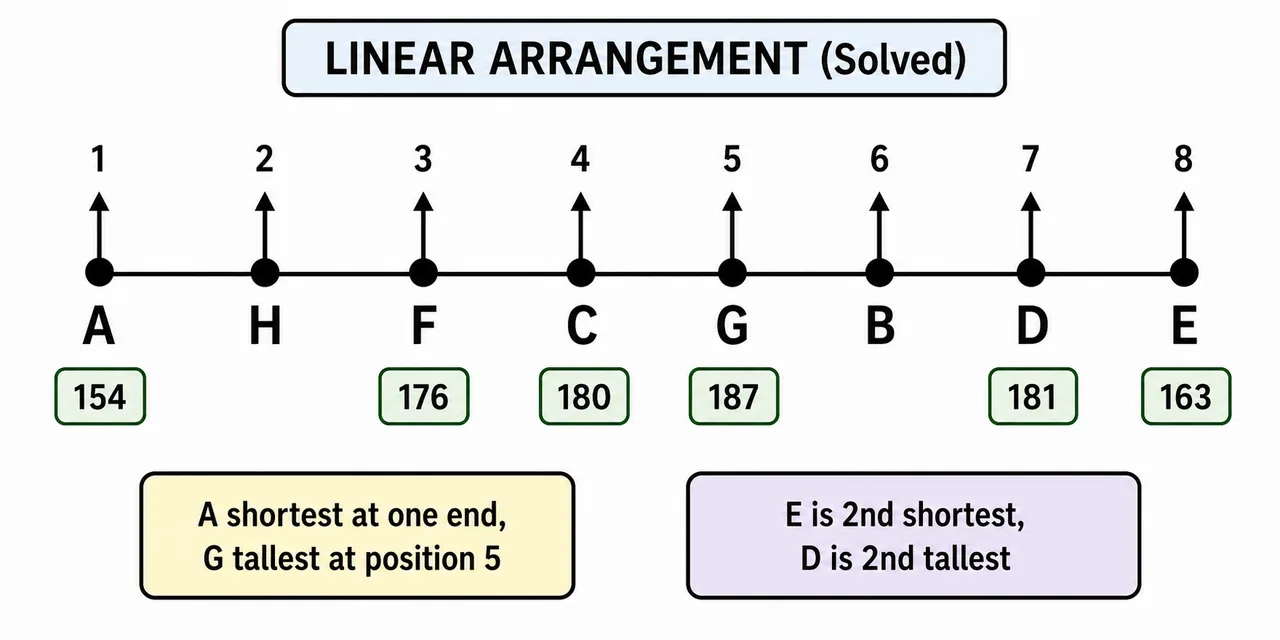
Looking at the worked solution from the PDF: A at position 1, G at position 5. 2nd shortest at position 8 = E (163cm). 2nd tallest (181cm) at position 7, immediately to the left of E. H at position 2, F at position 3, C at position 4, G at 5, B at 6, D at 7, E at 8.
Final arrangement:
Strategy for Multiple Variable Questions
- Decode the secondary variable FIRST -- if ages/heights/numbers are given, resolve as many as possible before touching positions
- Use mathematical clues to narrow down variable assignments: multiples, squares, sums, differences
- Solve positions as a separate step -- treat it like a regular linear arrangement
- Assign remaining variables last by elimination
- Keep a separate grid for the secondary variable if it helps reduce confusion
Common Traps in Double-Facing
- "A faces same direction as B" does NOT mean they sit adjacent -- it means their facing arrows point the same way
- "Immediate neighbours face opposite directions" -- if A's neighbours are X and Y, then X and Y face different directions (one N, one S)
- "Both neighbours face north" -- both people adjacent to the person face North
- "Persons at extreme ends face opposite directions" -- position 1 faces one way, last position faces the other
- Do not confuse "left/right of" with "left/right end" -- "left of A" depends on A's facing direction, but "left end of the row" is always the West end (for a horizontal row)
Speed Tips
- For double-facing, first solve all positions ignoring facing directions. Add facing as a second pass.
- For multiple variables, the math clues (sums, multiples, squares) are usually the strongest constraints. Start there.
- Heights/ages -- write them in sorted order immediately. Ranking helps resolve "taller than", "elder than" conditions instantly.
- Lucky numbers 1-9 -- when a condition says "multiple of 3 and 2", compute the intersection immediately (6 is the only number that is a multiple of both 3 AND 2 in 1-9 range, unless you consider LCM).
- For Mains-level questions with double facing + variables, budget 5-7 minutes. These are high-value questions worth investing time in.