❓ Linear Arrangement — Uncertain & Indefinite Conditions
Master uncertain linear arrangements - indefinite total count, unknown positions, case analysis, and elimination strategies for Prelims and Mains
Linear Arrangement -- Uncertain & Indefinite Conditions
Uncertain linear arrangements are among the trickiest question types in banking exams. Unlike standard puzzles where you know exactly how many people are in the row, these puzzles introduce unknown elements: the total number of persons may not be given, facing directions may be ambiguous, or multiple valid arrangements may exist.
What Makes a Linear Arrangement "Uncertain"?
In a regular linear puzzle, you know:
- Exactly how many persons are in the row (e.g., 8 persons)
- Which direction everyone faces (e.g., all face North)
- All conditions lead to a single unique arrangement
In an uncertain puzzle, one or more of these is missing:
| Uncertain Element | Example |
|---|---|
| Total number of persons unknown | "A certain number of persons sit in a row" |
| Extra persons beyond named ones | "Some other unnamed persons also sit in the row" |
| Facing direction not specified | "Some face North, some face South" (you must deduce who faces which way) |
| Multiple possible arrangements | Conditions do not uniquely fix all positions; questions may ask "which of the following is possible?" |
The "Certain Number" Pattern
This is the most common uncertain pattern. The question says:
Pro Content Locked
Upgrade to Pro to access this lesson and all other premium content.
Charged once for one year · ₹1188 total
Save ₹100/month vs ₹2388/year launch price
- All Agriculture & Banking Courses
- AI Lesson Questions (100/day)
- AI Doubt Solver (50/day)
- Glows & Grows Feedback (30/day)
- AI Section Quiz (20/day)
- 22-Language Translation (100/day)
- Recall Questions (20/day)
- AI Quiz (15/day)
- AI Quiz Paper Analysis (100/day)
- AI Step-by-Step Explanations (100/day)
- Spaced Repetition Recall (FSRS)
- AI Tutor
- Immersive Text Questions
- Audio Lessons — Hindi & English
- Mock Tests & Previous Year Papers
- Summary & Mind Maps
- XP, Levels, Leaderboard & Badges
- Generate New Classrooms
- Voice AI Teacher (AgriDots Live)
- AI Revision Assistant
- Knowledge Gap Analysis
- Interactive Revision (LangGraph)
🔒 Secure one-time yearly payment via Razorpay · No hidden fees
Linear Arrangement -- Uncertain & Indefinite Conditions
Uncertain linear arrangements are among the trickiest question types in banking exams. Unlike standard puzzles where you know exactly how many people are in the row, these puzzles introduce unknown elements: the total number of persons may not be given, facing directions may be ambiguous, or multiple valid arrangements may exist.
What Makes a Linear Arrangement "Uncertain"?
In a regular linear puzzle, you know:
- Exactly how many persons are in the row (e.g., 8 persons)
- Which direction everyone faces (e.g., all face North)
- All conditions lead to a single unique arrangement
In an uncertain puzzle, one or more of these is missing:
| Uncertain Element | Example |
|---|---|
| Total number of persons unknown | "A certain number of persons sit in a row" |
| Extra persons beyond named ones | "Some other unnamed persons also sit in the row" |
| Facing direction not specified | "Some face North, some face South" (you must deduce who faces which way) |
| Multiple possible arrangements | Conditions do not uniquely fix all positions; questions may ask "which of the following is possible?" |
The "Certain Number" Pattern
This is the most common uncertain pattern. The question says:
"A certain number of persons are sitting in a row facing north."
Only some persons are named (e.g., S, T, Q, P, R, U, V, W), and the total count must be deduced from the conditions.
How to find the total:
The conditions will mention positions from an end (left end or right end). Use these to calculate the minimum row length. The key formula:
Total persons in row = Max position from left end (or right end) mentioned in any condition
Or more precisely, the total is determined when you place all named persons and check the furthest position used.
Approach: Definite/Least Possible Cases
The solving strategy for uncertain puzzles follows this framework:
Step 1: Extract Definite Information
- Start with definite place conditions: "S is eighth from the left end", "W is third from any of the ends"
- Start with definite conditions: "Q sits sixth to the right of S", "T sits 4th to the left of Q"
Step 2: Relate Conditions
- Connect the pieces. If you know S's position and "Q is 6th to the right of S", you know Q's position.
- Chain connections: S -> Q -> T -> others
Step 3: Count Known + Unknown = Total
- Once you have placed all named persons, count how many unnamed positions exist between or beyond them.
- The total = number of seats needed to satisfy all conditions.
Step 4: Answer the Question
- Common questions: "How many persons are sitting in the row?", "Who sits at which end?", "How many persons sit between X and Y?"
Solved Example 1: Finding Total Number of Persons
Question: A certain number of persons are sitting in a row. All of them are facing towards north.
Conditions:
- Q sits sixth to the right of S
- T sits 4th to left of Q
- Only two persons sit between Q and P
- R sits 4th to the left of S
- U sits between S and T
- V sits second to the right of U
- W is third from any of the end
- S is eighth from the left end of the row
- Six persons sit between W and V
Solution:
Step 1: From (8): S = position 8 (from left).
Step 2: From (1): Q = S + 6 = position 14.
Step 3: From (2): T = Q - 4 = position 10.
Step 4: From (4): R = S - 4 = position 4.
Step 5: From (5): U is between S(8) and T(10). U = position 9.
Step 6: From (6): V = U + 2 = position 11.
Step 7: From (3): 2 persons between Q(14) and P. P = 14 + 3 = 17 or P = 14 - 3 = 11. But V is at 11. So P = position 17.
Step 8: From (9): 6 persons between W and V(11). W = 11 + 7 = 18 or W = 11 - 7 = 4. But R is at 4. So W = position 18.
Step 9: From (7): W is third from any end. W = 18 means W is the 3rd from the right end. So total = 18 + 2 = 20 persons.
Verify: W at position 18 is 3rd from the right end of a 20-person row. 20 - 18 + 1 = 3. Correct.
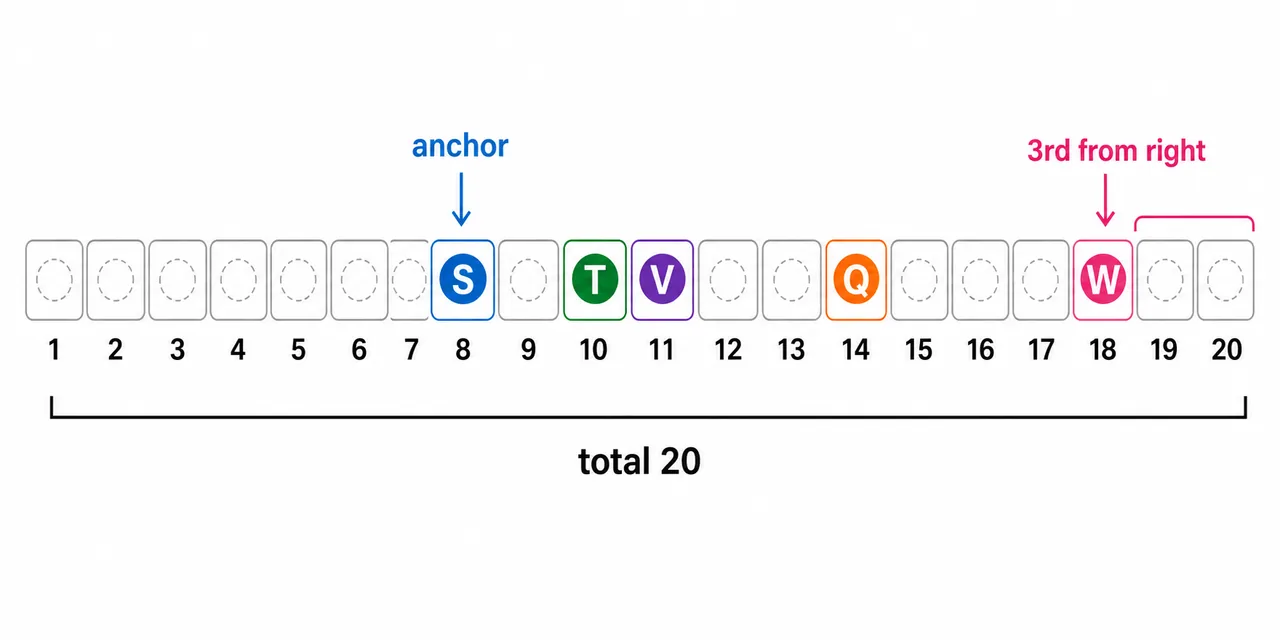
Answer: 20 persons are sitting in the row.
Solved Example 2: Uncertain with More Constraints
Question: A certain number of persons are sitting in a row facing south.
Conditions:
- Only three persons sit to the left of K
- B sits second to the left of F
- Only six persons sit between K and A
- There are only two persons between F and G
- G sits second from the extreme end
- Three persons sit between D and E, and B sits third to the right of E
- Number of persons between D and F is equal to number of persons between D and K
Solution:
From (1): K has 3 persons to its left. K = position 4 (from the left end).
Note: Since they face South, left = East, right = West. But position numbering from left end remains the same.
From (3): 6 persons between K(4) and A. A = 4 + 7 = 11 or A = 4 - 7 = -3 (impossible). A = position 11.
From (2): B = F - 2 (B is 2nd to the left of F). Since facing South, "left" is towards higher position numbers. B = F + 2.
From (6): B = E + 3 (3rd to the right of E). Facing South, "right" is towards lower position numbers. B = E - 3.
From (6): 3 persons between D and E. |D - E| = 4.
From (5): G is second from the extreme end. G = position 2 or (total - 1).
From (4): 2 persons between F and G. |F - G| = 3.
Working through: if G = 2, F = 5 or F = -1. F = 5. B = F + 2 = 7. From B = E - 3: E = B + 3 = 10. D is 4 apart from E: D = 14 or 6.
From (7): persons between D and F = persons between D and K(4). If D = 14: between D(14) and F(5) = 8. Between D(14) and K(4) = 9. Not equal. If D = 6: between D(6) and F(5) = 0. Between D(6) and K(4) = 1. Not equal.
Try G at the other end. We need to find the total first.
Let total = N. G = N - 1. F = G - 3 = N - 4 or F = G + 3 = N + 2 (too large). F = N - 4. B = F + 2 = N - 2. E = B + 3 = N + 1. This exceeds the row. Not possible.
Try: B = F - 2 (rechecking facing South convention). In facing South: "second to the left of F" -- left for South-facing = East = towards right end = higher position number. So B = F + 2. "Third to the right of E" -- right for South-facing = West = towards left end = lower position number. So B = E - 3.
If G = N-1: F = N-4, B = N-2, E = B+3 = N+1 -- impossible.
Re-examining with standard positional approach (ignoring facing for position numbering): B is 2 positions to the left of F in standard terms: B = F - 2. B is 3 positions to the right of E in standard terms: B = E + 3.
G = 2: F = 5, B = 3, E = B - 3 = 0 -- impossible. F = -1 -- impossible.
G at right end: G = N-1. F = N-4 or N+2. F = N-4. B = N-4-2 = N-6. E = B-3 = N-9. 3 between D and E: D = N-13 or N-5.
From (7): between D and F(N-4) = between D and K(4).
If D = N-5: |D-F| -1 = |(N-5)-(N-4)| -1 = 0. |D-K| -1 = |(N-5)-4| -1 = N-10. 0 = N-10 means N = 10. But then E = 10-9 = 1, D = 5, check: 3 between D(5) and E(1) = 3. Correct.
Total = 10? But K = 4, A = 11. A = 11 > 10. Contradiction. Try D = N-13.
If N isn't 10, try larger N. Going back to G = 2: Actually, let's reconsider the facing-direction conventions more carefully. Many exam questions use absolute position left/right (from an observer's perspective), not the seated person's perspective.
Using absolute positions: left end = position 1, right end = position N. "B sits second to the left of F" = B = F - 2. "B sits third to the right of E" = B = E + 3.
G = 2: F = 5 or F = -1. F = 5. B = 3. E = 0. Invalid.
G = N-1: F = N-4 or F = N+2. F = N-4. B = N-6. E = N-9. K = 4, A = 11. D = (N-9)+4 = N-5 or D = (N-9)-4 = N-13.
If D = N-5: persons between D(N-5) and F(N-4) = 0. Persons between D(N-5) and K(4) = N-10. 0 = N-10 -> N = 10. But A = 11 > 10. Invalid.
If D = N-13: persons between D(N-13) and F(N-4) = 8. Persons between D(N-13) and K(4) = N-18. 8 = N-18 -> N = 26.
G = 25 (second from right end of 26). F = 22. B = 20. E = 17. D = 13.
Answer: 26 persons in the row.
Solved Example 3: "Certain Number" with Variable Row Length
Question: A certain number of people are sitting in a straight line facing North.
Conditions:
- K sits eight from the left end of the line
- Only four people sit between K and U
- T sits second to the left of U
- V sits fourth to the right of T
- As many people sit between K and V as between V and X
- W sits third to the right of X
- The number of people sitting between K and T is same as that sitting to the right of W
Solution:
From (1): K = position 8.
From (2): U = 8 + 5 = 13 or U = 8 - 5 = 3.
From (3): T = U - 2.
If U = 13: T = 11. If U = 3: T = 1.
From (4): V = T + 4.
If T = 11: V = 15. If T = 1: V = 5.
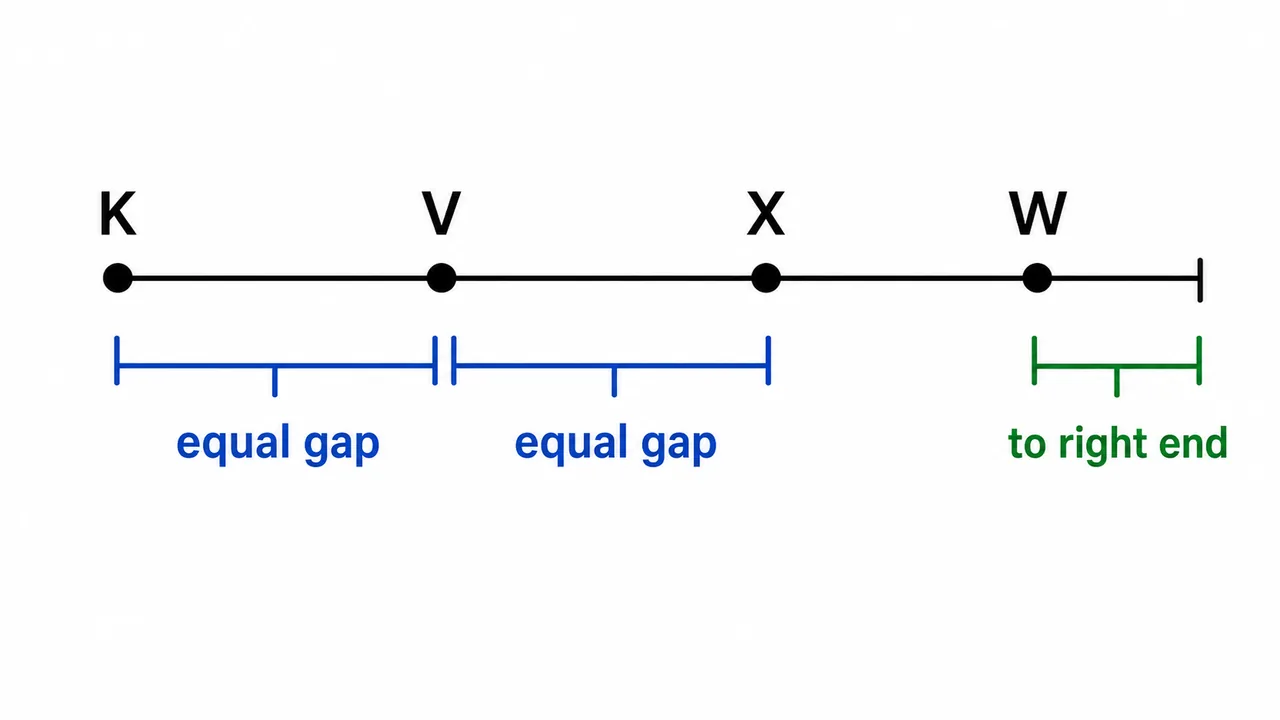
From (5): |K - V| = |V - X| (same number of people between each pair).
Case 1: U = 13, T = 11, V = 15. K = 8, V = 15. Between K and V = 6. So between V and X = 6. X = 15 + 7 = 22 or X = 15 - 7 = 8 (K is at 8). X = 22.
From (6): W = X + 3 = 25. From (7): People between K(8) and T(11) = |8-11| - 1 = 2. People to right of W = total - 25. 2 = total - 25. Total = 27.
Case 2: U = 3, T = 1, V = 5. K = 8, V = 5. Between K and V = 2. Between V and X = 2. X = 8 or X = 2. X = 2 (since 8 is taken by K). W = 2 + 3 = 5 (V is at 5). Clash. Invalid. X = 8 is taken by K. Invalid. Case 2 fails.
Answer: 27 persons.
Solved Example 4: Variable Total with Equality Conditions
Question: Certain number of people were seated in a linear row facing north. Information about only some of them is known.
Conditions:
- F is seated fifth to the left of V
- Two people are seated between V and K
- The number of people seated between K and F is half the number seated between P and K, where P is to the left of K
- Five people are seated between U and P, where the former (U) is to the right of the latter (P)
- The number of people seated between V and M was half the number seated between K and U
- M was seated at one of the ends
- Number of people seated between P and G is same as between K and M
- G is seated at one of the ends
Solution:
From (1): F = V - 5. From (2): 2 between V and K. K = V + 3 or K = V - 3.
If K = V + 3: F = V - 5. Between K and F = |(V+3)-(V-5)| - 1 = 7. From (3): between K and F = half of between P and K. 7 = (between P and K)/2. Between P and K = 14. P = K - 15 (P left of K). P = V + 3 - 15 = V - 12.
From (4): 5 between U and P, U right of P. U = P + 6 = V - 6.
From (5): between V and M = half of between K and U. Between K(V+3) and U(V-6) = 8. Half = 4. Between V and M = 4. M = V + 5 or M = V - 5. V - 5 = F. So M = V + 5.
From (6): M at an end. M = V + 5 is at one end. From (8): G at an end.
Let us assign V a value. Let V = 13. Then: F = 8, K = 16, P = 1, U = 7, M = 18.
From (7): between P(1) and G = between K(16) and M(18) = 1. G = 1 + 2 = 3 or G = 1 - 2 (impossible). G = 3.
But (8) says G at an end. G = 3 is not at an end unless the row is short. But M = 18 at an end, and P = 1 at the left end.
From (8): G at one end. G should be at position 1 or 18 (if M is at 18). P is at 1 already. G cannot be 1. G at 18? But M is at 18.
Adjust: between P and G = 1. If P = 1, G = 3 (not an end). Rethink.
Try V = 15: F = 10, K = 18, P = 3, U = 9, M = 20. Between P(3) and G = between K(18) and M(20) = 1. G = 5 or 1. G at an end: G = 1. M at an end: M = 20 (right end).
Total = 20 persons.
Strategy for Uncertain / Indefinite Questions
- Start with any "from the end" condition -- "K is 8th from the left end" gives K an absolute position. This is your anchor.
- Chain relative conditions from the anchor. Build outward: if you know K, find Q from K, find T from Q, etc.
- The total count is determined by "from the end" conditions -- if someone is "3rd from the right end", total = that position + 2.
- "As many between X and Y as between Y and Z" -- these equality conditions often pin down the total row length.
- When facing direction is uncertain, create two cases (North/South) and check which satisfies all conditions. Often one case leads to a contradiction.
- For "cannot be determined" type questions, if both arrangements are valid and the question asks about a position that differs between them, the answer is "cannot be determined."
Common Question Types in Uncertain Arrangements
| Question Type | How to Answer |
|---|---|
| "How many persons are sitting in the row?" | Calculate from end-position clues |
| "Who sits at the extreme left/right end?" | Check which named person lands at position 1 or N |
| "How many persons sit between X and Y?" | Use their positions: |Pos(X) - Pos(Y)| - 1 |
| "How many persons sit to the left/right of X?" | Left of X = Pos(X) - 1. Right of X = Total - Pos(X). |
| "Which of the following is true?" | Verify each option against your arrangement |
| "What is the position of X from the right end?" | Position from right = Total - Pos(X) + 1 |
Common Traps
- Assuming total = number of named persons -- in uncertain puzzles, there are usually more seats than named people. Unnamed persons fill the gaps.
- Ignoring "from the end" clues -- these are the ONLY way to anchor absolute positions. Miss one and the entire puzzle becomes unsolvable.
- Not checking both possibilities for gap conditions -- "4 persons between K and U" gives two options (K left of U or right of U). Test both.
- Forgetting that facing direction reverses left/right -- in South-facing rows, "2nd to the left" means 2 positions toward the right end (higher position number).
- Over-counting or under-counting "between" -- "6 persons sit between W and V" means |W - V| = 7. The gap is one more than the count.
Speed Tips
- Anchor first: find the person with an absolute position (from an end). Everything builds from there.
- Chain forward: work condition by condition, always building on what you already know. Do not jump around.
- Track the rightmost position: as you place persons, keep note of the maximum position number. This helps estimate total quickly.
- For "certain number" puzzles, the answer is almost always between 15-30 persons in Mains exams. If you get a very small or very large number, recheck.
- Draw a long number line on your rough sheet -- at least 30 positions. Mark persons as you go. This visual approach prevents arithmetic errors.
- In Prelims, uncertain puzzles are rare. In Mains, expect 1-2 sets. Budget 6-8 minutes per set.