⭕ Circular Seating Arrangement -- Basics
Fundamentals of circular seating arrangement - facing center, clockwise/anticlockwise rules, left-right conventions, opposite positions, gap counting, and solving approach
Introduction to Seating Arrangement
Seating arrangement is one of the most important topics in reasoning. In bank exams (IBPS PO, SBI PO, RRB, NABARD), you can expect 10-15 questions from this topic alone across Prelims and Mains.
Seating arrangement problems are broadly divided into two categories:
| Category | Sub-types |
|---|---|
| Circular | Circle, Square, Triangle, Rectangle, Concentric circles, Circumference |
| Linear | Straight row, Parallel rows, 3/4 rows |
Additional variations include: Inside/Outside facing, Relation-based, Same facing / North-South, and Uncertain/Indefinite conditions.
In this lesson, we focus on circular arrangement basics -- where all persons sit around a circular table and face towards the centre.
Facing Towards the Centre -- The Core Rule
When all persons face towards the centre of a circular table, the left-right directions follow a specific pattern:
- Right = Anticlockwise (ACW) direction
- Left = Clockwise (CW) direction
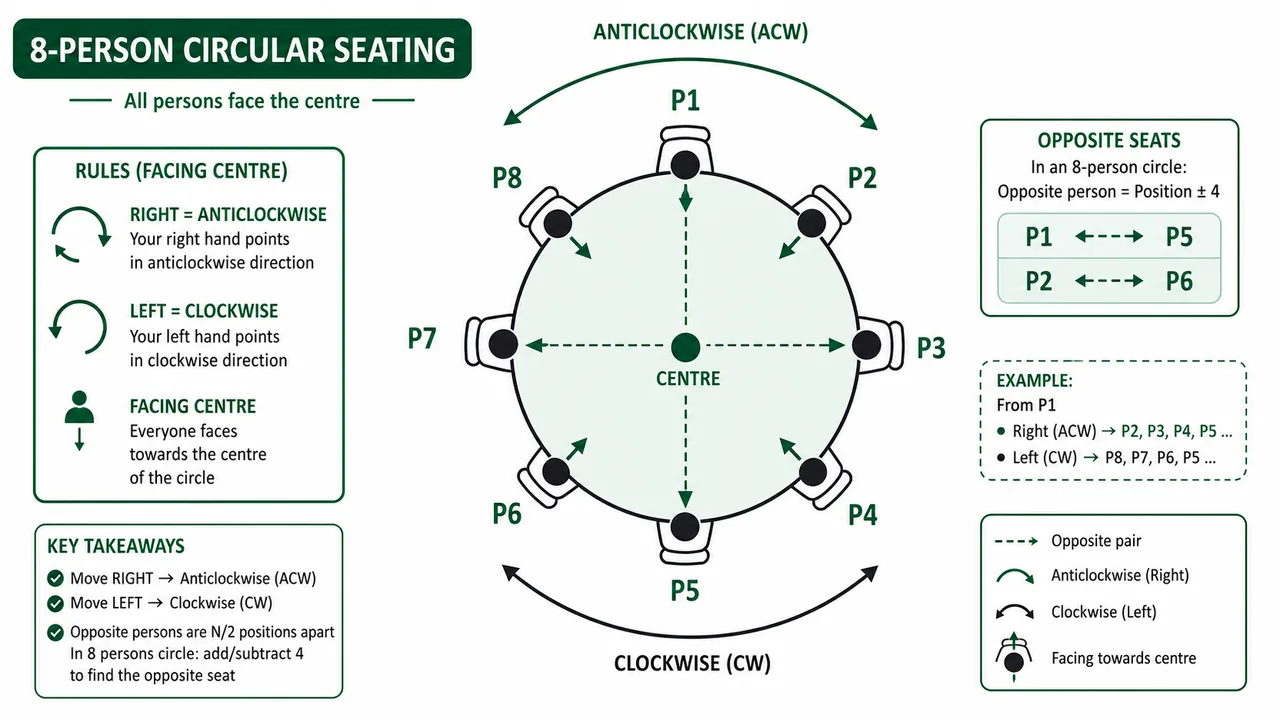
Think of it this way: if you are sitting at the table facing the centre, your right hand points in the anticlockwise direction and your left hand points in the clockwise direction.
Memory Trick: Facing Centre -- Right = ACW, Left = CW. This is the golden rule for all circular arrangement problems.
Facing Away from the Centre -- Reversed Rule
When persons face away from the centre (outward), everything reverses:
- Right = Clockwise (CW) direction
- Left = Anticlockwise (ACW) direction
Key Point: The direction rules flip completely when facing direction changes. This becomes critical in mixed-facing problems (covered in the next lesson).
Key Terminology for Exam Questions
Understanding the exact language used in exam questions is crucial. One misread word can lead to a wrong arrangement.
| Exam Phrase | Meaning |
|---|---|
| "A sits second to the right of B" | From B, count 2 positions in the RIGHT direction (ACW if facing centre) |
| "A sits immediate left of B" | A is exactly 1 position to the LEFT of B (CW if facing centre) |
| "A and B are immediate neighbours" | A and B sit next to each other (adjacent/beside) |
| "3 persons sit between A and B" | There are exactly 3 people in the gap between A and B |
| "A sits opposite to B" | A and B are diametrically opposite on the circle |
| "A is not an immediate neighbour of B" | A and B are NOT adjacent -- at least one person separates them |
Reading Compound Conditions
Exam questions often pack two conditions into one sentence using connectors. The key rule:
- who / whom refers to the 2nd person (the one just mentioned)
- and / but / while introduces a condition about the 1st person (the subject)
Example 1: Connector "and"
"R sits second to the right of A and immediate left of Q"
This gives us two separate facts:
- R sits second to the right of A
- R sits immediate left of Q
Both conditions are about R (the first person).
Example 2: Connector "who"
"R sits second to the right of A who sits immediate left of Q"
This gives us:
- R sits second to the right of A
- A sits immediate left of Q (because "who" refers to A, the 2nd person)
Example 3: Comma separator
"R sits second to the right of A, is immediate left of Q"
Here the comma + "is" means the subject is still R:
- R sits second to the right of A
- R is immediate left of Q
Trap Alert: Many students confuse "who" with "and". Always identify whether the connector refers to the 1st or 2nd person.
"N Persons Between A and B" in Circular
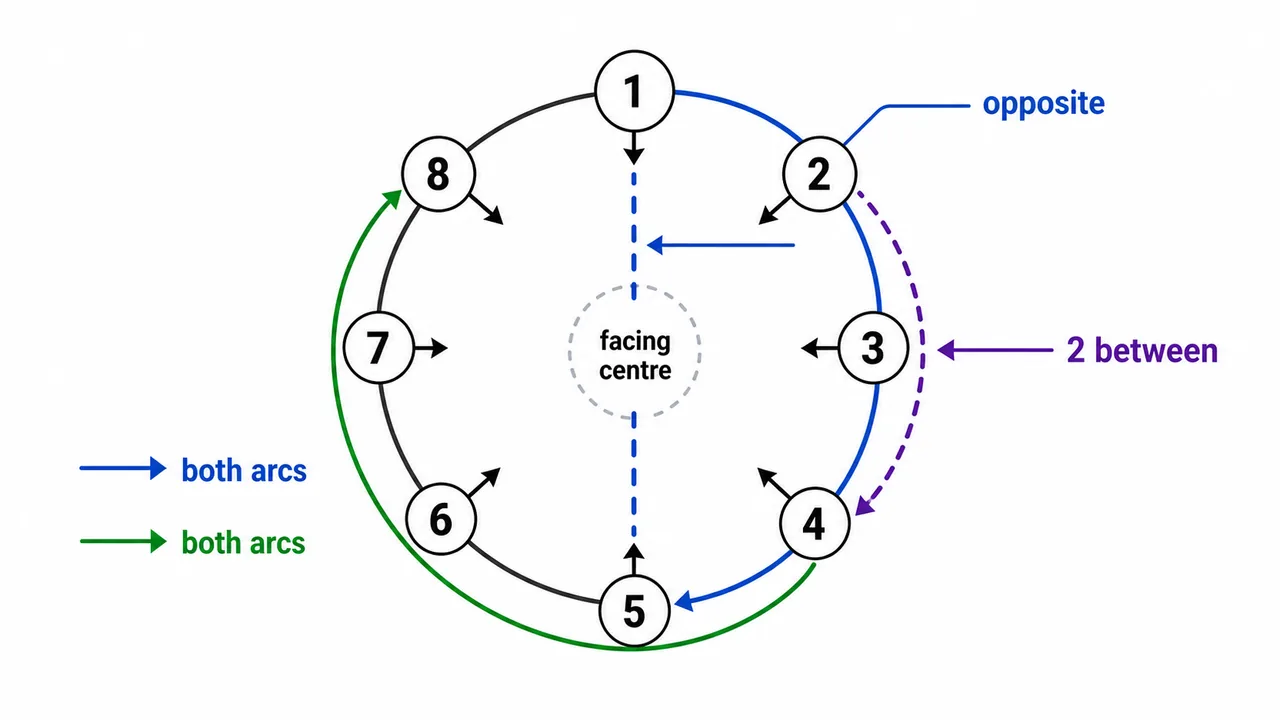
In circular arrangement, when the question says "N persons sit between A and B", you must check both arcs (both directions around the circle):
- In an 8-person circle, if "3 persons sit between A and B", this could mean:
- 3 persons on one arc, and 8 - 3 - 2 = 3 persons on the other arc
- So A and B are exactly opposite (equidistant from both sides)
However, if "2 persons between A and B":
- 2 persons on one arc, and 8 - 2 - 2 = 4 persons on the other arc
- Two possible placements to check
Important: Always verify both arcs before fixing positions.
Opposite Person in Even-Numbered Circles
In an even-numbered circle, every person has exactly one person sitting directly opposite.
Formula: In an N-person circle (N = even), the person opposite to position P is at position P + N/2.
| Circle Size | Gap to Opposite |
|---|---|
| 6 persons | Position + 3 |
| 8 persons | Position + 4 |
| 10 persons | Position + 5 |
| 12 persons | Position + 6 |
Note: In odd-numbered circles (7, 9, 11 persons), there is NO direct opposite. The concept of "opposite" does not apply unless specified differently.
Definite vs Indefinite Conditions
Before solving, classify each condition:
| Type | Description | Example |
|---|---|---|
| Definite | Gives an exact, fixed position | "A sits 3rd to the right of B" |
| Indefinite | Has multiple possibilities | "A sits either 2nd to the left or 3rd to the right of B" |
Solving Approach -- The Flowchart
- Start with Definite Conditions -- pick the one that is most repeated (appears in the most conditions) or most independent (connects many people)
- Add positive information -- place people using definite conditions
- Add negative information -- "A is NOT adjacent to B", "C does NOT sit opposite D"
- Find least possible places -- narrow down remaining positions
- Handle possibilities -- if multiple arrangements exist, maintain all valid cases
Strategy: Always process definite conditions first. Collect and relate them before touching indefinite ones.
Solved Example 1 -- 8 Persons (Even Circle, Facing Centre)
Question: Eight persons P, Q, R, S, T, U, V and W are sitting around a circular table facing the centre.
Conditions:
- S sits second to the right of Q, who is near to U and V
- R sits third to the right of Q
- Q sits third to the right of P
- W sits third to the right of U
Step 1: Fix Q at any position (since circular, we can fix one person).
Step 2: From condition 3 -- Q is 3rd to the right of P. So P is 3rd to the LEFT of Q. Place P, then Q is 3 positions anticlockwise from P.
Step 3: From condition 2 -- R is 3rd to the right of Q (3 positions ACW from Q).
Step 4: From condition 1 -- S is 2nd to the right of Q. Also, Q is near U and V (U and V are neighbours of Q).
Step 5: From condition 4 -- W is 3rd to the right of U.
Final Arrangement (clockwise from top):
Solved Example 2 -- 8 Persons (Classic Problem)
Question: A, B, C, D, E, F, G and H are sitting around a circular table facing the centre.
- C is second to the left of B
- B is fourth to the right of E
- F and A are not immediate neighbours of B
- F is third to the right of A
- H is not an immediate neighbour of A
- A is to the immediate left of G
Step 1: Start with the most connected person. B appears in 3 conditions. Fix B at top.
Step 2: C is 2nd to the LEFT of B = 2 positions CW from B.
Step 3: B is 4th to the RIGHT of E = E is 4 positions CW from B (opposite in 8-person circle). So E sits opposite B.
Step 4: F is 3rd to the RIGHT of A. Also, A is to the immediate LEFT of G (G is immediately CW-next to A... actually A is to the immediate left of G means A is one position clockwise from G).
Step 5: Apply negative conditions: F and A are NOT neighbours of B. H is NOT a neighbour of A.
Final Arrangement (clockwise):
Solved Example 3 -- 8 Persons with Neighbour Conditions
Question: S, T, U, V, W, X, Y and Z are sitting around a circular table facing the centre.
- S sits third to the right of U
- Z and X are not the immediate neighbour of U
- As many persons sit between S and Z as sit between S and X
- V sits third to the left of Z
- There are three persons between V and W
- Y is not an immediate neighbour of W
Step 1: Fix U. S is 3rd to the right (3 ACW) from U.
Step 2: Z and X are NOT immediate neighbours of U. So neither Z nor X sits adjacent to U.
Step 3: "As many between S and Z as between S and X" -- S is equidistant from both Z and X. In an 8-person circle, this means Z and X are symmetric around S.
Step 4: V is 3rd to the left (3 CW) of Z. Three persons between V and W.
Step 5: Y is not an immediate neighbour of W -- use this to eliminate wrong cases.
Final Arrangement (clockwise):
Solved Example 4 -- 11 Persons (Odd Circle)
Question: Eleven persons A, B, C, D, E, F, G, H, I, J and K sit in a circle facing the centre (not necessarily in order).
- D sits third to the right of B
- Three persons sit between D and I
- A does not sit near I
- K sits second to the right of A
- K does not sit near D
- Three persons sit between I and J
- C sits third to the right of K
- E is not the immediate neighbour of A and D
- G sits second to the left of H
Step 1: Start with D and B -- D is 3rd to the right (ACW) of B.
Step 2: Three persons between D and I. In an 11-person circle, place I accordingly (check both arcs).
Step 3: A does not sit near I. K is 2nd to the right of A. K does not sit near D.
Step 4: Three persons between I and J. C is 3rd to the right of K.
Step 5: E is NOT an immediate neighbour of A and D. G is 2nd to the left of H.
Final Arrangement (clockwise):
Key Learning: With odd-numbered circles, there is no direct "opposite". You must count positions carefully in both directions.
Solved Example 5 -- 9 Persons
Question: Nine people P, Q, R, S, T, U, V, W and X are sitting around a circular table facing the centre.
- V is fourth to the left of U who is second to the right of T
- W is fourth to the right of T and is second to the left of S
- R is fourth to the right of S
- P is not an immediate neighbour of either S or V
- Q is third to the right of X
Q. Who sits second to the right of U?
Step 1: Parse the compound condition: V is 4th to the LEFT of U. U is 2nd to the RIGHT of T.
- So first place T, then U is 2 ACW from T, then V is 4 CW from U.
Step 2: W is 4th to the RIGHT of T AND 2nd to the LEFT of S.
- W is 4 ACW from T. S is 2 positions such that W is 2 CW from S.
Step 3: R is 4th to the RIGHT of S (4 ACW from S).
Step 4: P is NOT an immediate neighbour of S or V.
Step 5: Q is 3rd to the RIGHT of X.
Final Arrangement (clockwise):
Answer: W sits second to the right of U. (Option 1: W)
Speed Tips for Pen-and-Paper Solving
- Always draw the circle first -- mark 8 (or N) equally spaced positions
- Fix one person at the top -- this saves time since circular arrangements have no fixed start
- Write R=ACW, L=CW inside the circle as a constant reminder
- Use arrows -- draw small arrows showing the direction you're counting
- Cross out used conditions -- tick each condition as you apply it
- Number the positions 1 through N clockwise if it helps with counting
- For 8-person circles, remember: opposite = position + 4
Common Traps to Watch For
- Confusing left and right -- The #1 mistake. Always check: facing centre? Then Right = ACW, Left = CW
- "Who" vs "And" -- "who" refers to the 2nd person; "and/but/while" stays with the 1st person
- Counting errors -- "Third to the right" means counting 3 positions, not including the starting person
- Ignoring both arcs -- "3 persons between A and B" has two possible placements in a circle
- Odd vs Even circles -- No direct opposite in odd circles; "opposite" questions cannot arise
- Not checking negative conditions -- After placing everyone, always verify ALL negative conditions ("not adjacent to", "not opposite")
- Rushing indefinite conditions -- Always handle definite conditions first, then attempt indefinite ones
Quick Reference Card
| Concept | Rule |
|---|---|
| Facing Centre: Right | Anticlockwise (ACW) |
| Facing Centre: Left | Clockwise (CW) |
| Facing Outside: Right | Clockwise (CW) |
| Facing Outside: Left | Anticlockwise (ACW) |
| Opposite (8-person) | Position + 4 |
| Opposite (even N) | Position + N/2 |
| Immediate neighbour | Adjacent / Beside / Next / Near |
| "who/whom" | Refers to 2nd person |
| "and/but/while" | Stays with 1st person |
| Solving order | Definite conditions first |