🔄 Circular Arrangement — Mixed Facing (Inward & Outward)
Circular seating with mixed facing directions - some face centre, some face outside, left-right reversal rules, notation system, and solved examples
Mixed Facing -- The Next Level
In basic circular arrangement, everyone faces the same direction (usually towards the centre). In mixed facing problems, some persons face the centre (inward) and some face away from the centre (outward).
This is a very common pattern in bank exams, especially in IBPS PO Prelims and Mains, SBI PO, and NABARD Prelims.
The key challenge: left and right directions reverse depending on which way a person faces.
The Two Direction Rules
You must memorize both rules and apply the correct one based on each person's facing direction.
Rule A: Facing Towards the Centre (Inward)
- Right = Anticlockwise (ACW)
- Left = Clockwise (CW)
Rule B: Facing Away from the Centre (Outward)
- Right = Clockwise (CW)
- Left = Anticlockwise (ACW)
Memory Trick: The physical positions around the circle stay the same. Only the interpretation of left/right changes based on which way the person faces.
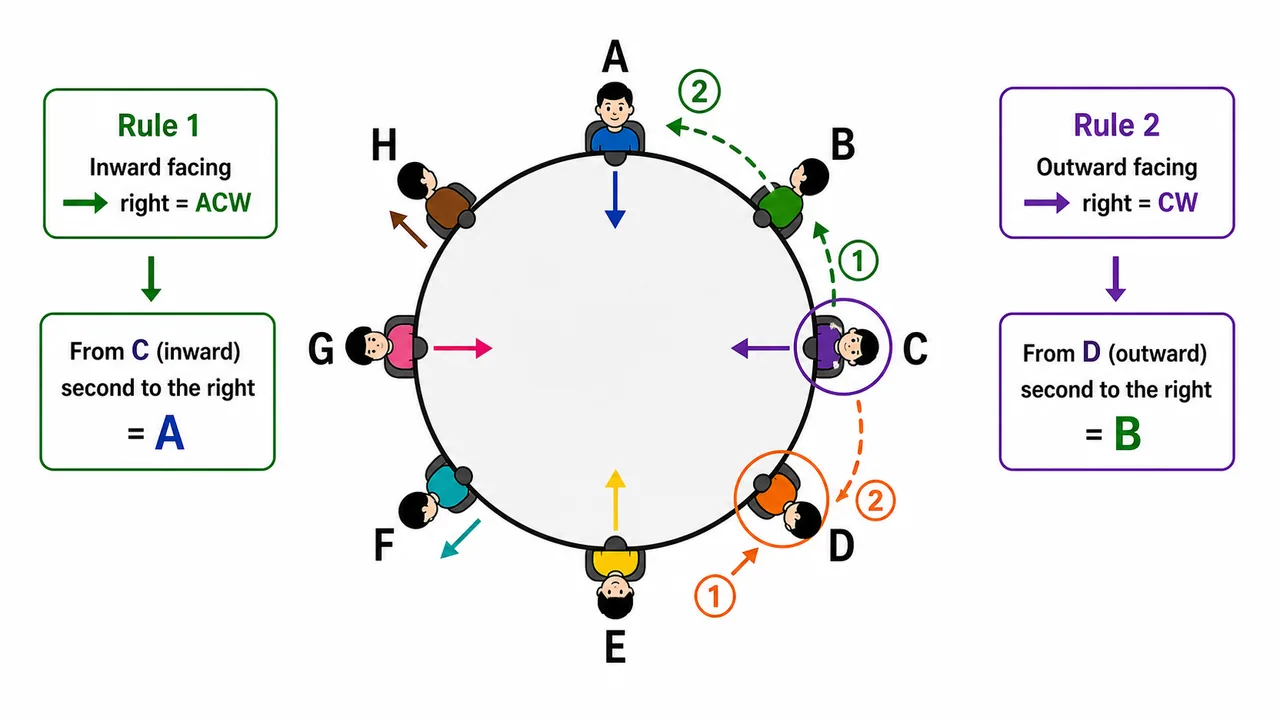
Understanding the Reversal
Imagine you are sitting at a circular table. If you face inward (towards the centre), your right hand points anticlockwise. Now if you turn around to face outward, your right hand now points clockwise. The person hasn't moved -- only their facing direction changed.
Pro Content Locked
Upgrade to Pro to access this lesson and all other premium content.
Charged once for one year · ₹1188 total
Save ₹100/month vs ₹2388/year launch price
- All Agriculture & Banking Courses
- AI Lesson Questions (100/day)
- AI Doubt Solver (50/day)
- Glows & Grows Feedback (30/day)
- AI Section Quiz (20/day)
- 22-Language Translation (100/day)
- Recall Questions (20/day)
- AI Quiz (15/day)
- AI Quiz Paper Analysis (100/day)
- AI Step-by-Step Explanations (100/day)
- Spaced Repetition Recall (FSRS)
- AI Tutor
- Immersive Text Questions
- Audio Lessons — Hindi & English
- Mock Tests & Previous Year Papers
- Summary & Mind Maps
- XP, Levels, Leaderboard & Badges
- Generate New Classrooms
- Voice AI Teacher (AgriDots Live)
- AI Revision Assistant
- Knowledge Gap Analysis
- Interactive Revision (LangGraph)
🔒 Secure one-time yearly payment via Razorpay · No hidden fees
Mixed Facing -- The Next Level
In basic circular arrangement, everyone faces the same direction (usually towards the centre). In mixed facing problems, some persons face the centre (inward) and some face away from the centre (outward).
This is a very common pattern in bank exams, especially in IBPS PO Prelims and Mains, SBI PO, and NABARD Prelims.
The key challenge: left and right directions reverse depending on which way a person faces.
The Two Direction Rules
You must memorize both rules and apply the correct one based on each person's facing direction.
Rule A: Facing Towards the Centre (Inward)
- Right = Anticlockwise (ACW)
- Left = Clockwise (CW)
Rule B: Facing Away from the Centre (Outward)
- Right = Clockwise (CW)
- Left = Anticlockwise (ACW)
Memory Trick: The physical positions around the circle stay the same. Only the interpretation of left/right changes based on which way the person faces.
Understanding the Reversal
Imagine you are sitting at a circular table. If you face inward (towards the centre), your right hand points anticlockwise. Now if you turn around to face outward, your right hand now points clockwise. The person hasn't moved -- only their facing direction changed.
This is why:
| Facing Direction | Right | Left |
|---|---|---|
| Inward (Centre) | ACW | CW |
| Outward (Away) | CW | ACW |
Notation System for Mixed Facing
When solving mixed-facing problems, you need a clear notation to track who faces which direction. Here are two effective methods:
Method 1: Arrow Notation
Draw arrows pointing inward or outward from each person's position:
- Arrow pointing towards centre = facing inward
- Arrow pointing away from centre = facing outward
Method 2: Table/Grid Method
Create a table alongside your diagram to track facing directions and apply conditions:
| Person | Facing | Definite Conditions |
|---|---|---|
| A | Inward | -- |
| B | Inward | -- |
| Q | Outward | -- |
| P | Inward | -- |
| K | Outward | -- |
| W | -- | -- |
This method is especially useful for cross-checking your arrangement at the end.
Key Concepts for Mixed Facing
"A faces B" / "A and B face each other"
When the question says "A and B face each other", it means:
- A and B sit opposite to each other (in an even-numbered circle)
- One faces inward, the other faces outward (so they look at each other)
Important: "Face each other" requires them to be opposite AND both facing in the direction that makes them look at each other. In an even circle, if both face inward and are opposite, they face each other.
"A and B sit opposite to each other"
This means they are at diametrically opposite positions. It says nothing about their facing direction.
"A faces B" (one-directional)
A is looking at B. This means:
- If A faces inward, B must be somewhere across the circle from A (typically opposite)
- The facing direction must be such that A's line of sight hits B
"Immediate neighbour / Adjacent / Beside / Next / Near"
All mean the same thing: the two persons sit next to each other with no one in between. These words are used interchangeably in exam questions:
- Immediate neighbour
- Adjacent
- Beside
- Next to
- Near
"Same Direction" vs "Opposite Direction"
Same Direction
"A and B face the same direction" means:
- If A faces inward, B also faces inward
- If A faces outward, B also faces outward
Opposite Direction
"A and B face opposite directions" means:
- If A faces inward, B faces outward
- If A faces outward, B faces inward
Neighbours Facing Opposite Directions
"One of the immediate neighbours of W faces opposite direction of W" means:
- If W faces inward, one neighbour faces outward (and the other may face either way)
Approach for Mixed-Facing Problems
The solving strategy builds on the basic approach but adds facing-direction tracking:
Step 1: Read all conditions. Identify the facing direction of persons where stated.
Step 2: Start with definite conditions about positions (ignore facing for now).
Step 3: Place persons using standard left/right rules. But remember: when a condition says "A sits 2nd to the right of B", the direction of "right" depends on B's facing direction.
Step 4: After placing all persons, assign facing directions using the facing-related conditions.
Step 5: Cross-check ALL conditions, especially left-right conditions, with correct facing direction applied.
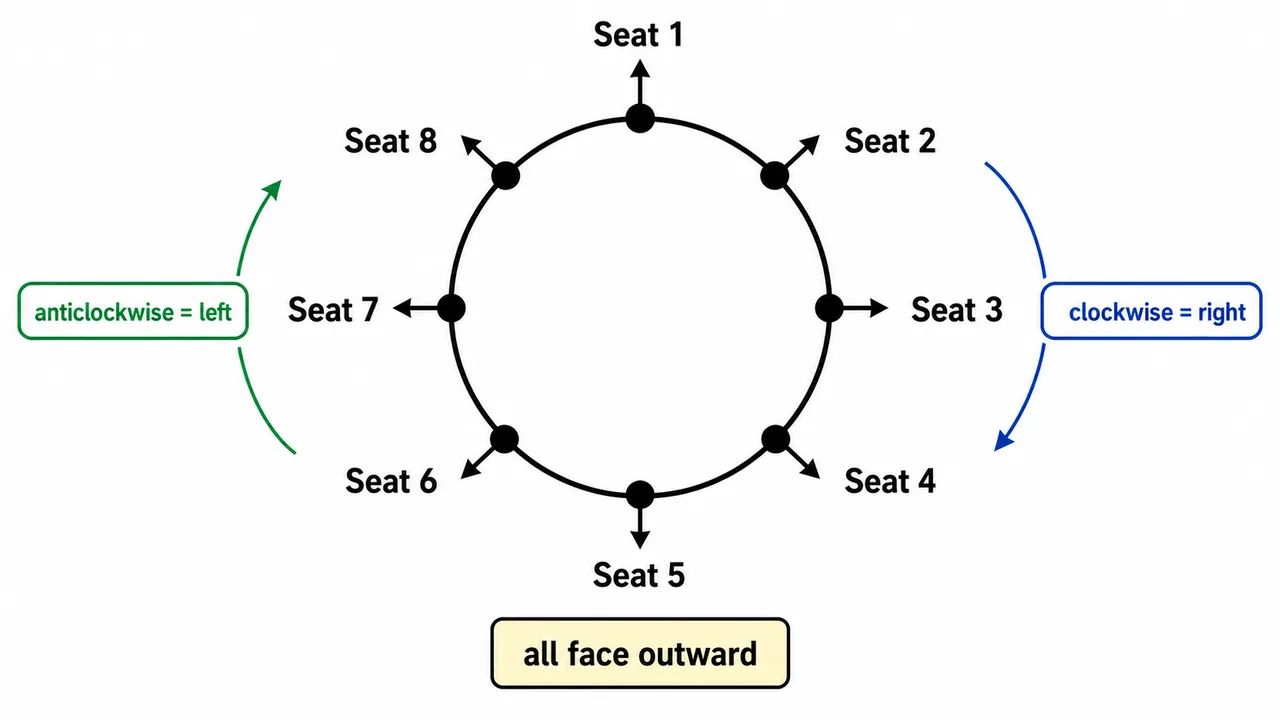
Solved Example 1 -- All Facing Outward (8 persons)
Question: A, B, C, D, E, F, G and H are sitting around a circular table facing away from the centre.
- A sits fourth to the left of H, who is 2 places away from B
- Number of persons sitting between A and F are equivalent to number of people sitting between C and G
- Only 3 persons sit between E and C
- B sits to the immediate left of C
- F does not sit to the immediate left of E
- D is not an immediate neighbour of B
Key Rule: All face outward, so: Right = CW, Left = ACW
Step 1: A is 4th to the LEFT of H. Since all face outward, Left = ACW. So A is 4 positions ACW from H.
Step 2: H is 2 places away from B. This means 2 positions separate them (check both arcs).
Step 3: Persons between A-F equals persons between C-G.
Step 4: Only 3 between E and C. B is to the immediate left of C (ACW of C since facing outward).
Step 5: Apply negatives: F not immediate left of E. D not adjacent to B.
Final Arrangement (clockwise):
Solved Example 2 -- Mixed Facing (8 persons with IPL teams)
Question: A, B, C, D, E, F, G and H are eight friends sitting around a circular table. Four of them face away from the centre and four face towards the centre. All belong to different IPL teams: CSK, KKR, RCB, Punjab Kings, Delhi Capitals, Mumbai Indians, Rajasthan Royals, Gujarat Titans (not in order).
Conditions:
- E faces towards the centre and belongs to CSK. Both immediate neighbours of E face away from the centre and belong to RCB or Punjab Kings.
- D faces away from the centre. Both immediate neighbours of D do NOT face away from the centre.
- E sits third to the right of F, who belongs to Delhi Capitals and faces away from the centre.
- C sits third to the left of F.
- The one who belongs to RCB sits opposite to F.
- The one who belongs to KKR is not the immediate neighbour of F and faces away from the centre.
- A sits second to left of C and does not belong to Rajasthan Royals and Gujarat Titans.
- The only one who belongs to Rajasthan Royals sits between H and F.
- B faces away from the centre and does not belong to KKR.
Step 1: E faces inward. Place E. F is such that E is 3rd to the RIGHT of F.
- F faces outward, so F's Right = CW. E is 3 positions CW from F.
Step 2: Both neighbours of E face outward (away). D faces outward, but both D's neighbours face inward. So D is NOT adjacent to E.
Step 3: C is 3rd to the LEFT of F. Since F faces outward, Left = ACW. C is 3 ACW from F.
Step 4: A is 2nd to the left of C. Determine C's facing to know direction.
Step 5: Assign remaining persons and IPL teams using elimination.
Final Arrangement (clockwise):
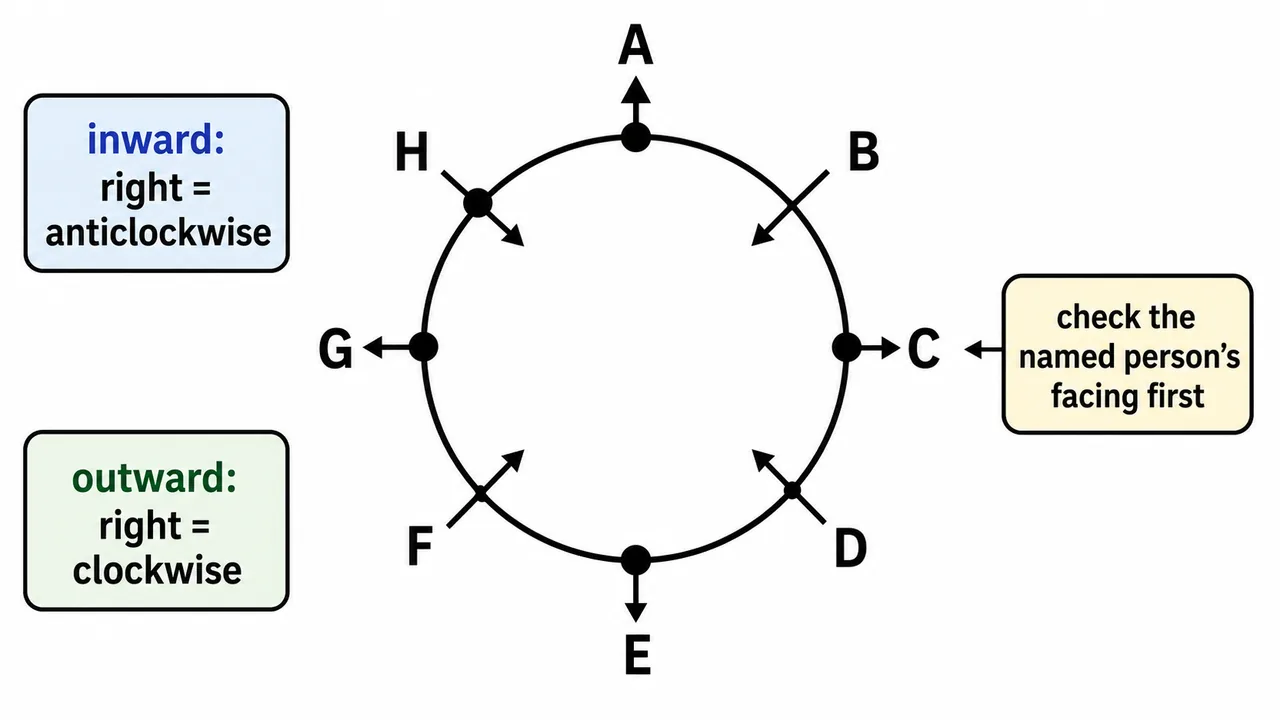
Key Learning: When conditions use "left/right of F" and F faces outward, you must use outward rules (Right = CW, Left = ACW). This is where most students make errors.
Solved Example 3 -- Mixed Facing with "Who Faces R?"
Question: Eight persons are sitting around a circular table facing the centre (not in order).
- Two persons sit between Q and P (either from left or right)
- R sits immediate to the right of Q
- One person sits between R and S, who faces T
- Q and T are not immediate neighbours of each other
- W sits 2nd to the left of V
- Three persons sit between U and V
Q. Who faces R?
Step 1: Place Q. R is immediate right of Q (ACW since facing centre).
Step 2: Two persons between Q and P -- check both arcs, giving two possible placements for P.
Step 3: One person between R and S. S faces T (S and T are opposite with appropriate facing).
Step 4: Q and T are NOT immediate neighbours -- eliminate invalid cases.
Step 5: W is 2nd to left of V. Three persons between U and V.
Final Arrangement (clockwise):
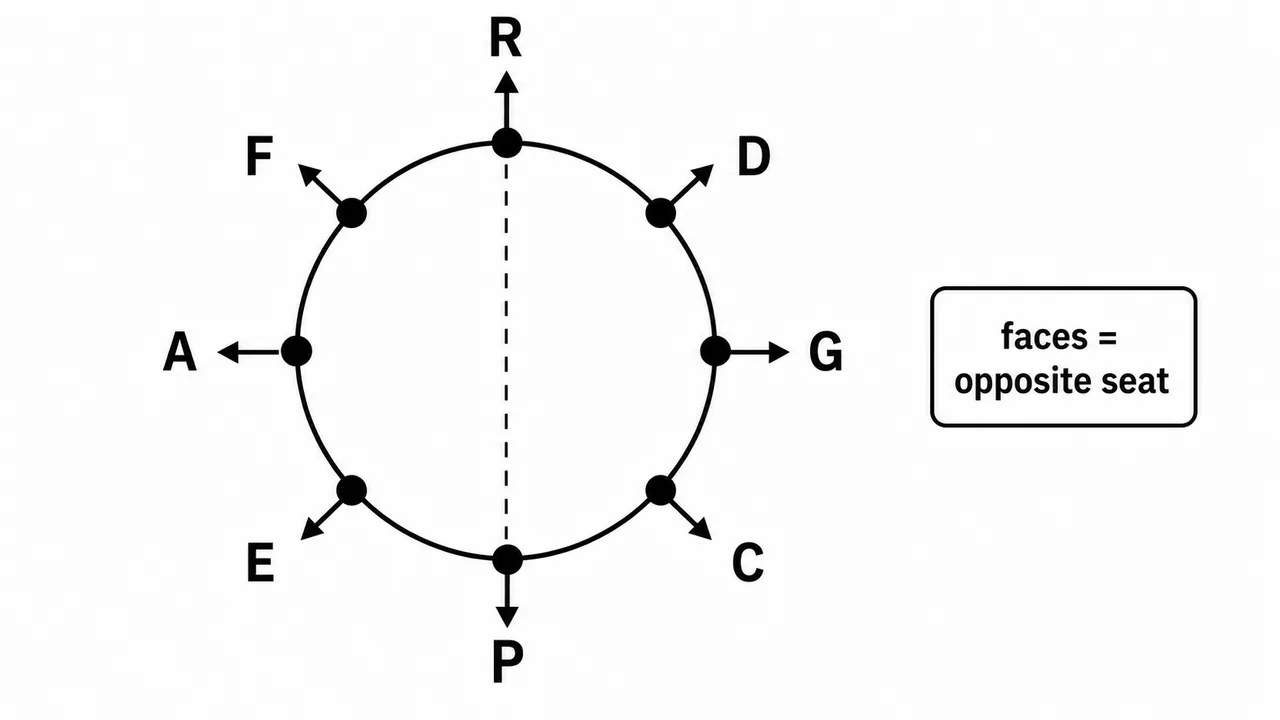
Answer: P faces R (they sit opposite each other, both facing centre).
Speed Tips for Mixed-Facing Problems
- Write the facing rule inside the circle -- "R=ACW, L=CW" for inward; "R=CW, L=ACW" for outward
- Use a facing-direction table alongside your diagram -- track each person's facing as you place them
- Handle position first, facing second -- place everyone on the circle first using position clues, then assign facing directions
- Count faces -- if question says "4 face outward and 4 face inward", keep a running tally
- Arrow notation -- draw small arrows (inward/outward) at each position for quick reference
- Cross-check neighbours -- conditions like "both neighbours of D face inward" are powerful constraints
Common Traps in Mixed-Facing Problems
- Applying wrong direction rule -- The biggest trap. "2nd to the right of A" depends on whether A faces inward or outward
- Forgetting to reverse for outward -- Students often default to "Right = ACW" even for outward-facing persons
- "Faces each other" confusion -- This means opposite seats, not adjacent seats
- Miscounting when facing direction unknown -- If facing is not yet known, you may need to try both cases
- Ignoring "same/opposite direction" clues -- These are critical constraints that can eliminate many possibilities
- Not cross-checking all conditions -- Always verify every single condition against your final arrangement
Quick Reference: Mixed-Facing Cheat Sheet
| Scenario | Right | Left |
|---|---|---|
| Person faces INWARD (centre) | ACW | CW |
| Person faces OUTWARD (away) | CW | ACW |
| Phrase | Meaning |
|---|---|
| "A and B face each other" | Opposite seats, looking at each other |
| "A faces B" | A is looking towards B (A's line of sight) |
| "Same direction" | Both inward or both outward |
| "Opposite direction" | One inward, one outward |
| "One neighbour faces opposite to A" | One adjacent person faces the other way |
| Distribution (8 persons) | Common splits |
|---|---|
| All inward | 8-0 |
| All outward | 0-8 |
| Mixed (equal) | 4-4 |
| Mixed (given count) | 3-5, 5-3, etc. |