🔷 Triangular & Rectangular Seating Arrangements
Seating arrangement around triangular, square, and rectangular tables - corner vs middle positions, mixed facing in non-circular shapes, and solving strategies
Beyond the Circle -- Non-Circular Tables
While circular arrangement is the most common, bank exams frequently feature non-circular table shapes such as:
- Square table (4 corners + 4 middle-of-sides = 8 positions)
- Rectangular table (varies: 2 on long sides + 1 on short sides, or other configurations)
- Triangular table (3 corners + 3 middle-of-sides = 6 positions)
The core left/right rules remain the same -- they just apply to a different shape.
The Golden Rule Still Applies
Regardless of the table shape, the direction rules depend ONLY on which way the person faces:
| Facing Direction | Right | Left |
|---|---|---|
| Facing the centre (inward) | Anticlockwise (ACW) | Clockwise (CW) |
| Facing away (outward) | Clockwise (CW) | Anticlockwise (ACW) |
The concept of "clockwise" and "anticlockwise" applies to the path traced around the table, just as it does with a circle.
Square Table Arrangement
Structure: 8 Positions
A square table has 4 corners and 4 middle-of-sides (midpoints), giving a total of 8 positions:
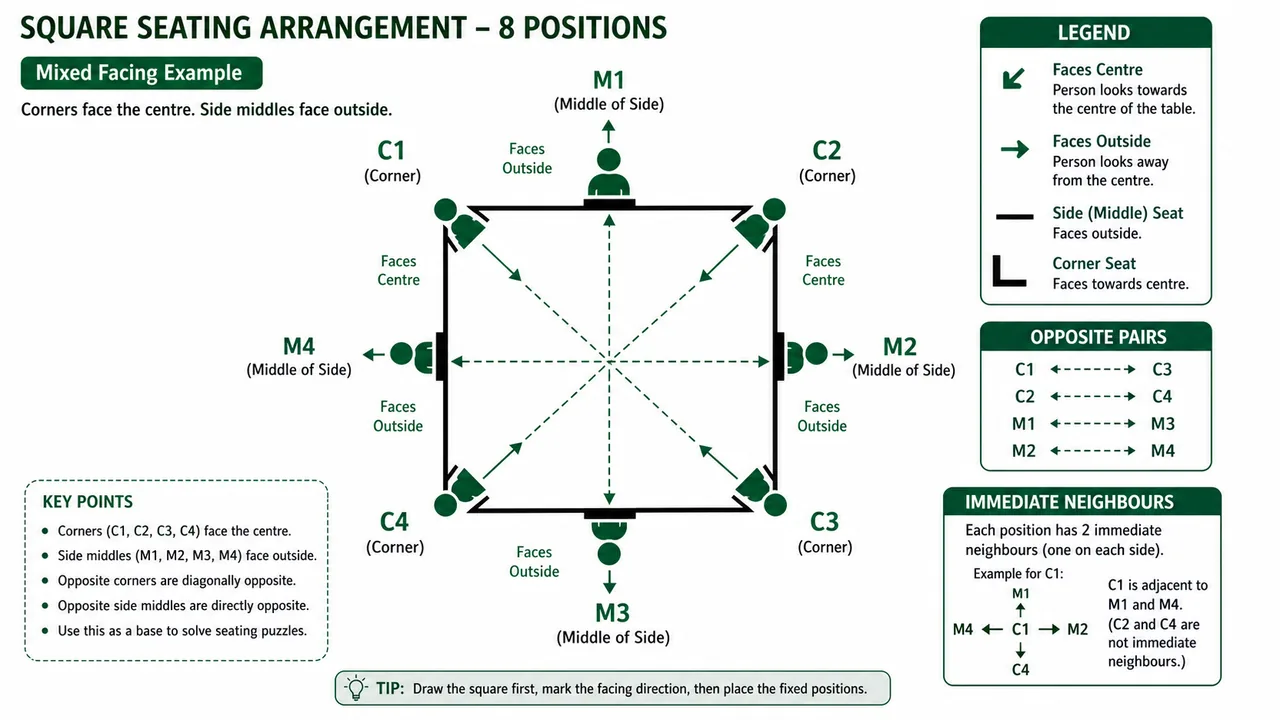
Common Facing Rule for Square Tables
The most common pattern in exam questions:
- Corner persons face the centre (inward)
- Middle-of-side persons face away from the centre (outward)
OR sometimes reversed:
- Corner persons face outward
- Middle-of-side persons face inward
Always read the question carefully to know which group faces which direction.
Neighbour Structure
- A corner person has exactly 2 immediate neighbours (the two mid-side persons adjacent to that corner)
- A middle-of-side person has exactly 2 immediate neighbours (the two corner persons on either side)
Opposite Positions in a Square
In an 8-position square table:
The person sitting opposite is the one diagonally across or directly across the table.
Solved Example 1 -- Square Table (8 persons, corner inward, middle outward)
Question: P, Q, R, S, T, U, V, and W are sitting around a square table such that four of them sit at four corners of the table while four of them sit in the middle of each of the four sides. The ones who sit in the middle of the sides face the centre while those who sit at the four corners face outside (not necessarily in the same order).
Conditions:
- Q sits third to the right of U
- There is only one person between Q and W
- Q sits at the corner of the table
- P is an immediate neighbour of S and U
- S is not an immediate neighbour of W
- T sits second to the right of R
- Q is not an immediate neighbour of T
Step 1: Q is at a corner and faces outward. Q is 3rd to the RIGHT of U.
- Since U's facing depends on position (corner or middle), we need to determine it.
- If U is at middle-of-side, U faces inward: Right = ACW. So Q is 3 ACW from U.
Step 2: Only one person between Q and W. Q is at a corner.
Step 3: P is an immediate neighbour of both S and U. S is NOT a neighbour of W.
Step 4: T is 2nd to the right of R. Q is NOT a neighbour of T.
Step 5: Assign remaining persons, checking corner/middle assignments.
Final Arrangement:
Solved Example 2 -- Square Table (Mixed Facing: corners inward, middles outward)
Question: Eight friends I, J, K, L, N, O, P and Q are sitting around a square table such that four sit at four corners and four sit in the middle of each side. The ones who sit at the four corners face towards the centre while those who sit in the middle of the sides face outside (not necessarily in the same order).
Conditions:
- J sits second to the right of P
- The one who sits opposite to J sits immediate left of K
- Q sits third to the right of I
- L and N sit opposite to each other
- Not more than one person sits between L and Q when counted to the left of Q
- O does not face outside the centre
Step 1: O does not face outside = O faces inward = O is at a corner.
Step 2: J is 2nd to the right of P. The person opposite J is to the immediate left of K.
Step 3: Q is 3rd to the right of I. L and N are opposite each other.
Step 4: Not more than one person between L and Q counted to the left of Q.
Final Arrangement:
Q. Who among the following sits immediate right of the one who sits opposite to I?
- Find who is opposite I. In the square, the diagonal opposite of I is the person across.
- Then find who is to the immediate right of that person (considering their facing direction).
Solved Example 3 -- Square Table (Reversed: middles away, corners towards centre)
Question: Eight persons -- A, B, C, D, E, F, G, and H are sitting around a square shape table such that one person each sits on the middle of the edge and one person sits on each corner. The persons sitting on the middle of the edges are facing away from the centre, and the persons sitting on the corner are facing the centre.
Conditions:
- B sits at the middle of the table (middle of a side)
- One person sits between B and E
- A sits third to the right of E
- Three persons sit between A and F
- One person sits between F and G
- H and G are immediate neighbours
- C sits second to the right of H
- C and D are not immediate neighbours
Step 1: B is at the middle of a side, so B faces outward.
Step 2: One person between B and E. A is 3rd to the right of E.
Step 3: Three persons between A and F. One person between F and G.
Step 4: H and G are immediate neighbours. C is 2nd to the right of H.
Step 5: C and D are NOT neighbours.
Final Arrangement:
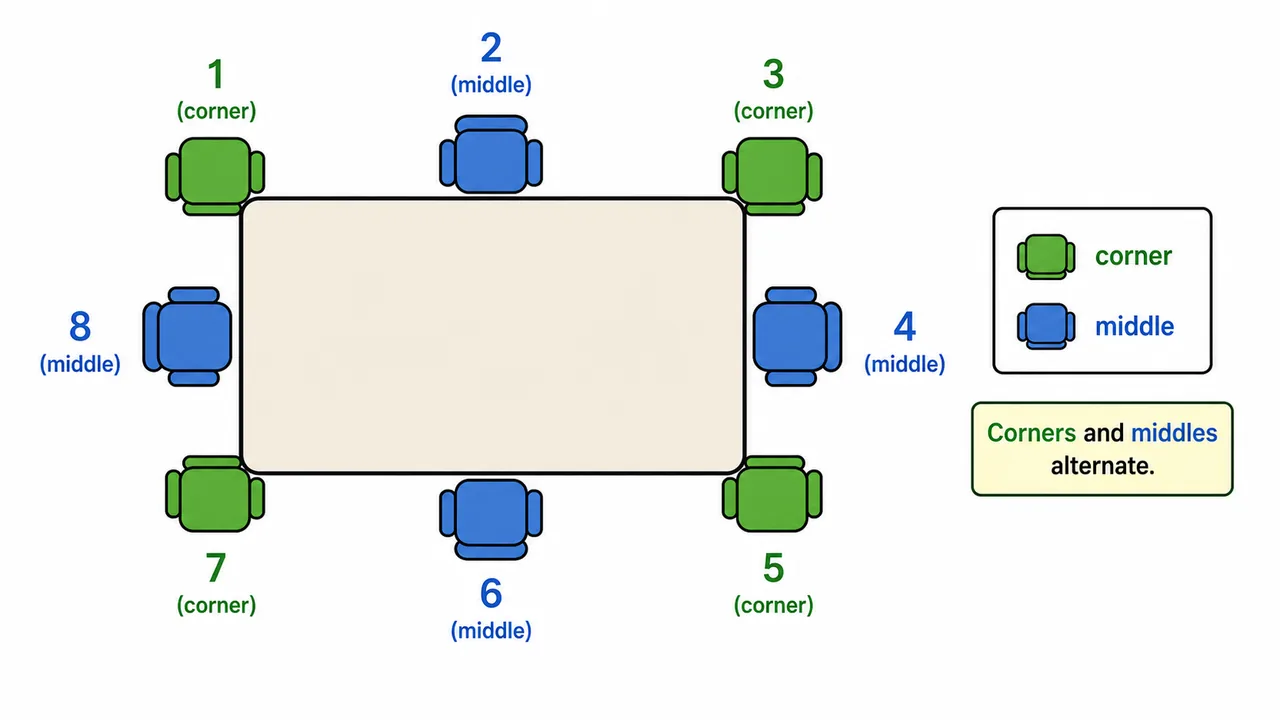
Q. What is the position of F with respect to H?
- Count from H to F around the table.
- The answer depends on H's facing direction (inward at corner).
Triangular Table Arrangement
Structure: 6 Positions
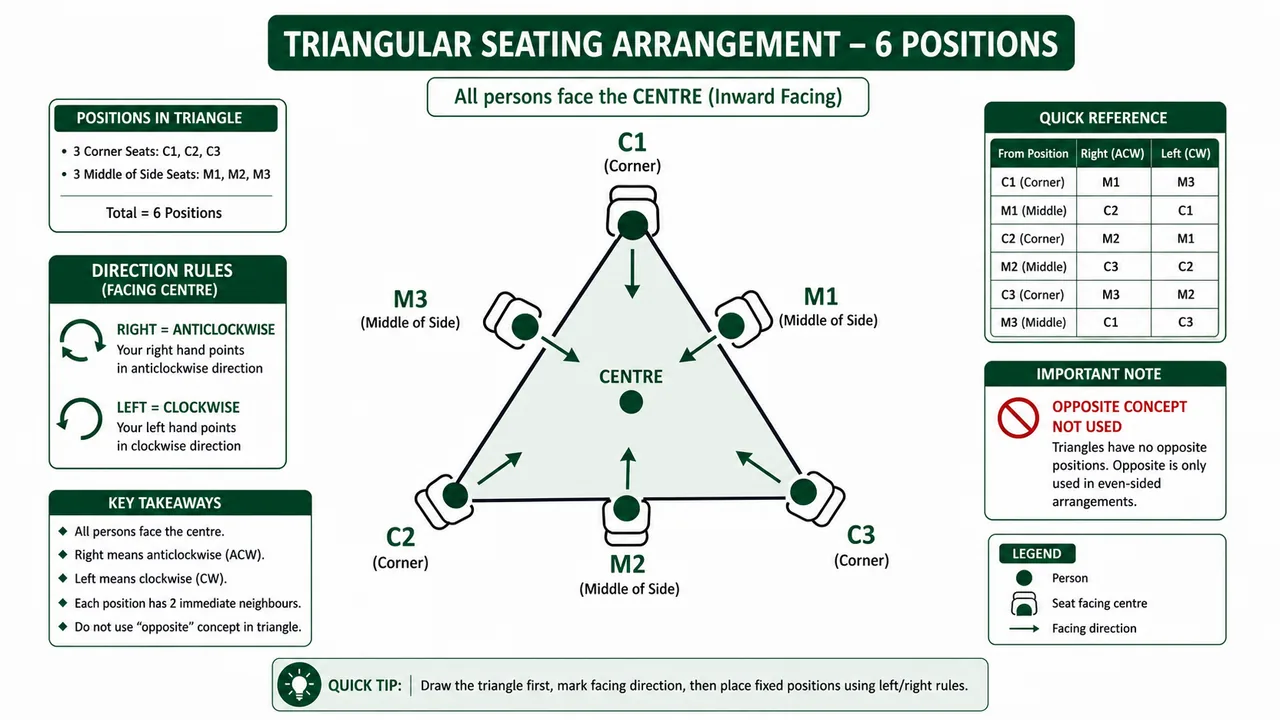
A triangular table has 3 corners and 3 middle-of-sides, giving 6 positions:
Neighbour Rules
- Each corner person has 2 neighbours (the two mid-side persons on the adjacent sides)
- Each middle-of-side person has 2 neighbours (the two corner persons on either end of that side)
Facing Rules
The same inward/outward rules apply:
- Facing inside the triangle: Right = ACW, Left = CW (going around the triangle)
- Facing outside the triangle: Right = CW, Left = ACW
Opposite in Triangular Table
There is no direct "opposite" in a triangular table with 6 positions since 6 is even. However, the person across from a corner is the middle of the opposite side, and vice versa:
Solved Example 4 -- Triangular Table (6 persons)
Question: Six persons i.e. A, B, C, D, E and F are sitting around a triangular table. Three of them are sitting at the corner of the table and the other three are sitting at the middle of the table. All of them are facing inside the table.
Conditions:
- A sits second to the right of C
- Two persons sit between A and E
- B sits to the immediate left of E
- Two persons sit between F and B
- D does not sit at the middle side of the table
Step 1: All face inward: Right = ACW, Left = CW.
Step 2: D is at a corner (not at middle side).
Step 3: A is 2nd to the right (ACW) of C. Two persons between A and E.
Step 4: B is immediate left (CW) of E. Two persons between F and B.
Final Arrangement (going clockwise around the triangle):
Q. Who sits immediate right of A?
- A faces inward, so Right = ACW.
- Moving ACW from A, the next person is D.
- Answer: D
Rectangular Table Arrangement
Structure
A rectangular table can have various configurations:
Config 1: 8 positions (like square -- 4 corners + 4 middles)
Config 2: 6 positions (2 on each long side + 1 on each short side)
Config 3: 10 or 12 positions (for Mains-level problems)
The approach remains the same regardless of configuration.
Corner vs Middle -- Key Differences
| Feature | Corner Person | Middle-of-Side Person |
|---|---|---|
| Neighbours | 2 (one on each adjacent side) | 2 (one on each end of same side) |
| Facing (common) | Often inward | Often outward (or vice versa) |
| Position relative to sides | Where two sides meet | Centre of one side |
| Opposite | Diagonal corner | Middle of opposite side |
Approach for Non-Circular Tables
Step 1: Draw the table shape with all positions marked (corners + middles).
Step 2: Note who sits at corners vs middles (if specified).
Step 3: Note who faces inward vs outward (often determined by corner/middle position).
Step 4: Apply definite conditions first, remembering to use correct left/right rules based on facing.
Step 5: Apply negative conditions to eliminate possibilities.
Step 6: Cross-check every condition.
Speed Tips for Non-Circular Tables
- Draw the shape accurately -- a rough square/triangle/rectangle with clearly marked positions
- Label corners as C and middles as M before placing people
- Alternate C-M-C-M around the shape -- corners and middles always alternate
- Remember: going around any shape clockwise or anticlockwise works the same as a circle -- the left/right rules are identical
- Count positions carefully -- in a square table, "3rd to the right" skips 3 positions around the square
- Corner conditions are constraints -- "D does not sit at the middle" immediately restricts D to a corner
- Opposite in square = diagonal -- C1 is opposite C3, M1 is opposite M3
Common Traps in Non-Circular Tables
- Confusing corner and middle -- A person "at the corner" has a very different neighbour structure than one "at the middle of a side"
- Wrong facing assignment -- Read carefully: do corners face in or out? It varies by question.
- Miscounting around non-circular shapes -- Moving "3rd to the right" around a square still goes through 3 consecutive positions. The shape doesn't change the count.
- Forgetting that triangular tables have only 6 positions -- Don't accidentally add positions
- Not reading corner/middle restrictions -- "D does not sit at the middle" is a strong constraint
- Rectangular table confusion -- Long sides have more positions than short sides. Read the configuration carefully.
Quick Reference Card
Square Table (8 positions)
Triangular Table (6 positions)
Direction Rules (same as circular)
| Facing | Right | Left |
|---|---|---|
| Inward (centre) | ACW | CW |
| Outward (away) | CW | ACW |
Typical Facing Patterns
| Pattern | Corners | Middles |
|---|---|---|
| Pattern A | Inward | Outward |
| Pattern B | Outward | Inward |
| Pattern C | All Inward | All Inward |