🤔 Circular Arrangement — Uncertain & Indefinite Conditions
Handling uncertain/indefinite conditions in circular seating - unknown number of persons, either-or clues, multiple valid arrangements, and advanced solving strategy
What Are Uncertain / Indefinite Conditions?
In standard seating arrangement problems, all conditions are definite -- they give you exact positions (e.g., "A sits 3rd to the right of B"). But in uncertain (indefinite) problems, some conditions allow multiple possibilities:
- The total number of persons may not be given
- Conditions use "either-or" phrasing
- "Some persons" or "certain number" instead of exact counts
- The number of people must be derived from the clues
- Multiple valid arrangements may exist
These problems are Mains-level and appear in IBPS PO Mains, SBI PO Mains, and NABARD Mains.
Definite vs Indefinite -- Key Distinction
| Type | Description | Example |
|---|---|---|
| Definite | Exact, single interpretation | "A sits 3rd to the right of B" |
| Indefinite / Uncertain | Multiple possible interpretations | "A sits either 2nd to the left or 3rd to the right of B" |
Definite Conditions (Odd/Even distinction)
Definite conditions further split based on whether the total number of persons is:
Pro Content Locked
Upgrade to Pro to access this lesson and all other premium content.
Charged once for one year · ₹1188 total
Save ₹100/month vs ₹2388/year launch price
- All Agriculture & Banking Courses
- AI Lesson Questions (100/day)
- AI Doubt Solver (50/day)
- Glows & Grows Feedback (30/day)
- AI Section Quiz (20/day)
- 22-Language Translation (100/day)
- Recall Questions (20/day)
- AI Quiz (15/day)
- AI Quiz Paper Analysis (100/day)
- AI Step-by-Step Explanations (100/day)
- Spaced Repetition Recall (FSRS)
- AI Tutor
- Immersive Text Questions
- Audio Lessons — Hindi & English
- Mock Tests & Previous Year Papers
- Summary & Mind Maps
- XP, Levels, Leaderboard & Badges
- Generate New Classrooms
- Voice AI Teacher (AgriDots Live)
- AI Revision Assistant
- Knowledge Gap Analysis
- Interactive Revision (LangGraph)
🔒 Secure one-time yearly payment via Razorpay · No hidden fees
What Are Uncertain / Indefinite Conditions?
In standard seating arrangement problems, all conditions are definite -- they give you exact positions (e.g., "A sits 3rd to the right of B"). But in uncertain (indefinite) problems, some conditions allow multiple possibilities:
- The total number of persons may not be given
- Conditions use "either-or" phrasing
- "Some persons" or "certain number" instead of exact counts
- The number of people must be derived from the clues
- Multiple valid arrangements may exist
These problems are Mains-level and appear in IBPS PO Mains, SBI PO Mains, and NABARD Mains.
Definite vs Indefinite -- Key Distinction
| Type | Description | Example |
|---|---|---|
| Definite | Exact, single interpretation | "A sits 3rd to the right of B" |
| Indefinite / Uncertain | Multiple possible interpretations | "A sits either 2nd to the left or 3rd to the right of B" |
Definite Conditions (Odd/Even distinction)
Definite conditions further split based on whether the total number of persons is:
- Even (8, 10, 12) -- direct opposite exists, symmetric arrangements
- Odd (7, 9, 11) -- no direct opposite, asymmetric gaps
Indefinite Conditions
These introduce uncertainty that must be resolved by combining with other clues:
- "Either-or" position conditions
- Unknown total count (must be calculated)
- "At least" / "not more than" constraints
- Proportional clues ("thrice as many between X and Y as between Y and Z")
The Approach -- Always Start with Definite Conditions
The core strategy for uncertain problems:
Critical Rule: NEVER start with an indefinite condition. Always exhaust definite conditions first. The definite conditions will often resolve or narrow down the indefinite ones.
Type 1: Unknown Number of Persons
In these problems, you must figure out how many people are sitting at the table using mathematical relationships.
Clue Patterns
| Clue Pattern | How to Use |
|---|---|
| "Not more than 18 persons" | Total is at most 18 (set upper bound) |
| "More than 10 persons" | Total is at least 11 (set lower bound) |
| "A prime number between 15 and 20" | Total is 17 or 19 |
| "Distance is equal among all persons" | Equal spacing -- total must divide evenly |
| "N between X and Y from left = 3 times N between Y and Z from right" | Set up equation: a = 3b, then a + b + 2 = total |
Solving Unknown Count
General Method:
- Let the total number of persons = N
- Use proportional/relational clues to form equations
- Solve for N, checking against upper/lower bounds
- Verify N makes all conditions consistent
Solved Example 1 -- Deriving the Total Count
Question: Some persons are sitting around a circular table facing towards the centre. The distance is equal among all the persons and the number of persons was not more than 18.
Conditions:
- Number of persons between Z and N when counted from LEFT of Z was thrice the number of persons seated between Z and L when counted from RIGHT of Z
- L and N are neighbours of each other
- I was seated to the immediate left of J and three persons are sitting between J and K
- L was third to the right of K
- M was second to the right of O and second to the left of I
- L is to the immediate left of N
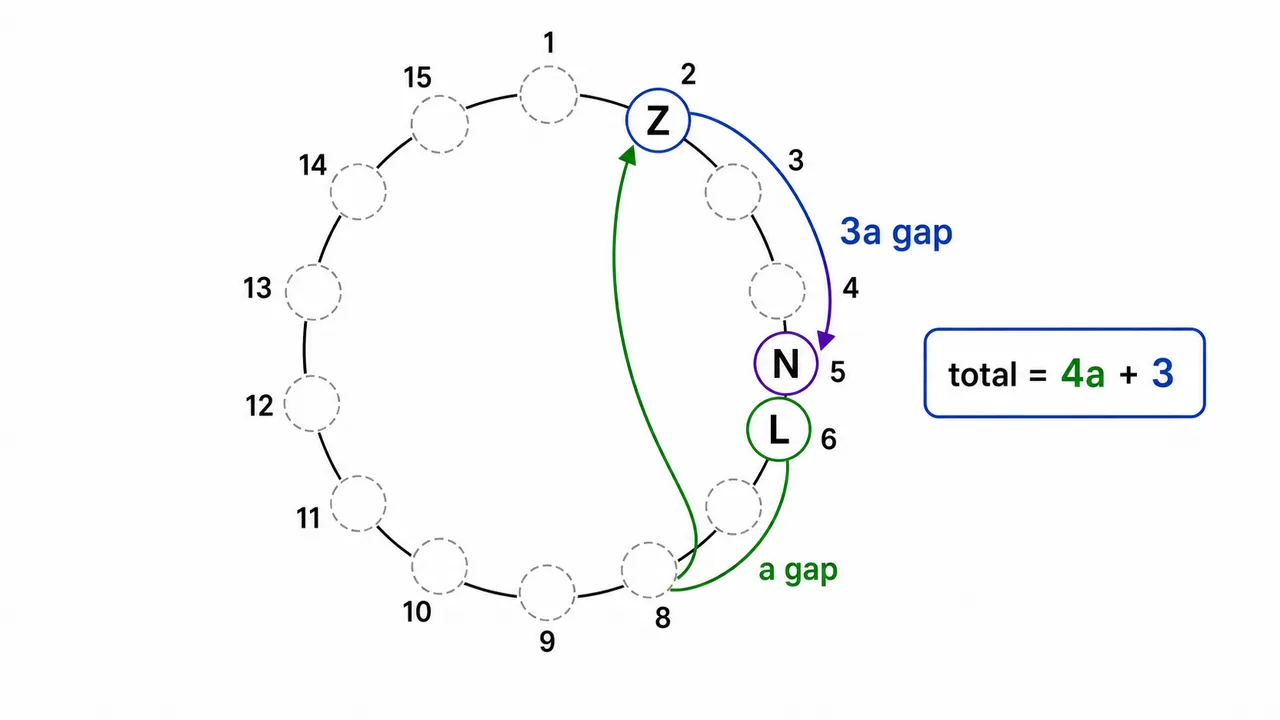
Step 1: Let persons between Z-N (from left of Z) = 3a, and persons between Z-L (from right of Z) = a.
Step 2: L and N are neighbours, and L is to the immediate left of N. So L-N are adjacent with L on N's left side.
Step 3: Since L and N are adjacent, the arc from Z going LEFT: Z ... (3a persons) ... N-L. The arc from Z going RIGHT: Z ... (a persons) ... L-N.
Total around the circle: Z + 3a persons + N + L + a persons = N (total). So: 1 + 3a + 1 + 1 + a = N, which gives N = 4a + 3.
Step 4: N is at most 18. Try values:
- a = 1: N = 7
- a = 2: N = 11
- a = 3: N = 15
- a = 4: N = 19 (exceeds 18, invalid)
Step 5: Check which value is consistent with remaining conditions (I, J, K, L, M, N, O, Z = 8 named persons, so N >= 8).
- a = 2 gives N = 11 -- but need to verify all persons fit
- a = 3 gives N = 15 -- works with conditions about M, I, J, K spacing
Step 6: With N = 15, place all persons and verify.
Final Arrangement (15 persons, clockwise):
Type 2: "Either-Or" Conditions
These conditions give two possible placements:
"A sits either 2nd to the left or 3rd to the right of B"
This means:
- Case 1: A is 2nd to the left of B
- Case 2: A is 3rd to the right of B
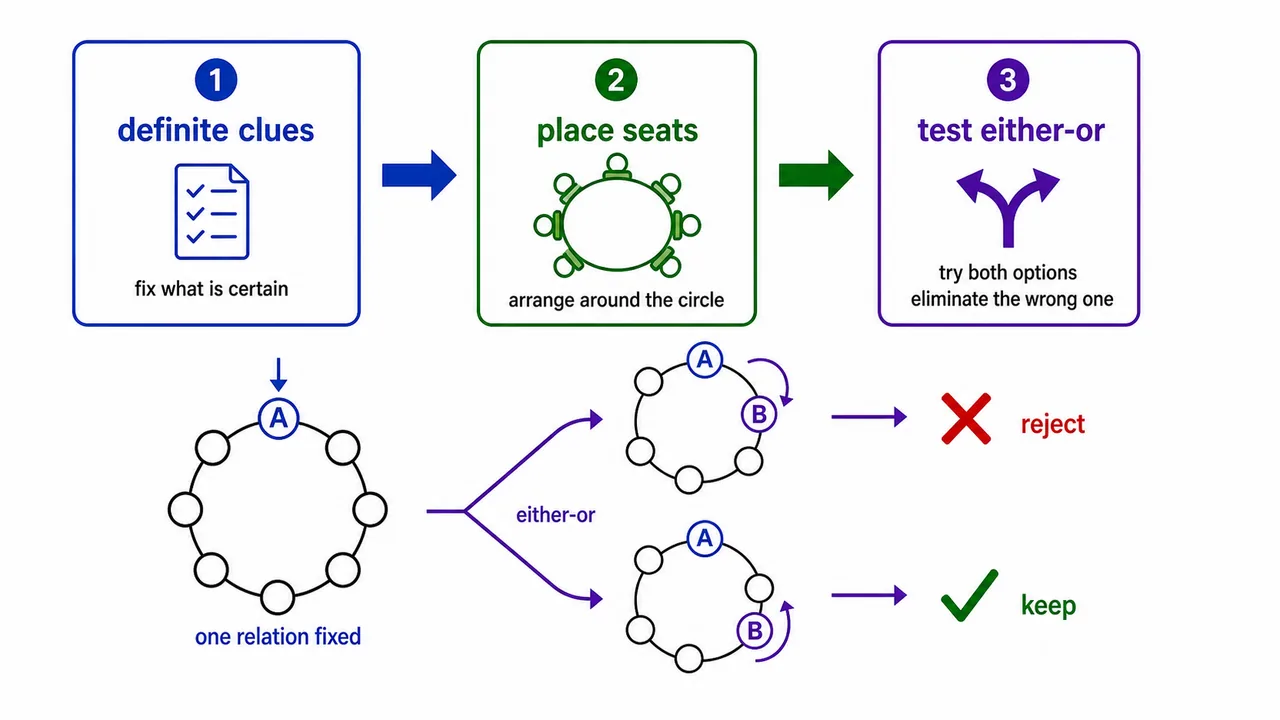
Strategy
- Do NOT start with either-or conditions
- Place all definite conditions first
- When you reach the either-or condition, check which case(s) are consistent with what you've already placed
- Often, one case will be eliminated by the existing arrangement
Type 3: "Same Direction" / "Opposite Direction" with Uncertainty
In mixed-facing problems, conditions about facing direction add another layer of uncertainty:
"Y and V face the same direction as X faces"
This means: once you determine X's facing, Y and V must match it.
"V doesn't sit opposite to both W and U"
This means V is NOT opposite W AND V is NOT opposite U (V is opposite to someone else).
These conditions create dependencies -- you must solve position first, then use facing conditions to resolve remaining uncertainty.
Solved Example 2 -- Uncertain with Mixed Facing (8 persons)
Question: Eight persons U, V, W, X, Y, Z, A, and B are seated around a circular table. Among them, only 3 face opposite to the centre (outward) and the rest face towards the centre (not necessarily in the same order).
Conditions:
- U sits second to the left of W
- V is not an immediate neighbour of both W and U
- One of the immediate neighbours of W faces opposite direction of W
- B sits third to the left of U
- Z sits second to the left of B
- X is not an immediate neighbour of V
- A sits third to the left of X
- Y and V face the same direction as X faces
- V doesn't sit opposite to both W and U
Step 1: Definite position conditions first.
- U is 2nd to left of W
- B is 3rd to left of U
- Z is 2nd to left of B
- A is 3rd to left of X
Step 2: Place U, W, B, Z using definite conditions.
Step 3: Apply negative conditions: V not adjacent to W or U. X not adjacent to V.
Step 4: Now handle facing. 3 face outward, 5 face inward.
- One neighbour of W faces opposite to W.
- Y and V face same direction as X.
- Use these to determine who faces which way.
Step 5: V doesn't sit opposite to both W and U -- check and eliminate.
Final Arrangement (clockwise):
Solved Example 3 -- Unknown Count with Facing Clues
Question: Certain persons are seating around a circle. Some of them are facing the centre and some are facing outside.
(Same direction means both face centre or both face outside. Opposite direction means one faces centre and other faces outside.)
Conditions:
- Only one person sits between A and O
- O sits third to the left of Q
- Q sits on the immediate right of M. Q faces outward.
- L sits immediate left of P
- P is not an immediate neighbour of O
- A is not an immediate neighbour of Q
- M sits opposite to O. A faces opposite to J.
- L faces a direction opposite that of O
- The immediate neighbours of L face opposite directions
- J sits second to the left of L
- N is an immediate neighbour of A
- M and J face the direction same as that of N
Step 1: Start with definite position conditions. Place Q, M (Q is immediate right of M). O is 3rd to the left of Q.
Step 2: M is opposite O -- this helps determine total count (even number needed for opposite).
Step 3: One person between A and O. L is immediate left of P. J is 2nd to left of L.
Step 4: Apply negatives: P not adjacent to O. A not adjacent to Q.
Step 5: Assign facing directions:
- Q faces outward (given)
- L faces opposite to O
- Neighbours of L face opposite directions to each other
- A faces opposite to J
- M and J face same direction as N
Final Arrangement (8 persons, clockwise):
Solved Example 4 -- "Certain Number" with Multiple Gaps
Question: A certain number of persons are sitting in a circle facing outside the centre.
- F and C are immediate neighbours
- B sits second to the left of F
- Only five persons sit between C and A
- There is only one person between F and G
- C and B are not immediate neighbours
- Three persons sit between D and E
- B sits third to the right of E
- Number of persons between D and F (counted to right of D) equals number between D and C (counted to left of D)
Step 1: All face OUTWARD: Right = CW, Left = ACW.
Step 2: F and C are neighbours. B is 2nd to the LEFT (ACW) of F.
Step 3: Five between C and A. One between F and G. C and B not neighbours.
Step 4: Three between D and E. B is 3rd to the RIGHT (CW) of E.
Step 5: Equal gap condition: persons D-to-F (right of D) = persons D-to-C (left of D). This helps determine the total.
Working through the math: the total comes to 19 persons.
Final Arrangement (19 persons, all facing outward):
Solved Example 5 -- Prime Number Total
Question: A certain number of people are seated around a circular table facing the centre. Only a few are known to us. Not more than two persons whose information is known sit together.
Conditions:
- One person sits between E and A
- I sits third to the right of A
- X who is adjacent to Q, sits second to the left of E
- Number of people seated between Q and P is the same as number between I and A
- Number of people seated between P and O is the same as number between O and I
- Total number of people seated around the table is a prime number between 15 and 20
- Number of people between Q and O when counted clockwise from Q is an even number
Step 1: Prime between 15 and 20 = 17 or 19.
Step 2: One between E and A. I is 3rd to right (ACW) of A. X is adjacent to Q and 2nd to left (CW) of E.
Step 3: Equal gap conditions: Q-P gap = I-A gap, and P-O gap = O-I gap.
Step 4: Q to O clockwise = even number.
Step 5: Test N = 17 and N = 19. Check which satisfies all conditions.
Working through: N = 17 satisfies all conditions.
Final Arrangement (17 persons, clockwise):
Q. In which position is I seated with respect to E?
- Count from E to I. Answer: 5th to the right (Option C).
Solved Example 6 -- "More Than 10" Constraint
Question: More than 10 persons were sitting in a circular row facing the centre.
- B is 3rd to the left of C
- Two persons are sitting between D and B
- A sits immediate right of E
- One person is sitting between C and E
- Less than two persons are sitting between D and A
- A does not sit second to the right of B
Step 1: "More than 10" -- so at least 11 persons.
Step 2: B is 3rd to the LEFT (CW) of C. Two between D and B.
Step 3: A is immediate RIGHT (ACW) of E. One between C and E.
Step 4: Less than two between D and A -- so either 0 or 1 person between them.
Step 5: A does NOT sit 2nd to the right of B.
Step 6: The minimum total that satisfies all conditions is 11 persons.
Final Arrangement (11 persons):
Strategy Summary for Uncertain Problems
The "Collect and Relate" Method
- Collect all definite conditions and group them by person
- Relate conditions that share common persons (build chains)
- Place using the longest chain of definite conditions
- Test indefinite conditions against what's already placed
- Eliminate impossible cases
- Verify all conditions in the final arrangement
Determining Unknown Totals
| Given Information | Method |
|---|---|
| Upper/lower bound ("not more than 18") | List possible values, test each |
| Proportional gaps ("thrice as many") | Set up equation: a + b + known = N |
| Equal gaps ("same number between...") | Set both expressions equal |
| Mathematical property ("prime between 15-20") | List values (17, 19), test each |
| Constraint + gap counts | Sum all placed gaps and verify against N |
Common Traps in Uncertain Problems
- Starting with indefinite conditions -- This wastes time and creates unnecessary cases. Always start definite.
- Not deriving the total count -- If the question says "some persons" or "certain number", you MUST figure out the total before solving.
- Missing valid cases -- In either-or conditions, ensure you test BOTH cases before eliminating one.
- Mathematical errors -- Gap equations like "a = 3b" with "a + b + 2 = N" need careful algebra.
- Forgetting bound constraints -- "Not more than 18" means N can be 18 (inclusive). "More than 10" means N is at least 11.
- Questions with "cannot be determined" -- Some uncertain problems are designed so that the answer genuinely cannot be determined. Don't force an answer if multiple valid arrangements give different results.
- Overlooking "equal distance" -- "Distance is equal among all persons" means equally spaced, which constrains N.
Quick Reference Card
Condition Types
| Condition | Type | Action |
|---|---|---|
| "A sits 3rd to the right of B" | Definite | Place directly |
| "A sits either 2nd left or 3rd right of B" | Indefinite | Defer, test later |
| "Some persons sit around a table" | Unknown count | Derive N from clues |
| "Not more than 18" | Bound | N is at most 18 |
| "Prime number between 15 and 20" | Constraint | N = 17 or 19 |
| "Same number between A-B as between C-D" | Equation | Set equal, solve |
Solving Priority
Common Total Counts in Uncertain Problems
| Clue | Possible N |
|---|---|
| "Not more than 18" + gap equations | Calculate using gap formula |
| "More than 10" + 5 named persons | At least 11 |
| "Prime between 15-20" | 17 or 19 |
| "Even number, not more than 20" | 2, 4, 6, ..., 20 (narrow with gaps) |
| Equal spacing + named count | N must accommodate all gaps |