🎯 Concentric Circle Seating Arrangement
Master concentric (embedded) circle seating - two circles with inner facing outward and outer facing inward, pairing logic, ahead/behind concepts, and solved examples
Concentric Circle Seating Arrangement
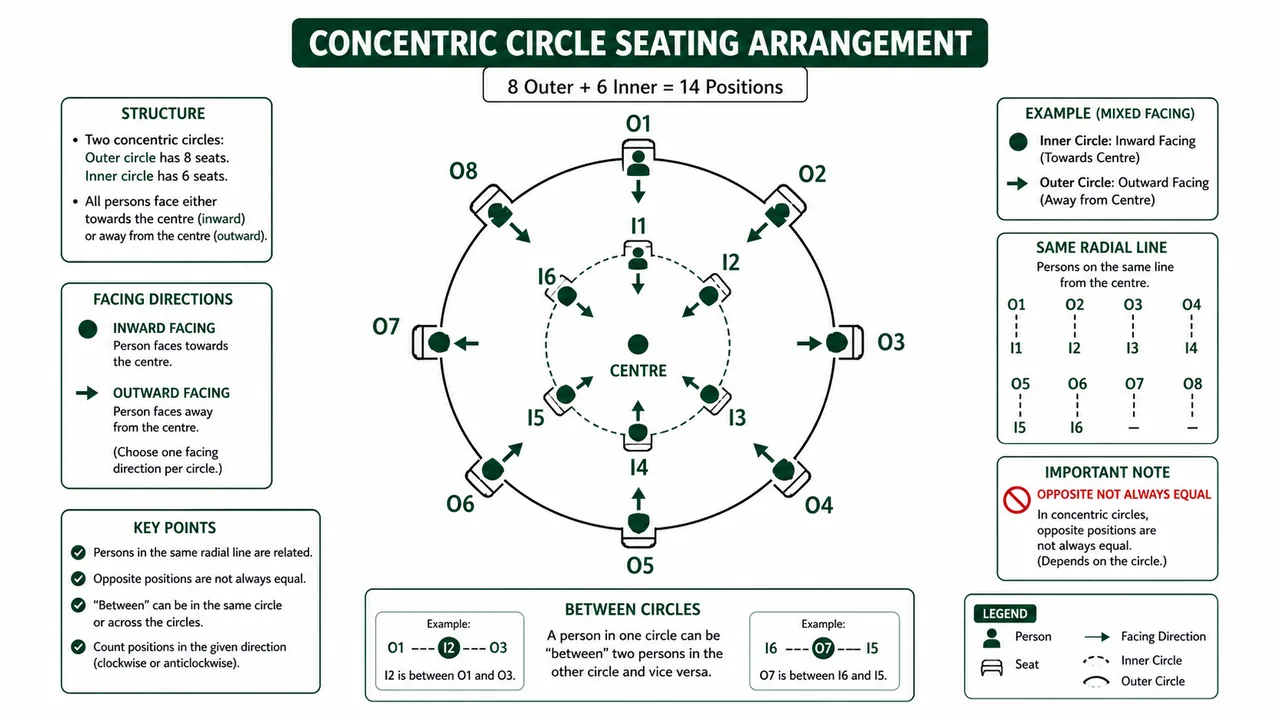
Concentric circle arrangements (also called embedded circle arrangements) are among the most important topics for Prelims and Mains level banking exams. Unlike a single circular table, here we have two circles -- one inside the other -- with people sitting on both.
This topic is a guaranteed question in IBPS PO, SBI PO, RRB PO, and NABARD Mains papers.
What Is a Concentric Arrangement?
A concentric arrangement means two (or more) circles sharing the same centre, with people seated on each circle. The key characteristic is:
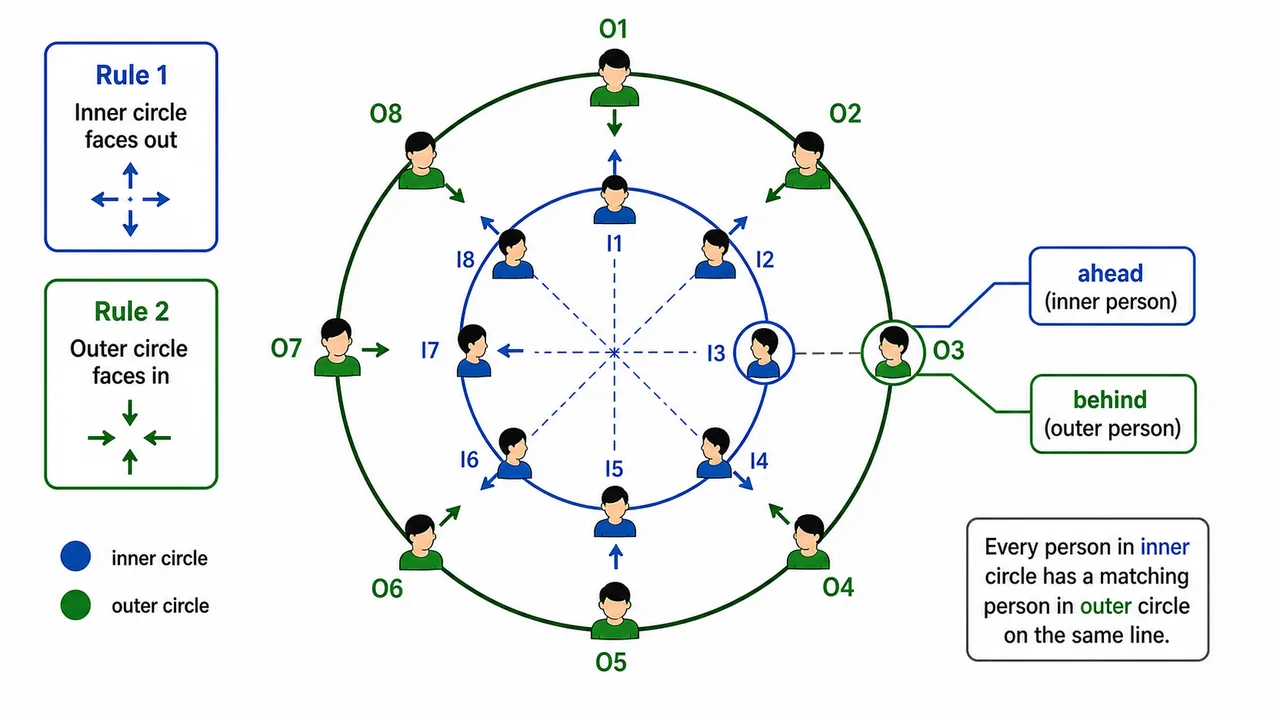
- Inner circle persons face outward (away from the centre)
- Outer circle persons face inward (towards the centre)
Because inner people face out and outer people face in, they face each other across the two circles.
Key Rule: Each member of the inner circle sits exactly opposite a member of the outer circle. They form a facing pair.
Pro Content Locked
Upgrade to Pro to access this lesson and all other premium content.
Charged once for one year · ₹1188 total
Save ₹100/month vs ₹2388/year launch price
- All Agriculture & Banking Courses
- AI Lesson Questions (100/day)
- AI Doubt Solver (50/day)
- Glows & Grows Feedback (30/day)
- AI Section Quiz (20/day)
- 22-Language Translation (100/day)
- Recall Questions (20/day)
- AI Quiz (15/day)
- AI Quiz Paper Analysis (100/day)
- AI Step-by-Step Explanations (100/day)
- Spaced Repetition Recall (FSRS)
- AI Tutor
- Immersive Text Questions
- Audio Lessons — Hindi & English
- Mock Tests & Previous Year Papers
- Summary & Mind Maps
- XP, Levels, Leaderboard & Badges
- Generate New Classrooms
- Voice AI Teacher (AgriDots Live)
- AI Revision Assistant
- Knowledge Gap Analysis
- Interactive Revision (LangGraph)
🔒 Secure one-time yearly payment via Razorpay · No hidden fees
Concentric Circle Seating Arrangement
Concentric circle arrangements (also called embedded circle arrangements) are among the most important topics for Prelims and Mains level banking exams. Unlike a single circular table, here we have two circles -- one inside the other -- with people sitting on both.
This topic is a guaranteed question in IBPS PO, SBI PO, RRB PO, and NABARD Mains papers.
What Is a Concentric Arrangement?
A concentric arrangement means two (or more) circles sharing the same centre, with people seated on each circle. The key characteristic is:
- Inner circle persons face outward (away from the centre)
- Outer circle persons face inward (towards the centre)
Because inner people face out and outer people face in, they face each other across the two circles.
Key Rule: Each member of the inner circle sits exactly opposite a member of the outer circle. They form a facing pair.
Essential Terminology
| Exam Phrase | Meaning |
|---|---|
| A faces B | A (inner) and B (outer) are directly opposite, looking at each other |
| Inner circle faces outward | People on the inner circle look away from the centre |
| Outer circle faces centre | People on the outer circle look towards the centre |
| Exactly opposite / Directly opposite | The person across the two circles (the facing pair) |
| Immediate right | The next person clockwise on the SAME circle |
| Immediate left | The next person anticlockwise on the SAME circle |
| A is ahead of B | A sits in the inner circle, B sits in the outer circle (inner is "ahead" of outer) |
| A is behind B | A sits in the outer circle, B sits in the inner circle (outer is "behind" inner) |
| X persons between A and B | Counted on the SAME circle only |
Ahead / Behind Concept
This is a frequently tested and tricky concept in concentric arrangements.
Think of it this way: The inner circle is closer to the centre. A person on the inner circle is considered to be "ahead" (in front) of the person they face on the outer circle.
- B is ahead of A means B is on the inner circle (closer to centre)
- A is behind B means A is on the outer circle (farther from centre)
Trap Alert: "A is ahead of B" does NOT mean A is to the left or right. It means A is on the inner circle and B is on the outer circle, and they face each other.
How Right and Left Work in Concentric Circles
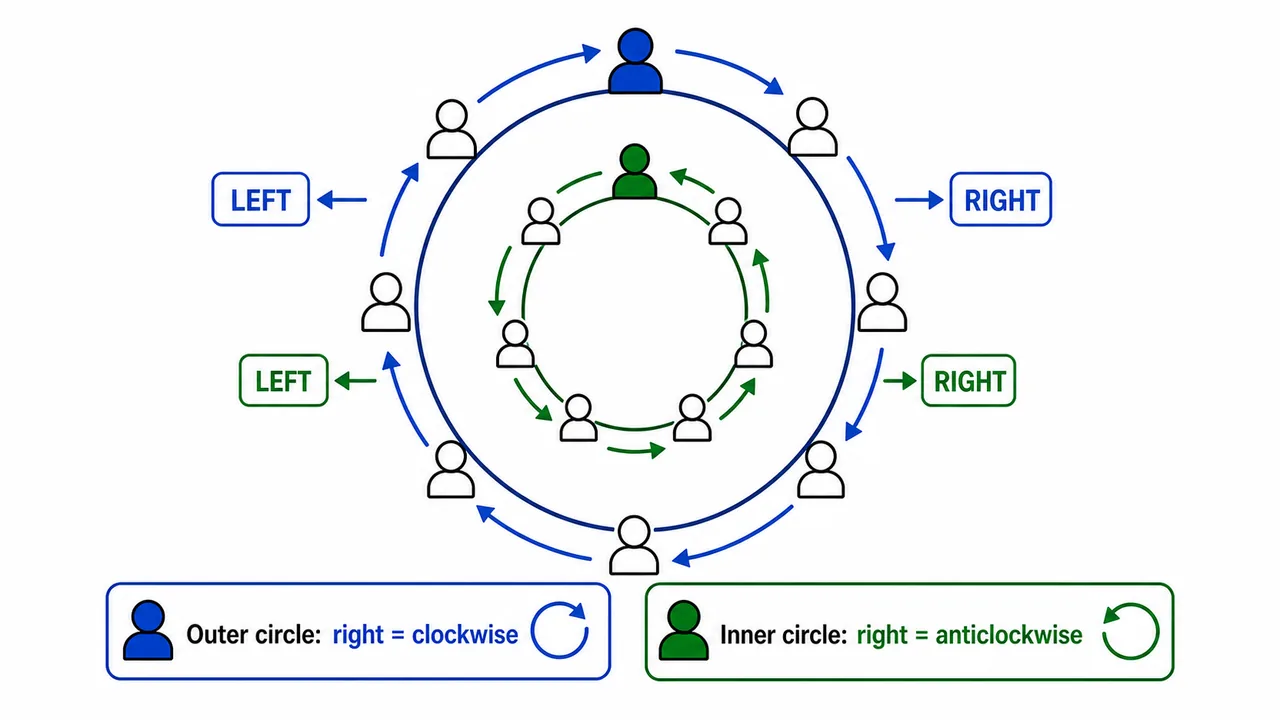
Since inner and outer circle people face opposite directions, their left and right are mirrored.
Outer circle (facing inward):
- Right = Clockwise
- Left = Anticlockwise
Inner circle (facing outward):
- Right = Anticlockwise (because they face the opposite direction)
- Left = Clockwise
Speed Tip: For the inner circle, right and left are reversed compared to the outer circle. If you rotate your diagram, always double-check which direction each person faces.
Step-by-Step Solving Methodology
Step 1: Draw Two Concentric Circles Draw an outer circle and an inner circle. Mark equal positions on each (4, 5, 6, or 8 positions depending on the question).
Step 2: Identify Inner vs Outer Read the question carefully. It will tell you:
- Who sits in the inner circle
- Who sits in the outer circle
- OR you must figure this out from clues
Step 3: Start with the Most Definite Clue Look for statements like "R faces Q" -- this gives you a pair. Place one person and build from there.
Step 4: Remember the Mirror Rule When the question says "P is to the immediate right of R" and R is on the outer circle, right = clockwise. But if R is on the inner circle, right = anticlockwise.
Step 5: Use "Faces" to Connect Circles Every "faces" clue links one inner and one outer person. Plot them as directly opposite pairs.
Step 6: Verify All Conditions After placing everyone, re-read every single clue to verify.
Solved Example 1: Eight Persons in Two Circles (4 + 4)
Question:
There are eight persons -- P, Q, R, S, T, U, V, and W -- sitting in two circles in such a manner that each member of the inner circle sits exactly opposite the member of the outer circle. The members sitting in the outer circle are facing towards the centre while the members of the inner circle are facing away from the centre.
Clues:
- There is one person standing between Q and S.
- R faces Q.
- P is to the immediate right of R.
- V is not either to the immediate right or immediate left of S.
- V faces neither S nor U.
- One person is sitting between W and U.
- T does not sit in the inner circle.
Step-by-Step Solution:
Step 1: Draw two circles with 4 positions each.
Step 2: From clue 7, T is in the outer circle.
Step 3: From clue 2, R faces Q. This means R and Q are on different circles, directly opposite each other. Let us say R is on the outer circle and Q is on the inner circle (we will verify).
Step 4: From clue 3, P is to the immediate right of R. If R is on the outer circle (facing inward), right = clockwise. Place P clockwise next to R on the outer circle.
Step 5: From clue 1, one person between Q and S. Since Q is on the inner circle, S must also be on the inner circle (same circle for "between" to make sense). Place S with one gap from Q on the inner circle.
Step 6: From clue 6, one person between W and U. These must be on the same circle too.
Step 7: From clue 5, V faces neither S nor U. From clue 4, V is not immediate right or left of S.
After working through all possibilities:
Let us re-derive carefully:
Since R faces Q, and T is on the outer circle (clue 7):
Verification:
- Clue 1: One person between Q and S on inner circle? S is at top of inner, Q at bottom. W is between them on one side, U on the other. One person between Q and S (going one way) -- Yes, W is between.
- Clue 2: R faces Q -- Yes (directly opposite).
- Clue 3: P is immediate right of R. R is outer circle facing inward, right = clockwise. P is clockwise from R -- Yes.
- Clue 4: V is not immediate right or left of S. V is on the outer circle, S is on the inner circle -- they are on different circles, so this condition is automatically satisfied.
- Clue 5: V faces neither S nor U. V faces W -- Yes.
- Clue 6: One person between W and U. On the inner circle, S is between W and U -- Yes (one person).
- Clue 7: T is not in inner circle -- Yes, T is in outer circle.
All conditions satisfied.
Solved Example 2: Twelve Persons in Two Concentric Hexagons (6 + 6)
Question:
12 persons A, B, C, D, E, F, G, H, I, J, K, and L are sitting in two concentric hexagons with six people in each hexagon. A, B, C, D, E, and F are sitting in the outer hexagon facing the centre while G, H, I, J, K, and L are sitting in the inner hexagon facing outside. No one sits in the middle of any side of the hexagon (everyone sits at corners).
Clues:
- The person who faces D is an immediate neighbour of I.
- There is only one person between L and the person who faces D.
- K is 2nd to the left of L.
- L and H are opposite to each other.
- J is an immediate neighbour of H.
- E sits 2nd to the left of B.
- One of the immediate neighbours of I faces B.
- A and B are not immediate neighbours of each other.
- One person sits between A and F.
- G faces the one who sits immediate left of B.
- C and D are immediate neighbours of each other.
Key Setup Points:
In a hexagonal concentric arrangement:
- Each hexagon has 6 corners
- Outer hexagon faces inward (towards centre)
- Inner hexagon faces outward (away from centre)
- Each outer corner person faces one inner corner person
After solving through all clues, the final arrangement is:
Verification of key clues:
- Clue 3: K is 2nd to left of L. On inner hexagon (facing out), left = clockwise. From L, go clockwise 2 positions = K. Verified.
- Clue 4: L and H are opposite. In a hexagon with 6 corners, opposite means 3 positions apart. Verified.
- Clue 11: C and D are immediate neighbours. They sit at adjacent corners of outer hexagon. Verified.
Speed Tips for Exam
- Always draw both circles first with the correct number of positions before reading any clues.
- Label directions clearly: Mark "faces inward" and "faces outward" on your diagram.
- Start with "faces" clues -- they immediately link inner and outer persons.
- Remember the mirror: Inner circle left/right is REVERSED compared to outer circle.
- Circle counting shortcut: In an 8-person concentric (4+4), there are only 4 positions per circle. Any "2 persons between" on one circle means they are at opposite ends.
- For hexagons: Opposite in a hexagon = 3 positions apart (out of 6 corners).
Common Traps to Watch For
Trap 1: Confusing "opposite" with "faces" In a single circle, "opposite" means diametrically opposite on the same circle. In concentric circles, "faces" means the person across the inner-outer gap. Do NOT confuse the two.
Trap 2: Right/Left reversal Since inner and outer persons face opposite directions, "immediate right" for an inner person goes in the opposite rotational direction compared to an outer person. This is the number one mistake students make.
Trap 3: "Between" across circles "One person between A and B" -- this ALWAYS means on the same circle. You cannot count "between" across two different circles.
Trap 4: Assuming circle assignment Questions may not directly tell you who is on which circle. You may need to deduce it from clues like "T does not sit in the inner circle" or "A faces B" (which means they are on different circles).
Trap 5: "Not immediate neighbour" across circles If A is on the outer circle and B is on the inner circle, they CANNOT be immediate neighbours (they are on different circles). So a clue saying "A and B are not immediate neighbours" might be a hint that they are on the SAME circle.
Practice Recognition Patterns
When you see these phrases in a question, immediately think concentric arrangement:
- "Two circles"
- "Inner circle and outer circle"
- "Faces towards centre / away from centre"
- "Each member of one circle sits exactly opposite a member of the other"
- "Embedded circle"
- "Concentric"
Exam Strategy: Concentric circle questions typically have 5 sub-questions. Invest 7-8 minutes to solve the arrangement correctly -- all 5 answers will follow directly from your diagram. Getting the arrangement right is everything.