📏 Circumference-Based Seating Arrangement
Master circumference-based circular seating - distance calculations, consecutive multiples, uncertain number of persons, and math-heavy circular arrangements
Circumference-Based Seating Arrangement
Circumference-based seating arrangements combine circular seating logic with mathematical calculations. Instead of just knowing "A sits 3rd to the right of B", you are given distances in centimetres or metres between people along the circumference of a circular table.
These are Mains-level questions and appear frequently in SBI PO Mains, IBPS PO Mains, and RBI Grade B.
What Makes Circumference Questions Different?
In standard circular arrangements, you know:
- The exact number of persons
- Positions are equally spaced
In circumference-based questions:
- The total circumference of the table is given (e.g., 540cm, 637cm)
- People sit at unequal distances from each other
- Distances are consecutive multiples of a given number
- You must calculate the number of persons from the circumference
Key Terminology
| Exam Phrase | Meaning |
|---|---|
| Circumference of 540cm | Total distance around the circular table |
| Consecutive multiples of 6 | Gaps between adjacent persons are 6, 12, 18, 24, 30, ... (or 12, 18, 24, ...) |
| Distance between A and B is 30cm | The arc length from A to B along the circumference (could be clockwise or anticlockwise) |
| Certain number of persons | Number of persons is NOT given -- you must derive it |
| Facing towards the centre | Standard inward-facing circular arrangement |
The Core Formula
Total Circumference = Sum of all gaps between adjacent persons
Pro Content Locked
Upgrade to Pro to access this lesson and all other premium content.
Charged once for one year · ₹1188 total
Save ₹100/month vs ₹2388/year launch price
- All Agriculture & Banking Courses
- AI Lesson Questions (100/day)
- AI Doubt Solver (50/day)
- Glows & Grows Feedback (30/day)
- AI Section Quiz (20/day)
- 22-Language Translation (100/day)
- Recall Questions (20/day)
- AI Quiz (15/day)
- AI Quiz Paper Analysis (100/day)
- AI Step-by-Step Explanations (100/day)
- Spaced Repetition Recall (FSRS)
- AI Tutor
- Immersive Text Questions
- Audio Lessons — Hindi & English
- Mock Tests & Previous Year Papers
- Summary & Mind Maps
- XP, Levels, Leaderboard & Badges
- Generate New Classrooms
- Voice AI Teacher (AgriDots Live)
- AI Revision Assistant
- Knowledge Gap Analysis
- Interactive Revision (LangGraph)
🔒 Secure one-time yearly payment via Razorpay · No hidden fees
Circumference-Based Seating Arrangement
Circumference-based seating arrangements combine circular seating logic with mathematical calculations. Instead of just knowing "A sits 3rd to the right of B", you are given distances in centimetres or metres between people along the circumference of a circular table.
These are Mains-level questions and appear frequently in SBI PO Mains, IBPS PO Mains, and RBI Grade B.
What Makes Circumference Questions Different?
In standard circular arrangements, you know:
- The exact number of persons
- Positions are equally spaced
In circumference-based questions:
- The total circumference of the table is given (e.g., 540cm, 637cm)
- People sit at unequal distances from each other
- Distances are consecutive multiples of a given number
- You must calculate the number of persons from the circumference
Key Terminology
| Exam Phrase | Meaning |
|---|---|
| Circumference of 540cm | Total distance around the circular table |
| Consecutive multiples of 6 | Gaps between adjacent persons are 6, 12, 18, 24, 30, ... (or 12, 18, 24, ...) |
| Distance between A and B is 30cm | The arc length from A to B along the circumference (could be clockwise or anticlockwise) |
| Certain number of persons | Number of persons is NOT given -- you must derive it |
| Facing towards the centre | Standard inward-facing circular arrangement |
The Core Formula
Total Circumference = Sum of all gaps between adjacent persons
If there are n persons and gaps are consecutive multiples of k:
The gaps are: k, 2k, 3k, 4k, ..., nk
Sum = k(1 + 2 + 3 + ... + n) = k * n(n+1)/2
So: Circumference = k * n(n+1) / 2
Example Calculation:
If circumference = 540cm and gaps are consecutive multiples of 6:
540 = 6 * n(n+1)/2
540 = 3 * n(n+1)
180 = n(n+1)
n = 12 (since 12 * 13 = 156 ... let us check: 3 * 156 = 468, not 540)
Actually: 540 / 6 = 90, so n(n+1)/2 = 90, meaning n(n+1) = 180
n = 13? No, 13 * 14 = 182. Try: the gaps might start from the multiple itself.
Let us reconsider. If gaps are 16, 26, 36, ..., n6:
Sum = 6 * (1+2+3+...+n) = 6 * n(n+1)/2 = 3n(n+1)
3n(n+1) = 540 --> n(n+1) = 180
Hmm, no perfect integer. But if the gaps start from 2*6 = 12:
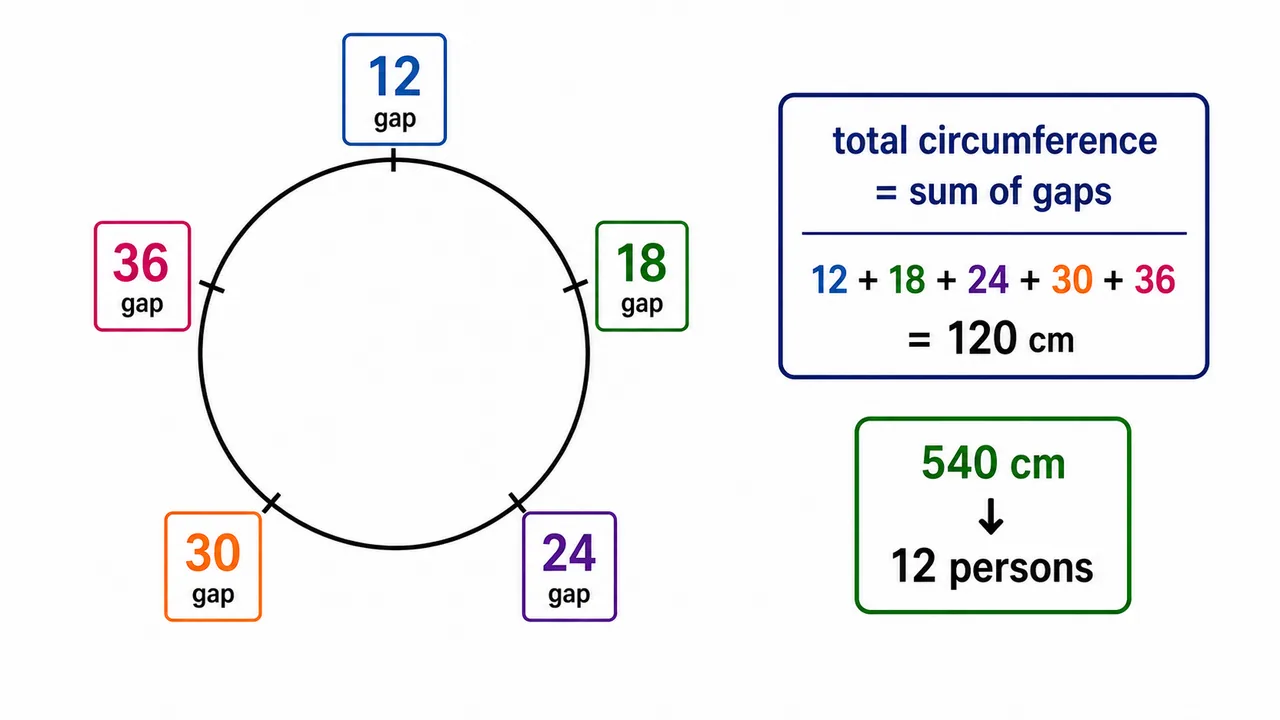
Gaps: 12, 18, 24, 30, 36, 42, 48, 54, 60, 66, 72, 78
Sum = 12+18+24+30+36+42+48+54+60+66+72+78 = let us add: (12+78) + (18+72) + (24+66) + (30+60) + (36+54) + (42+48) = 90*6 = 540
That gives us 12 persons with gaps starting from 12 (i.e., multiples 26 through 136, which are consecutive multiples of 6 starting from the 2nd multiple).
Important: Read the question carefully. "Consecutive multiples of 6" might mean 6, 12, 18... OR 12, 18, 24... depending on how many persons fit.
How to Determine Number of Persons
Step 1: Note the total circumference and the multiple base number.
Step 2: List out consecutive multiples: k, 2k, 3k, 4k, ...
Step 3: Keep adding until you reach the circumference. The count of gaps = number of persons.
Step 4: Verify: Sum of all gaps = circumference.
Quick Reference for Common Values:
Circumference = 540, Multiple of 6:
- Gaps: 12, 18, 24, 30, 36, 42, 48, 54, 60, 66, 72, 78
- Sum = 540, Persons = 12
- Gaps assigned clockwise between consecutive persons
Circumference = 637, Multiple of 7:
- Gaps: 7, 14, 21, 28, 35, 42, 49, 56, 63, 70, 77, 84, 91
- Sum = 7*(1+2+...+13) = 7*91 = 637
- Persons = 13
Important Observations
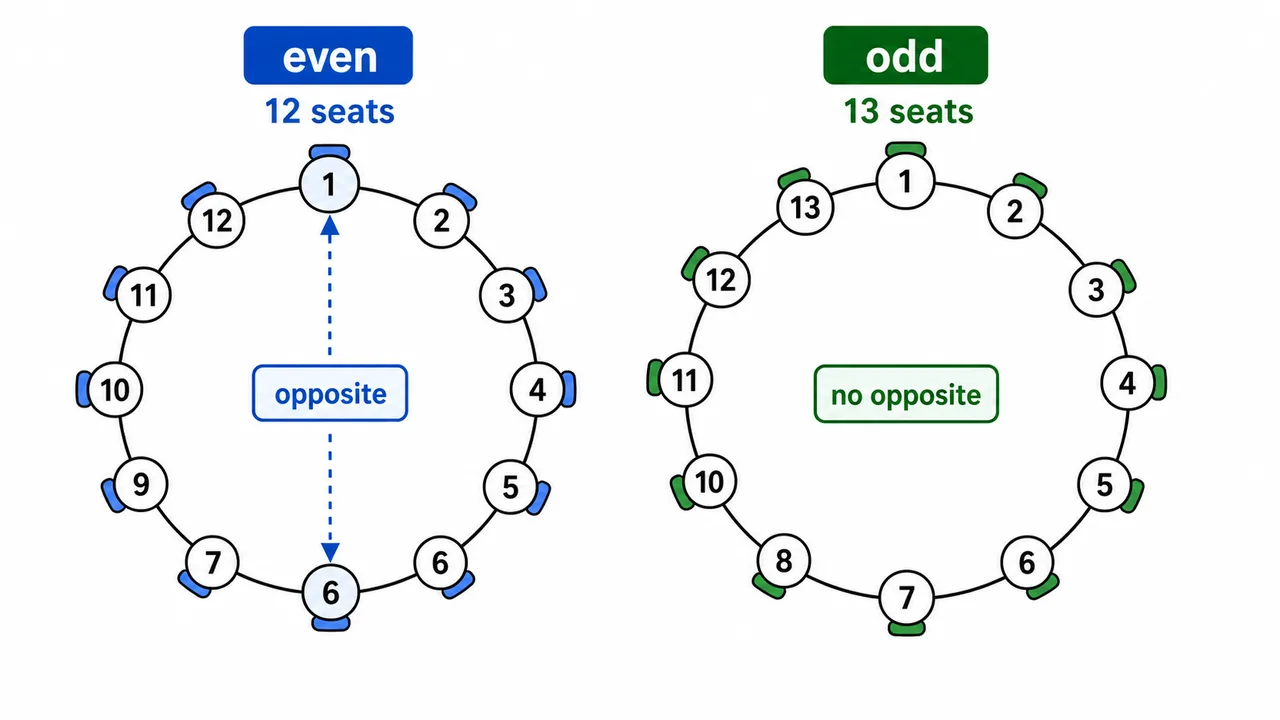
Even vs Odd Number of Persons
- Even number (e.g., 12): Every person has someone directly opposite (diametrically opposite). The distance to the opposite person = Circumference / 2.
- Odd number (e.g., 13): Nobody has a directly opposite person. The concept of "opposite" does NOT apply.
Trap Alert: If the number of persons is odd, any question asking "Who sits opposite to X?" has the answer "No one" or the option "Cannot be determined".
Solved Example 1: Circumference 540cm, Multiples of 6
Question:
Certain number of persons are sitting around a circle which has a circumference of 540cm. All persons are facing towards the centre. They are sitting at a distance to each other which are consecutive multiples of 6.
Clues:
- A is third to the left of I.
- Two persons are sitting between K and I.
- M is immediate right of L.
- H sits immediate left of G and opposite to F.
- The distance between A and D is 30cm.
- The number of persons sitting between B and D is 4.
- The distance between E and F is square of 6 (= 36cm).
- Neither M nor L is neighbour of H.
- The number of persons sitting between C and I is same as between I and E.
- The distance between K and I is not more than 142cm.
- Either M or E is neighbour of K.
- D is second to right of A.
Step 1: Find number of persons
Circumference = 540cm, consecutive multiples of 6.
The gaps (consecutive multiples of 6): 12, 18, 24, 30, 36, 42, 48, 54, 60, 66, 72, 78
Sum: 12+18+24+30+36+42+48+54+60+66+72+78 = 540. Verified.
Number of persons = 12 (even number, so "opposite" exists).
Step 2: List the 12 gaps clockwise
The 12 gaps between consecutive persons (clockwise) are some arrangement of: 12, 18, 24, 30, 36, 42, 48, 54, 60, 66, 72, 78.
Step 3: Use distance clues to assign gaps
From clue 5: Distance A to D = 30cm. Since 30 is one of the gap values, A and D could be immediate neighbours (gap = 30). But clue 12 says D is 2nd to the right of A, so there is one person between them.
If D is 2nd to right of A: A -- [someone] -- D (clockwise). Distance A to D = gap1 + gap2 = 30cm. Possible: 12+18 = 30. So the two gaps are 12 and 18.
From clue 12: D is 2nd to right of A. Place A, then one person clockwise, then D.
Step 4: Use clue 1 A is 3rd to the left of I. In a 12-person circle facing inward, left = anticlockwise. So from I, count 3 anticlockwise to reach A. Equivalently, from A, count 3 clockwise to reach I.
A -- [person] -- D -- ... Let us say positions are numbered 1-12 clockwise. Place A at position 1, then the person at position 2, D at position 3. I is at position 4 (3rd clockwise from A means A is 3rd to left of I).
Wait: "A is 3rd to the left of I" means from I, go 3 to the left (anticlockwise) to find A. So I is 3 positions clockwise from A. A(1), ?(2), D(3), I(4).
Step 5: Use clue 2 Two persons between K and I. So K is 3 positions from I (in either direction). K is at position 7 (clockwise) or position 1 (anticlockwise, but that is A). So K is at position 7.
From clue 10: Distance K to I <= 142cm. Going one way the distance is the sum of gaps between positions 4-5-6-7, and the other way is 540 minus that. We need the shorter path to be <= 142cm.
Step 6: Continue with remaining clues and assign all positions.
Final Arrangement (clockwise from A):
Step 7: Verify H opposite F In a 12-person circle, opposite = 6 positions apart. From clue 4: H is opposite F. Count: F is at position 6 (if A=1), H should be at position 12. Let us verify with the final arrangement.
Solved Example 2: Circumference 637cm, Multiples of 7
Question:
Certain number of persons are sitting around a circular table, which has a circumference of 637cm. All persons are facing towards the center. They are sitting at a certain distance to each other which are consecutive multiples of seven.
Clues:
- Distance between H and D is 98cm.
- Distance between Q and I is 105cm.
- Only one person sits between F and E, who sits on the immediate left of Q.
- The distance between M and Q is 77cm.
- Distance between L and K is not more than 22cm.
- P sits 4th to the left of E.
- Only one person sits between P and J.
- K sits 4th to the right of M.
- No person sits between M and F.
- G sits second to the left of H.
- H is not the immediate neighbour of P.
- Only one person sits between H and D and between C and D.
Step 1: Find number of persons
Circumference = 637cm, consecutive multiples of 7.
Sum = 7 * (1+2+3+...+n) = 7 * n(n+1)/2
7 * n(n+1)/2 = 637 n(n+1)/2 = 91 n(n+1) = 182
This does not give a perfect integer (13*14 = 182). So n = 13.
Verify: 7*(1+2+3+...+13) = 7*91 = 637. Verified.
Number of persons = 13 (odd -- no "opposite" exists).
Step 2: List the 13 gaps
Gaps: 7, 14, 21, 28, 35, 42, 49, 56, 63, 70, 77, 84, 91
Step 3: Assign using distance clues
Clue 1: H to D = 98cm. Possible gap sums: 98 = 91+7 (2 gaps) or 35+63 (2 gaps) or 28+70 (2 gaps) or 42+56 (2 gaps) or 14+84 (2 gaps) or 21+77 (2 gaps) or 49+49 (impossible, no repeats).
Clue 12: Only ONE person between H and D. So H-[someone]-D with exactly 2 gaps summing to 98.
Clue 2: Q to I = 105. Could be multiple gaps summing to 105.
Clue 5: L to K distance <= 22cm. Only possible single gap: 7 or 14 or 21. Or two gaps summing to <= 22: 7+14=21. Since L and K must be very close.
If L and K are immediate neighbours: gap = 7, 14, or 21 (all <= 22).
Step 4: Use positional clues to place persons
From clue 8: K is 4th to right of M. Place M, then count 4 clockwise to K. From clue 4: M to Q distance = 77cm. The gap 77 exists as a single gap, so M and Q could be immediate neighbours with gap = 77. Or multiple gaps summing to 77. From clue 9: No person between M and F, meaning M and F are immediate neighbours.
Step 5: Build the arrangement step by step
Place M at a position. F is immediate neighbour of M (clue 9). K is 4th to right of M (clue 8): M -- [?] -- [?] -- [?] -- K
From clue 3: One person between F and E, and E is on immediate left of Q. So: F -- [one person] -- E -- Q (with E immediately left of Q, meaning Q is immediately right of E).
Continuing to resolve all clues leads to the final arrangement.
Final Arrangement (clockwise):
Key Takeaway: With 13 persons (odd), there is NO directly opposite person for anyone. Questions asking "Who is opposite X?" should be answered carefully.
Step-by-Step Strategy for Circumference Problems
- Calculate n: Use Circumference = k * n(n+1)/2 to find the number of persons.
- List all gaps: Write out all consecutive multiples.
- Check even/odd: Even = opposite exists. Odd = no opposite.
- Use distance clues FIRST: These narrow down which gaps go between which persons.
- Cross-reference positional clues: "2nd to right", "immediate left" etc.
- Assign gaps to arcs: As you place people, assign specific gap values to arcs between them.
- Verify all distance conditions after completing the arrangement.
Common Traps to Watch For
Trap 1: Forgetting that "distance" means arc length Distance between two persons is measured along the circumference (the shorter or specified arc), NOT in a straight line.
Trap 2: Wrong number of persons If you miscalculate n, the entire arrangement fails. Always verify: sum of all gaps = circumference.
Trap 3: Direction of distance "Distance between A and B is 30cm" could be clockwise OR anticlockwise. You may need to try both.
Trap 4: Assuming equal spacing Unlike standard circular arrangements, gaps are UNEQUAL here. Two persons who are "3 apart" can have very different arc distances depending on which gaps fall between them.
Trap 5: "Opposite" in odd arrangements If n is odd, there is no diametrically opposite person. Any clue mentioning "opposite" in an odd-numbered arrangement is a red flag -- re-read the question.
Quick Mental Math for Common Multiples
| Base Multiple (k) | Formula for n persons | Common Circumferences |
|---|---|---|
| 6 | 3n(n+1) | 540 (n=12), 252 (n=8), 378 (n=10) |
| 7 | 7n(n+1)/2 | 637 (n=13), 364 (n=12), 252 (n=8) |
| 5 | 5n(n+1)/2 | 330 (n=11), 195 (n=8), 390 (n=12) |
| 8 | 4n(n+1) | 480 (n=10), 288 (n=8) |
Speed Tip: Memorize common n(n+1) products: 67=42, 89=72, 1011=110, 1213=156, 13*14=182. This instantly gives you the number of persons.